


Your LinkedIn profile is open right now. A potential buyer just searched for someone who sells what you sell, in your industry, in your region. They clicked your name. They read your headline. And now they are reading your About section.
What does it say?
For most sales professionals, the answer is something like: “Results-driven sales professional with 7+ years of experience in B2B sales, passionate about building relationships and exceeding targets.” And just like that, the buyer clicks away.
Here is the uncomfortable truth: most sales professionals are terrible at selling themselves on LinkedIn. They spend their careers perfecting pitches, objection handling, and closing techniques — and then write an About section that would put a recruiter to sleep. In 2026, that gap is more costly than ever.
LinkedIn has evolved into the primary research channel for B2B buyers. Before a decision-maker responds to your outreach, before a recruiter calls you about a VP role, before a prospect agrees to a meeting — they read your profile. Your summary is not a biography. It is a sales asset. And like any sales asset, it either works or it does not.
This guide gives you the best LinkedIn summary examples for sales professionals in 2026, broken down by role, career stage, and objective — along with the frameworks, templates, and practical advice you need to write one that actually converts.
Why Your LinkedIn Summary Is Your Silent Sales Pitch
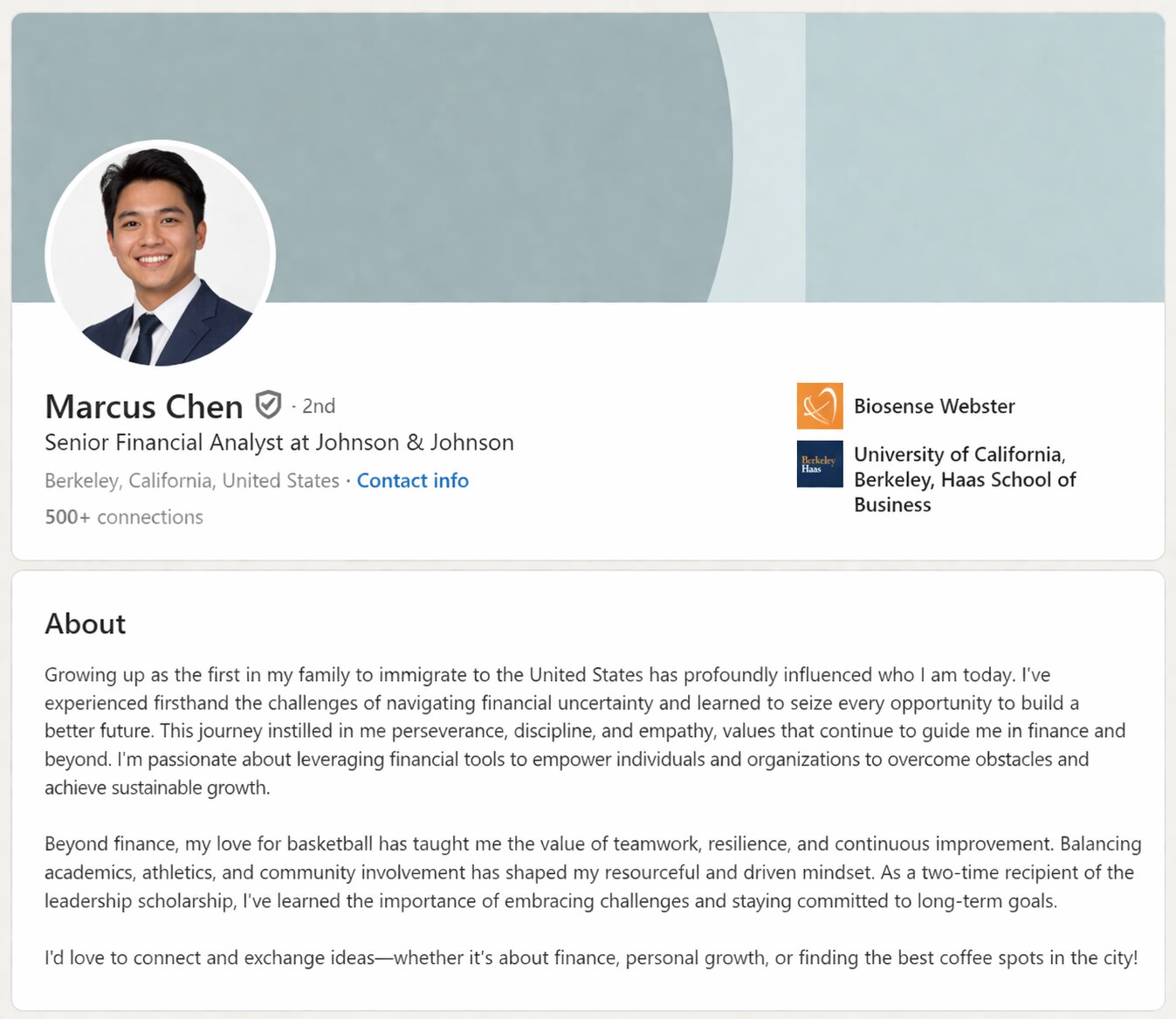
Think about the last time you used a LinkedIn outreach tool or sent a cold connection request. What is the first thing a prospect does after receiving it? They click your profile. They read your headline. Then they scroll to your About section.
That About section — 2,600 characters of prime real estate — is your first real opportunity to make a case for why they should respond, connect, meet, or hire you. And unlike a cold email or a phone call, it works without you being present. It is running 24 hours a day, seven days a week, making an impression on every buyer, recruiter, and potential partner who lands on your page.
For sales professionals specifically, the stakes are even higher than for other roles. Here is why:
Buyers vet reps before responding to outreach. Research consistently shows that B2B decision-makers check the LinkedIn profile of a salesperson before deciding whether to respond to their message or email. If your summary reads like a generic HR document, you have already lost credibility before the conversation began.
Recruiters look for specific signals. When a VP of Sales or a talent acquisition partner is evaluating candidates, they scan LinkedIn summaries for quota attainment language, deal sizes, industries served, and leadership indicators. If those signals are absent, you are invisible.
Social selling has become standard practice. In 2026, LinkedIn’s Social Selling Index and profile completeness directly influence how often you appear in search results and suggested connections. A well-written summary contributes to your visibility, not just your credibility.
AI-assisted sourcing has raised the bar. Buyers and recruiters increasingly use AI tools to identify and evaluate candidates and vendors. These tools parse profile content. Vague, generic summaries do not surface in relevant searches. Specific, keyword-rich, outcome-focused summaries do.
The bottom line: your LinkedIn summary is not a formality. For a sales professional, it is one of the highest-leverage pieces of writing you will ever produce.
What Makes a Great LinkedIn Summary for Sales Professionals
Before looking at the linkedin summary examples themselves, it helps to understand what separates a high-performing summary from a forgettable one. Every excellent sales professional summary shares five structural elements.
The First Two Lines — The “See More” Hook
LinkedIn displays only the first two to three lines of your About section before collapsing the rest behind a “See more” button. On mobile, this is even fewer characters. Those first lines are everything.
Most people waste them. They write something like “Experienced sales professional based in Chicago with a background in technology sales.” Nobody clicks “See more” for that.
The best opening lines do one of two things: they state a specific, compelling outcome (“I help SaaS companies cut their average sales cycle from 90 days to 45 without discounting”) or they ask a question that the target reader cannot help but answer (“What would it mean for your pipeline if 40% of your cold outreach actually converted?”).
Your opening must earn the click. Write it last, after you know exactly what the summary says, and treat it like the subject line of the most important email you will ever send.
The Value Proposition Section
Once you have earned the “See more” click, the next 150 to 200 words should answer a simple question: what do you do, for whom, and with what result?
This is not your job history. It is not a list of your responsibilities. It is a clear, specific articulation of the value you create. The best sales summaries make the reader feel as if you understand their world — their problems, their goals, their frustrations — better than most people they know.
Proof and Credibility Signals
Claims without evidence are just noise. After your value proposition, the best LinkedIn summaries include specific proof: quota attainment percentages, deal sizes, client names (where appropriate), industries served, awards, or recognizable company logos in the experience section.
Numbers build credibility in a way that adjectives never can. “Consistent top performer” means nothing. “114% of quota for three consecutive years, including a $2.3M enterprise deal in Q4 2024” means everything.
Personality and Voice
Sales is a human profession. People buy from people they like, trust, and feel comfortable with. A LinkedIn summary that reads like a press release or a job description misses the opportunity to let personality come through.
The best sales summaries have a voice. They sound like a real person wrote them. They might include something personal — how you got into sales, what drives you, what you believe about your industry — that creates a point of connection with the right reader.
The Call to Action
Every good sales asset ends with a next step. Your LinkedIn summary should too. A clear, specific, low-friction CTA tells the reader exactly what to do if they want to engage further. It should match your primary objective — generating leads, finding a job, building a network — and make the action feel easy and worthwhile.
Common Mistakes Sales Professionals Make in Their LinkedIn Summary
Understanding what not to do is just as important as knowing what to do. These are the patterns that appear most frequently in underperforming sales summaries.
Leading With Job Title Instead of Value
“Senior Account Executive at TechCorp” is a job title, not a value proposition. Starting your summary by restating your headline wastes the most valuable real estate in your profile. A buyer already knows your title — they want to know what you actually do for people like them.
Vague Claims Without Numbers
“Passionate about exceeding targets,” “dedicated to delivering results,” “committed to customer success” — these phrases appear in thousands of sales profiles and mean absolutely nothing to a reader. They are unfalsifiable, unverifiable, and indistinguishable from every other profile. Replace every adjective-driven claim with a specific number or outcome.
Writing in Third Person
“John is a results-driven sales leader with over a decade of experience…” reads as stiff, impersonal, and oddly formal for a first-person platform. LinkedIn is a conversational professional network. Write in first person. It is warmer, more direct, and frankly more trustworthy.
No Clear Call to Action
Many sales professionals end their summary with a general statement like “Feel free to connect!” This is the equivalent of ending a sales call without asking for the meeting. Tell the reader specifically what to do and why it benefits them.
Copying a Generic Template Without Personalizing
Templates are starting points, not finished products. A summary that reads like it was generated from a generic prompt — or copied from a “LinkedIn hacks” article — is immediately recognizable as such. Buyers and recruiters read hundreds of profiles. Yours needs to sound like you, not like a placeholder.
How to Write a LinkedIn Summary as a Sales Professional — Step by Step
Here is the system behind every strong LinkedIn summary example you will see in this guide.
Step 1 — Identify the One Outcome Your Summary Must Drive
A summary trying to accomplish everything accomplishes nothing. Before writing a single word, decide: what is the single most important thing this summary should cause a reader to do or believe?
The four most common outcomes for sales professionals are generating inbound leads or client inquiries, attracting job offers or recruiter attention, building a thought leadership audience, and establishing credibility for partnership or speaking opportunities.
Your entire summary — every sentence, every choice of language — should serve that one outcome. If a sentence does not support the goal, cut it.
Step 2 — Know Your Buyer or Audience
Who actually reads your profile? For a sales rep focused on social selling, it might be procurement managers or CMOs at mid-market companies. For a job-seeking AE, it is VP of Sales and talent acquisition leads at SaaS companies. For a consultant, it might be founders and business owners.
Write specifically to that person. Use their language. Reference their problems. Demonstrate that you understand their world. The more specifically you write to one reader, the more everyone in that category will feel you are speaking directly to them.
Step 3 — Lead With a Hook That Speaks to Their Problem
Use your first two to three lines to grab the reader with something immediately relevant to their world. Options include a specific outcome statement (“I help fintech sales teams close enterprise deals 30% faster”), a thought-provoking question, a surprising statistic from your industry, or a bold belief statement about how sales should be done differently.
Avoid starting with “I am” — it immediately shifts focus to you rather than the reader.
Step 4 — Add Proof in the Body
After the hook and value proposition, dedicate a short section to evidence. This might be two or three bullet points listing key achievements, a brief mention of notable clients or industries, or a sentence about awards or recognition. Keep it tight — three to five proof points are more convincing than ten, because they signal selectivity rather than desperation.
Step 5 — Show Personality Without Losing Professionalism
Include one element that is distinctly human. This might be a sentence about your sales philosophy, something about how you got into the industry, a personal belief about what makes great salespeople, or even something briefly personal that creates a memorable connection point. This is what makes your summary readable instead of skimmable.
Step 6 — Close With a Specific, Low-Friction CTA
End with a sentence that tells the reader exactly what to do next and makes it feel easy. “If you are exploring [relevant outcome], send me a message — I respond to every connection request.” Or: “I am currently open to [specific type of role] — if you are building a [type of team], let us connect.” Match the CTA to the outcome you defined in Step 1.
Best LinkedIn Summary Examples for Sales Professionals in 2026
Here are ten role-specific linkedin summary examples, each annotated to explain the key decisions behind the writing.
LinkedIn Summary Example for SDR / BDR — Entry Level
Most SDRs send 80 emails a day and wonder why nobody responds.
I figured out early that volume without relevance is just noise. So I shifted to a research-first, personalization-heavy approach — and my reply rates went from 4% to 23% in 90 days.
I am a Business Development Representative at [Company], focused on outbound pipeline generation for mid-market SaaS. In the last 12 months, I have:
— Booked 47 qualified meetings for the AE team — Maintained a 23% email reply rate (industry average: 5–8%) — Consistently hit 120%+ of monthly meeting targets
I believe great SDRs are great researchers first. My edge is finding the signal in a prospect’s world that makes them stop and read.
Open to connecting with sales leaders, AEs, and fellow SDRs who are serious about the craft. Message me anytime.
Why it works: Opens with a relatable industry problem, demonstrates self-awareness and a specific approach, uses concrete numbers, and shows genuine curiosity about the profession. The CTA is friendly but purposeful.
LinkedIn Summary Example for Account Executive
I sell enterprise software to CFOs and VPs of Finance — people who have heard every pitch and trust almost none of them.
My approach: I do not sell a product. I build a business case. By the time I ask for a decision, the prospect has already made it.
At [Company], I manage a $2.1M annual quota across the Northeast region. In 2024:
— Closed 118% of quota, including two deals over $400K — Reduced average sales cycle by 22 days through earlier multi-threading — Expanded two accounts by 60%+ through strategic EBRs
I specialize in complex sales involving multiple stakeholders, long evaluation cycles, and competitive displacement — particularly in financial services and healthcare tech.
If you are building an enterprise sales team or looking to partner with someone who knows how to navigate complex deals, let us connect.
Why it works: Immediately signals the buyer persona (CFOs), states a differentiated philosophy, and provides specific, role-appropriate proof points. The closing line opens two doors simultaneously — recruiter interest and partnership.
LinkedIn Summary Example for Sales Manager
Managing a sales team is the hardest thing I have ever done. And the most rewarding.
I spent eight years as an individual contributor — SDR, AE, Senior AE — before moving into leadership. That path shapes how I coach. I do not manage metrics. I develop people who understand why the metrics matter.
In my current role as Regional Sales Manager at [Company], I lead a team of 9 AEs covering the West Coast:
— Team hit 107% of annual quota in 2024 — Reduced average ramp time for new hires from 5 months to 3.5 — Promoted 3 AEs to Senior AE within 18 months
My coaching philosophy centers on deal inspection, skill development, and psychological safety. Great reps do not need micromanagement — they need context, clarity, and someone who will go to bat for them.
If you are a sales leader navigating team performance challenges, or a company looking for someone who builds culture alongside revenue, I would love to connect.
Why it works: The personal opening about the difficulty of management immediately builds relatability. The coaching philosophy section is specific and memorable. Results are framed around team outcomes, not just personal numbers — appropriate for a manager.
LinkedIn Summary Example for VP of Sales
Revenue is a system, not a result.
That belief has shaped everything I have built across three sales organizations over the past 14 years. When companies call me in, they usually have the same three problems: inconsistent pipeline, too-long sales cycles, and reps who are busy but not productive.
What I do: redesign the revenue architecture — hiring profiles, compensation structure, sales methodology, forecasting cadence, and tech stack — so that the system produces consistent results regardless of who is having a good week.
Results across my last two VP roles:
— Scaled ARR from $8M to $34M in 3 years at [Company A] — Built and led a 42-person sales org through Series B and C — Reduced sales cycle from 94 days to 61 through methodology overhaul — 3x pipeline coverage maintained consistently for 6 quarters
I am particularly experienced in SaaS, fintech, and B2B marketplaces. Open to advisory conversations, full-time executive roles, or fractional VP engagements.
Best way to reach me: direct message or [email].
Why it works: Opens with a philosophy statement that signals strategic thinking. Frames the value proposition around common organizational pain points. Proof is at the right level — ARR scale, team size, multi-quarter consistency. Multiple engagement options in the CTA serve different reader intents.
LinkedIn Summary Example for Sales Director
I bridge the gap between sales strategy and sales execution — and I have learned that most organizations struggle with the second part, not the first.
As a Sales Director at [Company], I oversee three regional teams covering North America, managing $18M in annual revenue targets. My focus is on building the systems, processes, and coaching cadences that turn good reps into great ones and great teams into predictable revenue engines.
2024 highlights:
— North America region closed at 109% of target — Launched a new sales methodology that cut discovery-to-proposal time by 30% — Built a manager development program now used across four regions
Before moving into leadership, I spent five years as a top-performing AE, which means I coach from experience, not theory.
Interested in connecting with revenue leaders, sales operations professionals, and founders building their first sales motion.
Why it works: The opening line addresses a nuanced, sophisticated problem — strategy vs. execution — that senior readers immediately recognize. Demonstrates credibility at both the rep and leadership level, which is a rare combination that stands out.
LinkedIn Summary Example for SaaS Sales Professional
SaaS sales in 2026 is harder than it was two years ago. Budgets are tighter, buying committees are larger, and every demo looks like every other demo.
I have spent the last five years selling [category] software to operations and IT leaders at companies between 200 and 2,000 employees. My edge is not the pitch — it is the discovery. I ask better questions, surface the real business problem faster, and build internal champions who sell for me when I am not in the room.
Current role: Account Executive at [Company]
— $1.4M quota, closed at 122% in FY2024 — Average deal size: $85K ARR — Specialization: mid-market, competitive displacement, multi-stakeholder deals
I also write occasionally about SaaS sales methodology — follow me if that is interesting to you.
Open to connecting with SaaS founders, RevOps leaders, and fellow AEs. Always happy to share what is working.
Why it works: Opens with an industry-specific observation that immediately resonates with anyone in SaaS. The discovery-focused differentiation is specific and credible. The content mention adds an extra dimension and encourages follows.
LinkedIn Summary Example for B2B Sales Rep
I help [target industry] companies solve [core problem] — not by selling them something, but by understanding their business well enough to know whether I can actually help.
That approach has built my career on referrals, repeat business, and long-term relationships rather than one-time transactions.
Over the past six years in B2B sales, I have worked with companies ranging from 50-person regional businesses to Fortune 500 procurement teams. My specializations:
— Complex B2B deals with 3+ stakeholders — Manufacturing, logistics, and industrial services — New territory development and whitespace penetration
What sets me apart: I am a student of my customer’s business. I read their earnings calls, talk to their teams, and understand their competitive pressures before I ever propose a solution.
If that approach interests you — whether you are a potential customer or someone building a B2B sales team — send me a message.
Why it works: The opening philosophy immediately differentiates this rep from the commodity “I sell things” positioning. The reference to research habits is specific and memorable. Works well for both lead generation and job seeking simultaneously.
LinkedIn Summary Example for Sales Consultant / Freelance Sales
Companies hire me when their pipeline has dried up, their close rate has plateaued, or their sales team needs a structural overhaul — and they need results faster than a full-time hire can deliver them.
I work as a fractional VP of Sales and sales consultant for B2B companies between $1M and $20M in revenue, typically on 3–6 month engagements. My work covers:
— Sales process design and documentation — Rep hiring, onboarding, and ramp systems — Pipeline methodology and CRM implementation — Coaching and performance management frameworks
Recent engagement results:
— Helped a Series A SaaS company triple MQLs-to-SQL conversion in 4 months — Rebuilt sales process for a logistics firm, reducing close time by 35% — Trained and ramped a 6-person SDR team from zero to 90% quota in 60 days
I work with 2–3 companies at a time and am selective about engagements. If you are scaling your sales function and need an experienced operator to build alongside your team, let us talk.
Best way to reach me: DM or [email].
Why it works: The opening immediately qualifies the reader (“companies when their pipeline has dried up”). The scarcity signal (“2–3 companies at a time”) increases perceived value. Results are framed as client outcomes, which is exactly right for a consultant.
LinkedIn Summary Example for Career Switcher Breaking Into Sales
I spent seven years in customer success before I realized the thing I loved most about the job was the moment a customer said yes.
I have decided to channel that into a sales career — specifically B2B SaaS, where my background in onboarding, retention, and product adoption gives me a perspective that most SDRs simply do not have: I understand what happens after the sale, which makes me a better seller.
What I bring from my CS background:
— Deep understanding of buyer psychology and post-sale expectations — Proven ability to navigate complex customer relationships and multi-stakeholder accounts — Track record of growing accounts: managed $3.2M in ARR across 40 accounts
What I have been doing to build sales skills:
— Completed [Sales Training Program] — Volunteered for inbound lead follow-up at current company — Studying MEDDIC and Challenger Sale methodologies
I am looking for an SDR or AE role where my CS background is a feature, not a footnote. If you are building a team that values customer empathy alongside pipeline generation, I would love to connect.
Why it works: The career switch is framed as a strength, not a gap. The narrative about why the switch makes sense is compelling and logical. The work being done to build sales skills signals seriousness and initiative.
LinkedIn Summary Example for Sales Professional Actively Job Searching
After five years of consistently hitting quota at [Company] — including 127% last year — I am exploring my next chapter in enterprise SaaS sales.
What I am looking for: an Account Executive or Senior AE role at a growth-stage SaaS company, ideally in the $50M–$200M ARR range, selling into operations, finance, or IT leadership.
What I bring:
— $1.8M annual quota with 110%+ attainment for four consecutive years — Experience in competitive displacement across healthcare tech and fintech — Strong at multi-threading, executive alignment, and late-stage deal acceleration — Fast ramp: hit first-quarter quota in every role I have held
I am open to conversations with VP of Sales leaders, talent acquisition partners, and founders building their first enterprise sales team.
If my background looks relevant to what you are building, a 20-minute conversation is all it takes to know whether there is a fit. Send me a message.
Why it works: Opens with specific quota attainment before even mentioning the job search — immediately establishes credibility rather than need. The ideal role description is specific enough to attract the right opportunities and filter out mismatches. The CTA is confident and low-pressure.
LinkedIn Summary Templates for Sales Professionals
| Template Type | Structure |
|---|---|
| Pipeline / Lead Generation | Hook (buyer problem) → What you do and for whom → 3 specific proof points → Sales philosophy sentence → CTA to connect or message |
| Job Seeker | Credibility opener (quota/results) → What you are looking for (specific) → What you bring (3–4 bullets) → Who you want to connect with → Low-friction CTA |
| Sales Leader / Manager | Leadership philosophy → Team scope and responsibility → Team results (not just personal) → Coaching approach → CTA for recruiters or partnerships |
| Consultant / Fractional | Problem you solve → Who you work with → Scope of services → 2–3 client results → Availability/scarcity signal → Direct contact CTA |
| Career Switcher | Narrative bridge (why sales, why now) → Transferable strengths → New skills being built → What you are looking for → CTA |
How to Optimize Your LinkedIn Summary for Search in 2026
Writing a compelling summary is only half the equation. The other half is making sure the right people can find it. LinkedIn’s search algorithm in 2026 places significant weight on profile completeness and keyword relevance, and your About section is one of the most heavily weighted fields.
Here is how to optimize without turning your summary into a keyword-stuffed mess:
Use the language your buyers and recruiters use. If your target buyers search for “enterprise SaaS sales consultant” or “revenue operations advisor,” those exact phrases should appear naturally in your summary. Do not use internal jargon or titles that only your current company uses.
Include industry-specific terminology. If you sell into healthcare, use healthcare terminology. If you sell fintech software, mention the specific sub-categories — payments, lending, compliance — that your prospects care about.
Name the roles you sell to. “I work with CFOs, VP of Finance, and financial controllers at mid-market manufacturing companies” is infinitely more searchable than “I help finance teams.”
Mention geography when relevant. If you cover a specific region, naming it helps you appear in location-filtered searches.
Do not keyword-stuff. LinkedIn’s algorithm has become sophisticated enough to identify and penalize profiles that feel artificially optimized. Write for the human reader first. If the right keywords appear naturally in a well-written summary, the algorithm will find them.
Keep it within 2,000 characters for readability. While LinkedIn allows up to 2,600 characters, profiles that are too long often lose readers before the CTA. Aim for tight, purposeful writing that covers all five elements without padding.
LinkedIn Summary vs. LinkedIn Outreach
Your summary and your outreach strategy are two sides of the same coin. Many sales professionals invest heavily in finding a great LinkedIn outreach tool to automate or streamline their prospecting, then undermine all that effort with a weak profile that fails to convert the interest they generate.
Think about the journey: you send a thoughtful connection request or message using your preferred LinkedIn outreach tool. The prospect is intrigued enough to click your name. They land on your profile. In the next thirty seconds, they decide whether to accept, respond, or ignore.
Your summary is the conversion layer between your outreach and the reply. If your outreach creates curiosity but your profile creates doubt, the sequence fails.
The practical implication: before investing significant time or money in any outreach strategy or tool, make sure your profile can convert the traffic it receives. A great summary multiplies the return on every outreach effort you make. A poor summary makes even the best outreach tools less effective.
| Outreach Stage | Profile Element That Matters Most |
|---|---|
| Connection request accepted | Headline + Profile photo |
| Message opened and considered | Headline + Opening summary lines |
| Reply sent | Full summary + Proof/credibility signals |
| Meeting agreed | Summary + Featured section + Recommendations |
| Offer or deal progressed | Full profile + Content history |
Conclusion
Your LinkedIn summary is one of the most underutilized assets in a sales professional’s toolkit. It runs 24 hours a day. It makes a first impression on every buyer, recruiter, and potential partner who finds you through search, through outreach, or through your content. And unlike a cold call or an email, it cannot be interrupted, redirected, or dismissed in two seconds.
The linkedin summary examples in this guide are not templates to copy verbatim. They are demonstrations of principles — of what it looks like when a sales professional writes specifically, proves their claims, shows personality, and ends with a clear next step. Use them as inspiration, then write something that sounds unmistakably like you.
The best summary you can write is one that makes the right reader — your ideal buyer, your dream employer, your perfect referral partner — feel like you wrote it specifically for them. That is not a coincidence or a trick. It is the same skill you use every day in sales: understanding your audience deeply enough that your message lands.
Start with the framework. Follow the steps. Use the examples as a benchmark. Then write your summary, test it, and refine it over time based on the responses you get — or do not get.
In sales, everything is a test. Your LinkedIn summary is no different.
Frequently Asked Questions
How long should a LinkedIn summary be for a sales professional?
There is no universal ideal length, but the most effective sales summaries tend to fall between 1,500 and 2,000 characters — long enough to include a hook, value proposition, proof points, personality, and a CTA, but short enough to be readable in under two minutes. Avoid padding your summary with filler sentences just to fill space. Every sentence should earn its place.
Should I write my LinkedIn summary in first or third person?
Always first person for a personal LinkedIn profile. Third person reads as stiff, impersonal, and oddly formal — more like a press release than a professional introducing themselves. Writing in first person (“I help,” “I lead,” “My approach”) feels direct, warm, and trustworthy, which is exactly the tone a sales professional wants to set.
What should a sales rep put in their LinkedIn About section?
A strong sales rep summary includes a hook that speaks to the buyer or audience, a clear value proposition (what you do, for whom, and with what result), specific proof points such as quota attainment, deal sizes, or client industries, a brief glimpse of personality or sales philosophy, and a clear call to action. Avoid generic claims, restating your job title, or writing a formal biography.
How do I make my LinkedIn summary stand out to buyers?
Write specifically to your buyer’s world, not about your own career. Use the language they use, reference the problems they face, and demonstrate that you understand their industry deeply. Buyers are far more interested in whether you understand them than in how many years of experience you have. Specific numbers and outcomes also build credibility in a way that adjectives never can.
Should I include a CTA in my LinkedIn summary?
Absolutely. Every good sales asset ends with a next step, and your LinkedIn summary is no different. A clear, specific, low-friction CTA tells the reader exactly what to do if they want to engage further. Match the CTA to your primary objective — whether that is generating leads, finding a job, or building a network — and make the action feel easy and worthwhile.
How often should I update my LinkedIn summary?
Review your summary at minimum every six months and update it whenever something significant changes: a new role, a notable achievement, a shift in your target buyer, or a change in what you want your profile to accomplish. The best sales professionals treat their LinkedIn summary as a living document, not a one-time task.
Can I use the same LinkedIn summary for both job searching and client prospecting?
Not ideally. The language, tone, and CTA for a job-seeking summary are fundamentally different from those for a lead-generation summary. A job-seeking summary speaks to VP of Sales and talent acquisition readers. A prospecting summary speaks to potential buyers. If you need your profile to serve both purposes simultaneously, try to craft a summary that leads with credibility and achievement — which appeals to both audiences — while keeping the CTA broad enough to invite both types of connection.
What is the biggest mistake sales reps make on their LinkedIn profile?
The single most common and costly mistake is leading with a job title and generic descriptors (“results-driven,” “passionate,” “dedicated”) instead of a specific value proposition. This signals that the person has not thought carefully about who reads their profile or what those readers need to hear. The second biggest mistake is having no CTA — ending the summary with a vague “feel free to connect” instead of a direct invitation to take a specific, meaningful action.