

Every B2B sales team faces the same question at some point. You have a list of prospects, a value proposition worth hearing, and limited time to get in front of the right people. The question isn’t whether to do outreach — it’s where to do it.
Do you send a cold email? Or do you reach out on LinkedIn?
In 2019, this was a simpler debate. Email was the dominant channel. LinkedIn messaging was an afterthought for most sales teams. But 2026 looks completely different. AI has transformed what’s possible with personalization at scale. LinkedIn has crossed one billion members and become a genuine primary sales channel. Email inboxes have become exponentially harder to land in. And the buyers on the other side of your outreach have gotten dramatically better at ignoring anything that feels generic or automated.
The email vs LinkedIn message debate matters more now than it ever has — because the wrong answer doesn’t just mean lower reply rates. It means wasted budget, wasted time, and pipeline that never materializes.
This guide gives you the full picture. Not an opinion piece. A data-backed, practical comparison of both channels across the metrics that actually matter for B2B outreach in 2026 — with clear guidance on when to use each one, when to combine them, and how to build sequences that work regardless of which channel your prospects prefer.
Before diving into the full breakdown, here are the core findings upfront:
- LinkedIn wins on engagement — open rates of 85–95% versus email’s 20–35% — but volume is severely constrained by platform limits
- Email wins on scale — you can reach thousands of prospects per day; LinkedIn caps you at 20–50 messages daily
- Neither channel wins outright — the most effective outreach in 2026 uses both channels in coordinated sequences
- AI has changed both channels — personalization at scale is now achievable on email; LinkedIn automation has become safer and smarter
- Multichannel sequences outperform single-channel by 30–50% on reply rates across most B2B segments
- The human element remains non-negotiable — automation amplifies good outreach strategy but cannot replace genuine relevance and value
Quick Comparison Table
| Metric | Cold Email | LinkedIn Message |
|---|---|---|
| Average open rate | 20–35% | 85–95% |
| Average reply rate | 1–5% | 10–25% |
| Daily volume capacity | 500–1,000+ | 20–50 |
| Cost per contact | Very low | Low-moderate |
| Deliverability risk | High | Low |
| Platform/account risk | Low | Medium |
| Personalization at scale | High (with AI) | Moderate |
| Context for recipient | Low | High |
| Relationship persistence | Low | High |
| CRM integration maturity | Very mature | Maturing |
| A/B testing capability | Advanced | Basic |
| Setup complexity | Moderate-high | Low-moderate |
| Best prospect type | Cold, top-of-funnel | Warm, decision-makers |
| Typical response time | Slower (24–72 hours) | Faster (same day) |
These numbers tell part of the story. Context tells the rest. Let’s start with cold email.
Cold Email in 2026: Benefits and Real Problems
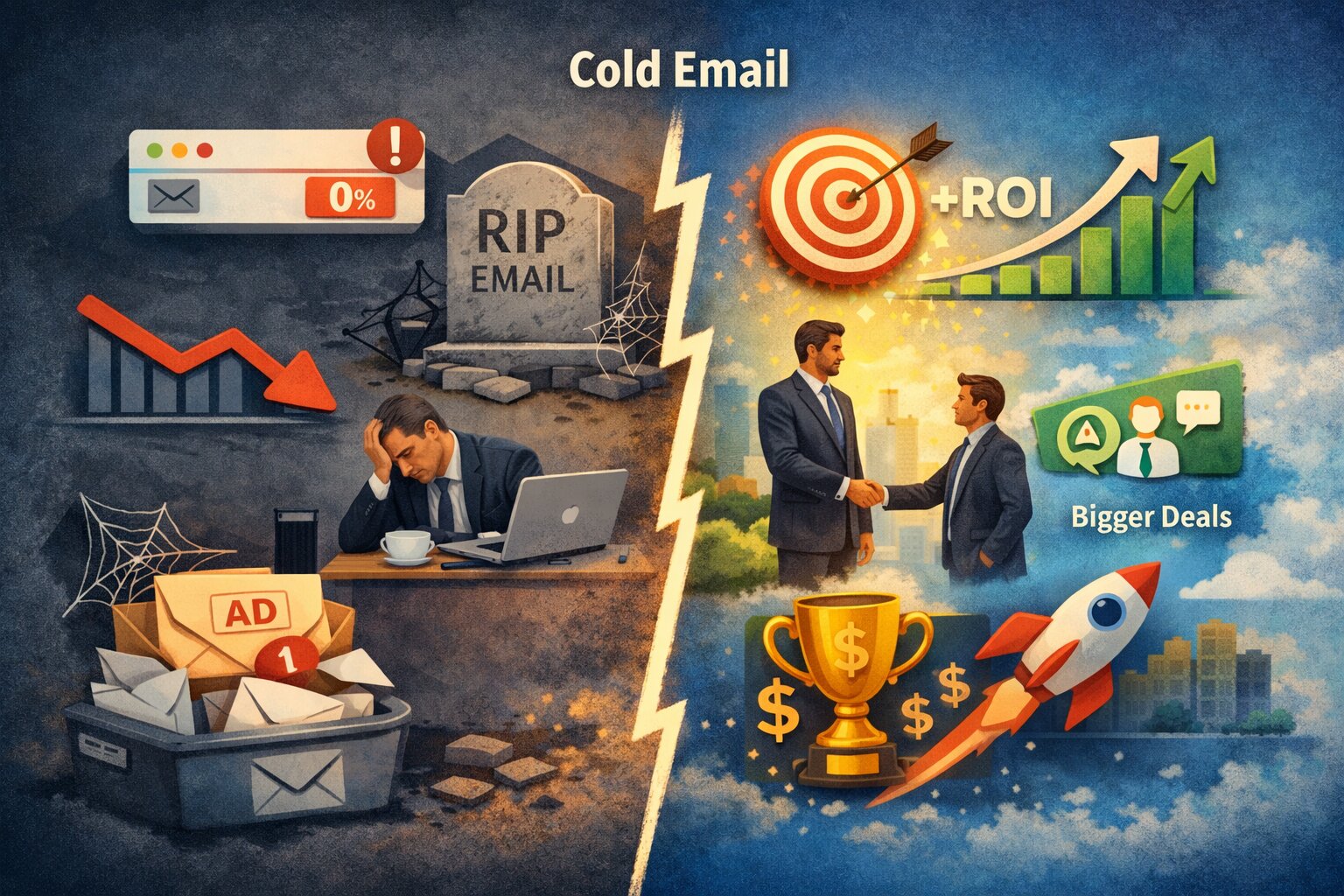
Cold email has been declared dead approximately forty times in the last decade. It hasn’t died. But it has changed — and the teams still treating it like a 2018 channel are the ones producing the terrible statistics that fuel the “email is dead” narrative.
The truth is more nuanced: cold email in 2026 is harder to do well, but the upside for teams that do it well is larger than ever.
Cold Email Benefits in 2026
Unmatched Scale
No other outreach channel gives you the volume capability of cold email. With a properly warmed sending infrastructure, a sales team can reach 500 to 1,000+ prospects per day. LinkedIn caps you at a fraction of that. This scale advantage becomes critical when you’re working a large total addressable market, running top-of-funnel awareness campaigns, or trying to book meetings at high velocity during a product launch or market expansion.
Here’s what the scale difference looks like in real numbers:
| Channel | Daily Capacity | Weekly Capacity | Monthly Capacity |
|---|---|---|---|
| Cold email (warmed domain) | 500–1,000+ | 3,500–7,000+ | 15,000–30,000+ |
| LinkedIn messages | 20–50 | 140–350 | 600–1,500 |
| LinkedIn connection requests | 20–30 | 100–150 | 400–600 |
At these volumes, even a 2% reply rate on email produces more absolute conversations than a 20% reply rate on LinkedIn — because the denominator is so much larger.
Cost Efficiency at Scale
Once your email infrastructure is set up — sending domains, warm-up completed, sequences built — the marginal cost per additional email sent approaches zero. There are no per-message costs, no credit systems, no platform fees tied to send volume. A $200/month email outreach tool can reach 15,000 prospects. The cost-per-contact is fractions of a penny.
LinkedIn InMail, by contrast, costs credits. High-volume LinkedIn outreach requires Premium or Sales Navigator subscriptions that add meaningful per-seat cost. For budget-conscious teams, email’s cost efficiency is a significant operational advantage.
Full Ownership and Portability
Your email list belongs to you. LinkedIn connections belong to LinkedIn. This distinction matters more than most sales teams realize until something goes wrong. A LinkedIn account restriction can cut off your entire outreach operation overnight. An email list lives in your CRM regardless of what any platform decides.
Email also integrates with virtually every CRM, sales engagement tool, and automation platform in the market. Data flows cleanly, attribution works properly, and sequences can be built and managed with a level of sophistication that LinkedIn-native tools are still catching up to.
Mature Optimization Ecosystem
Cold email has decades of tooling behind it. A/B testing subject lines, optimizing send timing, segmenting by persona, analyzing step-by-step sequence performance — all of this is mature, accessible, and standard in modern email outreach platforms. Teams can run systematic optimization programs that improve performance month over month with measurable, attributable results.
AI-Powered Personalization and the Deliverability Problem
Here’s the core tension in cold email in 2026: the channel has never been easier to send at scale, and the channel has never been harder to actually land in the inbox.
The Deliverability Problem
Gmail, Outlook, and other major email providers have deployed increasingly sophisticated filtering systems. They’re not just looking for obvious spam signals anymore. They’re analyzing sending patterns, domain reputation, engagement rates, and even the semantic content of emails to determine whether a message belongs in the inbox, the promotions tab, or the spam folder.
The technical requirements that separate inbox delivery from spam classification in 2026:
| Technical Requirement | What It Does | Consequence of Ignoring |
|---|---|---|
| SPF record | Authenticates the sending domain | Elevated spam classification rate |
| DKIM signature | Verifies email hasn’t been tampered with | Promotions folder or spam |
| DMARC policy | Prevents domain spoofing | Deliverability collapse at scale |
| Domain warm-up | Builds sender reputation gradually | Blacklisting within weeks |
| List hygiene | Removes invalid and unengaged addresses | Bounce rate penalties |
| Sending cadence | Gradual volume increase over time | Domain flagging |
| Dedicated sending domains | Separates cold outreach from company email | Protects primary domain reputation |
Every single item on this list requires intentional setup. Teams that skip these steps don’t just see lower open rates — they see their domains blacklisted, their emails permanently filtered, and months of sending history destroyed.
AI Personalization as the Answer
The most important development in cold email in 2026 is the maturity of AI-powered personalization. Three years ago, “personalized at scale” was largely a marketing claim. Today, it’s a genuine operational capability.
AI tools can now generate authentic, specific first lines and opening paragraphs using a prospect’s LinkedIn activity, recent company news, job changes, published content, and role-specific context — at scale, for thousands of prospects, in minutes. This isn’t mail merge with a name field. It’s genuine contextual relevance that reads like research.
Why does this matter for deliverability? Because personalized, relevant emails get opened, read, and replied to — which builds positive engagement signals that improve domain reputation over time. Irrelevant bulk emails get deleted or marked as spam — which destroys domain reputation. AI personalization isn’t just a reply rate optimization. It’s a deliverability strategy.
The important caveat: AI-generated personalization still requires human review before sending at scale. Systems that create personalized lines without oversight will inevitably produce errors — wrong company names, outdated context, awkward phrasing — that make the outreach feel worse than a generic email. The workflow that works is AI-generated + human-reviewed, not AI-generated + auto-sent.
Best Practices for Cold Email Outreach in 2026
Technical Setup Checklist (Non-Negotiable)
Before sending a single cold email:
- Configure SPF, DKIM, and DMARC on every sending domain
- Use secondary domains for cold outreach — never your primary business domain
- Warm up new domains for 4–6 weeks before any high-volume sending
- Maintain bounce rates below 3% and spam complaint rates below 0.1%
- Verify email addresses before adding them to sequences — never send to unverified lists
Content Framework
| Element | Best Practice | What to Avoid |
|---|---|---|
| Subject line | 4–7 words, specific, curiosity or relevance-based | Clickbait, ALL CAPS, excessive punctuation |
| First line | Personalized, references something real about the prospect | “I hope this email finds you well” |
| Body | Problem-focused, shows understanding of their situation | Product-first, feature-heavy |
| CTA | One ask, specific, low-friction | “Let me know if you’re interested” |
| Length | 75–125 words | 300+ words |
| Tone | Human, direct, respectful | Formal, corporate, overly enthusiastic |
Sequence Structure That Works
| Timing | Purpose | Tone | |
|---|---|---|---|
| Email 1 | Day 0 | Introduction + specific value angle | Warm, specific, personalized |
| Email 2 | Day 3 | Follow-up from different angle | Brief, curious, non-pushy |
| Email 3 | Day 7 | Share useful resource or insight | Generous, helpful, zero ask |
| Email 4 | Day 14 | Soft close — acknowledge no response | Direct, respectful, honest |
| Email 5 | Day 21 | Breakup email | Short, honest, leaves door open |
The most important rule in cold email sequencing: every email should provide standalone value. If a prospect reads only email three of your five-email sequence, they should still get something useful from it. Sequences that feel like escalating pressure campaigns consistently underperform sequences that feel like a helpful expert trying to start a useful conversation.
LinkedIn Messaging in 2026
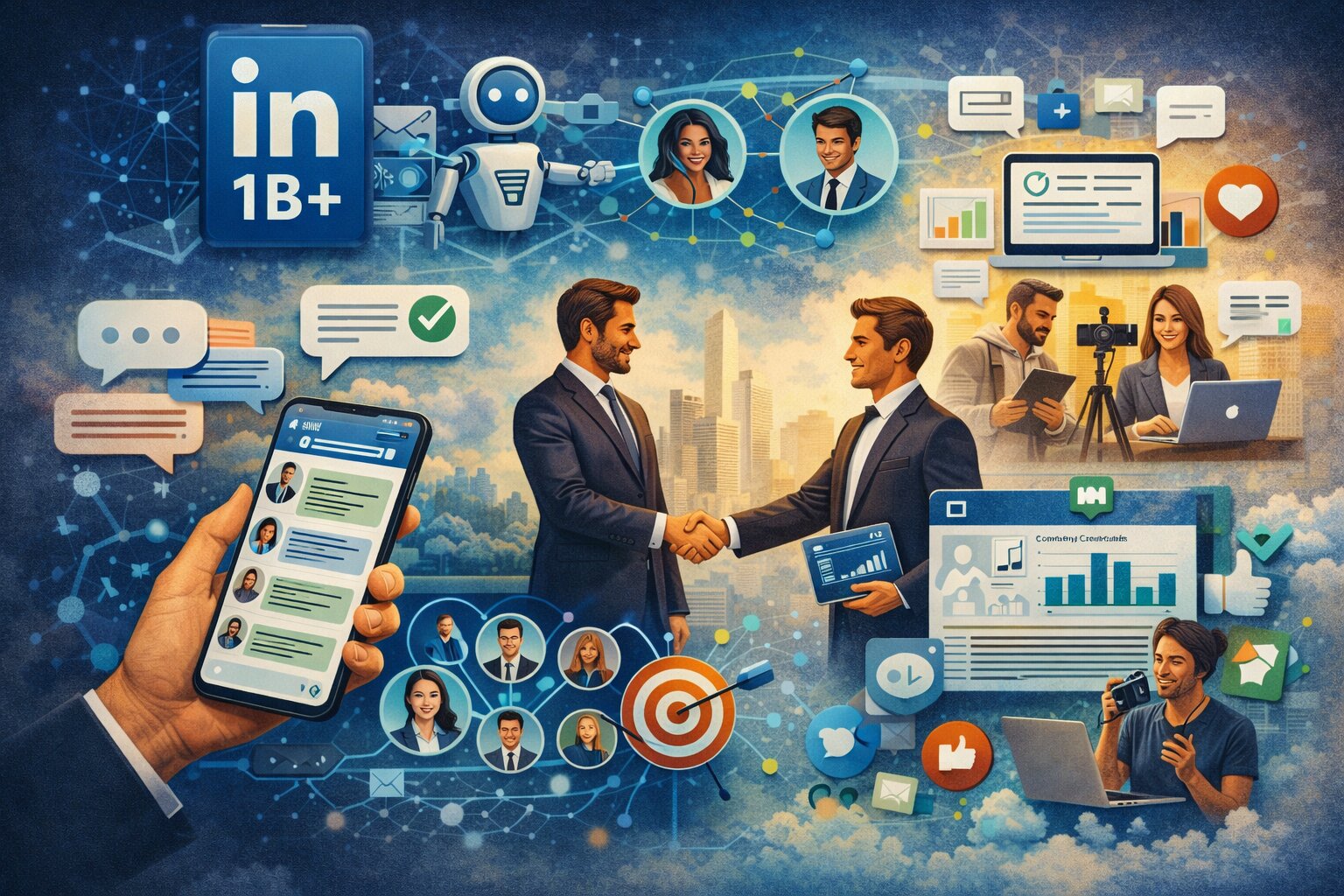
Understanding the email vs LinkedIn message debate properly requires understanding what LinkedIn messaging actually is in 2026 — not what it was three years ago.
LinkedIn has evolved significantly as a sales channel. The platform now has over one billion members, AI-powered matching features, expanded messaging capabilities, and a creator ecosystem that means many of your prospects are actively publishing content and building their professional brand on the platform. This context changes the outreach equation fundamentally.
LinkedIn Messaging Benefits in 2026
Context and Credibility That Email Can’t Match
When someone receives a LinkedIn message, they can see everything about you before deciding whether to respond. Your job title, company, experience, shared connections, mutual groups, content you’ve published — all visible instantly. This context dramatically changes the trust equation compared to a cold email from an unknown sender at an unknown domain.
For senior decision-makers especially, this context matters enormously. A C-suite executive who receives a cold email from someone they’ve never heard of has very little signal about whether this person is worth their time. The same message from someone with a relevant professional profile, mutual connections, and published content in their field lands completely differently.
Engagement Rates That Dwarf Email
The numbers here are not subtle. LinkedIn messages are opened at rates of 85–95% compared to 20–35% for cold email. Reply rates of 10–25% versus email’s 1–5%. These aren’t marginal differences — they’re order-of-magnitude improvements in engagement at every stage of the outreach funnel.
Why does LinkedIn win on engagement so decisively? Three reasons:
First, lower volume. Most LinkedIn users receive far fewer messages than emails. The inbox is quieter, which means individual messages get more attention. Second, professional intent. People on LinkedIn are in a professional mindset — business conversations are expected and don’t feel intrusive the way a cold sales email can. Third, notification behavior. LinkedIn’s notification system creates a different behavioral trigger than email — people check LinkedIn notifications more deliberately than they manage a crowded email inbox.
Relationship Persistence
A LinkedIn connection is a long-term asset in a way that an email lead is not. Once connected, you can warm up that relationship over months through content — every post you publish appears in their feed, every comment you leave on their content creates a touchpoint, every reaction builds familiarity. By the time you send a direct message to a LinkedIn connection you’ve been cultivating through content for three months, you’re not cold anymore.
This relationship infrastructure simply doesn’t exist in email. An email address without ongoing engagement goes cold. A LinkedIn connection, nurtured through consistent content, stays warm indefinitely.
Lower Competition
Senior decision-makers — the people most sales teams most want to reach — typically receive hundreds of cold emails per week. Their LinkedIn inboxes are dramatically less crowded. For the highest-value prospects, LinkedIn messaging represents a channel where you’re competing with far fewer voices for the same attention.
Scalability and Automation Challenges on LinkedIn
The engagement advantages of LinkedIn messaging come with a significant operational constraint: the platform limits how much you can do in a day, and actively detects and restricts automated behavior.
LinkedIn’s 2026 Activity Limits
| Action Type | Daily Safe Limit | Weekly Limit | Monthly Limit |
|---|---|---|---|
| Connection requests | 20–30 | 100–150 | 400–600 |
| Direct messages (1st degree) | 100–150 | 700–1,000 | 3,000–4,000 |
| InMail messages | Based on Premium credits | Variable | Variable |
| Profile views | 80–100 | 500–700 | 2,000–3,000 |
| Safe automated actions | 20–50 | 140–350 | 600–1,500 |
These limits are non-negotiable — and pushing against them is one of the fastest ways to get your account restricted. LinkedIn’s detection systems have grown significantly more sophisticated in 2026. They monitor timing between actions, behavioral patterns, IP addresses, and device consistency. Browser-based automation tools that operate inside your Chrome session are increasingly flagged.
The Account Dependency Risk
Unlike email — where your list lives in your CRM regardless of what any platform does — your LinkedIn network lives on LinkedIn’s platform. An account restriction doesn’t just slow down your outreach. It can eliminate your ability to reach thousands of connections you’ve built over years. This platform dependency is the most significant strategic risk of relying on LinkedIn as your primary outreach channel.
Mitigation: always run LinkedIn outreach as part of a multichannel strategy, never as your only channel. And when using automation, use cloud-based tools with dedicated IP addresses rather than browser extensions — the safety architecture difference is significant.
Best Practices for LinkedIn Outreach in 2026
Profile Optimization Before You Send a Single Message
Your LinkedIn profile is your credibility document. Before scaling any outreach, every element needs to communicate clearly to your ICP:
| Profile Element | What Good Looks Like | What to Avoid |
|---|---|---|
| Headline | “Helping [ICP] achieve [outcome] at [Company]” | “Founder at [Company]” |
| Banner | Communicates value proposition visually | Blank grey default |
| About section | Written to your ICP, not your resume | Career summary format |
| Featured section | Lead magnet, best post, or case study | Empty |
| Experience | Results and impact with metrics | Job description format |
Connection Request and Message Framework
| Step | Action | Timing | Key Principle |
|---|---|---|---|
| 1 | Profile view | Day 0 | Silent warmup — creates notification |
| 2 | Follow | Day 1 | Second visibility touchpoint |
| 3 | Connection request + personalized note | Day 2 | Reference something specific |
| 4 | Welcome message | Day 0 post-acceptance | Context, no pitch |
| 5 | Value message | Day 5 | Insight or resource, no ask |
| 6 | Follow-up | Day 10 | Gentle re-engagement |
| 7 | Soft CTA | Day 15 | Low-friction invitation |
The single most important principle in LinkedIn outreach: never pitch in the connection request. The connection request is asking for permission to have a conversation. It is not the conversation. Teams that violate this principle consistently see connection acceptance rates collapse — and deservedly so.
Content as a Force Multiplier
Posting consistently on LinkedIn — 3 to 5 times per week — warms up your entire connection network simultaneously. Every post you publish appears in the feeds of your connections. By the time you send a direct message to someone who’s been seeing your content for six weeks, you’re reaching someone who already knows your perspective, already respects your expertise, and is significantly more likely to respond.
This content flywheel doesn’t exist in email. It’s one of LinkedIn’s most powerful and underutilized advantages as an outreach channel.
Email vs LinkedIn Message: What the Data Actually Shows
The most important section of this comparison is also the most commonly oversimplified. Raw engagement metrics tell one story. The full picture is more nuanced.
Key Metrics Comparison
| Metric | Cold Email | LinkedIn Message | Channel Winner |
|---|---|---|---|
| Average open rate | 20–35% | 85–95% | |
| Average reply rate | 1–5% | 10–25% | |
| Daily volume capacity | 500–1,000+ | 20–50 | |
| Cost per contact | Very low | Low-moderate | |
| Deliverability risk | High | Low | |
| Account/platform risk | Low | Medium | |
| Personalization at scale | High (AI-enabled) | Moderate | |
| Context for recipient | Low | High | |
| Relationship persistence | Low | High | |
| CRM integration | Very mature | Maturing | |
| A/B testing capability | Advanced | Basic | |
| Setup complexity | Moderate-high | Low-moderate | |
| Response speed | 24–72 hours | Same day | |
| Best for senior decision-makers | Moderate | Strong |
Reading the data correctly: LinkedIn wins on engagement metrics decisively. Email wins on operational metrics decisively. The right interpretation isn’t “LinkedIn is better” or “email is better.” It’s that each channel has a specific job to do — and the teams that understand those jobs build sequences that assign the right channel to the right moment.
When to Use Each Channel
The channel choice should follow the situation, not the preference:
Use Cold Email When
| Situation | Why Email Is the Better Choice |
|---|---|
| Reaching large prospect lists (1,000+) | LinkedIn’s volume limits make scale impossible |
| Targeting technical buyers who live in their inbox | Higher email engagement for developer/engineering personas |
| Following up on a cold LinkedIn prospect | Email as a second-channel re-engagement tool |
| Sending content-heavy outreach | Email handles long-form content and attachments better |
| Building top-of-funnel awareness at scale | Cost-efficient for high-volume prospecting |
| Prospects where LinkedIn profiles are sparse | Less profile context means LinkedIn credibility signal is weaker |
| Re-engaging a list that’s gone cold | Email volume allows for broad re-engagement campaigns |
Use LinkedIn When
| Situation | Why LinkedIn Is the Better Choice |
|---|---|
| Targeting C-suite and VP-level decision-makers | Lower inbox competition, higher professional context |
| Outreach where your profile credibility matters | Your experience and network create trust before the message |
| Account-based selling to specific target companies | Research and outreach happen in the same platform |
| Building relationships for long sales cycles | Content flywheel keeps you warm over months |
| Following up after meeting someone in person | LinkedIn reinforces and maintains the connection |
| Prospects actively publishing content on LinkedIn | Engagement with their content creates natural warm-up |
Combining Both Channels: The Multiplier Effect
Here’s the data point that changes the conversation for most sales teams: multichannel sequences outperform single-channel outreach by 30–50% on reply rates across most B2B segments.
The mechanism isn’t mysterious. Repeated exposure across different contexts builds familiarity. A prospect who sees your LinkedIn profile, reads your connection request note, receives a relevant email, and then gets a LinkedIn follow-up message has encountered you four times across two different environments. By the time they reply, they don’t feel like they’re responding to a cold outreach — they feel like they’re continuing a conversation that’s already started.
Here’s what an effective combined sequence looks like in practice:
| Day | Channel | Action | Purpose |
|---|---|---|---|
| Day 0 | Profile view | Silent warmup — creates notification | |
| Day 1 | Follow prospect | Second micro-touchpoint | |
| Day 2 | Connection request + personalized note | Core LinkedIn outreach action | |
| Day 4 | First cold email (references LinkedIn) | Scale channel introduction | |
| Day 5 | Welcome message (if connected) | Build context, zero pitch | |
| Day 8 | Follow-up email — different angle | Second email touchpoint | |
| Day 10 | Value message or resource share | Relationship-building touchpoint | |
| Day 14 | Third email — fresh perspective | Maintain email presence | |
| Day 18 | Soft CTA | Low-friction meeting invitation | |
| Day 21 | Breakup email | Close the loop respectfully |
The key principle across every touchpoint: each message on each channel should reference or acknowledge the other channel without being mechanical about it. “I reached out on LinkedIn last week” is a natural connection. “This is my follow-up as per my LinkedIn message” is not.
Multi-Channel Outreach
Understanding why multichannel outreach works is different from knowing how to build it. Here’s the practical implementation.
Creating Multi-Channel Sequences
Three sequence models work in different situations:
Model 1: LinkedIn-First (For Warm Markets and Senior Targets)
Start with LinkedIn touchpoints — profile view, follow, connection request, content engagement — and add email after a connection is established or after a defined period of no response. This model works best for account-based selling, senior decision-makers, and markets where your LinkedIn presence is a strong credibility signal.
The logic: use LinkedIn’s credibility and engagement advantages for the first impression, then use email’s volume and persistence capabilities for follow-up.
Model 2: Email-First (For Scale Prospecting and Large TAMs)
Start with email for volume — reach hundreds of prospects simultaneously — and add LinkedIn as a warming and follow-up channel for active responders or high-priority targets. This model works best when you’re working a large total addressable market and need to identify warm prospects efficiently before investing LinkedIn capacity.
The logic: use email to find who’s interested, then use LinkedIn to deepen those relationships.
Model 3: Parallel Sequences (For Competitive Markets and High-Value Accounts)
Run LinkedIn and email simultaneously from the first day of outreach. Every prospect receives both channels from the beginning. This maximizes touchpoint frequency and ensures you’re present wherever the prospect is most active. Best for time-sensitive campaigns, highly competitive markets, or high-value accounts where maximum coverage justifies the additional effort.
Universal Sequence Design Principles:
| Principle | Application |
|---|---|
| Each touchpoint adds standalone value | Don’t repeat the same message on both channels |
| Track engagement across channels | A LinkedIn reply should pause the email sequence |
| Personalize the first touchpoint on each channel | Automation starts with message 2 and beyond |
| Remove people the moment real conversation starts | Never send an automated follow-up into an active reply thread |
| Keep total touchpoints to 8–12 over 21–28 days | More than this becomes noise |
Tools to Manage Multi-Channel Campaigns
Managing two channels simultaneously without losing track of where each prospect is requires the right infrastructure. Here’s what to look for:
| Feature | Why It Matters |
|---|---|
| Unified prospect view | See LinkedIn and email activity in one place per contact |
| Cross-channel sequence builder | Build LinkedIn and email steps in one workflow |
| Smart reply detection | Automatically pause sequences when a prospect responds on either channel |
| CRM integration | Keep pipeline data synchronized with all outreach activity |
| Analytics across channels | Compare performance at campaign and individual step level |
| Team collaboration | Multiple reps working the same sequence without conflicts or overlap |
| Daily action limits management | Prevent LinkedIn over-automation that risks account flags |
Categories of tools that handle multichannel outreach:
Purpose-built multichannel sales engagement platforms handle both channels natively with unified analytics. LinkedIn-specialist tools with email add-ons prioritize LinkedIn campaign management and treat email as supplementary. Email-specialist tools with LinkedIn integration do the reverse. The right category depends on which channel your team uses more heavily as the primary touchpoint.
The most important evaluation question before choosing any tool: does it handle reply detection across both channels? A tool that doesn’t automatically pause sequences when a prospect replies — whether on LinkedIn or email — will inevitably send automated follow-ups into live conversations. Nothing damages a prospect relationship faster.
Conclusion
The email vs LinkedIn message debate has consumed more sales team meeting time than almost any other tactical question in B2B outreach. And for good reason — the stakes are real. Choose the wrong channel, or the wrong approach on the right channel, and you’re burning budget, burning time, and watching pipeline opportunities disappear before they ever materialize.
But after examining the data, the best practices, and the real-world performance of both channels across different use cases and buyer personas, the conclusion is clear: this was never a binary choice.
Email and LinkedIn are not competitors for your outreach budget. They are complementary tools with fundamentally different strengths — and the teams treating them as such are consistently outperforming the teams still debating which one to use.
Frequently Asked Questions
1. Is cold email or LinkedIn better for B2B outreach in 2026?
Neither is definitively better. LinkedIn delivers higher open and reply rates but is limited to 20–50 daily actions. Email scales to thousands of sends per day but faces serious deliverability challenges. The strongest B2B outreach combines both channels in coordinated sequences.
2. What is the average reply rate for cold email in 2026?
Cold email reply rates typically range from 1–5% for well-optimized campaigns. Poorly personalized campaigns with deliverability issues often fall below 1%. AI-assisted personalization combined with proper technical setup can push reply rates toward the higher end of that range.
3. What is the average reply rate for LinkedIn messages in 2026?
LinkedIn direct messages to first-degree connections typically generate reply rates of 10–25%, significantly higher than cold email. Connection request acceptance rates range from 20–55% depending on personalization quality and how well the prospect matches your profile’s positioning.
4. How many LinkedIn messages can I safely send per day?
The safe operational limit for LinkedIn messages is 20–50 automated actions per day depending on your account age, profile strength, and the tool you’re using. Exceeding these limits consistently increases the risk of temporary restrictions or permanent account flagging.
5. Does AI personalization actually improve cold email reply rates?
Yes — meaningfully. AI-generated personalized first lines referencing a prospect’s LinkedIn activity, company news, or published content consistently outperform generic templates on open rates, reply rates, and spam filter performance. The key requirement: human review before sending at scale to catch errors and awkward phrasing.
6. How long should a cold email be in 2026?
75–125 words is the optimal range for cold email body length in 2026. Shorter emails feel dismissive. Longer emails get skimmed or deleted. The goal is one specific problem, one credible observation, and one clear low-friction call to action — all within that word count.
7. Is LinkedIn automation safe to use in 2026?
Cloud-based LinkedIn automation tools with dedicated IP addresses and human-behavior simulation are significantly safer than browser-based extensions. No automation is completely risk-free — LinkedIn’s terms technically prohibit all automation — but cloud-based tools used within daily action limits represent the most responsible approach to LinkedIn outreach at scale.
8. How many touchpoints should a multichannel outreach sequence have?
Eight to twelve touchpoints across both channels over 21–28 days is the optimal range for most B2B outreach sequences. Fewer than eight touchpoints misses prospects who weren’t ready to engage early. More than twelve starts feeling like pressure rather than outreach and increases unsubscribe and block rates.
9. Should I use my primary business domain for cold email outreach?
No — this is one of the most important technical decisions in cold email setup. Always use secondary sending domains for cold outreach. If your primary domain gets flagged or blacklisted due to cold outreach activity, it affects all company email — including transactional messages, customer communication, and internal email. Secondary domains protect your primary domain reputation entirely.
10. How do I know which channel is working better for my specific audience?
Run a multichannel sequence for 30 days and measure reply rates separately for LinkedIn messages and cold emails across the same prospect pool. Track open rates, reply rates, and conversion to booked meetings per channel. Most ICPs show a clear preference — technical buyers often respond better to email, senior decision-makers typically show higher engagement on LinkedIn. Let your data tell you which channel your specific audience prefers, then weight your sequence accordingly.