


Your inbox is full of referral requests. Most of them sound like a robotic plea for help. They open with “I hope this message finds you well” and close with “it would mean a lot if you could refer me.” Generic. Forgettable. Zero personalization.
Then one lands that makes you stop. It’s short. It’s specific. It reminds you of something real you did together. Suddenly, you’re not annoyed. You’re actually considering helping.
The difference between a referral request that gets buried and one that gets action isn’t luck. It’s strategy. And that strategy starts with understanding that asking for a referral on LinkedIn is not about desperation. It’s about reminding someone of the value you can deliver, making their job to refer you effortless, and respecting their network as if it were your own.
Most people rush the referral request. They skip the relationship-building phase. They don’t give their contact a reason to stake their reputation on a recommendation. And then they wonder why referrals don’t materialize.
This guide shows you exactly how to ask for a referral on LinkedIn in a way that feels natural, not transactional. You’ll get templates that have been tested by recruiters, sales leaders, and job seekers who actually understand that referrals are built on trust, not templates alone.
Why Referrals on LinkedIn Are 10x More Powerful Than Cold Outreach
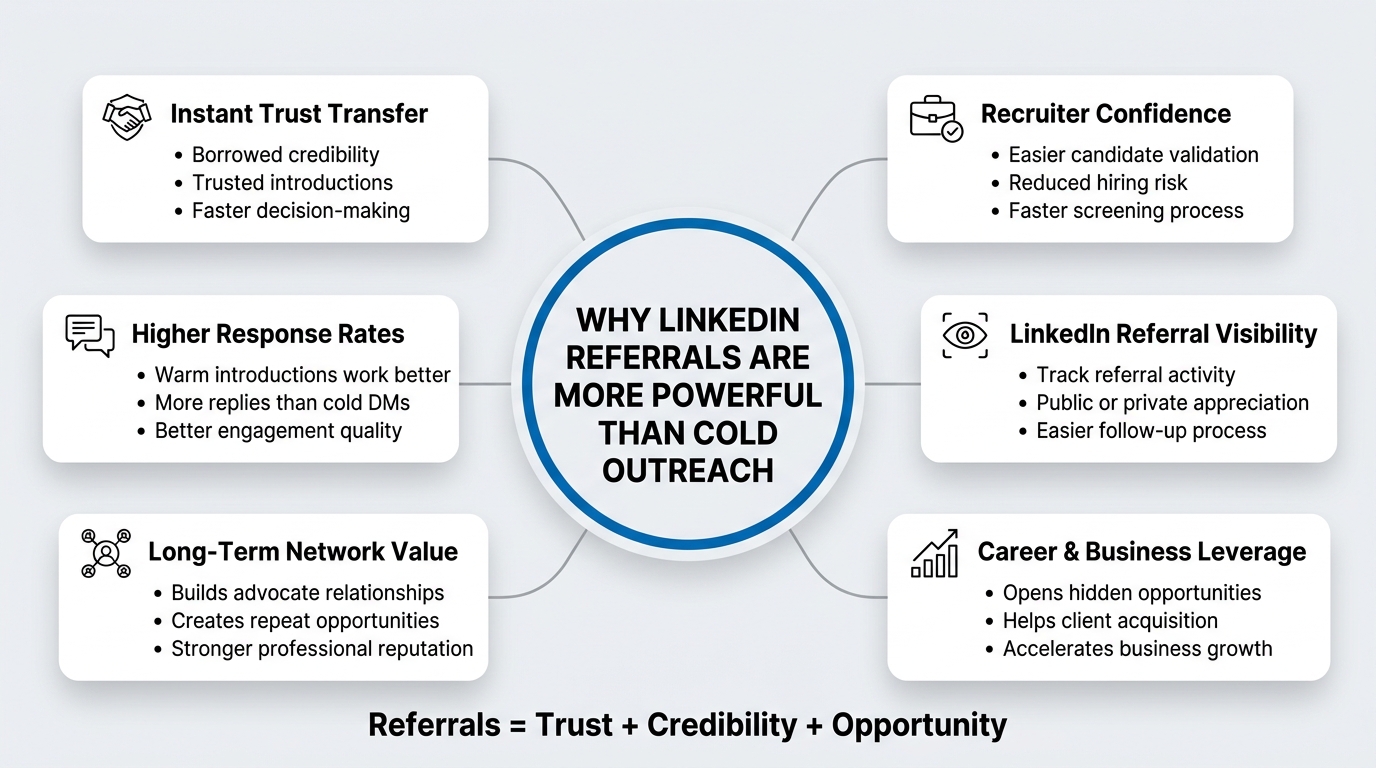
Before you ask for anything, you need to understand why referrals matter so much more than blind connection requests.
A cold LinkedIn message has a reply rate of somewhere between 2% and 5% if you’re doing it well. A referral from someone trusted in your network? That lands your resume or opportunity in front of decision-makers with immediate credibility. You’re not a stranger. You’re someone who comes with a vouching relationship.
The recruiter doesn’t have to vet you from scratch. The hiring manager doesn’t have to wonder if you’re real or qualified. Someone they know and trust just said, “This person is worth talking to.” That’s enormous leverage. Studies on B2B sales show that referred leads are three times more likely to convert than those from cold outreach. That same dynamic applies to job hunting, client acquisition, and business development.
Here’s what most people miss: LinkedIn has made referrals easier to track and measure. You can now see whether someone has given you a referral through the platform. You can thank them publicly (or privately, depending on the situation). You can follow up on the outcome. This means referrals are no longer ephemeral favors. They have continuity.
But that visibility cuts both ways. A sloppy referral request is now on record. A well-crafted one that shows you’ve done your homework? Also on record. Someone who refers you and sees that you handled the opportunity well will likely refer you again. This is how you build a network of advocates, not just contacts.
The real power of a referral is that it positions you as someone worth knowing, not someone asking for help. The person making the referral is putting their reputation on the line. That’s why they need to be absolutely clear on who you are, what you’re looking for, and why you’d be an asset to whoever they’re introducing you to.
The Psychology Behind How to Ask for Referral on LinkedIn (And Why Most Requests Fail)
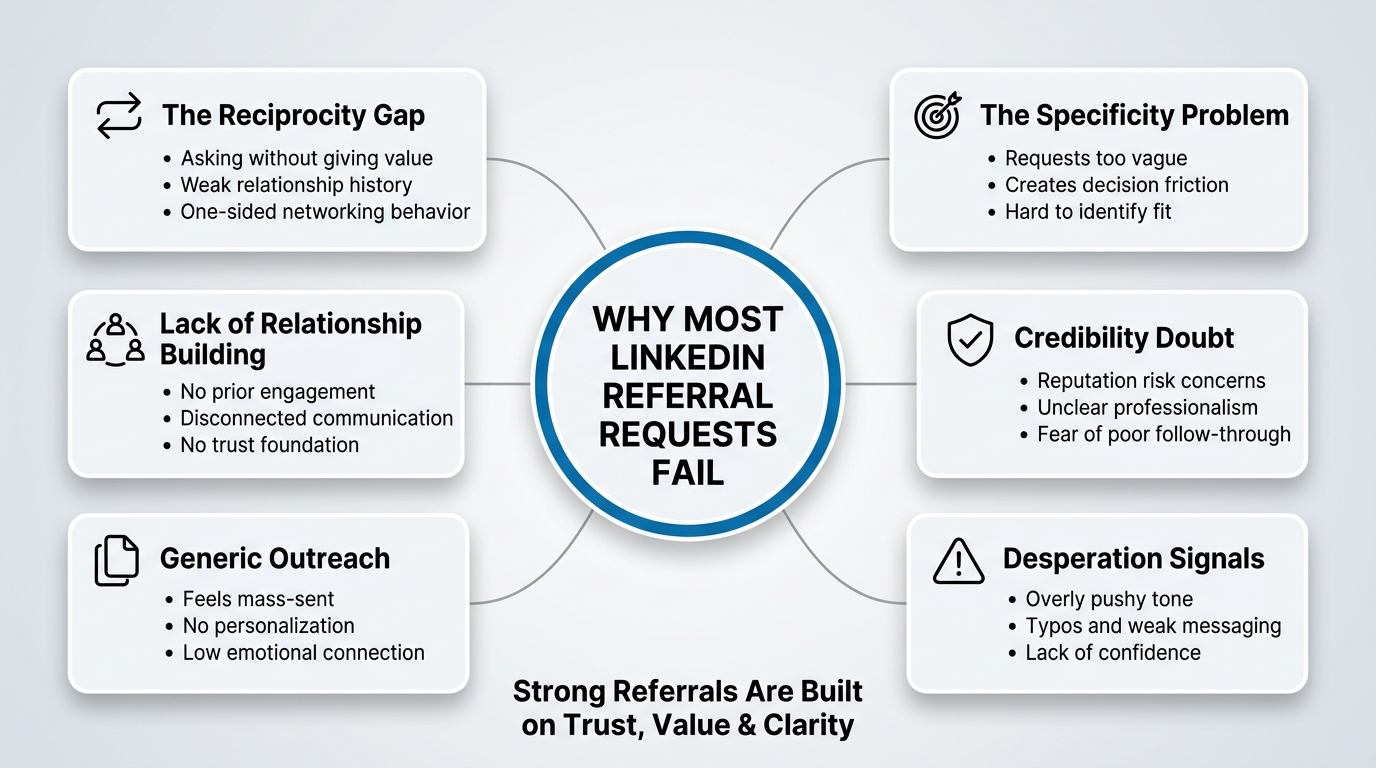
Most LinkedIn referral requests fail because they focus only on what the sender wants, not what the other person risks. People are more likely to help when there’s trust, familiarity, and a sense of mutual value. Understanding the psychology behind referrals, including reciprocity, credibility, and timing, can completely change how you approach outreach. In this section, we’ll break down why most referral requests get ignored and how to write messages that feel genuine, respectful, and worth responding to.
The Reciprocity Gap
Most referral requests fail because they’re one-sided. Someone you haven’t talked to in two years suddenly messages asking for an introduction. They want you to use your social capital. They want you to put your reputation on the line. But what have you done for them lately?
This is the reciprocity gap. In healthy relationships, favors flow both directions. If all you do is ask, people develop a mental shield. They stop responding as readily. They deprioritize your messages.
Here’s the thing: you need to have already given value before you ask for a referral. Not days before. Months or even years before. I’m talking about genuine, unsolicited help. A tip about a job opening they might care about. An introduction to someone in their space. Engagement on their content. Thoughtful comments on their posts that show you actually read what they wrote.
That reservoir of goodwill is what makes a referral request feel reasonable instead of like an ask from someone out of the blue. You’re not just calling in a debt. You’re activating an existing relationship.
The Specificity Problem
People don’t like vague requests. The more specific you are about what you’re asking for, the easier it is to say yes. Vague requests require them to guess. Are you looking for introductions to anyone in their company? A specific person? Someone in a particular department? At what level?
When you’re vague, they have to do the work of figuring out whether they can help. That friction kills the referral. A specific request that says “I’m looking to chat with marketing directors at B2B SaaS companies with 50 to 200 employees” is infinitely easier to process than “Do you know anyone who might be interested in talking to me?”
The specific request lets them run through their mental Rolodex fast. They either know someone who fits or they don’t. No decision paralysis. No guesswork on their part.
The Credibility Doubt
Deep down, when someone asks you for a referral, they’re asking you to vouch for them. The unspoken question in their head is, “Will this person reflect well on me when I make this introduction?” If there’s any doubt in their mind about your professionalism, follow-through, or ability to be a good contact, they’ll hesitate.
This is why the request message itself needs to be professional but personable. If your message is riddled with typos or sounds desperate, it undermines your credibility right there. If you include something that shows you’ve done the work (mentioning something specific about their career, referencing a conversation you had), it signals that you’re organized and thoughtful, not just spray-and-praying requests across your network.
How to Build Your Referral Network Before You Need It
The best time to ask for a referral is never when you suddenly need one. The best time is when you’ve been actively building relationships month after month.
Engagement is the Long Game
This is not sexy advice, but it works. People who build real referral networks don’t wait until they need something. They engage with their contacts’ content. They respond to posts. They celebrate wins. They share thoughtful insights in conversations.
On LinkedIn specifically, this means: spend time actually using the platform. Read the posts in your feed. Comment with something that adds to the conversation (not just a thumbs-up emoji or “Great post!”). Reply to comments in threads. When someone shares something relevant to your industry, acknowledge it. When a contact lands a new job or gets a promotion, congratulate them.
This sounds like it takes forever, but it doesn’t. Fifteen to twenty minutes a day of genuine engagement builds enormous goodwill. People notice. They start seeing your name regularly. They get used to hearing from you in a positive context. When you eventually ask for a referral, you’re not a ghost coming back from the dead. You’re someone they’ve been hearing from all along.
Give First, Ask Later
The easiest way to build a referral network is to give value first. Have a connection who’s looking to hire? Refer a good candidate even if it doesn’t directly help you. Know someone who should know each other? Make the introduction without expecting anything in return.
This creates a culture of mutual support in your network. People start to see you as a connector, not just someone asking for things. And when you eventually ask for a referral, they’re happy to return the favor because you’ve already shown them how it’s done.
The second-order effect is that every introduction you make reflects on you. If you refer someone who’s great, people remember that. If you refer someone who’s terrible, people also remember that. Your reputation as a connector becomes currency. Spend it wisely.
Stay in Touch, Even When You Don’t Need Anything
The contacts who say yes to referral requests fastest are the ones who’ve heard from you recently. Not six months ago. Recently. That might be a quick message checking in, sharing an article they’d care about, or congratulating them on something.
Here’s a practical system: every month, identify three to five people from your network who you want to deepen your relationship with. Reach out to each one. It might just be, “Hey, I saw you recently joined XYZ company. That’s exciting! Would love to catch up soon.” That’s it. No ask. Just a genuine touchpoint.
People who receive regular, low-pressure contact from you are dramatically more likely to say yes when you do ask for something. Because you’re not a stranger. You’re someone they actually hear from.
The 6 Templates for How to Ask for Referral on LinkedIn (With Personal Touches)
Now let’s get to the actual asks. These templates work because they’re specific, they acknowledge the relationship, and they make it easy for the other person to say yes. Each one is designed for a different scenario.
Template 1: The Warm Reactivation (For Someone You Haven’t Talked to in a While)
Use this when: You want to reconnect with someone from your past before diving into an ask. This builds back the relationship first.
Hi [Name],
I was looking back at some old projects and realized we worked together on [specific project/initiative]. That experience taught me a lot, especially the way you [mention something specific they did well].
I’m currently focused on [brief description of what you’re doing now], and I’m building my network in [specific industry/function]. I know you’ve been doing great things at [their company], and I’d love to reconnect.
I’m looking to talk with [specific type of person/role/company size], and if you happen to know someone who might be open to a conversation, I’d be grateful for the introduction. No pressure at all if it’s not on your radar.
Either way, would be great to catch up soon.
All the best, [Your Name]
Why this works: You’re not jumping straight to the ask. You’re reminding them of a positive shared experience. You’re acknowledging time has passed. You’re being specific about what you’re looking for (this makes their job easy). And you’re explicitly saying no pressure, which means they can say no without feeling guilty.
The key detail is the bracketed phrase “[mention something specific they did well].” This proves you actually remember them, not just that you need something. It changes the tone from transactional to genuine.
Template 2: The Specific Mutual Connection Ask (For Someone You Know Well)
Use this when: You have a real relationship with someone and you know they’d be likely to know exactly who you need to talk to.
[Name],
Quick ask: I’m currently looking to connect with [specific role] at [type of company], ideally someone focused on [specific area/pain point]. Given what you know about my background and what I do well, do you know anyone who might be worth a conversation?
Here’s what I’m really looking to do: [specific goal – whether that’s learning about their process, exploring a partnership, finding a customer, whatever].
Happy to return the favor if there’s anyone in my network who could help you.
Thanks for thinking about it.
Why this works: This is direct without being demanding. You’re specific about what you want and why. You’re acknowledging upfront that they might not know anyone. And you’re offering reciprocity. When someone knows you’ll help them in return, they’re more willing to help you.
This template works best with people you have enough rapport with that you don’t need to re-establish the relationship first.
Template 3: The Value-First Reference (When You’ve Recently Helped Them)
Use this when: You just sent them an introduction, helped them solve a problem, or added value in some way. Strike while goodwill is hot.
Hi [Name],
Hope the connection with [person you introduced them to] is going well. I thought you two would work well together given [reason].
Since things have been going well for you lately (congrats on [recent win]), I wanted to ask about something I’m working on. I’m trying to build relationships with [specific type of person/role/company]. Do you happen to know anyone in that space who might be open to a conversation?
No worries if nothing comes to mind. Either way, let’s grab coffee soon. I’d love to hear what you’ve been working on.
Why this works: You’ve just done something nice. The goodwill is recent and tangible. You’re referencing it. Then you ask. Then you immediately follow up with something that’s not transactional (grabbing coffee). This shows that your relationship isn’t just about what they can do for you.
Template 4: The Specific Problem Reference (When You’re Looking for Expertise, Not Just a Job)
Use this when: You’re not just job hunting or prospecting. You’re genuinely looking for someone with specific expertise or experience to learn from or partner with.
Hi [Name],
I’ve been thinking about [specific challenge you’re facing] and your work at [previous company] keeps coming to mind. You handled that [specific situation/project] in a way that few people could.
I’m now working on [your current initiative], and we’re facing some of the same challenges. Would you know someone in your network who’s successfully navigated [specific aspect]? Even just a 20-minute conversation with the right person would be incredibly valuable.
I’m also happy to share what we’re learning on our end. Would love to exchange ideas.
Why this works: You’re appealing to someone’s expertise and accomplishments, not just their Rolodex. You’re showing that you’ve paid attention to their career trajectory. You’re asking for something specific (expertise-based, not just “do you know anyone”). And you’re offering genuine intellectual exchange, not just a one-way favor.
This approach often works better than job-focused referral requests because it positions the other person as someone interesting with real knowledge, not just a gatekeeper.
The LinkedIn Recruiter Reference (When a Recruiter is in Your Network)
Use this when: You’re reaching out to a recruiter or HR person you already know for referrals or opportunities.
Hi [Name],
I see you’re now the [role] at [company]. That’s fantastic. I’ve always appreciated how you assess talent – you never just focus on the resume, you actually think about fit.
I’m in the market for [specific role/situation], and I’m particularly interested in companies where [specific value/culture/focus]. Given your eye for talent and your network at [their industry/space], I wanted to reach out.
If you know of anyone hiring or know someone who knows someone, I’d love to have a conversation. Happy to send over my updated background.
Either way, would love to catch up and hear about what you’re building at [company].
Why this works: Recruiters get hundreds of ask messages. This one stands out because it acknowledges their skill at assessing people (not just their access to jobs). It’s specific about the type of role and culture you’re targeting. It shows you understand their role and respect it. And it acknowledges that they’re busy, so you’re not demanding their time.
Template 6: The Long-Term Network Building Ask (For Your “Warm List”)
Use this when: You’re building a long-term referral network and want to set expectations that you might ask for introductions periodically.
Hi [Name],
I really respect what you’re doing at [company] and what you’ve built in [their industry/domain]. I know we don’t talk every week, but I value the times we’ve connected.
I’m in the process of building my professional network in [your target industry/focus], and I’m looking for ways to meet [type of person] who’s actively dealing with [specific challenge]. You probably run into a lot of these people.
Rather than reaching out every few months with a new ask, I wanted to get ahead of it: if you come across someone who might be worth me knowing, would you be open to an introduction? I’d be happy to return the favor whenever I can.
No pressure at all if this isn’t something you’re interested in. But if you are, it would be huge.
Why this works: This is brilliant because you’re being upfront about your intent to ask again. You’re not being sneaky. You’re asking for permission to be in touch periodically. You’re acknowledging that this is a favor they might not be interested in. And you’re making it optional for them.
People who actually like you and want to help you will appreciate this directness. They’ll be more likely to say yes because you’ve given them an out and treated them with respect.
Comparison Table: When to Use Each Template
| Template | Best For | Tone | Effort to Answer | Success Rate |
|---|---|---|---|---|
| Warm Reactivation | Reconnecting after time | Warm, nostalgic | Medium (requires them to search network) | 40-50% |
| Specific Mutual Connection Ask | Close relationships | Direct, collaborative | Low (quick yes or no) | 60-70% |
| Value-First Reference | Right after helping them | Grateful, natural | Low (momentum-based) | 70-80% |
| Specific Problem Reference | Expertise-based requests | Respectful, consultative | Medium (requires thinking) | 50-60% |
| Recruiter Reference | HR/recruiting professionals | Professional, informed | Low (within their expertise) | 65-75% |
| Long-Term Network Building | Ongoing relationships | Honest, low-pressure | Very Low (just permission) | 75-85% |
The Timing and Context That Make Your Referral Request Actually Get Opened
A perfect template fails if it lands at the wrong time or in the wrong context. Here’s how to stack the odds in your favor.
Don’t Ask Right After They’ve Changed Jobs
This is counterintuitive, but people who just changed jobs are drowning. They’re onboarding. They’re learning systems. They’re establishing themselves in a new role. They’re not thinking about their network. They’re thinking about their first 90 days.
Wait two to three months after someone changes jobs. By then they’ve settled in. They have some breathing room. They know who’s important in their new company. Now when you ask for an introduction, they can actually think clearly about whether it makes sense.
Leverage Recent Engagement
If someone just responded to your message, commented on something you posted, or engaged with your content, that’s the moment to ask. The relationship is currently active in their mind. You’re not a surprise reappearance. You’re someone they were just thinking about.
This is why consistent engagement on your part matters. It creates these micro-moments of connection where a referral request feels natural instead of random.
Ask in Direct Message, Not in Comments
A referral request belongs in a DM, not in a comment thread on a post. The public nature of a comment changes the dynamic. They might say no in a comment when they would have said yes in a private message. Keep the ask private and respectful of their public image.
Timing Within the Week
If you’re sending a DM, research shows Tuesday through Thursday gets higher open rates than Monday or Friday. Monday people are swamped. Friday people are checked out. Mid-week, people are actually reading messages.
This is a small lever, but every small lever matters when you’re trying to get attention.
What to Do After They Say Yes (And How to Make Them Want to Refer You Again)
Most people focus only on the ask. They forget about what comes next. But how you handle the introduction is what determines whether this person ever refers you again.
Follow Up Immediately
When someone makes an introduction, follow up with them within 24 hours. Not with the person you were introduced to (that’s obvious). With the person who made the introduction. Tell them you got the intro, you appreciated it, and you’re grateful.
Then, after you’ve talked to the person they introduced you to, tell them how it went. No elaborate update needed. Just, “Hey, thanks again for connecting me with [person]. We had a great conversation about [topic]. Really valuable.”
This closes the loop. It shows that the introduction led to something real, not just you disappearing into the void. It gives the person who referred you a win. They get to feel like they helped. They get evidence that they made a good call.
Update Them on Outcomes
If the referral leads to a job, a customer, a partnership, or even just a valuable relationship, tell the person who made the introduction. They deserve to know that they played a role in something meaningful.
This is where the referral becomes a completed project for them, not just a favor they did and forgot about. And it sets the stage for them to be willing to refer you again in the future.
Return the Favor
This is less about obligation and more about building a culture of mutual support. When you see an opportunity to help the person who referred you, take it. Make an introduction if you can. Share a relevant article or opportunity. Give them something valuable that has nothing to do with payback.
This isn’t scorekeeping. It’s relationship building. People who feel supported by you are more likely to support you in return.
Mistakes People Make When Asking for LinkedIn Referrals
Being Too Vague About What You Want
“Do you know anyone I could talk to?” is a terrible referral request. So is “I’m looking for opportunities in tech.” These are too broad. Your contact’s mind immediately goes blank. They can’t picture who would fit. So they say no, not because they don’t want to help, but because they literally cannot execute your request.
The antidote is specificity. “I’m looking for the director of sales at B2B SaaS companies with 10-50 employees that are still growing quickly” is infinitely more actionable.
Asking People You Don’t Know
This is the cold outreach killer. You cannot ask for a referral from someone you have no relationship with. A connection you made once at a conference five years ago doesn’t count. Someone who’s been on your network for a month doesn’t count.
The minimum bar for a referral request is: you’ve had meaningful interaction with this person in the past six months, or you have a strong existing relationship. Below that, you’re not asking for a referral. You’re asking for a favor from a stranger.
Asking Too Frequently
People have limited social capital to spend. If you ask every person in your network for a referral multiple times a year, you’ll burn through goodwill fast. Space your requests out. Focus on quality over volume. Ask the right people at the right time, not everyone all the time.
Making It About Desperation, Not About Value
“I really need this referral” is the vibe that kills referrals. What works is: “I’m doing something interesting and I’d like to meet more people in this space to learn and share ideas.” The second version makes you sound like someone worth introducing. The first makes you sound needy.
This comes down to framing. Are you looking for help or looking to build? Are you asking them to do you a favor or inviting them to be part of something interesting? The difference in tone is everything.
Not Personalizing at All
Using the exact same template for everyone is transparent and it fails. People know when they’re getting a form letter. They can see it immediately. And they’re less likely to help someone who clearly couldn’t be bothered to customize their request.
At minimum, reference something specific about their career. Mention a recent move or accomplishment. Show that you actually know who they are, not just that they’re a name on your contact list.
Advanced Strategy: Building Your “Warm Referral Engine”
Once you understand how to ask for a referral, the next level is building a systematic way to get referrals on an ongoing basis.
Create a Warm List and Tier It
Not all contacts are equal. Some are actively in industries you care about. Some have huge networks. Some have referred people before. Create a tier system: Tier 1 (your strongest relationships, most likely to refer), Tier 2 (good relationships, moderate likelihood), Tier 3 (weaker relationships, but worth staying in touch).
Then focus your referral requests on Tier 1 people first. You have a much higher success rate. Once you’ve exhausted Tier 1, move to Tier 2. Most people never get past this step because they try to ask everyone at once.
Develop a “Referral Asking Rhythm”
Instead of asking for referrals sporadically, develop a rhythm. Maybe you reach out to five Tier 1 contacts every month asking for one specific referral each. Or you reach out quarterly to a larger group. The consistency builds predictability.
When people know you’re going to ask occasionally, they stop being surprised by the ask. They stop feeling ambushed. They start keeping you in mind when the right introduction comes up.
Create a Simple System for Tracking and Following Up
Use a simple spreadsheet or CRM to track who you’ve asked, when you asked, what you asked for, and whether they said yes. Include notes on outcomes. This does two things: it keeps you from asking the same person for the same referral twice, and it shows you which people are most likely to say yes when you ask again.
Over time, you’ll see patterns. Certain people say yes to job-related requests but not business development ones. Some people are slow to respond but always eventually say yes. Others say yes immediately but the referral rarely leads anywhere. Knowing these patterns helps you ask better questions.
Give Before You Ask
Every month, make two to three introductions without expecting anything in return. Find people in your network who should know each other and connect them. Share opportunities with people you think might care.
This builds your reputation as a giver, not just a taker. When you ask for a referral after you’ve given three, people are in a much better headspace to help you.
Conclusion
Asking for a referral on LinkedIn isn’t a transaction. It’s an investment in your professional relationships. The best referrals don’t come from clever templates. They come from people who genuinely want to help you because you’ve given them reason to trust you, respect you, and believe that introducing you to their network reflects well on them.
The templates in this guide work, but they only work if the foundation is there. They’re frameworks for a conversation that already has momentum. Use them as starting points, not as scripts. Customize them. Make them yours. Infuse them with specifics about the person you’re asking and why you’re asking them specifically.
Then, once someone says yes and makes the introduction, make it count. Follow up. Share outcomes. Return favors. Build a culture where referrals flow in both directions because your network sees you as someone worth supporting.
The person who gets the most referrals isn’t the best at asking. It’s the person who’s already built a reputation as someone valuable to know.
Frequently Asked Questions
Q: How soon after connecting with someone on LinkedIn can I ask for a referral?
A: Wait at least 2 to 3 months. A connection request and a referral ask in the same timeframe feels transactional. Build the relationship first by engaging with their content, responding to their messages, and having some genuine interaction. The minimum bar is meaningful contact within the past 6 months.
Q: What’s the difference between asking for a referral and asking for an introduction?
A: A referral is when someone vouches for you to someone in their network (“I know someone you should talk to, and I think highly of them”). An introduction is just connecting two people without necessarily vouching. Always ask for a referral, not just an introduction. The personal vouching is what makes the difference.
Q: Should I offer to pay someone for a referral?
A: No. Offering money changes the dynamic from relationship-based to transactional. It can even make some people uncomfortable. If your referral eventually leads to a hire or a customer, a thank-you gift (a nice bottle of wine, a donation to their favorite charity) can be appropriate. But asking for a referral is about mutual support, not payment.
Q: How many people should I ask for referrals at once?
A: Focus on five to ten at a time, maximum. Asking 50 people simultaneously feels like carpet bombing. It’s also harder for you to follow up meaningfully with each person. Quality focus beats broad spray.
Q: What do I do if someone says no to my referral request?
A: Accept it gracefully. No elaboration needed. Just, “No problem at all, thanks for thinking about it.” Then move on. Don’t follow up asking why they said no. Don’t push. Pushing after a no will damage the relationship far more than accepting the no will.
Q: Is it better to ask for a referral in a LinkedIn message or over email?
A: LinkedIn DM is better. It’s where you already have a connection, and it’s less formal than email. Email can work, but a LinkedIn message feels more natural and in-platform.
Q: How often can I ask the same person for referrals?
A: Once every 6 to 12 months, ideally with different asks each time. “I’m looking for someone in marketing now” is different from “I’m looking for someone in sales.” Spacing out your asks and varying the request type means you’re not just using the same person repeatedly.
Q: What if I’m a job seeker and most of my network is from previous jobs? Can I ask them for referrals?
A: Absolutely. Your strongest referral network is usually your previous colleagues and managers. They know your work best. Reach out to them with specificity: “I’m looking for a director of sales role at B2B SaaS companies where X, Y, Z are important.” They can likely help. This is one of the rare situations where it’s normal to reconnect after a gap.
Q: Should I ask for a referral on a call or in writing?
A: Writing is better for the initial ask. It gives the person time to think. It lets you be specific. It’s a record they can reference. If you’ve already had a call and discussed your goals, following up in writing is ideal: “Thanks for the call. As we discussed, I’m looking for X. Do you know anyone who fits?”
Q: What’s the success rate I should expect from referral requests?
A: If you’re asking the right people in the right way, expect 40% to 60% of people to say yes and provide at least one name. Not all introductions will lead anywhere, but the conversion rate of referrals to conversations is still dramatically higher than cold outreach.
Q: Can I ask for a referral on LinkedIn if I’ve never actually talked to the person?
A: You can try, but the success rate is very low. LinkedIn is still an online platform. Even one brief conversation (a comment exchange, a quick video call, a message thread) changes the dynamic dramatically. Invest in one small interaction before asking.
Q: How do I follow up if someone doesn’t respond to my referral request?
A: Wait one week, then send one follow-up message, brief and casual: “Hey [Name], not sure if my last message got buried. Just checking in. Hope you’re well.” Then stop. If they don’t respond to the follow-up, they’re not interested. Move on. Pushing further damages the relationship.