


The average cold email reply rate right now is 3.43%. That number sounds bad until you realize some teams are consistently hitting 10–18%. Same channel, same inboxes, wildly different results. The gap isn’t luck. It’s not budget either.
The teams winning at email outreach in 2026 aren’t sending more emails. They’re doing something structurally different — smarter targeting, better-timed messages, cleaner infrastructure. Meanwhile, everyone else is blasting templated pitches into inboxes and wondering why nobody responds.
This guide breaks down exactly what that difference looks like, phase by phase. Not theory. Not “best practices” lifted from a slide deck. Actual mechanics — the ICP work, the infrastructure setup, the signal-based targeting, the copywriting, the sequences. Everything you need to build an outbound email system that gets replies at real volume.
Why Most B2B Email Outreach Fails in 2026 (And What’s Actually Changed)
The Reply Rate Reality Check
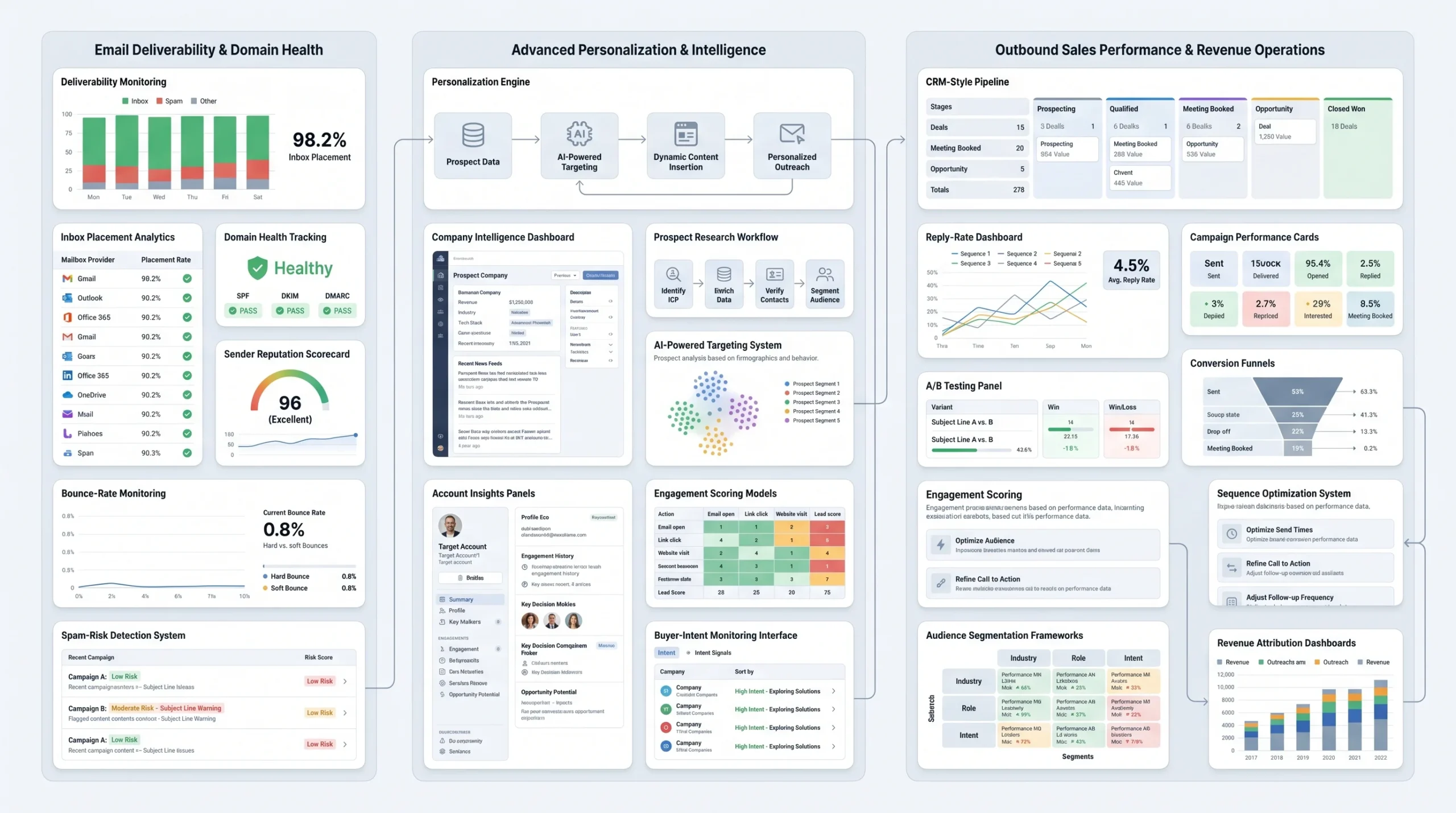
Here’s a number that should make you pause: roughly 17% of cold emails never even reach the inbox. Not ignored. Never delivered. That’s before anyone has a chance to read or ignore the thing. Domain authentication failures, high bounce rates, spam-triggering language — all of it kills deliverability before the message has a shot.
And the emails that do land? Platform-wide reply rates have dropped from 5.1% to 3.43% over the past few years. Inboxes are noisier, buyers are more skeptical, and spam filters are smarter than they used to be. Gmail and Outlook aren’t just checking whether your content looks spammy anymore. They’re evaluating how you send — your volume, your pacing, your engagement patterns. The bar to get seen has genuinely gone up.
Batch-and-blast is dead. Not dying. Dead. The math just doesn’t work anymore.
The Personalization Gap Is Widening
Here’s what’s interesting though: while average reply rates have stagnated around 1–1.5% for years, companies using AI-driven personalization at scale are pulling 2–3x that number. The gap between the top senders and everyone else keeps getting wider.
Personalized subject lines alone jump reply rates from 3% to 7% — a 133% lift measured across 5.5 million emails. Advanced personalization that connects with specific company-level pain points can push replies to 18%. That’s not a marginal improvement. That’s a different category of result.
The problem is most teams are doing “personalization” wrong. Dropping a first name and a company logo into a template isn’t personalization. Buyers can smell it immediately.
What 2026 Buyers Actually Expect from Cold Outreach
B2B buying cycles are long, involve multiple stakeholders, and require content that supports actual evaluation — not impulse. One email doesn’t close a deal. It never did, but teams seem to keep forgetting this.
What buyers actually respond to is relevance. A message that connects to something they’re actively thinking about — a problem they’re trying to solve, a change happening in their business — gets read. Everything else gets deleted in two seconds. The shift from pitch-led to value-led outreach isn’t a trend. It’s just what works.
Phase 1 — Build the Foundation (ICP, Data, and Infrastructure)
Define a Sharp Ideal Customer Profile — Not Just a Persona
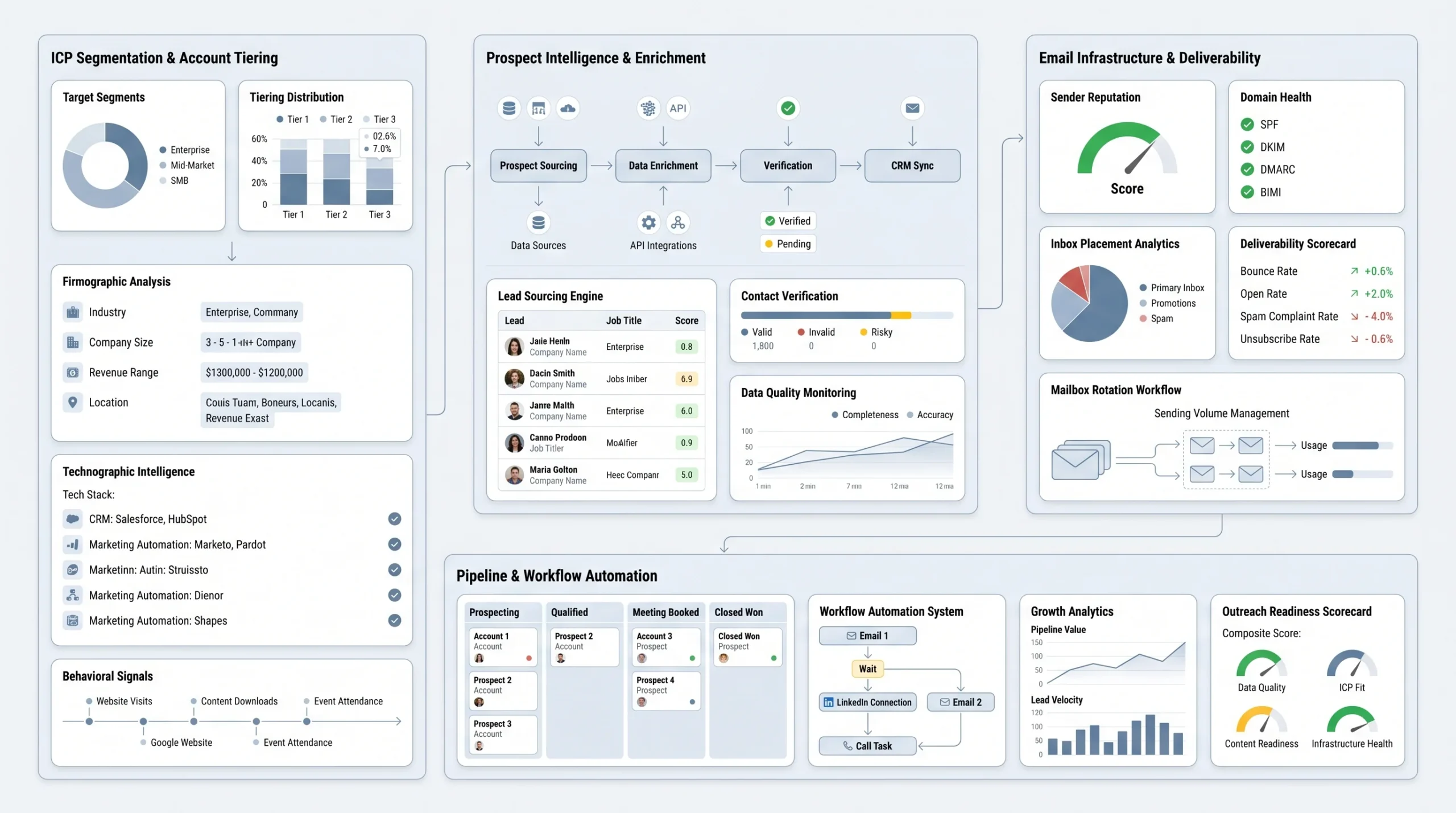
Most ICPs are too broad. “Mid-market SaaS companies with 50–500 employees” is not an ICP. That’s a universe. A real ICP layers firmographic data (company size, industry, revenue) with technographic signals (what tools they’re using, what they’ve just adopted or dropped) and behavioral indicators (hiring patterns, recent funding, expansion signals).
The reason this matters at the outreach level: the sharper the ICP, the more relevant the message can be. You can’t write a relevant email to everyone. You can write a relevant email to companies that just raised a Series B, are hiring SDRs, and are running HubSpot but not an outbound sequencing tool. That’s a real audience with a real, timely problem.
Tier your ICP by revenue potential and likely conversion rate. Tier 1 accounts deserve more manual research and more personalized outreach. Tier 3 can run through more automated sequences. Don’t treat every lead the same.
Source and Enrich High-Quality Prospect Lists
Modern B2B data platforms need to give you continuously refreshed data — not static exports from six months ago. Stale data means bounced emails, and bounced emails damage your sender reputation. Stale data is one of the most common and least-discussed reasons outreach programs underperform.
For list building: combine first-party data (your own CRM and website activity), LinkedIn research, and privacy-compliant intent signals from platforms like Apollo, ZoomInfo, or Cognism. For list verification, run a multi-provider waterfall — using four or more verification providers has been shown to drop bounce rates from 35% to under 4%. That’s not a small fix. One team that made that switch went from $100K to $300K in weekly pipeline. Not from better copy. From cleaner data.
For compliance: source ethically. GDPR and CCPA aren’t going away and, honestly, clean sourcing just produces better results anyway.
Set Up Your Technical Sending Infrastructure
This is where most teams skip steps. SPF, DKIM, and DMARC authentication are table stakes now — Gmail and Yahoo enforce DMARC, full stop. If you haven’t set these up, do it before anything else.
Beyond authentication:
- Use dedicated sending domains, not your main company domain. Protect your primary domain’s reputation by keeping cold outreach on a subdomain or a dedicated domain.
- Warm up slowly. Start at 20–30 emails per day per inbox and increase over 4–6 weeks. Sudden volume spikes are a red flag to inbox providers.
- Rotate mailboxes. Don’t send everything through one inbox. Spread volume across multiple addresses.
- Keep daily sends under 35–40 emails per mailbox. Going higher risks deliverability, especially on newer domains.
- Maintain bounce rates below 2% and spam complaint rates below 0.1%. These aren’t suggestions — inbox providers use them as hard signals.
- Run ongoing list hygiene. Remove unengaged, invalid, and bounced contacts regularly. Don’t let a dirty list drag your reputation down over time.
Phase 2 — Target With Intent, Not Just Demographics
Understand Buying Signals and Why They Change Everything
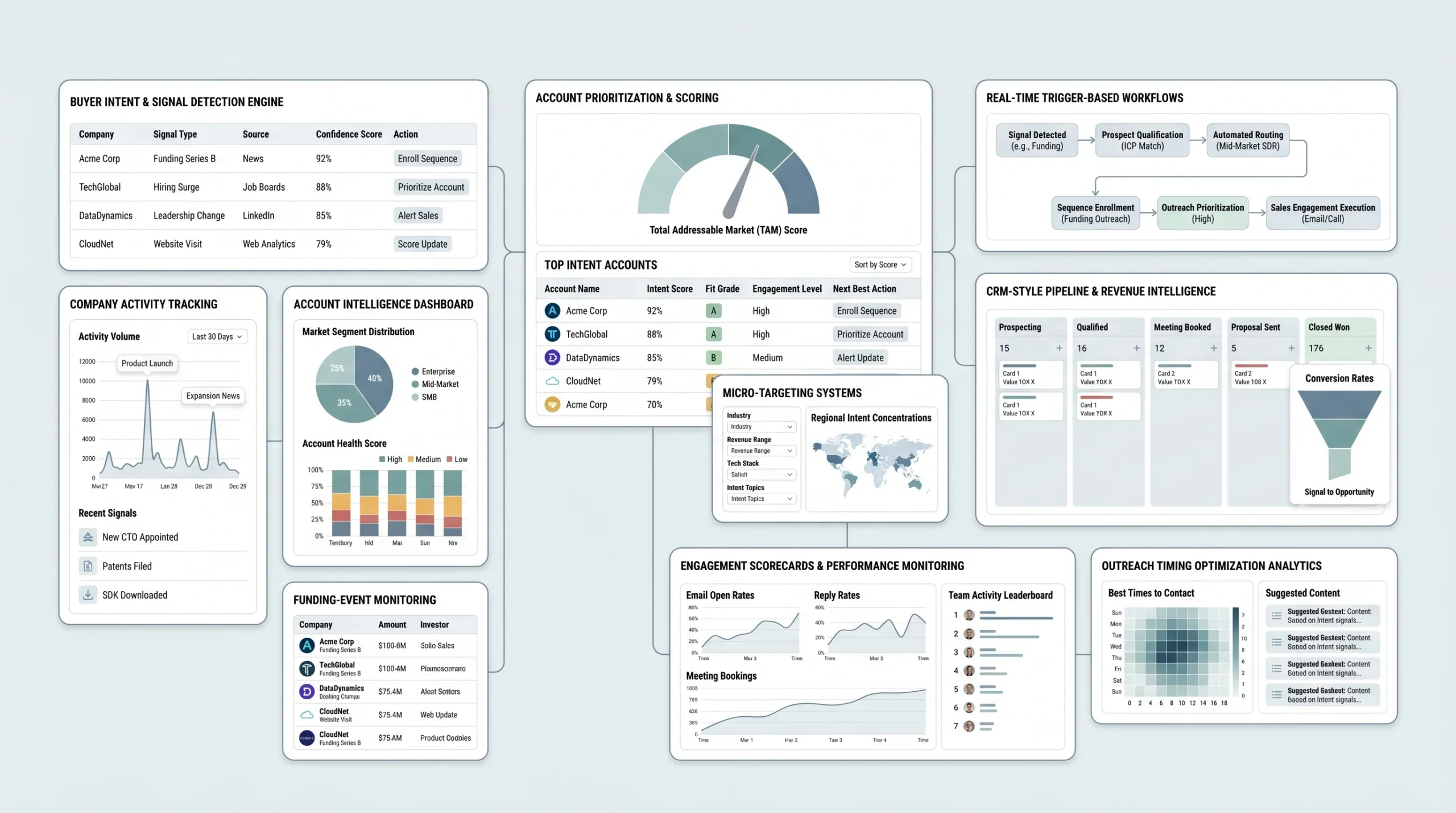
Signal-based cold emails — ones that reference a specific buying trigger like a funding round, leadership change, or technology adoption — achieve 5–18% reply rates. Compare that to the 1.5% average on generic outreach. That’s not a marginal improvement. The message lands when the buyer is already thinking about the problem you solve. Timing is a multiplier.
This is the shift most teams haven’t fully made yet. They’re still building lists based on who fits the ICP. The smarter approach is building lists based on who fits the ICP and is showing active signals right now.
Types of Signals to Monitor and Act On
Signals fall into a few buckets, and the best programs layer them:
- First-party signals: Your website visitors are the highest-quality signal you have. Pricing page visits, repeat content reads, demo page drops — these are people already thinking about the problem. Act on them fast.
- Third-party intent: Platforms like Bombora track when companies are consuming content around specific topics across thousands of sites. A Bombora surge on “outbound sales software” tells you an account is actively researching.
- Trigger events: Funding rounds, leadership changes, hiring spikes, new technology adoptions, expansions. These are operational signals that create buying windows.
One thing worth knowing: the window between “actively researching” and “vendor selected” is often 2–4 weeks for mid-market deals. If your intent data has a two-week delay and it takes another week to act on it, you’ve already missed the window. Speed matters with signal-based outreach.
Build Micro-Segmented Lists Around Signals
Campaigns under 50 recipients pull a 5.8% reply rate. Campaigns over 1,000 recipients pull 2.1%. Almost 3x difference — purely from tighter targeting, not from better copy.
The implication is clear: smaller, tighter lists outperform big broad ones every time. Build lists around specific signal clusters. “Series B SaaS companies that recently hired a VP of Sales and are running Salesforce” is a list you can write one very specific email to. “B2B tech companies 50–500 employees” is not.
Operationally, this means building a signal-to-sequence workflow. When a specific signal fires (say, a funding round hits), that account automatically enters the right sequence within 24–48 hours. Clay is one of the tools teams use to automate this kind of enrichment and routing.
Phase 3 — Write Emails That Actually Get Replies
The Anatomy of a High-Converting Cold Email
Short wins. Emails in the 50–75 word range deliver 12% reply rates among top performers. At 200+ words, you’re down to 2%. That’s a massive dropoff for something as fixable as email length.
Subject lines should be under 6 words. 2–4 words hits a 46% open rate. Specificity beats cleverness — “Outbound stack for FinTech SDRs” beats “Quick question” nine times out of ten.
The structure that works:
- Opening line: Relevance, not credentials. Reference something specific to them — a signal, a recent event, a problem in their space. Not “I came across your LinkedIn profile and was impressed.”
- Value proposition: One problem, one solution, one sentence. Don’t stack claims.
- CTA: Ask for something small. “Would it make sense to swap 15 minutes?” converts better than “Let’s schedule a full demo.” Remove friction from the ask.
Relevance Over Personalization — The Critical Distinction
“Hi [First Name], I noticed you went to [University]” is not personalization. It’s data insertion. Nobody responds to that because it signals nothing except that you pulled their LinkedIn profile.
Real relevance connects your offer to a specific, timely problem they actually have. If their job posting says they’re struggling to scale outbound, and your product fixes that, the email should say that — plainly, directly, without hype.
Competency mapping is one way to think about this: look at what someone’s role requires them to do, find where your product removes friction in that workflow, and write to that specific gap. It takes more thought than a template, but it’s what separates a 1% reply rate from a 10% one.
AI Personalization at Scale — What Works and What Doesn’t
AI personalization is the main driver of 10%+ reply rates right now. But there’s a right and wrong way to use it.
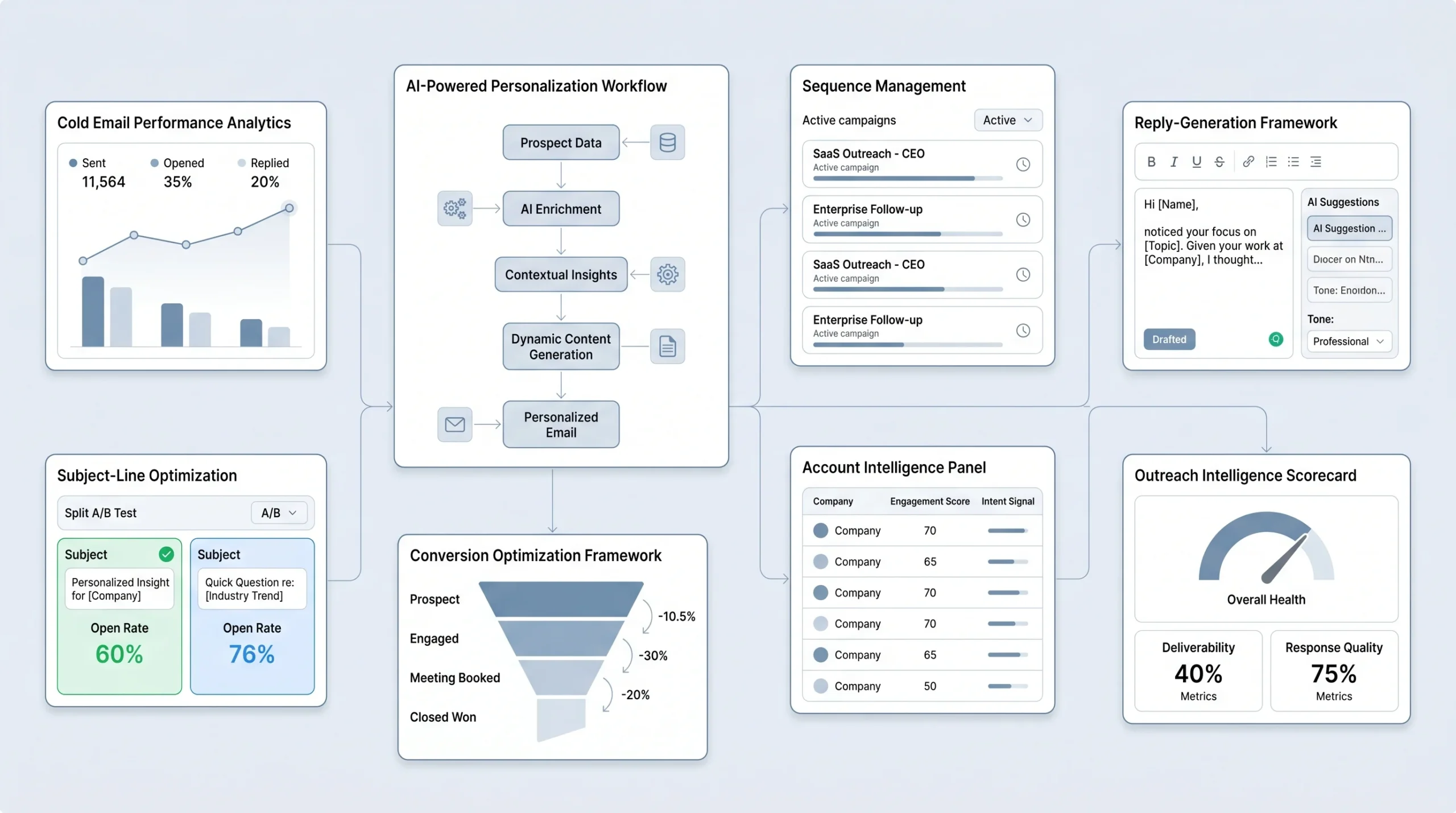
The 80/20 approach works best: template 80% of the email, and use AI to generate the personalized 20% — an opening line, a specific company reference, a pain point that maps to a signal. The templated section handles the value prop and CTA consistently. The AI-generated section makes it feel written for one person.
The failure mode is letting AI generate the whole email without QA. AI-generated emails have a texture that buyers recognize — a certain generic smoothness that reads as machine-made. Always review for authenticity before sending. If it sounds like every other cold email in their inbox, rewrite it.
Tools worth knowing: Clay for enrichment and personalization at scale, Instantly for sequence management with dynamic tokens, Smartwriter for AI-generated opening lines.
Cold Email Frameworks and Templates by Use Case
Different situations need different angles. Here are the ones that actually get replies:
- Problem-agitate-solve (PAS): Name the specific problem, show you understand why it’s painful, offer the fix. Works well for ICP audiences with a known, common pain.
- Trigger event email: Reference the signal directly. “Saw you just raised a Series A — congrats. A lot of companies at that stage run into X when scaling outbound. We help with that.” Short, relevant, timely.
- Competitor switch email: “A lot of [competitor] customers come to us when they hit [specific limitation].” Works when you have real differentiation to reference.
- Social proof email: Lead with a result from a similar company. “We helped [similar company] book 40 meetings in the first 60 days. Here’s what we did.” Proof beats promises.
- Short ask re-engagement: For sequences that haven’t gotten a reply — one short sentence asking if the timing’s off, nothing else. Often gets replies from people who were interested but got busy.
Phase 4 — Build Sequences That Nurture Without Annoying
How Many Touches, and How Far Apart
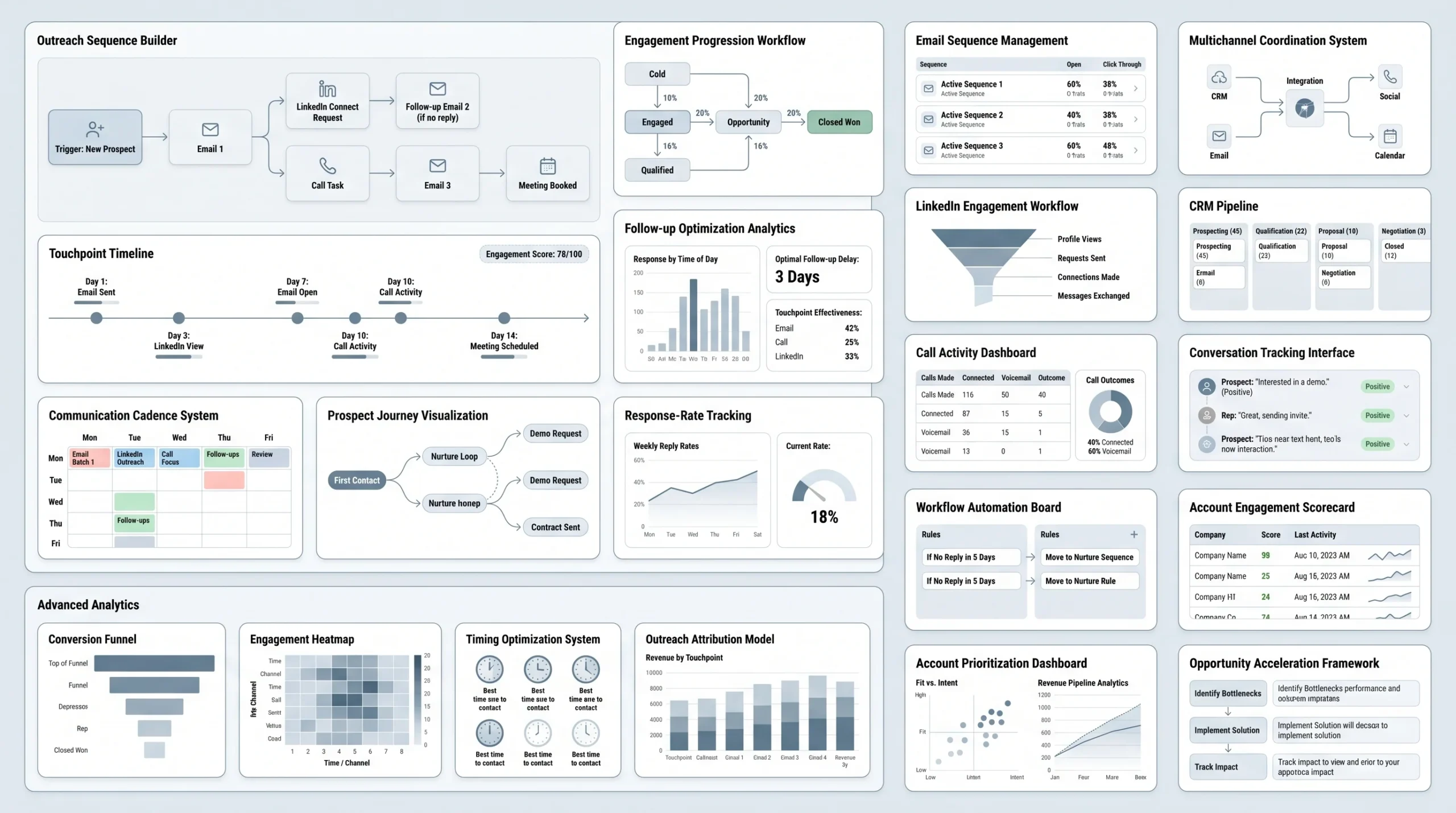
The data on this is pretty clear. Optimal sequence length is 4–6 touches. 48% of reps never send a second email — leaving real replies on the table. But stacking too many follow-ups creates its own problem: spam complaint rates jump from 0.5% on email one to 1.6% by email four. Front-load the value.
Your first email gets 58% of all replies. So yes, it matters most. But the sequence matters too — just with diminishing returns.
For timing: emails sent Tuesday through Thursday, between 8–10 AM local time, consistently outperform other windows. For follow-up spacing, a cadence of Day 1, Day 3–4, Day 7–10, Day 14 gives enough breathing room without going cold.
For shorter plays — targeting high-signal accounts where speed matters — three emails works well: initial, follow-up at 3 days, final at 6–7 days.
Write Follow-Ups That Add Value, Not Just Pressure
“Just bumping this up” is not a follow-up. It’s noise. Every follow-up needs to earn its place in the inbox with something new — a different angle, a new piece of evidence, a question that opens a different door.
Well-timed, value-driven follow-ups can push reply rates past 20%. That’s not from pestering people. It’s from giving them multiple relevant reasons to respond.
The breakup email — a short, genuine “I won’t reach out again after this” message — often gets the most replies of any touchpoint in a sequence. It removes pressure, and it gives fence-sitters a low-stakes moment to respond.
Multi-Channel Sequencing — Email + LinkedIn + Phone
Multi-channel campaigns combining cold email with LinkedIn touchpoints generate 2–3x more positive replies than single-channel email. That number alone should change how sequences are built.
The coordination matters though. LinkedIn connection requests, profile views, message follow-ups — these should be timed around the email sequence, not scattered randomly. A prospect who sees your LinkedIn activity, then gets a relevant email, then gets a LinkedIn message has a coherent experience. It feels like intentional outreach, not spam from multiple angles.
For C-level and VP targets: 57% favor phone calls. Email gets the conversation started. The phone closes it. Build your cadence to include a call touchpoint, especially for Tier 1 accounts.
Phase 5 — Optimize Deliverability as an Ongoing System
Inbox Placement vs. Open Rates — What to Actually Track
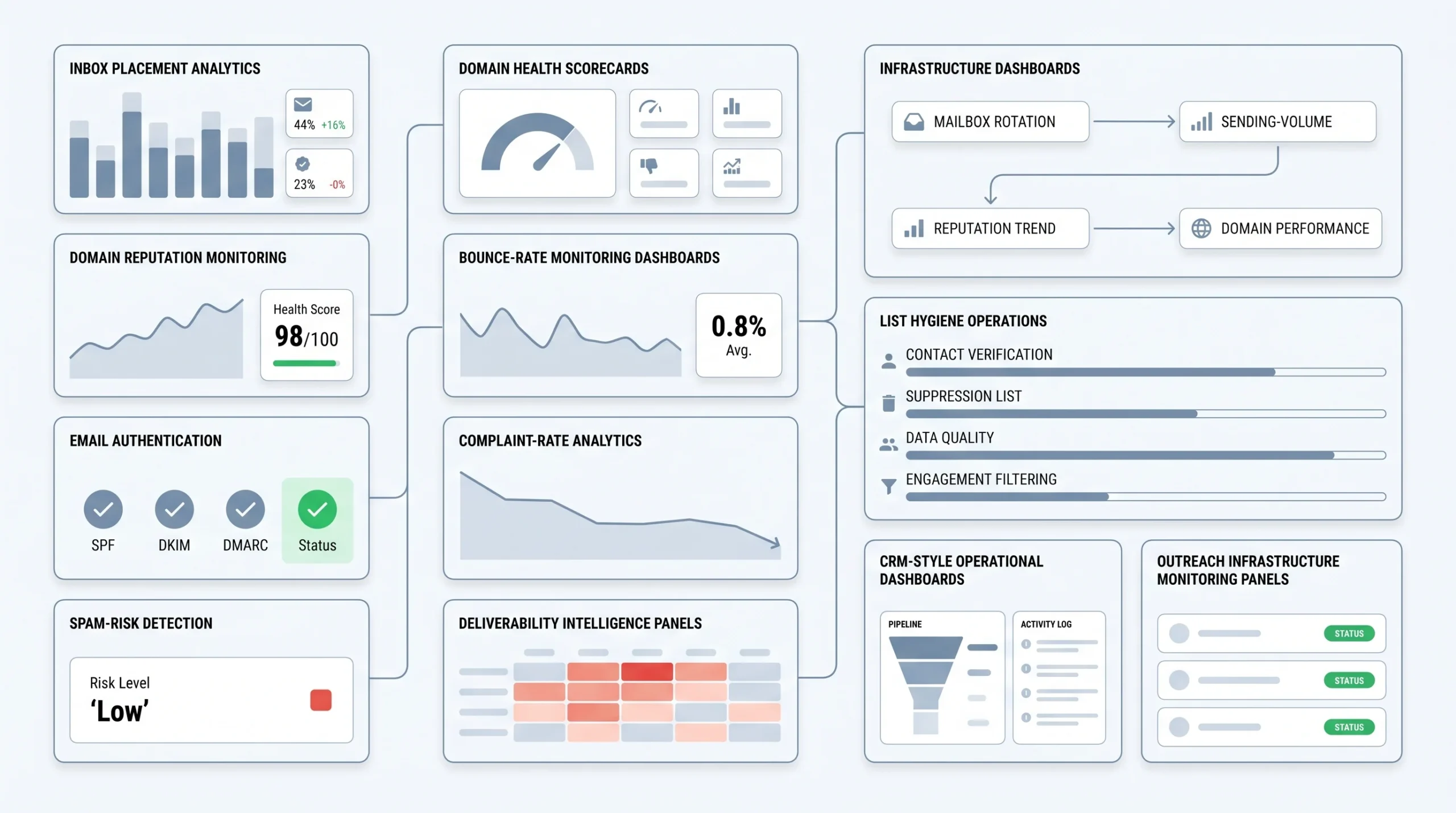
Open rates are unreliable. Apple’s Mail Privacy Protection fires open pixels automatically, regardless of whether someone actually opened the email. Tracking opens from iOS devices is basically noise at this point.
More importantly: open tracking pixels cost real replies. One large-scale test showed removing open-tracking pixels increased reply rates by roughly 3%. Deliverability fixes like this commonly raise reply rates 10–30% relative to baseline. That’s a bigger lever than most teams realize.
Track what matters: reply rate, positive reply rate, bounce rate, and spam complaint rate. These tell you what’s actually happening.
Domain Health Maintenance
Domain reputation is a slow-moving but high-stakes variable. It builds over months and can collapse in days if something goes wrong.
Monitor reputation through Google Postmaster Tools. Watch domain reputation scores, spam rate, and authentication pass rates. Set up alerts for anything that drops unexpectedly. Rotate sending domains and mailboxes as volume scales — no single domain should be carrying disproportionate load.
The early signs of domain burnout are subtle: slight drops in open rates, reply rates creeping down, increasing bounce rates. By the time you’re in spam folders, the damage takes months to reverse. Catch it early.
List Hygiene as a Continuous Process
List hygiene isn’t a one-time project. It’s ongoing maintenance. Re-verify lists before every major send. Remove anyone who hasn’t engaged in 90+ days. Keep suppression lists updated and consistent across all tools in your stack. Handle unsubscribes immediately and reliably — both for compliance and for sender reputation.
The math is simple: sending to 5,000 clean addresses beats sending to 10,000 messy ones. Smaller, cleaner lists outperform bigger, messier ones every time.
Phase 6 — Measure, Test, and Scale What Works
The Metrics That Actually Predict Pipeline
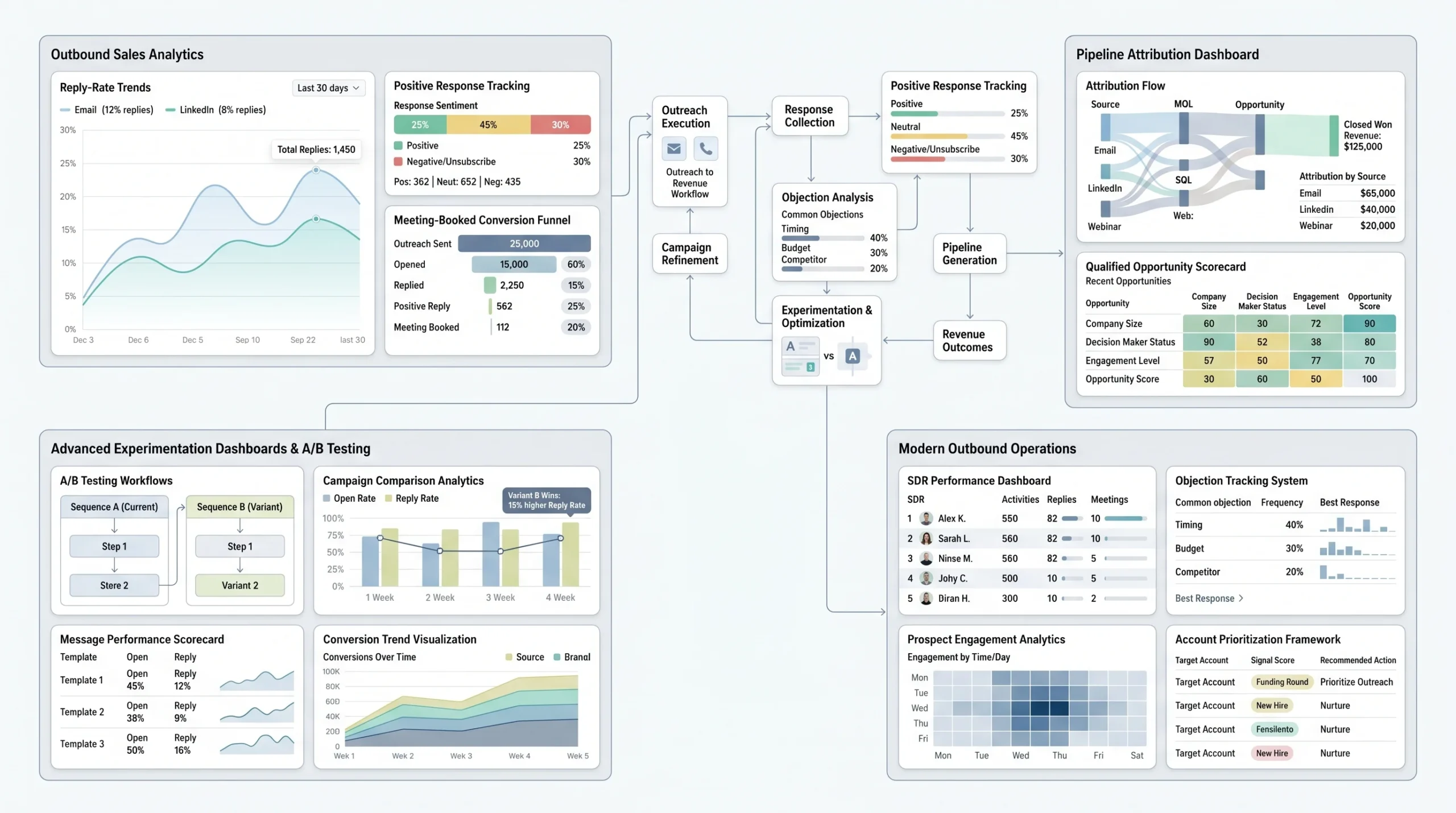
Reply rate is the headline number, but positive reply rate tells a more useful story. You can get replies that are negative or out-of-office — those don’t build pipeline. Positive reply rate (interested responses, meeting requests, “tell me more”) is what actually moves deals.
Track all three of these consistently: reply rate, positive reply rate, and meeting-booked rate. From there, cost per meeting and cost per qualified opportunity tie the outreach program to business outcomes. These are the numbers that justify the investment and guide where to put more resources.
A/B Testing That Moves the Needle
Test in order of impact: subject line first, then opening line, then CTA, then email length, then send time. Don’t touch all of them at once. Changing multiple variables in one test tells you nothing useful.
For statistical validity at cold email volumes — which are typically lower than marketing email volumes — you need a few hundred sends per variant before drawing conclusions. Ending tests after 50 sends per variant is how people convince themselves of things that aren’t true.
Common mistakes: testing too many variables simultaneously, switching off a test too early, or testing things that don’t actually affect conversion (like whether to sign off with “Best” vs “Thanks”).
Scaling Without Sacrificing Quality
There’s a sequence to scaling outbound correctly: first, improve conversion on existing volume. Then add infrastructure to handle more volume. Teams that add sending infrastructure before they’ve figured out what works just scale bad results faster.
Document what’s working. When a specific trigger event + angle combination is pulling a 12% reply rate, write it down, build it into a repeatable playbook, and train the team on it. The highest-leverage thing a sales leader can do is turn one rep’s working formula into a system everyone uses.
Build a feedback loop between replies, objections, and messaging. The most common objections are telling you something — either about your positioning, your targeting, or the timing of the outreach. Track them. Let them inform the next iteration.
Managing the SDR Function for Outbound Performance
SDRs need to be coached on signal identification, not just call scripts. If they can’t read a company’s job postings, recent funding news, and tech stack and connect those to a relevant value prop, the personalization work upstream doesn’t matter — the email still sounds generic.
Track objections systematically. Build a shared objection log — what comes up, how often, at what stage. This data is gold for improving positioning and copy.
On the automation question: automate the routing, enrichment, and scheduling. Keep humans involved in the personalization review and the high-value account strategy. AI doesn’t replace the judgment call on which angle to take with a Tier 1 account. It handles the volume work underneath.
Cold Email Compliance in 2026 — What You Need to Know
CAN-SPAM, GDPR, and CASL — The Rules That Apply
CAN-SPAM applies to US recipients and requires honest subject lines, a physical address, and an easy opt-out mechanism that gets honored within 10 business days. GDPR applies to EU residents and requires a lawful basis for processing — for B2B cold outreach, “legitimate interest” is the most commonly used, but it has specific requirements around necessity and balancing tests. CASL (Canada) is stricter — it generally requires implied or express consent before commercial electronic messages.
The basics across all of them: don’t deceive in subject lines, honor opt-outs immediately, keep accurate records of consent and sourcing, and don’t buy lists from shady sources.
If targeting across multiple geographies, get legal review on your specific setup. The rules differ enough that a one-size-fits-all approach creates risk.
Compliance as a Deliverability Asset
Here’s the thing about compliance that most people miss: clean compliance practices directly improve deliverability. Proper opt-out handling reduces complaints. Accurate contact sourcing reduces bounces. Both of these protect sender reputation.
The plain-text vs. HTML debate also has a compliance angle. Plain-text emails are less likely to trigger spam filters, can’t have invisible tracking pixels, and — frankly — often perform better for cold outreach anyway. They look like real emails from a real person. HTML-heavy emails with logos and banners look like marketing.
Tools and Tech Stack for B2B Email Outreach at Scale
Core Categories You Need Covered
A working outbound stack covers five functional areas. Skip one and something breaks:
- Data and enrichment: Clay, Apollo, ZoomInfo, Cognism. These give you contact data, firmographic signals, technographic data, and intent. Clay is particularly useful for building enrichment workflows that pull from multiple sources.
- Email infrastructure: Mailforge, Instantly, Smartlead handle domain and mailbox management, warming, and rotation at scale.
- Deliverability monitoring: MailReach, GlockApps, and Warmup Inbox test inbox placement, monitor domain health, and flag issues before they become disasters.
- Personalization at scale: Clay (again), Smartwriter, Autobound — these generate personalized opening lines and context using AI, pulling from company signals.
- CRM and sequencing: HubSpot, Salesforce, Outreach, Salesloft. These handle the actual send management, activity logging, and pipeline tracking.
How to Build a Stack by Team Size
Stack size should match team size. Bigger isn’t better if the team can’t use the tools.
- Solo SDR or small team (1–3 people): Apollo or Instantly for everything in one place, MailReach for deliverability, HubSpot for CRM. 3–5 tools is enough.
- Mid-size outbound team (4–10 SDRs): Add Clay for enrichment, Smartwriter or Autobound for AI personalization, Smartlead for multi-mailbox management, and your CRM of choice. 8–12 tools with cleaner handoffs between them.
- Agency or high-volume operation (10+ people, multiple client domains): Full orchestration layer — 15+ specialized tools covering data sourcing, multi-provider verification, personalization, multi-channel sequencing, and CRM integration. At this scale, the number of tools in the stack has a measurable effect on results. Orchestrating 35+ specialized tools is achievable but requires a systems-minded operator to manage it.
Conclusion
Cold email isn’t broken. The way most teams do it is.
The difference between a 3% reply rate and a 15% reply rate isn’t a secret formula or a bigger sending budget. It’s sharper targeting, cleaner infrastructure, messages that actually connect to something real, and sequences that respect the buyer’s time. Every piece of this guide exists on that axis — remove the friction, add the relevance, build the system that compounds over time.
The teams pulling the best numbers right now aren’t doing anything exotic. They’re just doing the fundamentals better than everyone else. Clean data. Proper domain setup. Tight ICPs. Signals-first targeting. Short, specific emails. Follow-ups that earn a response instead of demanding one.
Pick one phase from this guide that’s clearly broken in your current setup and fix it this week. Not all six phases at once — that’s how nothing gets done. Deliverability, targeting, copy, sequences, compliance, tooling — one thing, done properly, compounds fast. Start there.
Frequently Asked Questions
What is a good cold email reply rate in 2026?
Above 5% is solid. 8–12% means the targeting and personalization are working well. The industry average sits at 3.43%, so anything above that is ahead of the field. Under 1% signals something foundational is broken — usually deliverability or targeting.
How many cold emails should I send per day?
No more than 35–40 per mailbox per day. If you need more volume, add mailboxes — don’t push single mailboxes past their limit.
Does cold email still work for B2B?
Yeah, clearly. The teams complaining it doesn’t work are the ones still sending generic templates. Signal-based, personalized outreach with good infrastructure consistently produces meetings. It’s harder than it used to be, but the ROI is still there.
What’s the difference between cold email and email marketing?
Email marketing goes to opted-in subscribers — newsletters, product updates, nurture sequences. Cold email is prospecting outreach to people who haven’t engaged with you before. Different rules, different tools, different metrics.
How do I avoid the spam folder?
Authenticate properly (SPF, DKIM, DMARC), warm up your domain gradually, keep bounce rates below 2%, remove open-tracking pixels, and maintain a clean list. Spam folder placement is usually an infrastructure problem, not a content problem.
Is cold emailing legal?
In most jurisdictions, yes — with conditions. CAN-SPAM (US), GDPR (EU), and CASL (Canada) each have specific requirements. For B2B outreach, legitimate interest under GDPR is commonly used. Get legal advice for your specific situation, especially if targeting across multiple geographies.