


Here is a number that should stop you mid-scroll: C-level executives actually respond 23% more often than non-C-suite employees. Yet 98% of cold emails to executives go unanswered. Read that again. The executives are more responsive — the outreach is just that bad.
The problem is not access. It is execution. Most B2B sales teams treat executive outreach like a volume game — blast enough emails, book enough calls, and eventually someone bites. That logic works when you’re selling to mid-level managers with 40 emails in their inbox. It collapses completely when you’re trying to reach a CFO who has seen every pitch angle imaginable and has an executive assistant filtering everything that lands in her calendar.
Reaching C-suite decision makers is a two-part challenge, and most teams only solve for one of them. The first part is qualification — figuring out which executives are actually worth your time, at what company, with what budget authority, and with what urgency. The second part is outreach — getting your message in front of them, through the right channel, with the right framing, at the right moment in their decision cycle. Solve only one of these and you either pursue the wrong people efficiently or pursue the right people ineffectively. Both outcomes waste pipeline.
This guide is built for SDRs, AEs, and demand gen teams who are selling into enterprise accounts and need a repeatable system — not a list of hacks. Every section covers both the why and the how, and every claim is backed by data. By the end, you will have a complete framework for identifying which executives to target, qualifying whether they are worth pursuing, and executing the multi-channel outreach strategy that actually gets responses.
Understanding the C-Suite Buyer — Who You’re Actually Selling To
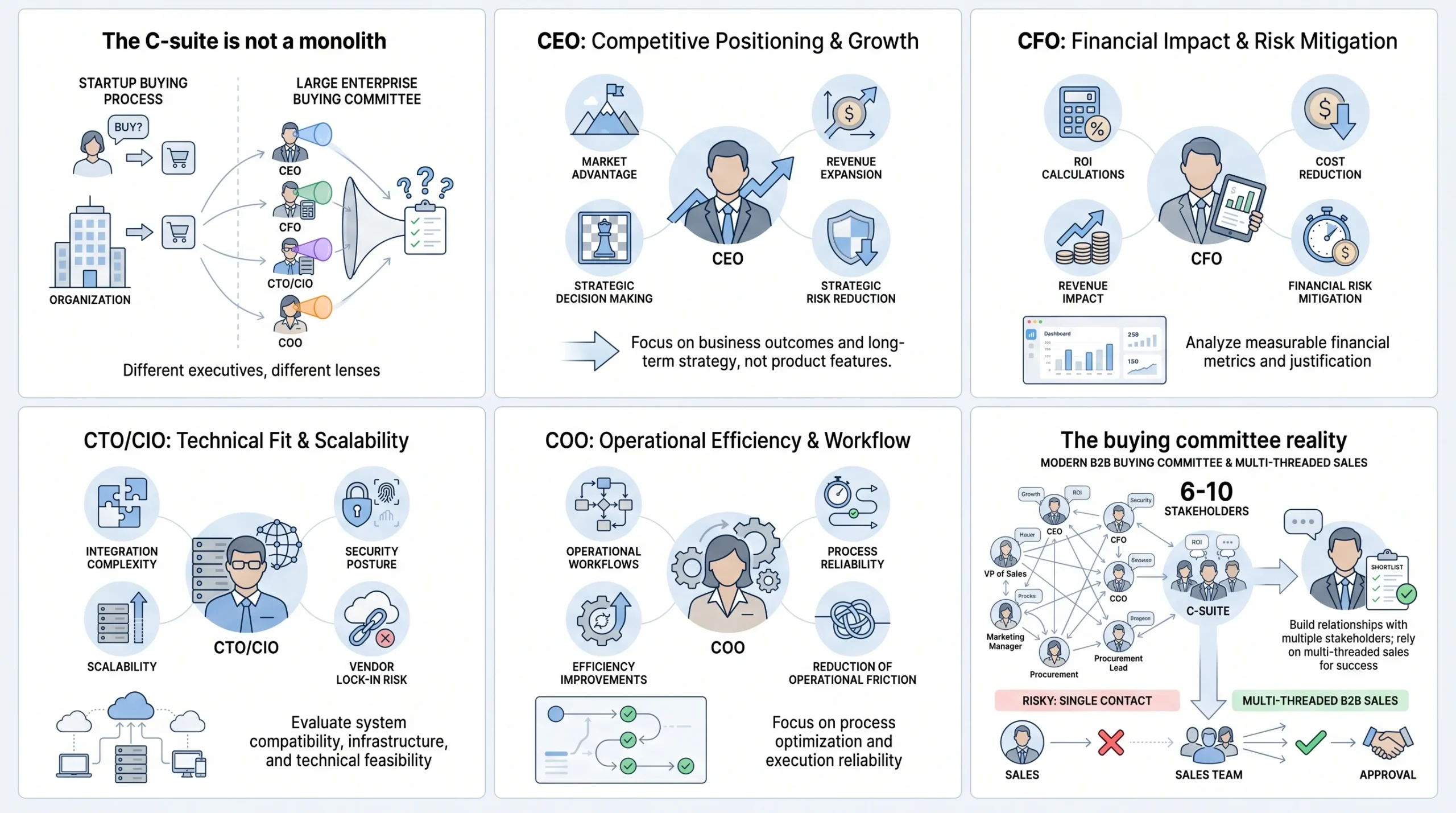
Before you write a single email or pick up the phone, you need to understand who you are selling to. “C-suite” is not a monolith. The way a CEO thinks about a purchasing decision is fundamentally different from the way a CFO does — and pitching both of them with the same message is one of the most common and costly mistakes in B2B sales.
The C-Suite Is Not a Monolith
Decision makers exist across different levels of an organization — C-level executives, department heads, and business owners — and their authority varies depending on company size and structure. In a 50-person Series B startup, the CEO might approve every vendor contract. In a 5,000-person enterprise, procurement and legal have as much say as the executive sponsor.
What stays consistent, regardless of company size, is that each executive role has its own lens. Generic messages that could apply to any executive at any company get deleted. Specific messages that address role-based priorities get responses. That is not an opinion — it is a documented pattern from analysis of millions of cold email campaigns.
Here is how each of the four most common C-suite targets actually thinks:
- CEO — The CEO cares about competitive positioning, revenue growth, and strategic risk. She is not the person to pitch on features or implementation timelines. She wants to know if your solution gives her company an edge, reduces exposure to a meaningful risk, or opens a new market. Lead with business outcomes, not product capabilities.
- CFO — The CFO needs a number. Not a range, not an estimate — a defensible ROI figure with a clear payback period. He is responsible for saying no to things that do not generate measurable returns, so your pitch needs to give him ammunition to say yes. Cost reduction, revenue impact, risk mitigation: these are his three filters.
- CTO / CIO — The CTO evaluates your solution through the lens of her existing architecture. Integration complexity, security posture, scalability under load, and vendor lock-in risk are the questions she is asking before you even finish your first sentence. Leading with “easy to integrate” without specifics will lose her immediately.
- COO — The COO is focused on execution. Does your solution reduce operational friction, improve process reliability, or eliminate headcount dependency? He thinks in workflows, not features. Show him what changes in the day-to-day operation of his team.
The Buying Committee Reality
This is the part that kills more deals than any other factor. Decisions at the enterprise level involve 6–10 people on average. Each stakeholder has different priorities, so messaging must be tailored — CFO concerns, CTO requirements, and operations needs addressed separately.
More importantly: over half of B2B buying groups (53%) have at least one C-suite executive involved in the decision. Notice the phrasing — “involved,” not “initiating.” The C-suite executive is often not the person who found your product, requested the demo, or runs the evaluation. She is the person who reviews the shortlist at the end and either signs the check or kills the deal.
That means qualifying one contact is never enough. If you only have a relationship with the VP of Operations and the CFO has never heard of you, you are one internal meeting away from losing a deal you thought was closed. Mapping the full buying committee before your first outreach is not extra work — it is the work.
Step 1 — Build Your Executive Ideal Customer Profile (ICP)
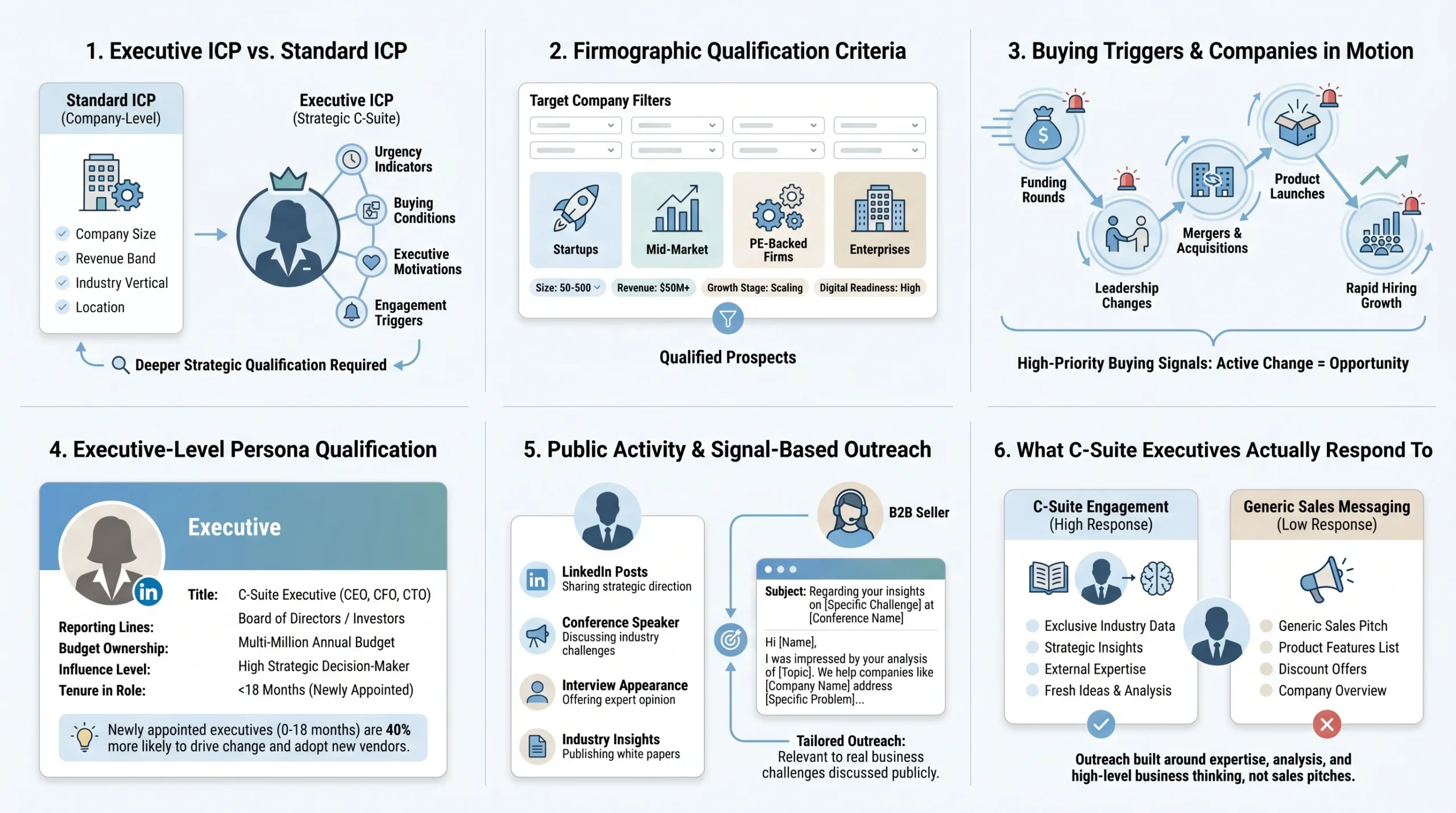
An ICP for executive outreach is different from a standard ICP. You are not just describing the company — you are describing the conditions under which a C-suite executive is likely to engage, prioritize, and move fast. Those conditions are specific, and getting them right is what separates a 2% response rate from a 15% one.
Firmographic Qualification Criteria
Start with the company, then drill into the executive. The firmographic layer filters out accounts that will never convert regardless of how good your outreach is.
- Company size and revenue band — Know your sweet spot. If your solution is priced for $50M+ ARR companies, do not spend time on Series A startups. If you sell to mid-market, do not chase Fortune 100 procurement processes you cannot support.
- Industry vertical — Some verticals move faster, have more standardized budgets, and have clearer pain patterns. Know which industries convert for your product and weight your prospecting accordingly.
- Growth stage — Series B and beyond, PE-backed companies preparing for exit, and enterprises in digital transformation cycles are different buying environments with different urgency levels.
- Buying triggers — New funding rounds, executive leadership changes, M&A activity, product launches, and headcount growth are all signals that a company is in motion. Companies in motion buy things. Companies at steady-state usually do not.
Get involved earlier in their research process before they form preferences. Build visibility months before they are actively evaluating vendors. By the time a C-suite executive opens a formal vendor evaluation, she has usually already formed opinions — often before talking to a single sales rep.
Executive-Level Persona Criteria
Once you have qualified the account, qualify the individual.
- Title and seniority — “VP” at a 20-person company is different from “VP” at a 10,000-person one. Look at reporting lines, not just titles.
- Direct budget ownership vs. influence — An executive who influences purchasing decisions but does not control budget is a champion, not an economic buyer. Both matter, but do not confuse them.
- Tenure in role — Executives in the first 18 months of a new role are significantly more likely to make changes. They have a mandate, they are not yet locked into legacy vendor relationships, and they need wins. This is one of the highest-signal buying triggers in enterprise sales.
- Recent public activity — An executive who published a LinkedIn post about a challenge your product solves has just told you exactly what to say. Executives who speak at industry events, publish thought leadership, or give media interviews are more likely to be open to outside ideas.
C-suite executives are very responsive to content from sources they perceive as experts in their industries, especially exclusive data and analysis. Research from surveys of over 1,300 global C-suite executives found that they thrive on “fresh ideas from outside their companies” — and specifically want to be told things they cannot get from their own people. That is the bar your outreach needs to clear.
Step 2 — Choose the Right Qualification Framework for Executive Deals
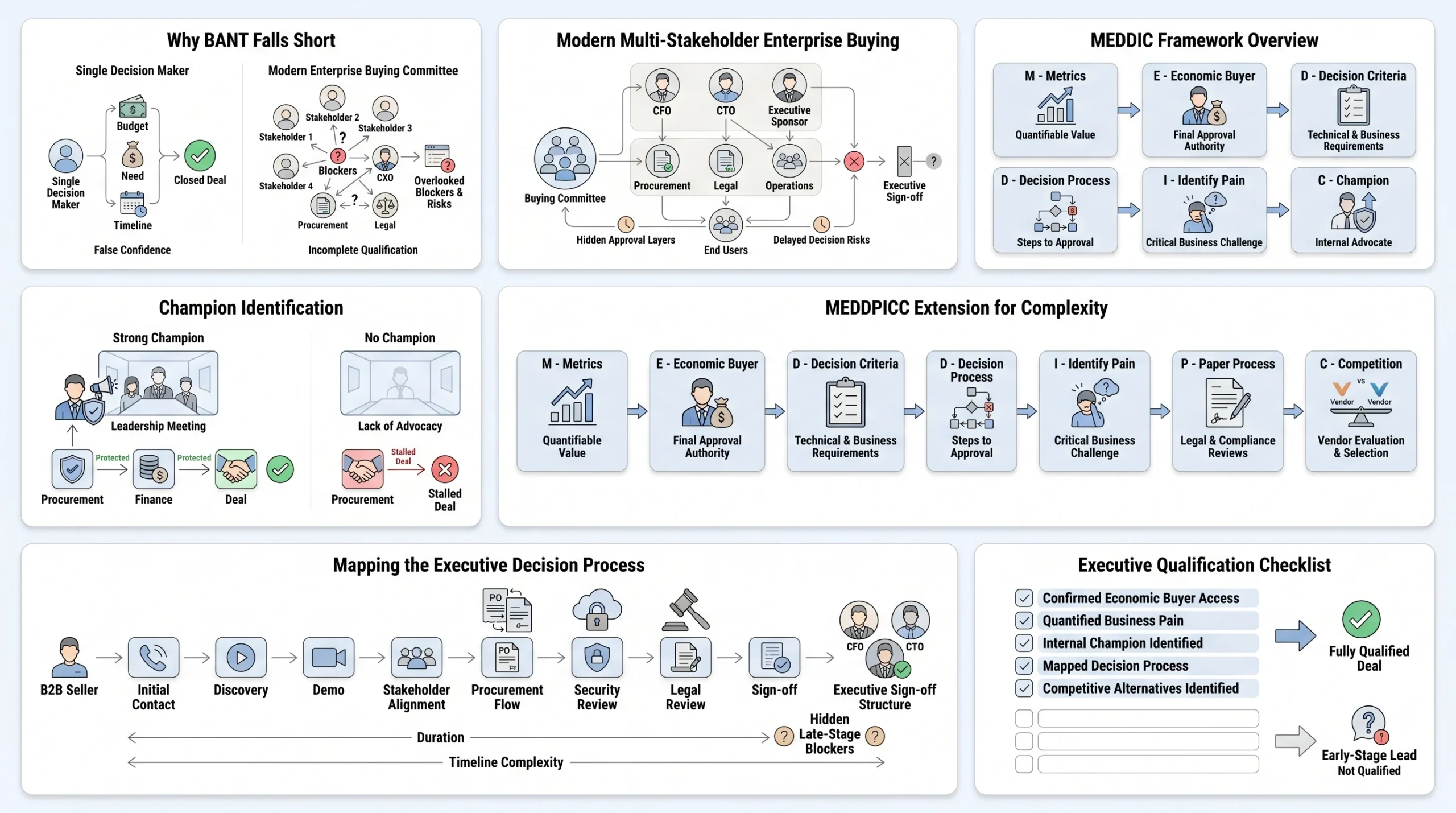
Not all qualification frameworks are built for executive-level, multi-stakeholder deals. Using the wrong one does not just produce bad results — it actively misleads your pipeline by creating false confidence in deals that will stall or die at final approval.
Why BANT Falls Short for C-Suite Sales
BANT (Budget, Authority, Need, Timeline) is the most commonly used qualification framework in B2B sales, and it works well in narrow contexts. For C-suite outreach, it has two structural problems that undermine it.
First: BANT assumes there is a single decision maker, but in modern B2B sales, buying committees often involve multiple stakeholders — resulting in missed opportunities or delayed deals. If you qualify “authority” by confirming that one executive can say yes, and you have not mapped the other 7 people who can say no, you have not actually qualified authority.
Second: Budget is a lagging indicator. In most enterprise deals, budget is not allocated at the start of the process — it is created when a compelling enough problem justifies spending. Asking “Do you have budget?” in the first conversation with a C-suite executive does not tell you whether they will find budget. It only tells you whether they have already started the procurement process, which is rarely the case in outbound-initiated deals.
MEDDIC — The Executive-Grade Qualification Framework
MEDDIC was built for exactly the kind of deal that BANT cannot handle: multi-stakeholder, long-cycle, high-ACV enterprise sales. Each element addresses a specific failure point in complex deals.
- Metrics — What measurable business outcome does the prospect expect? Revenue increase, cost reduction, time saved? If you cannot quantify the value in their terms, you cannot build a business case.
- Economic Buyer — Who has final authority over the budget? This is the person MEDDIC calls out specifically — not just any stakeholder, but the person whose signature closes the deal.
- Decision Criteria — What standards will the prospect use to evaluate vendors? Price, integration, support SLAs, security certifications? Knowing this shapes every conversation.
- Decision Process — How does approval actually work? Who presents to whom? Is there a procurement review? A security questionnaire? A legal review? If you do not map this, you will be surprised by a 6-week procurement delay after you thought the deal was done.
- Identify Pain — What is the urgent, quantified business problem that makes your solution a priority right now? Not a nice-to-have — a problem with a cost to not solving it.
- Champion — Who inside the account will carry your solution internally, advocate for it in rooms you are not in, and protect it when the CFO pushes back?
Champion identification is the element most teams underinvest in. Deals with fewer than three active internal advocates are significantly more likely to stall at final approval stages. A single champion who loses internal credibility or leaves the company can kill a deal that was weeks from closing.
MEDDPICC for Complex Enterprise Outreach
MEDDPICC extends MEDDIC with two additional elements that address the most common late-stage failure points in enterprise deals.
- Paper Process — The procurement, legal, and compliance steps required to execute the contract. In regulated industries, this alone can add months to a deal cycle.
- Competition — Who else are they evaluating, and what is your differentiated position against each alternative?
MEDDPICC evaluates eight elements in total and is designed for deals with multiple stakeholders, long sales cycles, procurement complexity, and competitive evaluations. For enterprise deals above $200K with 6+ month cycles and formal procurement, MEDDPICC is worth the training investment — not just the time to fill in a CRM field, but the skill to surface the answers through real discovery conversations.
Practical Qualification Checklist for Executive Targets
Before moving any executive target from “prospect” to “active opportunity,” run through this checklist:
- Is there a confirmed economic buyer you have directly accessed — not just been told about?
- Is the pain articulated in quantified business terms (revenue impact, cost, risk exposure)?
- Is there an internal champion with organizational influence and a personal motivation to solve this problem?
- Has the decision process been mapped — who approves, in what sequence, with what criteria?
- Have you identified the competitive alternatives they are considering?
If you cannot answer yes to all five, you have an early-stage lead, not a qualified opportunity.
Step 3 — Research and Prequalification Before First Contact
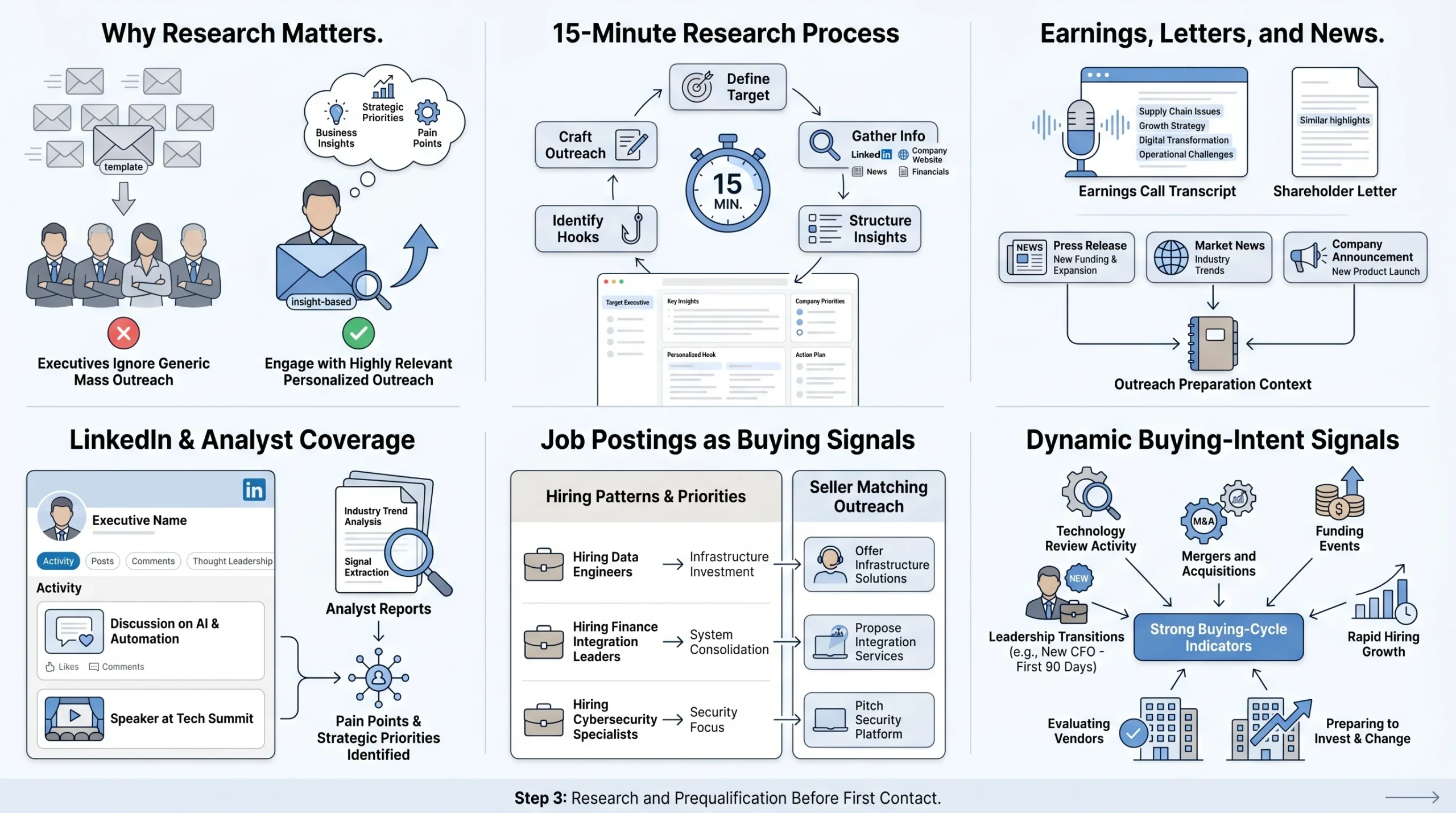
The research phase is where most teams rush or skip entirely. That is exactly why 90% of salespeople fail when selling to the C-suite — not because executives are inaccessible, but because the emails executives actually receive are generic templates with a first name swapped in. Reaching C-suite decision makers requires more effort upfront, but the payoff per email is dramatically higher.
The 15-Minute Executive Research Process
Fifteen minutes per prospect is enough time to produce outreach that is meaningfully different from what everyone else sends. The key is knowing where to look.
- Earnings calls and shareholder letters (for public companies) — These are the closest thing to a CEO reading you his priorities out loud. If the last earnings call mentioned supply chain pressure four times, you know what the COO is losing sleep over.
- LinkedIn posts and activity — What has the executive published or engaged with in the last 90 days? What questions is she asking in comments? What content is she sharing?
- Company press releases and news — New product launches, market expansions, partnership announcements, and leadership changes all signal where the company is investing and what problems they are trying to solve.
- Industry analyst coverage — What are analysts saying about this company’s sector? If there is a macro challenge that affects the whole vertical, every executive in that space is thinking about it.
- Job postings — A company hiring five data engineers is building a data infrastructure. A company hiring a Chief Risk Officer is dealing with a risk problem. Job postings tell you what is broken or growing, often before any press release does.
Intent Signals That Indicate Executive Readiness
Beyond static research, look for dynamic signals that indicate a company is in a buying cycle right now.
- Technology review signals — Traffic spikes to review sites like G2 or Capterra, or activity on technology comparison communities, indicate someone inside the company is actively evaluating vendors.
- Hiring patterns — A company bringing on SDRs at volume is investing in outbound. A company hiring a Head of Finance Integration is consolidating financial systems. Match your solution to the signal.
- Leadership transitions — A new CFO in the first 90 days is in a mandate window. She needs to demonstrate judgment and impact. If your solution helps her do that, timing is everything.
- Funding events and M&A activity — A Series C close means capital is available and the board is expecting growth infrastructure. An acquisition means two technology stacks that need to be reconciled.
Step 4 — Multi-Channel Outreach Strategy to Actually Reach Executives
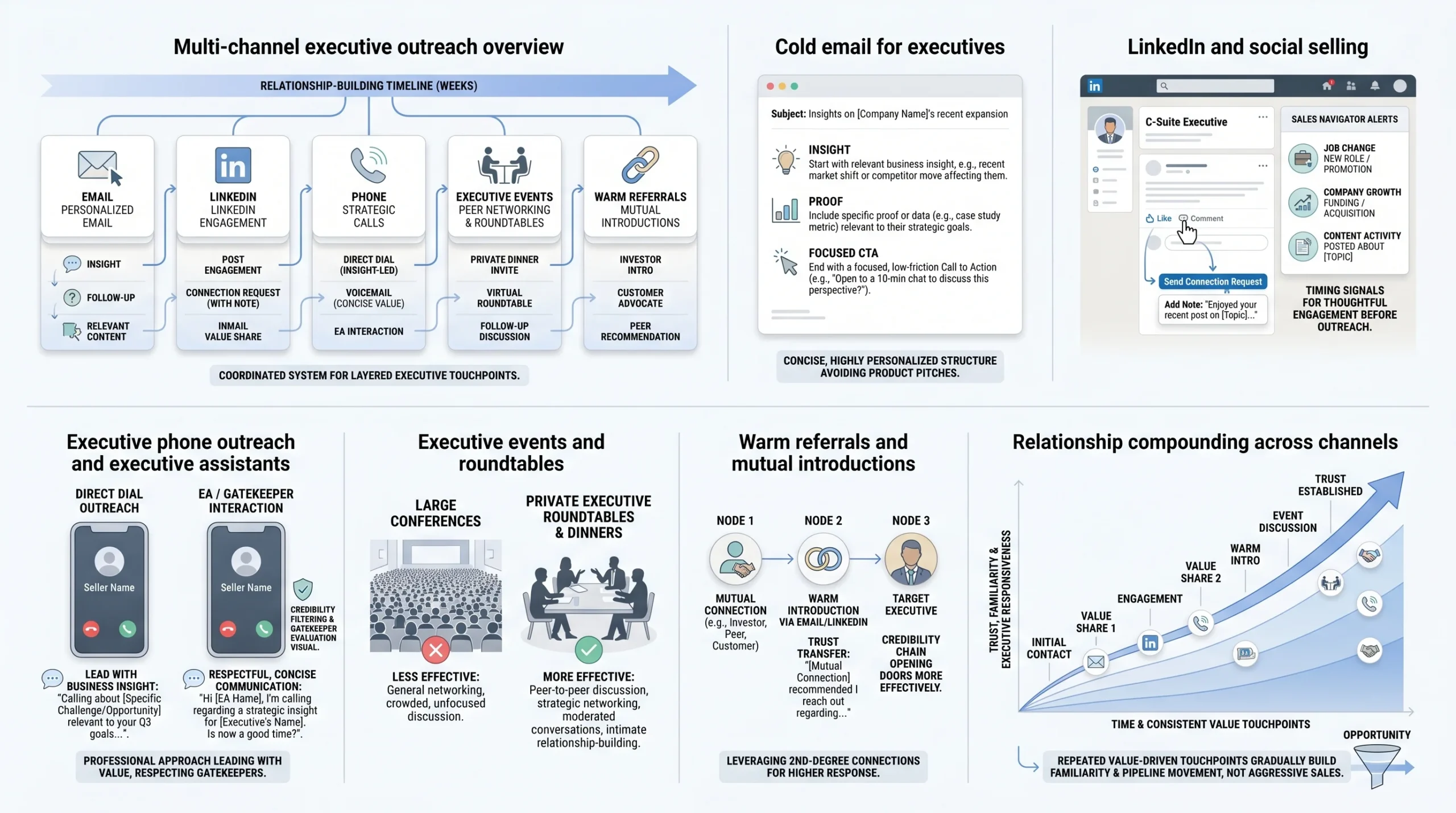
Single-channel outreach to executives does not work. Not because executives are harder to reach, but because a single touchpoint from an unknown sender carries almost no weight. Most successful engagements happen after 5–8 touchpoints across different channels over 6–12 weeks. The key is adding new value with each touchpoint rather than repeating the same message with different subject lines.
Channel 1 — Cold Email (When Done Right)
Cold email to executives works — but the bar is high. C-level executives respond to 6.4% of cold emails on average, which means they do engage with unsolicited outreach when messages are relevant and valuable. The problem is that the vast majority of cold emails are neither.
The structure that works at the executive level is simple: lead with value, provide brief proof, and end with a specific question. Do not open with who you are or what your company does. Start with an insight about their business — something that shows you have done the work.
Short emails win. The data from cold email analysis shows that emails in the 50–120 word range outperform longer ones. Personalization has to fit inside that — one strong, specific line that proves this email is for this person, not a list. Referencing a specific company initiative, recent funding round, new hire, or market move is the difference between being deleted and getting a reply.
On follow-up: stop after three or four attempts with no response. Persistence shows genuine interest — but pestering shows you do not respect their decision to ignore your outreach. An executive who has seen your message three times and not replied has told you something. Send a breakup email on the fourth touch and move on.
Channel 2 — LinkedIn and Social Selling
LinkedIn is not a replacement for email — it is a warm-up channel that makes your email land differently. When an executive has seen your name commenting thoughtfully on her posts before your cold email arrives, you are no longer a stranger in her inbox.
- Engage with their content before initiating contact. Comment with a specific, substantive insight — not “great post!” but a genuine addition to the conversation. Do this two or three times over a few weeks before sending a connection request.
- Keep the connection request note short and direct. Do not pitch in the request — just provide a clear reason for connecting that is relevant to them.
- Use LinkedIn Sales Navigator to set alerts for job changes, company growth, and content activity. These are real-time signals that tell you when to reach out and what to say.
- Note the channel preference data: 57% of C-suite executives prefer phone outreach when contacted by a sales rep. LinkedIn warms the relationship before that call happens.
Channel 3 — Phone and Executive Direct Dial
The phone is underused in executive outreach, partly because cold calling feels uncomfortable and partly because reaching an executive directly is harder than reaching a manager. But those two facts together are exactly why it works when executed well.
The executives who take cold calls are not the ones who are bored — they are the ones who recognize a relevant, credible call when they hear one. The first ten seconds determine everything. Lead with a specific insight or observation about their business, not a product pitch.
Working with executive assistants is a skill most sales reps do not develop. EA strategies that rely on deception — pretending to be a personal contact, being vague about purpose — destroy credibility the moment they are discovered. A better approach: treat the EA as the gatekeeper she is, which means your communication needs to pass her filter first.
Instead of bypassing gatekeepers aggressively, successful companies position their communication so that gatekeepers see value in passing it forward. What EAs evaluate: Is this person credible? Is the ask relevant to what the executive cares about right now? Is the message clear, not rambling? If your email or voicemail passes those three filters, a good EA will pass it forward.
Channel 4 — Executive Events, Roundtables, and Peer Networks
In-person and virtual executive events rank among the best channels to reach C-suite leaders because they provide natural access without the barriers of cold outreach. Research shows that 80% of C-suite leaders find moderated peer-to-peer discussions useful. The format matters enormously: a 300-person conference gives you brief introductions at best, while a 25-person executive dinner creates actual relationship time.
There are three ways to play executive events:
- Attend — Go where the executives you are targeting go. This takes research (which events do CEOs in your target vertical actually attend?) and patience. You are building relationships, not booking demos.
- Sponsor — Sponsoring the right executive event gives you a captive audience and implied credibility. The key word is “right.” Sponsoring a generic marketing conference to reach CFOs is wasted money.
- Host your own roundtable — This is the highest-leverage move for teams with the resources to execute it. A private dinner or half-day roundtable on a topic your target executives care about creates 2–3 hours of unfiltered access and positions your company as a convener, not a vendor.
Channel 5 — Warm Referrals and Mutual Network Introductions
When a trusted connection introduces you, it not only enhances your credibility but also opens doors more smoothly than cold outreach. This is not new information — but most teams treat referrals as lucky accidents rather than a system to build deliberately.
Building a referral engine for executive outreach involves three things:
- Map your mutual connections — For every executive target, run a LinkedIn second-degree connection search. Find people you know who know them, and prioritize the ones with a genuine relationship (not just a LinkedIn connection).
- Activate your customer advisory board — Happy customers who are executives in the same vertical as your targets are the most credible possible introduction source. A peer recommendation from a sitting CFO carries more weight than any cold email you will ever write.
- Work your investor and board network — If your company has investors or board members with relevant networks, a warm introduction from them lands differently than anything your sales team produces.
Step 5 — Personalization at the Executive Level
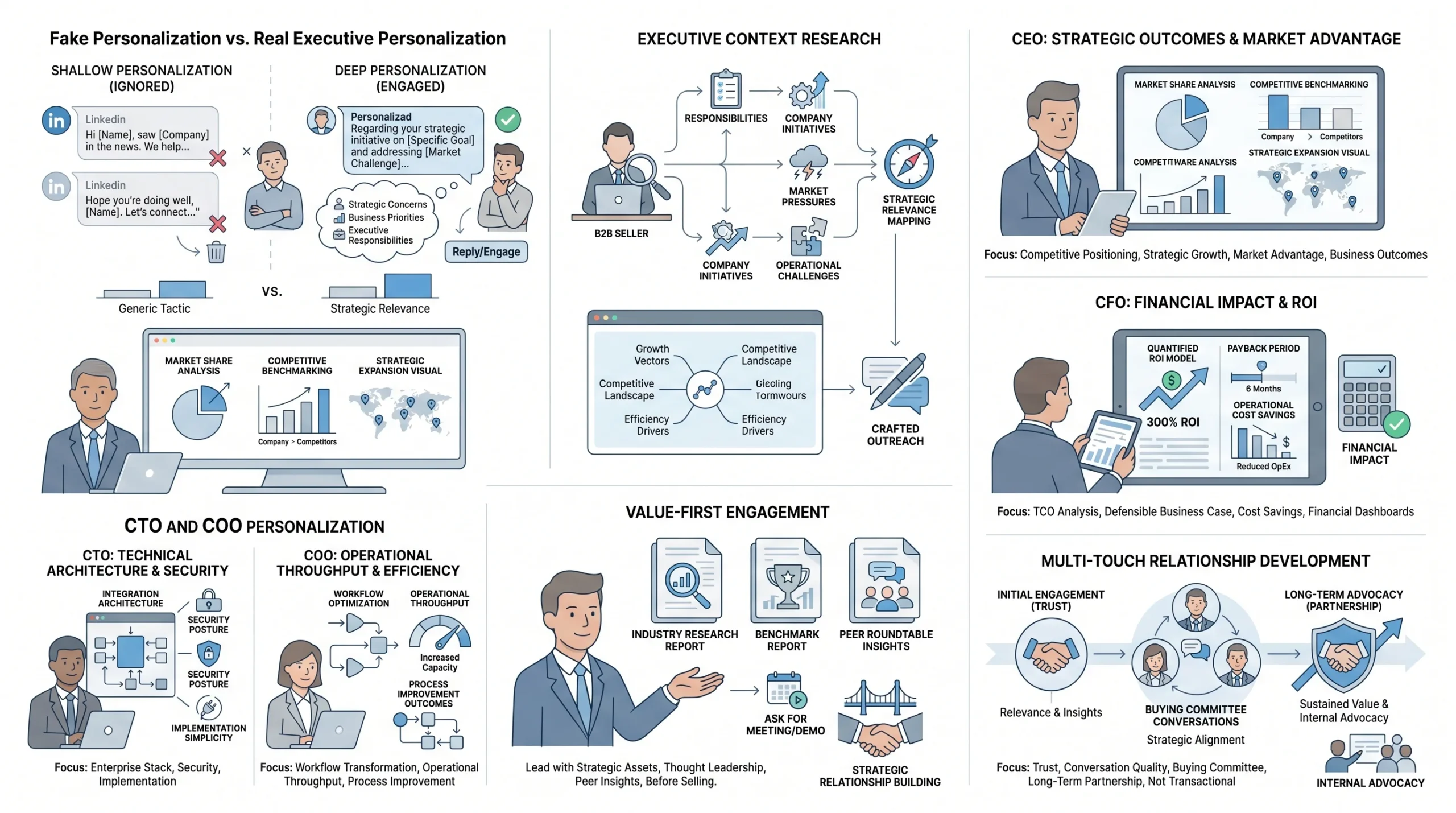
Personalization is the most overused and least understood concept in B2B sales. Most teams treat it as a cosmetic layer — swap in the company name, mention a recent news story, call it personalized. C-suite executives see through this immediately. Real personalization means demonstrating that you understand what this specific person is responsible for, what she is worried about, and why your solution is relevant to that specific situation.
What C-Suite Personalization Actually Means
C-suite executives expect sales pitches tailored to their unique needs and challenges. Thorough research on the company, industry, and the executive themselves is the baseline — not the differentiator. The differentiator is what you do with that research.
Referencing a specific company initiative or market move in your outreach is not just a personalization tactic — it is a qualification signal. If you cannot find a specific, relevant connection between their current business reality and your solution, either you have not done the research or the fit is not strong enough to pursue. Either way, that is useful information before you send the email.
Messaging by Executive Role
Every executive role has a different frame for evaluating new solutions. Here is the logic structure for each:
- CEO messaging — Frame everything around competitive advantage and strategic outcome. The CEO is not thinking about operational details; she is thinking about whether this decision helps the company win. Your angle: “Here is what companies in your position are doing that your competitors are not yet.” Your proof: market share data, competitive benchmarks, growth outcomes from similar companies.
- CFO messaging — Lead with a quantified ROI figure and a payback period. The CFO needs a number he can defend to the board. Do not say “significant cost savings” — say “$340K in avoided operational costs over 18 months based on similar deployments.” Your proof: case studies with hard numbers, industry benchmarks, TCO analyses.
- CTO messaging — Lead with integration simplicity and security posture, not product features. The CTO needs to know this will not create a new problem while solving the current one. Your angle: “Here is how this fits into your existing stack and what the implementation timeline looks like.” Your proof: technical documentation, security certifications, reference calls with other CTOs.
- COO messaging — Show what changes in their day-to-day operations, and quantify the change. The COO thinks in workflows and headcount. Your angle: “Here is the specific process that changes and what that means for throughput/error rates/labor hours.” Your proof: process benchmarks, time-motion studies, operational case studies.
The Value-First Principle
C-suite marketing centers on relationship building and strategic influence. It is less concerned with form fills and more focused on conversation quality, internal advocacy, and multi-touch engagement across a buying committee. What this means practically: your first point of contact with an executive should give something before it asks for anything.
This could be exclusive research your team has produced on their vertical. It could be a benchmark report comparing how companies of their size handle a problem your solution addresses. It could be an invitation to a peer roundtable where they get to hear how their counterparts at similar companies are thinking about the challenge. The pattern is consistent: lead with value, not with a pitch.
Step 6 — Managing the Executive Sales Cycle Post-Contact
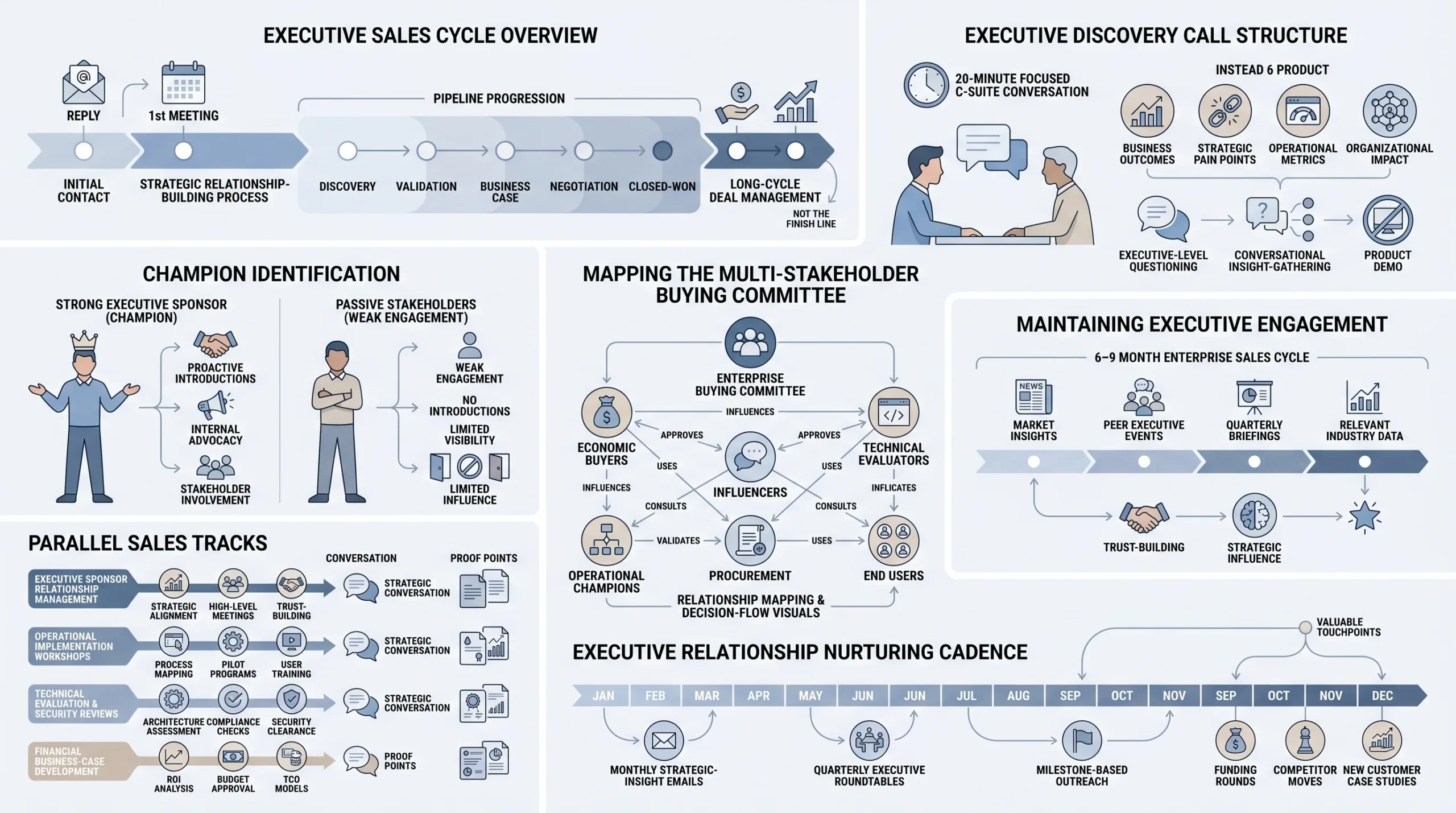
Getting the first response or meeting is not the finish line — it is the starting line. The way you manage the executive relationship after initial contact determines whether the deal moves forward, stalls, or dies quietly.
The Discovery Call With a C-Suite Executive
An executive discovery call is not a product demo, and treating it like one is a fast path to losing the next meeting. A 20-minute executive call has a different structure and a different purpose.
The goal of the first executive call is to confirm qualification, identify pain at the strategic level, and determine whether there is a champion inside the organization. Here are the questions that work:
- “What business outcome are you trying to drive in the next 12 months that is hardest to achieve with your current setup?”
- “Where does this problem show up in your P&L or operational metrics?”
- “Who else inside your organization would need to be part of this conversation for it to move forward?”
That last question is not just information gathering — it is champion identification. Listen for who the executive names, how she describes their role, and whether she offers to make introductions. The executive who says “You should talk to my Head of Operations — let me set that up” has just become your executive sponsor. The one who says “I’ll have someone from my team reach out” may not be a champion at all.
Navigating the Multi-Stakeholder Approval Process
After the first executive conversation, your job is to map the full buying committee. Buying committees include economic buyers controlling the budget, technical evaluators assessing functionality, end users adopting the solution, and influencers shaping opinions without formal authority.
Each of these roles requires a different conversation, different proof points, and different objections to address. The mistake most teams make is running a single-track sales process — one contact, one conversation stream, one set of materials. Complex enterprise deals require parallel tracks:
- Executive sponsor track — Maintain regular contact with the C-suite champion. Share strategic updates, market insights, and business case developments. This is a relationship, not a transaction.
- Operational champion track — The person responsible for implementation or day-to-day use needs to know the details. Run technical sessions, proof-of-concept evaluations, and process workshops with this person.
- Technical evaluator track — Security reviews, integration assessments, and compliance questionnaires happen here. Make sure your technical team is directly engaged with their technical team.
- Financial approver track — The CFO or budget owner needs a business case. Build it with them, not for them — a financial model they helped construct is one they will defend.
Keeping Executives Engaged During Long Sales Cycles
Long sales cycles create a specific risk: the executive loses urgency between your meetings, gets pulled into other priorities, and your deal slowly slides down the stack rank. High-value targets often require a longer engagement timeline, and the teams that win are the ones that stay visible without being annoying.
Invitations to exclusive events, quarterly briefings, and curated thought leadership are effective tools for sustaining executive attention over time. The logic is simple: every touchpoint should add something the executive values — a relevant industry insight, a peer perspective, a data point that changes how they think about the problem. A touchpoint that only serves your pipeline adds nothing to her and will eventually feel like pressure.
A practical cadence for a 6–9 month enterprise deal:
- Monthly — A short email with one relevant piece of external data or market intelligence. Not your newsletter. Something specific to their situation.
- Quarterly — An invitation to a peer event, executive briefing, or private roundtable.
- At key milestones — A direct call or meeting when something changes: new funding at their company, a relevant competitor move, a new case study from a similar customer.
Step 7 — Measuring and Refining Your Executive Outreach Program
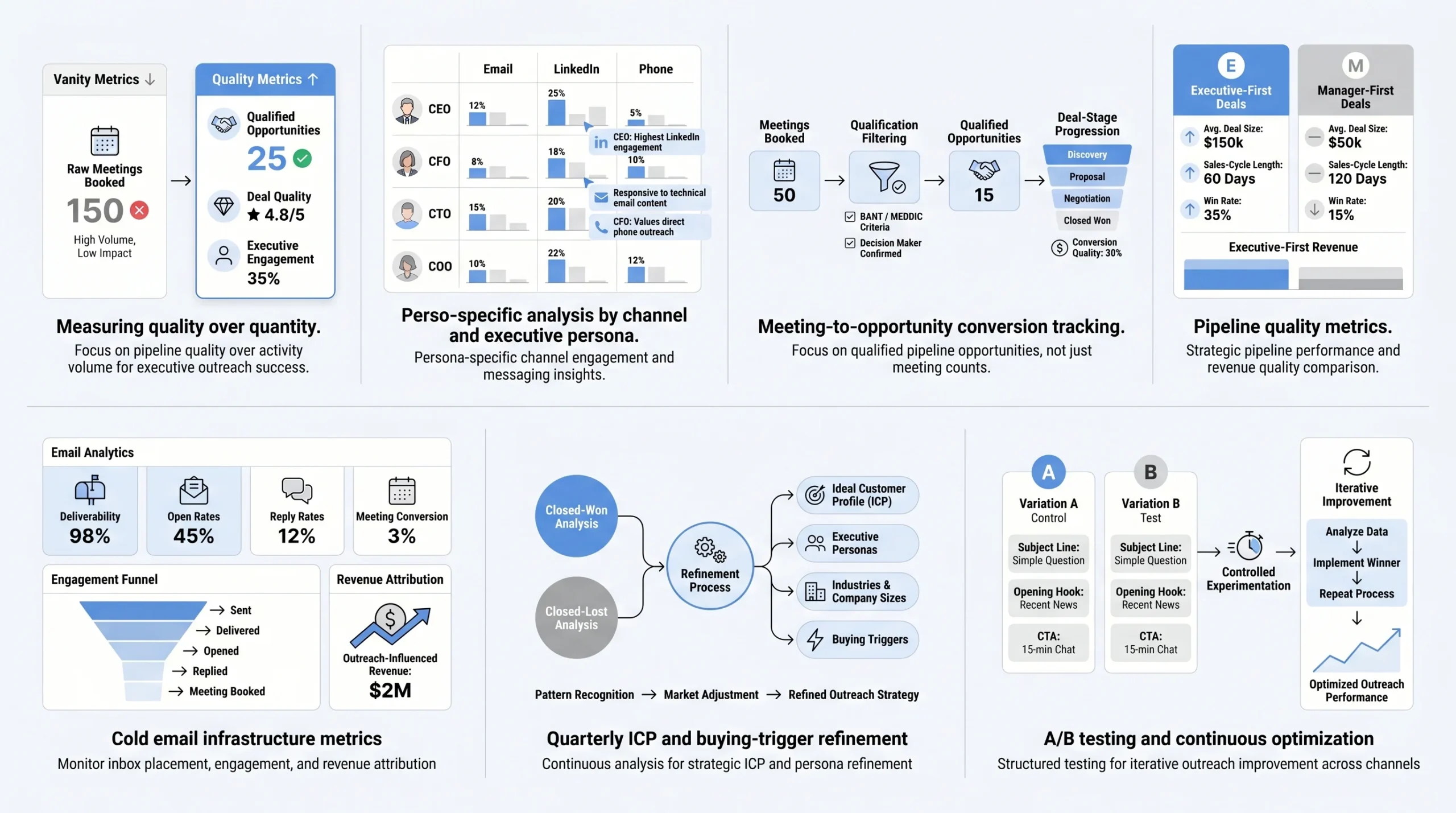
The most common mistake in executive outreach measurement is tracking the wrong things. Meetings booked is a vanity metric if the meetings are with the wrong people or the wrong accounts. The metrics that tell you whether your program is working are about quality, not quantity.
Metrics That Actually Matter
- Response rate by channel and persona — Track response rates separately for email, LinkedIn, and phone, and separately for each executive title (CEO, CFO, CTO, COO). If your CFO email response rate is 3% and your CTO rate is 12%, that tells you something specific about your messaging or your ICP fit.
- Meeting-to-opportunity conversion rate — What percentage of meetings with executives convert to a qualified opportunity? A high meeting rate with a low conversion rate means you are getting in the door but not qualifying effectively once you are there.
- Pipeline quality metrics — Average deal size from executive-first deals vs. manager-first deals. Sales cycle length. Win rate. These tell you whether investing in executive outreach produces better outcomes than your existing motion.
- Email infrastructure metrics — For cold email specifically, track deliverability (target above 95%), open rate (target above 60%), reply rate (target above 15%), and meeting conversion (target above 4%). These four numbers tell you whether your emails are reaching inboxes, resonating, and driving revenue.
Continuous Qualification Review
Your ICP and qualification criteria are not permanent. The market moves, your product evolves, and the customers who converted last year may not match the customers who will convert next year. A quarterly review process keeps your targeting accurate.
- Quarterly ICP review — Look at the last 90 days of deals closed and deals lost. What titles, industries, company sizes, and growth stages converted? What patterns appear in the deals that stalled or died? Adjust your ICP accordingly.
- Buying trigger refinement — Which signals actually predicted deal velocity? If companies going through leadership transitions closed 40% faster than the baseline, that is a trigger worth prioritizing in your prospecting. If funding rounds produced a lot of meetings but few conversions, it may be the wrong signal for your product.
- A/B testing outreach messaging — Run controlled tests on subject lines, opening lines, and CTAs by executive role and channel. Do not change multiple variables at once. The goal is to know which specific element drove the difference in response rate.
Conclusion
The central insight of this guide is in the title: qualifying and reaching C-suite decision makers are not two separate workstreams that happen in sequence. They are deeply interconnected, and teams that treat them as independent miss the point.
You cannot run effective outreach without qualification — you end up sending the right message to the wrong people, or the wrong message to executives who might have been the right people if you had understood their priorities. And you cannot qualify without engaging — the only way to confirm that an executive is the economic buyer, that the pain is urgent, and that there is a champion in place is through real conversations.
Strategic outreach mixes personalized emails, social selling, networking, content, and referrals to reach decision makers through multiple channels — and developing real relationships with follow-up builds the trust that gets you past gatekeepers and into meaningful conversations with people who can actually buy.
The B2B teams consistently winning enterprise deals are not the ones with the biggest lists or the most sophisticated tech stacks. They are the ones who do the research before the first email, choose qualification frameworks that match the complexity of the deal, run multi-channel campaigns that add value at every touchpoint, and treat executive relationships as long-term assets rather than single-transaction events.
The C-suite is reachable. The question is whether your outreach is worth reaching.
FAQs
1. Why do most cold emails to C-suite executives go unanswered?
The problem isn’t access — it’s execution. Most outreach treats executives like mid-level managers, using generic templates and volume-based tactics. C-suite executives filter for relevance instantly, and messages that don’t demonstrate specific knowledge of their business, role, and priorities get deleted without a second look.
2. How is selling to a CEO different from selling to a CFO?
Entirely different conversations. A CEO wants to know if your solution creates competitive advantage or reduces strategic risk. A CFO needs a defensible ROI figure with a clear payback period — not a range, a specific number he can defend to the board. Pitching both with the same message is one of the most common and costly mistakes in B2B sales.
3. Why is BANT insufficient for C-suite deals?
BANT assumes a single decision maker and treats budget as a fixed prerequisite. Both assumptions break down at the executive level. Enterprise deals involve 6–10 stakeholders on average, and budget is rarely pre-allocated — it gets created when the problem is compelling enough. MEDDIC or MEDDPICC are better frameworks because they account for buying committees, champion identification, and the full approval process.
4. How much research should I do before contacting an executive?
Fifteen focused minutes per prospect is enough to produce meaningfully differentiated outreach. That means reviewing LinkedIn activity from the last 90 days, recent press releases, earnings calls (for public companies), and relevant job postings. The goal is one specific, accurate insight that proves the email was written for this person — not a list of generic observations.
5. How many touchpoints does it typically take to reach a C-suite executive?
Most successful engagements happen after 5–8 touchpoints across multiple channels over 6–12 weeks. Single-channel outreach rarely works because one touchpoint from an unknown sender carries almost no weight. The key is that each touchpoint should add new value — not just repeat the same pitch with a different subject line.
6. What role do executive assistants play, and how should I approach them?
EAs are gatekeepers, and trying to bypass or deceive them is a credibility-destroying mistake. The better approach is treating the EA as your first filter to pass: Is your message clear? Is it credibly relevant to what the executive cares about right now? EAs who see genuine value in a communication will pass it forward — that’s their job.
7. How do I keep a C-suite executive engaged during a long sales cycle?
Every touchpoint needs to earn its place by adding something the executive values — a relevant market data point, a peer perspective, or a timely industry insight. A practical cadence is a short, specific email monthly, a peer event or roundtable invitation quarterly, and a direct call whenever something materially changes in their business or market.
8. What metrics should I use to evaluate my executive outreach program?
Avoid vanity metrics like raw meetings booked. The numbers that matter are response rate broken down by channel and executive title, meeting-to-qualified-opportunity conversion rate, and pipeline quality indicators like deal size, cycle length, and win rate compared to your standard motion. For cold email specifically, target above 95% deliverability, 60% open rate, 15% reply rate, and 4% meeting conversion.