


The way marketers build backlinks has changed fundamentally. A decade ago, you could blast hundreds of templated emails to any website with a contact form, drop a link, and call it a strategy. Today, that approach doesn’t just fail — it actively damages your brand’s reputation and your site’s standing with Google. The search engine has grown sophisticated enough to distinguish between earned, editorial links and links that exist purely because someone asked nicely (or paid).
What actually works in 2025 and beyond is relationship-first outreach — treating bloggers, publishers, and content creators as long-term partners rather than link dispensaries. This shift isn’t just philosophical. It’s backed by real-world results. High-authority blogger outreach campaigns have driven measurable SEO gains, with documented case studies showing organic traffic increases exceeding 200% when the strategy is executed correctly. One well-known example saw monthly visitors grow from 790,000 to over 2.4 million — not from paid ads, but from strategic, relationship-driven backlink acquisition.
This guide is written for SEOs, content marketers, in-house marketing teams, and founders who want to build a durable, white-hat backlink profile. It covers everything from understanding what constitutes a high-quality backlink, to finding and qualifying the right bloggers, crafting pitches that get replies, nurturing relationships after the link goes live, and scaling the entire process without sacrificing the personalization that makes it work. Every section is grounded in how outreach actually functions today — not how it worked five years ago.
What Is Blogger Outreach (And Why It Still Works in 2025–26)?
The Core Definition
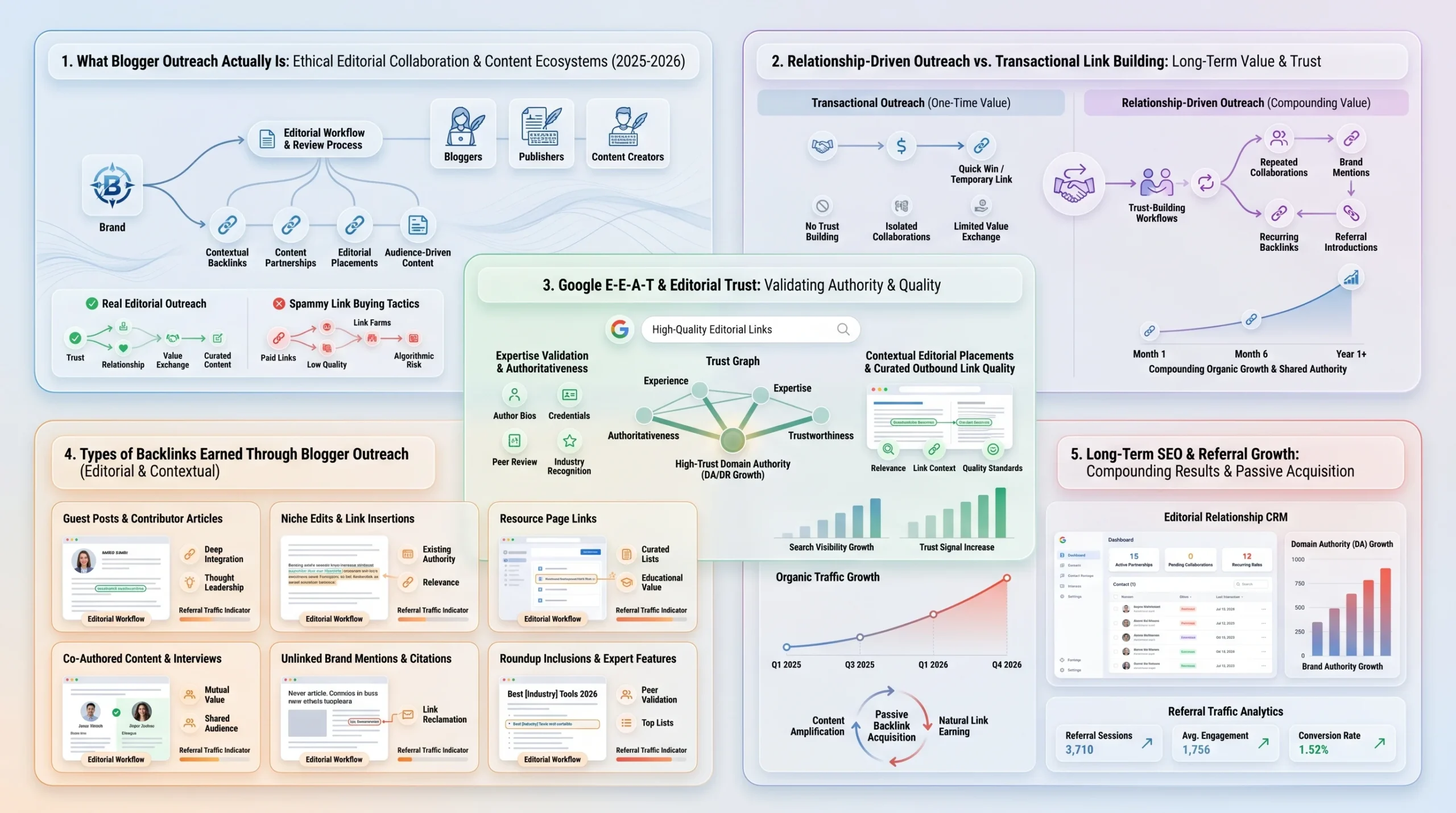
Blogger outreach is the process of building relationships with bloggers, independent publishers, and content creators in your niche with the goal of earning contextual backlinks, brand mentions, and referral traffic through genuine collaboration. At its core, it is about identifying people who publish content your target audience already reads, and finding ways to contribute value to that content — either through writing, data, expert commentary, or resources — in exchange for a link back to your site.
It is important to distinguish blogger outreach from two things it is commonly confused with. First, it is not influencer marketing. Influencer marketing typically involves paying someone with a large social following to promote a product or service, often with a commercial disclosure. Blogger outreach, done correctly, is about editorial collaboration — the link is earned because your content genuinely adds value to the host’s readers, not because money changed hands for a followed link. Second, it is not a paid link scheme. Google’s guidelines explicitly prohibit exchanging money or goods for links that pass PageRank without a rel="sponsored" or rel="nofollow" attribute. Ethical blogger outreach stays firmly on the editorial side of that line.
Why Relationship-Driven Outreach Outperforms Transactional Link Building
The fundamental problem with treating outreach as a transaction is that it produces one-time results. You send a pitch, you get a link (if you’re lucky), and the relationship ends. The blogger has no particular reason to think about your brand again, feature your content again, or introduce you to others in their network. You are a stranger who asked for something and received it — nothing more.
Relationship-driven outreach produces compounding results. Blogger outreach has evolved into a long-term strategy focused on relationship development rather than single short-term benefits. When bloggers trust your brand and respect your work, they become long-term advocates — they think of you when writing future posts, they mention your content without being asked, and they introduce you to other publishers in their space. Each of these outcomes is difficult to manufacture through transaction alone.
Google’s E-E-A-T framework (Experience, Expertise, Authoritativeness, and Trustworthiness) reinforces this. Links from real publishers who genuinely vouch for your content carry significantly more weight than links from sites that link to everyone. An editorial link from a domain that carefully curates its outbound references is a strong trust signal; a link from a site that sells placements indiscriminately is a weak one, and increasingly, a risky one. Unlike automated link building or spammy tactics, relationship-based outreach is built on trust, quality, and genuine partnerships — which is precisely what creates long-term SEO benefits rather than short-term spikes that disappear after the next algorithm update.
Types of Backlinks You Can Earn Through Outreach
Blogger outreach is not a single tactic — it is an umbrella strategy that encompasses several distinct types of link acquisition, each with different levels of effort, different placement contexts, and different SEO value:
- Guest post backlinks: You write a full article for a host blog, and a link to your site is included naturally within the content or author bio. This is the most common form of outreach and provides the most editorial context for the link.
- Niche edits / link insertions: You identify an existing, already-indexed post on a relevant blog and pitch the editor on inserting a contextual link to your content within that existing article. These links sit in aged, established content and can carry strong authority signals.
- Resource page links: Many blogs maintain curated “resources” or “tools” pages. If your content or tool fits, a placement here can generate both a strong backlink and ongoing referral traffic.
- Co-authored content mentions: You collaborate with a blogger on a jointly produced piece — an expert roundup, a data study, a co-written guide — and both parties link to the published content.
- Unlinked brand mention conversions: If a blogger has already mentioned your brand or content without linking to it, a polite outreach email asking them to convert the mention into a link has a high success rate because they already know who you are.
- Roundup inclusions: Many bloggers publish weekly or monthly roundups of useful content in their niche. Getting your content featured in these roundups builds both links and audience exposure over time.
What Makes a Backlink “High-Quality”? (Know Before You Prospect)
One of the most expensive mistakes in blogger outreach is spending weeks securing placements that do little to nothing for your SEO. Before you prospect a single blogger, you need a clear, criteria-based definition of what a high-quality backlink looks like for your specific site and niche. Not all backlinks are equal — and some are actively harmful.
Domain-Level Quality Signals
The domain a backlink comes from determines a large portion of its SEO value. Several signals matter here:
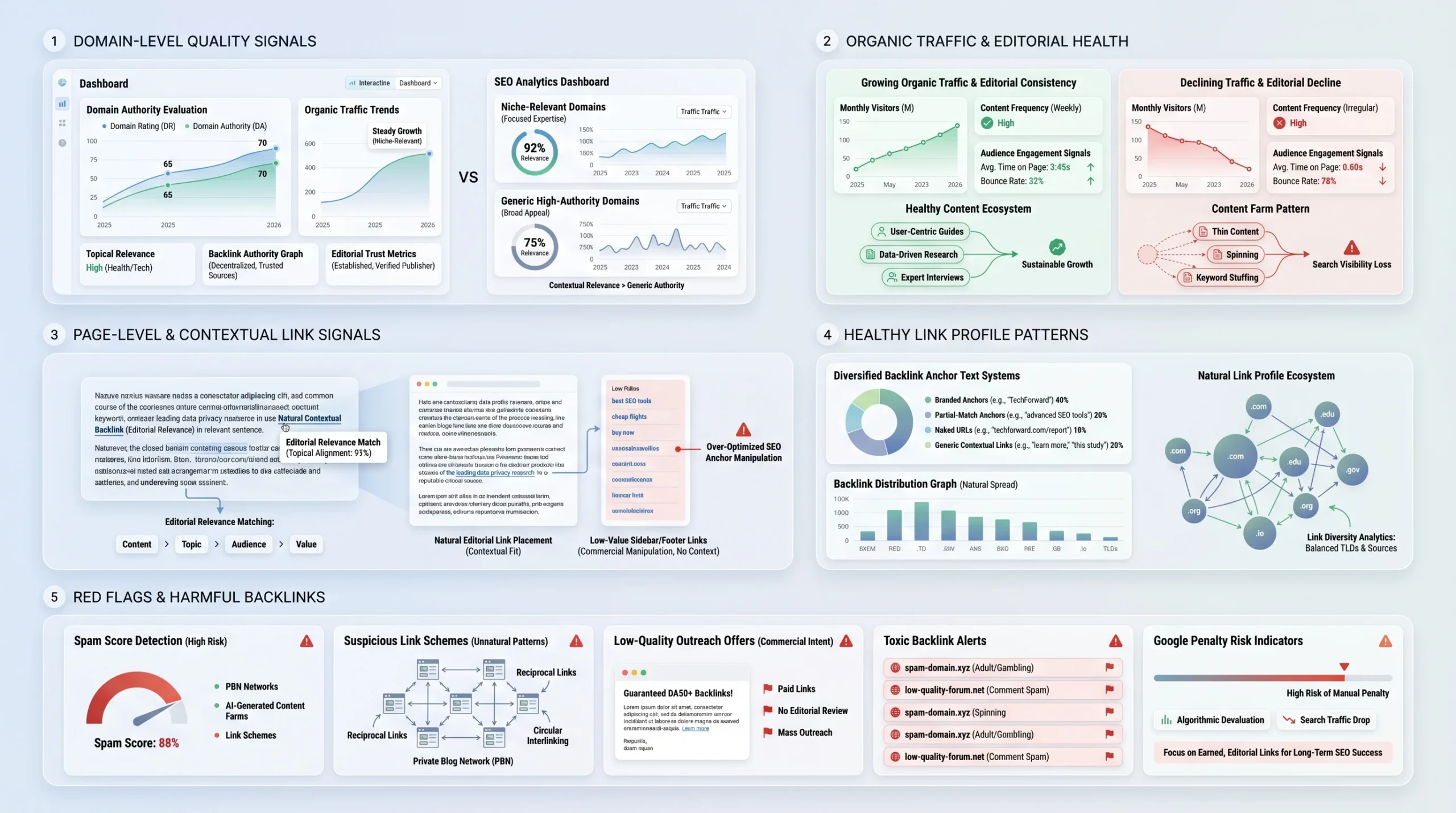
- Domain Rating (DR) / Domain Authority (DA): These third-party metrics from Ahrefs and Moz respectively estimate how authoritative a domain is based on the quality and quantity of its own backlink profile. Higher is generally better, but a DR 45 site in your exact niche will typically outperform a DR 70 site with no topical relevance to your content.
- Organic traffic volume and trend: A site with a DR of 60 but declining organic traffic may have been penalized or may be losing relevance. A site with a DR of 40 and growing traffic signals editorial health and real audience engagement. Always check traffic trend, not just volume.
- Niche and topical relevance: Google’s algorithms assess topical authority. A link from a site that publishes exclusively about your industry sends a stronger relevance signal than a link from a general-interest site, regardless of the DA differential.
- Key evaluation metrics: The most comprehensive qualification framework checks domain rating, organic traffic volume, outbound linking patterns (how many external links the site typically gives per post), the proportion of traffic from English-speaking countries if that is your target market, and whether the site has experienced any sudden large traffic drops — which can indicate a manual penalty or algorithm hit.
Page-Level and Contextual Signals
Beyond the domain, the specific page your link appears on matters considerably:
- Topical relevance of the specific page: A link from a page about “best project management tools” to your project management software is highly relevant. The same link from a page about “best running shoes” is not. Google understands page-level context, not just domain-level context.
- Natural anchor text placement: The anchor text — the clickable words that contain your link — should read naturally in context. A link that says “learn more about project management workflows here” with a natural sentence construction looks editorial. A link that says “best project management software 2025” in an awkward sentence construction looks like it was placed for SEO rather than the reader.
- Link placement within body content vs. sidebar/footer: Links placed within the main body copy of an article carry more weight than links in sidebars, footers, or author bio sections. Body content links are editorially integrated; sidebar and footer links are often sitewide and carry much less value.
- Avoiding over-optimized anchor text and unnatural patterns: If every backlink pointing to your site uses the exact same keyword phrase as anchor text, that pattern looks manipulative. Healthy backlink profiles contain a mix of branded anchors, partial-match anchors, naked URLs, and generic phrases like “read more” or “click here.”
Red Flags to Filter Out
Identifying the wrong sites to avoid is just as important as identifying the right ones to target:
- Sites with high spam scores (Moz): Moz’s Spam Score estimates the likelihood that a domain has been penalized or is associated with spammy practices. Sites scoring above 30% spam score should be avoided entirely.
- PBNs and link networks: Private Blog Networks are collections of websites created specifically to sell links. They often have thin content, unnatural interlinking patterns, and irregular traffic profiles. A link from a PBN is not just worthless — it is a liability if Google identifies and devalues or penalizes those domains.
- Sites with thin or AI-generated content at scale: Since Google’s Helpful Content updates, sites that exist primarily to publish AI-generated, low-effort content have been heavily devalued. A backlink from one of these sites carries negligible value and may eventually become negative.
- Suspiciously cheap “outreach” offers: Cost per outreach link from legitimate publishers ranges from $50 to $1,500 depending on domain authority, niche, and placement type. Offers promising hundreds of backlinks for under $100 invariably come from PBNs or link farms. The price point is not a bargain — it is a warning sign.
Step 1 — Define Your Outreach Goals and Strategy
Jumping into outreach without defined goals is the equivalent of driving without a destination. You will move, but you will not get anywhere useful. Before you research a single blogger or write a single pitch, you need strategic clarity on what you are trying to achieve and how blogger outreach fits into your broader SEO and content strategy.
Set Clear, Measurable Objectives
Effective outreach goals are specific and measurable, not vague aspirations like “get more backlinks”:
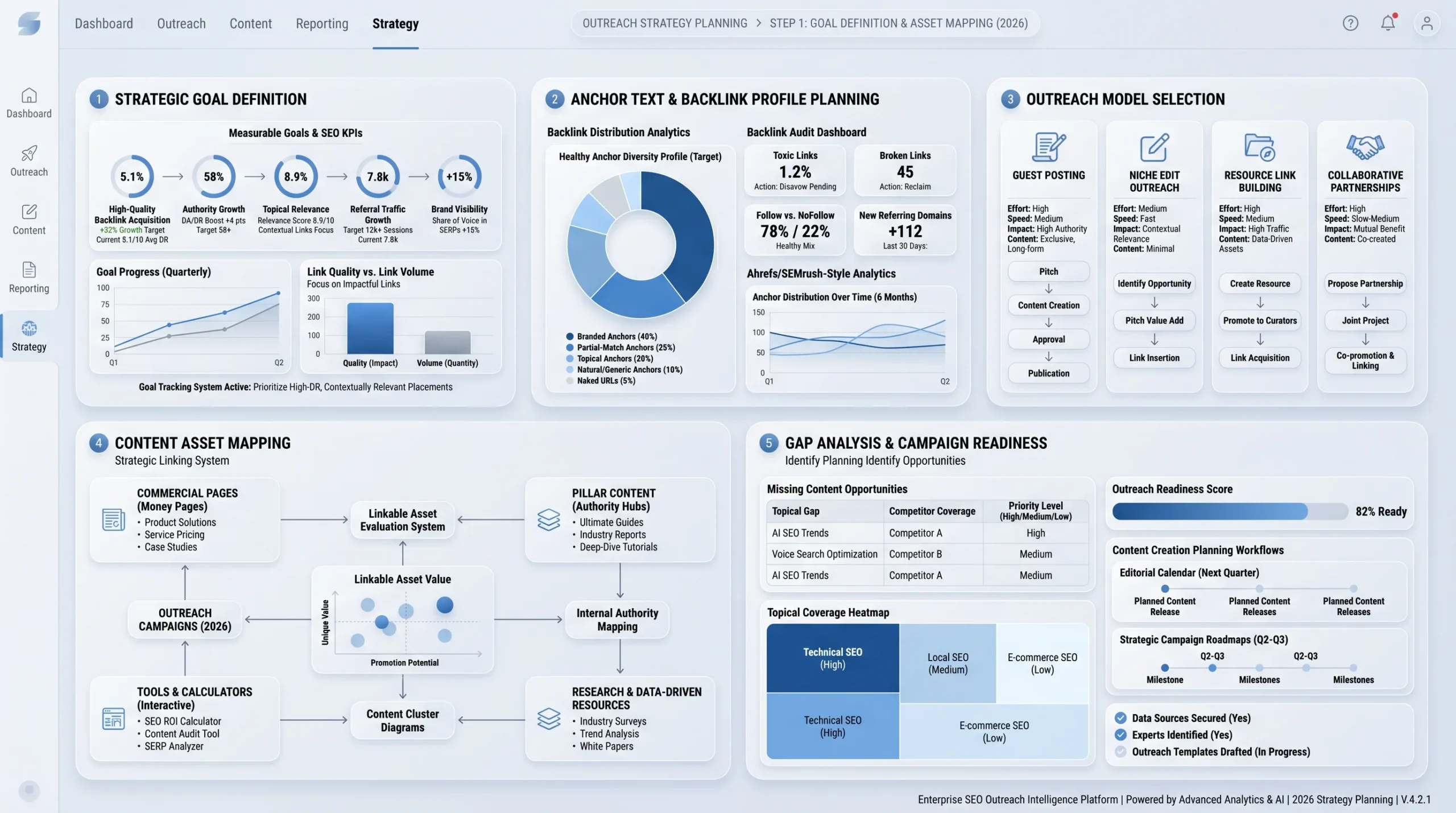
- Link volume targets vs. link quality targets: Decide which matters more for your current situation. If you are a new site with minimal authority, securing 10 high-quality links from DR 50+ domains may move the needle more than 50 links from DR 20–30 sites. If you are an established site trying to close a gap with a competitor in a specific topic cluster, volume within that niche may matter more.
- Anchor text distribution goals: Audit your existing backlink profile using Ahrefs or SEMrush and identify gaps or over-representations. If 80% of your current backlinks use branded anchor text, your next outreach wave should target partial-match and topical anchors. If you are over-indexed on exact-match anchors, you need more branded and generic anchors to balance the profile.
- Secondary goals: Backlinks are the primary objective, but outreach can simultaneously build brand awareness in your target community, generate referral traffic from high-readership blogs, and establish topical authority as a recognized voice in your niche. Define these upfront so you can measure them alongside link acquisition.
Choose Your Outreach Model
Different outreach models suit different goals, timelines, and content assets:
- Guest posting campaigns: Best for building topical authority, demonstrating expertise, and earning in-content links. Requires significant content investment — a high-quality guest post typically takes 3–6 hours to research and write. Best suited for sites with strong content production capacity.
- Niche edit / link insertion outreach: Best for faster results with less content investment. You are not writing a new article — you are pitching a contextual addition to an existing one. Acceptance rates can be higher because the ask is smaller, but you have less control over the surrounding content context.
- Resource link building: Best for sites with genuinely useful tools, guides, calculators, or datasets. If your content truly belongs on a resource page, placements here tend to be durable and editorially natural.
- Collaborative content: Best for relationship building and audience expansion simultaneously. A data study co-published with a prominent blogger in your niche earns links, earns mentions, and puts your brand in front of their audience in a highly credible format.
Map Goals to Content Assets
Outreach without strong content to link to is largely wasted effort. Before scaling any campaign, conduct an honest audit:
- What pages do you want to build authority to? Identify your highest-priority commercial or pillar pages — the ones where a ranking improvement would have the greatest business impact — and focus link acquisition on these first.
- Do you have linkable assets? Linkable assets are pieces of content so valuable, data-driven, or useful that bloggers genuinely want to reference them — original research, comprehensive tools, unique datasets, in-depth guides, or interactive calculators. If you do not have these, outreach will be harder and results will be thinner.
- Identify content gaps: If your target guest post hosts publish content on topics you have not covered, create that content first. You cannot pitch a guest post or niche edit if the destination page you want to link to does not exist or is not strong enough to warrant a link.
Step 2 — Find and Qualify the Right Bloggers
Prospect quality determines campaign quality more than almost any other variable. A perfectly written pitch to the wrong blogger is wasted effort. A slightly imperfect pitch to a highly relevant, well-qualified blogger with a genuine audience can still generate results. Investing heavily in prospecting — finding the right targets — pays dividends across every subsequent step.
Prospecting with SEO Tools
Modern SEO tools make it possible to find qualified blogger prospects at a scale and with a precision that manual searching alone cannot match:
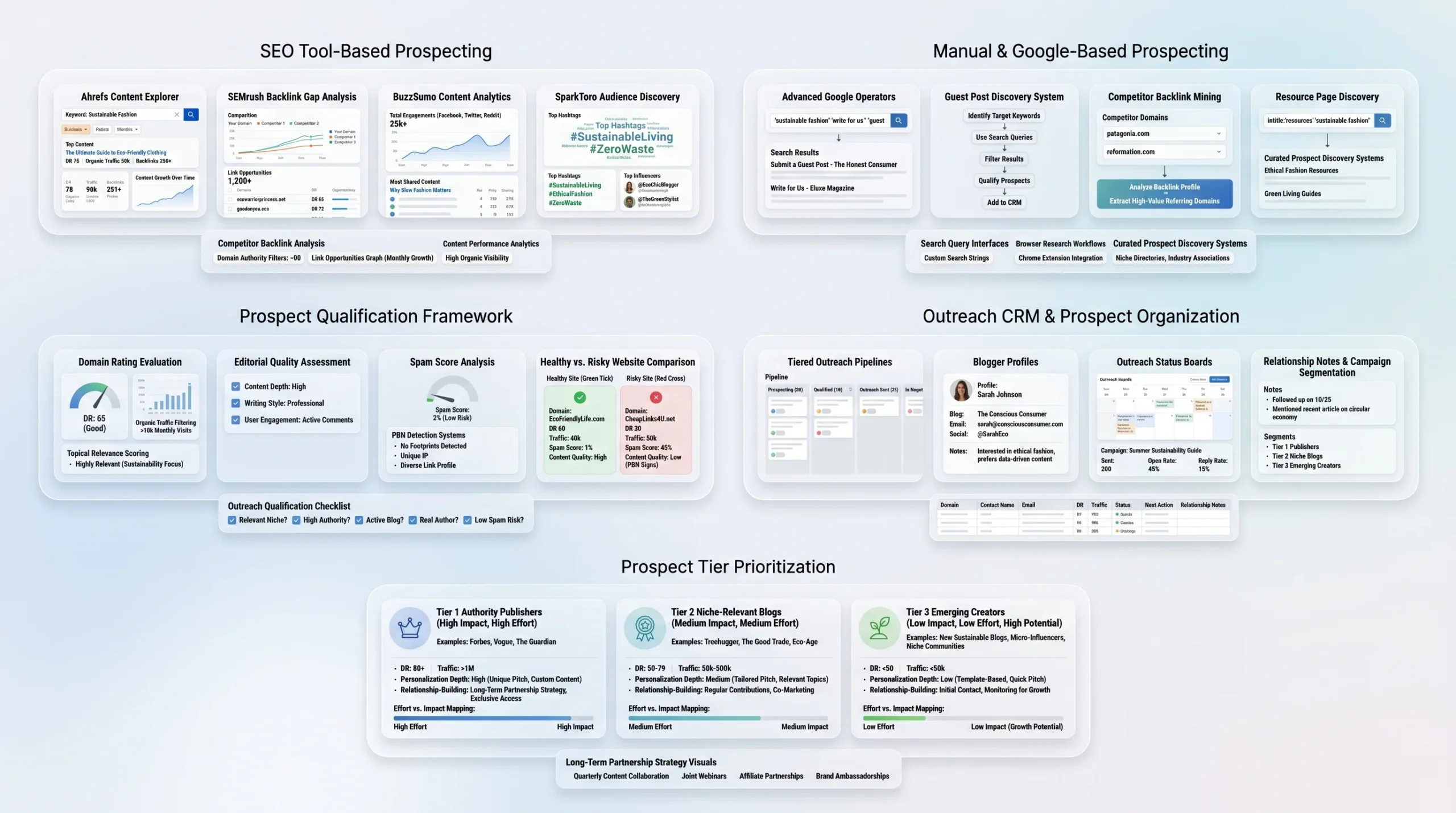
- Ahrefs Content Explorer: Enter a topic relevant to your niche and Content Explorer returns the top-performing articles by traffic, backlinks, and domain rating. This tells you not only which blogs are active and authoritative in your space, but also which specific topics perform best — giving you direct pitch angles. You can also identify your competitors’ top linking domains here and systematically target the same sources.
- SEMrush backlink gap analysis: Enter your domain and up to four competitors. SEMrush identifies domains that link to your competitors but not to you — these are pre-qualified prospects who have already demonstrated willingness to link to content like yours.
- BuzzSumo allows you to analyze content performance based on social shares and backlinks, surfacing influential bloggers who consistently produce content that resonates in your niche. SparkToro takes a different angle — it discovers influencers and audience interests through social behavior data across platforms, helping you identify bloggers your target audience actually follows rather than just those with high domain authority.
Manual and Google-Based Prospecting
Automated tools are powerful, but manual prospecting surfaces opportunities that algorithmic searches miss — particularly newer blogs with engaged audiences that have not yet accumulated the backlink profile that makes them visible in tool-based searches:
- Advanced search operators: Google search operators allow precise discovery of guest posting opportunities. Searches like
"write for us" + [your niche],"guest post guidelines" + [your topic],intitle:"submit a guest post" + [keyword], orinurl:guest-post + [niche]surface blogs actively seeking contributor content — a strong signal that they will be receptive to a pitch. - Competitor backlink profile mining: Export the full backlink profile of 3–5 competitors from Ahrefs or SEMrush. Filter by DR range and link type, then systematically work through the list. Any site that has already linked to similar content in your space is a validated prospect for yours.
- Roundup and resource page discovery: Search for
[your niche] + "resources",[your topic] + "useful links", or[your keyword] + "weekly roundup". These pages are explicitly designed to link outward and often have low barriers to inclusion if your content genuinely belongs there.
Building a Qualified Prospect List
Raw prospects from any source need qualification before they enter your outreach pipeline. Running an unqualified list wastes your most limited resource — the attention you invest in personalized outreach:
- Minimum qualification criteria: Define a floor for each key metric before any prospect enters your list. A reasonable baseline might be DR 30+, minimum 1,000 monthly organic visitors, content published within the last 30 days (demonstrating the site is still active), and clear topical relevance to your niche. Adjust these thresholds based on your industry — in highly competitive niches, your floor may be DR 50+; in specialized verticals, a DR 25 site with 2,000 hyper-targeted visitors may outperform a DR 60 generalist.
- Screening for spam and PBNs: Check Moz Spam Score, look for signs of link-selling (pages titled “advertise” or “sponsored posts” prominently positioned), review the quality and depth of published content, and check whether the site links out to known low-quality networks. Reject any site showing these patterns regardless of its other metrics.
- Organizing prospects: Maintain your list in a dedicated CRM or outreach tool. BuzzStream, Pitchbox, and Ahrefs’ built-in prospect management tools all support structured tracking. At minimum, a well-organized Google Sheet with columns for URL, DR, monthly traffic, contact name, email, status, and notes will serve smaller campaigns effectively.
Prioritizing Your Prospect Tiers
Not all qualified prospects deserve equal effort. Tiering your list allows you to allocate your personalization and relationship-building energy where it will produce the greatest return:
- Tier 1 (High DR, high traffic, high difficulty): These are the most authoritative blogs in your niche — the ones that would meaningfully move your domain authority and send real referral traffic. They receive hundreds of pitches. Getting a placement requires deep personalization, strong content, and often a warm relationship built before the formal ask. Invest the most time here; the return justifies it.
- Tier 2 (Mid-range DR, strong niche relevance, moderate difficulty): These sites offer the best balance of attainability and impact. They are established enough to provide real SEO value, but not so prominent that they are bombarded with pitches daily. Most of your active outreach volume should concentrate here.
- Tier 3 (Lower DR, emerging blogs with strong growth trajectory): These blogs may not move your authority metrics significantly today, but building relationships with rising bloggers now means you have established partners when they reach greater prominence. The cost of a relationship here is low; the potential long-term value is significant.
Step 3 — Build Relationships Before You Pitch
The single most important strategic difference between outreach that produces consistent results and outreach that gets ignored is what happens before the formal pitch. Cold outreach — emailing a blogger you have never engaged with, asking for something — has a fundamentally lower success rate than warm outreach, where a real (even if brief) relationship already exists.
Why “Warm Outreach” Outperforms Cold Emailing
Because bloggers receive hundreds of pitches, generic messages get ignored instantly. Personalized outreach shows respect, proves you have done your homework, and meaningfully increases the probability of a positive response. The difference is not marginal — response rates for genuinely warm, personalized outreach can be three to five times higher than cold campaigns with templated messaging.
The pre-pitch relationship window — the period between when you first identify a blogger as a target and when you send your formal pitch — should ideally be one to three weeks. This is enough time to have appeared in their notifications several times as a genuine, engaged reader of their work, without being so long that your engagement looks like a calculated sequence rather than natural interest.
How to Warm Up a Prospect
The warming process is deliberate but should never feel manipulative. Every interaction during this phase should be genuine — if you cannot find anything legitimately interesting or valuable in a blogger’s work, that is a signal they may not be the right target:
- Follow them on social media and engage meaningfully: Follow the blogger on Twitter/X, LinkedIn, or wherever they are most active. When they post something insightful, engage with a specific, thoughtful comment — not a generic “great post!” but a response that demonstrates you read and understood what they wrote.
- Leave thoughtful comments on their blog posts: Before you pitch, comment on two or three of their recent posts. Reference a specific point they made, add a related perspective, or ask a genuine question. This puts your name in front of them as an engaged reader, not an anonymous inbox entry.
- Share their content with a genuine mention: If a piece of their content is genuinely worth sharing with your own audience, share it and tag them. This is a low-effort, high-signal action — it demonstrates that you find their work valuable enough to amplify it.
- Start by engaging with their content before reaching out — comment on their blogs, share their posts, and establish a connection genuinely. This approach ensures that when your pitch does arrive, your name carries positive associations rather than being completely unfamiliar.
Research the Blogger Thoroughly
Deep research before a pitch serves two purposes: it enables genuine, specific personalization that distinguishes your email from templated outreach, and it reveals whether the blogger is actually a good fit for your campaign:
- Read their recent posts and understand their tone and audience: Every blog has a distinct voice and a specific audience expectation. A blog written in a conversational, jargon-free style for small business owners is not the right placement for technical content written for enterprise developers. Understanding tone helps you pitch content that genuinely fits their editorial context.
- Identify their content themes and the gaps you could fill: Look for topics they cover consistently and topics they have touched on but not covered in depth. A gap is a pitch opportunity — you can propose content that genuinely expands their coverage of a topic their audience cares about.
- Note brands and topics they already cover or have linked to: This reveals both their editorial standards (who have they considered credible enough to link to before?) and potential conflicts (do they have an existing relationship with a direct competitor that would make featuring you awkward?).
Step 4 — Find Contact Details
A perfectly crafted pitch sent to the wrong person, or never delivered because you could not find a working email, never gets read. Contact discovery is a procedural step, but getting it right — reaching the actual decision-maker with a verified, deliverable email — determines whether your outreach effort gets its first opportunity to succeed.
On-Site Discovery
The most reliable contact information is always what the blogger publishes themselves:
- Contact pages: Most established blogs have a dedicated contact page. Check these first. Some explicitly state whether they accept guest contributions, which also serves as a pre-qualification signal.
- About pages: About pages frequently include the primary author’s name, professional background, and sometimes a direct email address or preferred contact method.
- Author bios: On multi-author publications, individual author bios often contain social profile links, personal website links, or direct contact information for the contributor you want to reach.
For larger publications or multi-author blogs, the decision-maker for content contributions may be a managing editor, content director, or editorial coordinator rather than the primary blogger. LinkedIn is the most reliable tool for identifying the right person at a publication:
- Search the publication name and filter by employees in content, editorial, or marketing roles
- Review their profile to confirm they handle contributor content or outreach decisions
- Some editors accept LinkedIn connection requests and messages from professional contacts, though email is generally preferable for formal pitches
Email Finding Tools
When on-site discovery and LinkedIn do not yield a direct email, dedicated email-finding tools can surface contact information based on the domain:
- Hunter.io is the most widely used tool in this category. Enter a domain name and it returns known email addresses associated with that domain, along with a confidence score for each address.
- Snov.io and Voila Norbert offer similar functionality with slightly different database coverage — using two tools increases the probability of finding a valid address.
- Email verification before sending: Before adding any found email to your outreach sequence, verify it using a tool like Hunter’s built-in verifier, NeverBounce, or ZeroBounce. Sending to unverified emails increases your bounce rate, which damages your sending domain’s reputation and reduces deliverability for your entire campaign.
Contact Form Outreach
When no direct email is available, many blogs offer a contact form as the only point of access:
- When to use contact forms: Use them as a genuine fallback when all other discovery methods have failed, not as a primary channel. Response rates through contact forms tend to be lower than direct email because messages can be filtered or deprioritized.
- How to keep contact-form pitches effective: Contact forms often have character limits and no subject line field. Get to the point immediately — state who you are, what you are proposing, and why it serves their readers within the first two to three sentences. Save the detailed pitch for the follow-up email after they respond.
Step 5 — Craft a Pitch That Gets Replies
Your pitch email is the moment all of your research, relationship-building, and content development either converts into a conversation or disappears into an ignored inbox. The quality of your pitch is the most direct variable you control in determining your outreach response rate. Getting it right requires understanding both what makes bloggers respond and what makes them delete emails on sight.
The Anatomy of a High-Converting Outreach Email
A pitch that gets replies is not a long email — it is a precise, human, specific email that makes a clear ask:
- Subject line: The subject line determines whether the email gets opened at all. The most effective subject lines are short (under 50 characters), personalized, and either reference the blogger by name or reference a specific piece of their content. Curiosity-driven subject lines that hint at value for the blogger outperform subject lines that lead with your own name or your company.
- Opening: The first sentence must demonstrate that you are not sending a mass email. Reference something specific about their recent work — a particular insight from a post they published, a perspective they shared on social media, or a content gap you noticed in their coverage. This is not flattery; it is proof of attention.
- The value proposition: Clearly articulate what is in it for them. Will your guest post cover a topic their audience has been asking about? Does your data study give them unique content they can be among the first to publish? Does the resource you want added to their page genuinely serve their readers? The pitch must make the blogger’s benefit evident without requiring them to infer it.
- The ask: Make one specific, low-friction request. “Would you be open to a guest contribution covering X?” is a clear ask. Multiple requests in a single email (a guest post AND a link insertion AND a social mention) create decision fatigue and reduce response rates significantly.
- Closing: Sign off professionally and without pressure. Do not add artificial urgency (“I need a response by Friday”) and do not over-apologize for reaching out. A confident, respectful close communicates that you are a professional who has something genuinely valuable to offer.
Personalization at Scale Without Losing Quality
The tension in outreach at any significant volume is maintaining meaningful personalization while managing the time cost of researching every prospect in depth. Several approaches make this balance achievable:
- Dynamic fields that go beyond first name: First-name personalization is now table stakes — every email tool can insert a name variable. What actually signals genuine attention are references to specifics: the title of a recent post, a particular statistic or argument from their content, an observation about a gap in their topic coverage. These cannot be automated; they require the researcher to spend time with each blogger’s work.
- Generic templates are immediately recognizable: Generic templates with phrases like “Dear Webmaster” or “Hello Admin” feel impersonal and are instantly identified as mass-produced outreach. The goal is for every email to feel as though it was written for one specific person — because the best ones genuinely are.
- Batch personalization method: Rather than trying to research and write pitches for 100 bloggers simultaneously, work in focused batches of 10. Research all 10 deeply — read their recent posts, note specific details, identify your pitch angle — then write all 10 emails in sequence while the research is fresh. This produces higher-quality personalization in less total time than switching between research and writing for each individual.
Pitch Templates for Different Outreach Types
A template is a starting point, not a finished email. Each template below requires genuine personalization in the bracketed fields before sending:
- Guest post pitch: Open with a specific reference to their blog and audience, propose two or three concrete topic ideas that fill identified gaps in their coverage, briefly establish your credibility as a contributor, and make a clear, single ask: “Would any of these topics be a good fit for [Blog Name]?”
- Niche edit / link insertion pitch: Identify a specific existing post of theirs, explain exactly where within that post your link would add value for their readers (not for you), and provide the URL of the content you want linked. The pitch should be short — this is a smaller ask than a guest post and the email should reflect that.
- Resource page inclusion pitch: Reference the specific resource page by name, explain precisely why your content belongs on it (what unique value it provides that the other listed resources do not), and make the inclusion ask directly.
- Collaborative content / data study pitch: Propose the collaborative project, explain your contribution (the data, the research capacity, the distribution you bring), and frame it explicitly as a mutual project that benefits both parties’ audiences and backlink profiles.
- Broken link outreach pitch: Identify a specific broken link on their site, provide the exact URL where it appears, and offer your content as a relevant replacement. This is one of the highest-conversion pitch types because you are solving a problem for the blogger rather than asking for something.
Subject Line Formulas That Work
- The specific compliment opener: References a particular post or achievement — “[Post Title] — a follow-up idea” or “Your piece on [Topic] — related research you might find useful”
- The mutual benefit hook: Makes the value exchange evident — “A data study on [Topic] for [Blog Name] readers”
- The content gap approach: Hints at something missing — “A topic your audience keeps asking about”
- The shared audience angle: Establishes relevance immediately — “Reaching the same [Niche] audience — collaboration idea”
Step 6 — Follow Up Without Being Annoying
Even a well-crafted pitch sent to the right person at the right time frequently goes unanswered on the first attempt. This is not necessarily a rejection — bloggers, editors, and content managers are busy, inboxes are full, and your email may have been opened and set aside with good intentions. A well-executed follow-up strategy recovers a substantial portion of potential responses that would otherwise be lost.
The Follow-Up Sequence
A single follow-up, sent at the right time and with the right content, is professional and expected. Multiple follow-ups become harassment:
- When to follow up: A good rule is to follow up once after 3–5 days — keep it short, polite, and pressure-free. If there is no response after two attempts, move on without spamming. Most responses come from the second or third contact, but attempting contact more than twice without any signal of interest crosses from persistence into intrusion.
- How to add new value: The follow-up should not be a copy-paste of the original pitch with “Just wanted to bump this up” appended. Add something new — a relevant piece of content you have published since the original email, an updated statistic related to your pitch, or a slightly different angle on your original proposal. A follow-up that adds value gives the blogger a new reason to engage rather than just reminding them they did not respond.
Multi-Channel Follow-Up (Done Right)
If the blogger is active on social media, a gentle follow-up via Twitter/X or LinkedIn can be effective — but only if it is a single, low-pressure touch, and only if you have already established a genuine presence in their social sphere through prior engagement. Do not spam across multiple platforms simultaneously. If you have been commenting on their blog and engaging with their social posts during the warm-up phase, a brief social mention (“Sent you an email about a collaboration idea — hope it reaches you!”) is natural. Cold-approaching someone on three platforms at once is not.
Managing Non-Responses and Rejections
- How to interpret silence: A non-response after two attempts most commonly means the blogger is too busy, that your pitch did not reach the right person, or that the timing was poor — not that they have a negative view of your brand. Keep the prospect in your CRM, mark the status as “No Response — Re-engage Later,” and schedule a note to approach them again in 60–90 days after further genuine engagement with their content.
- Handling a soft no: Some bloggers respond with polite rejections — “Not taking guest posts right now” or “Doesn’t fit our editorial focus at the moment.” Respond graciously, thank them for the reply, and express genuine interest in staying in touch. A “not right now” is frequently a “maybe later” — especially if you continue to engage authentically with their content.
- Keeping the door open: Never respond to a rejection with pressure, disappointment, or an argument. Thank them, wish them well, and move on. Bloggers talk to each other; a professional, gracious response to a rejection is itself a form of relationship building.
Step 7 — Deliver Value and Secure the Backlink
Getting a positive response to your pitch is a milestone, not a finish line. The quality of what you deliver after a blogger agrees to collaborate determines not only whether this specific backlink gets placed, but whether the relationship continues producing value in the future. Underdelivering on content quality after a pitch is accepted is one of the fastest ways to burn a relationship that took weeks to build.
Writing Guest Posts That Editors Actually Accept
A guest post that an editor accepts without revisions, publishes promptly, and feels genuinely proud to share with their audience is the gold standard — and it is the standard that produces the strongest relationship outcomes:
- Match the host blog’s tone, depth, and audience: Before writing a single word, re-read three to five of the host blog’s top-performing posts. Note their average word count, their use of headings and bullet points, their technical depth, and their tone. A casual, example-driven blog for small business owners requires a fundamentally different piece than a technical publication for enterprise software engineers. Writing in your own habitual style instead of theirs is the most common guest post mistake.
- Provide original insights, data, or examples — not rehashed content: The easiest way to get accepted and to earn the editor’s genuine appreciation is to bring something their existing content does not already provide. Original data, a framework derived from your own experience, a case study from your work, or a perspective that genuinely challenges conventional wisdom in the niche are all examples of content that earns editorial enthusiasm rather than grudging acceptance.
- Internal linking to the host’s content: Within your guest post, link naturally to two or three of the host blog’s existing relevant articles. This is not just courtesy — it demonstrates that you read their archive, it improves the user experience for their readers, and it signals to the editor that you are contributing to their content ecosystem rather than just extracting a link from it.
Anchor Text Strategy
The anchor text of the backlink you earn is one of the variables you may have partial influence over, either through the natural way you embed your link in the content or through a direct conversation with the editor:
- Natural anchor text vs. exact-match over-optimization: A single exact-match anchor text link (“best CRM software for small businesses”) is not inherently problematic. But if every backlink to your target page uses that same phrase, the pattern looks engineered rather than editorial. Vary your anchor text across different placements to maintain a natural profile.
- Varying anchor types: A healthy backlink profile includes branded anchors (“Salesforce explains”), naked URL anchors (“visit salesforce.com”), partial-match anchors (“CRM tools for growing businesses”), and generic anchors (“learn more here” or “this guide”). Diversifying across placements over time produces a more natural and algorithmically resilient link profile.
- Avoiding patterns that look manipulative: If you are managing outreach at scale, audit your anchor text distribution quarterly using Ahrefs or SEMrush. Over-concentration in any single anchor phrase — especially exact-match commercial keywords — is a risk factor that should be corrected by intentionally varying anchor text in future placements.
Link Placement Best Practices
- Body content placement vs. author bio links: Links within the main body of an article are contextually integrated and carry substantially more SEO value than links in the author bio, which search engines recognize as a less editorially meaningful position. Whenever possible, ensure your link appears naturally within the body content, embedded in a sentence that makes genuine contextual sense.
- Contextual relevance of the linking paragraph: The paragraph surrounding your link should be topically relevant to the page you are linking to. A link to your guide on email marketing appearing in a paragraph about email marketing best practices is contextually strong. The same link appearing in a paragraph about social media strategy is not — it looks inserted rather than organic.
- Negotiating dofollow vs. nofollow placement: Most guest posts on legitimate editorial sites carry dofollow links by default. If an editor mentions that all external links are nofollow, it is reasonable to have a professional conversation about whether a dofollow link is possible given the editorial nature of the content — but accept their policy graciously if they decline. A nofollow link from a high-authority site still provides brand exposure and referral traffic, and the relationship remains valuable.
Preparing Your Info Pack
Having a ready-to-send info pack removes friction from the collaboration process and signals professionalism to editors:
- Bio, headshot, website, and social profiles: Editors frequently need these for the author attribution on published guest posts. Having them in a single shareable document or Google Drive link saves a back-and-forth exchange.
- Pre-approved topic ideas and content briefs: Some editors want to see a brief outline before committing to a full draft. Having two or three pre-researched outlines ready to share at this stage moves the process forward significantly faster.
- Style guide alignment checklist: Before submitting a final draft, check it against the host blog’s submission guidelines or inferred style preferences — word count, heading structure, citation format, image requirements, and preferred link format. Editors who receive compliant submissions consistently prioritize contributors who make their job easier.
Step 8 — Nurture the Relationship After the Link Goes Live
Most outreach strategies end the moment the backlink goes live. The link appears, the campaign gets a tick in the “secured” column, and the blogger moves out of the active pipeline. This is the most significant missed opportunity in the entire outreach process — and it is the step that separates campaigns that compound in value from campaigns that plateau.
Why Post-Link Relationship Management Matters
Successful outreach is about partnerships, not just securing a single link. The best collaborations come from consistent effort, patience, and providing value over time. A blogger who has collaborated with you once and had a genuinely positive experience is your highest-probability source for a second collaboration — at a fraction of the acquisition cost of finding and warming up a new prospect. Repeat collaborations from established blogger partners represent compounding SEO value: each successive link costs less to earn and often carries more weight because the blogger’s willingness to link to you repeatedly signals genuine editorial endorsement.
How to Maintain Blogger Relationships Long-Term
Maintaining a blogger relationship after your link goes live is not a major time investment — it is a series of small, genuine interactions that keep you visible and valued in the blogger’s professional world:
- Promote and share their content after publication: When the post containing your link goes live, share it across your own social channels. Tag the blogger. This demonstrates that you value the collaboration beyond the link itself and drives additional traffic to their content — a concrete, immediate benefit to them.
- Engage with their new posts consistently: Continue commenting on and sharing their content after the collaboration. Do not vanish from their orbit the moment you have what you came for. A one-time engager followed by complete silence is a transparent signal that your earlier interest was purely instrumental.
- Send occasional value-add messages: If you encounter data, a study, or a resource that is highly relevant to their content and audience, send a brief, friendly email pointing them to it — with no ask attached. “Thought you might find this useful for your coverage of [topic]” is the kind of message that builds genuine professional goodwill over time.
- Engage with their content even after your collaboration — share their posts, comment on updates, and stay in touch for future partnerships. The key word is “genuine.” These interactions only build goodwill if they reflect real interest in the blogger’s work.
Turning One-Time Collaborators Into Long-Term Partners
A blogger who has worked with you once, received something of genuine value, and experienced you as a reliable and professional collaborator is primed to become a long-term partner:
- Building a personal blogger CRM: Maintain detailed notes on each blogger relationship — their content preferences, the topics they have covered with you previously, their preferred communication style, their response time patterns, and anything personal they have shared in conversation that helps you treat them as a person rather than a domain name. This is the infrastructure of a real professional relationship.
- Proposing recurring content series or co-created assets: After a successful initial collaboration, consider proposing an ongoing format — a quarterly data roundup, an annual industry survey you co-publish, or a recurring expert commentary column. These arrangements produce multiple links and sustained brand exposure from a single relationship.
- Referrals within their network: A blogger who respects your work and your professionalism is often willing to introduce you to other bloggers in their network. A warm introduction from a trusted peer carries significantly more weight than a cold outreach email — it is the highest-quality prospect you can receive.
Tools to Power Your Blogger Outreach Strategy
The right tools do not replace the human judgment and genuine relationship-building at the center of effective outreach, but they dramatically increase the efficiency with which you can find prospects, research quality signals, manage communication, and measure results. Using a deliberately chosen stack of complementary tools is what enables outreach at meaningful scale without sacrificing quality.
Prospecting and Research Tools
- Ahrefs is the most comprehensive tool for both Content Explorer prospecting and backlink gap analysis. Its Content Explorer allows you to search any topic and filter results by DR, traffic, and publishing date. Its backlink gap tool identifies domains linking to competitors but not to you — the most pre-qualified prospect list available.
- SEMrush provides strong competitor analysis capabilities, including organic keyword overlap and backlink auditing. Its Topic Research and Content Marketing toolkit are particularly useful for identifying the specific content angles most likely to resonate with a target blog’s audience.
- BuzzSumo analyzes content performance based on social shares and backlinks to identify influential bloggers. It is particularly strong for identifying content formats and topics that generate high engagement in specific niches — which directly informs pitch angle development.
- SparkToro discovers influencers and audience interests through social behavior data across platforms. Rather than showing you who has the highest domain authority, it shows you who your target audience actually reads and trusts — a fundamentally different and often more actionable signal.
Contact Finding Tools
- Hunter.io remains the industry standard for domain-based email discovery. Its bulk domain search functionality is particularly valuable for qualifying large prospect lists efficiently.
- Snov.io combines email finding with basic CRM functionality and email warm-up features — useful for smaller teams managing the full outreach workflow in a single tool.
- Voila Norbert offers strong email verification alongside its finding functionality, making it particularly useful when deliverability is a priority concern.
Outreach and CRM Tools
- BuzzStream provides all-in-one outreach functionality: prospecting, email campaigns, relationship tracking, and backlink reporting. Its particular strength is relationship history — it maintains a complete log of every interaction with every contact, preventing the embarrassing situation of pitching someone you already pitched three months ago.
- Pitchbox is better suited to larger-scale campaigns and agency workflows, with stronger automation capabilities for follow-up sequences and more detailed performance reporting at the campaign level.
- NinjaOutreach provides access to a large influencer and blogger database, making it particularly useful for initial prospect discovery in niches where manual prospecting is time-intensive.
SEO Evaluation Tools
- Moz provides Domain Authority and Spam Score metrics that are particularly useful for quick qualification screening. Its Spam Score is the most widely used metric for identifying potentially problematic domains in a prospect list.
- Ahrefs is the primary tool for DR assessment and traffic estimation. Its accuracy on traffic estimates has been well-regarded in the SEO community, making it reliable for prospect qualification.
- SEMrush provides traffic estimates and SEO metrics to evaluate the potential of target sites, with particularly strong data on keyword rankings and visibility trends that reveal whether a site’s traffic is growing or declining.
- The Siege Media Chrome Extension allows quick validation of blog quality based on SEO signals directly from the browser — a time-efficient way to screen prospects without opening multiple tool tabs for each domain.
How to Measure Blogger Outreach Success
Without a measurement framework, outreach is a black box. You invest time, send emails, secure placements, and hope rankings improve — but you cannot identify what is working, what is not, or where to adjust. Structured measurement transforms outreach from an activity into a managed process with predictable outcomes.
Link-Level Metrics
These metrics describe the quality and composition of the backlinks your outreach is producing:
- Number of placements secured: The most basic volume metric. Track this monthly and compare against your outreach volume to calculate conversion rate.
- Average DR / DA of acquired links: Track the average domain authority of your secured placements over time. If this number is declining while your outreach volume is increasing, you are likely compromising on quality to hit volume targets.
- Dofollow vs. nofollow ratio: Most legitimate guest posts on editorial sites should produce dofollow links. If a high proportion of your placements are coming back as nofollow, review whether you are targeting the right types of sites or whether the sites in question have a blanket nofollow policy you should have identified during qualification.
- Anchor text distribution: Track the breakdown of anchor types across your full backlink profile. Review this quarterly and adjust future pitching to maintain a natural, diverse distribution.
SEO Impact Metrics
These metrics connect your outreach activity to actual SEO outcomes:
- Organic traffic growth to target pages: Use Google Search Console and Google Analytics to track organic traffic to the specific pages you have been building links to. Compare traffic trends before and after significant link acquisition campaigns.
- Keyword ranking improvements for targeted terms: Track the ranking positions of your target keywords in Ahrefs, SEMrush, or a dedicated rank tracker. Link acquisition should produce upward ranking trends for targeted terms over a three-to-six-month horizon.
- Domain-level authority growth over time: Track your overall domain rating or domain authority as a long-term indicator of outreach program health. This metric moves slowly and reflects the cumulative quality of your entire backlink profile, not individual campaigns.
Relationship and Campaign Metrics
These metrics describe the effectiveness of your outreach process itself — independent of the SEO outcomes it produces:
- Outreach response rate: The industry benchmark for cold outreach response rates is 5–15%. Consistently falling below 5% indicates a systemic problem with targeting, personalization, or pitch quality. Consistently achieving above 15% indicates a high-performing campaign worth analyzing and scaling.
- Conversion rate (response to placement): Of the bloggers who respond positively to your pitch, what percentage produce an actual live backlink? This metric identifies drop-off in the post-acceptance stage — problems with content quality, editorial back-and-forth, or relationship management during the collaboration phase.
- Time-to-placement per outreach type: Track how many days elapse between the initial pitch and the backlink going live for each outreach model (guest post, niche edit, resource page, etc.). This data improves planning accuracy and identifies outreach types with unreasonably long pipelines.
- Campaign reporting and accountability: Blogger outreach campaigns should include structured reports that enable tracking of campaign results over time. Even for in-house teams not reporting to clients, maintaining campaign records enables learning and process improvement across successive outreach waves.
Tracking Tools and Reporting Setup
- Google Search Console is the authoritative source for organic click and impression data by page and keyword. Set up regular exports or a Data Studio dashboard to track target page performance over time.
- Ahrefs and SEMrush backlink alerts: Configure new backlink notifications for your domain so you are immediately aware when a secured placement goes live — and can catch cases where a previously secured link has been removed.
- BuzzStream and Pitchbox for outreach pipeline metrics: both tools provide campaign-level reporting on emails sent, response rates, follow-up sequences, and placement outcomes — the operational data that reveals what is working in your outreach process.
Scaling Blogger Outreach Without Sacrificing Quality
There is an inherent tension in outreach at scale: the personalization and genuine relationship-building that makes outreach effective requires human time and attention that cannot simply be multiplied by spending more money. Scaling outreach without degrading quality requires building the right systems, hiring the right people, and knowing when to consider external help.
Building Outreach SOPs and a Playbook
A Standard Operating Procedure (SOP) documents exactly how each step of your outreach process works — not at a high level, but in precise, executable detail. An effective outreach playbook includes the following documented components:
- Prospecting SOP: Which tools to use, in what order, to find and qualify prospects. What the minimum qualification criteria are for each tier. How to export, clean, and organize a qualified prospect list.
- Research and personalization SOP: How many posts to read per prospect before writing a pitch. What to look for (tone, audience, content gaps, recent themes). Where to record research notes and how they feed into email personalization.
- Pitch SOP: Which template to start from for each outreach type. What the mandatory personalization fields are (not just name, but specific content references). What the approval process is before emails go out at volume.
- Follow-up SOP: When to follow up, how many times, through which channels, and with what content. When to mark a prospect as “closed” and move on.
Delegating Without Losing Personalization
Outreach can be partially delegated, but it requires understanding which components are systematizable and which require genuine human judgment:
- What can be systematized: Prospect list building (once criteria are defined), contact discovery (tools can do this mechanically), CRM data entry, initial draft templates (as starting points, not finished emails), follow-up scheduling, and performance reporting.
- What must stay human: Prospect research (reading actual blog posts and forming genuine observations), final pitch personalization (the specific references that prove genuine attention), content quality review before submission, and post-placement relationship management.
- Hiring and training outreach specialists: When hiring for an outreach role, prioritize writing quality and research ability over technical SEO knowledge — the SEO criteria can be trained; the ability to write a genuinely compelling, non-robotic email cannot. Train all outreach staff on the qualification criteria, the personalization standards, and the relationship management expectations before they send their first email.
When to Consider an Agency
In-house outreach is cost-effective and relationship-rich, but there are situations where an agency’s existing relationships and specialized capacity make them the more practical choice:
- Signs your in-house outreach has hit a ceiling: Diminishing response rates despite genuine personalization, inability to break into high-authority domains in your niche, internal bandwidth constraints that prevent consistent outreach volume, or a specific campaign (product launch, market expansion) that requires a volume and speed of placement beyond in-house capacity.
- How to select the right agency: When choosing a blogger outreach agency, prioritize transparency, niche expertise, and proven link results over low prices or volume promises. Agencies that combine manual email outreach with relationship-driven networking typically achieve the highest response and placement rates. Ask to see sample links from past campaigns, ask specifically how they qualify prospects, and ask for explicit confirmation that they do not use PBNs or link networks. The right agency will welcome these questions; the wrong ones will deflect them.
Conclusion
Blogger outreach works because it is built on a principle that no algorithm change can invalidate: genuine endorsement from trusted sources matters. Google’s entire ranking system is, at its most fundamental level, an attempt to identify which content the internet’s most credible voices vouch for. When you build real relationships with real publishers and earn links through real editorial value, you are not gaming the system — you are participating in it exactly as it was designed to function.
The eight-step framework in this guide — defining goals, qualifying prospects, warming up relationships, finding contacts, crafting personalized pitches, following up professionally, delivering genuine value, and nurturing the relationship after the link goes live — is not a set of tricks. It is a structured approach to building the kind of professional network that produces compounding SEO returns over time. Each blogger who considers you a trusted contributor is a relationship asset that becomes more valuable, not less, with each successive year.
The measurement framework and mistake-avoidance principles in this guide exist to ensure that your effort produces results you can track and improve. Outreach without measurement is expensive guesswork. Outreach with a clear quality standard, a defined pipeline, and honest response-rate data is a manageable, scalable discipline.
The mindset shift that changes everything in blogger outreach is deceptively simple: stop asking “how do I get a link?” and start asking “how do I become someone worth linking to?” A brand that produces genuinely excellent content, engages authentically with its industry’s publishing community, and contributes real value to every collaboration it enters will attract links — and the relationships that produce them — with steadily decreasing effort over time.
Start this week with ten deeply researched prospects. Not a hundred cold emails. Ten bloggers whose content you have read carefully, whose audiences overlap with yours meaningfully, and for whom you can construct a pitch that offers something genuinely useful. Build from there, measure what you learn, and let the relationships compound.
Frequently Asked Questions
How long does blogger outreach take to show results?
Blogger outreach operates on a timeline that many practitioners underestimate at the outset. The first secured placements from an active campaign typically appear within four to eight weeks of consistent outreach activity — accounting for the time to research prospects, warm up relationships, pitch, negotiate, and deliver content. However, the SEO impact of those links on your rankings is a separate, slower process. Google indexes and weighs new backlinks gradually, and meaningful ranking improvements for competitive keywords typically become visible within three to six months of consistent link acquisition at quality standards.
Several factors influence this timeline significantly. The competitiveness of your niche determines how many high-quality links are required to move the needle — a niche with few strong competitors may respond to five excellent links; a highly competitive category may require sustained acquisition over twelve months. The quality of your target prospects matters enormously — a handful of links from genuinely authoritative, topically relevant domains typically produces faster ranking impact than dozens of links from mid-tier generalist sites. Your outreach volume, content readiness, and the responsiveness of your targeted bloggers all affect how quickly the pipeline flows from first contact to live placement.
How many outreach emails should I send per week?
The most productive outreach volume is the number of genuinely personalized, well-researched pitches your team can produce without compromising quality — not the maximum number your email tool allows you to send. Research and practical experience consistently support 20–50 highly personalized emails per week as a more effective approach than sending 200 generic ones. The logic is straightforward: a 15% response rate on 40 emails generates 6 responses. A 2% response rate on 200 emails generates 4. The personalized approach produces more conversations with meaningfully less effort.
When building an outreach program from scratch, starting conservatively — 10–15 emails per week — and measuring response rates before scaling is strongly advisable. This baseline gives you honest data on what your current prospect quality, pitch quality, and targeting are actually producing before you invest in scaling. Warning signs that you are sending at too high a volume for your current personalization capacity include response rates falling below 3% consistently, any spam complaints being registered, or a decline in your sending domain’s deliverability metrics.
What is a good response rate for blogger outreach?
Cold outreach response rates in the 5–15% range are considered industry-standard benchmarks for well-targeted, personalized campaigns. Warm outreach — where you have engaged with the blogger’s content prior to pitching and have established some degree of recognition — can achieve response rates of 20–35% or higher, depending on the quality of the relationship-building and the relevance of the pitch.
Diagnosing a response rate below 5% requires examining four variables in sequence. First, targeting quality: are you pitching bloggers whose content and audience are genuinely aligned with what you are offering? A misaligned pitch list will underperform regardless of email quality. Second, subject line performance: are your subject lines generating opens? If your email platform shows low open rates, the problem is the subject line rather than the pitch body. Third, personalization depth: are your emails demonstrating specific knowledge of the blogger’s work, or are they recognizable as templates with a name variable inserted? Fourth, value proposition clarity: is the benefit to the blogger immediately evident, or does it require them to infer it?
It is also important to distinguish response rate from placement rate. Getting a reply is step one; converting that reply into a live backlink is the metric that ultimately matters. Tracking both gives you visibility into where in the pipeline your process has friction.
Is blogger outreach a white-hat SEO strategy?
Yes — when executed correctly, blogger outreach is explicitly a white-hat SEO strategy and one of the few link-building approaches that aligns with both the letter and spirit of Google’s quality guidelines. Earning editorial links by producing genuinely valuable content and building real relationships with publishers is precisely the kind of link acquisition that Google’s guidelines endorse as appropriate.
The line into grey or black hat territory is crossed in specific ways. Paying a blogger a fee in exchange for a followed (dofollow) link, without disclosing that the link is sponsored and adding the appropriate rel="sponsored" attribute, violates Google’s link scheme policies. Participating in link exchange arrangements (“I’ll link to you if you link to me”) that exist purely to manipulate PageRank rather than serve readers is another violation. Submitting identical or near-identical guest posts to multiple sites simultaneously — a practice sometimes called “content syndication” when done without canonical tagging — can also create quality issues.
Legitimate blogger outreach with genuine content value, transparent editorial relationships, and no exchange of money for followed links is unambiguously white-hat. It is also one of the most sustainable link-building strategies available because it produces the kind of editorial endorsements that Google’s algorithms are explicitly designed to reward.
What’s the difference between blogger outreach and guest posting?
Guest posting is one specific tactic within the broader strategy of blogger outreach. When someone says they are “doing blogger outreach,” they may be running guest post campaigns, but they may also be executing several other link acquisition methods simultaneously — and conflating the two leads to unnecessarily narrow strategy.
Blogger outreach encompasses niche edits (inserting links into existing posts), resource page inclusions (getting your content listed on curated resource pages), co-created content such as expert roundups and data studies, collaborative articles, and unlinked brand mention conversion — none of which involve writing a new guest article. Guest posting is the most time-intensive of these methods because it requires producing original, high-quality content for each placement. Niche edits, by contrast, require identifying an existing post and proposing a contextual addition — a smaller ask that can move through the pipeline faster.
The strategic choice between these approaches depends on your goals and resources. Guest posting is best when you want to establish topical authority, demonstrate expertise to a new audience, and earn deeply integrated in-content links. Niche edits are best when you need placements faster, when a specific existing piece of content on a high-authority domain is the ideal context for your link, or when your content production capacity is limited.
How do I find bloggers to reach out to in my niche?
Finding qualified bloggers requires a combination of tool-based and manual discovery methods used in parallel. SEO tools provide scale and metric data; manual methods surface opportunities and emerging publishers that tools have not yet indexed at high rankings.
For tool-based prospecting, Ahrefs Content Explorer is the most powerful starting point — search your core topic and filter results by DR range, monthly traffic, and publishing date to surface active, authoritative blogs. SEMrush’s backlink gap analysis identifies domains that link to your competitors but not to you, providing a pre-qualified list of sites that have already demonstrated willingness to link to content like yours. BuzzSumo surfaces influential bloggers based on content performance — who consistently produces the most shared, engaged-with content in your niche.
For manual prospecting, Google advanced operators remain highly effective. Searching for "write for us" + [your niche] or "guest post guidelines" + [your topic] surfaces blogs that actively welcome contributors. Competitor backlink profiles — available through any major SEO tool — show exactly who links to sites like yours. Social media searches on Twitter/X, LinkedIn, and niche Facebook groups or Substack communities surface engaged writers who may not yet appear in tool-based searches but who have built genuine, loyal audiences.
What should I do if a blogger doesn’t respond?
A non-response after your initial pitch is the expected outcome for the majority of cold outreach emails — not an exception. The appropriate response is a single, value-adding follow-up sent three to five days after the original email. This follow-up should not be a copy of the original pitch with “Just bumping this up” added at the top. It should add something new — a piece of content you have published since the original pitch, an updated angle on your proposal, or a brief reiteration of the specific benefit to their readers.
After two unanswered contact attempts, the right move is to stop pursuing that particular blogger in that campaign cycle. Do not send a third or fourth email; this crosses from persistence into spam territory and can permanently damage your sender reputation with that person and their network. Mark the prospect in your CRM as “No Response — Re-engage Later” with a note to re-approach after 60–90 days, following a fresh period of genuine engagement with their content.
It is important to avoid misinterpreting silence as rejection. A non-response most commonly reflects inbox volume, poor timing (published right before a holiday, during a major project deadline, during a period when the blogger was publishing less), or the fact that your email was filtered into spam — not a considered decision against working with you. Continuing to engage authentically with their content in the interim ensures that when you do reach out again, you are not a complete stranger.
How much does blogger outreach cost?
The total cost of blogger outreach depends significantly on whether it is managed in-house, through a freelancer, or through an agency — and on the quality and authority level of the sites being targeted.
For in-house outreach, the primary cost is time. Securing a single high-quality placement from initial prospecting through live link typically requires two to five hours of work — encompassing prospect research, warm-up engagement, pitch writing, content production, and editorial back-and-forth. At a fully-loaded internal marketing salary rate, this translates to meaningful per-link costs even before accounting for the tools required to run the program at scale. Outreach tooling costs — BuzzStream, Pitchbox, Ahrefs, and contact discovery tools — typically run $50–$300 per month depending on the combination and usage tier.
For agency outreach, link pricing from legitimate, quality-focused agencies ranges from $50 to $1,500 per placement depending on domain authority, niche competitiveness, and placement type. High-authority placements on DR 70+ domains in competitive niches command the upper end of this range. The appropriate framing for this cost is return on investment rather than absolute spend: a single contextual link from a DR 70 domain in a competitive niche can produce ranking improvements that drive organic traffic worth several thousand dollars per month in equivalent paid traffic value — making a $500–$1,500 per-link investment straightforward to justify when the targeting and execution are sound.