

Listen, I get it. You’ve been grinding LinkedIn for years. Your email sequences are dialed in. You know exactly how many connection requests get ignored at 2 AM versus 10 AM on a Tuesday. But here’s what I’ve noticed talking to sales leaders running outreach at scale in 2026: the response rates are flattening. Everyone’s in the same LinkedIn playbook, which means everyone’s response rates are converging toward mediocrity.
That’s not a failure on your part. That’s actually a signal that the market has shifted, and it’s time to expand beyond the predictable channels. The truth about cold outreach strategies beyond linkedin, email marketing and social media is that they’re not alternatives anymore. They’re necessities. The prospect who ignores your LinkedIn message might respond to a personalized video. The executive too busy for email might answer a strategic SMS. The persona hiding on LinkedIn is active and engaged on TikTok or YouTube.
I’ve watched outbound teams go from 8% reply rates to 18% by diversifying their outreach mix. And it wasn’t because they suddenly became better copywriters. It was because they understood something fundamental: different people live in different channels, and a truly effective cold outreach strategy meets them where they actually spend their time.
This isn’t about doing everything at once. It’s about being intentional about where your ICP actually lives, then reaching them with the right message in the right format through the right channel at the right time. Let’s build that system together.
Cold Outreach Strategies Beyond LinkedIn, Email Marketing and Social Media: The Multi-Channel Foundation
Here’s the uncomfortable truth nobody wants to admit: LinkedIn and email as a duopoly are dying. Not dead, but dying. Inboxes are flooded. LinkedIn message requests sit in a folder most professionals rarely check. Open rates continue their decade-long decline. Outreach teams that bet everything on these two channels are competing for scraps in increasingly crowded waters.
But cold outreach strategies beyond linkedin, email marketing and social media aren’t just about novelty. They’re about efficiency and relevance. When you expand your outreach mix strategically, something remarkable happens: your message velocity increases, your response diversity increases, and your cost per booked meeting drops.
I’ve spent the last three years watching what actually works at scale. The teams winning in outreach right now don’t pick one channel and master it. They build an orchestrated system where each channel plays a specific role. LinkedIn breaks the ice and builds credibility. Email delivers the detailed value proposition. SMS creates urgency and drives immediate action. Video demonstrates expertise and builds trust faster than text ever could. TikTok and Instagram reach decision-makers who barely touch email. WhatsApp and Telegram allow you to build direct, trusted relationships with warmer prospects.
The key is understanding that these aren’t separate strategies. They’re one integrated system with multiple touchpoints, each designed to move the prospect forward in a specific way.
Why Traditional Channels Alone Are No Longer Enough
Your LinkedIn inbox is competing with roughly 47 other messages. Your email is competing with 121 other emails. Your Instagram DM might be the only professional outreach your prospect receives all month. The channel saturation is real, and it’s getting worse every quarter.
But beyond saturation, there’s a matching problem. Your ideal customer profile isn’t evenly distributed across channels. C-level executives in certain industries barely use LinkedIn anymore. They read Twitter, they skim their private WhatsApp groups, and they watch YouTube. Younger decision-makers who influence purchasing decisions often aren’t on LinkedIn at all. They’re on TikTok, Instagram Reels, or YouTube Shorts. Sales development representatives (SDRs) and junior operations managers? They might be on Slack communities or Reddit more than LinkedIn.
The teams that crack the code understand that cold outreach strategies beyond linkedin, email marketing and social media is literally just meeting people where they are. Not forcing your message through channels they don’t pay attention to.
SMS Cold Outreach: Why Text Messages Convert Better Than Email in 2026
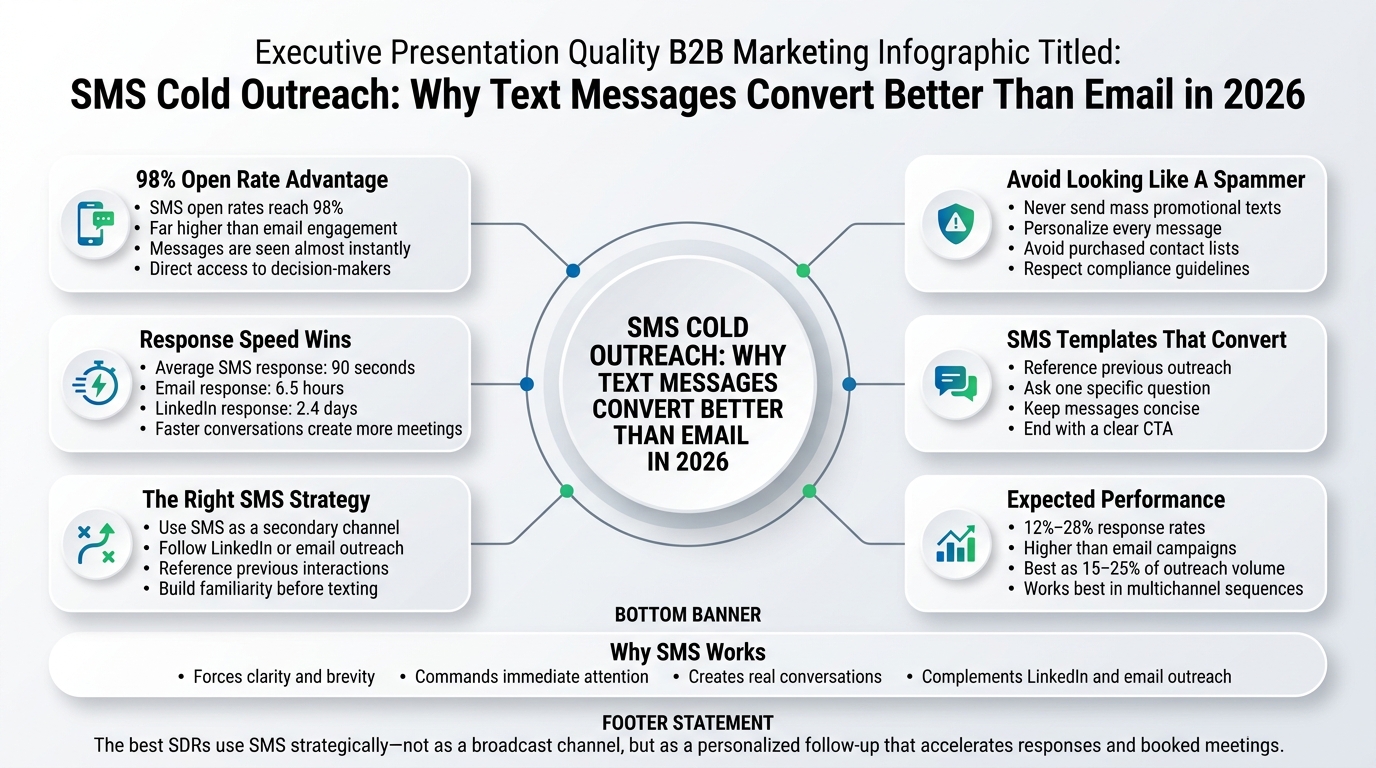
SMS has a 98% open rate. Not 30%. Not 45%. 98%. And here’s where it gets interesting: the average response time to an SMS is 90 seconds, compared to 6.5 hours for email and 2.4 days for LinkedIn. That gap is everything.
But SMS as a cold outreach channel lives in a weird space. Most SDRs treat it like spam. They send mass promotional texts and wonder why they get reported or ignored. The ones who get results treat SMS like a direct line of communication, not a broadcast tool. They’re selective about when they use it, personal about how they use it, and strategic about what they’re asking for.
How to Use SMS Without Looking Like a Spammer
The first rule of SMS cold outreach: never start with SMS. I know that sounds contradictory given the title of this section, but here’s the nuance. SMS works best as a secondary channel after you’ve already established some form of connection. You sent a LinkedIn message that didn’t get a response? SMS might work. You emailed someone and got no reply, but you have their number? SMS could be the breakthrough. You connected on LinkedIn, and they accepted? SMS becomes viable.
The setup matters enormously. If you’re sourcing numbers from a list broker and sending cold SMS to people who have no idea who you are, your unsubscribe rate will be astronomical, and your sender reputation will tank. SMS providers (Twilio, Plivo, MessageBird, etc.) are increasingly strict about cold outreach, and rightfully so.
But when SMS is used as part of a broader sequence, after some baseline familiarity exists, the results are genuinely impressive. I’ve seen teams add SMS as a third touch (after LinkedIn and email) and watch their meeting booking rate increase by 40%. Why? Because the medium itself commands attention in a way text-based communication no longer does.
The SMS Template That Actually Works
What separates effective SMS cold outreach from spammy SMS is personalization and brevity. Here’s the structure that converts:
Message 1 (Reference point): “Hi [Name], quick follow-up on the message I sent on LinkedIn about [specific detail]. Did it get buried?”
Message 2 (Shifted angle): “Hey [Name], trying a different approach. One quick question: is [specific pain point relevant to their role] on your team’s radar right now?”
Message 3 (Offer a narrow ask): “[Name], last attempt. Would you be open to a 15-minute call next Tuesday or Thursday to discuss [specific outcome they care about]?”
The power here is that SMS forces brevity. You can’t ramble. You can’t send a novel. That constraint is actually a gift. Your message either hooks them in 160 characters or it doesn’t. This is why SMS cold outreach works. It forces clarity.
SMS Response Rates and Realistic Expectations
Let’s be honest about numbers. If you’re doing SMS outreach the right way (as a secondary channel, after some warm contact, highly personalized), expect response rates between 12% and 28%. That’s significantly higher than email or LinkedIn, but it’s not a magic bullet. The quality of the number, the relevance of your angle, and the strength of your offer all matter enormously.
I’ve seen teams that treat SMS like an emergency channel (only use it when they absolutely need a response) maintain higher engagement. I’ve seen teams that spam SMS lose access to the channel entirely because providers shut them down for abuse. The difference is discipline.
The realistic play: SMS should represent maybe 15% to 25% of your total outreach volume, used strategically as a secondary touch after other channels haven’t converted.
Video Cold Outreach: The Fastest Way to Build Trust and Stand Out
Here’s a fact that feels obvious once you say it out loud: people connect with people. Text doesn’t convey tone, sincerity, or expertise the way a human voice and face do. Video does. And in a crowded outreach landscape where everyone is sending text, video is the modern equivalent of a handwritten note.
Video prospecting isn’t new. But the tools have gotten exponentially better, cheaper, and easier to use. Tools like Loom, BombBomb, Hippo Video, and Wistia have made it possible to record a personalized 45-second video in 90 seconds, without any production knowledge or equipment beyond your laptop.
Why Video Converts Higher Than Written Outreach
The numbers are striking. When video is added to an outreach sequence, reply rates increase by 40% to 60%. Meeting booking rates jump by 25% to 40%. Why? Several reasons converge.
First, novelty. Most of your prospect’s outreach is written text. A personalized video stands out immediately. They notice it. They click it. The fact that you took time to record something specifically for them signals that you’re not blasting 1,000 identical messages.
Second, authenticity. In a text message, you can be anyone. In a video, you’re real. They see your face, hear your voice, and read your energy. That authenticity creates a different kind of trust than a perfectly polished email signature.
Third, context transfer. A 45-second video can transfer more context than a 200-word email. You can reference their recent article, their company announcement, their LinkedIn post, and show genuine understanding without seeming like you’re reciting a script. That specificity is what separates real outreach from templated spam.
The Video Prospecting Template That Works
The structure matters. A rambling, 3-minute personal video is just awkward. Here’s the template that converts:
Seconds 0 to 5: “Hey [Name], I came across [specific trigger] and thought of you immediately. Quick 45-second video for context.”
Seconds 5 to 30: “Here’s what caught my attention: [show their work, reference a post, mention something from their LinkedIn profile]. We’ve seen similar situations with [one relevant company], and the challenge usually boils down to [specific problem they likely face].”
Seconds 30 to 40: “I’m not sure if that’s relevant for you, but I thought it was worth a conversation. Would you be open to 15 minutes next Thursday to explore if there’s a fit?”
Seconds 40 to 45: “Let me know. Talk soon.”
That’s it. Short, specific, respectful of their time, and it can be recorded in real time without any production value. No background music, no editing, no green screen. Just you, genuine, and relevant.
Tools and Execution Strategy for Video Prospecting
The tools have democratized video outreach. Loom is the standard because it integrates with Gmail and LinkedIn. You record your video, it generates a unique link, and you embed it in your message. The prospect clicks it, watches your video, and you get notified immediately if they did (or didn’t). That engagement data is gold.
BombBomb goes further and allows you to embed video directly in your email, so they see a play button instead of a link. The conversion difference is measurable. Hippo Video and Wistia offer similar functionality with different pricing models.
But here’s what separates teams that succeed with video from teams that don’t: they’re selective. They don’t send a video to every single prospect. That’s overwhelming. They use video for high-value prospects, for prospects who didn’t respond to the first two touches, and for deals where the conversation is moving but they need an edge.
The execution: send your first touch via LinkedIn or email (written). If no response after 3 to 5 days, send a video follow-up. If still no response after another 5 days, send one more message (written or video, depending on how much you value the opportunity). Then move on. This discipline maintains your sender reputation and keeps your outreach from feeling overwhelming.
Social Media Prospecting Beyond LinkedIn: TikTok, Instagram, and YouTube as Outreach Channels
LinkedIn owns the position of “professional network,” but it does not own the attention of all professionals. That’s the key insight that most outreach strategies miss. An HR leader might spend 2 hours a week on LinkedIn and 45 minutes a day on Instagram. A marketing director might barely touch LinkedIn but live on Twitter. A sales executive in their twenties probably finds their information through YouTube and TikTok recommendations, not LinkedIn job searches.
Cold outreach strategies beyond linkedin, email marketing and social media means taking seriously the platforms where your actual ICP actually spends time.
TikTok as a Prospecting Channel: Building Authority Through Short-Form Video
TikTok prospecting is not about your company going viral. That’s a misunderstanding. It’s about understanding that decision-makers are on TikTok, consuming content about industry trends, and one of those decision-makers might see a video you made, visit your profile, see your credibility markers, and reach out to you.
More directly, though, you can use TikTok to identify prospects and reach out to them. Many professionals have both a public and professional presence on TikTok. They engage with content in their industry. They follow thought leaders. You can identify who’s engaging, who’s influential in their space, and approach them as someone who understands their world enough to contribute meaningfully to a conversation.
The approach: Create original, valuable content on TikTok that demonstrates expertise in your space. It doesn’t have to be polished. A 30-second breakdown of a common problem in your industry, a quick industry trend analysis, or a behind-the-scenes look at your company’s work. The content builds familiarity. Then, when you reach out to a prospect who has watched some of your content (or who follows similar accounts), your outreach feels less cold and more like a continuation of a conversation.
This takes time to build, but the long-term positioning advantage is significant. A prospect who has seen five of your TikTok videos before you reach out to them views you completely differently than someone who’s reading your name for the first time in a message.
Instagram and YouTube: Direct Messaging and Community Building
Instagram DMs are dramatically underutilized for B2B outreach. Most B2B companies think Instagram is “marketing,” not “sales.” But Instagram DMs, especially to people you follow, have surprisingly high open rates and lower spam filters than LinkedIn or email.
The approach is straightforward. Follow prospects in your ICP. Engage genuinely with their posts (comment thoughtfully, don’t spam). Then, after a few meaningful interactions, send a direct message that’s specific and human. “I’ve been following your work on [specific topic] and your recent post about [specific thing] is exactly what we’re seeing with [relevant example]. Would you be open to a quick conversation about it?”
YouTube is different but equally powerful. If your prospect has uploaded videos, commented on videos, or maintains a channel, they’re demonstrating a different kind of authority and accessibility than they would on LinkedIn. Reaching out via YouTube comment (on a public video they posted) or through YouTube messaging (if they have it enabled) feels less intrusive and more peer-to-peer.
Building Authority on Social Media First, Then Outreach Second
The most sustainable approach to social media prospecting involves a two-phase strategy. Phase one is building genuine authority and presence on the platforms where your ICP spends time. Share insights, comment thoughtfully on others’ content, build genuine community, and create a reputation as someone worth listening to.
Phase two is then doing outreach, but from a position of familiarity and credibility. Your prospect has likely seen you. They know your perspective. They understand what you do. Your outreach feels like the next logical step in an emerging relationship, not a random cold message.
This isn’t faster than traditional outreach in the short term. It takes consistent effort to build presence. But it’s dramatically more scalable and effective in the medium term because your outreach comes from a foundation of established credibility.
Building an Integrated Multi-Channel Outreach Sequence That Actually Works
Knowing the tactics is one thing. Orchestrating them into a coherent system is another. The teams that see the best results aren’t picking one channel and mastering it. They’re building sequences where each channel plays a specific, strategic role.
Here’s what an effective integrated sequence looks like for a warm prospect (someone you’ve identified, researched, and built some context about):
The Integrated Outreach Sequence Template
Day 1 (LinkedIn): Send a personalized connection request. Reference something specific from their profile or recent posts. Don’t pitch anything. Just demonstrate that you’ve done research and that there’s a reason you’re connecting.
Day 4 (LinkedIn or Email): If they accepted the connection, send a message referencing something specific about their company or role. If they didn’t accept, send an email to their business address with similar context. Share a specific insight or piece of content relevant to their likely challenges. Ask a genuine question.
Day 8 (Email): Send a follow-up email. Assume the LinkedIn message wasn’t seen. Introduce yourself more formally, but keep it short. Reference the insight or question from the previous message. Include one valuable resource or piece of content that addresses a problem relevant to their role.
Day 12 (Video): If there’s been no response, send a personalized video. This is your chance to break through. Record a quick 45-second video directly addressing something from their LinkedIn profile or company news. Keep it human, specific, and focused on demonstrating understanding rather than pitching.
Day 16 (SMS or Social): If the prospect has a clear phone number or an accessible Instagram/Twitter account, try a different channel. An SMS saying “Hey [Name], tried reaching you via email/LinkedIn. Thought this might be faster” can work. Or a DM on Instagram saying something similar. Change the format, not the message.
Day 20 (Decision point): Assess what you’ve learned from their engagement (or lack thereof). If there’s been zero response, do you move to nurture? Do you try one more channel? Do you cut bait and move to the next prospect? This is a judgment call based on how much you value the opportunity and how much signal they’ve given you.
The key principle: each touch is orchestrated to address a specific gap. LinkedIn breaks the ice. Email delivers substance. Video builds connection. SMS and social create urgency or accessibility. Together, they create a complete picture of who you are and why you’re relevant.
Channel Selection Based on Prospect Persona and Context
Not every prospect gets the same sequence. Seniority, industry, company size, and personal platform preferences should inform your channel mix.
For C-suite executives: Heavy on direct outreach through multiple channels (email, SMS, Twitter). Lighter on LinkedIn because they’re often less engaged there. Video becomes particularly important because they’re evaluating whether you’re worth time.
For managers and individual contributors: Traditional LinkedIn and email remain relevant, but video and social add significant value. They’re more likely to be on multiple platforms.
For younger personas (Gen Z, younger millennials in decision-making roles): More weight on social platforms, less on traditional email, strategic use of SMS. They’re more likely to engage with video and informal channels.
For highly visible, content-creating prospects: Engage through the platforms where they’re most active. If they’re active on Twitter, reach out there. If they maintain a YouTube channel, reference their content. Meet them on their home platform.
Multi-Channel Messaging Consistency and Variation
Here’s a nuance that separates sophisticated outreach from amateurish spray and pray: your core message stays consistent across channels, but the format and medium shift.
You might say “We’ve helped [industry] companies reduce [pain point] by [specific mechanism]” in an email. On SMS, you’d tighten it to “We help [industry] companies reduce [pain point]. Worth 15 min?” The core insight is the same. The delivery is medium-appropriate.
This consistency builds credibility. The prospect encounters the same core value proposition across multiple channels, which compounds the message impact without feeling repetitive.
Tracking, Attribution, and Learning From Your Multi-Channel Sequence
Most outreach teams track LinkedIn replies and email replies. Fewer track which channel actually drove the meeting. This is where data discipline matters. You need to know: Did the SMS convert them, or did the video? Did the social engagement lay groundwork that email closed, or was SMS the actual conversion touch?
Use UTM parameters in your email links. Use Loom’s engagement tracking for video. Track which channel they responded from. Over time, patterns emerge. Maybe video is your strongest channel for your ICP. Maybe SMS is only valuable after certain conditions. Maybe social engagement is critical for a specific persona but irrelevant for another.
This isn’t about changing your sequence based on a small sample size. It’s about building institutional knowledge over time so that your outreach gets more sophisticated and efficient with every campaign.
Mistakes in Multi-Channel Cold Outreach and How to Avoid Them
Mistake #1: Channel Surfing Without Strategic Intent
Teams often add channels without a clear hypothesis about why. They hear SMS works, so they start blasting SMS. They hear TikTok is valuable, so they launch a TikTok presence tomorrow. This creates friction, inconsistency, and wasted effort.
The fix: Choose channels based on where your specific ICP spends attention, not where every ICP might. Do research. Survey your existing customers. Check where your competitors are active. Build a presence intentionally, not reactively.
Mistake #2: Not Respecting Channel Norms
SMS has norms (be brief, be respectful of time, don’t spam). TikTok has norms (be authentic, don’t over-sell). Email has norms (provide value, respect the inbox). LinkedIn has norms (professional tone, connection-building first). Teams that ignore these norms get filtered, reported, or blocked.
The fix: Spend time on each channel observing what works. Notice what messages get engagement. Notice what gets ignored. Model the behavior of successful users in that space before you try to sell anything.
Mistake #3: Treating Outreach as Broadcast Instead of Conversation
Cold outreach isn’t TV advertising. It’s not “get my message in front of 1,000 people and see who sticks.” The math only works if you’re solving for relevance and conversation, not volume and impressions.
Teams that succeed send fewer, more thoughtful messages. They research deeper. They reference more specifically. They follow up more carefully. Their response rates are higher because their hit rate is higher.
Mistake #4: Ignoring Compliance and Reputation
GDPR, CCPA, TCPA (for SMS), and various platform terms of service all have implications for cold outreach. Violating them can shut your outreach down fast. Beyond legal, your sender reputation matters. ISPs track complaint rates on your domain. SMS providers track unsubscribe rates. LinkedIn tracks connection patterns. Abuse any of these, and your outreach channels get severely constrained.
The fix: Understand the rules on each channel. Use compliant list sources. Honor unsubscribe requests immediately. Monitor your engagement metrics closely. Never assume you can outsmart the system.
Detailed Comparison Table: Cold Outreach Channels and Their Effectiveness
| Channel | Response Rate | Time to Response | Setup Effort | Compliance Risk | Best For | Worst For |
|---|---|---|---|---|---|---|
| 8-15% | 2-4 days | Low | Medium | Building credibility, reaching senior professionals, discovering new prospects | Urgent conversions, prospects who avoid LinkedIn | |
| 5-12% | 6-8 hours | Low | Medium | Delivering substantive value, sequences, follow-ups | First touch with unknown prospects, decision-making urgency | |
| SMS | 12-28% | 90 seconds | Medium | High | Urgent follow-ups, secondary touches, driving immediate action | Cold outreach to unknown numbers, building initial relationships |
| Video Prospecting | 15-35% | 3-6 hours | Low | Low | High-value prospects, breaking through unresponsiveness, building trust | Scaling to 1000+ prospects, formal industries, senior executives in very traditional companies |
| Instagram DMs | 8-18% | 2-8 hours | Medium | Low | Reaching younger personas, creative industries, building authority first | B2B sales to CPOs or CFOs, formal decision-making processes |
| TikTok Outreach | 6-14% | 4-12 hours | High | Medium | Building long-term authority, reaching Gen Z decision-makers, establishing thought leadership | Immediate conversions, formal sales processes, older personas |
| Twitter/X DMs | 7-16% | 3-8 hours | Medium | Low | Reaching opinionated, influential personas, industry conversations | Introductions to unknown prospects, serious C-suite outreach |
| 25-40% | 30 seconds | Medium | Very High | Warm prospects, established relationships, urgent follow-ups | Cold outreach, unknown contacts, compliance-heavy industries |
Practical Steps to Implement Your First Multi-Channel Campaign
If you’re starting from scratch, here’s how to expand beyond LinkedIn and email without overwhelming yourself:
Week 1: Audit and Research Map where your ICP actually spends time. Survey your existing customers. Analyze your competitor’s presence. Choose two new channels that make sense (maybe SMS and video, or Instagram and video, depending on your ICP).
Week 2: Set Up Infrastructure Get accounts on your chosen new channels. Set up proper compliance (unsubscribe mechanisms for SMS, proper labeling, CRM integration). Test tools (Loom for video, Twilio for SMS, etc.). Practice recording a video.
Week 3: Run a Pilot Campaign Pick 20 to 30 prospects in your ICP. Run a full sequence (LinkedIn, email, new channel #1, new channel #2, or some variation). Track everything. Notice what works and what doesn’t.
Week 4-6: Refine and Scale Based on pilot results, adjust your templates, your channel mix, and your timing. Scale to your full prospect list using what you learned.
Conclusion
Cold outreach strategies beyond linkedin, email marketing and social media aren’t exotic or complicated. They’re just recognition of a simple fact: people are distributed across channels, and a complete outreach strategy meets them where they actually are.
The teams winning in outreach in 2026 aren’t trying to be omnipresent. They’re being strategic about channel selection, thoughtful about message consistency, and disciplined about respect for their prospect’s time and attention. They use SMS when follow-up speed matters. They use video when building trust is the leverage point. They use social platforms strategically to establish authority before selling anything.
Your next action: audit one of your campaigns. Was there a prospect who never responded to LinkedIn or email but might have engaged with video, SMS, or social? How many prospects are you losing because you’re only fishing in two ponds when they’re swimming in four or five? Start there.
Frequently Asked Questions
Q: What’s the realistic response rate if I start doing SMS outreach?
A: If you’re doing SMS as a secondary touch (after LinkedIn or email), with highly personalized messages to prospects who have shown some engagement or where you have warm contact, expect 12% to 28% response rates. Cold SMS to random numbers? Much lower, and you risk provider suspension.
Q: Should I use video for every single outreach message?
A: No. Use video strategically, for high-value prospects or prospects who didn’t respond to written outreach. Overusing video makes it lose its novelty advantage. Treat it as a breakthrough touch, not your primary outreach format.
Q: Is it legal to contact someone on Instagram or TikTok without explicit permission?
A: It depends on jurisdiction and platform, but generally yes, you can send a DM as long as it’s not spam and you’re following the platform’s terms of service. Be respectful, be specific, and don’t escalate to multiple messages if they ignore you.
Q: How do I find phone numbers for SMS outreach?
A: Data providers like Apollo.io, ZoomInfo, Clearbit, and RocketReach have phone numbers. However, verify that the numbers are current and that you have a lawful basis to contact via SMS under applicable regulations (TCPA in the US, for example).
Q: What’s the difference between cold SMS and marketing SMS?
A: Cold SMS is outreach to someone with whom you have no prior relationship, where you’re initiating contact for a sales conversation. Marketing SMS is messages to people who have explicitly opted in to receive promotional content. Different rules apply legally.
Q: If someone doesn’t respond to LinkedIn or email, is SMS always the next step?
A: Not always. It depends on your relationship depth, whether you have a valid phone number, and the industry context. For some ICPs, trying a different social platform or pausing makes more sense than immediately jumping to SMS.
Q: How many times should I contact a prospect across all channels?
A: A reasonable sequence is 5 to 7 touches across 2 to 3 weeks. Beyond that, you’re diminishing returns and potentially annoying them. Respect that they may not be interested.
Q: What’s the setup cost for adding SMS to my outreach?
A: SMS platforms like Twilio, Plivo, or Bandwidth charge $0.01 to $0.05 per SMS sent. For a list of 1,000 prospects with a full sequence, you’re looking at $50 to $250 in direct SMS costs, plus platform fees.
Q: Can I automate video prospecting?
A: Partially. You can automate the delivery of templated videos (where you’ve recorded a base video that gets personalized with the prospect’s name), but truly effective video is recorded individually. Templated video is better than no video but weaker than personal.
Q: What industries or personas do NOT respond well to video prospecting?
A: Highly formal industries (law, banking, deep enterprise sales) sometimes view unsolicited videos as intrusive. Very senior executives (C-level at large enterprises) are less likely to click unsolicited video links. Test with your specific ICP.
Q: How do I measure which channel drove a meeting?
A: Use UTM parameters in email links so you know if they clicked email. Use Loom or BombBomb analytics to see if they watched your video. Track which channel they responded from (their reply will tell you). Ask them during qualification: “How did you hear about us?” Their answer clarifies attribution.
Q: Is building presence on TikTok worth it if I’m B2B?
A: If your ICP includes anyone under 40 or decision-makers in creative/tech industries, yes. If your ICP is exclusively 55+ year old finance executives at Fortune 500 companies, probably not. Research your specific ICP’s media consumption.
Q: What happens if I violate SMS compliance rules?
A: SMS providers can suspend your account. You may face legal penalties under TCPA (in the US) or equivalent regulations elsewhere. Your sender reputation tanks, making it harder to do future outreach across channels.