


In the competitive landscape of modern sales and marketing, understanding your return on investment (ROI) isn’t just a nice-to-have metric—it’s absolutely essential for business survival. Cold outreach remains one of the most powerful yet misunderstood channels for generating new business, but without proper measurement frameworks, you’re essentially flying blind. If you’ve ever wondered whether your cold email campaigns are actually generating value or just burning through your marketing budget, this comprehensive guide will help you cut through the confusion and implement a data-driven approach to cold outreach ROI measurement.
The reality is that most businesses lack a clear understanding of what their cold outreach efforts are actually delivering. They send thousands of emails, track a few vanity metrics like open rates, and call it a day. But true cold outreach ROI measurement goes much deeper—it requires understanding the entire customer journey, attributing revenue correctly, and continuously optimizing based on real performance data.
What is Cold Outreach ROI and Why It Matters for Your Bottom Line
Before we dive into measurement tactics, let’s establish what we mean by cold outreach ROI. In its simplest form, cold outreach ROI is the ratio of profit gained from cold email and cold messaging campaigns relative to the costs invested in those campaigns. However, this definition only scratches the surface.
Cold outreach ROI measurement encompasses far more than just revenue divided by cost. It’s about understanding the complete picture of how your outbound efforts impact your business. This includes direct revenue from deals closed through cold outreach, the lifetime value of customers acquired through these channels, the cost per acquisition, the quality of leads generated, and the efficiency of your sales process.
The importance of measuring cold outreach ROI cannot be overstated. Here’s why:
First, it provides accountability. You need to know whether the resources you’re investing in cold outreach are actually generating returns. Without this data, decision-makers have no basis for budget allocation.
Second, it enables optimization. By measuring specific metrics at each stage of your outreach funnel, you can identify bottlenecks and inefficiencies. Maybe your open rates are excellent, but your response rates are abysmal—this tells you that your subject lines work but your email copy needs improvement.
Third, it facilitates strategic decision-making. When you understand which channels, audiences, and messaging approaches deliver the best ROI, you can double down on what works and eliminate what doesn’t. This is how you build a scalable, profitable outreach engine.
Fourth, it justifies continued investment. In times of budget cuts or economic uncertainty, teams with clear ROI data can defend their budgets and continue operations, while those without metrics often face cuts first.
What are the 6 Key Metrics for Cold Outreach ROI Measurement
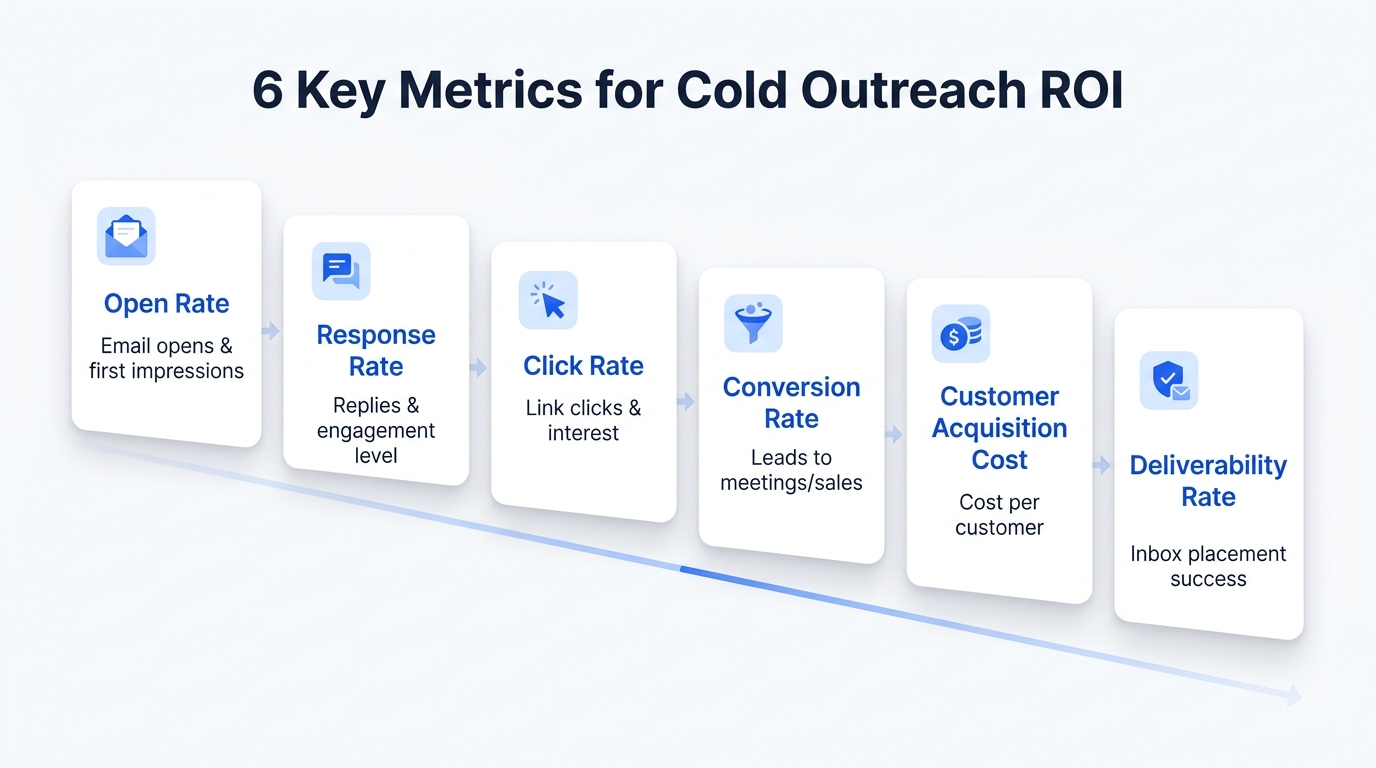
The foundation of any effective cold outreach ROI measurement system is understanding the key performance indicators that matter. Let’s break down each metric and explain why it matters.
1. Open Rate: Your First Impression Metric
The open rate represents the percentage of emails that recipients actually opened. If you send 1,000 cold emails and 350 of them are opened, your open rate is 35%.
Why it matters: Open rates are your first-stage funnel metric. They tell you whether your subject lines, sender name, and sending time are compelling enough to get people to click. An email that never gets opened can never generate a response or conversion.
Industry benchmarks: Across industries, average cold email open rates typically range from 15% to 25%, though high-performing campaigns can achieve 40% or higher. These benchmarks vary significantly by industry, with B2B SaaS typically seeing higher open rates than consumer products.
What impacts open rates:
- Subject line quality and relevance
- Sender reputation and domain authority
- Send time and recipient timezone
- Email list quality and segmentation
- Personalization level (generic blasts perform poorly)
How to improve: Test different subject line formats (questions vs. statements vs. urgency-based), experiment with sending at different times, ensure your sending domain has proper authentication (SPF, DKIM, DMARC), and focus on list hygiene.
2. Response Rate: Engagement That Matters
The response rate measures the percentage of recipients who actually replied to your email. This is fundamentally different from open rate because it indicates genuine engagement—the recipient not only opened your email but felt compelled to write back.
Why it matters: Response rates are the true measure of interest and relevance. A high open rate doesn’t mean much if people aren’t responding. Responses indicate that your message resonated with the recipient and that they saw value in engaging with you.
Industry benchmarks: Cold email response rates typically range from 2% to 5% for well-executed campaigns, with exceptional campaigns sometimes reaching 10% or higher. B2B campaigns generally achieve better response rates than B2C because of the nature of business decision-making.
What impacts response rates:
- Email copy quality and relevance
- Personalization depth (research-backed personalization vs. superficial personalization)
- Value proposition clarity
- Call-to-action strength
- Recipient segmentation (sending the right message to the right person)
- Follow-up sequencing
How to improve: Write email copy that speaks to specific pain points, demonstrate that you’ve researched the recipient, include specific social proof relevant to their situation, and implement a thoughtful follow-up sequence (typically 3-5 follow-ups over 2-3 weeks).
3. Conversion Rate: From Interest to Actual Sales
Conversion rate in cold outreach typically refers to the percentage of responses that move to the next stage—whether that’s scheduling a meeting, making a purchase, or another desired action. Some teams define this as the percentage of opens that lead to conversions.
Why it matters: This metric bridges the gap between engagement and business outcomes. It tells you how effectively you’re converting interest into actual opportunities.
Industry benchmarks: Conversion rates vary dramatically by industry and sales cycle length. For SaaS companies with longer sales cycles, converting 5-10% of responses into qualified meetings is respectable. For lower-ticket items, conversion rates might be higher.
What impacts conversion rates:
- Follow-up responsiveness
- Sales qualification process
- Sales rep training and messaging
- Offer clarity and attractiveness
- Sales process design
- Lead quality
How to improve: Implement a robust follow-up process, train sales reps on handling cold outreach responses, create clear next-step instructions, offer incentives for taking action, and ensure your follow-up is timely (respond within a few hours for best results).
4. Customer Acquisition Cost (CAC): The Real Cost of a Deal
Customer Acquisition Cost is calculated by dividing the total costs of your cold outreach campaign by the number of customers acquired through that campaign. For example, if you spent $10,000 on a campaign and acquired 5 customers, your CAC is $2,000.
Why it matters: CAC tells you whether your outreach is economically viable. If your CAC exceeds your profit margin per customer, you have a problem. This metric also allows you to compare the efficiency of different channels.
How to calculate it properly:
CAC = (Total Campaign Costs) / (Number of Customers Acquired) Total Campaign Costs = Tool costs + Personnel costs + Infrastructure costs + Data acquisition costs + Creative development costs
What impacts CAC:
- Campaign efficiency at each stage
- Lead quality and targeting precision
- Sales team productivity
- Tool stack choices
- Outsourcing vs. in-house operations
How to improve: Improve targeting to reduce wasted outreach, optimize your sales process to close more deals, train your team more effectively, and eliminate inefficient processes.
5. Click Rate: Beyond Opening
Click rate measures the percentage of recipients who clicked a link in your email. This is particularly important if your cold outreach strategy includes driving traffic to a landing page or resource.
Why it matters: Clicks indicate a higher level of engagement than opens alone. Someone who clicks has gone beyond just reading your subject line—they’ve engaged with your message enough to take action.
Industry benchmarks: Average cold email click rates typically range from 2% to 5%, though well-designed emails with clear, compelling CTAs can achieve 10% or higher.
What impacts click rates:
- Link placement and prominence
- CTA clarity and urgency
- Landing page relevance
- Email design and formatting
- Trust signals
- Mobile optimization
How to improve: Use clear, action-oriented CTAs, ensure your landing page matches your email message, include relevant social proof, optimize for mobile viewing, and test different link placements and CTA formats.
6. Email Deliverability Rate: The Invisible Metric That Matters Most
Email deliverability rate refers to the percentage of emails that successfully reach the recipient’s inbox without bouncing or being filtered to spam. This metric is often overlooked but is absolutely critical—if your emails never reach the inbox, none of the other metrics matter.
Why it matters: Your email deliverability rate directly impacts all other metrics. If 30% of your emails go to spam, you’re only reaching 70% of your target list, which means your response rates, conversion rates, and CAC all suffer.
Industry benchmarks: Industry-standard deliverability rates should be 95% or higher. Anything below 90% indicates serious problems with your sending practices or infrastructure.
What impacts deliverability:
- Sender reputation and domain authority
- Authentication setup (SPF, DKIM, DMARC)
- Email list quality and validation
- Sending volume and patterns
- Email content (spam trigger words, links, formatting)
- ISP relationships
- Infrastructure setup
How to improve: Use authenticated domains, warm up new domains gradually, clean your email lists regularly, avoid spam trigger words, include clear unsubscribe options, and monitor bounce rates and feedback loops closely.
How to Calculate ROI for Cold Outreach Campaigns: A Step-by-Step Framework
Now that we understand the key metrics, let’s implement a practical framework for calculating your actual cold outreach ROI measurement.
Step 1: Define Your Metrics and Goals
Before launching any campaign, establish clear definitions and targets:
- Define what counts as a conversion: Is it a scheduled meeting? A qualified opportunity? An actual sale? Be specific.
- Establish baseline metrics: What are your current open rates, response rates, and conversion rates? These become your benchmarks.
- Set realistic goals: Goals should be ambitious but achievable. If your industry average open rate is 20%, targeting 35% is reasonable; targeting 70% is not.
- Determine your timeframe: Will you measure ROI weekly, monthly, or at campaign end?
Step 2: Calculate the Total Cost of Your Campaign
This is where many teams get it wrong. True cold outreach costs extend far beyond just the tool subscription.
Costs to include:
| Cost Category | Examples | Typical Range |
|---|---|---|
| Personnel Costs | Salaries for outreach reps, sales reps, campaign managers | 40-60% of total cost |
| Tool Costs | Cold email platform, CRM, email warm-up tool | 5-15% of total cost |
| Data Costs | Lead list purchase, data enrichment, verification | 10-20% of total cost |
| Infrastructure | Email domain setup, authentication, hosting | 2-5% of total cost |
| Creative Development | Copywriting, testing, A/B experiments | 5-10% of total cost |
| Management & Overhead | Project management, analytics, optimization | 5-10% of total cost |
Example calculation:
- 1 outreach specialist @ $50,000/year = $4,166/month
- Cold email tool = $300/month
- Lead list & enrichment = $500/month
- Email domain & infrastructure = $100/month
- Total monthly cost = $5,066
Step 3: Calculate Revenue Generated From Your Campaign
This requires proper attribution and tracking:
- Track all deals that originated from cold outreach: Use UTM parameters, email subject line codes, or manual CRM notes.
- Calculate the revenue per deal: Don’t just count the number of customers; calculate the actual revenue they generated.
- Include lifetime value where relevant: If you’re in a subscription business, consider the lifetime value of acquired customers, not just the first payment.
- Account for sales cycles: In longer sales cycles, you may need to measure revenue attribution over extended periods.
Example calculation:
- Month 1: 50 emails sent → 8 responses → 2 meetings scheduled → 0 deals closed
- Month 2: 50 emails sent → 8 responses → 2 meetings scheduled → 1 deal closed ($15,000)
- Month 3: Follow-ups from previous months → 2 additional deals closed ($12,000 and $8,000)
- Total revenue from cold outreach (month 1-3 period) = $35,000
Step 4: Calculate the ROI of Your Cold Email Campaign
Now we bring it together:
ROI = ((Revenue Generated – Total Costs) / Total Costs) × 100
Using our example:
ROI = (($35,000 – $15,198) / $15,198) × 100
ROI = ($19,802 / $15,198) × 100
ROI = 130% ROI
This means that for every dollar spent on cold outreach, you generated $1.30 in profit.
Step 5: Analyze and Improve Your Cold Outreach ROI Measurement Results
ROI calculation is only valuable if you use it to drive improvements:
- Identify bottlenecks: Where are you losing the most prospects? At the open stage? The response stage?
- Compare segments: Do different industries, company sizes, or personas respond differently?
- Calculate metrics by stage: Know your open rate, response rate, and meeting-to-deal rate for each segment.
- Benchmark against goals: How did actual performance compare to your targets?
- Identify high-performers: Which emails, subject lines, or campaigns generated the best ROI?
- Plan improvements: Based on data, what will you change for the next iteration?
5 Critical Factors That Impact Your Cold Outreach ROI
Understanding these factors helps explain why your ROI is what it is and where to focus optimization efforts.
1. Sales Team and Employee Hiring Costs
Your personnel costs often represent 40-60% of your total cold outreach investment. The quality and productivity of your sales team directly impacts ROI.
Key considerations:
- Experience level: A junior outreach specialist might cost $35,000/year but close fewer deals than a senior rep at $80,000/year. Calculate deals per dollar spent.
- Training and onboarding: Well-trained reps are more productive. Factor in training costs upfront.
- Attrition rates: High turnover means constantly rebuilding skills and relationships. This hidden cost significantly impacts ROI.
- Blended rates: Different outreach specialists may have different productivity levels. Track individual contribution to ROI.
Optimization strategy: Calculate ROI per team member. This reveals which team members are most productive and who might need additional training or different role placement.
2. Cold Email Outreach Tool Costs
The right tools amplify your team’s productivity, but the wrong tools waste money.
Cost considerations:
- Monthly platform fees: Range from $50/month for basic tools to $500+/month for enterprise solutions
- Per-contact charges: Some platforms charge based on the number of prospects in your database
- Add-on costs: Integrations, advanced features, and additional seats increase costs
- Hidden switching costs: Moving platforms requires data migration, team retraining, and workflow disruption
Optimization strategy: Choose tools based on your specific workflow needs and scale. A solo founder sending 200 emails/week needs different tools than a team sending 10,000 emails/week. Track the productivity gains from your tools to ensure ROI.
3. Email Infrastructure and Technical Costs
Many teams underestimate the cost of proper email infrastructure.
Cost considerations:
- Domain setup and management: $10-20/year per domain, but you may need multiple domains
- Email warm-up tools: $30-100/month to maintain domain reputation
- SMTP services: If you’re not using your email provider’s native SMTP, alternative services cost $20-100/month
- Email validation and cleaning: $50-200/month to verify your list
- Monitoring and analytics: Dedicated services to track deliverability cost $20-100/month
Optimization strategy: Proper infrastructure improves deliverability, which directly impacts all other metrics. The ROI on infrastructure spending is often the best in your entire operation.
4. Lead Data Acquisition and Enrichment Costs
The quality of your leads determines everything downstream.
Cost considerations:
- List purchase: $0.10-0.50 per contact for basic lists; $0.50-2.00 for enriched data
- Data enrichment services: $100-1,000/month for adding company info, job titles, emails to existing contacts
- List validation: $0.01-0.05 per contact to verify email addresses are current
- Intent data: $500-5,000/month for tools that identify companies actively researching your solution
Optimization strategy: Better targeting reduces wasted outreach. Spending more on list quality and enrichment often improves overall ROI by dramatically improving conversion rates.
5. Ticket Size of Each Sale From Your Cold Outreach Campaign
This is the variable that most directly impacts ROI.
Critical analysis:
- High-ticket products ($10,000+): Can support higher CAC. A $50,000 product can support $5,000-10,000 in acquisition costs.
- Mid-ticket products ($1,000-10,000): Need tighter targeting and higher conversion rates. CAC should typically be 10-20% of deal value.
- Low-ticket products ($100-1,000): Require very efficient outreach. CAC should typically be less than 10% of deal value.
Optimization strategy: Know your break-even CAC for different products. If you’re selling multiple products, segment your outreach and ROI tracking by product line.
How to Improve Cold Outreach ROI: 5 Best Practices for 2026
Beyond measurement, here are the most effective strategies for improving your actual cold outreach ROI.
1. Refine Your Lead List: Quality Over Quantity
The foundation of cold outreach success is starting with the right list.
Implementation steps:
- Define your ideal customer profile (ICP): Create a detailed profile of your perfect customer including company size, industry, geography, revenue, technology stack, and pain points.
- Segment strategically: Don’t send the same message to everyone. Segment by industry, company size, job function, or other relevant factors.
- Use intent data: If possible, layer in intent data to identify companies actively researching solutions in your space.
- Clean aggressively: Remove duplicate emails, invalid addresses, and known unresponsive contacts regularly.
- Validate before sending: Use email validation tools to verify list quality before investing in outreach.
Expected impact: Better list quality typically improves response rates by 30-50% and dramatically improves deliverability.
2. Write Cold Emails That Convert: The Psychology of Persuasion
Email copy is where most cold outreach campaigns fail.
Proven formula:
- Subject line: Create curiosity or address a specific pain point. Avoid generic openers like “Quick question” or “Interested in…”
- Personalized opening: Reference something specific about them—a recent article they published, a mutual connection, a company announcement
- One clear pain point: Don’t list five problems. Focus on the single biggest challenge relevant to your prospect
- Specific social proof: Don’t say “we help companies grow.” Share a concrete result: “We helped $100M+ SaaS companies reduce sales cycles by 30%”
- Single clear ask: One specific ask, not multiple options
- Signature: Keep it minimal—name, title, company, phone number
What not to do:
- Don’t lie about mutual connections
- Don’t use clichés (“I hope this email finds you well”)
- Don’t make it about you
- Don’t use multiple exclamation marks or unnecessary formatting
- Don’t use phrases that feel salesy (“take advantage of,” “limited time”)
Expected impact: Well-written emails typically achieve 40-60% higher response rates than generic templates.
3. Choose the Right Tools for Every Stage of Outreach
Different tools serve different purposes in your workflow.
Essential tools for a complete stack:
- Outreach platform: For managing campaigns and sequencing (Lemlist, Instantly, Outreach.io, HubSpot, etc.)
- Email warm-up: To maintain domain reputation (Lemlist’s warm-up, Instantly’s warm-up, Superhuman, etc.)
- Email validation: To clean lists (ZeroBounce, NeverBounce, BriteVerify, etc.)
- CRM: To track conversations and opportunities (HubSpot, Salesforce, Pipedrive, etc.)
- Email finder: To discover email addresses (Hunter.io, RocketReach, Apollo, Clearbit, etc.)
Optimization strategy: Don’t just accumulate tools. Each tool should solve a specific problem and integrate with your existing workflow. Track the cost and value of each tool quarterly.
4. Track and Analyze Results Continuously
What gets measured gets managed.
Key dashboards to build:
- Campaign-level dashboard: Open rate, response rate, conversion rate, ROI for each campaign
- Segment-level analysis: How do different industries, company sizes, or personas perform?
- Email-level performance: Which subject lines, email templates, and CTAs perform best?
- Rep-level productivity: Which team members generate the best ROI?
- Timeline analysis: How long from email to response? Response to meeting? Meeting to deal?
Monthly review process:
- Review overall campaign metrics vs. goals
- Identify top-performing segments and campaigns
- Analyze low-performing segments for improvement areas
- Make data-driven adjustments to subject lines, email copy, or targeting
- Plan experiments for the next month
Expected impact: Teams that review and optimize monthly improve ROI by 20-30% quarter-over-quarter.
5. Write Perfect and Strong Calls-to-Action
Your CTA is the bridge between interest and action.
Strong CTA principles:
- Specific: Instead of “Let’s chat,” try “Let’s schedule a 15-minute call Wednesday or Thursday?”
- Low friction: Make it easy to say yes. Don’t require them to figure out how to respond.
- Urgent but not pushy: “I have a few slots this week” creates urgency without being aggressive.
- Question format: CTAs phrased as questions get higher response rates than statements.
- Social proof: “Several founders we work with have found value in a brief conversation” reduces resistance.
Testing your CTA:
- Test question format vs. statement format
- Test specificity (specific times/dates vs. vague “let’s chat”)
- Test different levels of social proof
- Test single ask vs. multiple options
Which Industries Benefit Most From Cold Outreach?
Understanding which industries generate the best ROI helps you benchmark expectations and refine strategy.
1. SaaS Software Business
Why it works: Clear ROI, longer sales cycles requiring education, multiple stakeholders to influence
Typical benchmarks:
- Average CAC: $2,000-8,000 depending on average deal size
- Payback period: 6-12 months
- Response rates: 3-8% for well-executed campaigns
Optimization focus: Education about your platform, social proof from similar companies, case studies with specific metrics
2. Marketing and Advertising Agencies
Why it works: Agencies understand ROI and are open to new vendor relationships, decision-makers are accessible
Typical benchmarks:
- Average CAC: $1,500-4,000
- Payback period: 3-6 months
- Response rates: 4-10%
Optimization focus: Time-saving benefits, case studies showing results for clients, exclusive agency partnerships
3. Recruitment and IT Staff Agencies
Why it works: High-volume hiring, clear ROI calculation, commission-based models that align incentives
Typical benchmarks:
- Average CAC: $500-2,000
- Payback period: 1-3 months
- Response rates: 5-12%
Optimization focus: Volume metrics, speed of placement, candidate quality
4. Real-Estate and Property Investment
Why it works: High-ticket deals, tight-knit networks, relationship-driven sales
Typical benchmarks:
- Average CAC: $3,000-10,000+
- Payback period: 2-6 months
- Response rates: 2-5% (lower volume but higher value)
Optimization focus: Deal showcase, neighborhood insights, exclusive investment opportunities
5. Financial Companies
Why it works: Complex products requiring explanation, high-value transactions, regulated industry means relationships matter
Typical benchmarks:
- Average CAC: $2,000-7,000
- Payback period: 6-12 months
- Response rates: 2-6%
Optimization focus: Regulatory expertise, risk mitigation, portfolio performance examples
Practical Examples of Cold Outreach ROI Measurement in Action
Let’s look at real-world scenarios to ground this in practice.
Example 1: SaaS Cold Outreach Campaign
Campaign details:
- Target: VP of Sales at Series A/B SaaS companies
- Outreach volume: 500 emails over 3 weeks
- Tools: Cold email platform, email validator, HubSpot CRM
- Team: 1 outreach specialist, 1 sales rep for follow-ups
Results:
- Emails sent: 500
- Delivered: 480 (96% deliverability)
- Opens: 168 (35% open rate on delivered)
- Responses: 21 (4.2% response rate on delivered)
- Meetings booked: 12 (57% conversion from response to meeting)
- Deals closed: 2 (17% conversion from meeting to deal)
- Average deal value: $25,000
- Sales cycle: 45 days
Cost breakdown:
- Outreach specialist salary (3 weeks): $2,000
- Sales rep follow-up (6 weeks): $3,000
- Cold email tool: $200
- Email validator: $50
- List purchase & enrichment: $400
- Total cost: $5,650
ROI calculation:
- Revenue generated: $50,000 (2 deals × $25,000)
- Total cost: $5,650
- Profit: $44,350
- ROI: 785%
This demonstrates why cold outreach can be such a high-ROI channel when executed properly.
Example 2: Agency Services Cold Outreach
Campaign details:
- Target: CMOs at mid-market companies (100-1,000 employees)
- Outreach volume: 1,000 emails monthly
- Team: 2 outreach specialists, 1 account executive
- Average deal value: $8,000 (3-month project)
Results (first month):
- Opens: 280 (28%)
- Responses: 42 (4.2%)
- Discovery calls booked: 18 (43%)
- Proposals sent: 8 (44%)
- Deals closed: 2 (25%)
Results (second month – optimized):
- Opens: 320 (32%)
- Responses: 58 (5.8%)
- Discovery calls booked: 26 (45%)
- Proposals sent: 12 (46%)
- Deals closed: 4 (33%)
Cost comparison:
| Metric | Month 1 | Month 2 |
|---|---|---|
| Total Cost | $8,000 | $8,000 |
| Revenue Generated | $16,000 | $32,000 |
| ROI | 100% | 300% |
This shows how optimization improves ROI without increasing costs—by improving email copy and targeting in month 2, they doubled revenue while maintaining the same budget.
Conclusion
Cold outreach ROI measurement isn’t a one-time exercise—it’s an ongoing practice that gets better and more sophisticated over time. The teams that excel at cold outreach aren’t necessarily the ones with the most advanced tools; they’re the ones that obsessively measure, learn, and optimize based on data.
Start with the basics: define your key metrics, calculate your costs accurately, track revenue attribution carefully, and calculate ROI honestly. Then establish a regular review rhythm where you analyze results, identify bottlenecks, and test improvements.
Over time, you’ll develop sophisticated segment-level insights: which industries generate better ROI, which messaging approaches resonate most, which team members are most productive, and which stages of your funnel need the most attention.
This data-driven approach transforms cold outreach from a guessing game into a predictable, scalable revenue engine. Whether you’re just starting with cold outreach or looking to optimize mature campaigns, implementing rigorous cold outreach ROI measurement will unlock significant growth and efficiency gains.
The companies winning in sales today aren’t the ones sending the most emails—they’re the ones measuring the most carefully and learning the fastest.
Frequently Asked Questions
1. What is a Good ROI for a Cold Email Campaign?
This depends significantly on your industry and deal size. Generally:
- Low-ticket products ($100-500): 100-200% ROI is solid (you need efficiency due to low revenue per deal)
- Mid-ticket products ($1,000-10,000): 300-500% ROI is achievable
- High-ticket products ($10,000+): 500%+ ROI is realistic even with lower volume
However, benchmarking against your own baseline matters most. If your campaign improves ROI by 25% month-over-month, you’re moving in the right direction.
2. How Do I Calculate the ROI of My Cold Email Campaigns?
Follow these steps:
- Calculate total costs: Personnel + tools + data + infrastructure + overhead
- Track revenue attribution: Tag all deals coming from cold outreach
- Calculate ROI: (Revenue – Costs) / Costs × 100
Use UTM parameters, unique tracking codes in email signatures, or CRM source fields to ensure accurate attribution.
3. Does Cold Emailing Really Work?
Yes, cold emailing absolutely works when executed properly. The evidence is overwhelming:
- Companies using cold outreach report 3-5x better response rates when focusing on personalization
- High-performing campaigns achieve 30%+ open rates and 5%+ response rates
- Many companies report that cold outreach is their highest-ROI sales channel
- Even in crowded niches, proper list segmentation and targeting yield results
The key is implementation quality. Generic, untargeted cold email campaigns don’t work. Research-backed, personalized, value-driven cold outreach campaigns work exceptionally well.
4. Should I Outsource Cold Outreach or Keep It In-House?
This depends on your scale and resource allocation:
Keep in-house if:
- You have unique insights into your market
- Deal values are high (outsourcing becomes too expensive)
- You’re early stage and need to control messaging
- You have an experienced outreach person
Outsource if:
- You need to scale quickly
- You want to focus your team on sales and delivery
- You can’t attract outreach talent internally
- You need specialized expertise in specific industries
Most successful companies use a hybrid: in-house strategy and optimization, outsourced execution at scale.
5. What’s the Typical Sales Cycle Length from Cold Outreach?
This varies dramatically by industry:
- B2B SaaS: 30-90 days average
- Marketing services: 15-45 days
- Recruitment: 5-15 days (fastest)
- Enterprise software: 90-180+ days
- Real estate: 30-90 days
When calculating ROI, remember to account for sales cycle length. If your sales cycle is 120 days, you won’t see full ROI for 120+ days from campaign launch.
6. How Often Should I Review and Optimize My Cold Outreach Campaigns?
Implement these review cycles:
- Daily: Check metrics dashboard for any obvious issues (deliverability drops, spam complaints)
- Weekly: Review response rates, identify technical issues
- Monthly: Full analysis of all metrics, plan experiments, optimize underperforming segments
- Quarterly: Strategic review of overall approach, ROI analysis, budget allocation decisions
7. What’s the Connection Between Email Deliverability and ROI?
Direct and critical. If 20% of your emails go to spam, you’re operating at 80% efficiency. Every metric suffers:
- 20% fewer opens
- 20% fewer responses
- 20% lower revenue
- 20% higher CAC
A 5% improvement in deliverability often has a bigger impact on ROI than a 5% improvement in response rates because it improves all downstream metrics simultaneously.