


Pick the wrong LinkedIn outreach tool and you waste months. Not because the tool is broken — most of them work fine — but because they’re built for different problems. And if your problem doesn’t match what the tool solves, you’re running uphill from day one.
That’s the situation a lot of teams find themselves in when they’re choosing between DealsFlow and La Growth Machine. Both are legitimate outreach platforms. Both have paying customers who swear by them. But they’re solving different bottlenecks, and the one that’s right for you depends entirely on where your outreach is actually breaking down.
This post covers LinkedIn automation depth, multichannel capabilities, AI features, ease of use, pricing, and who each tool is actually built for. No filler. No “both are great tools” hedging. Here’s what actually matters.
Quick Overview: What Each Tool Actually Does
Before getting into features, it helps to understand the core bet each product is making.
DealsFlow
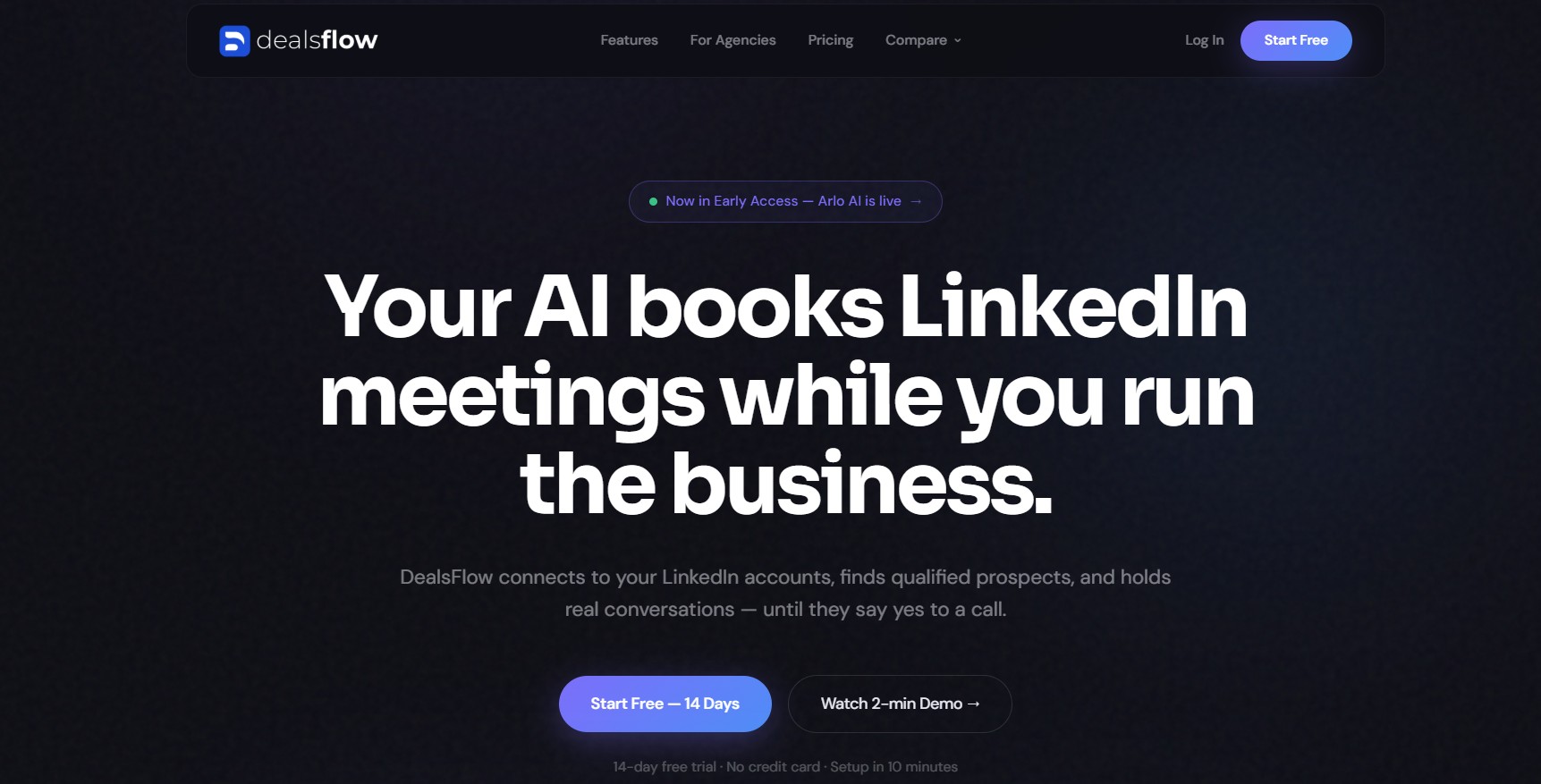
DealsFlow is a LinkedIn-first outreach automation platform built around a specific insight: most tools stop doing useful work the moment a prospect replies. They automate the send, and then they leave you with an inbox full of “Interested, tell me more” messages and no scalable way to handle them.
DealsFlow’s answer to that is Arlo AI — an AI engine that reads replies and continues the conversation autonomously. Prospect says they’re interested but want to know more about pricing? Arlo handles it. They push back on timing? Arlo responds. The sequence doesn’t just stop because a human entered the picture.
On top of that, DealsFlow has multi-sender inbox rotation built in as a native feature, not an add-on. You can run outreach across multiple LinkedIn accounts from one dashboard, which matters a lot if you’re an agency or a team doing serious volume.
The target buyer is SDRs, growth teams, and agencies doing LinkedIn outreach at scale who need AI to handle the post-reply work.
La Growth Machine
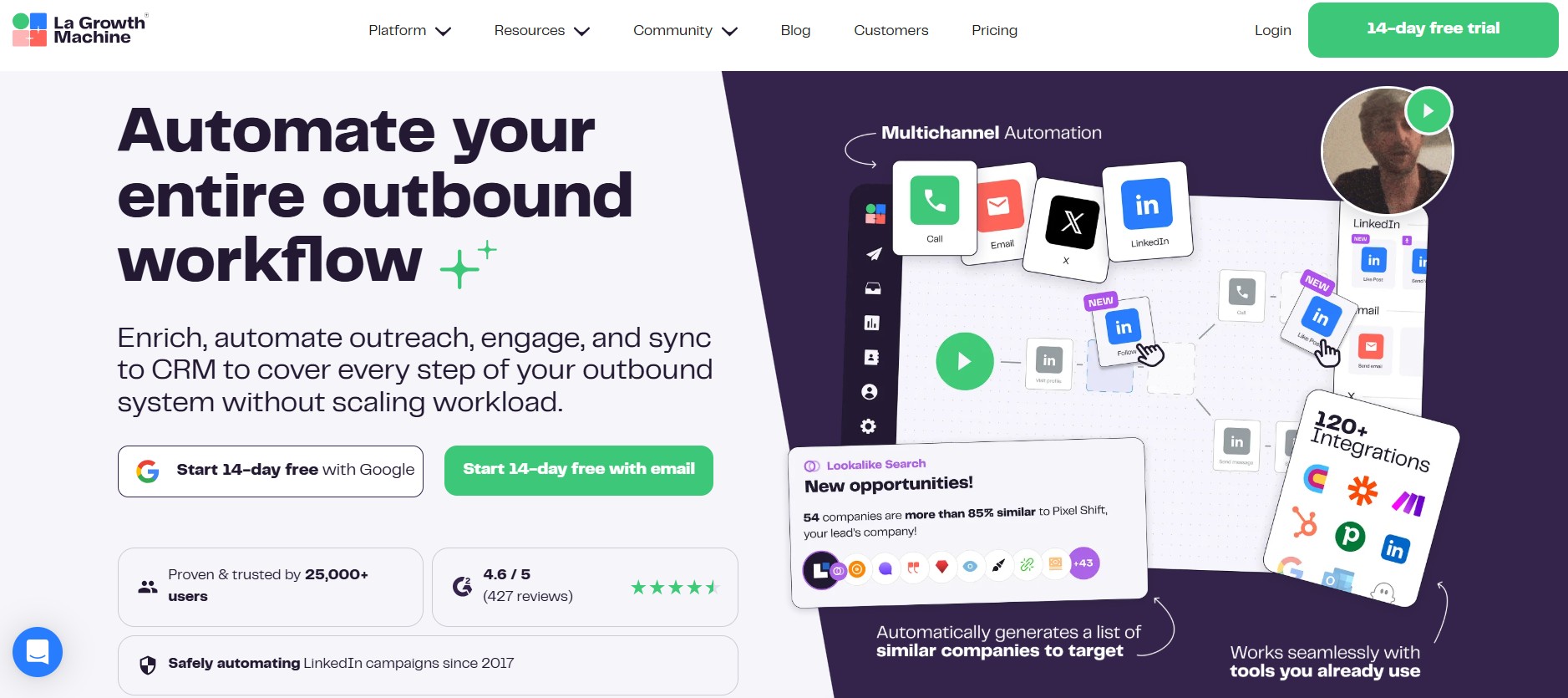
La Growth Machine (commonly called LGM) is a multichannel outreach platform that combines LinkedIn, email, and Twitter/X into a single sequence builder. The core pitch is visual, conditional workflow design — you drag and drop actions across channels, set conditions like “if no reply in 3 days on LinkedIn, send an email; if they reply anywhere, exit the sequence,” and let it run.
LGM also supports LinkedIn voice messages and phone calls within sequences, and has native CRM integrations with HubSpot and Pipedrive baked in at higher tiers.
The target buyer is sales teams and agencies that genuinely need LinkedIn and email (and sometimes Twitter) working together in a single automated sequence, with clean CRM sync.
Here’s the real framing: LGM covers more channels. DealsFlow goes deeper on what happens after someone replies on LinkedIn. These are genuinely different bets, and understanding that upfront saves a lot of time.
LinkedIn Automation: Feature by Feature
This is the core of the comparison. Let’s go through the features that actually move the needle.
Connection Requests and Message Sequences
Both tools handle the basics of LinkedIn outreach — automated connection requests, follow-up message sequences, profile visits, and drip-style campaign management. Neither is lacking here.
Where they diverge is in how they handle the logic. LGM’s sequence builder allows conditional branching across channels. You can literally say: if someone hasn’t replied on LinkedIn in 3 days, send them an email; if they reply on LinkedIn, move them to a different branch and exit the email thread. That kind of cross-channel conditional logic is genuinely useful when your outreach strategy spans multiple channels.
DealsFlow handles LinkedIn sequencing with multi-sender rotation built in from the ground up. You spread volume across multiple LinkedIn accounts to reduce per-account exposure, and manage everything from a single dashboard. LGM supports team-level access, but it isn’t architecturally built around multi-sender rotation the way DealsFlow is.
- LGM wins on multichannel conditional logic
- DealsFlow wins on LinkedIn-specific safety at scale through multi-sender rotation
Post-Reply Conversation Handling
This is where the tools split sharply, and honestly, this is the most important thing to understand about DealsFlow.
LGM is a sequencer. It automates the send side of outreach. The moment a prospect replies, automation stops and a human has to take over. That’s fine if you have the rep capacity to handle replies quickly and consistently. A lot of teams don’t.
DealsFlow’s Arlo AI is built for exactly that gap. When a prospect replies, Arlo reads the message, figures out what’s going on — positive response, objection, question, timing issue — and responds accordingly. If someone’s interested, Arlo moves toward booking a call. If there’s an objection, Arlo handles it with a professional rebuttal. A human can step in at any point, but Arlo is designed to run the middle-of-funnel conversation without needing someone hovering over the inbox.
For agencies managing outreach for multiple clients, or for lean SDR teams running high-volume campaigns, this is a serious operational difference. DealsFlow’s own FAQ puts it plainly: “Unlike tools that stop, Arlo reads the reply.”
- DealsFlow wins, and it isn’t particularly close
Voice Messages on LinkedIn
LGM supports LinkedIn voice messages natively, including an AI-generated voice feature that can personalize voice notes at scale by swapping in each prospect’s name using a recording of your actual voice. Multiple reviews of LGM specifically call this out as a differentiator that lifts reply rates.
DealsFlow does not currently support voice messages on LinkedIn.
- LGM wins
Multi-Sender and Team Outreach
DealsFlow is built around multi-sender from day one. The Agency Pilot plan supports 20 LinkedIn accounts, all managed from a single dashboard, with team management and custom workflows included. For agencies running outreach for multiple clients, this is the architecture that makes volume possible without proportionally increasing per-account risk.
LGM supports team access and multiple identities, but each identity is billed separately. A 5-person SDR team on LGM’s Pro plan would need 5 identities, which starts stacking up fast in terms of cost.
- DealsFlow wins for agencies and teams running volume across multiple accounts
Safety and Account Limits
Both platforms are cloud-based, which is the right starting point — cloud-based tools with smart rate limiting are generally safer than browser-extension approaches that depend on your computer being on.
DealsFlow states it uses “distributed cloud execution and randomized human-like timing,” with hard daily limits aligned to LinkedIn’s current safety thresholds. The multi-sender rotation also structurally distributes risk across accounts rather than pushing all volume through one.
LGM simulates human-like activity using AI to vary actions like profile visits and connection requests. Third-party reviewers have noted that like any automation tool, aggressive campaign settings can still create account risk.
Multichannel Outreach: LinkedIn + Email + Beyond
LGM is genuinely multichannel. LinkedIn, email, and Twitter/X can all live inside the same campaign sequence, with conditional logic tying them together. A sequence might look like: connect on LinkedIn, wait 2 days, if no reply send an email, wait 3 days, if still no reply send a Twitter DM. That logic is native to LGM and works.
DealsFlow is LinkedIn-first. Email is not a native sequence channel in the same way. If your outreach strategy requires hitting prospects on LinkedIn, then following up by email, then reaching out on Twitter — LGM handles that workflow and DealsFlow doesn’t.
That’s the honest disclosure, and it’s the most important one in this comparison: if true multichannel sequencing is a hard requirement for your team, LGM has the stronger setup on paper.
That said, there’s a real counterpoint worth sitting with. Multichannel outreach sounds great in theory but it adds significant data requirements. For LinkedIn-to-email sequences to work, you need email addresses for your prospects. LGM’s Basic plan caps enriched leads at 250 per month. Their Pro plan goes to 400. Run a team of 3 SDRs on Pro and you’re splitting 400 enriched leads three ways. That’s not a lot of runway. Teams that bump into those limits often end up pulling email data from external tools like Hunter or Apollo anyway, which adds cost and workflow friction on top of LGM’s per-identity pricing.
DealsFlow’s position is different. Go deep on LinkedIn, handle the conversation with AI, book the meeting — and let email be a separate outbound motion if needed. For a lot of LinkedIn-focused teams, that’s actually a cleaner operation.
AI Features: Arlo AI vs LGM’s AI Capabilities
This comparison is worth taking seriously because the two platforms are using AI in fundamentally different ways.
DealsFlow’s Arlo AI
Arlo is not a message personalization feature. It’s a conversation engine. The distinction matters.
When a prospect replies to an outreach message, Arlo reads the response, determines the intent behind it, and responds appropriately — qualifying the lead, handling objections, or routing the conversation to a human when the situation calls for it. This runs continuously. A prospect who replies at 11pm on a Tuesday doesn’t wait until Wednesday morning for a response — Arlo picks it up immediately.
DealsFlow describes Arlo as handling the “middle-of-funnel work” — the part of outreach that usually falls through the cracks because reps are too stretched to follow up every conversation within the window where interest is still warm.
For agencies managing outreach across multiple client accounts, Arlo is the leverage play that makes the whole thing scale without hiring more people.
La Growth Machine’s AI Features
LGM’s AI feature is called Magic Messages. It uses a lead’s job title, industry, company size, and recent LinkedIn activity to personalize outreach templates before they’re sent. Basically, it takes your starting template and makes it more relevant to each specific prospect.
LGM also supports AI-generated LinkedIn voice messages, which use a recording of your actual voice to create personalized voice notes at scale.
What LGM doesn’t do is handle replies. Once a prospect responds, the automated part of the workflow stops, and a human needs to engage.
The Actual Difference
LGM uses AI to write better messages going out. DealsFlow uses AI to handle what comes back.
These are solving different problems. If the bottleneck in your outreach is that initial messages aren’t personalized enough and reply rates are low, LGM’s Magic Messages and voice notes are directly useful. If the bottleneck is that replies are coming in faster than your team can handle them, or that conversations die because nobody followed up at the right moment, Arlo is the answer.
Most SDR teams and agencies that have scaled outreach before know that the reply bottleneck is usually the more painful one.
CRM Integrations and Workflow
La Growth Machine
LGM’s CRM integrations are a genuine strength, especially at the Ultimate tier. HubSpot and Pipedrive sync works natively, and the platform can push lead data, trigger sequences from CRM lists, and sync conversation activity back to the CRM. There’s also Zapier support, Clay compatibility, and Make integration for teams that have more complex automation stacks.
The catch: API access, Zapier, and native CRM integrations are locked behind the Pro and Ultimate plans. On the Basic plan at €60/identity/month, you’re running without CRM sync. That’s a meaningful limitation for teams that treat their CRM as the source of truth.
DealsFlow
DealsFlow covers the core integration needs. The platform works with Zapier and webhooks for connecting to external tools. For teams that need a CRM to be the trigger or destination for outreach, this gets the job done.
CRM integration is not DealsFlow’s headline feature, and it’s worth being upfront about that. Teams with heavy CRM dependency — especially those on HubSpot Enterprise or Salesforce with complex routing rules — will find LGM’s native integrations more capable out of the box.
- LGM has stronger native CRM depth. Factor this in if CRM sync is critical to your outreach workflow.
Ease of Use and Setup
La Growth Machine
LGM’s sequence builder is genuinely well-designed. The drag-and-drop, visual canvas approach makes it easier to see what a multichannel sequence actually looks like and where prospects are branching. For teams accustomed to flowchart-style thinking, it clicks pretty quickly.
The learning curve increases once you start building more complex sequences with multiple conditions, channel fallbacks, and enrichment steps. Getting the multichannel setup configured properly takes time, and there are reports of synchronization bugs between channels in some workflows.
DealsFlow
DealsFlow’s LinkedIn-focused setup is faster to go live. There’s less configuration required because you’re not managing three channels simultaneously. Most teams can have a campaign running the same day they connect their LinkedIn account.
Arlo AI requires some initial setup — defining the response tone, handling preferences, and setting the conditions under which Arlo should escalate to a human instead of continuing autonomously. Once that’s configured, it runs without ongoing input.
- LGM has a more polished interface. DealsFlow is faster to get a LinkedIn campaign live.
Pricing Comparison
DealsFlow Pricing
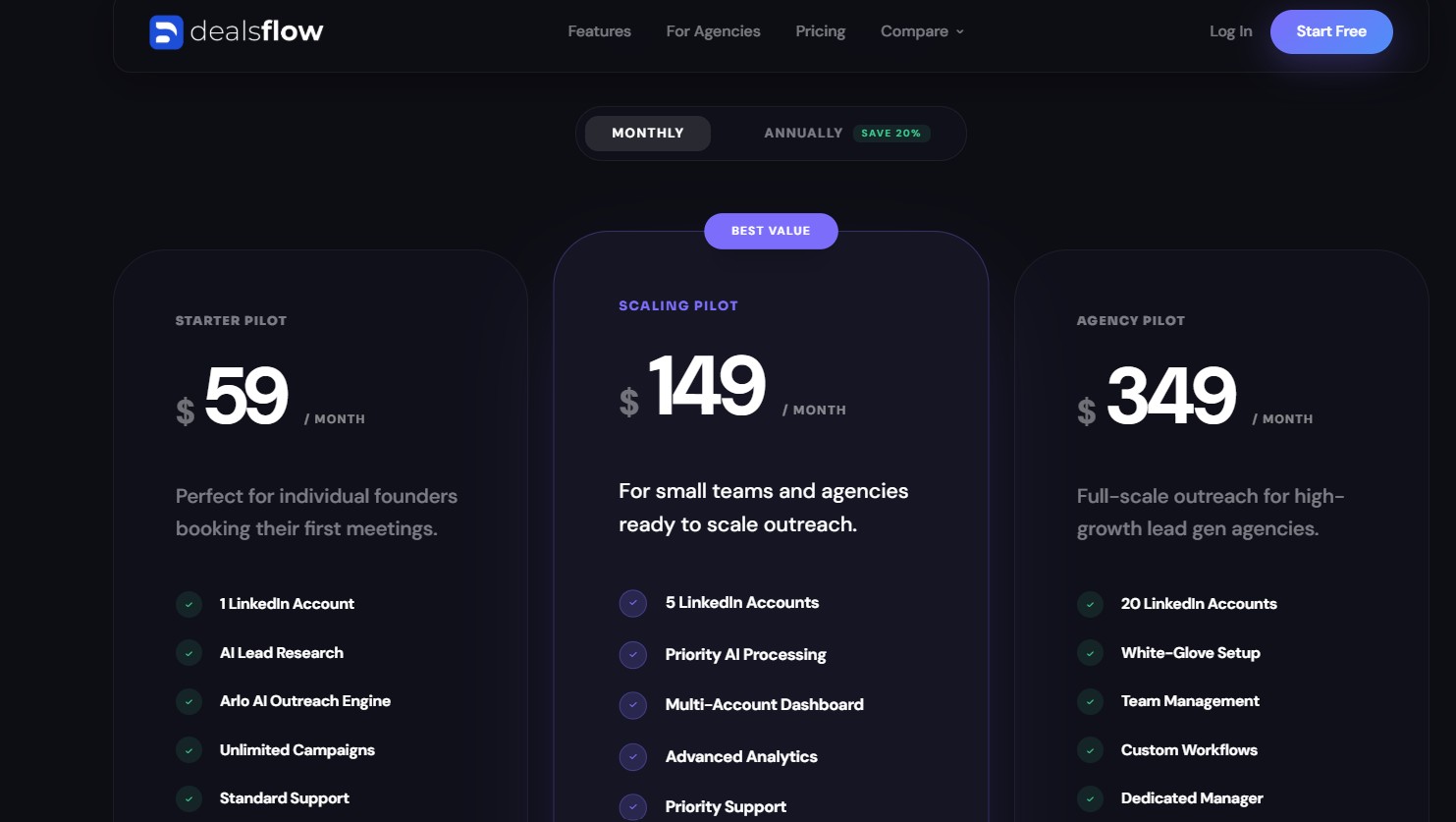
DealsFlow publishes flat, per-plan pricing. Annual billing (which saves 20%) breaks down as:
- Starter Pilot: $49/month — 1 LinkedIn account, AI Lead Research, Arlo AI Outreach Engine, Unlimited Campaigns, Standard Support
- Scaling Pilot: $129/month — 5 LinkedIn accounts, Priority AI Processing, Multi-Account Dashboard, Advanced Analytics, Priority Support
- Agency Pilot: $299/month — 20 LinkedIn accounts, White-Glove Setup, Team Management, Custom Workflows, Dedicated Manager
Monthly billing (without the annual commitment) is higher: $59/month for Starter, $149/month for Scaling, $349/month for Agency.
All plans include a 14-day free trial with no credit card required.
La Growth Machine Pricing
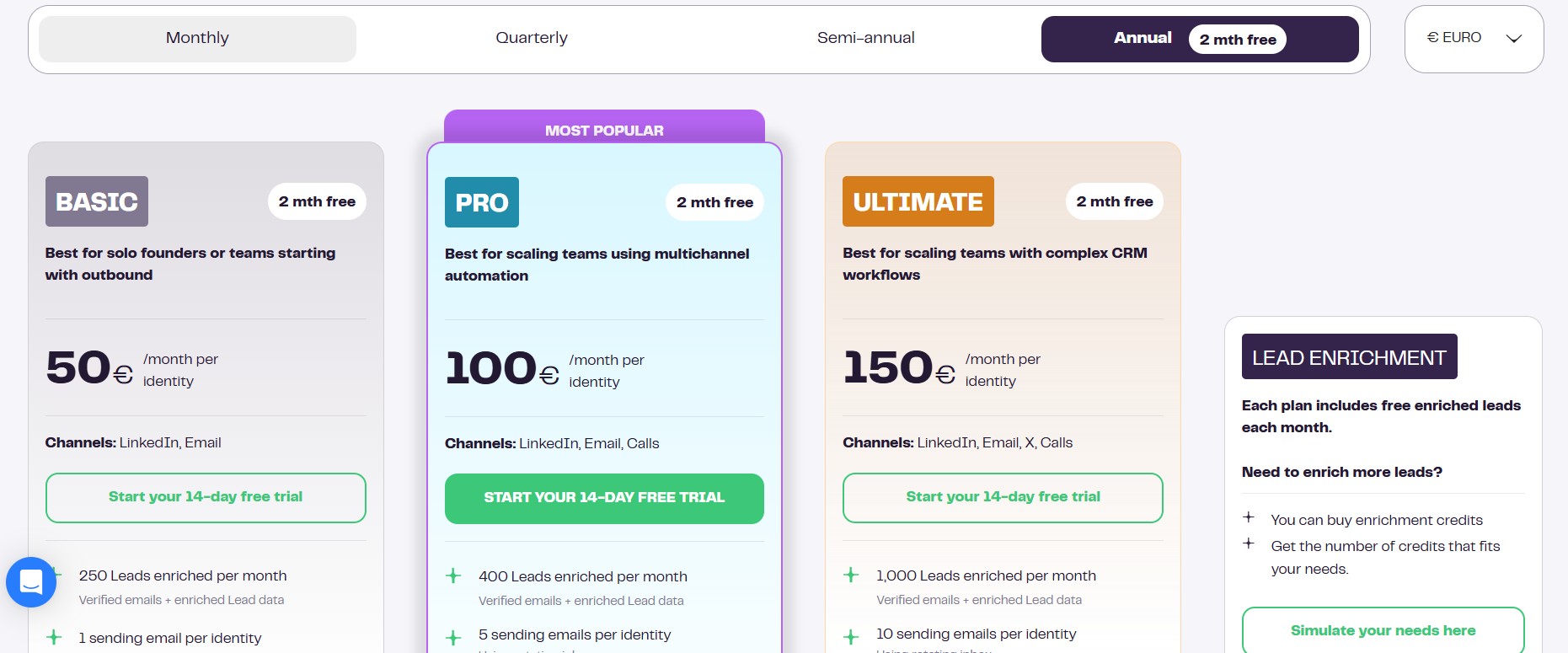
LGM uses per-identity billing. An “identity” is one LinkedIn account running campaigns. Plans as of 2026:
- Basic: €60/identity/month — LinkedIn + Email, 250 enriched leads/month, 3 active campaigns
- Pro: €120/identity/month — LinkedIn + Email + Calls, 400 enriched leads/month, 6 campaigns, advanced features
- Ultimate: €180/identity/month — adds Twitter/X, 1,000 enriched leads/month, CRM integrations, full API access
Annual billing offers two months free across all plans.
The Pricing Math That Actually Matters
LGM’s per-identity model compounds fast for teams. Three SDRs on the Pro plan costs €360/month before you hit the enrichment credit limits. Six identities — a small agency — at Pro is €720/month. If you’re managing outreach for 10+ LinkedIn accounts, the math gets uncomfortable.
DealsFlow’s Agency Pilot at $299/month covers 20 LinkedIn accounts. For agencies specifically, that’s a different conversation. You’re paying roughly $15/account instead of €120/account.
The Starter tier comparison is also relevant for solo founders: DealsFlow Starter at $49/month includes Arlo AI. LGM’s Basic at €60/month includes Magic Messages but no post-reply conversation handling. You’re paying less at DealsFlow and getting more in terms of AI conversation coverage.
The free trial is available on both platforms with no credit card. Neither charges you to evaluate.
Who Should Use Each Tool
Use DealsFlow if:
- LinkedIn is your primary outreach channel and you don’t need email + Twitter in the same automated sequence
- Your team is running high-volume outreach and you need multi-sender rotation across accounts to distribute risk
- Reply handling is the bottleneck — conversations are dying in the inbox because no one follows up fast enough, or the team can’t keep up with volume
- You’re an agency managing outreach for multiple clients and need affordable flat-rate pricing for multi-account operations
- You want AI to handle the middle-of-funnel — qualifying leads, handling objections, and nudging toward a booked call without needing a rep to intervene on every conversation
Use La Growth Machine if:
- Your outreach strategy genuinely requires LinkedIn, email, and Twitter/X working together in a single conditional sequence — and you have the data (email addresses, Twitter handles) to actually run it
- You need strong native CRM integrations out of the box, especially HubSpot or Pipedrive with bi-directional sync
- LinkedIn voice messages are part of your outreach playbook and you want AI-generated personalized voice notes at scale
- Your team wants a visual sequence builder with drag-and-drop multichannel logic
- You’re operating primarily in European markets where LGM has deeper support and the euro-denominated pricing works in your favor
The honest answer for most LinkedIn-first teams:
If true multichannel outreach is a real operational requirement — and you have the lead data to back it up — LGM is the stronger pick on the sequence-building side. But if the main problem is that LinkedIn replies go cold because your team can’t keep up, or you’re running an agency that needs to manage 10+ accounts affordably, DealsFlow solves problems LGM doesn’t address.
And Arlo AI is a capability LGM doesn’t have. That matters more than it sounds.
Conclusion
These are two different tools solving two different problems. LGM is a multichannel sequencer with a solid visual interface, LinkedIn voice messages, and decent CRM integrations at higher tiers. DealsFlow is a LinkedIn-first platform with an AI layer that handles what most tools ignore entirely — the conversation after someone replies.
For buyers primarily running LinkedIn outreach who need AI to handle post-reply conversations and multi-account scale, DealsFlow is the pick. For buyers who need true multichannel sequence logic with LinkedIn, email, and Twitter in one workflow, LGM has that capability.
The pricing math also matters here. LGM’s per-identity model gets expensive at team scale. DealsFlow’s Agency Pilot at $299/month for 20 LinkedIn accounts is a genuinely different value proposition for agencies comparing the two.
FAQs
Q1: What is the main difference between DealsFlow and La Growth Machine?
DealsFlow is LinkedIn-first and built around Arlo AI, which handles post-reply conversations autonomously — qualifying leads, addressing objections, and nudging toward a booked call without a human needing to intervene on every reply. La Growth Machine is a multichannel sequencer that connects LinkedIn, email, and Twitter/X in a single conditional workflow. LGM automates the send side of outreach well. DealsFlow handles what happens after someone responds. That’s the core difference.
Q2: Does La Growth Machine handle replies automatically like DealsFlow’s Arlo AI?
Nope. LGM stops when a prospect replies. From that point, a human needs to take over the conversation manually. DealsFlow’s Arlo AI reads the reply, determines intent, and responds — whether that’s answering a question, handling a pushback, or moving toward booking a call. For lean teams running high reply volume, that gap is significant.
Q3: Which tool is better for agencies managing multiple client accounts?
DealsFlow, and the pricing math makes it obvious. The Agency Pilot plan at $299/month covers 20 LinkedIn accounts, all managed from one dashboard. La Growth Machine bills per identity — each LinkedIn account that runs campaigns is a separate charge, starting at €60/month on the Basic plan. A 10-account agency on LGM’s Pro plan is paying €1,200/month. The same operation on DealsFlow’s Agency Pilot is $299/month.
Q4: Does La Growth Machine support LinkedIn voice messages?
Yes. LGM supports LinkedIn voice messages natively, including an AI-generated voice feature that personalizes notes at scale using a recording of your actual voice. DealsFlow does not currently support voice messages on LinkedIn. If voice notes are part of your outreach playbook, LGM has the edge there.
Q5: Which tool is better for multichannel outreach?
La Growth Machine. It’s built for it — LinkedIn, email, and Twitter/X can all live in the same sequence with conditional logic between channels. DealsFlow is LinkedIn-first and doesn’t run email and Twitter inside the same automated sequence. That said, LGM’s Basic plan caps enriched leads at 250/month and Pro at 400/month, so the multichannel capability is only useful if you actually have the prospect data (email addresses, Twitter handles) to fuel it.
Q6: How does DealsFlow pricing compare to La Growth Machine?
DealsFlow charges flat plan pricing: $49/month (Starter), $129/month (Scaling), and $299/month (Agency) on annual billing. La Growth Machine charges per identity — one LinkedIn account per charge — at €60/month (Basic), €120/month (Pro), and €180/month (Ultimate). For solo users, the prices are roughly comparable. For teams and agencies, DealsFlow’s flat pricing scales much more favorably.
Q7: Do both tools offer a free trial?
Yes. Both DealsFlow and La Growth Machine offer a 14-day free trial with no credit card required. DealsFlow’s trial includes Arlo AI, so you can test post-reply conversation handling on a real campaign before committing.
Q8: Is La Growth Machine safe for LinkedIn accounts?
LGM is cloud-based and simulates human-like activity with varied timing between actions. That’s the right foundation. Like any automation tool, account safety still depends on campaign settings — aggressive send volumes or connection request rates can create risk regardless of the underlying platform. DealsFlow uses distributed cloud execution and hard daily limits aligned to LinkedIn’s current safety thresholds, and multi-sender rotation structurally spreads volume across accounts rather than pushing it all through one.
Q9: Which tool is easier to set up and start using?
DealsFlow is faster to go live, especially for LinkedIn-only outreach. Fewer channels to configure means less setup time. Arlo AI requires some initial configuration for tone and escalation rules, but once that’s done it runs without ongoing management. LGM has a well-designed visual interface, but multichannel sequences with conditional logic take more time to build correctly, and there’s a steeper learning curve for non-trivial campaigns.