

Most people treat LinkedIn like an online resume they update once a year and forget about. Then someone posts about closing a $15,000 consulting deal from a single article, or landing a $3,000/month retainer from cold DMs, and suddenly everyone wants to know what’s going on over there.
LinkedIn has quietly become one of the most underrated places to make real money online. Not TikTok-viral money. Not dropshipping money. The kind where a B2B consultant in Bangalore charges $200/hour and gets it, or a career coach in London sells out a $997 cohort program to her connections before she even runs ads. That kind of money. The platform crossed 1 billion members in 2023, and the audience skews professional, senior, and decision-maker heavy in a way that no other social platform can touch. If you know how to earn money from LinkedIn, you are selling to buyers, not browsers.
The problem is that most “LinkedIn monetization” advice sounds like it was written by someone who has never actually done it. Post consistently. Build your personal brand. Engage with your network. Yeah, okay. That tells you nothing. This post breaks down 7 actual revenue streams, how they work mechanically, what you need before you can start, and the mistakes people make that keep them stuck at zero. No consultant-speak. Just what works.
How to Earn Money from LinkedIn as a Freelancer or Consultant (The Fastest Revenue Path)
This is where most people should start. Not because it’s the easiest, but because it has the shortest distance between effort and income.
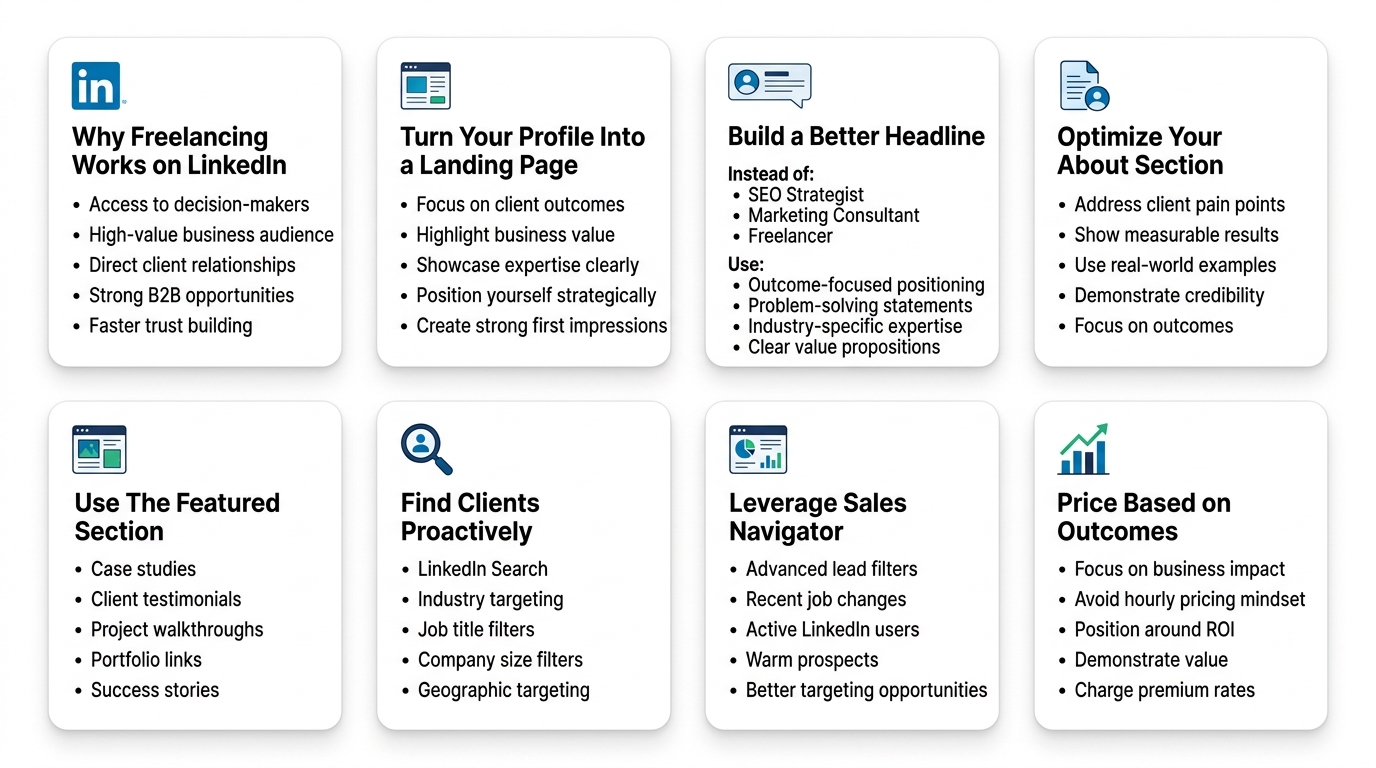
LinkedIn has 65 million decision-makers on the platform. That stat is from LinkedIn’s own data, and it’s the whole reason B2B freelancers do so well here. You are not convincing someone they have a problem. They are already looking for someone who can solve it. The work is getting in front of them and making it obvious you’re the right person.
Set Up Your Profile Like a Landing Page, Not a CV
This is where 90% of freelancers blow it before they’ve even started. A LinkedIn profile that reads like a job application is a dead end. Hiring managers read CVs. Clients read landing pages.
Your headline should not be your job title. It should be your value proposition. “SEO Strategist” means nothing. “I help SaaS companies rank on Google and reduce paid ad dependency” tells a potential client exactly what they get and why they should talk to you. That single change in the headline is what separates profiles that get ignored from ones that generate inbound DMs.
The About section is your pitch, not your biography. Write it in second person, address the reader’s problem in the first two lines (those first two lines show before the “see more” cutoff), and then back up your claim with specific results. Not “I helped clients grow traffic.” Try “Took a fintech SaaS from 8,000 to 340,000 monthly organic sessions in 14 months using a topical authority build.” See the difference? One is vague. One is citable.
Add featured posts, links to case studies, or a Loom walkthrough of your work. The Featured section is free real estate that most freelancers waste.
Use LinkedIn Search and Sales Navigator to Find Clients Proactively
Waiting for inbound is a slow game at the start. You need to prospect.
LinkedIn’s free search lets you filter by industry, company size, job title, and location. Sales Navigator (about $99/month) lets you layer on filters like “recently changed jobs,” “posted on LinkedIn in the last 30 days,” and “follows your company.” That last filter is useful because someone who already follows you or engages with your content is warmer than a cold connection.
The outreach message matters a lot. The worst thing you can do is paste a template. “Hi [Name], I came across your profile and I think I could add value to your team” gets deleted in two seconds. Reference something specific about them. Their recent post, a company announcement, a problem their industry is dealing with publicly. One sentence of genuine personalization does more than three paragraphs of selling.
Pricing Your Services on LinkedIn
LinkedIn clients generally pay more than clients from Upwork or Fiverr. The platform’s professional context sets different expectations. A LinkedIn connection who knows your content, has seen your results, and reached out first is not shopping for the cheapest option.
Price based on outcomes, not hours. A fractional CMO who charges $8,000/month on LinkedIn is not doing it because they’ve been freelancing for 20 years. They’re doing it because they’ve positioned around a measurable business outcome (pipeline generation, CAC reduction) and their profile backs it up. You can get there faster than you think if you document your work and share it publicly.
How to Earn from LinkedIn’s Creator Monetization Tools (Newsletters, Partner Program)
LinkedIn has been building out creator monetization features since 2022, and the offerings are actually worth knowing about now.
LinkedIn Newsletter
LinkedIn Newsletters let you publish long-form content that subscribers receive via notification and email. The distribution is built in, which means your newsletter doesn’t need a separate email list to grow. Every time you publish, LinkedIn notifies your subscribers directly.
The monetization angle here is not direct revenue from the newsletter itself (LinkedIn does not pay you per newsletter). The angle is audience building for your paid offers. A newsletter about B2B marketing with 12,000 subscribers is a warm list. You announce a workshop, a consulting package, or a digital product to that list and conversions come from existing trust, not cold traffic.
That said, LinkedIn did launch a paid newsletter feature in 2023 where creators can charge subscribers. As of 2026, it’s available to select creators who meet certain follower thresholds (generally 5,000+ followers and good engagement history). If you qualify, a paid newsletter on LinkedIn at $10/month with 300 subscribers is $3,000/month recurring. With 1,000 subscribers it’s $10,000/month. Those are real numbers that some creators are hitting.
LinkedIn’s Creator Accelerator and Partner Program
LinkedIn has run Creator Accelerator cohort programs in select markets, paying creators grants and providing resources to grow. These are competitive and not always open, but worth applying to when they are.
The LinkedIn Partner Program gives eligible creators access to monetization through events and content. LinkedIn Live hosts who build consistent audiences can earn through ticketed events or brand partnerships. A LinkedIn Live with 2,000 live viewers is genuinely valuable to B2B software companies looking for sponsored placement.
The catch: you need an audience first. None of these tools work well if you’re starting from zero. But they compound fast once you have 3,000 to 5,000 followers who genuinely engage.
Selling Digital Products: One of the Most Overlooked Ways to Earn Money from LinkedIn
LinkedIn’s audience is predisposed to buy educational content. They are professionals trying to get better at their jobs, get promoted, or start something new. That is a buyer’s mindset. Digital products fit perfectly into that gap.
What Types of Digital Products Sell Well on LinkedIn
Templates do well here. A collection of 15 LinkedIn outreach message templates sold for $27 sounds small, but if you get 200 buyers a month from your content and DMs, that’s $5,400/month from one product with zero delivery cost.
Mini-courses and workshops in the $97 to $497 range are the sweet spot for most LinkedIn creators. A 4-hour workshop on building a LinkedIn content strategy sold at $197 with 150 buyers is $29,550 in a single launch. These are not hypothetical numbers. Creators like Justin Welsh and Lara Acosta have built multi-million dollar businesses primarily off LinkedIn audiences buying their digital products and courses.
Guides and playbooks work especially well in B2B niches. An “outbound prospecting playbook for SaaS SDRs” sold at $49 to a LinkedIn audience of sales professionals is a fast mover. The specificity of the title, the niche, and the price point all work together.
How to Sell Without Being Annoying
The mistake most people make is treating every post as a pitch. LinkedIn’s algorithm actively suppresses overly promotional content, and your audience will start tuning you out.
The ratio that works: roughly 4 value posts for every 1 promotional post. The value posts build trust and demonstrate expertise. The promotional post has something to convert that trust into revenue. Inside the value posts, you can soft-mention your product when it’s genuinely relevant (“I put together a full template for this, linked in the comments”) without it feeling like a sales pitch.
Gated lead magnets work well here too. Offer a free resource (a checklist, a template, a short guide) in exchange for an email. That email goes into your list. Then you sell to your list. LinkedIn does not own your email list. They own your followers. Big difference.
Affiliate Marketing on LinkedIn: How to Earn from LinkedIn by Recommending Tools
Affiliate marketing works on LinkedIn, but only in specific categories. Consumer affiliate products, Amazon links, lifestyle stuff: those mostly flop here. The audience is in a professional context. They are not clicking on gym supplement links from a LinkedIn post.
What does work: B2B software, professional tools, online courses, and business services. The commission rates in B2B SaaS affiliate programs are often 20 to 30% recurring, meaning you get paid every month for as long as the customer stays. A $500/month SaaS tool with a 30% recurring commission pays you $150/month per customer. Get 50 customers and that’s $7,500/month in passive income.
The Right Approach for LinkedIn Affiliate Content
Reviews and comparisons work. A post titled “I tested 6 LinkedIn automation tools for 90 days, here’s what actually worked” is genuinely useful, builds your credibility, and can include affiliate links naturally. The disclosure is required (and honestly just good practice), and most professional LinkedIn audiences don’t mind affiliate links when the content is genuinely useful.
LinkedIn articles are better than posts for affiliate content because they can hold more context, links, and detail. A 1,500-word article comparing two project management tools can rank in LinkedIn search and on Google, generating passive clicks and commissions over time.
Tools worth building around: HubSpot (20% recurring for 1 year), Notion (up to 50% for 1 year), Semrush (40% recurring), Taplio (30% recurring), and most professional email tools like ConvertKit and ActiveCampaign. These all have affiliate programs and their audiences overlap directly with LinkedIn’s professional user base.
One thing to not skip: only promote tools you have actually used. LinkedIn audiences are savvy. A post that reads like it was written from a product page without any real-world testing sticks out. Your credibility is the asset. Don’t trade it for a quick commission.
Coaching and Course Selling: Building a Scalable Income from Your LinkedIn Expertise
Coaching is one of the highest-earning ways to monetize LinkedIn because the margins are near 100% and LinkedIn’s audience actively seeks growth-oriented professional advice. Career coaches, executive coaches, sales coaches, and business coaches consistently generate $10,000 to $50,000+ months using LinkedIn as their primary acquisition channel.
How to Position Yourself as a Coach on LinkedIn
Pick one niche and be relentlessly specific. “Career coach” is vague. “I help mid-level engineers at FAANG companies get promoted to Staff in under 18 months” is a niche. The specificity sounds like it would narrow your audience, but it actually increases conversion because the right person reads it and thinks “that’s exactly me.”
Your content strategy should directly address the problems your coaching clients have. If you coach sales directors on building outbound teams, your posts should be about outbound strategy, SDR hiring mistakes, pipeline forecasting, and the like. Every post is proof of expertise. Potential clients are not just reading your content for information. They are deciding whether you know enough to charge them $2,000 to $5,000 per month for your time.
From Coaching to Group Programs and Cohorts
One-on-one coaching has a ceiling. Your hours are finite. The move that most successful LinkedIn coaches make is productizing their coaching into a group program or cohort.
Instead of charging $3,000/month for 1-on-1 coaching with 10 clients ($30,000 revenue, 40+ hours of your time), you run a 6-week group cohort with 30 people at $997 each. That’s $29,910 for maybe 15 hours of live instruction plus some async support. Same revenue. Less than half the time. And cohorts create community, which creates word-of-mouth, which fills the next cohort.
LinkedIn is the acquisition channel. The cohort is the product. Waiting lists, early bird pricing, and teaser posts before launch all work to build demand before you even open the cart.
LinkedIn Lead Generation for Your Agency or Business
This one is slightly different from the others because it’s not about making money directly on LinkedIn. It’s about using LinkedIn to fill a pipeline for an existing business. But the revenue impact is often bigger than any other strategy on this list.
Agency owners who use LinkedIn properly for lead gen are consistently closing $5,000 to $50,000 contracts from the platform. A content agency owner who posts 3 times a week about content marketing mistakes, engages in comments across their niche, and sends 15 personalized connection requests per day to ideal clients can realistically add 2 to 4 qualified sales calls per week within 60 to 90 days.
The Mechanics: What Actually Drives Leads
Content does the warming. Outreach does the booking. Both need to happen.
Content that performs well for lead gen on LinkedIn includes: opinion posts that call out a common mistake your ideal clients make, behind-the-scenes posts showing your actual work and results, and “here’s what I learned from [specific client situation]” posts that demonstrate real-world expertise without revealing confidential details.
The DM sequence that works is not a funnel with five messages. It’s one message that is genuine, specific, and short. Reference their post, their company news, or a specific problem you noticed. Ask one question. Do not pitch in the first message. The pitch comes after a reply, when you have context and a real reason to offer your service.
LinkedIn also has an Event feature that many agency owners underuse. Running a free 45-minute LinkedIn Live or webinar on a problem your clients have is a lead gen machine. People register with their LinkedIn profiles, you get their contact info, and you follow up personally. A webinar with 150 attendees in your niche, even with a 3% conversion rate to a discovery call, gives you 4 to 5 high-quality leads in one session.
LinkedIn’s Own Monetization Features: How to Earn from LinkedIn Directly
Beyond creator programs, LinkedIn has rolled out a few direct monetization features that are worth knowing.
LinkedIn Live and Audio Events
LinkedIn Live is free to host and reaches your entire network. A live session with 500 to 1,000 engaged viewers is real audience attention. Brands in B2B categories pay between $500 to $5,000 for a sponsored mention in a LinkedIn Live, depending on audience size and engagement rate. Some creators with 50,000+ followers charge significantly more.
Audio Events (LinkedIn’s version of a Twitter/X Space) follow the same logic. You build an audience around regular audio conversations in your niche, and brand partnerships or sponsorships follow as the audience grows.
LinkedIn Learning Instructor Program
If you have deep expertise in a professional skill (Excel, Python, project management, LinkedIn marketing, data analysis), LinkedIn Learning pays instructors royalties for courses hosted on their platform. LinkedIn Learning is available to LinkedIn Premium subscribers and reaches a large professional audience. Royalty rates vary but are based on minutes watched. A well-made course that stays relevant for 2 to 3 years generates passive income for that entire period.
The barrier to entry is quality. LinkedIn Learning has a submission review process. Your course needs to be professionally produced with clear audio, good pacing, and genuine instructional value. If you already create content well, this is a natural extension.
Paid Consulting Calls via Intro or Calendly
This is simple and often overlooked. Put your booking link in your LinkedIn featured section and bio. Charge $150 to $500 for a 60-minute strategy call. Announce it in a post every few weeks. Some creators earn $2,000 to $6,000/month from paid consultations alone without any other product or service, just the expertise they share publicly and the trust that builds over time.
Conclusion
LinkedIn is not a slow game if you actually play it like a business. Most people post and hope. The ones making real money are treating LinkedIn as a distribution channel, a prospecting tool, and an audience asset simultaneously.
Whether you’re figuring out how to earn money from LinkedIn through consulting, digital products, affiliate recommendations, or lead generation, the thing that connects every successful approach is the same: a clear positioning, consistent proof of expertise, and an actual conversion path. Posting without a way to capture and convert attention is just a hobby.
Pick one revenue stream from this list. Not all seven. One. Build a profile that supports it, create content that speaks directly to the person who would pay you, and run that for 90 days before you decide it’s not working. Most people quit in week three. That’s your edge.
Frequently Asked Questions
How to earn money from LinkedIn without any products or services?
You don’t necessarily need your own product or service to earn money from LinkedIn. Affiliate marketing lets you recommend B2B software tools and earn recurring commissions (often 20 to 40%) when your audience signs up. Some LinkedIn creators also earn through brand sponsorships, paid newsletter features, and LinkedIn Live event sponsorships once they build an engaged following in a specific professional niche.
How many LinkedIn followers do you need to start making money?
There’s no magic number, but practically speaking, 1,000 to 5,000 engaged followers is enough to start generating consulting leads, selling digital products, or booking paid calls. The key word is “engaged.” 500 followers who are your ideal clients are worth more than 10,000 random connections who never interact with your content.
Is LinkedIn good for selling digital products?
Yes, especially in B2B, career development, sales, marketing, and tech niches. LinkedIn’s audience is already in a professional growth mindset and often has a company budget or personal investment budget. Templates, playbooks, mini-courses, and cohort programs consistently sell well to LinkedIn audiences when the creator has built genuine trust through consistent content.
How long does it take to start making money on LinkedIn?
The honest answer is 60 to 90 days if you are actively prospecting and posting consistently. Most people who “try LinkedIn for a few months and see nothing” are posting without a conversion strategy, not sending outreach, and not optimizing their profile for inbound leads. The platform rewards patience, but 90 days of intentional effort will almost always produce some revenue.
What is the best type of content to post on LinkedIn to earn money?
Content that directly demonstrates your expertise in solving a specific problem performs best for monetization. Case studies, opinion posts that call out industry mistakes, before-and-after transformation stories, and practical how-to posts all build the kind of credibility that converts. Inspirational quotes and generic productivity tips get likes but rarely produce clients.
How to earn from LinkedIn as a complete beginner?
Start by picking one skill you have that solves a professional problem. Freelance writing, graphic design, HR consulting, paid ads, bookkeeping, anything. Optimize your profile around that skill. Post three times per week about problems in that space. Send 10 to 15 personalized connection requests per day to people who match your ideal client profile. Do this for 90 days and you will have conversations that convert. Most beginners skip the outreach step. That is usually why nothing happens.
Can you make passive income on LinkedIn?
Yes, but it takes time to set up. Recurring affiliate commissions from B2B software tools, a paid LinkedIn newsletter, royalties from LinkedIn Learning courses, and sales of digital products are all forms of passive or semi-passive income. The “passive” part only kicks in after you’ve built an audience and created the product. The upfront work is very much active.
Is LinkedIn Premium worth it for making money?
LinkedIn Premium (around $40/month) gives you InMail credits, profile view insights, and some extra search filters. Sales Navigator ($99/month) is the more useful investment if you are prospecting for clients, because the filtering options are significantly deeper. For most freelancers and consultants, Sales Navigator pays for itself in one client and the ROI is easy to calculate.
How do LinkedIn newsletters make money?
LinkedIn newsletters make money indirectly by building a large, warm subscriber base that you can then pitch your products, services, or partnerships to. LinkedIn also has a paid newsletter subscription feature available to creators who meet eligibility requirements, letting you charge subscribers directly. Some creators also sell sponsored placements inside newsletters to B2B brands once their subscriber count is large enough to justify it.
Is LinkedIn better than Instagram or Twitter for monetization?
For B2B products, professional services, consulting, and business coaching: yes, significantly. LinkedIn’s average household income is higher, the professional intent is stronger, and decision-makers use LinkedIn specifically to solve business problems. Instagram and Twitter have larger general audiences but lower buyer intent in professional categories. If what you sell helps businesses or professionals, LinkedIn is the more direct path to revenue.
Can you do affiliate marketing openly on LinkedIn?
Yes. LinkedIn does not prohibit affiliate marketing as long as you disclose that your content contains affiliate links. The FTC requires disclosure anyway. Most professional audiences on LinkedIn are not bothered by affiliate disclosures when the content is genuinely useful. The mistake to avoid is posting content that is clearly written just to push an affiliate link without real perspective or expertise behind it.
What niches make the most money on LinkedIn?
The niches with the strongest buyer intent and highest spending power on LinkedIn include SaaS and B2B software, executive and leadership coaching, sales training and revenue operations, digital marketing and SEO, finance and investment for business owners, and technical skills like data science, AI implementation, and software development. These categories have large professional audiences who have both the problem and the budget to solve it.