
LinkedIn is not just a professional directory. In 2026 it is the single most powerful platform for B2B networking, career development, recruiting, and business development on the planet. With over one billion registered members, more than 65 million decision-makers, and four out of five members influencing business decisions at their organisations, the opportunity sitting inside LinkedIn’s search bar is staggering. Yet most people waste it entirely.
The reason is not a lack of effort. Most professionals know they should be reaching out. They know there are clients, mentors, hiring managers, collaborators, and advisors accessible to them through a single well-crafted message. What they lack is a clear, situation-specific answer to the question that stops most people in their tracks: how do I actually reach out to someone on LinkedIn without coming across as pushy, generic, or transactional?
This guide answers that question completely. You will find 11 specific tactics covering every realistic scenario in which you might want to reach out to someone on LinkedIn — from selling to networking, from asking for mentorship to following up after a job application. Each tactic comes with a detailed explanation of the psychology behind it, the exact structure to follow, common mistakes to avoid, and a ready-to-use message template. Before the tactics, we cover three foundational principles that make every LinkedIn message more effective, regardless of context.
Whether you are a sales professional, a job seeker, a recruiter, a founder, or simply someone trying to grow a meaningful professional network, this is the most practical guide to LinkedIn outreach you will read in 2026.
Keys to LinkedIn Outreach Success
Before you write a single word of any outreach message, there are three foundational principles that separate LinkedIn messages that get replies from the ones that fill up someone’s archived folder. Skipping this section is the most common reason experienced professionals still get ignored on LinkedIn. These are not optional extras — they are the engine behind every tactic that follows.
Define Your Goal and How You Can Be of Value
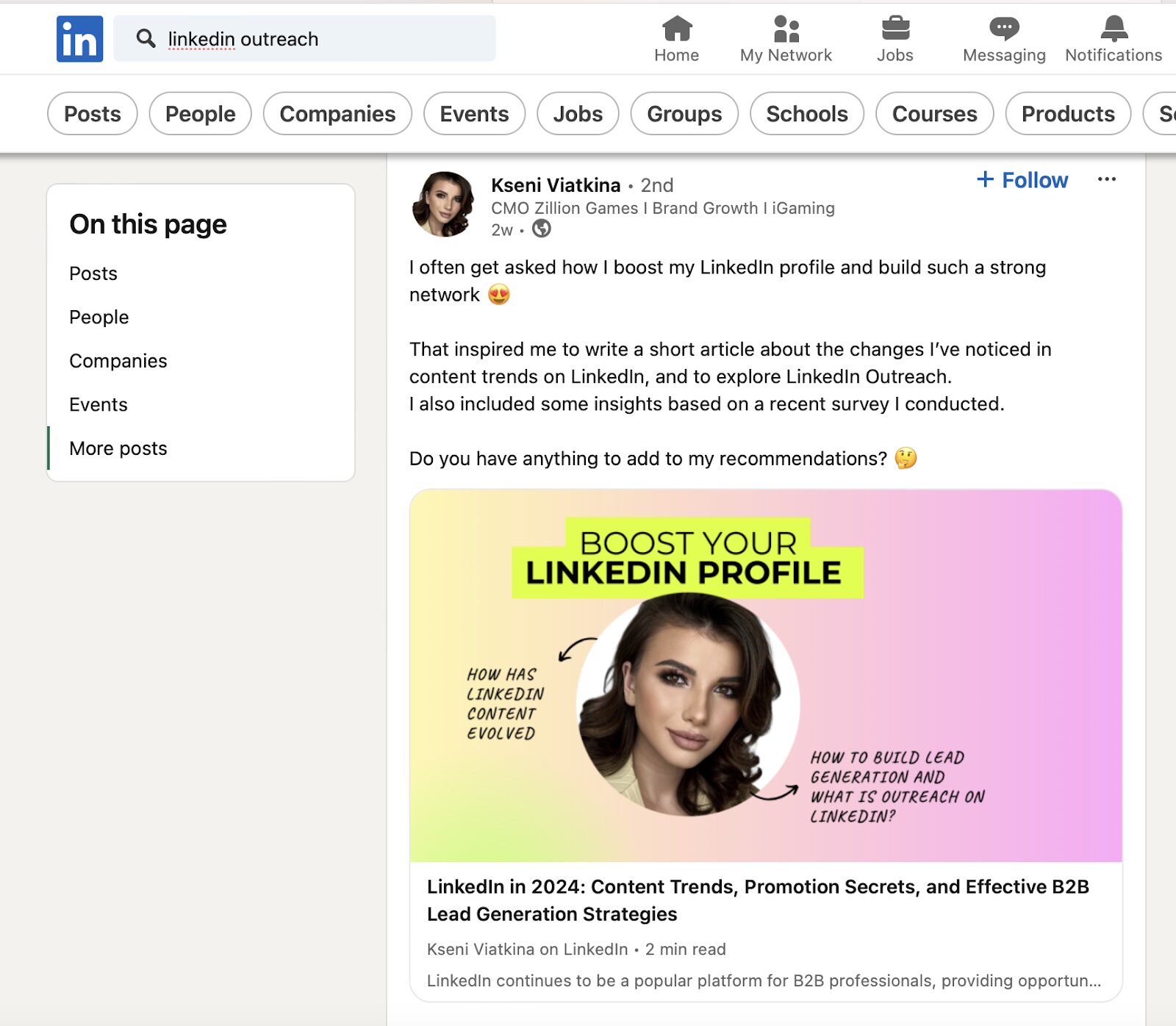
This sounds obvious, but ask yourself honestly: when was the last time you sat down and answered both halves of this question before writing a LinkedIn message? Most people answer the first half — I want a call, I want a referral, I want an introduction — and completely ignore the second half. That oversight is why most outreach fails.
LinkedIn outreach is not a one-way transaction. Every person you message is busy, distracted, and receiving a dozen similar requests from other people. The only messages that break through are the ones that answer the unspoken question in every recipient’s mind: “why should I give this person my time?” Your answer to that question is your value proposition, and it needs to be in the message.
Before writing any outreach on LinkedIn, answer two specific questions in writing: what is the single outcome I want from this interaction, and what can I genuinely offer this person in return? The answer to the second question might be a relevant insight, a connection to someone in your network, a piece of feedback, a shared experience, or simply a thoughtful conversation. It does not need to be transactional. But it needs to exist. Without it, your message is a request disguised as an introduction, and experienced professionals see through that instantly.
| Goal-Value Alignment Framework
Selling something: Offer a relevant insight or industry data point before mentioning your product. Networking: Offer a genuine perspective on something they care about. Job seeking: Offer clarity about what specific value you bring to their team. Asking for advice: Offer the flattery of genuine specificity — you researched them enough to ask them specifically. Seeking mentorship: Offer commitment, curiosity, and respect for their time. |
Choose the Best Approach
Not all LinkedIn outreach is created equal. The platform offers several distinct ways to contact someone, and choosing the wrong one for your situation significantly reduces your chances of a reply. Here is a breakdown of the main options and when each one is appropriate.
| Approach | Best Used When | Key Consideration |
| Connection request with note | You have a clear, specific reason to connect | LinkedIn caps notes at 300 characters — be precise |
| Connect first, message after | You want more space to introduce yourself properly | Wait for acceptance, then message within 24 hours |
| LinkedIn InMail (Premium) | Contacting people outside your network at scale | Higher cost per message; best for high-value targets |
| Message via shared group | You share a LinkedIn group with the person | Group membership is a natural warm introduction |
| Engage first, message later | Building credibility before outreach | Comment on their posts 2–3 times before messaging |
The most consistently effective approach for cold outreach is a connection request with a personalised note followed by a more detailed message once the connection is accepted. The connection request note acts as a preview — it shows intent and creates context — while the follow-up message is where you deliver the substance. Sending a wall of text as a connection request note is a common mistake that reduces acceptance rates significantly.
Timing also matters more than most people realise. Messages sent on Tuesday, Wednesday, and Thursday between 8am and 10am in the recipient’s time zone consistently outperform messages sent on Friday afternoons or weekends. This is not a rigid rule, but it reflects the reality that professionals are most engaged with LinkedIn during the early part of their working week.
Research and Open the Conversation
Research is the single most reliable predictor of whether a LinkedIn message will receive a reply. The difference between a message that feels personal and one that feels like spam is almost always traceable back to how much time the sender spent understanding the recipient before writing.
A minimum research process for any LinkedIn outreach should take no more than five to seven minutes and cover the following five areas: the person’s current role and what it likely involves day-to-day; their About section, which is where people often reveal their values and professional philosophy; their recent activity on LinkedIn, including posts they have written and content they have engaged with; their career history for any notable transitions, pivots, or achievements that might be relevant; and any shared connections, groups, or interests that create natural common ground.
The goal of this research is not to become an expert on the person’s entire career. It is to find one specific, genuine hook that you can use to open the conversation in a way that proves you have actually paid attention. A message that references something the person wrote, shared, or achieved in the last 30 days is orders of magnitude more likely to receive a reply than one that starts with “I came across your profile and was impressed.”
| 5-Minute Research Checklist
Read their full About section, not just the headline. Check their last three LinkedIn posts or shares. Note any recent career move, promotion, or milestone. Identify one mutual connection you could reference naturally. Find one challenge or topic in their feed you could add genuine value on. |
How to Reach Out to Someone on LinkedIn: 11 Proven Tactics
The following 11 tactics each address a specific situation in which you might want to reach out to someone on LinkedIn. Each tactic includes a detailed strategic explanation, the exact message structure to follow, what to avoid, and a complete template you can adapt immediately.
Tactic 1: How to Reach Out on LinkedIn to Sell
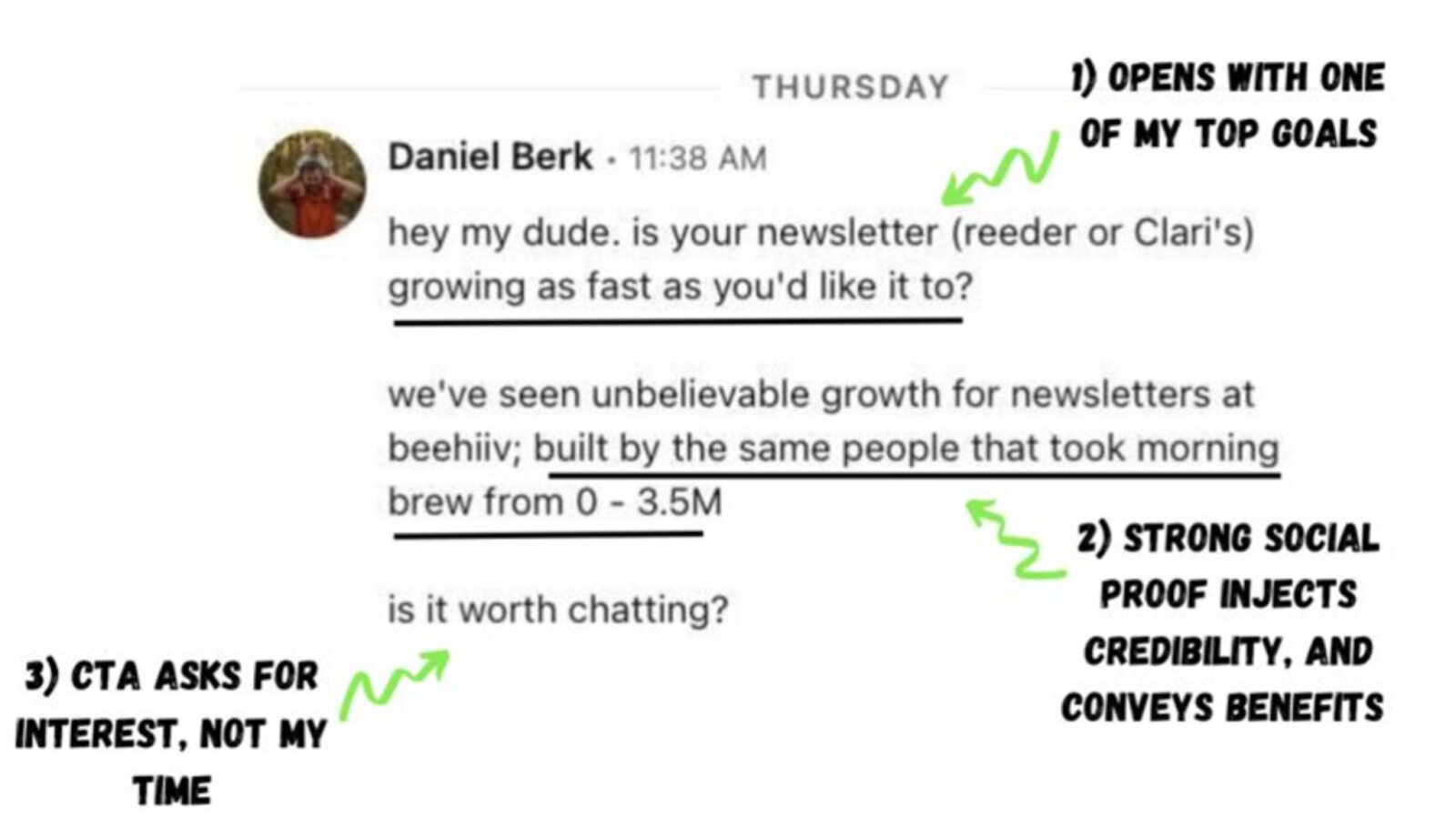
LinkedIn sales outreach has a reputation problem, and it is entirely self-inflicted. The majority of sales messages sent on LinkedIn follow the same broken pattern: a generic compliment, a three-paragraph company pitch, and a request for a “quick 15-minute call.” Recipients have become so conditioned to this format that they filter it out in under two seconds. The result is that genuinely relevant, well-targeted sales messages get ignored alongside the spam simply because they look the same.
The fix is a complete inversion of the standard approach. Effective LinkedIn sales outreach starts not with what you sell but with what you know about the buyer. This means identifying a specific signal — a recent company announcement, a job posting that suggests a strategic priority, a piece of content they shared that reveals a challenge they are navigating — before writing a single word. That signal becomes the opening of your message and the reason the message feels relevant rather than random.
The structure of an effective LinkedIn sales message follows a simple three-part formula. The first part is a one-sentence reference to the signal you identified — specific enough to prove it was not generated by a template. The second part is a one-sentence connection between that signal and the problem your solution addresses, framed in terms of an outcome rather than a feature. The third part is a single, low-pressure question that invites a reply without triggering sales resistance. There is no pitch, no pricing, no product description, and no request for a call in the first message.
What to avoid: Pitching in the first message, using phrases like “I’d love to show you how we can help,” listing product features, asking for a call before establishing any rapport, and sending the same message to everyone on your prospect list.
| Sales First-Touch LinkedIn Message Template
Hi [First Name], [One specific observation about their company, role, or recent content — e.g. “I noticed [Company] recently opened three new enterprise sales roles’’]. That usually signals [relevant challenge or priority — e.g. “scaling a new market segment”], which is exactly where teams like yours often run into [specific friction point your product addresses]. Curious whether that’s on your radar right now — or is the focus somewhere else entirely? [Your name] |
Tactic 2: How to Reach Out to Someone Who Visited Your Website
A website visit from a LinkedIn-identifiable professional is one of the warmest outreach opportunities that exists in modern B2B sales, and most people either do not know about it or do not act on it. When someone visits your website, they have already taken a deliberate action to learn more about what you do. They are, by definition, not cold. Reaching out within 24 to 48 hours of a visit is one of the highest-converting LinkedIn outreach moves available to sales and marketing teams.
Tools like LinkedIn’s Insight Tag, Clearbit Reveal, and Leadfeeder can help identify the company and sometimes the specific individual behind a website visit. Once you have identified the person, the key to making this outreach work is framing it as helpful curiosity rather than surveillance. Nobody wants to feel tracked. The message should acknowledge the visit lightly and move quickly to offering something of value based on what they may have been looking for.
The timing window here is critical. Research suggests that the probability of a reply drops by more than 50% if you wait longer than 48 hours after the visit. The person was actively interested in what you do at the moment of the visit. The longer you wait, the more that interest fades into the background noise of their day. Act fast, keep it short, and make it easy for them to take a next step without committing to anything.
What to avoid: Mentioning exactly which pages they visited or how long they spent on your site, which feels intrusive. Being vague about why you are reaching out is also a mistake — the visit is your context, so use it. Do not pitch on the first message.
| Website Visitor LinkedIn Message Template
Hi [First Name], I noticed [Company] had a look at what we do recently — wanted to reach out in case there was something specific you were trying to solve. We work with [type of company] on [one-line description of what you help with]. Happy to share more context if it’s relevant, or point you somewhere more useful if it’s not. Either way, worth a quick note. [Your name] |
Tactic 3: How to Reach Out to Someone Who Viewed Your Profile
A LinkedIn profile view is a mild but genuine signal of interest. When someone visits your profile, they have taken a moment to look at who you are, what you do, and whether you might be relevant to something they are thinking about. That is more than most cold contacts have done, and it creates a natural and non-intrusive reason to reach out.
The psychology here is one of mutual curiosity. They looked at you. You noticed. You are reaching out to find out why, and to see whether there is something worth exploring together. When framed this way, the message does not feel like a sales pitch or a desperate networking attempt — it feels like the natural next step in a two-way interaction that has already begun, however passively.
The key to making this work is keeping the tone light and low-pressure. You are not demanding an explanation for the visit. You are extending a friendly hand and giving them an easy opportunity to either engage or ignore without awkwardness. LinkedIn Premium users can see exactly who has viewed their profile in the last 90 days, which gives a significant outreach advantage for anyone doing this at scale.
What to avoid: Asking directly “why did you visit my profile?” which sounds accusatory. Also avoid immediately pitching something after mentioning the visit — it makes the friendly opener feel like a trap.
| Profile Viewer LinkedIn Message Template
Hi [First Name], I noticed you came across my profile recently — thought it was worth saying hello rather than leaving it as a one-sided glance. I work in [your field/function] and focus on [one-line description of your work]. If anything I do is relevant to what you’re working on, I’d be happy to chat. Either way, good to connect. [Your name] |
Tactic 4: How to Reach Out After Getting No Email Address
There are many situations in which you want to contact someone but cannot find a working email address for them. Your outreach tool may have returned no match. The email may have bounced. The person may not have a publicly listed professional email at all. In these cases, LinkedIn is not a fallback — it is often a better channel than email would have been in the first place.
LinkedIn messages have a dramatically higher open rate than cold emails in many industries. According to multiple B2B sales benchmarks, LinkedIn messages achieve open rates of 50% to 90% compared to cold email open rates of 15% to 25%. When someone cannot be reached by email, moving to LinkedIn is not an admission of defeat — it is a smart channel switch that often produces better results.
The key to making this work is transparency. Do not pretend you chose LinkedIn as your first-choice channel when you did not. Mentioning briefly that you tried to reach them by email and wanted to make sure your message got through is both honest and disarming. It shows you made a genuine effort to contact them, which signals that what you have to say is worth hearing. It also preempts any awkwardness about the channel switch.
What to avoid: Sounding like you have been hunting for their contact information, which can feel invasive. Keep the reference to the email attempt brief and move quickly to the substance of your message.
| Post-Failed-Email LinkedIn Message Template
Hi [First Name], I tried to reach you by email last week but wasn’t sure it got through — wanted to make sure my note actually landed. [One-sentence context: who you are and why you are reaching out]. [One-sentence value proposition or reason the connection is relevant]. Worth a brief conversation? [Your name] |
Tactic 5: How to Reach Out After Getting an OOO Email
An out-of-office email reply is one of the most underused pieces of intelligence in B2B outreach. Most salespeople and recruiters treat an OOO as a dead end and move on. In reality, it is a gift. It tells you the exact date your contact will return, sometimes provides the name of an alternate contact you can approach in the meantime, and occasionally reveals cultural or communication style signals that help you write a better follow-up.
The strategy here is straightforward: while your contact is away, reach out on LinkedIn with a brief, pressure-free message that acknowledges they are out and plants a seed for when they return. This approach works because it is genuinely considerate — you are not demanding attention at an inconvenient time, you are simply ensuring your message is waiting for them when they come back. Many professionals find this approach refreshingly respectful compared to the relentless follow-up emails that fill their inbox on return.
The timing of your follow-up matters enormously. If the OOO states a return date, send the LinkedIn message one to two days before that date, and send a follow-up email on the actual return day. This two-channel, two-touch approach maximises the chances of your message being one of the first things they engage with when they get back. The LinkedIn message primes them; the email converts.
What to avoid: Sending an aggressive pitch immediately after someone returns from leave — they are catching up on dozens of things and need a gentle re-introduction, not a sales call request.
| Post-OOO LinkedIn Message Template
Hi [First Name], I got your out-of-office reply — hope you’re having a good break. Rather than adding to the email avalanche waiting for you, I thought I’d drop a quick note here instead. [One sentence: who you are and what you do]. [One sentence on why it’s relevant to them specifically]. No rush at all — happy to reconnect whenever suits you after [return date]. [Your name] |
Tactic 6: How to Reach Out on LinkedIn to Network
Pure networking is the most misunderstood form of LinkedIn outreach. Most people either do it with no real intention — collecting connections like trading cards — or they attach a hidden agenda to it that the recipient can feel immediately. Neither approach builds a genuine professional network. What does work is reaching out with a clear, honest reason for wanting to connect that does not hinge on wanting something from the other person.
The best networking messages on LinkedIn lead with a genuine shared context — an industry challenge you are both navigating, a topic you both engage with, an event or group you have in common, or a perspective their work has given you that you want to explore further. The message should read like something you would say to someone interesting you met at a conference, not like a template generated by a CRM.
After the connection is accepted, the follow-up step is where most people drop the ball. A huge proportion of LinkedIn connections are made and then left to stagnate without any meaningful interaction. If you want the connection to mean something, send a short follow-up message within 24 to 48 hours of being accepted that continues the conversation rather than pivoting immediately to an ask. Share something useful, ask a genuine question, or reference something from their recent activity. That one extra step converts a passive connection into the beginning of an actual professional relationship.
What to avoid: Sending a blank connection request with no note, using “I’d love to connect” as your entire reason, and pivoting immediately to a sales pitch or job request after the connection is accepted.
| Pure Networking LinkedIn Message Template
Hi [First Name], [Specific personalisation hook — reference a post, shared challenge, or mutual context]. I’m [your name], a [role] working in [field/industry]. I’ve been following [relevant topic or theme from their work] closely and think there’s genuine overlap in what we’re both thinking about. Would love to have you in my network. [Your name] |
Tactic 7: How to Reach Out on LinkedIn for Referrals
Referral requests are among the most valuable messages you can send on LinkedIn, and also among the most anxiety-inducing. Most people avoid asking for referrals because they fear being perceived as pushy, entitled, or presumptuous. In practice, a well-crafted referral request to the right person is one of the most natural things you can do in professional life — as long as you follow two fundamental rules: ask someone who knows you well enough to genuinely vouch for you, and make it as easy as possible for them to say yes.
There are two distinct types of referral you might seek through LinkedIn outreach. The first is a job referral, where you are asking someone at a company you want to join to put your name forward internally. The second is a business referral, where you are asking a client, former colleague, or professional contact to introduce you to someone in their network who might benefit from what you do. Both require the same underlying approach: context first, ask second, easy action third.
The context element means being specific about what you are looking for and why the person you are asking is uniquely positioned to help. The easy action element means doing as much of the work as possible for them — drafting a short paragraph they could use to introduce you, naming exactly who you would like to be introduced to, or attaching a one-page profile they can simply forward. The more work you remove from the referral process, the higher your acceptance rate.
What to avoid: Asking for referrals from people who do not know you well enough to vouch for you, vague requests like “if you know anyone who might be interested,” and failing to follow up with a thank you regardless of the outcome.
| LinkedIn Referral Request Message Template
Hi [First Name], I hope you’re well. I’m currently [looking for a new role / exploring a specific opportunity] and you came to mind as someone I respect and trust. Specifically, I’m interested in [company / type of role / specific person]. I think my background in [relevant experience] would be a strong fit because [one compelling reason]. Would you be comfortable [referring me internally / introducing me to X]? I’ve written a short note below that you’re welcome to forward as-is or adapt. [Draft introduction paragraph] No pressure at all if it’s not a good fit. I genuinely value your opinion either way. [Your name] |
Tactic 8: How to Reach Out on LinkedIn for Advice
Asking for advice is consistently one of the highest-converting LinkedIn outreach strategies available, and the reason is rooted in basic human psychology. Being asked for advice activates a positive self-image response in most people — it signals that you respect their expertise, that you have thought specifically about why they are the right person to ask, and that you are genuinely trying to learn rather than extract something commercial. These signals make advice requests feel fundamentally different from sales messages or connection-collection attempts.
The single most important element of an effective advice request is specificity. A vague request like “I’d love to get your thoughts on my career” is easy to ignore because it requires the recipient to do significant interpretive work before they can even formulate a reply. A specific request like “I’m navigating the transition from agency-side to in-house marketing and I’d love fifteen minutes of your perspective on how you approached the same move five years ago” is much easier to say yes to because the scope is clear, the relevance is obvious, and the time commitment is bounded.
Time-bounding your advice request is one of the most reliable ways to increase your acceptance rate. Asking for “a quick fifteen-minute call” or even “three questions via message if a call is too much” removes a significant psychological barrier. People are not unwilling to help — they are unwilling to commit to an undefined time drain. When you give them a clear, small commitment, the cost-benefit calculation changes dramatically in your favour.
What to avoid: Generic requests that could have been sent to anyone, asking for broad mentorship under the guise of “advice,” and failing to follow up with what you did with the advice they gave.
| LinkedIn Advice Request Message Template
Hi [First Name], [Specific personalisation: reference something about their career path or experience that is directly relevant to what you are asking about. I’m currently [brief context: your situation] and navigating [specific challenge or decision]. Your experience with [specific aspect of their background] seems particularly relevant. Would you be open to a 15-minute call or even a few questions by message? I’ve done my research and have specific questions ready — I promise not to take more time than that. [Your name] |
Tactic 9: How to Reach Out on LinkedIn for Mentorship
Mentorship requests are among the most common and most poorly executed forms of LinkedIn outreach. The standard mentorship message follows a predictable and ineffective pattern: a paragraph about how impressive the person is, a vague description of where you are in your career, and then a direct ask for them to become your mentor. This approach fails for three reasons. First, it places an enormous, undefined commitment on the recipient. Second, it leads with flattery rather than genuine connection. Third, it gives the mentor no clear sense of what the relationship would actually involve.
The most successful approach to seeking mentorship through LinkedIn is to not ask for mentorship at all — at least not initially. Instead, ask for a single, specific conversation. A mentor relationship that has any chance of lasting is built from a series of small, genuine interactions, not a formal agreement extracted from a cold message. Your goal in the first message is to start a conversation, not to close a deal.
What mentors actually respond to is evidence of three things: genuine curiosity about the specific domain in which they have expertise, a demonstrated willingness to do the work rather than just receive wisdom passively, and respect for their time that manifests in keeping requests small and well-defined. Your first message should demonstrate all three of these qualities. It should show that you have thought carefully about one specific question you want their perspective on, that you have already done some work on the problem yourself, and that you are asking for fifteen minutes — not a weekly commitment.
What to avoid: The phrase “will you be my mentor” in a cold first message, leading with an extended description of your own situation and needs, and failing to show what you have already tried or learned on your own.
| LinkedIn Mentorship Request Message Template
Hi [First Name], Your career path from [specific background] to [current role] is one of the clearest examples I’ve seen of [relevant transition or achievement]. I’m at a similar crossroads — [one sentence describing your current situation and the specific challenge you’re navigating]. I’ve been working through it using [what you have already tried], but I’ve hit a specific wall around [precise point where you need guidance]. I’d genuinely value 15 minutes of your perspective. One focused conversation, not an ongoing commitment. Would that be possible? [Your name] |
Tactic 10: How to Reach Out on LinkedIn About a Job
Reaching out about a job on LinkedIn before you have even submitted an application is one of the most effective career moves most job seekers never make. The conventional approach — apply online, wait, hope — puts you in a pool of hundreds of identical applications. Reaching out directly to a hiring manager, a recruiter, or someone currently doing the role you want creates a human connection that makes your application stand out before it is even reviewed.
The key distinction in job inquiry outreach is understanding who to message and what to say to each person. A hiring manager needs to feel that you have done your homework on the role, the team, and the company, and that you have a specific and compelling reason for being interested in this organisation over others. A recruiter needs to know quickly whether you are a credible candidate for the roles they are filling. Someone currently in the role you want can be approached more conversationally — you are seeking their perspective, not their approval.
One of the most common mistakes in job inquiry messages is attaching a CV unsolicited. This immediately frames the interaction as a formal application rather than a human conversation, and it puts the recipient in an evaluator role they did not ask to be in. Save the CV for when it is requested. The goal of the first message is to start a conversation that makes the person want to know more about you — not to complete a formal application through an informal channel.
What to avoid: Writing your entire career history in the message, attaching a CV without being asked, making generic claims about being “passionate” about the company, and reaching out to multiple people at the same company with the same message.
| LinkedIn Job Inquiry Message Template (No Application Yet)
Hi [First Name], I’ve been following [Company]’s work on [specific product, initiative, or mission element] closely and it’s genuinely one of the organisations I’m most interested in for my next move. I have [X years] of experience in [relevant function], specifically around [one or two specific areas directly relevant to the role]. I think there could be a strong alignment with what your team is building. Would you be open to a brief conversation to explore whether there’s a fit? Happy to share more context about my background if that helps. [Your name] |
Tactic 11: How to Reach Out on LinkedIn After Applying for a Job
Following up on a job application via LinkedIn is one of the most underutilised advantages available to job seekers, and the research is clear on why it works: hiring managers read applications differently when they have already had a brief human interaction with the candidate. A LinkedIn follow-up after applying does not guarantee you an interview. But it does transform your CV from an anonymous document into a communication from a real person, and that distinction matters more than most people realise.
The timing of this message is important. Sending it within 24 to 48 hours of submitting your application is the sweet spot. Early enough that your application is still recent in the hiring manager’s mind, late enough that the message does not arrive before the application. If you are applying through a company careers portal, many applications take 24 hours to be processed before they are visible to the hiring team, so timing your LinkedIn message for the day after you apply is usually ideal.
The tone of this message should be warm, confident, and concise. You are not asking about the status of your application — that would be presumptuous and mildly annoying. You are introducing yourself as a human being, briefly reinforcing why you are a strong fit, and leaving the door open for further conversation. The message should be short enough to read on a mobile screen in 30 seconds. If it takes longer than that, it is too long.
What to avoid: Asking about your application status in the first message, rewriting your entire CV in prose form, sounding desperate or apologetic, and sending the same message to multiple people at the company.
| Post-Application LinkedIn Follow-Up Message Template
Hi [First Name], I submitted an application for the [Job Title] role at [Company] yesterday and wanted to put a human face to my CV. What drew me specifically to this role is [one genuine, specific reason]. I’ve spent the last [X years] doing [relevant one-line experience summary], and I think the fit is strong. I know you’re likely reviewing many applications — I just wanted to make sure mine didn’t disappear into a portal. Happy to share more context if useful. [Your name] |
Summary of How to Reach Out to Someone on LinkedIn
Whether you are reaching out to sell, network, find a job, seek advice, or request a referral, the fundamentals of how to reach out to someone on LinkedIn remain consistent: research before you write, lead with them rather than yourself, keep the first message focused on a single goal, and always make the ask small and easy to respond to. Here is a complete reference table for all 11 tactics covered in this guide.
| Tactic | Best For | Key Principle | Message Length | Follow-Up? |
| Sales outreach | SDRs, founders | Signal-led opening, no pitch | 80–100 words | Yes, +5 days |
| Website visitor | Sales, marketing | Strike within 48 hours | 60–80 words | Yes, +3 days |
| Profile viewer | Networking, sales | Mutual curiosity framing | 50–70 words | Optional |
| No email found | Sales, recruiting | Transparency builds trust | 60–80 words | Yes, +5 days |
| After OOO email | Sales, recruiting | Time the return strategically | 70–90 words | Yes, on return date |
| Pure networking | Everyone | Give before you ask | 80–100 words | Yes, +24 hrs |
| Referral request | Job seekers, sales | Make the ask easy to action | 100–130 words | Yes, +7 days |
| Advice request | Career builders | Specific + time-bounded | 80–100 words | Yes, +5 days |
| Mentorship | Early career pros | One question, not a life story | 100–120 words | Yes, +7 days |
| Job inquiry | Job seekers | Human before CV | 80–100 words | Yes, +7 days |
| Post-application | Job seekers | Face to your name | 70–90 words | Once, +7 days |
One final principle that applies universally across all 11 tactics: never send more than two follow-up messages to any contact who has not replied. After a connection request, one follow-up is appropriate. After a direct message, one follow-up spaced five to seven days later is the maximum before moving on. Persistence is a virtue in outreach. Harassment is not. The line between them is a second unanswered follow-up.
| 7 Universal Rules That Apply to All 11 Tactics
1. Always research before writing — minimum five minutes per person. 2. Lead with something about them — not your product, career, or agenda. 3. One message, one goal — never stack multiple asks in a first touch. 4. Keep first messages under 100 words — write for mobile readers. 5. Always follow up once — most replies come from the second message. 6. Never follow up more than twice — three unreplied messages is spam. 7. Personalise every message with at least one specific, unique hook. |
Frequently Asked Questions
What is the best way to reach out to someone on LinkedIn you don’t know?
The best approach is to send a connection request with a short personalised note of no more than 200 to 250 characters that includes one specific reason for connecting. Once they accept, follow up within 24 hours with a slightly longer message that delivers your actual context and ask. Lead with something specific about them or their work — never with a pitch or a request. The connection request is an introduction; the follow-up message is the conversation.
How long should a LinkedIn outreach message be?
First messages should be between 50 and 100 words for most situations. LinkedIn is primarily a mobile platform and most people read messages on their phones during brief pauses in their day. A message that requires scrolling to read in full is a message that most people will not read in full. Follow-up messages can be slightly longer if you are providing additional context, but as a rule, shorter and more focused messages consistently outperform longer ones at every stage of the outreach sequence.
How many follow-up messages should you send if someone does not reply?
Send one follow-up message after your initial message, spaced five to seven days apart. If there is still no reply after the follow-up, send one final message two weeks later that adds a new piece of value or context. After three total unreplied messages, stop. More than three messages to someone who has not replied crosses the boundary from persistence into unwanted contact. If they reply at any point, continue the conversation naturally — the three-message rule only applies to unreplied sequences.
Is it okay to send a LinkedIn message without a connection request first?
Yes, in some situations it is actually preferable. If you have a genuine and time-sensitive reason to contact someone and you are a LinkedIn Premium member with InMail credits, sending a direct message without a connection request first can work well for high-value targets. It is also appropriate to message someone you share a LinkedIn group with, as shared group membership allows direct messaging without a connection. For most situations, however, the connection-request-first approach gives the recipient a chance to learn who you are before deciding whether to engage.
What time of day should you send LinkedIn messages for the best response rate?
The research on LinkedIn message timing consistently points to Tuesday, Wednesday, and Thursday mornings between 8am and 10am in the recipient’s time zone as the highest-performing windows. Monday mornings tend to be reserved for internal priorities, and Friday afternoons see a sharp drop in LinkedIn engagement as people wind down their week. Avoiding weekends is generally advisable unless you are targeting industries where weekend LinkedIn usage is common, such as real estate or entrepreneurship communities.
Should you use LinkedIn InMail or a connection request for cold outreach?
For most cold outreach scenarios, a personalised connection request followed by a message after acceptance outperforms InMail. Connection requests are free, they create a persistent relationship, and they give the recipient a natural way to learn about you before deciding to engage. InMail is better suited for reaching senior individuals you are unlikely to connect with cold, for high-volume outreach where connection request limits are a constraint, or for time-sensitive situations where you need to bypass the connection acceptance step. Note that InMail response rates vary significantly by industry and seniority, and should be tested before being deployed at scale.