

Public relations has always been about relationships. Getting the right story in front of the right journalist, building trust with the right editor, earning coverage in the right publication — none of that has ever been purely transactional, and none of it ever will be.
What has changed, dramatically, is where those relationships begin.
In 2026, the cold press release sent to a generic media list is about as effective as a fax machine. Journalists are overwhelmed. Editors are stretched thin across more beats than ever before. Podcasters, newsletter writers, and independent media voices have emerged as equally powerful coverage channels alongside traditional outlets. And nearly all of them — reporters, editors, producers, analysts, and influencers — are active on one platform more than any other: LinkedIn.
LinkedIn has quietly become the most powerful platform for PR and media outreach that most communications professionals are still massively underusing. Not because the tools aren’t there. Because most people are still approaching it the way they approached email pitching in 2012 — volume over relevance, broadcast over relationship, ask before earn.
This guide breaks down exactly how to use LinkedIn for PR and media outreach in 2026 — from building your presence to finding the right contacts, crafting pitches that actually get responses, and building the kind of media relationships that generate consistent, long-term coverage.
Why LinkedIn for PR & Media Outreach Is Becoming Essential for Modern Brands
Before getting into tactics, it’s worth understanding why LinkedIn specifically has become so central to modern PR and media relations.
Journalists and media professionals have largely retreated from Twitter/X as a professional networking platform. Email inboxes are flooded. Cold calls are almost universally ignored. LinkedIn, by contrast, has become the place where media professionals maintain their public professional presence, signal what they’re working on, share their recent coverage, and stay connected with sources.
Several platform dynamics make LinkedIn uniquely valuable for linkedin pr media outreach:
| Platform Dynamic | Why It Matters for PR |
|---|---|
| Professional context | Journalists are on LinkedIn in a work mindset — they’re receptive to professional pitches |
| Content visibility | Posts and articles are visible to your network and beyond — building familiarity before you pitch |
| Search functionality | You can find journalists by beat, publication, location, and seniority |
| Direct messaging | InMail and connection-based messaging creates direct lines to media contacts |
| Activity signals | Journalist posts reveal exactly what stories they’re pursuing and what angles interest them |
| Mutual connections | Warm introductions are possible at scale through shared network connections |
| Profile research | Journalists’ profiles tell you exactly who they are, what they cover, and what matters to them before you write a single word |
The fundamental shift in 2026 is this: LinkedIn has made it possible to build genuine familiarity with a journalist before you ever send a pitch. By the time you reach out, they recognize your name. That changes everything.
How to Build the Foundation: Your LinkedIn Presence Before You Pitch Anyone
Here is the most common mistake PR professionals make on LinkedIn: they treat the platform purely as an outreach channel and neglect to build the presence that makes their outreach credible.
Journalists receive dozens of pitches daily. When they get a LinkedIn message from someone they don’t recognize, the first thing they do is click through to that person’s profile. What they find in the next fifteen seconds determines whether your pitch gets read or ignored.
What Your LinkedIn Profile Must Communicate to Journalists
Your profile needs to answer three questions instantly for any journalist visiting it:
1. Who are you and what do you represent?
Your headline should be specific enough to communicate your area of expertise immediately. “PR Professional” tells a journalist nothing. “Communications Director — B2B Technology | Fintech | Cybersecurity” tells them exactly whether your pitches are likely to be relevant to their beat.
2. Are you credible and worth engaging with?
Your About section should demonstrate a history of working with credible clients, generating meaningful coverage, and understanding the media landscape — not just list your agency’s client roster. Specific coverage wins, named publications, and real outcomes build credibility fast.
3. Do you understand how media relations actually works?
Journalists can tell within seconds whether a PR professional respects their time and understands the editorial process. A profile that reads like a self-promotional brochure signals the opposite. A profile that demonstrates genuine industry knowledge and a track record of useful, relevant pitches signals a potential source worth responding to.
| Profile Element | What It Should Communicate to Journalists |
|---|---|
| Headline | Your specific expertise area and the industries you represent |
| Banner image | Professional, clean — signals that you take your work seriously |
| About section | Your approach to PR, the kinds of stories you help tell, specific credibility signals |
| Featured section | Published coverage you’ve secured, articles you’ve written, resources for media |
| Experience section | Specific results — named publications, coverage metrics, notable clients |
| Recommendations | Voices from clients, colleagues, and ideally journalists you’ve worked with |
Build this foundation before you send a single outreach message. Your profile is your introduction.
How to Find the Right Journalists and Media Contacts on LinkedIn
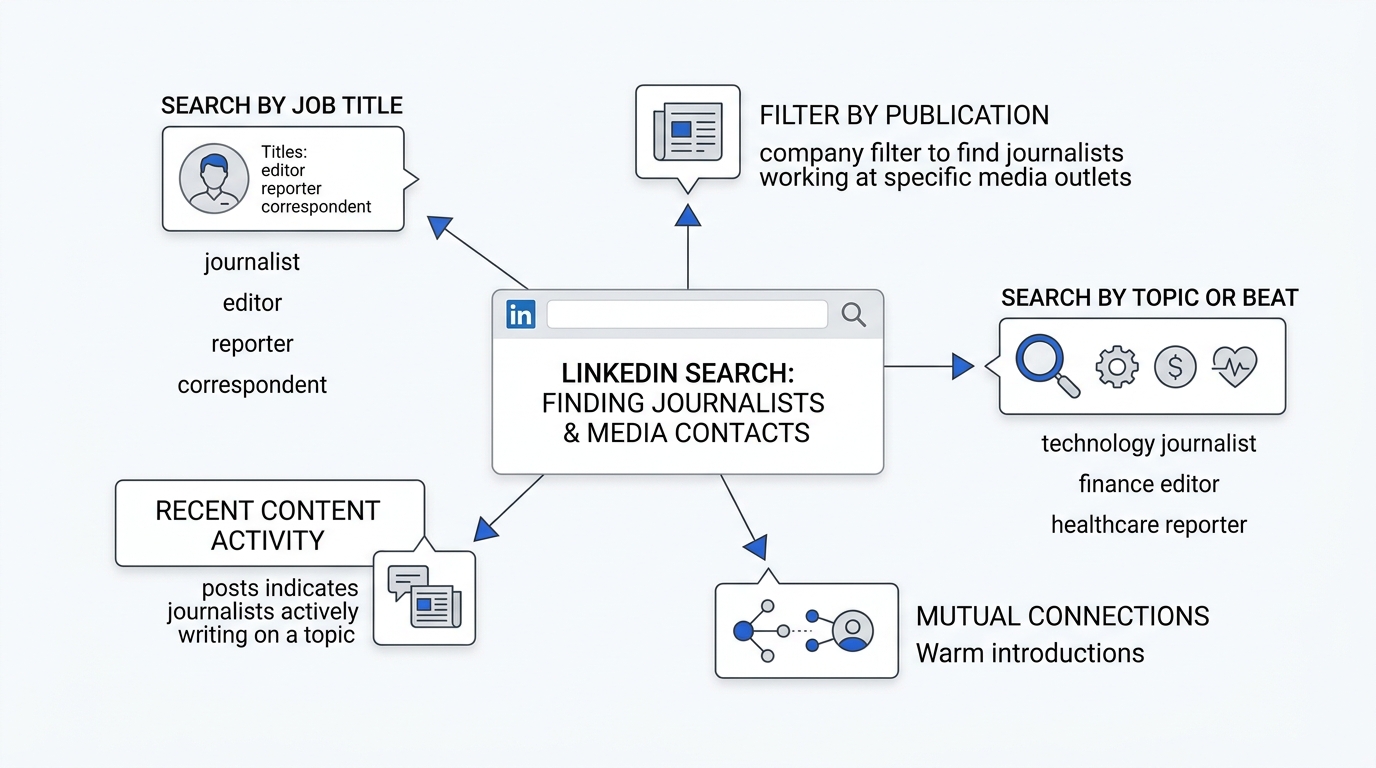
LinkedIn’s search functionality is one of its most underused assets for PR professionals. The ability to find journalists by beat, publication, geography, and seniority — and then see their recent activity, shared connections, and professional history — is genuinely powerful for media list building.
Using LinkedIn Search for Media Contact Discovery
Basic search approach:
- Search by job title: “journalist,” “editor,” “reporter,” “producer,” “correspondent”
- Combine with keywords for beat: “technology journalist,” “health reporter,” “finance editor”
- Filter by company (publication name) to find specific outlet contacts
- Filter by location for regional media targeting
Advanced search strategies:
| Search Approach | Best Used For |
|---|---|
| Job title + keyword filter | Finding journalists by specific beat or topic area |
| Company filter | Building a complete contact list for a specific publication |
| Mutual connections filter | Identifying journalists reachable through warm introduction |
| Content search | Finding journalists who’ve recently posted about your topic area |
| Alumni filter | Connecting with journalists who share your university background |
| Group membership | Finding media communities where journalists are active |
Reading journalist profiles before outreach:
A journalist’s LinkedIn profile is one of the richest research sources available. Before sending any pitch, study their profile for:
- Recent posts — what stories are they currently pursuing? What angles are they finding interesting right now?
- Recent articles shared — what publications are they writing for and what’s their current editorial focus?
- Skills and endorsements — what do their colleagues say their strongest areas are?
- Career history — what beats have they covered historically? What’s their editorial background?
- Mutual connections — is there a shared contact who could provide a warm introduction?
This research takes five minutes per journalist and dramatically increases the quality and relevance of your pitch.
linkedin pr media outreach — The Right Way to Build Relationships Before You Pitch
The single biggest differentiator between PR professionals who consistently generate media coverage through LinkedIn and those who don’t is relationship sequencing. The former build familiarity before asking for anything. The latter go straight to the ask.
Building familiarity with journalists on LinkedIn before pitching is not complicated. It requires consistency and patience, but the mechanics are simple.
The Relationship-First Engagement Sequence
Stage 1: Follow and observe (Week 1–2)
Follow the journalist before connecting. Read their posts. Understand their current editorial interests. Identify the topics they’re covering actively. This costs you nothing and gives you everything you need to pitch relevantly.
Stage 2: Engage genuinely with their content (Week 2–4)
Leave thoughtful comments on their posts. Not “Great article!” — that’s noise. Engage with the substance of what they’ve written. Add a perspective, reference a related data point, share a relevant experience from your clients. Good comments get noticed. Journalists see who engages with their work.
Stage 3: Share their work with context (Week 2–4)
Share their articles to your network with a comment that adds genuine perspective. Tag them when you do. This demonstrates that you read their work, respect it, and think their audience should read it. It’s a low-friction way to get on their radar before any ask is made.
Stage 4: Connect with a specific reason (Week 3–5)
Send a connection request with a note that references something specific — a recent article, a post they shared, a mutual connection. Never a pitch. Never an ask.
Example connection note:
“Saw your recent piece on [specific topic] — the section on [specific angle] was particularly sharp. I work on the communications side for several companies in this space and find your coverage genuinely useful. Would be good to be connected.”
Stage 5: Pitch after earned familiarity (Week 5+)
Now — and only now — you pitch. But because they recognize your name, because you’ve added value to their work, because your pitch arrives in the context of an existing (if light) professional relationship, your message gets opened and read instead of deleted.
| Stage | Action | Timeline | Goal |
|---|---|---|---|
| 1 | Follow and observe | Week 1–2 | Understand editorial focus |
| 2 | Engage with content | Week 2–4 | Get on their radar |
| 3 | Share their work | Week 2–4 | Demonstrate respect for their coverage |
| 4 | Send connection request | Week 3–5 | Establish direct line |
| 5 | Pitch with relevance | Week 5+ | Earn the response |
Crafting LinkedIn Pitches That Actually Get Responses
Once you’ve built the foundation of familiarity and sent a connection request, the pitch itself matters enormously. LinkedIn messages are not emails. They’re read differently, on different devices, in a different context. A pitch that might work in email will often fail in a LinkedIn message and vice versa.
The Anatomy of an Effective LinkedIn PR Pitch
Length: Keep it under 150 words. Journalists read LinkedIn messages on mobile as often as desktop. Long messages get scrolled past.
Opening: Reference something specific — their recent work, a topic they’ve been covering, a post they shared. Never open with your name, your company, or what you’re pitching.
The hook: One sentence. The story angle, the data point, the source offer — whatever makes this pitch worth reading in the next 10 seconds.
Why them, why now: One or two sentences explaining why this story is relevant to their specific beat and why the timing is right.
The ask: Specific and low-friction. Not “I’d love to schedule a call to discuss a potential partnership.” Simply: “Would this angle be useful for your coverage? Happy to send background materials.”
Contact information: Your email and phone number at the end. Make it easy to continue the conversation off-platform.
| Pitch Element | What It Should Contain | Word Count |
|---|---|---|
| Opening | Specific reference to their recent work | 1–2 sentences |
| The hook | The story angle in one compelling sentence | 1 sentence |
| Why them/now | Relevance to their beat + timing | 1–2 sentences |
| The ask | Low-friction next step | 1 sentence |
| Contact info | Email + phone | 2 lines |
What to avoid:
- Attachments in initial messages — they signal spam and reduce open rates
- Lengthy background on your company or client — save it for the follow-up
- Multiple story angles in a single message — pick one and pitch it clearly
- Generic openers that could have been sent to anyone
- Pitching a story that’s not relevant to their beat under any reasonable interpretation
Using a LinkedIn Outreach Tool for PR and Media Relations at Scale
For individual pitches and relationship building, manual outreach is perfectly manageable. For PR teams handling multiple clients, building media lists across dozens of publications, or running coordinated outreach campaigns around a product launch or news event, the manual approach has clear limitations.
A LinkedIn outreach tool allows PR professionals to systematize parts of the outreach process without losing the personalization that makes LinkedIn pitching effective. The key distinction between using these tools well and using them badly is this: automation should handle logistics, never personalization.
What a LinkedIn Outreach Tool Can and Cannot Do for PR
| Function | Can Be Automated | Should Stay Manual |
|---|---|---|
| Connection request sending | Yes — with personalized note templates | The note content itself |
| Follow-up message sequencing | Yes — with timing controls | The first follow-up message |
| Profile visit tracking | Yes — who has viewed your profile | Your response to profile views |
| Contact list building | Yes — search and export | List qualification and prioritization |
| Message scheduling | Yes — optimal timing | Message content and tone |
| Engagement tracking | Yes — open and response rates | Relationship nurturing |
Best practices for using a LinkedIn outreach tool in PR:
- Build personalization variables into every template: journalist name, publication, recent article, beat focus — these should auto-populate but should be checked before sending
- Set conservative daily limits — LinkedIn’s algorithm flags and restricts accounts that show unnatural activity patterns. Most tools allow you to set daily connection and message limits that stay within safe thresholds
- Never use automated sequences for follow-ups beyond the second message — anything beyond that requires genuine human judgment
- Use the tool’s analytics to identify which pitch angles generate the highest response rates, then refine your outreach accordingly
- Segment your contact lists carefully — a technology journalist and a finance journalist should never receive the same pitch template
The goal of any LinkedIn outreach tool in a PR context is efficiency, not replacement of genuine relationship building. Used well, these tools free up time for the high-quality, personalized relationship work that actually generates coverage.
Advanced LinkedIn Tactics for PR and Media Relations
Effective PR and media outreach today requires more than traditional pitching; it demands strategic relationship building on platforms where journalists and industry voices are most active. LinkedIn for PR & Media Outreach offers powerful opportunities to connect with reporters, editors, and influencers in a more natural and professional environment. In this section, we explore advanced LinkedIn tactics that help PR professionals identify the right media contacts, engage with their content, build credibility, and create meaningful conversations that lead to successful media coverage.
Leveraging LinkedIn Content for Media Visibility
One of the most underused PR strategies on LinkedIn is positioning your client — or yourself — as a media source through consistent thought leadership content. Journalists on LinkedIn are actively looking for expert sources. They’re reading their feeds. They’re searching for credible voices on topics they’re covering.
When your client regularly publishes insightful content on LinkedIn about their area of expertise, journalists start to notice. An editor covering enterprise software who repeatedly sees insightful commentary on B2B buying trends from the same executive is primed to reach out when they need a source for their next story.
Content types that attract media attention:
| Content Type | Why Journalists Notice It | Frequency |
|---|---|---|
| Data-backed insights | Gives journalists ready-to-use statistics | 2x/month |
| Contrarian industry takes | Offers a compelling, quotable perspective | 1–2x/week |
| Breaking news commentary | Positions your client as a real-time source | As news breaks |
| Original research or surveys | Creates newsworthy findings | Quarterly |
| Case studies with specific metrics | Provides proof points for stories | Monthly |
Using LinkedIn Articles for Journalist Credibility Building
LinkedIn Articles — long-form content published natively on the platform — rank in both LinkedIn and Google search. A well-written article on a topic a journalist is researching can surface in their search results and introduce them to your client or your own expertise organically, before any outreach is made.
Topics for LinkedIn Articles in a PR context:
- Industry trend analysis with original data
- Commentary on regulatory changes affecting your client’s sector
- Forward-looking predictions backed by research
- In-depth breakdowns of topics journalists in your client’s space are consistently covering
LinkedIn Newsletters for Building an Owned Media Audience
LinkedIn Newsletters allow you to build a subscriber base that receives your content directly via email notification — bypassing the algorithm entirely for your most engaged readers. For PR professionals, building a newsletter around your area of expertise (a communications-focused newsletter, an industry-specific insights newsletter for your client) creates a direct channel to journalists, analysts, and media contacts who’ve opted in to hear from you.
Building Long-Term Media Relationships Through LinkedIn
Tactical pitching generates coverage. Genuine relationship building generates consistent, long-term media attention. LinkedIn is the ideal platform for the latter because it enables ongoing, low-friction professional connection that doesn’t require continuous email exchanges.
The Long-Term Relationship Maintenance Framework
| Action | Frequency | Purpose |
|---|---|---|
| Engage with journalist’s content | Weekly | Stay visible and relevant |
| Share their coverage with commentary | When relevant | Demonstrate you value their work |
| Send useful information without a pitch | Monthly | Position yourself as a resource |
| Congratulate on bylines, promotions, new roles | When it happens | Human relationship touchpoints |
| Make introductions to useful sources | When genuinely relevant | Add value beyond your own pitches |
| Comment on editorial changes at their publication | When relevant | Signal you follow their career |
The journalists who become long-term media partners — who think of you when they’re working on a story in your area, who reach out proactively for sources and commentary — are almost always ones where the relationship was built over time through consistent, genuine engagement rather than sporadic, pitch-heavy contact.
Measuring the Effectiveness of Your LinkedIn PR and Media Outreach
Every PR professional knows that measurement is where communications programs live or die. LinkedIn provides enough native analytics to build a useful measurement framework for your outreach activity.
| Metric | What It Measures | How to Track | Target |
|---|---|---|---|
| Connection acceptance rate | How well your profile and intro note resonate | Manual tracking | 50–70%+ from targeted journalists |
| Message response rate | Pitch relevance and relationship quality | Manual or tool tracking | 15–25%+ for warmed contacts |
| Profile views from target list | Journalist awareness of your presence | LinkedIn analytics | Growing month-over-month |
| Content engagement from media contacts | Whether your thought leadership is landing | Post analytics | Increasing over 90-day window |
| Coverage generated per campaign | Direct PR outcome | CRM or PR tracking tool | Establish baseline, improve quarterly |
| Journalist follow-backs | Organic interest from media contacts | LinkedIn analytics | Track monthly |
| Inbound journalist inquiries via LinkedIn | Measure of earned media authority | Manual tracking | Goal: 1–3+/month after 90 days |
Monthly review questions:
- Which journalists responded to outreach this month, and what was common about the pitches that worked?
- Which content generated engagement from media contacts?
- How has the connection acceptance rate changed versus last month?
- Are any journalists on the target list engaging with your content organically?
- How many coverage pieces were generated through LinkedIn-initiated relationships?
Common LinkedIn PR Outreach Mistakes to Avoid
Even experienced communications professionals make these mistakes regularly. Avoiding them puts you ahead of the vast majority of PR outreach landing in journalists’ inboxes.
| Mistake | Why It Fails | What to Do Instead |
|---|---|---|
| Pitching without prior engagement | No familiarity = ignored message | Build engagement first over 3–4 weeks |
| Sending the same pitch to everyone | Journalists know generic when they see it | Customize every message to their specific beat |
| Pitching off-beat stories | Wastes their time and your credibility | Research their beat thoroughly before outreach |
| Following up too aggressively | Annoys journalists and damages relationship | One follow-up, 5–7 days after initial pitch |
| Treating LinkedIn like email | Long messages get ignored on mobile | Keep pitches under 150 words |
| Using automation for personalization | Personalization can’t be fully automated | Use tools for logistics, manual for content |
| Ignoring journalist content between pitches | Transactional relationship that erodes over time | Engage consistently regardless of pitch cycle |
| Not updating your profile | Weak profiles undermine pitch credibility | Review and update profile quarterly |
Conclusion
LinkedIn has fundamentally changed the architecture of media relations. The platform where professional relationships are built, maintained, and leveraged has shifted — and the PR professionals generating the most consistent, high-quality media coverage in 2026 are the ones who understood that shift early and built their presence accordingly.
LinkedIn pr media outreach done well is not a shortcut to coverage. It’s a commitment to building genuine professional relationships with the journalists, editors, and media voices whose coverage matters to your clients — using the most powerful professional networking tool available to do it at scale, with relevance, and with the kind of credibility that makes your pitch the one that gets the response.
Build the presence. Build the relationships. Then pitch. In that order, every time.
Frequently Asked Questions
Is LinkedIn better than email for pitching journalists in 2026?
It depends on the relationship and the context. For cold outreach to journalists you have no prior relationship with, LinkedIn typically outperforms cold email because your profile gives journalists immediate context about who you are and why they should engage. For journalists you have an established relationship with, email may still be the preferred channel. The most effective approach uses both — LinkedIn for relationship building and warming, email for formal pitches once a relationship exists.
How many journalists should a PR professional target on LinkedIn at once?
Quality beats quantity every time. A focused list of 30–50 highly relevant journalists, engaged with consistently and pitched relevantly, will generate more coverage than a spray-and-pray list of 500. Start with the journalists most important to your current client priorities and build outward as capacity allows.
What’s the ideal frequency for following up on a LinkedIn pitch?
One follow-up, sent five to seven days after your initial message, is the standard. Keep the follow-up shorter than the original pitch — a brief one-sentence acknowledgment that you wanted to make sure it didn’t get lost, with a reiteration of your contact information. Anything beyond one follow-up risks damaging the relationship permanently.
Should PR professionals use LinkedIn Creator Mode?
Yes, if you’re posting content consistently. Creator Mode unlocks enhanced analytics, allows you to add topic hashtags to your profile, and switches your profile to a “follow” model — which means journalists can follow your content without sending a connection request. This expands your organic reach to media contacts who are interested in your expertise but not yet ready to connect.
How long does it take to generate media coverage through LinkedIn outreach?
Building media relationships through LinkedIn is a medium-term strategy. Expect four to twelve weeks of consistent engagement and relationship building before seeing meaningful coverage results. The compounding effect, however, is significant — relationships built through LinkedIn tend to be more durable and more consistently productive than those initiated through cold email.
Can a LinkedIn outreach tool be used effectively for media pitching?
A LinkedIn outreach tool can be genuinely useful for the logistics of PR outreach — managing contact lists, scheduling connection requests, tracking responses, and analyzing which approaches generate the best response rates. The critical condition is that the tool handles mechanics while the PR professional handles all substantive personalization and relationship nurturing. Over-automation in media outreach is immediately obvious to journalists and immediately damaging to credibility.
What should PR professionals never do when pitching journalists on LinkedIn?
Never pitch off-beat. Never send a generic message. Never follow up more than once without a new angle or genuine addition. Never use LinkedIn as a broadcast channel for press releases. And never — under any circumstances — connect with a journalist, get accepted, and immediately send a pitch. That approach has the same effect as walking up to someone at a networking event, shaking their hand, and immediately asking them for a favor.