

You just hung up the call. It went well. The prospect was engaged, asked thoughtful questions, and said they’d “think about it.” Now most sales reps go silent and wait for the prospect to reach out again. This is exactly where deals die.
Here’s what actually works: within minutes of hanging up, you send a thoughtful follow-up. A LinkedIn thank you message after a sales call isn’t just polite. It’s a tactical move that reminds the prospect who you are, reinforces the value you discussed, and makes you the one driving the next step. Not all follow-ups are equal, though. Send something generic, and your message gets buried in their inbox. Send something sharp and specific, and it becomes a deal accelerator.
In this guide, I’m going to show you exactly how to write a LinkedIn thank you message after a sales call that actually gets responses. You’ll learn the structure that works, the timing that matters, the common mistakes that kill reply rates, and templates you can customize for any scenario. Whether you’re in SaaS, consulting, recruiting, or services, these principles apply directly to your outreach.
Why LinkedIn Thank You Messages Matter After Sales Calls: The Psychology Behind Post-Call Follow-Up
The assumption most reps make is simple: the call did the heavy lifting, so the follow-up is just a formality. This assumption costs deals.
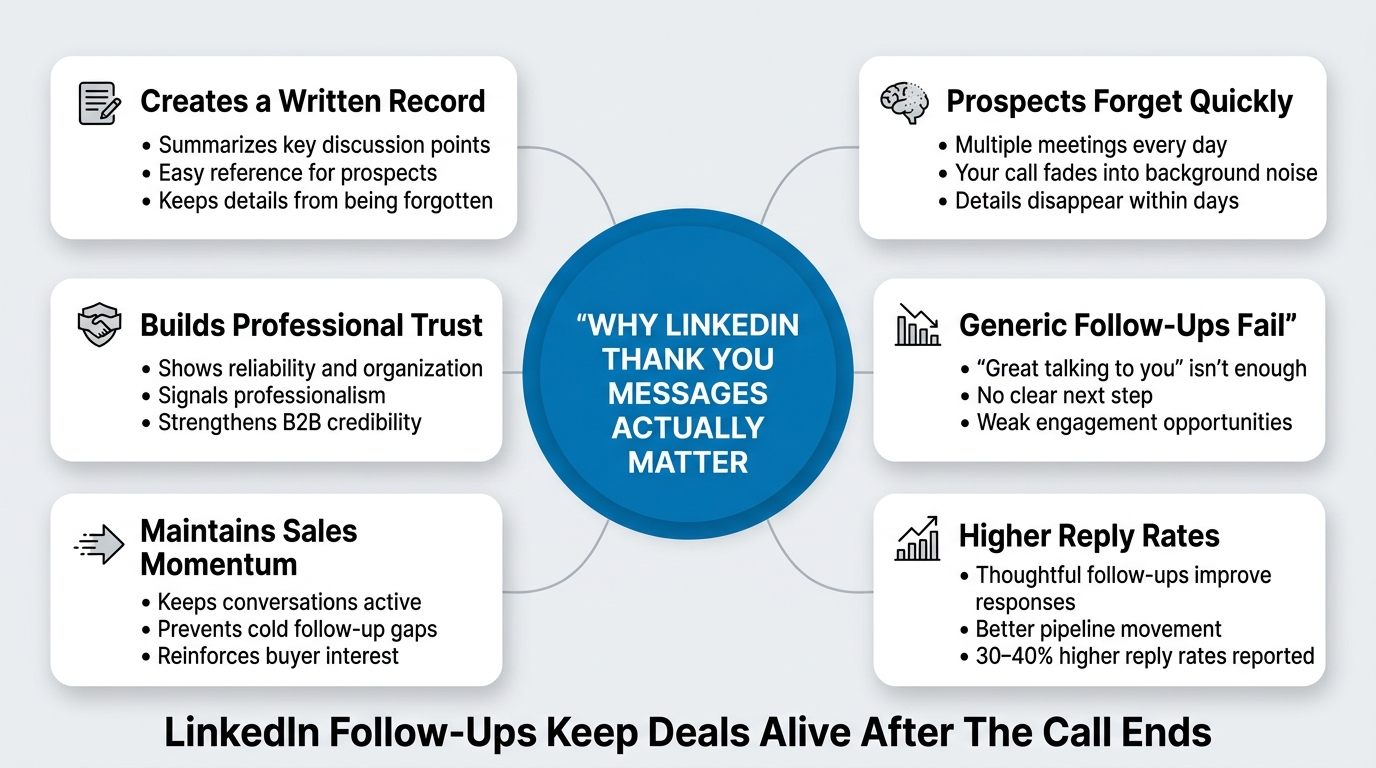
Here’s what actually happens after a sales call. Your prospect hangs up and moves on to their next meeting. If they liked what you discussed, it registers somewhere in their mind, but it’s not the top priority. By tomorrow, they’ve had five more meetings, attended three emails, and your call has faded into background noise. A week later, they honestly do not remember the specifics of what you discussed. They definitely do not remember the exact problem you solved for them or the timeline you mentioned.
A quick, well-timed follow-up on LinkedIn accomplishes four critical things:
First, it creates a written record. When you send a message that summarizes the key points from the call, you’re giving them a reference document. They can scroll back and remind themselves of what was discussed without having to dig through their email or calendar notes.
Second, it positions you as organized and thorough. Reps who follow up promptly send a signal: “I’m professional, I value this conversation, and I’m going to be reliable to work with.” That message matters more than you think, especially in B2B sales where trust is already fragile. If you can’t send a follow-up in a timely manner, why should they trust you to deliver on a contract?
Third, it keeps momentum going. Sales is momentum. If there’s dead air between the call and the next touchpoint, it breaks psychological momentum. But if you send a quick, substantive message within hours, you’re saying the conversation is still active. You’re keeping the door open. You’re showing you’re thinking about their problem. Momentum is the difference between a prospect who feels pursued and one who feels forgotten.
Fourth, it gives them a reason to respond. A vague “great talking to you” message doesn’t ask them to do anything. But a message that includes a specific question, a relevant resource, or the next clear step invites them to engage. You’re not asking them to make a decision. You’re asking them to take the next natural step in the conversation.
Here’s the tactical payoff: according to sales execution research, reps who send thoughtful follow-ups within 24 hours of a call see reply rates improve by 30 to 40% compared to those who don’t. That’s not just a nice-to-have. That’s the difference between a stalled pipeline and one that moves.
When to Send Your LinkedIn Thank You Message After a Sales Call
Timing is not arbitrary. Send your follow-up at the wrong moment and it gets lost or feels desperate. Send it at the right moment and it lands at exactly the point when they’re thinking about your conversation.
The Immediate Follow-Up Window (0 to 2 Hours)
The best time to send a LinkedIn thank you message after a sales call is within 30 minutes to 2 hours of hanging up. Here’s why this matters more than people realize.
When you send within this window, the call is still fresh in their head. They’ve likely told someone else about the conversation, checked a detail you mentioned, or started thinking about next steps. Your message arrives while they’re still in that mental space. It feels like you’re continuing the conversation, not starting a new one days later.
This timing also communicates something psychological: you cared enough to write this down immediately. You weren’t so busy after the call that you forgot. You weren’t unsure enough to wait and see if they’d reach out first. You took action. That matters.
Practically speaking, if your call ends at 2 PM, send your message by 3:30 PM at the latest. If it’s a call late in the day, send it before the day ends. The worst case is the call happens at 4:55 PM on a Friday. In that scenario, sending it first thing Monday morning is acceptable, but do not wait longer than that.
The “Don’t Send Too Late” Rule
Here’s a mistake reps make: they think “I’ll send this at a better time when they’re less busy.” So they write a message on Monday and schedule it for Thursday. This is wrong. LinkedIn’s algorithm and the human brain do not reward delayed follow-ups.
When you send your message minutes or hours after a call, it’s contextually obvious why you’re writing. The call is recent. Your message makes sense as a continuation. But if you send it three days later with no explanation, it feels cold and disconnected. They may not even remember why you’re following up.
So send it the same day, or the very next morning if the call was late. Do not batch your follow-ups for “better delivery times” if it means creating distance between the call and your message.
The Friday-to-Monday Question
If you have a call on Thursday afternoon, send your follow-up before close of business Thursday. If you have a call Friday morning, send it Friday afternoon. Do not wait until Monday thinking they’ll pay more attention. By Monday, they’ve spent the weekend not thinking about your call, and your message arrives out of context.
The exception: if you have a call late Friday and you know they’re checked out for the weekend, sending first thing Monday at 8 AM is acceptable. But do not wait until Tuesday or later.
Time-Zone Sensitivity
If you’re communicating with someone in a different time zone, send your message at a time when they’re likely working. If you’re in US Eastern and they’re in Europe, do not send at 10 PM your time. That’s 3 AM for them, and your message gets buried in their morning avalanche. Send it by 5 PM your time so it lands in their morning.
This small detail lifts response rates noticeably because your message gets seen when they’re actually checking LinkedIn and thinking about work, not when it’s buried under 47 other messages.
How to Write a LinkedIn Thank You Message After Sales Calls: Key Elements That Boost Response Rates
A great LinkedIn thank you message after sales call has a specific structure. It is not just three sentences of gratitude. It’s a mini-conversation that includes five distinct elements:
Element 1: A Genuine Opening That References Something Specific From the Call
Start with something personal that proves you were actually paying attention. Do not open with “Thanks for taking the time to chat.” That’s forgettable. Instead, reference something they said, a question they asked, or a detail they shared.
Examples of strong openings:
- “Really enjoyed hearing about the challenges your team ran into with their current reporting system.”
- “The point you made about scaling without hiring more headcount stuck with me after the call.”
- “I appreciated your candor about the timeline your executives are pushing for.”
These openings do three things at once. First, they show you listened. Second, they prove the conversation actually happened and was meaningful. Third, they give the reader an immediate context refresh. As soon as they see that sentence, they think, “Oh right, yes, I was just talking about that.”
Element 2: A Bridge Statement That Connects Their Problem to Your Solution
After the opening, write one sentence that connects what they told you to what you discussed offering them. This is not a feature dump. It’s a one-sentence reminder of the fit.
Examples:
- “That’s exactly where most of our customers get stuck before they move to an automation-first approach.”
- “The bandwidth constraint you described is actually why we built the system we walked through.”
- “That’s a problem our recent clients in your vertical have solved in 60 to 90 days with our process.”
This bridges the gap between their pain and your relevance. It says, “I heard your problem, and what I showed you is actually made for solving that exact problem.” It’s not salesy. It’s logical.
Element 3: One Specific, Valuable Takeaway or Resource
Next, include something tangible they can use immediately. Do not just say “I’ll send over some resources.” Actually mention what the resource is or provide the specific insight.
Options:
- “I’ve attached a short summary of how we’ve helped three companies in your space reduce report generation time from weeks to days.”
- “One thing that came up in our call was the integration question. I’m passing along our technical docs for your IT team to review.”
- “Based on what you shared, I’m sending a case study of a company that faced the exact scaling problem you mentioned.”
Notice what these have in common: they’re specific, they reference the call, and they provide immediate value that does not require a reply. This is important. You’re not asking them to hunt for something. You’re not sending a 50-slide deck. You’re giving them exactly one thing they asked about or that was implied in the conversation.
Element 4: A Clear, Low-Friction Next Step
Now here’s where most follow-ups fail. They end without asking for anything, or they ask for something too big (“Should we schedule another call?”). Instead, ask for one small thing.
Strong next-step asks:
- “Would it make sense to loop in your team lead so they can see how this applies to their workflow?”
- “When you’ve had a chance to review the docs, would a 15-minute call to answer questions be helpful?”
- “Do you have a preferred time next week for a quick walkthrough with your tech team?”
- “Is there a specific metric or timeline your stakeholders are focused on that I should factor in?”
These are specific enough to feel real, but they’re not pushy. You’re not asking them to commit to a three-month engagement. You’re asking them to take the next obvious step in a conversation that’s already moving. If they say yes, great. If they do not respond, you have a natural place to follow up again.
Element 5: A Professional, Personal Closing
Close with something warm but not sappy. You want to sound like a person, not a template.
Good options:
- “Looking forward to moving this forward together.”
- “Happy to adapt our approach based on what works best for your team.”
- “Let me know what makes sense on your end, and we’ll take it from there.”
Avoid closings that feel corporate or forced:
- “I look forward to discussing this further at your earliest convenience.” (Too formal.)
- “Excited to explore this opportunity together.” (Too sales-y.)
- “Synergies await.” (This is a joke, but I’ve seen close approximations.)
The closing should feel like the end of a real conversation, not the end of a sales email that was mailed out to 1,000 people.
LinkedIn Thank You Message Templates You Can Customize
Here are templates for the most common post-call scenarios. Use them as frameworks, not copy-paste jobs. The personalization details are what make the difference.
Template 1: After an Initial Discovery Call With a Prospect
“Hi [Name],
Really valued getting to hear more about the challenges your team’s facing with [specific problem they mentioned]. That’s exactly where most companies hit a wall before things start moving.
What stuck with me was your point about [specific insight they shared]. That’s actually why we built the system to handle [your solution angle].
I’m going to send over a brief overview of how we’ve helped teams like yours cut [their main metric] from [timeline] to [timeline]. More importantly, I’ve included a specific walkthrough of how your workflow would change.
When you’ve had a chance to scan through it, would a quick 20-minute call be helpful to answer questions or talk through any concerns your stakeholders might have?
Looking forward to it.
[Your Name]”
This template works because it validates their problem, connects to your solution, provides a concrete resource, and asks for a small next step. The specificity makes the difference. You’re not saying “we’ve helped customers,” you’re saying “we’ve helped teams like yours cut X from Y to Z.”
Template 2: After a Demo Call (Technical or Product Walkthrough)
“Hi [Name],
Enjoyed the conversation earlier, especially when you walked me through your current process with [specific system or workflow they mentioned]. I can see exactly where the friction points are happening on your end.
The question you asked about integration with [specific tool] is something our team deals with regularly. I’m sending over our technical docs and a case study of a company that had the exact same requirement. Your IT team might find it useful to see how they approached it.
Also, I want to make sure we’re solving for the right problem. When you mentioned [their stated timeline/goal], I want to confirm: are there other stakeholders we need to get aligned, or is this a decision you’re making independently with your team?
Let me know what would be helpful next.
[Your Name]”
This template acknowledges a technical concern head-on, provides resources for the technical team, and asks a qualifying question. It’s not asking for a sale. It’s asking for clarity, which is actually how deals move forward.
Template 3: After a Meeting With Multiple Stakeholders or a Committee
“Hi [Name],
Really appreciated the chance to spend time with you and the team this morning. I got a clear sense of what success looks like on your end, and I think there’s a genuine fit.
A couple of things resonated with me:
- [Point from Stakeholder 1]’s feedback about [their concern]
- [Stakeholder 2]’s question about [timeline/integration/budget], which we should solve for
Because this involves your team, I’m going to send over something that addresses both of those points specifically. I’ve also included some benchmarks from comparable companies so your group has context for why our approach works.
Would it make sense to schedule a follow-up with the group by [specific date]? That way we can make sure everyone’s questions are addressed before anyone makes a decision.
[Your Name]”
The multi-stakeholder scenario requires you to prove you listened to all parties, not just the decision-maker. By naming specific feedback from different people, you’re showing you were paying attention to the room, not just the loudest voice.
Template 4: After a Longer, Complex Sales Conversation (Extended Calls With Objections or Deep Dives)
“Hi [Name],
That was a comprehensive conversation, and I appreciate your toughness on the questions you asked. [Prospect] who challenges the approach helps us actually solve the right problems, not just sell solutions.
To your point about [their main objection or concern], I want to be direct: we have [specific data/case study/proof point] that shows how we’ve handled exactly that. But I also want to acknowledge that [legitimate concern/limitation if it exists]. Here’s how we navigate that…
I’m sending a few things:
- A breakdown of how we’ve solved [their specific objection] for [types of companies/verticals]
- A reference customer in a similar situation who’s happy to talk (if you want to vet our claims directly)
- A framework for how the first 30 days would actually work on your end
The thing I don’t want to do is pretend we’re the perfect fit if we’re not. But based on what you told me today, I think we are. So before we move forward, let me know: what else would you need to see or hear to feel confident in that?
[Your Name]”
This template works for complex or contentious calls where you need to show you listened to skepticism, not just bought into their problem. It’s honest, it provides proof, and it invites them to name what would actually move them forward.
Mistakes That Hurt Your Follow-Up Credibility
The difference between a follow-up that works and one that kills your chances is sometimes just a few words. Here are the most common mistakes that tank reply rates.
Mistake 1: Being Too Generic
“Thanks for taking the time to talk today. I really think there’s potential here. I’d love to discuss this further when you have availability.”
This message could be sent to anyone after any call. There’s nothing in it that proves you were paying attention or that you understand their specific situation. When a prospect reads something this generic, they think one of two things: either you send this same message to everyone (undifferentiated), or you didn’t care enough to remember what we talked about (disrespectful).
The fix: Always include at least one specific detail from the call. Not a generic problem they might have. The specific problem they told you about.
Mistake 2: Asking Too Much, Too Soon
“Would you like to schedule a call with our VP of Sales and your executive team to align on next steps? I have time Tuesday or Thursday.”
You just had a call with them. They do not yet know if they even want to move forward, and you’re asking them to coordinate a multi-person meeting. This is premature and feels pushy. You’ve overestimated the relationship strength.
The fix: Ask for one small thing. A 15-minute call to answer questions. A chance for them to review something. A conversation with one peer or colleague. Incremental advancement, not jumping to a deal-review meeting.
Mistake 3: Making It About You, Not Them
“I’m really excited to work with you because our solution is perfect for your use case. We’ve helped hundreds of customers, and I think you’d be a great fit for our platform.”
This message centers your excitement, your solution, your track record. It does not center their need or their next step. When they read it, they do not feel heard. They feel pitched.
The fix: Start with them. “I got a clear picture of what’s slowing your team down.” Make it about solving their problem, not about your solution’s features.
Mistake 4: Sending a LinkedIn Message That Should Have Been an Email
Some follow-ups are too long or too detailed for LinkedIn. If your message is 500 words with multiple bullet points, a spreadsheet, or a complex explanation, it belongs in an email, not in a LinkedIn DM.
The fix: Keep LinkedIn messages to 3 to 4 paragraphs maximum. If you need to send more detail, write a short LinkedIn message that says “I’m going to email over X because it’s too detailed for here,” then send the comprehensive version via email.
Mistake 5: Sounding Like a Template
“Circling back on our conversation from this morning. I wanted to touch base and see if you’d had a chance to think more about the proposal.”
This language is so worn out that it immediately signals you’re running a generic sales process. Prospects sense it, and their guard goes up. They think, “They probably send this same follow-up to 50 people a week.”
The fix: Write like you actually talk. “I’ve been thinking about the challenge you mentioned with your current process, and I think I’ve got a solution that could actually work.”
Mistake 6: Waiting Too Long
Sending a follow-up three days after your call signals that you weren’t all that interested or that you’ve been too busy to get to it. By then, the prospect has moved on mentally. Your message feels late. It feels reactive instead of proactive.
The fix: Send within 2 to 24 hours maximum. If you’re going to send it, make it part of your immediate post-call routine, not something you batch later.
Personalizing Your Message: Going Beyond Generic “Thanks”
Generic follow-ups get ignored. Personalized ones get responses. Here’s how to personalize at scale without making it feel fake.
Layer 1: Reference a Specific Quote or Comment From the Call
Write down or mentally note something the prospect said during the call. Not a topic. An actual quote or comment that was unique to them.
Weak example: “Thanks for sharing information about your sales process.”
Strong example: “I remembered you mentioning that your reps spend 60% of their day on admin work instead of selling. That’s where most of our customers get stuck.”
The specific mention of “60% on admin” or “reps spend time on admin” proves you heard them. It reminds them what they said. It gives them context immediately.
How to do this: Right after a call, spend 30 seconds noting the one most important thing they said. Not everything. One thing. One number, one concern, one goal. Then reference that.
Layer 2: Connect Their Problem to a Specific Outcome You’ve Delivered
Do not say “we’ve helped customers.” Say “we’ve helped companies like yours reduce sales cycle time from 90 days to 45 days” or “we’ve helped teams in your industry cut their data entry time by 70%.”
This is personal because it’s specific to them. You’re not talking about a generic customer success story. You’re saying “we’ve solved exactly your problem for companies exactly like you.”
How to do this: Before you get on a call, identify the main problem they might have and think about the one best example or metric you have for that specific problem. Then reference it in your follow-up.
Layer 3: Acknowledge a Concern They Raised, Don’t Ignore It
If they expressed skepticism, budget concerns, timeline challenges, or any other objection, mention it in your follow-up. Show you heard it even if you did not fully address it on the call.
“I know you mentioned the timeline is tight and your budget has already been allocated for this quarter. That’s real. But I want to show you how we’ve helped companies accelerate implementation in ways that fit existing budgets.”
This works because you’re not pretending the objection does not exist. You’re addressing it head-on. You’re saying “I get it, and here’s how we deal with that.”
How to do this: As the call ends, mentally summarize the one main concern they raised. In your follow-up, name it and offer to solve for it.
Layer 4: Add a Micro-Detail Only They Would Know
If you remember something small but specific, mention it. Not something creepy. Something from the conversation.
“You mentioned your team just came back from a conference where they saw [competitor’s product]. That context is actually useful because we built our approach differently on that exact front.”
Or: “I noticed you have [specific software] open in the background during our call. That’s actually relevant because most of our customers use that same tool, and we integrate well with it.”
This level of detail signals you’re not in autopilot. You were present. You were paying attention.
How to do this: Do not manufacture details. Just notice real things during the call and include them naturally if they came up.
Layer 5: Customize the Resource or Offer to Their Specific Situation
Instead of “I’m sending over some resources,” name the resource and why you’re sending it to them specifically.
Weak: “I’m attaching our case study for your review.”
Strong: “I’m sending a case study of how a [similar company type] in your market reduced [their specific metric] in the first 60 days. Thought it would be helpful context.”
The second one is personalized because you’ve framed why it’s relevant to them specifically.
How to do this: Choose the resource or example that most directly addresses what they told you they care about, then name it in your message.
Tracking and Measuring Your Follow-Up Success
You cannot improve what you do not measure. Most reps send follow-ups and have no idea if they’re working or not. You need three metrics.
Metric 1: Reply Rate
How many of your follow-up messages actually get a response?
Most sales teams see a 10 to 15% reply rate on cold outreach. But post-call follow-ups should be significantly higher. If you’re only getting 15 to 20% replies on your follow-ups after calls, something is wrong.
A well-executed follow-up should land somewhere between 30 to 50% reply rate, depending on the stage of the deal and the quality of the initial call.
To track this: Set up a simple tracker in a spreadsheet or CRM. For each follow-up you send, log the date sent, the prospect name, and whether they replied. Calculate your percentage weekly. If it’s trending down, you need to change your approach.
Metric 2: Time to First Response
Not just whether they respond, but how fast.
If your follow-ups are good, most responses should come within 24 to 48 hours. If you’re getting responses after 3+ days, the follow-up landed but did not create urgency. If you’re getting responses within hours, you’ve hit something that resonated.
Track the average time between when you send the follow-up and when you get a reply. If it’s trending longer, it might mean your ask is unclear or your follow-up isn’t creating momentum.
Metric 3: Conversion to Next Step
The ultimate metric: of the people who reply to your follow-up, how many actually take the next step you asked for?
You asked them to review docs and let you know questions. Did they do it? You asked them to schedule a meeting. Did they? You asked for a callback from a specific person. Did they loop them in?
This matters more than total reply rate because a reply that does not lead to action is just noise. You want replies that move the deal forward.
Track this by comparing total replies to total meetings scheduled or total next steps taken. Aim for 60% of replies converting to action. If it’s lower, your next-step ask is not compelling enough or not clear enough.
The Table: Follow-Up Performance Benchmarks
Here’s what healthy post-call follow-up performance looks like:
| Metric | Target | Strong | Exceptional |
|---|---|---|---|
| Reply Rate (%) | 20-30 | 30-40 | 40-50+ |
| Avg. Time to Reply (hours) | 24-48 | 12-24 | 2-8 |
| Replies Leading to Next Step (%) | 40-50 | 50-60 | 60-70+ |
| Booked Meetings from Follow-ups (%) | 10-15 | 15-25 | 25-35+ |
| Time to Follow-up (minutes) | 0-240 | 0-60 | 0-30 |
The right side of this table is not theoretical. These numbers are real for teams that optimize follow-up follow-ups as a discipline. The difference between sending generic follow-ups and personalized, timely ones is a 2X to 3X improvement in these metrics.
Track these metrics weekly for the next month. You’ll get a clear picture of whether your follow-up approach is working or whether you need to adjust tone, timing, or personalization depth.
Scaling Without Losing Personalization: The Automation Question
Here’s the question most teams ask: if you have 20 calls a week, how do you send personalized follow-ups to everyone without it becoming a part-time job?
The honest answer: you need a system.
The specific system depends on your volume and your role. If you’re doing 5 to 10 calls a week, you can hand-write each follow-up in 10 minutes. Takes you 50 to 100 minutes a week. That’s manageable.
If you’re doing 30+ calls a week, you need to systematize the personalization part without losing authenticity.
One approach is to create a framework for follow-ups that includes placeholders for the custom details, but the structure and tone stay consistent. Write the message in real-time right after the call, fill in the specific details, and send it. This gives you speed without sacrificing personalization.
Another approach, if your organization runs at higher volume, is to use sales automation platforms like LinkedIn’s native tools or third-party tools that let you schedule messages while preserving the personalization. The key is that the custom details (the specific thing they said, the specific problem you’re solving) still go in the message, not just a first name merge.
If you’re selling at massive scale, some teams use AI-assisted follow-up tools that generate the message draft based on call notes, which you then review and send. The AI handles the structure, but you verify that the personalization is real and specific. This keeps the human touch while scaling the volume.
The warning: do not scale in a way that loses personalization entirely. If you start sending the same message to everyone, you’ve just become a spam engine with a LinkedIn interface. That does not work.
The goal is to scale in a way that preserves what makes the message work (the specific reference to their situation, the clear next step, the human tone) while accelerating the operational speed of sending them.
Conclusion
A LinkedIn thank you message after a sales call is not a nice-to-have. It’s the moment when reps who move deals actually separate from reps who do not.
The reps who send thoughtful, timely, personalized follow-ups see faster sales cycles, higher reply rates, and more deals closed. The reps who skip it or send generic messages see deals slow down, conversations die, and pipelines stagnate.
Here’s what actually matters:
Send your follow-up within 2 hours of the call. Include one specific detail they shared that proves you were listening. Provide one valuable resource or insight they can use immediately. Ask for one small next step. And write it like a real person, not like you’re checking a box.
If you do these five things consistently, you will see a measurable improvement in your post-call follow-up performance within two weeks.
The next time you finish a sales call, do not wait until tomorrow to send your message. Do not batch follow-ups for better send times. Open LinkedIn right then, write something personalized and specific, and hit send. That responsiveness and that specificity is how you stay top-of-mind and keep deals moving.
Start tracking your reply rates, response time, and conversion to next steps. Most teams discover they’re underperforming here and have no idea. Once you see the data, you’ll optimize toward better follow-ups naturally. You’ll start noticing what language works, what timing works, and what level of personalization actually changes behavior.
This is not complex. It’s just disciplined. And discipline compounds.
Frequently Asked Questions
Q1: How long should a LinkedIn thank you message be after a sales call?
A LinkedIn thank you message should be 3 to 4 short paragraphs maximum, roughly 150 to 250 words. Long enough to be substantive and specific, short enough to read in under 60 seconds on a phone. If your message is longer than that, put the detailed information in an email and send a shorter LinkedIn message that directs them to the email.
Q2: Should I send a thank you message on LinkedIn or via email after a sales call?
LinkedIn is better if you want to keep the conversation in their face and maintain visibility on the platform. Email is better if you need to send something longer or more formal. Best practice: send a short, personalized message on LinkedIn immediately (within 2 hours), then follow up with a longer email if you have significant information to share. The LinkedIn message keeps momentum. The email delivers the details.
Q3: What do I do if the prospect doesn’t reply to my thank you message?
Wait 3 to 4 days after your initial thank you message, then send one follow-up message that references your previous message and adds new value (a new insight, a relevant article, updated information). If they don’t reply after that, move on. You’ve done your job. Some prospects will not engage. That’s not a reflection on your message quality. That’s just sales.
Q4: Is it okay to send a thank you message immediately after the call ends?
Yes. Sending within 30 minutes is actually ideal because the call is still fresh in both of your minds. The prospect has not moved on yet. Your message will land when they’re thinking about your conversation. Immediate follow-up shows respect for their time and eagerness to move forward.
Q5: Should I personalize every follow-up, or is a template okay?
Always personalize. Use templates as a framework, but replace the placeholders with real details from the specific conversation. A template with no personalization is indistinguishable from a mass-mailed follow-up. The personalization is what makes it work.
Q6: What if I didn’t take good notes during the call? Can I still send a good follow-up?
It’s harder, but yes. Reference something general from the conversation (“I got a sense of the challenges you’re facing with your current system”) or acknowledge that and reach out to ask for clarification (“I want to make sure I captured your priorities correctly—can you confirm that timeline is your main constraint?”). The worst thing is to fake specificity. If you didn’t hear them clearly, just acknowledge it and ask again.
Q7: How do I handle a follow-up message if the call didn’t go well or felt awkward?
Even more reason to send a thoughtful follow-up. A good follow-up message can reset a bad first impression. Acknowledge what happened, take responsibility if you dropped the ball, and offer a path forward. “I realize I didn’t fully address your integration question on the call, and I want to make sure we get that right. Here’s what our team told me, and I’d love to follow up once you’ve reviewed it.”
Q8: Can I use the same thank you message for multiple prospects if they had similar calls?
No. Even if the calls were similar, send individual messages. If you send the same message to 10 people and they compare notes (which happens), you lose all credibility. The time investment to personalize 10 messages is less than the damage of being caught sending copy-paste follow-ups.
Q9: Should I ask them to schedule a follow-up meeting in my thank you message?
You can, but keep the ask small. Asking them to pick a time on your calendar is one small next step. Asking them to schedule a full meeting with multiple stakeholders is too big. Keep it simple: “Would a 15-minute call next week to answer questions be helpful?” Let them say yes or no. Do not try to land a big commitment in the follow-up.
Q10: What should I do if the prospect replies to my thank you message very quickly?
This is a great sign. It means your message resonated and created momentum. Reply immediately (within a few hours) to keep the momentum going. Do not let the conversation die by taking a day to respond. Quick back-and-forth exchanges signal that both parties are engaged.
Q11: Is there any difference in how I should follow up if I’m a recruiter versus a sales rep?
The principles are the same, but the context is different. If you’re recruiting, your follow-up should acknowledge what you learned about what they’re looking for, reference a specific opportunity that fits, and propose a next step (usually a conversation with a hiring manager). If you’re selling, your follow-up addresses their business problem and offers a next step toward a pilot or demo. The structure is the same. The substance changes based on your role.
Q12: How often should I follow up if I don’t get a reply to my first thank you message?
Send one follow-up 3 to 4 days later. If they don’t reply to that, one more follow-up 5 to 7 days after that (so roughly 10 days after the original call). After three touches with no response, stop. They’ve either decided not to move forward, or they’re not actively looking right now. Continuing to follow up after three touches in two weeks signals that you’re not reading their signals.