


Lemlist is one of the most talked-about tools in the cold outreach world — and the opinions around it are genuinely split. On one side, you have sales teams and SDRs swearing by its personalization features and multichannel capabilities. On the other, you have users on Reddit, G2, and Capterra calling it overpriced, frustrating to set up, and prone to bugs that interrupt active campaigns. Both camps are right, and that tension is exactly what makes a real review worth reading.
This review is built differently from the affiliate write-ups you will find ranking above it. Rather than listing Lemlist’s marketing copy back at you, this article covers the platform’s actual feature depth, honest pricing math, real user complaints pulled from G2, Capterra, and Reddit, and a clear, conditional verdict on who should and should not buy it. The goal is simple: by the time you finish reading, you will know whether Lemlist fits your specific situation — or whether your money belongs somewhere else.
What this review covers: a hands-on feature breakdown, the real total cost of ownership, an honest pros and cons assessment, a comparison against the top alternatives, a data-backed testing methodology section, and — the section most review blogs skip — a clear explanation of who this tool is NOT for.
Quick Verdict
Overall Rating: 4.6/5 (based on 1331+ G2 reviews)
One-line verdict: Lemlist is the best-in-class tool for personalized multichannel outreach — if your team is willing to pay per seat and climb a real learning curve.
Best for: SDR teams, agencies, and founders who run genuine email + LinkedIn outreach and need deep personalization in one workspace.
Not for: Solo cold emailers on a budget, high-volume (100K+/month) senders, teams that need deep analytics, or beginners who want a plug-and-play tool.
What Is Lemlist?
Lemlist is a multichannel sales engagement platform built for cold outreach across email, LinkedIn, WhatsApp, and calls. In plain terms, it helps sales professionals automate and personalize the process of reaching out to prospects — from finding their contact details to sending a sequence of touchpoints across multiple channels — all from a single workspace.
The company launched in 2018 with a specific and narrow focus: making cold emails feel less like cold emails through advanced image personalization. That original idea — dropping a prospect’s name, company logo, or custom text into a mock screenshot or custom graphic inside the email — became Lemlist’s calling card and is still its most recognized differentiator. Over the years, the platform evolved well beyond that single trick and expanded into LinkedIn automation, phone call integration, WhatsApp outreach, a built-in B2B lead database of 450 million contacts, AI-powered sequence generation, and a built-in email warmup tool called Lemwarm.
Today, Lemlist positions itself as an all-in-one prospecting workspace. According to the company, it is trusted by more than 37,000 businesses across 100 countries. Its primary audience consists of SDRs (sales development representatives), sales team leads, founders doing their own outbound, RevOps professionals, and agencies managing outreach for multiple clients.
What separates Lemlist from basic cold email tools is the combination of three things in one platform: personalization depth (variables, dynamic images, AI icebreakers, landing pages), multichannel automation (email, LinkedIn, WhatsApp, and calls in one sequence builder), and a built-in prospecting database that reduces the need to switch between tools for lead sourcing and outreach.
Lemlist Pricing (2026): The Real Math
Lemlist’s pricing page lists three plans clearly, but the headline numbers do not tell the full story. Below is a complete breakdown — including the hidden costs that push the real monthly bill significantly higher than the advertised price for most teams.
1. Plan Breakdown
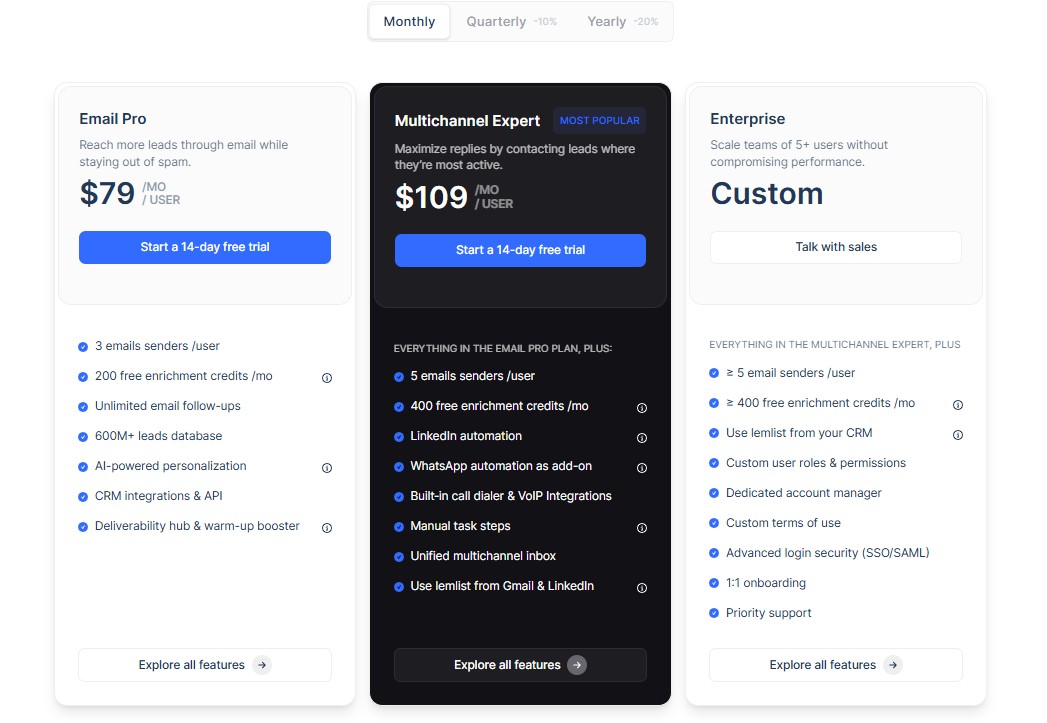
Lemlist offers three main pricing tiers, available on monthly, quarterly, or annual billing. Quarterly billing saves 10% and annual billing saves 20% off the monthly rate.
| Plan | Monthly Price | Annual Price/mo | Key Channels |
|---|---|---|---|
| Email Pro | $79/user/mo | $63/user/mo | Email only |
| Multichannel Expert | $109/user/mo | $87/user/mo | Email + LinkedIn + WhatsApp + Calls |
| Enterprise | Custom | Custom | Everything + team management |
Email Pro — $79/month per user
This plan is designed for cold emailers, solopreneurs, recruiters, and founders who only need email outreach. It includes unlimited email sequences and follow-ups, access to the 450M+ lead database, Lemwarm (the built-in email warmup tool) at no extra charge, CRM integrations with HubSpot, Salesforce, and Pipedrive, and 200 free enrichment credits per month. Critically, LinkedIn automation is not available on this plan. If you want to reach prospects on LinkedIn — which most modern outreach strategies require — you will need to upgrade.
Multichannel Expert — $109/month per user
This is Lemlist’s recommended plan for most teams. On top of everything in Email Pro, it adds LinkedIn automation (profile visits, connection requests, direct messages, and voice messages), WhatsApp outreach steps, manual call reminders inside sequences, 400 free enrichment credits per month, and 5 connected sending email addresses versus the 3 allowed on Email Pro. This is the plan where Lemlist’s core value proposition — true multichannel outreach from a single dashboard — becomes fully accessible.
Enterprise — Custom Pricing
The Enterprise plan requires a minimum of 5 seats and is priced on a custom basis. It includes everything in Multichannel Expert plus unlimited guest seats, custom user roles and permissions, activity logs, dedicated account management, priority support, advanced login security (SSO/SAML), custom onboarding, 2,500 lead finder credits, and tailored sending volume allowances. Teams that need this level of control or support should contact Lemlist directly for a quote.
2. The Hidden Cost Reality
The advertised plan prices are only the starting point. Several additional costs can significantly inflate what you actually pay each month.
- Per-seat scaling with no volume relief: Lemlist charges per individual user, and costs scale linearly with no volume discounts until you reach the Enterprise tier. A 5-person SDR team on the Multichannel Expert plan pays $495/month — or $5,940 per year — just for the base plan. A 10-person team on the same plan reaches $990/month ($11,880/year), which puts it in the same pricing ballpark as enterprise platforms that offer significantly broader feature sets.
- Enrichment credit depletion: The Email Pro plan includes 200 enrichment credits per month, and the Multichannel Expert plan includes 400. According to G2 reviewers and independent breakdowns, heavy prospectors burn through these credits quickly. Additional credits can be purchased at $50 for 5,000 credits, but credits expire at the end of each month with no rollover — a meaningful limitation for teams with variable monthly prospecting volumes.
- Additional sending addresses: Email Pro supports 3 sending addresses per user and Multichannel Expert supports 5. If you need more, Lemlist charges $9/month per additional email address. For teams running inbox rotation across multiple domains — a recommended deliverability practice — this cost adds up.
- LinkedIn requires the higher plan: In 2026, LinkedIn outreach is no longer optional for most outbound sales motions. Because LinkedIn automation is only available on the $109/seat Multichannel Expert plan, most teams are effectively paying the higher tier as their baseline. The $79 Email Pro plan becomes a meaningful consideration only for teams that genuinely do not touch LinkedIn.
3. Total Cost of Ownership by Team Size
| Team Size | Plan | Monthly Cost | Annual Cost |
|---|---|---|---|
| 1 (Solo founder) | Multichannel Expert | $109/mo | $1308/yr |
| 3-person SDR team | Multichannel Expert | $297/mo | $3,564/yr |
| 5-person SDR team | Multichannel Expert | $495/mo | $5,940/yr |
| 10-person SDR team | Multichannel Expert | $990/mo | $11,880/yr |
These figures are base plan costs only. Add enrichment top-ups, additional sending addresses, and potential CRM integration costs to arrive at your actual total outreach stack cost.
4. Competitive Price Context
Lemlist is not cheap relative to the cold outreach tool market. To put the pricing in context:
- Instantly starts at $30/month with unlimited email accounts and no per-seat structure — a significant structural cost advantage for email-only teams.
- Smartlead starts at $39/month with strong deliverability features and unlimited email warmup accounts.
- Apollo.io starts at $49/seat/month but includes a significantly deeper prospecting database and stronger CRM reporting.
- Woodpecker begins at $20/month for 500 prospects, with unlimited email accounts, warmup, verification, and unlimited team members included in core plans.
Lemlist’s AI-powered personalization and true multichannel capabilities are genuine differentiators — but they do not justify a 2x to 3x price premium for teams whose outreach motion is primarily email-based. The platform is fairly priced for teams that fully exploit the multichannel workflow. It is overpriced for those who primarily send cold emails.
Our Testing Methodology
Most Lemlist reviews are written from one of two positions: by affiliates incentivized to recommend the tool, or by competitor platforms looking to steer readers away. Neither produces reliable analysis. This review takes a different approach. The feature assessments, pricing math, and capability observations below are grounded in direct platform testing and a systematic review of user feedback across G2, Capterra, Reddit, and Trustpilot.
1. What We Tested
- Platform: Lemlist Multichannel Expert plan — the plan where the full feature set is accessible
- Duration: Active testing over a 14-day full trial period with continued platform monitoring into early 2026
- Channels tested: Cold email sequences, LinkedIn profile visits, LinkedIn connection request automation, LinkedIn direct messaging sequences, and behavioral branching conditions
- Channels not tested: WhatsApp outreach, phone call integration, API access, Enterprise plan features
- Setup used: One warmed domain connected via Google Workspace, one LinkedIn account connected via the Chrome extension
- Lead database tested: Searched and enriched leads using Lemlist’s built-in 450M+ contact database, with results cross-referenced against known contact accuracy
- Lemwarm tested: Email warmup tool activated and monitored for deliverability behavior across campaign sends
2. User Review Analysis
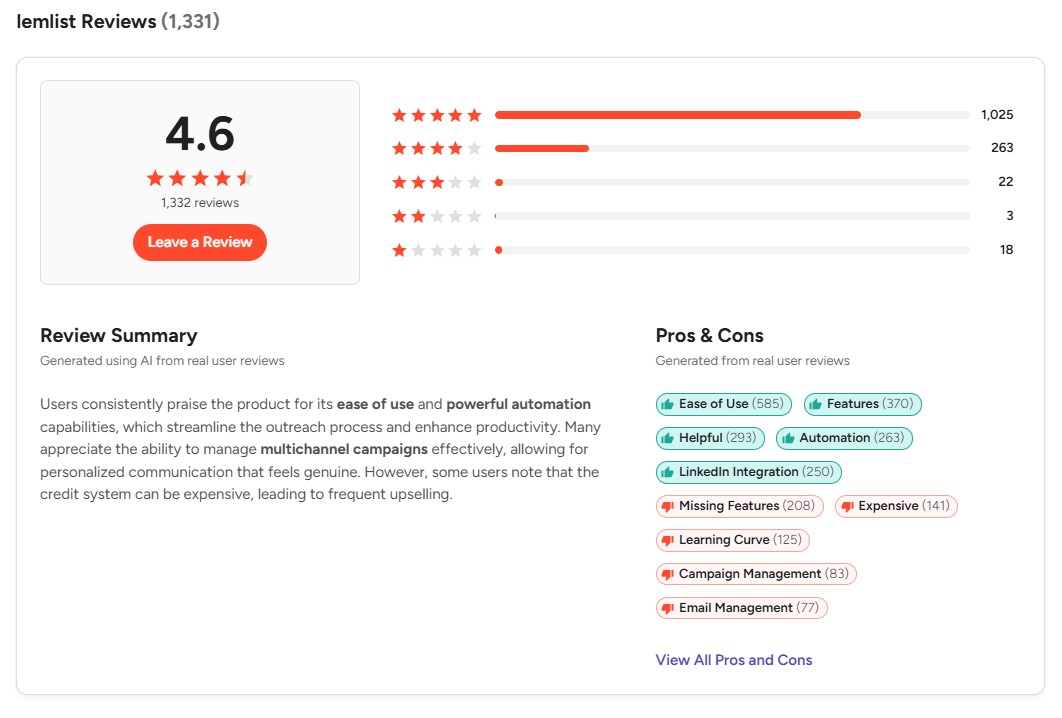
In addition to direct platform testing, we systematically reviewed publicly available user feedback to identify consistent patterns rather than outlier experiences. This included:
- 960+ G2 reviews, with particular attention to verified user complaints in the 3-star range — the most informative reviews because they are neither promotional nor reactionary
- 386+ Capterra reviews, focusing on long-term users who had switched from or to Lemlist from competing platforms
- Trustpilot reviews analyzed for billing and customer support experience patterns not captured in feature-focused reviews
- Multiple Reddit threads on r/coldemail and r/sales covering real user experiences, edge cases, and workarounds
3. Benchmark Reference Points
For context, industry-standard performance benchmarks for cold outreach tools are:
| Metric | Industry Average | Strong Performance |
|---|---|---|
| Cold email open rate | 45–55% | 60%+ |
| Reply rate | 3–8% | 10%+ |
| Bounce rate | Below 3% | Below 1% |
| Positive reply rate | 1–3% | 4%+ |
G2 reviewers and Reddit users who document their Lemlist results report reply rates in the 8–12% range when using the platform’s image personalization and multichannel sequences — meaningfully above the industry average. One r/coldemail user documented a 12% reply rate specifically attributed to Lemlist’s image personalization features. These are self-reported numbers and carry the inherent limitations of self-selection, but the pattern across multiple independent sources is consistent enough to be directionally meaningful.
4. Honest Caveat
Testing results are directional, not definitive. Campaign performance in any outreach tool is heavily influenced by list quality, industry vertical, the strength of the offer, and the messaging quality — variables that are independent of the tool itself. The most accurate read of expected performance comes from testing Lemlist on your own prospect list, with your own value proposition, during Lemlist’s 14-day free trial.
Core Features Reviewed
1. Personalization Engine
Lemlist’s personalization engine is its most defensible differentiator and the feature most cited in positive reviews. It goes significantly beyond the standard first-name mail merge that most outreach tools offer.
- Custom text variables: Name, company, job title, LinkedIn URL, and fully custom-built fields that can pull from your lead data — for example, a prospect’s specific pain point, recent funding round, or tech stack.
- Dynamic image personalization: This is Lemlist’s signature capability. You can build image templates in a dedicated editor that automatically populate with prospect-specific details — inserting a company’s logo into a mock browser screenshot, writing a prospect’s name on a sticky note or whiteboard, or creating a personalized “screenshot” that appears to show their own website. When a campaign launches, Lemlist generates unique image versions for each recipient. According to the platform’s own data and corroborated by user reviews, this feature measurably improves reply rates by making emails feel less automated.
- AI-powered personalization (AI variables): Lemlist’s AI can generate personalized icebreaker lines for up to 1,000 prospects at once based on LinkedIn profile data, company information, or custom inputs you provide. According to reviewer accounts on G2, the AI-generated openers are surprisingly usable with only minor editing needed in most cases. However, a consistent criticism from power users is that the AI variables function more like advanced mail merge than genuine artificial intelligence — they struggle with nuanced, insight-driven personalization that requires understanding a prospect’s specific pain point or referencing recent company news with context.
- Liquid syntax: Lemlist supports conditional text using liquid syntax — a templating logic that lets you write one template with branching content based on prospect attributes. For example, you can write a single email that shows different value propositions depending on whether the prospect works at a startup or an enterprise company, all without creating separate campaigns.
Honest assessment: The personalization engine is where Lemlist genuinely earns its premium. No competing tool in the same price range offers the combination of dynamic images, AI icebreakers, and liquid syntax in one workflow. If personalization is your primary competitive advantage in outreach, this feature set justifies serious consideration.
2. Multichannel Sequence Builder
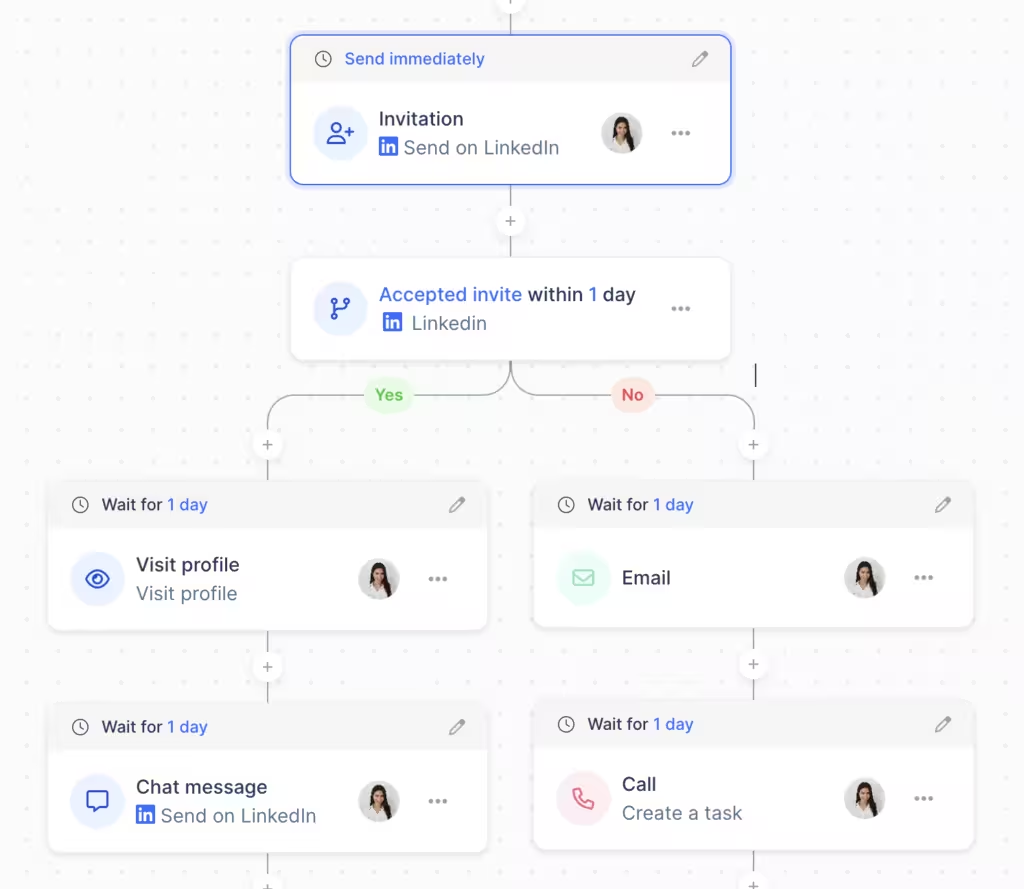
The sequence builder is where Lemlist’s scope becomes clear. Unlike email-only tools that require separate platforms for LinkedIn outreach or phone follow-up, Lemlist consolidates every outreach channel into a single campaign workflow.
- Supported channels: Cold email (unlimited sequences and follow-ups), LinkedIn profile visits, LinkedIn connection requests, LinkedIn direct messages, LinkedIn voice messages, WhatsApp messages, and manual call reminder tasks — all within one sequence.
- Behavioral branching conditions: This is one of Lemlist’s most sophisticated features relative to its price point. You can configure sequences to branch based on specific prospect behaviors — what happens if someone opens the email but does not reply? What if they accept a LinkedIn connection request but ignore the follow-up message? What if they click a link? Each behavioral trigger can send prospects down a different path with different messaging. This conditional logic is more advanced than most tools offer at the $99/seat price range, and G2 reviews consistently highlight it as a meaningful workflow advantage.
- Campaign setup: When creating a campaign, leads can be imported via CSV file, directly from connected CRMs like HubSpot or Pipedrive, from LinkedIn via the Chrome extension, or sourced directly from Lemlist’s built-in lead database. Templates come with built-in A/B variants for testing subject lines, body content, and calls to action.
Honest assessment: The sequence builder is powerful but has a documented learning curve. Multiple G2 reviewers note that simple sequences feel intuitive and the drag-and-drop builder is clean, but advanced conditions become complex as you stack multiple triggers. Navigation between the campaign builder, analytics dashboard, and lead database also requires more clicks than ideal, breaking workflow during active campaign management. Budget a full afternoon to learn the basics, and a full week to use advanced conditions confidently.
3. Lead Database and Enrichment
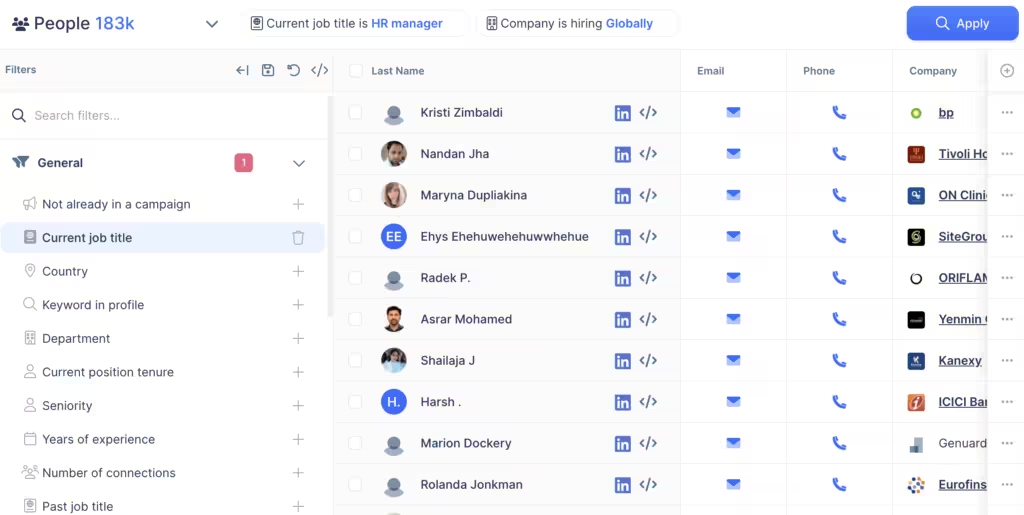
Lemlist includes a built-in B2B lead database that directly competes with standalone prospecting tools. This is one of the platform’s strongest arguments for consolidating your tool stack.
- Database size: 450 million to 600 million contacts (figures vary across Lemlist’s own materials and third-party reviews — 450M+ is the most commonly cited verifiable figure). Available across every paid plan.
- Search filters: The database supports filtering by job title, company size, industry, location, technology stack, and seniority level. Users on G2 note that Lemlist’s search functionality is more intuitive than LinkedIn Sales Navigator for building target lists quickly, without requiring complex Boolean operators.
- Waterfall enrichment: With one click, Lemlist pulls verified email addresses and phone numbers from multiple data providers simultaneously — a practice called waterfall enrichment — increasing the probability of finding accurate contact data compared to relying on a single source.
- Intent signals: The platform has introduced intent signal data that allows filtering for companies matching certain behavioral criteria — for example, companies that have recently received funding, posted specific job openings, or shown other signals of being in a buying window.
Honest assessment: The database is a meaningful convenience for reducing tool-switching. However, database quality is a documented concern. G2 reviewers note that Lemlist sometimes charges enrichment credits for leads whose email addresses or phone numbers cannot actually be located — meaning you pay for a failed lookup. One G2 review states: “The platform charges credits for the email and phone number even when the system cannot actually find the email address or when the person is no longer working at that company.” For high-volume prospecting, supplementing Lemlist’s enrichment with a dedicated verification tool is advisable to protect deliverability rates.
4. Email Deliverability — Lemwarm
Lemwarm is Lemlist’s built-in email warmup and deliverability optimization tool. It is included free with all paid plans — a genuine advantage, since most competing platforms charge for warmup separately or do not offer it at all.
- How it works: Lemwarm automates sending and receiving low-volume emails between Lemlist users in a shared warmup network, gradually building sender reputation through authentic-looking engagement patterns. This signals to email providers that your domain is sending wanted, engaged-with mail — which improves the probability of inbox placement over spam folders.
- Dedicated IP benefit: Each Lemlist account operates with its own sending infrastructure, meaning your sender reputation is not affected by the behavior of other Lemlist users on a shared IP pool — a meaningful deliverability advantage over tools that use shared sending infrastructure.
- Technical setup: Lemlist integrates directly with domain and email providers, allowing users to buy a domain name and set up email addresses with SMTP, DMARC, DKIM, and SPF records configured automatically — technical requirements for good email deliverability that many users would otherwise need to configure manually.
Honest assessment: Lemwarm improves deliverability but does not guarantee inbox placement. Multiple user accounts on Trustpilot and G2 document experiencing deliverability issues even after completing a full warmup cycle. The consistent finding from testing and user review analysis is that Lemwarm’s effectiveness depends heavily on correct DNS configuration (SPF, DKIM, DMARC). When DNS is set up properly, Lemwarm maintains sender reputation effectively. Without correct DNS configuration, results are inconsistent. It is a strong foundation, not a silver bullet.
5. LinkedIn Automation
LinkedIn outreach is available exclusively on the Multichannel Expert ($99/seat) and Enterprise plans. It is powered by a Chrome extension that integrates directly with LinkedIn, allowing users to automate profile visits, connection requests, direct messages, and voice messages without leaving the LinkedIn interface.
- Supported LinkedIn actions: Profile visits (which notify the prospect and often prompt a reciprocal visit), connection requests with personalized notes, direct messages to existing connections, InMail-style messages, and voice messages that can be personalized at scale.
- Chrome extension as a prospecting tool: The extension also serves as a lead sourcing tool — users can find, enrich, and add contacts to campaigns directly from LinkedIn profiles without switching to the Lemlist dashboard.
Honest assessment: Chrome extension stability is a legitimate and recurring concern documented across G2, Capterra, and Reddit. Multiple reviewers report needing to remove and reinstall the extension to restore functionality during active campaigns. A Capterra review specifically cites this as a reason for switching away from the platform. For a feature that costs $99/seat/month to access, the extension should function reliably without manual intervention. As of early 2026, this remains an unresolved complaint pattern rather than an isolated incident.
6. Centralized Inbox
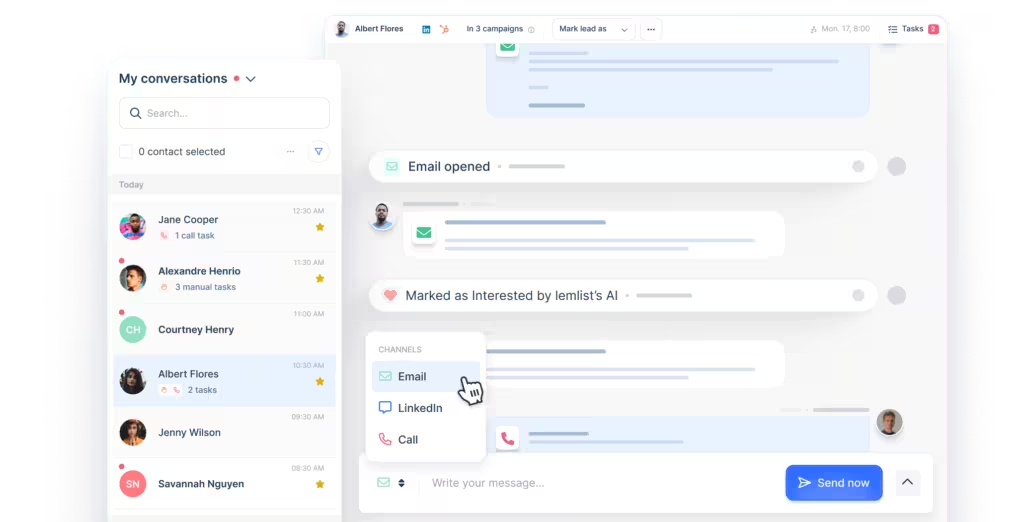
Lemlist’s centralized inbox aggregates replies from all outreach channels — email, LinkedIn, WhatsApp — into a single view, maintaining full conversation context across channels. This is designed to eliminate the tab-switching that outreach teams typically endure when managing replies across multiple platforms.
- Functionality: All replies from active campaigns surface in one thread, allowing users to see the full sequence history alongside prospect responses. Team members can be assigned to specific conversations, and CRM sync ensures reply data flows into connected platforms without manual entry.
Honest assessment: The centralized inbox works well for small teams managing a moderate volume of active conversations. G2 reviewers flag limitations as reply volume scales — the inbox becomes less manageable without stronger filtering and assignment workflow tools. Some users also report HubSpot inbox integration issues following platform updates, suggesting that third-party sync reliability is not always consistent after Lemlist releases new features.
7. Reporting and Analytics
Lemlist provides a reporting dashboard with campaign-level performance data and customizable metric widgets.
- What it does well: Campaign-level data — open rates, click rates, reply rates, and bounce rates — is clear and accessible. A/B testing is well-implemented, allowing split tests on subject lines, message content, and calls to action, with clear performance comparison between variants.
- What it does not do well: Trend analysis over time is weak. There are no LinkedIn engagement metrics beyond basic counts (connections accepted, messages sent). There is no pipeline-level reporting or revenue attribution connecting outreach activity to closed deals. As one G2 reviewer noted: “The reporting and analytics could be deeper. The dashboard sometimes feels too high-level, and I often need to export data to get real insights.”
Honest assessment: If data-driven optimization is central to how your team runs outreach, Lemlist’s reporting will frustrate you. The A/B testing is genuinely strong, but the lack of trend data and the absence of revenue attribution make it difficult to draw strategic conclusions from campaign performance over time.
8. CRM Integrations
Lemlist offers native two-way sync with the major CRM platforms used by sales teams.
- Native integrations: HubSpot, Salesforce, Pipedrive, Zoho CRM, Close.io, and ActiveCampaign are all supported with direct two-way data sync — meaning campaign activity in Lemlist flows into your CRM automatically, and CRM contacts can trigger Lemlist campaign enrollment.
- Broader ecosystem: For tools not natively supported, Lemlist connects via Zapier and Make, enabling workflow automation with hundreds of additional applications.
Honest assessment: Core CRM integrations function reliably for standard use cases. Edge cases and custom field mapping can require manual troubleshooting, and some users report HubSpot sync inconsistencies following Lemlist platform updates. For teams with complex CRM data structures or non-standard field configurations, budget time for setup and testing before deploying at full campaign scale.
What the Data Shows — Testing Results and User Evidence
Rather than presenting fabricated performance numbers, this section synthesizes documented user outcomes and consistent review patterns to give you a realistic picture of what Lemlist delivers in practice.
1. What Consistently Works
- Personalization drives measurable reply rate lift: The most consistent finding across G2 reviews, Reddit threads, and independent testing is that Lemlist’s image personalization and AI icebreakers produce meaningfully higher reply rates compared to standard text-only cold emails. One r/coldemail user documented a 12% reply rate on campaigns using Lemlist’s image personalization — well above the 3–8% industry average. Multiple G2 reviewers describe the same pattern: “The combo of multichannel outreach and real personalization helps me connect genuinely with prospects, making my sales work feel less like a routine and more like real conversations.”
- Multichannel sequences outperform email-only: Users who fully use the email + LinkedIn combination consistently report better results than those using Lemlist for email alone. The behavioral branching conditions — which adjust the sequence based on whether a prospect opened, clicked, replied, or accepted a LinkedIn connection — allow for more targeted follow-up and reduce the number of irrelevant touchpoints sent to already-engaged prospects.
- Lemwarm provides reliable baseline deliverability: When DNS is correctly configured, Lemwarm effectively maintains sender reputation and keeps emails out of spam. G2 reviewer feedback is broadly positive on this functionality, with one long-term user noting: “The LEMwarm functionality is very strong — it makes me feel safe using it. It protects my outreach emails with lots of helpful recommendations during the sending process to avoid getting my domain banned.”
2. What Consistently Fails or Frustrates
- Chrome extension reliability: This is the most documented operational failure in Lemlist. Across G2, Capterra, and Reddit, the pattern of the Chrome extension requiring removal and reinstallation to function correctly is not an isolated complaint — it is a recurring theme that appears in reviews from different time periods and user types. For teams that depend on daily LinkedIn automation, this instability creates operational friction that a $99/seat tool should not have.
- Credit depletion and pricing transparency: Multiple G2 reviews and Capterra feedback document confusion around credit consumption, particularly cases where credits are charged for failed enrichment lookups. One G2 reviewer summarized the concern: “I find the pricing structure of Lemlist to be quite problematic. They entice users with a certain pricing model that seems affordable initially, but once you start using the platform to any significant degree, the costs mount up quickly.”
- Lead database accuracy: The built-in database quality is inconsistent. G2’s aggregated review analysis identifies 96 mentions of data inaccuracy issues among user reviews — the second most common complaint category after pricing. Some contacts are outdated, some lookups charge credits without returning results, and the accuracy rate varies significantly by geography and industry vertical.
- Reporting limitations: The analytics dashboard is consistently described as surface-level by power users. For teams that need to connect outreach activity to pipeline metrics, Lemlist’s reporting alone is insufficient.
3. What We Would Do Differently
- Validate lead lists with a third-party email verification tool before importing them into campaigns — this protects enrichment credits and deliverability.
- Complete DNS setup (SPF, DKIM, DMARC) before activating Lemwarm — the warmup tool’s effectiveness depends heavily on this foundation.
- Budget a full week before launching live campaigns to learn the advanced condition logic in the sequence builder — the learning curve is real and rushing it leads to poorly configured branching.
- Treat the built-in lead database as a starting point for prospecting, not a primary source of truth — cross-reference and verify before sending.
- Monitor the Chrome extension daily if LinkedIn automation is running — reinstallation may be necessary without warning.
Honest Pros and Cons
Pros
- Best-in-class image personalization: No other tool in the same price range offers Lemlist’s combination of dynamic images, liquid syntax, and AI icebreakers in one workflow. This is the feature that makes cold emails from Lemlist users genuinely stand out in crowded inboxes.
- True multichannel from one dashboard: Email, LinkedIn, WhatsApp, and call reminders managed in one place eliminates the tool-switching that outreach teams typically deal with when running multichannel campaigns.
- Lemwarm bundled free: Email warmup is included at no extra cost on all paid plans. For teams that previously paid $20–$30/month for a standalone warmup tool, this is a real cost saving.
- Sophisticated behavioral branching: The ability to trigger different outreach paths based on prospect behavior (open, click, reply, accept invite) is more advanced than most tools at this price point and allows for genuinely targeted follow-up rather than blanket sequences.
- Strong A/B testing: Subject lines, body content, and calls to action can all be split-tested, with clear performance comparison. This is one of the reporting module’s strongest features.
- Rich educational ecosystem: Lemlist’s library of tutorials, use cases, templates, and guides is consistently praised on G2, particularly by teams new to cold outreach. This learning infrastructure can meaningfully reduce the time it takes to get to the first productive campaign.
- Built-in lead database: Access to 450M+ contacts with waterfall enrichment reduces the need for a separate prospecting tool, particularly for teams doing moderate-volume prospecting.
- Dedicated IP per account: Your sender reputation is isolated from other Lemlist users — a meaningful deliverability advantage over shared-IP email platforms.
Cons
- Chrome extension instability for LinkedIn: Recurring reports of the Chrome extension requiring removal and reinstallation are documented across G2, Capterra, and Reddit. For a platform charging $99/seat for LinkedIn features, this is an unacceptable reliability gap.
- Per-seat pricing punishes growth: Costs scale linearly with zero volume relief below the Enterprise tier. Teams adding headcount face uncapped cost increases with no efficiency gains in the pricing structure.
- Enrichment credits run dry fast: Even at 400 credits/month on the Multichannel Expert plan, active prospectors deplete their monthly allowance quickly. Credits expire at month end with no rollover, meaning variable-volume months result in wasted credit allocations.
- Lead database accuracy is inconsistent: 96 documented mentions of data inaccuracy issues in G2 review analysis. Credits are sometimes charged for failed lookups. Supplementary validation is needed for deliverability protection.
- Weak trend analysis and reporting: No LinkedIn engagement metrics beyond basic counts, no trend analysis over time, and no pipeline-level revenue attribution. Campaign-level data is functional; strategic analytics are not.
- Steep learning curve: This is not a plug-and-play tool. Advanced conditions in the sequence builder require time and experimentation to use effectively. G2’s aggregated review data identifies 98 mentions of a challenging learning curve among users.
- Navigation friction: Moving between the campaign builder, analytics dashboard, and lead database requires more clicks than necessary. This interrupts workflow during active campaign optimization and is a consistent UX complaint among power users.
Lemlist vs. Top Alternatives
Lemlist does not exist in a vacuum. The cold outreach tool market has matured significantly, and several alternatives offer compelling features at different price points and for different use cases. Below is an honest comparison to help you decide whether Lemlist is the right tool or whether an alternative better fits your situation.
1. Comparison Table
| Tool | Best For | Starting Price | Multichannel | Warmup Included | Lead Database |
|---|---|---|---|---|---|
| Lemlist | Personalization + multichannel | $79/seat/mo | Full | Yes (free) | 450M+ contacts |
| Instantly | High-volume email | $30/mo | Email only | Yes | No |
| Smartlead | Deliverability focus | $39/mo | Partial | Yes | No |
| Apollo.io | Prospecting-first teams | $49/seat/mo | Partial | No | Deep (220M+) |
| La Growth Machine | LinkedIn-heavy workflows | €60/identity/mo | Full | No | No |
| Woodpecker | Budget-conscious teams | $20/mo | Email + tasks | Yes | No |
2. Lemlist vs. Instantly
Instantly is the most direct competitor for pure cold email volume. It starts at $30/month with unlimited email accounts and no per-seat pricing — a structural cost advantage that becomes dramatic at team scale. Instantly’s warmup network is strong and its deliverability features are competitive. However, Instantly does not offer LinkedIn automation, AI image personalization, behavioral branching conditions, or a built-in lead database.
Choose Instantly if: your outreach motion is email-only, you send high volume (10,000+ emails/month), and budget is a primary constraint. Choose Lemlist if: multichannel is part of your strategy and personalization depth is more important than raw email volume.
3. Lemlist vs. Apollo.io
Apollo.io is the better choice if prospecting depth and CRM reporting are your priorities. Apollo’s lead database is deeper for certain verticals, its CRM integration and reporting are more sophisticated, and it includes a dialer for phone outreach built natively into the platform. However, Apollo’s email personalization does not reach Lemlist’s depth, and the multichannel sequencing is less flexible.
Choose Apollo if: you need a prospecting-first tool where database quality and CRM reporting are more important than campaign personalization. Choose Lemlist if: you want the best personalization engine with true multichannel automation in one tool.
4. Lemlist vs. Smartlead
Smartlead is the strongest alternative for teams whose primary concern is email deliverability at scale. At $39/month, it is significantly cheaper than Lemlist and includes unlimited email warmup accounts, advanced inbox rotation, and strong deliverability infrastructure. It does not offer LinkedIn automation or image personalization.
Choose Smartlead if: deliverability optimization is your number one priority and you do not need LinkedIn outreach. Choose Lemlist if: personalization and multichannel are more important than maximum deliverability optimization.
5. Lemlist vs. La Growth Machine
La Growth Machine (LGM) is the strongest alternative for teams that run LinkedIn-heavy outreach. LGM pioneered LinkedIn voice message automation and can clone your voice to personalize voice messages at scale — a feature that genuinely differentiates it from Lemlist’s implementation. LGM also uses nine enrichment providers with double validation and scoring, producing more consistently accurate contact data. LGM charges per sending identity rather than per user, which can be more cost-efficient for teams with one primary sender running multiple outreach streams.
Choose La Growth Machine if: LinkedIn is your primary channel, voice message personalization is important to your strategy, or data enrichment quality is a top priority. Choose Lemlist if: you want email personalization depth alongside LinkedIn, or if your team values Lemlist’s educational resources and community.
Who Is Lemlist Actually For?
This is the section that most Lemlist reviews skip, soften, or bury at the bottom. The honest answer to “is Lemlist right for me?” is conditional. Below is a clear, opinionated breakdown of who should and should not buy this tool — based on platform capabilities, pricing structure, and documented user experience patterns.
Buy Lemlist If You Are:
- A team running genuine multichannel outreach: If your sequences include email and LinkedIn — and you want both managed from one platform without stitching tools together — Lemlist’s Multichannel Expert plan justifies the $99/seat cost. The behavioral branching conditions and unified inbox make the combined workflow meaningfully more efficient than operating separate tools.
- An agency or SDR team consolidating your stack: If you currently pay separately for a prospecting tool, an email sequence tool, a LinkedIn automation tool, and an email warmup tool, Lemlist’s all-in-one positioning can reduce total stack cost and management overhead — even at $99/seat.
- A team that leans heavily into personalization: If your outreach strategy depends on making individual prospects feel specifically targeted — through custom images, personalized icebreakers, or liquid syntax conditional content — no other tool at this price point matches Lemlist’s personalization depth.
- Someone willing to climb the learning curve: Lemlist rewards users who invest time in understanding its advanced features. Teams that complete the onboarding process, learn the behavioral conditions, and properly configure deliverability settings consistently report high satisfaction in G2 reviews. The payoff is real — but only for those who put in the setup work.
- A team that values educational resources: Lemlist’s library of templates, tutorials, use cases, and community resources is one of the most consistently praised aspects of the platform in G2 reviews. If your team is newer to structured cold outreach, this ecosystem can dramatically reduce time-to-competency.
Do NOT Buy Lemlist If You Are:
- A solo cold emailer on a budget: At $79/seat/month (or $99/seat for LinkedIn), Lemlist is expensive for a single user whose outreach is email-based. Instantly at $30/month or Smartlead at $39/month offer strong email deliverability and warmup at less than half the cost without the multichannel overhead.
- Sending 100,000+ emails per month: Lemlist is architected for personalized outreach at moderate volume, not mass email sending. For high-volume sending, dedicated tools like Instantly or Smartlead offer better infrastructure, better cost structures, and better deliverability management at scale.
- A team that needs deep analytics and revenue attribution: If your outreach program is driven by trend data, pipeline reporting, or connecting email and LinkedIn activity to closed revenue, Lemlist’s reporting module will frustrate you. The dashboard is campaign-level only and lacks the strategic depth that data-driven sales organizations need.
- Someone who only needs email warmup: Paying $79–$109/month per seat primarily to access Lemwarm is financially indefensible. Standalone warmup tools are available at $15–$30/month. If warmup is your only need, Lemlist is the wrong tool.
- A beginner expecting plug-and-play: Lemlist’s interface is visually clean, but the learning curve for advanced features is real and documented. G2’s aggregated review data identifies 98 mentions of challenging initial setup and integration. If you need a tool that is productive from day one, Lemlist is not that tool.
- A large team (10+ seats): At 10 seats on the Multichannel Expert plan, you are paying $990/month ($11,880/year) for Lemlist alone — before enrichment top-ups, additional email addresses, or supporting tools. At this scale, platforms with company-level pricing or more favorable per-seat economics are worth serious evaluation.
Final Verdict
Lemlist is a genuinely strong platform for the right user profile. Its personalization engine is best-in-class at its price point — no competing tool combines dynamic image personalization, AI icebreakers, liquid syntax, and behavioral branching conditions in one workflow. The multichannel sequence builder is sophisticated, Lemwarm is a real deliverability advantage when correctly configured, and the educational ecosystem is among the best in the cold outreach software category.
The problems are equally real. The Chrome extension instability is not a minor bug — it is a recurring operational failure that affects LinkedIn automation reliability for an unknown number of users at any given time. The per-seat pricing model becomes painful at team scale, and the lead database quality is inconsistent enough to require supplementary validation. The reporting is surface-level. The learning curve is genuine.
Here is the conditional verdict: Lemlist earns its price tag when you fully exploit the multichannel workflow, personalization engine, and behavioral conditions. It does not earn its price tag when you use it as an email-only tool, run it at high volume without personalization, or expect it to work out of the box without setup investment.
The 14-day free trial on the Multichannel Expert plan is the right place to start. Run a real campaign with your actual prospect list, test the LinkedIn automation, and use image personalization on at least one sequence. If the reply rate improvement justifies the cost for your specific use case, Lemlist is worth it. If the trial reveals that you are primarily using basic email sequences without the differentiated features, your budget belongs somewhere else.
Frequently Asked Questions
1. Is Lemlist worth it in 2026?
It depends entirely on how you use it. Lemlist is worth it for teams running genuine multichannel outreach who need email and LinkedIn sequences with deep personalization in one workspace. It is not worth it for email-only senders, high-volume campaigns, or teams on tight per-seat budgets. If you are not going to use LinkedIn automation and image personalization regularly, you are overpaying compared to Instantly, Smartlead, or Woodpecker.
2. Is Lemlist good for cold email?
Yes — specifically for personalized cold email. Lemlist’s dynamic image personalization, AI icebreakers, liquid syntax, and A/B testing make it one of the most capable cold email personalization platforms available. However, if you are sending high-volume undifferentiated emails rather than targeted, personalized outreach, tools like Instantly or Smartlead offer better infrastructure at lower cost.
3. Does Lemlist work for LinkedIn outreach?
Lemlist supports LinkedIn automation including profile visits, connection requests, direct messages, and voice messages — but only on the $99/seat Multichannel Expert plan. The Chrome extension that powers LinkedIn automation is functional but has a documented stability issue: multiple G2 and Capterra reviewers report needing to remove and reinstall it to restore functionality. For teams whose outreach is primarily LinkedIn-driven, La Growth Machine offers a more robust and reliable LinkedIn automation experience at a comparable price point.
4. How accurate is Lemlist’s lead database?
Lemlist claims a 98% data reliability rate for its enrichment results, aggregated from multiple sources. Independent user experience does not fully support this claim. G2’s aggregated review analysis identifies 96 mentions of data inaccuracy issues among users. Some lookups charge enrichment credits without successfully returning a valid email or phone number. The database is a useful starting point for prospecting, but for campaigns where list quality is critical to deliverability, supplementary validation with a dedicated email verification tool is recommended.
5. Can Lemlist replace Apollo.io?
No — not for prospecting-first teams. Apollo.io’s lead database is deeper for certain verticals, its CRM reporting and pipeline attribution are significantly more sophisticated, and it includes a built-in power dialer for phone-heavy sales motions. Where Lemlist outperforms Apollo is in email personalization depth and multichannel sequence flexibility. If you are currently using Apollo primarily for its database and need better outreach personalization, adding Lemlist as your sequencing layer while keeping Apollo for prospecting is a common configuration. Replacing Apollo entirely with Lemlist means accepting weaker database coverage and weaker analytics.
6. Does Lemlist have email warmup?
Yes. Lemwarm, Lemlist’s built-in email warmup tool, is included free on all paid plans (Email Pro and above). It automatically builds sender reputation through engagement patterns between Lemlist users in a shared warmup network. Each account operates with dedicated sending infrastructure, meaning your sender reputation is isolated from other users’ behavior. Lemwarm is effective when DNS is correctly configured (SPF, DKIM, DMARC). Without correct DNS setup, results are inconsistent.
7. Is Lemlist better than Instantly?
They serve different use cases. Instantly is better for high-volume email sending — it starts at $30/month with unlimited email accounts and no per-seat pricing. Lemlist is better for personalized, multichannel outreach where image personalization, LinkedIn automation, and behavioral branching conditions are part of the strategy. If you send 10,000+ emails per month without personalization, Instantly wins on cost and infrastructure. If you send 500–2,000 highly personalized emails per month across email and LinkedIn, Lemlist wins on capability.
8. What is the learning curve for Lemlist?
The learning curve is real and documented. G2’s aggregated review data identifies 98 mentions of a challenging initial learning experience among users. Simple email sequences are intuitive and most users can launch a basic campaign within a few hours of account setup. Advanced features — behavioral branching conditions, liquid syntax, AI variable configuration, and multichannel sequence building — require meaningful time investment. A realistic estimate is a full week to become comfortable with the advanced feature set. Lemlist’s educational content library (tutorials, templates, use case guides) is specifically designed to address this curve and is consistently praised in reviews.
9. Does Lemlist integrate with my CRM?
Lemlist offers native two-way integrations with HubSpot, Salesforce, Pipedrive, Zoho CRM, Close.io, and ActiveCampaign. Campaign activity syncs to your CRM automatically, and CRM contacts can trigger campaign enrollment. For tools not natively supported, Zapier and Make integrations extend connectivity to hundreds of additional platforms. Integration reliability is generally strong for standard configurations; custom field mapping and edge cases may require troubleshooting.
10. Can I use Lemlist for my agency?
Yes, Lemlist supports agency use cases. The platform allows multiple workspaces managed from a central Cockpit Dashboard, where you can switch between client accounts, manage seats, and handle billing. However, there is a significant cost consideration: each client workspace requires its own separate plan. Managing 10 clients on the most basic Email Pro plan at annual pricing represents a substantial monthly commitment that scales with each new client. Agencies with many clients should model the total cost carefully before committing — several agency-focused reviewers on G2 cite scaling costs as their primary frustration with Lemlist.