


LinkedIn reach is weird right now. You can have 8,000 followers, post something genuinely useful, and get 200 views. Then someone posts a three-word hot take with a line break after every sentence and gets 40,000 impressions. That’s not a coincidence. LinkedIn’s algorithm heavily weights early engagement. The first 60 to 90 minutes after you post decide whether the algorithm pushes your content to a wider audience or buries it. If your post gets likes and comments fast, it spreads. If it sits quiet, it dies.
That’s the problem Lempod was built around. It’s an engagement pod tool for LinkedIn. You join a pod of people in your niche, and when you post, everyone in the pod automatically likes and comments on your content. Their engagement signals LinkedIn’s algorithm that your post is worth distributing. Your reach goes up. Sounds like a smart hack, and for a while it genuinely was.
But that was 2019, 2020, maybe 2021. The question that actually matters in 2026 is whether Lempod still works the way it used to, whether LinkedIn has gotten better at detecting pod activity, and whether the risk to your account and your personal brand is worth whatever reach bump you get. Those are the questions this Lempod review answers, directly and without sugarcoating it.
This covers how Lempod works mechanically, what changed on LinkedIn’s side over the past few years, what the pricing looks like, where the tool genuinely has a use case left, and where you’re better off doing something else entirely. If you’re evaluating Lempod for your LinkedIn strategy in 2026, read this before you spend money or risk your account.
How Lempod Works: A Lempod Review of the Core Mechanics
Lempod is a Chrome extension. You install it, connect your LinkedIn account, and join engagement pods organized by topic or industry. When you publish a LinkedIn post, Lempod detects it and automatically triggers likes and comments from other pod members. Their accounts interact with your post within a set time window, usually within a few hours of publishing.
The Pod Structure and How Members Interact
Pods in Lempod are groups, typically ranging from 10 to 50 members, built around a shared topic. There are pods for SaaS founders, marketing professionals, recruiters, sales leaders, and dozens of other categories. You can join existing public pods or create a private pod with people you actually know and trust.
When you post on LinkedIn, Lempod pushes a notification to pod members. Members who have the extension active and are logged in will automatically like your post. Comments are either pre-written templates that rotate, or members can set their own default comments. The automation handles the action; no one is manually clicking anything.
Here’s what that looks like in practice. You post at 9am. By 10am, your post has 15 likes and 8 comments from pod members. LinkedIn’s algorithm sees early traction and starts distributing the post to second and third-degree connections. Your organic reach climbs because the algorithm interprets pod engagement as real audience interest.
That mechanism worked reliably when LinkedIn’s feed algorithm was simpler. The algorithm looked at engagement velocity and used it as a proxy for content quality. More early engagement meant wider distribution. Full stop.
What Changed With LinkedIn’s Algorithm
LinkedIn has made several significant changes to how it evaluates content quality since 2022. The two that hit pod activity hardest:
First, LinkedIn started weighting the relevance of the person engaging with your content, not just the fact of engagement. If your post is about B2B SaaS and the first 15 likes come from people whose profiles are in recruiting, finance, and healthcare with no apparent connection to SaaS, that signal is weaker than 15 likes from people actively engaged in SaaS conversations. Pod members are often spread across industries with no real connection to your content topic.
Second, LinkedIn introduced what it calls “dwell time” as an engagement signal. How long someone actually spends reading your post matters. Automated likes from pod members who never actually read the content register as near-zero dwell time. The algorithm can distinguish between someone who read a post for 45 seconds and then liked it versus a bot-assisted like that fires within milliseconds of the post going live.
So then the pods still generate vanity numbers. Likes still show up. Comments still appear. But the downstream algorithmic distribution isn’t as strong as it was because the quality signals behind that engagement look suspicious to LinkedIn’s systems.
The Comment Quality Problem
This is where Lempod gets genuinely awkward in 2026. The automated comments that pod tools generate are a real liability. Generic comments like “Great post!”, “Thanks for sharing this!”, and “Very insightful!” show up on posts and they look exactly like what they are: automated filler. Real LinkedIn users notice. If someone is evaluating your credibility as a thought leader and they see 12 identical-sounding generic comments on every single post you’ve made for the past six months, it reads as artificial. That perception damage can hurt more than the reach boost helps.
Some Lempod users try to get around this by pre-writing more specific comments. That takes effort and it’s inconsistent across a pod with 30 members. The comments that land well are the ones that engage with the actual content of the post. Automated systems can’t reliably do that at scale.
Lempod Review: Pricing and What You Get
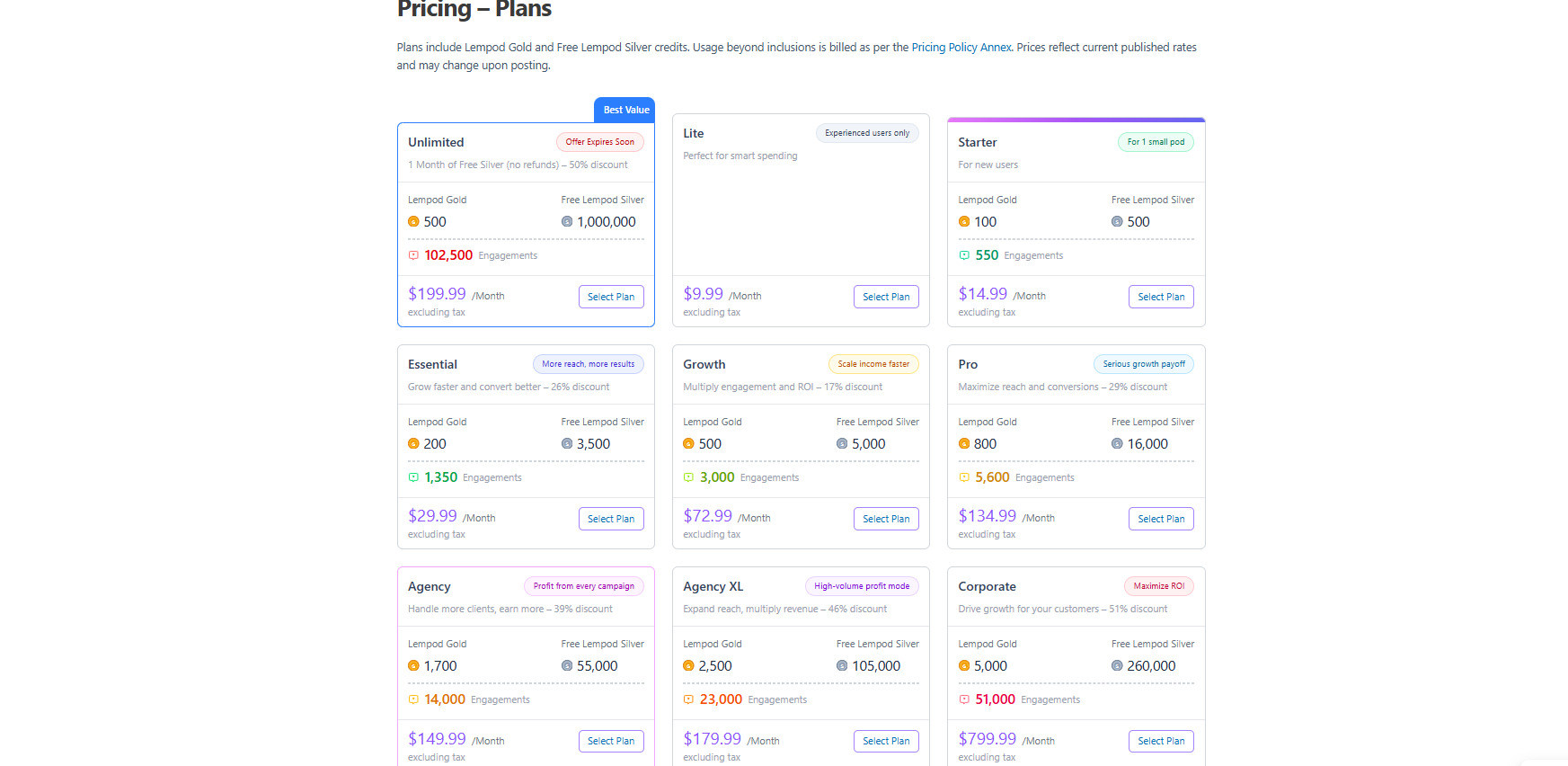
Lempod’s pricing is straightforward. It’s $9.99 per pod per month. You can join multiple pods, each at $9.99. There’s no free plan, but there’s a 3-day free trial available.
Breaking Down the $9.99 Per Pod Cost
At face value, $9.99 is cheap. For context, that’s less than a Netflix subscription. If joining three pods costs you $30/month and your LinkedIn content reaches 10x more people, the math seems easy.
But the cost calculation isn’t just the subscription fee. Factor in the time cost of managing pod membership, the risk cost to your account if LinkedIn takes action, and the brand cost if your audience notices the pattern. Those aren’t line items in a pricing table but they’re real.
The other thing worth knowing: Lempod charges per pod, not per month flat. If you want to be in a large, active pod with 50 relevant members in your industry, you’re paying for that one pod. If you want to be in five pods across different topic areas, that’s $50/month. That scales faster than it initially appears.
Comparing Lempod’s Price to What You Get
For $9.99/month you get access to the pod, the Chrome extension, and the automation layer. There’s no analytics dashboard showing you how much your reach actually increased as a result of pod activity. There’s no A/B testing. There’s no reporting on which pod members are most active or whether the engagement is actually driving profile visits or follower growth. You’re essentially buying engagement volume without data on whether that volume is doing anything useful.
Compare that to $29/month for a proper LinkedIn scheduling and analytics tool like Shield Analytics, which tells you exactly which posts performed well organically, what time your audience is most active, and what content formats drive real follower growth. The data from a tool like Shield will do more for your LinkedIn strategy than pod-inflated numbers that you can’t connect to business outcomes.
The Real Risks of Using Lempod in 2026
This section matters more than the feature breakdown. The risk profile of using Lempod has changed materially since the tool launched, and a lot of current reviews don’t reflect where things actually stand.
LinkedIn’s Policy on Artificial Engagement
LinkedIn’s terms of service explicitly prohibit artificial amplification of content. Section 8.2 of LinkedIn’s User Agreement covers this: members agree not to use bots, crawlers, scrapers, or other automated means to access the site or manipulate engagement. Engagement pods that automate likes and comments are a grey area at best and a direct violation at worst.
LinkedIn has been inconsistent in enforcement, which is why pod tools have survived this long. Some accounts using Lempod have been restricted or warned. Most haven’t, at least not yet. The inconsistency creates a false sense of safety. Just because LinkedIn hasn’t actioned the majority of pod users doesn’t mean the risk isn’t real. It means enforcement is selective and unpredictable.
In 2023 and 2024, LinkedIn ramped up detection of inauthentic engagement specifically. Several large LinkedIn automation tools were shut down with no warning. Lempod survived, but the pressure from LinkedIn’s trust and safety team on the broader automation category has increased, not decreased.
The Brand Perception Risk
Look at what actually happens when a savvy LinkedIn user sees your posts. They click your profile, they scroll through your last 10 posts, and they notice that every post has 8 comments that are generic two-sentence responses with no substance. They notice the same 12 profile names appearing in your comments section post after post. They figure out what’s happening pretty quickly.
For B2B founders and consultants whose LinkedIn presence is tied to credibility and trust, that perception damage is real. Prospects who notice pod activity don’t think “this person games the algorithm smartly.” They think “this person is faking their influence.” That’s a brand problem that’s hard to recover from.
The Algorithm Adaptation Reality
Here’s the thing about any hack that relies on fooling an algorithm: the algorithm gets updated specifically to counter that hack. LinkedIn knows engagement pods exist. They’ve known for years. Their engineers are not unaware that groups of accounts are coordinating to artificially boost posts. Every algorithm update from LinkedIn since 2021 has included signals designed to discount exactly this type of coordinated engagement.
The pods that still work reasonably well in 2026 are small, private pods where members are genuinely relevant to each other’s content and the comments are thoughtful and specific. That’s basically just a group of colleagues supporting each other’s content, which is legitimate and sustainable. The large public pods with 40 members across random industries? The effectiveness has dropped significantly and the risk has stayed the same.
Who Lempod Still Makes Sense For (And Who It Doesn’t)
Where It Still Has a Narrow Use Case
Small private pods with real relationships still work. If you’re building a personal brand in a specific niche and you have 8 to 12 genuine peers who are all trying to grow LinkedIn presence in the same space, a private Lempod pod for mutual support makes sense. You’re reading each other’s content anyway. The “automation” is just ensuring you don’t miss each other’s posts.
Content marketers at B2B companies who are testing whether LinkedIn content can drive pipeline sometimes use Lempod to get initial traction while their organic audience is still small. If you have zero followers and zero engagement, it’s hard to know whether your content resonates because the algorithm never distributes it. Some teams use pods as a temporary scaffold to get early data before building organic engagement properly.
LinkedIn thought leaders who already have strong audience growth and use pods as a small boost rather than their primary growth mechanism are the ones who seem to get the best risk-adjusted results. The pod engagement adds a little fuel; it doesn’t have to be the engine.
Who Should Absolutely Skip It
Founders and executives whose entire brand is built on authentic expertise should stay away. The reputational risk of being visibly in a pod is not worth it for someone whose LinkedIn presence is a direct reflection of professional credibility.
Marketers running LinkedIn Pages for company accounts should not use Lempod. LinkedIn Pages can’t join pods, and trying to simulate pod activity through employee accounts on company content is messy and even more detectable.
Anyone brand new to LinkedIn trying to build from scratch: just don’t. Building real followers takes longer but those followers convert to actual business. Pod-inflated reach attracts no one because the people liking your posts aren’t your target audience, they’re pod members in random industries hitting an automation trigger.
Lempod Alternatives That Are Actually Worth Considering
Since a meaningful part of this Lempod review is “the tool has real limits in 2026,” it’s worth being specific about what actually works for LinkedIn reach and engagement today.
Manual Engagement Groups (The Low-Risk Version of Pods)
A Slack or WhatsApp group with 10 to 20 people in your niche where members share their LinkedIn posts and genuinely engage with them. No automation, no Chrome extension, no ToS risk. Everyone reads the posts, leaves real comments, and builds real relationships in the process. This is what engagement pods were before they got automated.
It takes more effort and it’s slower. But the comments are real, the engagement is genuine, and there’s zero risk to your account. Several LinkedIn thought leaders with 50,000 to 100,000 followers built their initial traction this way.
LinkedIn Creator Mode and Newsletter Features
LinkedIn’s own Creator tools distribute content differently than a standard account. Creator Mode enables the Follow button, access to LinkedIn Live, and inclusion in the Creator Accelerator program if you qualify. LinkedIn’s newsletter feature specifically gets distributed via LinkedIn notifications to subscribers, bypassing the feed algorithm entirely. Building a LinkedIn newsletter with even 500 subscribers means 500 direct notification pings every time you publish. That’s more reliable reach than any pod can give you.
Shield Analytics for Content Optimization
Shield Analytics at $29/month shows you which of your posts actually drove follower growth, profile visits, and engagement from relevant audiences. Using that data to double down on content formats and topics that work organically is a sustainable strategy. You’re improving actual performance rather than masking weak performance with artificial engagement.
Taplio for LinkedIn Growth
Taplio is a LinkedIn content tool that includes a built-in engagement feature where you can interact with content from specific target accounts, helping you get on the radar of your ideal audience through genuine engagement. It also has scheduling, AI writing assistance, and analytics. At $49/month it’s more expensive than Lempod but it’s building real relationships rather than inflating vanity metrics.
Posting Consistently at the Right Time
This sounds boring but it’s genuinely more impactful than pods for most people. Posting 3 to 4 times per week at times when your specific audience is active (for B2B audiences in the US, Tuesday through Thursday between 7am and 9am or 5pm and 6pm consistently outperforms other windows) compounds over 6 to 12 months in a way that pod activity never does. The follower growth is slower but the followers are real, they engage with your content because they care about the topic, and that engagement converts to business outcomes.
Conclusion
Lempod had a real moment. Between 2018 and 2021, when LinkedIn’s algorithm was simpler and pod detection was basically nonexistent, it was a legitimate growth shortcut that a lot of B2B marketers and founders used to build early traction.
That moment has passed. LinkedIn’s algorithm in 2026 is specifically designed to discount the kind of coordinated, low-quality engagement that pod tools generate. The risk to your account and your reputation hasn’t gone down while the effectiveness has. That’s a bad trade.
The honest Lempod review answer for 2026: if you have a small, trusted group of peers in your niche and you want a lightweight way to stay on top of each other’s content, a private pod at $9.99/month is low stakes. If you’re expecting Lempod to meaningfully grow your LinkedIn reach and drive real business outcomes, you’re going to be disappointed and potentially flagged in the process.
Build real content. Engage genuinely with people in your niche. Use the algorithm’s own tools, like Creator Mode and newsletters, to get distribution. That’s slower and less exciting than a hack, but it’s what actually compounds into something useful over 12 to 24 months.
Frequently Asked Questions
Is Lempod against LinkedIn’s terms of service?
LinkedIn’s terms of service prohibit using automated means to artificially manipulate engagement on the platform. Lempod’s automation of likes and comments falls into a grey area that LinkedIn has inconsistently enforced. The tool hasn’t been shut down, but individual accounts using it have faced restrictions. The risk is real even if enforcement is selective.
Does Lempod still work in 2026?
Lempod still functions as a product. The Chrome extension works, pods are active, and engagement automation still runs. However, LinkedIn’s algorithm updates since 2022 have specifically reduced the algorithmic value of coordinated pod engagement. The reach boost is smaller than it was in 2019 to 2021, and the detection risk is higher. It works in the narrow sense but delivers significantly less ROI than it once did.
How much does Lempod cost?
Lempod charges $9.99 per pod per month. There’s no flat monthly fee for unlimited pods. If you join three pods, you pay $29.97/month. A 3-day free trial is available. There is no free plan.
Can LinkedIn detect Lempod usage?
LinkedIn’s systems analyze engagement patterns for signals of artificial amplification. Lempod activity creates recognizable patterns: near-simultaneous engagement from a consistent group of accounts who appear in your comments on every post regardless of topic. LinkedIn’s algorithm has been updated to discount these patterns. Whether LinkedIn takes action against your specific account is unpredictable, but detection of the pattern is increasingly likely.
What’s the difference between Lempod and a manual engagement pod?
A manual engagement pod is a group (usually on Slack, WhatsApp, or Telegram) where members share their LinkedIn posts and others engage genuinely and manually. No automation, no Chrome extension, no ToS risk. Lempod automates the engagement so members don’t have to actively participate. Manual pods produce better quality engagement and carry no account risk. They require more effort.
Is Lempod safe for a LinkedIn company page?
No. LinkedIn company pages cannot join Lempod pods. Trying to use employee personal accounts to pod-boost company page content is messier, more detectable, and still carries ToS risk for the personal accounts involved.
What happens if LinkedIn restricts my account for using Lempod?
LinkedIn restrictions for artificial engagement can range from temporary feature limits (not being able to send connection requests for a period) to permanent account suspension in severe cases. Most first-time restrictions are temporary warnings. However, repeated violations or usage at high volume can lead to permanent account action. LinkedIn customer support has limited capacity for appeals, and account reinstatements are not guaranteed.
Who gets the most value from Lempod in 2026?
The best case for Lempod in 2026 is a small private pod of 8 to 15 people in the same niche who are all genuinely building LinkedIn presence, using the tool to ensure they don’t miss each other’s posts rather than to artificially inflate reach. Content creators who already have strong organic growth and use pods as a minor supplement rather than their primary distribution strategy also get reasonable value at low risk.
Are there better alternatives to Lempod for LinkedIn growth?
Yes. Manual engagement groups in Slack or WhatsApp carry no account risk and produce better quality engagement. LinkedIn Creator Mode and newsletter features distribute content through LinkedIn’s own notification system. Shield Analytics helps you identify which content actually performs organically so you can double down on what works. Taplio combines scheduling, engagement features, and analytics in one tool focused on genuine relationship building rather than vanity metrics.
Does Lempod work for all types of LinkedIn posts?
Lempod works on standard text posts, image posts, and video posts on LinkedIn. It does not work for LinkedIn Articles (the long-form publishing feature) or LinkedIn newsletters. For document posts (carousel-style PDFs), which are one of the highest-performing content formats on LinkedIn right now, Lempod engagement automation works but the comments from pod members rarely engage with the document content specifically, making the automated responses look even more generic than usual.
How do you leave a Lempod pod?
You can leave a pod directly through the Lempod Chrome extension dashboard. Navigate to the pod you want to leave and select the leave option. Leaving a pod stops the automated engagement for your posts from that pod going forward. Billing for that pod stops at the end of the current billing period. There’s no penalty for leaving, and you can rejoin pods later if needed.