


Most SDRs and BDRs spend hours crafting the perfect outreach message — refining subject lines, testing call openers, A/B testing connection request notes. But the moment a prospect receives that message, a predictable thing happens: they click on the sender’s profile. What they find there — or fail to find — is what actually decides whether they reply.
Your LinkedIn About section is not a formality. It is not a digital résumé. For an SDR or BDR doing active outbound, it is a live conversion asset that works in parallel with every message you send. When your About section is built correctly, it closes the credibility gap between a cold message and a warm reply. When it is written poorly — or left blank — it quietly kills reply rates that no amount of message optimization can recover.
This guide covers everything you need to know to write a LinkedIn About section that converts profile views into replies: the psychology behind why it matters, the anatomy of a high-performing section, the most common mistakes to avoid, complete templates with breakdowns, and how to customize your section based on the buyer you are targeting.
Why Your About Section Is Killing Your Reply Rate
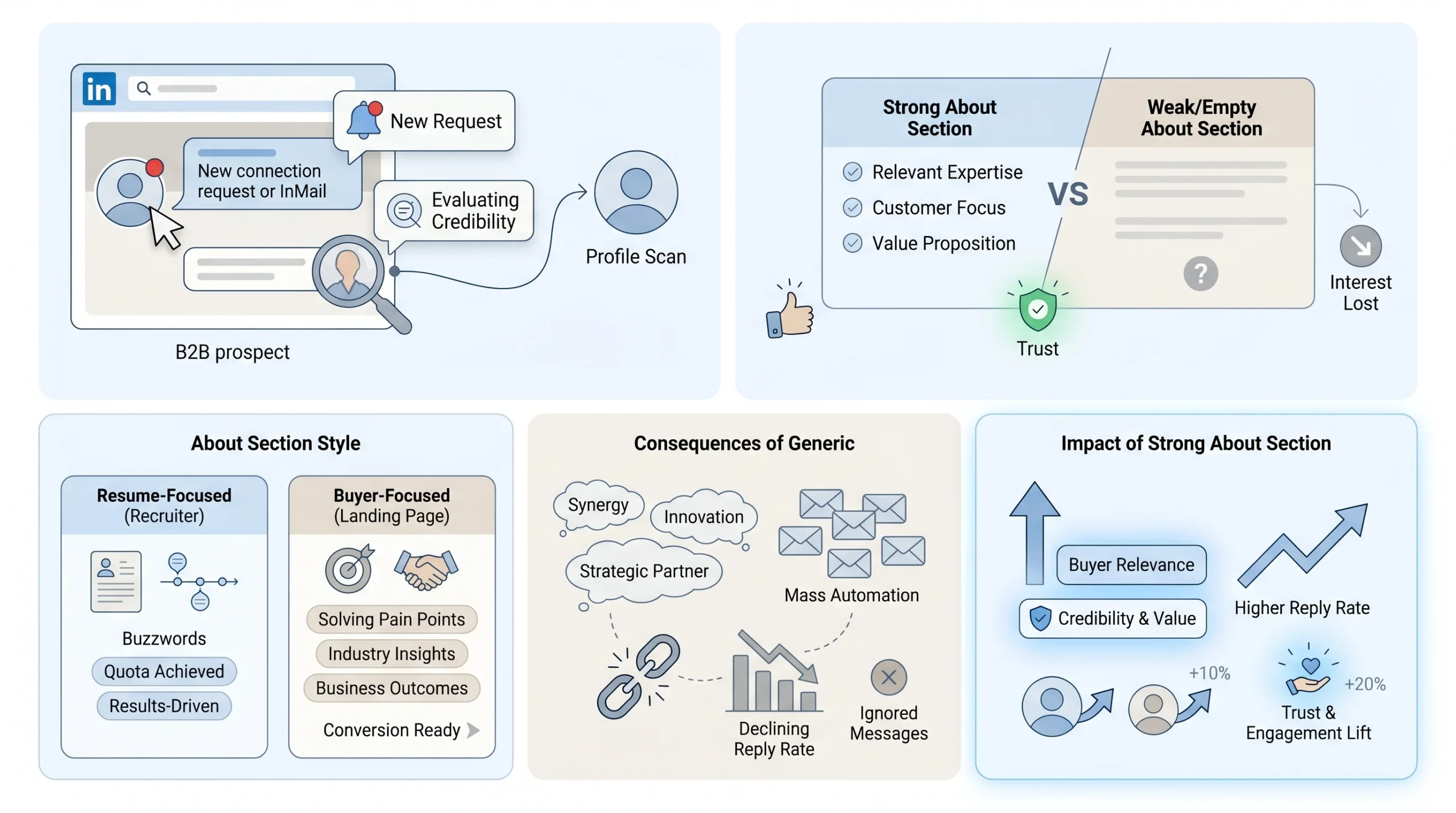
Before you can fix your About section, you need to understand the exact moment it comes into play — and why its current state is probably costing you replies every single day.
The “Profile Check” Moment Every Prospect Takes
When a prospect receives your connection request or InMail, they do not simply decide on the spot whether to accept or reply. Research confirms that 78% of B2B buyers check a seller’s LinkedIn profile before responding to outreach, and 64% of those profile views happen within 48 hours of receiving a message. This means that for nearly every outreach attempt you make, there is a moment — brief but decisive — where your prospect is standing at your profile door and deciding whether to knock back or walk away.
This “profile check” is not passive browsing. It is a trust evaluation. The prospect is asking a simple, silent question: Is this person credible enough for me to give up two minutes of my day? Studies show that response rates jump to 12–18% when prospects actively view your profile within 24 hours of receiving outreach, compared to just 2–4% for cold outreach where the prospect does not visit the profile at all. That gap — 2–4% versus 12–18% — is not caused by a better message. It is caused by a profile that passes the trust test.
Your About section is the primary place where that trust is built or broken.
Resume vs. Landing Page: The Mindset Shift That Changes Everything
The single most damaging mistake SDRs and BDRs make with their About section is writing it for the wrong audience. Most LinkedIn About sections are written as if the reader is a recruiter: they list previous roles, companies, quota attainment figures, and career progression. While that information is appropriate on a résumé, it is entirely wrong for outbound prospecting.
Your prospects are not hiring you. They are evaluating whether you understand their world well enough to be worth a conversation. Research published by LinkedIn’s own sales blog confirms this directly: profiles written for recruiters actively repel buyers, because they read like a job application rather than a resource. A résumé-style About section signals that the SDR’s attention is on their own career, not on the prospect’s problem.
The correct mindset is to treat your About section as a landing page for your ICP — your ideal customer profile. A landing page has one purpose: to convert a visitor into an action. It speaks entirely to the reader’s problem, builds trust through evidence, and ends with a clear next step. A résumé has zero of these characteristics. Every word in your About section should serve the person reading it, not the person who wrote it.
What Happens When Prospects Find a Generic or Empty About Section
The consequences of a weak About section are measurable. LinkedIn’s own data shows that profiles with professional photos receive 21 times more profile views and 36 times more messages than profiles without them. While that specific figure relates to profile photos, it illustrates the broader principle: completeness and quality of profile presentation directly affect engagement rates.
When a prospect clicks through to your profile and finds an empty About section, one of three things happens:
- They assume you are not serious about your role or your outreach, and they ignore the message.
- They conclude that you are running a mass automated campaign with no genuine understanding of their business — and they ignore the message.
- They simply cannot find any reason to trust you, so they move on to the next thing in their inbox.
A generic About section — one filled with buzzwords like “results-driven professional” or “passionate about helping companies grow” — produces a nearly identical result. Research confirms that excessive use of clichés and a lack of a clear value proposition are among the most common and damaging mistakes SDRs make on LinkedIn, because they produce profiles that fail to communicate what the rep actually does for buyers.
The absence of a strong About section does not produce a neutral result. It actively reduces your reply rate.
What Your LinkedIn About Section Is Actually Competing Against
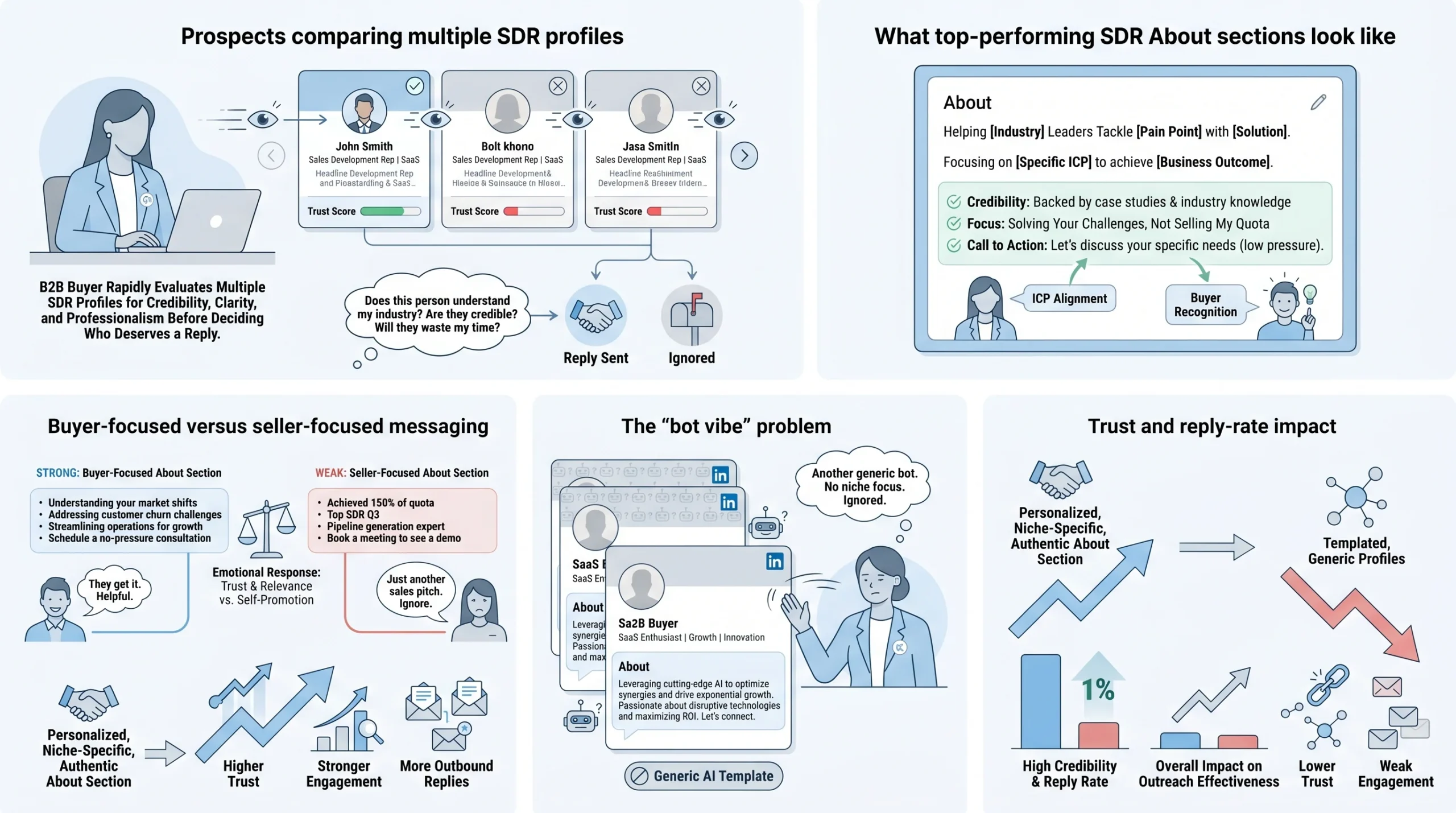
Your About section does not exist in a vacuum. Prospects who receive outreach from SDRs and BDRs are accustomed to checking profiles — which means they have seen dozens or hundreds of them. They know what a weak one looks like, and they make decisions accordingly.
What Top-Performing SDR About Sections Look Like in 2025
The best-performing SDR and BDR About sections in 2025 share a consistent set of characteristics. They are written entirely from the buyer’s perspective — they describe the problems the buyer faces, not the career achievements of the seller. They are specific about the ICP: naming the industries, company sizes, or roles the SDR works with, so the prospect immediately recognizes themselves in the text. They include credibility markers — brief, specific references to outcomes or industries served — without reading like a brag sheet. And they end with a direct, low-friction call to action that makes it easy for the reader to take the next step.
According to HubSpot’s analysis of LinkedIn summaries for sales professionals, the most successful representatives structure their About section around the principle that “sales isn’t about them — it’s about the prospect.” The best About sections demonstrate a deep understanding of the buyer’s world, not just a list of the seller’s accomplishments.
How Buyers Are Trained to Spot Pitch-First SDR Profiles
B2B decision-makers receive an enormous volume of cold outreach. LinkedIn InMail alone generates 18–25% response rates when done well, but the overwhelming majority of messages never reach that benchmark because the underlying profile fails the credibility check. Buyers who spend time on LinkedIn — particularly at the VP and C-suite level — develop a trained eye for SDR profiles that are self-promotional rather than buyer-focused.
These buyers can tell within seconds whether an About section was written to help them or to help the SDR get a meeting. Phrases like “I exceed quota every quarter” or “I’m passionate about building pipeline for fast-growing companies” orient the narrative around the seller. Buyers do not care about your quota. They care about their own problems. When an About section leads with seller achievements rather than buyer relevance, it confirms the prospect’s suspicion that the outreach is about the seller’s number — not about a genuine solution to a real problem.
The “Bot Vibe” Problem: Why Templated About Sections Backfire
A growing problem for SDRs in 2025 is what practitioners in the field call the “bot vibe” — the unmistakable sense that a profile was generated by an AI tool or pasted from a template without any personalization. Research confirms that this is a recognized pitfall: buyers can identify templated outreach and profiles, and when they do, they lose confidence in the sender’s ability to engage genuinely.
The bot vibe in an About section typically manifests through: identical or near-identical phrasing to other SDRs in the same space, an absence of any specific personality or professional voice, vague industry claims that could apply to any company (“I help businesses grow revenue”), and a complete lack of niche focus. When buyers spot this pattern on a profile, the outreach message — however well-written — is discarded. The profile and the message are evaluated together. A templated About section contaminates even a well-crafted outreach note.
The Anatomy of a High-Converting SDR/BDR About Section
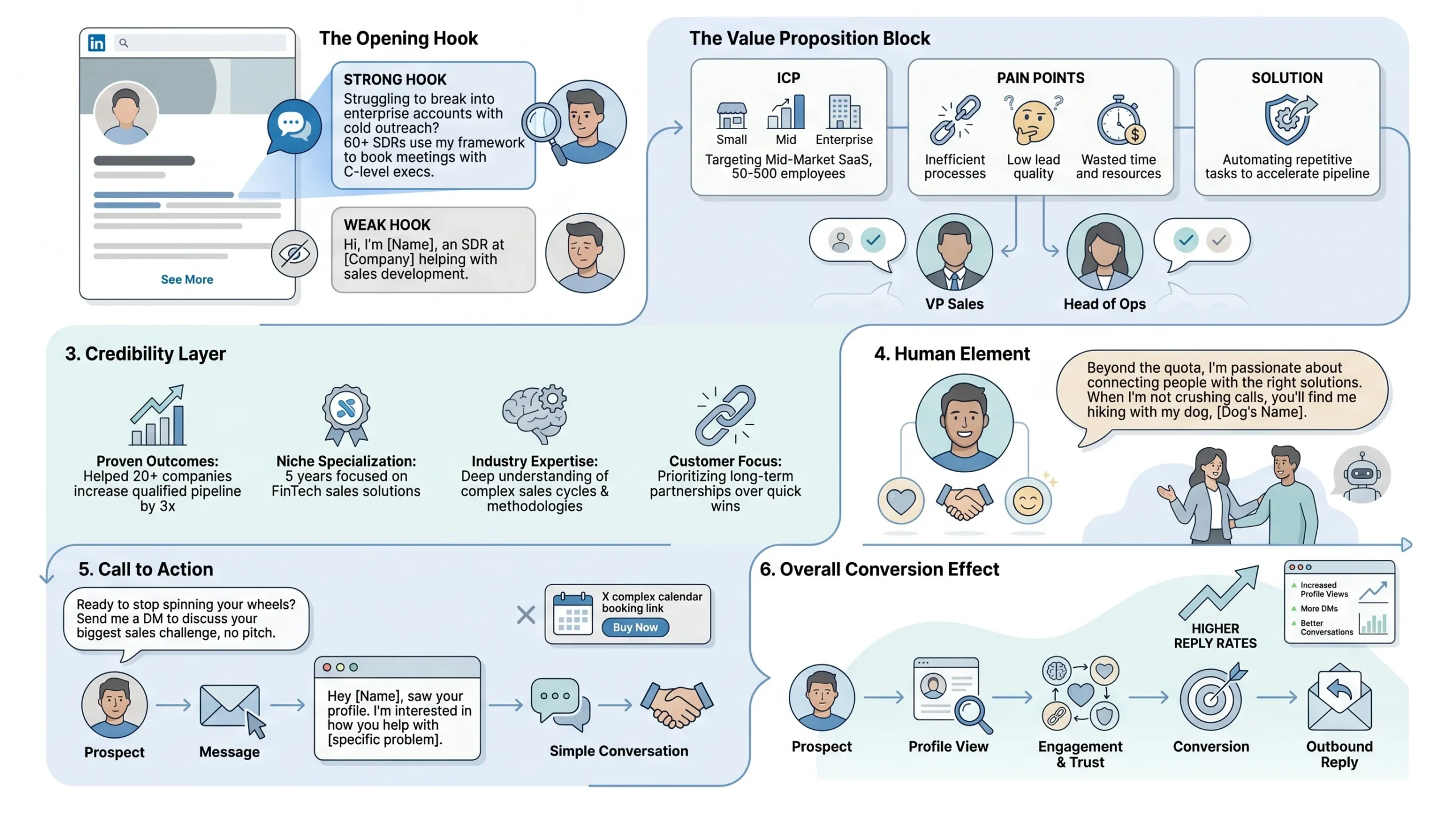
A high-converting About section is not a single undifferentiated block of text. It has distinct structural components, each serving a specific function in the trust-building process. Understanding what each component does — and why it must appear where it does — is what separates a profile that earns replies from one that doesn’t.
The Opening Hook (Lines 1–2 Before the “See More” Fold)
The single most important real estate in your entire LinkedIn About section is the first 200–300 characters. This is the text that appears before the “See More” click — the only part of your About section that a prospect reads before deciding whether your profile is worth their time. According to multiple LinkedIn character limit analyses, only the first 200–300 characters of the About section are visible on desktop before being truncated, with mobile showing even less.
This means your opening line has one job: it must make the reader want to click “See More.” If your opening line is “Hi, I’m [Name], an SDR at [Company]” — you have already lost them. That sentence tells the prospect nothing about what is in it for them.
The most effective opening hooks for SDRs and BDRs follow one of two formats:
- Problem-first: Name the specific, painful problem your ICP deals with. Example: “Most VP Sales at Series B SaaS companies spend 30% of their week on manual prospecting tasks that shouldn’t touch their team at all.” This works because the reader who matches your ICP immediately recognizes their own situation and clicks to read more.
- Outcome-first: Lead with the result you help buyers achieve. Example: “I help operations leaders at mid-market logistics companies cut software spend without replacing their stack.” This works because the outcome is specific, credible, and immediately relevant.
What you must avoid: starting with your name, your job title, your company name, or any statement about your passion for sales. These openings orient the narrative around you — and the prospect stops reading.
The Value Proposition Block: Who You Help and How
Immediately following the hook, your About section needs to answer two questions concisely: who do you work with, and what problem do you solve for them? This is the value proposition block, and it should be written entirely in the language of your buyer, not the language of your employer.
This is the section where the résumé-versus-landing-page distinction matters most. Compare these two versions of the same information:
Résumé version: “As an SDR at [Company], I focus on outbound pipeline generation through cold calling, LinkedIn outreach, and email sequences targeting mid-market accounts.”
Buyer-centric version: “I work with VP Sales and Revenue Operations leaders at B2B SaaS companies (50–500 employees) who are scaling their outbound motion but keep running into the same wall: too many tools, not enough signal, and reps who spend more time on data entry than selling.”
The second version does something the first version cannot: it makes the prospect feel seen. As research from LinkedIn’s own sales blog establishes, the “About” section should tell a story about who you help, how you help, and why it matters — not about what your daily tasks are.
Be specific about your ICP in this block. Name the company size, the industry, the job title of your buyer, and the specific problem category. Specificity is not limiting — it is credibility-building. A prospect who matches your ICP exactly will feel far more compelled to reply to someone who clearly understands their world than to someone offering vague, generic help.
The Credibility Layer: Social Proof Without Bragging
Once you have established who you help and what you solve, the next component is credibility. This is where you introduce brief, specific evidence that you are worth talking to — without turning your About section into a self-congratulatory highlight reel.
The distinction matters. “I’m a top-performing SDR with a track record of exceeding quota” is meaningless — it is what every SDR claims, and buyers know it. Compare that to: “Over the past 18 months, our team has helped 40+ logistics SaaS companies in the EU move from reactive inbound to a structured outbound motion.” The second version is specific, outcome-focused, and oriented around the buyer’s result, not the SDR’s achievement.
Effective credibility signals for an SDR or BDR About section include:
- Number of accounts or companies in a specific vertical you have worked with
- Specific industries or use cases where you have deep knowledge
- A brief, concrete outcome (without violating NDA or exaggerating): “helping teams like yours go from 0 to 30 qualified meetings per month”
- A relevant reference to your company’s positioning, framed from the customer’s perspective: “We work exclusively with HR tech platforms between 50 and 300 employees — which means when I reach out, it’s because the fit is usually real”
The goal of the credibility layer is not to impress the prospect into a reply. It is to remove the objection that you are another generic SDR with no relevant experience. Buyers are 50% more responsive to messages where sellers demonstrate industry-specific credibility, according to LinkedIn prospecting research. Your About section is the place to establish that credibility before the first conversation happens.
The Human Element: Personality, Relatability, and Trust
A LinkedIn About section that is purely professional and utterly devoid of personality reads like a corporate press release. It may be technically competent, but it does not build the kind of trust that turns a profile view into a reply. Buyers buy from people — and they can tell within a few sentences whether a profile represents a real human being or a polished sales instrument.
The human element of your About section does not need to be elaborate. One to two sentences of genuine, authentic personality are enough to shift the register from “sales machine” from “person worth talking to.” This might be a brief mention of the industries you personally find interesting and why, a sentence about how you approach prospecting differently from the standard playbook, or a genuine statement of what you care about in the sales conversations you have.
According to Skylead’s research on LinkedIn summaries for sales reps, the About section is the only place on a LinkedIn profile where you can express your personality and connect with prospects on a deeper level. This is a significant opportunity — most SDRs leave it entirely unused because they default to purely professional language.
What the human element is not: forced humor, performative enthusiasm, or personal information that is irrelevant to the professional context. The goal is authentic relatability, not entertainment. A sentence like “I got into enterprise SaaS sales because I spent three years on the operations side and saw firsthand how much bad tooling costs teams — so I take seriously the ones I reach out to” accomplishes more for trust-building than any amount of polished corporate language.
The Call to Action: Telling Prospects Exactly What to Do Next
The final component of a high-converting About section is a direct, specific, low-friction call to action. According to HubSpot’s analysis of effective LinkedIn summaries for sales professionals, your audience is measurably more likely to take action when you tell them what action to take, using clear, imperative language paired with a benefit-driven statement.
Most SDR About sections end with either nothing — the text simply stops — or with a passive statement like “feel free to connect.” Neither of these generates replies. A CTA that works is specific about what the prospect should do, why they should do it, and what they will get out of it.
Effective CTA formats for SDR/BDR About sections:
- Problem-triggered CTA: “If you’re managing an outbound team and running into [specific problem] — send me a DM. Worth a 15-minute chat.”
- Value-offer CTA: “If scaling your BDR team’s pipeline in the next 90 days is a priority, message me directly. I’m happy to share what’s working across [your industry].”
- Direct contact CTA: “Best way to reach me: DM here or [email]. I read everything and reply fast.”
The CTA should never require significant effort from the prospect. The easier the next step, the more likely it is to happen. Asking someone to “book a 30-minute discovery call” in your About section is too much friction. Asking someone to “send a DM if [specific problem] resonates” is the right level of friction — it is low, it is specific, and it is directly connected to the value proposition you just laid out.
The 5 Most Common LinkedIn About Section Mistakes SDRs Make
Understanding what not to do is as important as understanding what to do. These five mistakes appear repeatedly across SDR and BDR profiles and are consistently identified in research on LinkedIn profile optimization for sales professionals.
Mistake #1 — Writing It for a Recruiter, Not a Buyer
This is the most widespread mistake and the most damaging. A recruiter-facing About section is filled with career milestones, quota percentages, company names, and professional development language. It answers the question “what have you done?” rather than “what can you do for me?”
Research from LinkedIn’s sales blog and from social selling experts at Social Sales Link both confirm the same diagnosis: when your profile reads like a job application, it actively disqualifies you in the eyes of your buyer. The prospect who opens your profile is not looking to hire you. They are looking to understand whether you are worth a reply. Quota attainment and Presidents Club membership do not answer that question. A clear articulation of who you help and what you solve does.
The fix is a mindset reset before you write a single word: your buyer is the only audience that matters. Write every sentence asking yourself, “Does this sentence give my ICP a reason to engage?”
Mistake #2 — Leaving It Empty or Copy-Pasting the Job Description
An empty About section is the LinkedIn equivalent of sending a cold email with no subject line — it signals carelessness and makes every other element of your outreach less credible. Yet research confirms that leaving the About section blank is one of the most common mistakes among newer sales reps.
Copy-pasting your job description is equally harmful, if not more so. A job description is written for internal HR purposes, not for external buyers. It describes duties and responsibilities in language that means nothing to a prospect. When a buyer reads “responsible for outbound prospecting and pipeline generation across a defined territory,” they learn nothing about whether you understand their business.
The empty or job-description About section also fails the LinkedIn search test: profiles without keyword-rich, well-structured About sections rank lower in search results, reducing the organic inbound that a strong profile can generate.
Mistake #3 — One Giant Wall of Text (The Readability Killer)
Skylead’s research on LinkedIn summaries specifically identifies the “wall of text” as a major conversion killer. Even when the content of an About section is genuinely valuable, presenting it as a single unbroken paragraph pushes prospects away. Unstructured text signals disorganization and makes the profile feel like an effort to read — which means most people won’t.
The human brain processes broken text faster than dense prose, particularly in a digital environment where attention is scarce. Short paragraphs of two to four sentences, separated by white space, are far easier to scan than a five-hundred-word block. LinkedIn’s About section allows full paragraph breaks and line spacing, and these formatting tools should be used deliberately. Your About section should be scannable in ten seconds and fully readable in under sixty.
Mistake #4 — Leading With “I” and Talking About Yourself the Whole Time
Behavioral research in sales consistently shows that buyer-centric language outperforms seller-centric language in outreach. The same principle applies to your About section. An About section that opens with “I am an SDR at [Company] with X years of experience in B2B SaaS sales…” and continues for multiple paragraphs with “I” as the subject of every sentence produces the same psychological response as a pitch-slap in a LinkedIn DM: the reader feels like they are being talked at, not spoken to.
High-converting About sections orient the subject of the narrative toward the buyer. Instead of “I help sales teams,” try “Sales teams dealing with [specific problem]…” — then describe the problem in their terms before introducing yourself as the person who helps solve it. The difference is subtle in structure but enormous in impact. Prospects who feel that an About section understands their world are significantly more likely to respond to subsequent outreach.
Mistake #5 — No CTA, or a Weak One Like “Feel Free to Connect”
Research from HubSpot on LinkedIn summaries for sales representatives is unequivocal on this point: summaries that end with a direct, benefit-driven call to action consistently generate more action than those that do not. Yet the majority of SDR About sections either end with no CTA at all — the text simply stops after the final paragraph — or include a passive, low-signal phrase like “feel free to connect” or “always happy to chat.”
These weak endings fail because they do not tell the prospect what to do, they do not give the prospect a reason to do it, and they do not create any sense that a response will be worth their time. A strong CTA closes the loop on everything that came before it: you named the problem, you established credibility, you showed your personality — now give the prospect a specific, easy action that connects directly to the value you just described.
SDR/BDR LinkedIn About Section Templates (With Breakdowns)
The following four templates are designed for different selling contexts and experience levels. Each template includes a fill-in-the-blank structure and a line-by-line breakdown explaining why each component works.
Template 1 — The Problem-First Format (Best for Cold Outreach SDRs)
Template:
Most [job title] at [company type] are dealing with [specific problem]. [Describe the consequence of that problem in one sentence — what it costs them in time, money, or opportunity.]
I work with [ICP: job title + company type + size range] to [specific outcome you help them achieve], without [common objection or trade-off they fear].
Over the past [X months/years], [brief credibility signal — number of companies, specific vertical, concrete outcome].
I take outreach seriously — I only reach out when I genuinely believe the fit is there.
If [problem you described] is something your team is navigating right now, send me a DM. Happy to share what’s working.
Line-by-line breakdown:
- Opening problem statement: Leads with the buyer’s reality. The prospect who matches your ICP reads the first sentence and thinks “that’s me” — which is exactly the emotional trigger that makes them click “See More.”
- Value proposition: Introduces who you work with and what outcome you deliver, framed entirely around the buyer’s benefit. “Without [trade-off they fear]” directly addresses the objection most prospects carry before they even engage.
- Credibility signal: Short, specific, and outcome-oriented. Does not claim to be the best or most passionate — makes a concrete, believable statement about experience.
- Trust statement: One sentence that humanizes the outreach and pre-empts the “is this automated?” objection. Tells the prospect that their inbox is not being spammed.
- CTA: Direct, low-friction, problem-triggered. Asks for a DM only if the opening problem resonates — which means only the most relevant prospects respond, improving lead quality.
Template 2 — The Story-Led Format (Best for BDRs Focused on Relationship Selling)
Template:
[Brief professional origin story in one to two sentences — what drew you to this space, or a moment that clarified the problem you now solve. Keep it professional and specific, not generic.]
That experience is why I focus specifically on [ICP: job title, company type, or industry]. [Describe the core challenge they face in one sentence.]
At [Company], we help [ICP descriptor] [specific outcome] — typically within [timeframe or scope].
A few things that matter to me in how I work: [two to three specific professional values or working principles that differentiate your approach].
If any of this resonates, my DMs are open — or drop me your email and I’ll reach out directly.
Line-by-line breakdown:
- Origin story: Creates immediate authenticity and differentiates this About section from every templated, generic alternative. A credible, specific professional story signals that a real person wrote this — not a content generator. It also explains why you work in this space, which is more compelling than simply stating that you do.
- ICP pivot: Connects the origin story directly to the buyer. The transition “that experience is why I focus specifically on…” makes the prospect feel that the SDR’s background is relevant to their specific situation.
- Company value prop: Brief, ICP-specific, and outcome-framed. Gives the prospect the “what’s in it for me” in one clear sentence.
- Professional values: Two to three working principles that demonstrate self-awareness and buyer-centricity. Examples: “I don’t reach out without research,” “I’d rather have a five-minute honest conversation than a thirty-minute demo that wastes your time,” “I work in [specific industry] exclusively — which means I actually know what [specific challenge] feels like from the inside.”
- CTA: Dual-channel option (DM or email) reduces friction further. The phrase “if any of this resonates” keeps the ask conditional and non-pressuring.
Template 3 — The Results-Led Format (Best for Experienced Reps With Numbers)
Template:
In [X years] of working exclusively with [ICP descriptor], I’ve seen the same pattern play out across [number] companies: [describe the pattern — the problem cycle that keeps repeating].
[Two to three specific, credible outcomes you’ve contributed to — framed from the customer’s perspective, not your quota. E.g., “helped a Series B logistics SaaS go from 8 to 45 qualified outbound meetings per month in Q3.”]
The common thread: [one sentence that explains your methodology or philosophy — what you do differently].
I work at [Company], where we focus on [narrow ICP] — not everyone, just the companies where the fit is real.
Worth a conversation? DM me or reach out at [email].
Line-by-line breakdown:
- Pattern observation: Opens with experience and expertise rather than a pitch. “In X years of working exclusively with [ICP]” immediately signals deep familiarity. The pattern you describe functions as a mirror for the prospect — they recognize the problem cycle because they are living it.
- Outcome evidence: This is the highest-credibility section of a results-led format. The key is specificity: a company type, a metric, a timeframe. Vague claims (“helped companies grow”) carry no weight. Specific, believable outcomes (“went from 8 to 45 qualified meetings per month”) do. According to research on social selling effectiveness, specific credibility signals increase prospect responsiveness significantly.
- Methodology line: Differentiates you from every other SDR reaching out to the same prospect. One sentence about what you do differently — and why it works — establishes intellectual credibility beyond just having numbers.
- Company positioning: “Not everyone, just the companies where the fit is real” is a powerful trust signal. It tells the prospect that your outreach is selective, which makes the fact that you reached out feel more meaningful.
- CTA: Short, direct, dual-option.
Template 4 — The Niche Specialist Format (Best for Industry-Vertical SDRs)
Template:
I work exclusively in [specific industry vertical].
After [X years / specific experience], I understand the specific way [core challenge] plays out for [ICP: job title] at [company type or stage] — from [specific pain point A] to [specific pain point B].
At [Company], we focus specifically on [industry] companies that [specific qualifier — e.g., “are scaling from 50 to 200 employees” or “are moving from legacy systems to cloud-based infrastructure”].
I’m not reaching out to everyone. When I connect, it’s because I’ve done the research and believe there’s a real reason to talk.
If you’re navigating [specific challenge in your vertical], I’d like to hear about it — DM me.
Line-by-line breakdown:
- Niche declaration: Opening with a niche statement is the opposite of what most SDRs do — and that is precisely why it works. Most SDR profiles claim broad relevance. A niche specialist profile signals that every word that follows has been written for a specific type of person. For prospects inside the niche, this is an immediate trust accelerator.
- Vertical expertise: Names specific pain points that only someone with genuine industry knowledge would articulate. This cannot be faked convincingly — and that is the point. If your opening pain points are accurate and specific, the prospect knows you are not running a bulk spray-and-pray campaign.
- Company qualifier: Specifying exactly which companies you work with (by stage, size, or characteristic) has two effects: it makes the prospect feel accurately targeted, and it eliminates the suspicion that you will waste their time with a pitch that is not relevant to them.
- Research statement: Directly addresses the “is this automated?” objection that every experienced prospect carries. Claiming selectivity is only credible if the rest of your About section demonstrates genuine vertical knowledge — which this template does.
- CTA: Inverts the typical CTA by leading with “I’d like to hear about it” rather than “let me tell you about our product.” This positions the next conversation as a listening exercise, not a pitch — which dramatically lowers the friction to replying.
How to Customize Your About Section by ICP
A single About section cannot serve every prospect equally well. If you sell into multiple buyer personas — technical leaders, revenue leaders, and general business leaders — you either need to choose the ICP that represents your highest-value targets and write primarily for them, or (in cases where SDRs manage multiple territories or verticals) maintain separate LinkedIn profiles or rotate sections based on current campaign focus.
Writing for Technical Buyers (CTOs, DevOps, Engineering Leaders)
Technical buyers are among the most skeptical recipients of SDR outreach. They have high BS-detection skills, low tolerance for vague claims, and deep familiarity with the sales tactics used against them. An About section written for a technical buyer must demonstrate genuine technical literacy — not to the level of an engineer, but enough to show that you understand the architecture of the problem you are solving.
Key principles for technical ICP About sections:
- Use specific technical language relevant to their domain — but only the language you genuinely understand. Technical buyers will test your knowledge in the conversation, and inconsistencies between your About section and your actual expertise destroy credibility instantly.
- Avoid superlatives and emotional language. Technical buyers respond to precision, not enthusiasm. “We help DevOps teams reduce deployment failure rates” outperforms “we’re passionate about helping engineering teams move faster.”
- Credibility in this segment comes from specific technical outcomes and integration competence: “We work with teams running [specific stack]” or “we’ve helped engineering leaders at companies moving from monolithic to microservices architecture manage [specific challenge].”
- The CTA for technical buyers should be framed around solving a specific technical problem, not around a general “discovery call.” Example: “If [specific technical challenge] is something your team is dealing with, I’m happy to share how other teams in [industry] have approached it.”
Writing for Revenue Buyers (VPs of Sales, CROs, Revenue Operations)
Revenue buyers — VPs of Sales, CROs, and Revenue Operations leaders — are acutely focused on pipeline, efficiency, and measurable outcomes. They receive more SDR outreach than almost any other buyer persona and are therefore the most adept at identifying profiles that are not worth their time.
Key principles for revenue ICP About sections:
- Lead with pipeline, quota, or revenue language. These buyers think in metrics. An opening line that quantifies the problem — “most outbound teams at [company stage] are generating 40% fewer qualified meetings than their target” — speaks directly to their daily reality.
- Credibility evidence should be in the form of pipeline and revenue outcomes wherever possible: specific meeting volumes, pipeline values, conversion rates from outbound activity.
- Reference the organizational context — team size, growth stage, go-to-market model — to demonstrate that your About section was written for the specific type of revenue leader who matches your ICP.
- The human element for this ICP often involves acknowledging the pressure these leaders are under and the skepticism with which they receive outreach: “I know you get a lot of messages. I reach out when I think there’s a real reason to — not when the sequence tells me to.”
Writing for Business Buyers (CEOs, Founders, GMs at SMBs)
Business buyers at smaller companies — founders, CEOs, and general managers — have a different set of priorities than their enterprise counterparts. They are generalists managing multiple problems simultaneously, and they respond best to About sections that demonstrate breadth of understanding of their operational challenges while still being specific about the solution.
Key principles for SMB business buyer About sections:
- The problem framing for this ICP often touches on resource constraints: doing more with fewer people, avoiding expensive mistakes, and finding solutions that do not require a large implementation team.
- Avoid jargon-heavy language. SMB founders and GMs are not always deep specialists in the category you are selling into — they need to understand the problem and outcome in plain language.
- Social proof for this ICP works best in the form of company comparisons: “I work with founders at companies between 20 and 80 people, usually in the [industry] space, who are dealing with [challenge] for the first time.”
- The CTA for business buyers should be especially low-friction: “If you’re figuring out [challenge], I’d be glad to share what’s worked for similar companies — no pitch required.”
Optimizing Your About Section for LinkedIn Search (Without Keyword-Stuffing)
Your LinkedIn About section is not only a conversion tool for prospects who visit your profile directly. It is also a search-indexed asset — LinkedIn’s internal search algorithm reads the text of your About section when ranking profiles for search queries. This means a well-written About section can generate inbound profile views from prospects who are actively searching for someone like you, not just from outreach recipients.
Which Keywords Buyers and Decision-Makers Actually Search
The keywords that matter for SDR and BDR profiles are not the keywords you would include in a recruiter-facing profile. Buyers do not search for “SDR” or “sales development representative.” They search for the problems they are trying to solve, the industries they operate in, and the solutions they are researching.
To identify the right keywords for your About section, consider:
- The job titles of your ICP: if you sell to VP Sales, the phrase “VP Sales” should appear in your About section because some buyers search by their own title to find relevant content and profiles.
- The industry vertical you specialize in: “B2B SaaS,” “logistics technology,” “HR tech,” “fintech” — these vertical descriptors help your profile surface when buyers in those industries are browsing LinkedIn.
- The problem category: “outbound pipeline,” “sales process,” “revenue operations,” “cold outreach,” “meeting booking” — buyers researching solutions often search by problem category.
- The solution category: the specific type of product or service you sell, described in buyer-familiar terms rather than internal product naming conventions.
How to Weave Keywords In Naturally Without Sounding Like a Robot
The error most SDRs make when trying to optimize for search is keyword-stuffing: inserting keywords in unnatural ways that make the About section read as awkward and obviously optimized. This approach fails on two fronts — it makes the profile less readable for human visitors, and it is less effective for search than natural, contextual keyword use.
The correct approach is to write your About section for your human reader first, then review it for keyword presence. In most cases, if you have written a genuinely specific, ICP-focused About section, the relevant keywords will appear naturally — because you are describing your buyer’s world in their own language, which is also the language they use when searching.
Where specific keywords are missing, add them through light editing: introduce an industry term in the context of a sentence that already makes sense, or add a brief phrase that names the ICP or problem category in passing. The test for every keyword addition is: does this sentence still read like a human being wrote it? If yes, keep it. If no, cut the keyword and find a more natural way to introduce it.
The Character Limit Reality: 2,600 Characters and How to Use Them
LinkedIn’s About section allows up to 2,600 characters. However, only the first 200–300 characters are visible before the “See More” click on desktop, with mobile showing even less. This creates a two-tier structure: the visible hook and the full body.
Research on optimal About section length suggests that 1,800–2,200 characters represents the ideal range — substantial enough to cover all five structural components (hook, value proposition, credibility, human element, CTA) without creating a wall of text that exhausts the reader.
Practical guidance on character allocation:
- Opening hook (before fold): 150–250 characters. This must be your most compelling sentence.
- Value proposition block: 300–400 characters. Two to three short paragraphs.
- Credibility layer: 200–300 characters. Specific and brief.
- Human element: 100–200 characters. One to two sentences.
- CTA: 100–150 characters. Direct and specific.
The remaining character budget can be used for spacing and formatting — blank lines between sections that make the text scannable. Do not fill every available character with additional content. White space is not wasted space; it is a readability tool.
Beyond the About Section: Profile Elements That Amplify Your Replies
The About section does not operate in isolation. It is part of a profile that a prospect evaluates holistically. Three adjacent elements significantly affect how your About section is perceived and how likely a prospect is to act on it.
Your Headline Must Match Your About Section’s Promise
Your LinkedIn headline is the text that appears directly beneath your name — and it is visible every time you send a message, appear in a search result, or comment on a post. It is the first thing a prospect reads before clicking through to your full profile. According to research on LinkedIn profile optimization, profiles with buyer-centric headlines — those that describe who you help and what you solve rather than simply listing a job title — generate significantly more profile views than those with title-only headlines.
The critical principle is consistency: your headline and your About section must make the same promise. If your headline says “Helping B2B SaaS companies build outbound pipeline,” your About section must deliver on that premise with specificity, evidence, and a CTA that leads the prospect toward a relevant conversation. A disconnect between headline and About section — where the headline promises buyer focus but the About section reverts to a résumé — breaks the trust sequence and undermines both elements.
The Featured Section as a Credibility Multiplier
The Featured section appears directly below your About section on a LinkedIn profile and is one of the most underused credibility tools available to SDRs and BDRs. It allows you to pin specific content — LinkedIn posts, external articles, case studies, or media links — that your profile visitors will see immediately after reading your About section.
Research on LinkedIn profile best practices recommends pinning content that demonstrates the buyer-centric expertise your About section claims. If your About section says you understand the outbound challenges facing VP Sales at B2B SaaS companies, pinning a post that you wrote with specific, data-backed insight on that challenge provides immediate social proof for that claim. The Featured section is also the natural home for customer testimonials, case study summaries (with appropriate confidentiality maintained), and any third-party mentions that reinforce your credibility.
How Your Banner Image Sets Expectations Before Anyone Reads a Word
Your LinkedIn banner — the horizontal image behind your profile photo — is the largest visual element on your profile. Most SDRs either leave it as LinkedIn’s default grey, or use a generic landscape photo. Both choices represent a missed opportunity to establish context before the prospect reads a single word.
An effective SDR banner image accomplishes one of two things: it reinforces your company’s brand and positioning (making your profile look professional and organized), or it communicates your ICP and value proposition visually (using brief text over a relevant background). Research on LinkedIn profile optimization for sales professionals notes that neglecting visual components, including the banner, is a critical flaw that reduces overall profile credibility — even when the written elements are strong.
If your company has branded LinkedIn assets, use them. If not, a clean banner with a brief, bold statement — something as simple as “[Industry] SDR | Helping [ICP] achieve [outcome]” — communicates buyer-centricity immediately and sets the right expectation before the prospect reads your headline, your About section, or anything else.
Conclusion
Your LinkedIn About section is one of the few elements of your outreach stack that works on your behalf every hour of every day, without any additional effort from you. Every message you send, every connection request you make, every comment you leave on a prospect’s post — all of them send the prospect to your profile. What they find there either multiplies the impact of all that activity or quietly cancels it out.
The SDRs and BDRs who consistently outperform their peers on LinkedIn are not necessarily the ones with the best sequences or the most touchpoints. They are the ones whose profiles pass the trust test — the ones whose About section makes a prospect feel, in thirty seconds of reading, that this person actually gets it. That feeling is not an accident. It is a result of writing, structure, specificity, and a deliberate decision to write for the buyer rather than for yourself.
Write that About section once, write it well, and let it work.
Frequently Asked Questions
What should an SDR write in their LinkedIn About section?
An SDR’s LinkedIn About section should be written for their buyer, not for a recruiter. It should open with a hook that describes the specific problem the ICP faces, follow with a clear value proposition naming who you help and what outcome you drive, include brief credibility evidence (specific industries, outcomes, or company types served), add a sentence of genuine human personality, and end with a direct call to action. The goal is to make the profile visitor — specifically the prospect who just received your outreach message — feel that you understand their world and are worth a reply.
How long should a sales rep’s LinkedIn About section be?
Research on optimal About section length indicates that 1,800–2,200 characters (out of the 2,600-character maximum) is the most effective range. This is enough space to cover all the structural components of a high-converting section without overwhelming the reader. More important than total length is structure: short paragraphs, white space between sections, and a scannable format that allows a prospect to grasp your value proposition in ten seconds of reading.
Should my About section be written in first or third person?
First person is strongly recommended for SDR and BDR About sections. Third person (“John is a top-performing SDR who…”) creates distance, sounds overly formal, and often reads as though someone else wrote it — all of which work against the authenticity and trust-building that a strong About section is meant to create. Writing in first person allows you to speak directly to the prospect as a human being, which is the relational foundation that outbound prospecting depends on.
How do I write a LinkedIn About section if I’m a new SDR with no results yet?
Newer SDRs without quota attainment figures or long track records should emphasize two things: their understanding of the buyer’s world and their specific approach to their role. The credibility layer for a new SDR can draw on industry knowledge developed before entering sales (previous roles, education, or domain expertise relevant to the ICP), the company’s track record rather than personal metrics, and genuine specificity about the ICP and problem they focus on. A new SDR who demonstrates deep understanding of a buyer’s challenges is more credible than a veteran SDR with impressive numbers but a generic profile. Specificity and buyer-centricity compensate for limited tenure.
How often should I update my LinkedIn About section?
Your About section should be reviewed and updated whenever any of the following change: your ICP or territory, your company’s core value proposition or positioning, your product or offering, your credibility evidence (new outcomes, new verticals served), or your outreach strategy. Beyond trigger-based updates, a quarterly review is a reasonable cadence — reading through the section with fresh eyes and asking whether it still accurately represents the conversations you want to start and the buyers you most want to reach.
Does my LinkedIn About section affect whether prospects reply to my messages?
Yes — measurably. Research confirms that 78% of B2B buyers check a seller’s LinkedIn profile before responding to outreach, and that response rates for prospects who view a profile within 24 hours of receiving a message are 12–18%, compared to 2–4% for cold outreach where no profile view occurs. This means your About section is directly implicated in your reply rate. A profile that passes the trust test — one that is buyer-centric, specific, credible, and human — removes the most common reason prospects decline to reply: the belief that the sender does not understand their world well enough to be worth their time.