


If your sales team is relying on inbound leads alone, you’re already losing to competitors who aren’t. LinkedIn outreach at scale is now table stakes for B2B companies trying to hit aggressive pipeline targets, but there’s a critical fork in the road: do you hire an external LinkedIn outreach agency, invest in software and run it yourself, or build a team in-house? The wrong choice can waste six months and tens of thousands of dollars. The right choice can deliver your first booked call in 30 days and scale to hundreds of qualified meetings per month.
The decision isn’t as straightforward as vendors want you to believe. A LinkedIn outreach agency can mean anything from a freelancer running sequences on a shoestring to a sophisticated operation managing hundreds of accounts with AI and compliance infrastructure. Building your own operation sounds cheaper until you factor in salaries, training, tool stacks, and the reality that it takes months to get good at LinkedIn outreach at scale. Buying software appeals to cost-conscious teams until they realize they still need bodies to manage campaigns, handle replies, and troubleshoot when things break. Most companies get this wrong the first time and pay the price.
This guide walks you through the actual decision: what agencies do and don’t do, how to spot a good one from a mediocre one, how much everything really costs, and the specific triggers that tell you it’s time to build in-house instead. By the end, you’ll know exactly which path fits your situation.
Understanding the Three Paths to LinkedIn Outreach in 2026
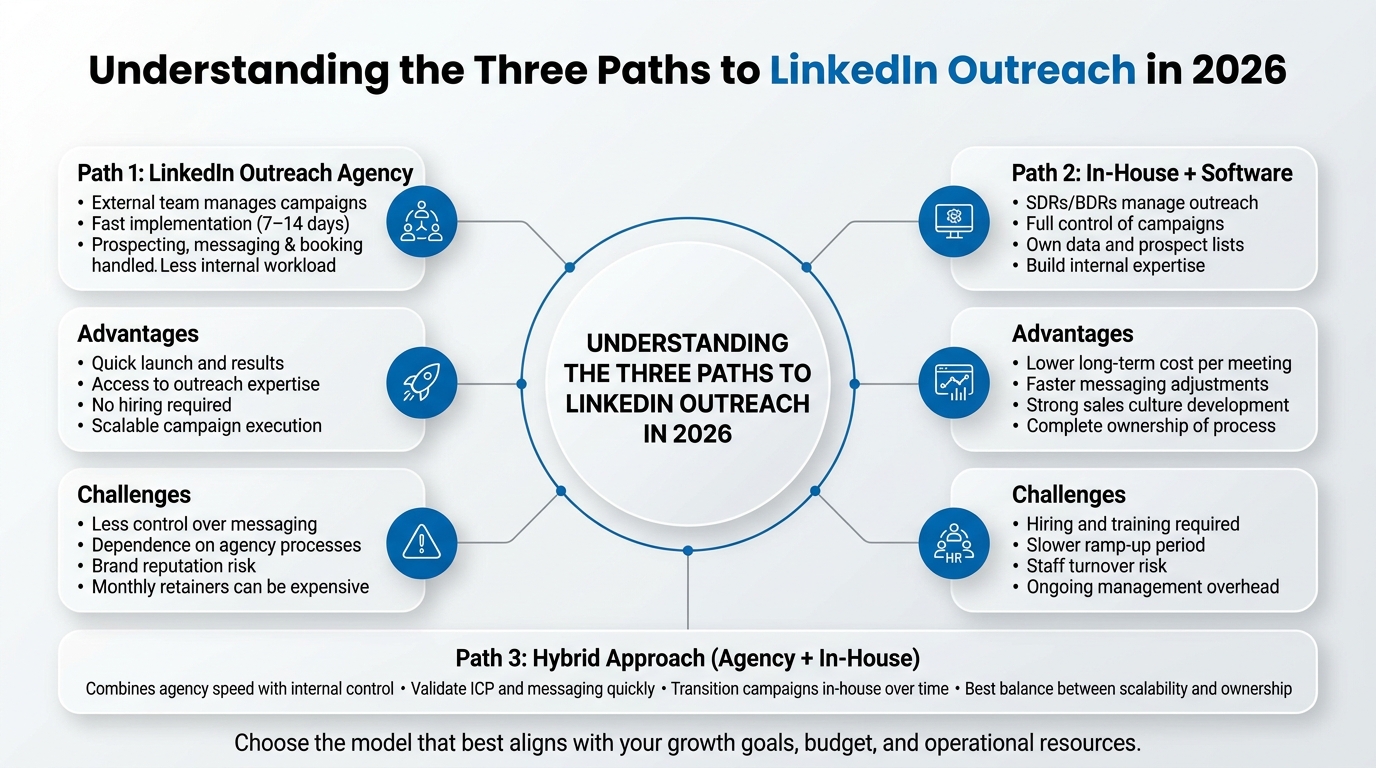
Before diving into whether to hire a LinkedIn outreach agency or go another route, you need to understand what you’re actually choosing between. These aren’t small differences. They affect your speed to first meeting, your cost per booked call, your control over messaging, compliance risk, and how you can scale when you’re winning.
The three paths are distinct in fundamental ways. Each has legitimate advantages, and each has failure modes that no amount of vendor hype will fix. Most companies find themselves wishing they’d started with a different approach after they’re already committed to one. This section breaks down what each path actually delivers and who should take it.
Path 1: Hiring a LinkedIn Outreach Agency
A LinkedIn outreach agency is an external team that manages your outreach campaigns end-to-end. They handle prospect research, they manage connection requests, they handle incoming replies, they book calls, and they report back to you on what worked. The appeal is obvious: you get a specialized team without adding permanent headcount.
The reality is more complex. An agency doesn’t remove the need for your involvement. You still need to provide the target audience, review messaging before it goes out, approve response scripts, and handle complex replies that need your product knowledge. The quality of your results depends entirely on how well the agency understands your ICP, your messaging, and your sales process. A good agency is a partner. A mediocre one is a vendor who executes your bad strategy faster.
The best agencies work with 10 to 30 clients at a time, so they have enough leverage to invest in training, compliance, and quality control. They usually charge a retainer between $2,000 and $10,000 per month depending on campaign scope, plus a fee per booked call (typically $200 to $500 per call in the B2B space). Some charge percentage-based fees on pipeline generated. Some charge only on success (per call booked). The model matters because it aligns incentives.
The speed advantage is real: a good agency can start running campaigns within 7 to 14 days. Your first meetings can be booked within 30 to 45 days if the ICP is clear and the messaging is solid. You don’t wait for hiring, onboarding, or for someone to learn your business.
The downside is loss of control. The agency manages your brand voice and your conversations. If they’re handling replies, they’re representing your company. If they mess up, your reputation takes the hit. You’re also locked into their tool stack, their process, and their ability to scale. When you want to adjust messaging or targeting, you’re dependent on the agency to execute. Scaling from one agency to five agencies is operationally messy.
Path 2: Building In-House with Software Tools
This path means you hire one or two people (SDRs, BDRs, or junior salespeople) and give them software tools to manage LinkedIn outreach at scale. Tools like Lemlist, Apollo, Expandi, Clay, or dedicated LinkedIn automation platforms let a small team manage dozens of campaigns across dozens of accounts.
The appeal is control. You own the process. Your team learns your business. You can adjust messaging on the fly. You can escalate complex conversations immediately. You own your data and your prospect list. Culturally, having in-house expertise builds sales DNA into your team.
The reality is that this requires hiring good people and giving them time to get good. An SDR or BDR with LinkedIn experience is worth their weight in gold, but they’re expensive (salaries typically $45,000 to $75,000 annually plus tools and benefits, so a true cost of $60,000 to $100,000 per person per year) and they take months to become productive. You need to invest in training them on your ICP, your pitch, your follow-up process, and how to use the tools without getting your accounts flagged for spam. The time-to-first-meeting is slower: 60 to 90 days is realistic if you’re hiring and training from scratch.
The tool stack is cheaper upfront (usually $200 to $1,000 per month depending on how sophisticated you go), but it’s hidden labor. Someone needs to manage leads, score them, sync them to your CRM, follow up on replies, and troubleshoot when outreach isn’t working. That’s easily 20 to 30 hours per week of admin work for one person running one campaign. Scale to three campaigns and you’re looking at hiring a second person.
The advantage of this path is that once your team is trained and productive, your cost per booked call becomes very predictable and actually quite cheap: you can get down to $100 to $200 per call if the process is dialed in. You own the intellectual property. You control the narrative. Scaling from 5 calls booked per week to 50 is mostly about hiring more bodies and more tool capacity.
The downside is people risk. If your best SDR leaves, they take institutional knowledge. If they get burned out by grinding manual outreach, your pipeline stops. You’re also competing for talent in a tight market, and junior sales talent is inconsistent. Some are naturals at outreach. Others tank. You won’t know until after you’ve spent months training them.
Path 3: Hybrid Approach (Agency + In-House Tools)
Some companies start with an agency to validate that their ICP works and their messaging lands, then transition to in-house operations once they understand what works. Others run an agency for high-touch accounts while their in-house team handles volume. This is increasingly common because it splits the difference.
The hybrid approach lets you move fast initially (via the agency) while your team gets ramped up (via software tools). Once your team is productive, you can transition campaigns off the agency and reduce the retainer. This approach requires more operational complexity, but it de-risks the decision. You get proof that LinkedIn outreach works for your business before you bet your entire team on it.
The cost is higher in the short term because you’re paying an agency retainer while also investing in hiring and tools. By month six, if the transition is smooth, your cost drops and you have more control. If the transition is messy, you’re paying for both and getting results from neither.
What a LinkedIn Outreach Agency Actually Does (And What It Doesn’t)
This is where marketing and reality collide. Most agencies claim to “manage your entire outreach operation” or “drive consistent pipeline growth” when what they actually do is execute a sequence of emails and messages based on a list you provide. Understanding the real scope of what an agency does is critical to choosing the right one.
A good LinkedIn outreach agency does these things:
Prospect Research and Targeting (sometimes): Some agencies help you define your ideal customer profile and pull a prospect list from LinkedIn Sales Navigator, Hunter, Apollo, or Clay. Some assume you’re bringing the list. Clarifying this upfront matters because it changes the scope and cost.
Sequence Design and Copy: The agency typically proposes a multi-touch sequence: an initial connection request with a personalized note, then one to three follow-up messages if they connect, then a call-to-action message, then possibly handing off to your sales team. They’ll usually show you proven templates, but your industry and ICP are unique, so they customize. Good agencies will run small tests (50 to 100 prospects) before scaling to full volume.
Account Setup and Warmup: If you’re using LinkedIn directly for outreach, the agency sets up accounts, manages connection limits (LinkedIn allows roughly 100 new connections per day per account before triggering warnings), and paces messages to avoid spam filters. If you’re using software that handles this automatically, the account setup is lighter.
Campaign Execution: Once the sequence is live, the agency monitors connection acceptance rates, reply rates, and response quality. They adjust pacing, adjust follow-up timing, and report back weekly on what’s working.
Reply Handling and Call Booking: Here’s where quality varies wildly. Some agencies hand off all replies to your sales team and let you deal with the back-and-forth. Some handle initial qualification and basic objection handling, then pass to sales only if someone is genuinely interested. The best agencies have scripts for common objections and can disqualify prospects who aren’t a fit without wasting your time. This is also where brand voice and product knowledge matter most. An agency that doesn’t understand your solution will fumble replies from interested prospects.
Reporting: All agencies report on volume (connections sent, connections accepted, replies received, calls booked). Good agencies also report on metrics that matter: reply-to-call conversion rates, deal velocity by campaign, cost per qualified conversation. Bad agencies send vanity metrics (500 connections sent, 142 accepted) without context on quality.
What a LinkedIn outreach agency does NOT typically do:
Lead Qualification and CRM Management: Some agencies will manually enter leads into your CRM or create records for prospects who reply. Most won’t, or they’ll do it as an add-on. You or your sales team own this work.
Sales Conversations: The agency might book the call, but your sales team runs the call. The agency has no role in closing. If your sales team is weak, a lot of booked calls will convert to nothing.
Strategy Development: A good agency will suggest optimizations, but they won’t sit in your quarterly business reviews or help you figure out what your actual ICP should be. That’s strategic work that requires your involvement.
Pricing and Negotiation: Most agencies won’t be part of the contract negotiation or pricing discussions. They’re handing off a qualified lead, not selling alongside you.
Account Expansion or Renewal: If the original campaign is to your own customer base (account expansion), some agencies can help with it, but most are designed for cold outreach, not relationship deepening.
Compliance and Legal Risk: This is the uncomfortable part. If an agency is accessing LinkedIn accounts on your behalf and the activity violates LinkedIn’s terms (which the API explicitly forbids and which LinkedIn’s enforcement is tightening), the liability is murky. Most agencies will have clauses in their contracts saying you assume the risk. Some agencies use software that sits between LinkedIn and their management tools, which is safer, but not all do. This is worth asking about directly.
The Agency Model Tradeoff: Control vs Speed
The core tradeoff with a LinkedIn outreach agency is that you’re trading direct control for speed and specialization. You get results faster because you’re not waiting to hire someone. You get better results on the execution level because the agency has run hundreds of campaigns. But you don’t control the narrative, you can’t easily pivot messaging mid-campaign, and if results aren’t hitting your targets, the conversation becomes contentious because you’re relying on an external partner.
This is why the best clients for a LinkedIn outreach agency are companies that have a crystal-clear ICP, proven messaging, and realistic expectations about how many meetings they can close. If you’re still figuring out who your customer is or if your pitch is untested, an agency will execute your unclear strategy quickly, and you’ll spend money learning a lesson you could have learned for cheaper in-house.
How to Choose a LinkedIn Outreach Agency: The Real Evaluation Criteria
When you’re evaluating a LinkedIn outreach agency, ignore the case studies where they “generated $2M in pipeline in three months.” That’s not data; that’s marketing. Focus instead on five concrete evaluation criteria that tell you whether this agency can actually deliver for your specific situation.
Criterion 1: Who Do They Work With and What’s Their Specialization?
A good LinkedIn outreach agency has a vertical or an ICP that they specialize in. They’ve run hundreds of campaigns to SaaS companies, or to healthcare providers, or to manufacturers. They know the buying cycles, the stakeholders, the common objections. They can tell you: “In this vertical, we typically see a 15-20% reply rate if the targeting is clean, a 5-8% call booking rate on replies, and a 25-30% show-up rate.”
This matters because it means they can set realistic expectations and they can spot when your targeting or messaging is off. A mediocre agency claims to work with everyone: SaaS, healthcare, finance, recruitment, agencies. That’s a red flag. You want someone who has run 100+ campaigns in your specific space, not someone who has run 1,000 campaigns across 50 different verticals.
In your first call, ask: “What’s the typical pipeline generated from our industry in the last 12 months? How many accounts do you manage? What’s the range of company sizes you usually target?” If they give you a range answer (“anywhere from startups to enterprises”), push back. You need specificity.
Also ask about retention: “What percentage of your clients stay with you after three months? After six months?” Good agencies have 70-80% retention rates. If an agency has high churn, their results aren’t sticking or their service is deteriorating over time.
Criterion 2: Can They Show You Real Results (Not Just Case Studies)?
Case studies are marketing. What you want is anonymized data. Specifically, ask for:
- Connection Acceptance Rate: The percentage of connection requests that get accepted. LinkedIn benchmarks are 30-40% for cold outreach to your target audience. If an agency claims 60%+, they’re either:
- Targeting warm lists (ex-customers, referrals) rather than true cold outreach.
- Using connected accounts with established trust (older, engaged accounts) rather than new ones.
- Gaming the system in a way that puts your accounts at risk (too many connections, too aggressive pacing).
- Reply Rate: The percentage of accepted connections who reply to your first message. Industry average is 5-15% depending on quality of targeting and copy. If they’re showing you 20%+, ask what the conversion rate is on those replies. A lot of agencies boost reply rates with tactics that lower the quality of the replies.
- Qualified Conversation Rate: The percentage of people who reply that your sales team actually wants to talk to. This is where agencies often get vague. A 5% reply rate means nothing if only 1% of replies are from someone who’s even theoretically a fit.
- Cost Per Booked Call: If they’re quoting a flat retainer, ask them to back into the cost per booked call based on their most recent client results. They should be able to tell you: “We charge $3,000 per month retainer, and for similar accounts, we typically deliver 8-12 booked calls per month, so the cost per call is $250-375.”
Red flag: If an agency refuses to share metrics or hides behind NDAs, they don’t have good metrics to share. Any agency with results to brag about will show you data. They’ll anonymize the client names, but they’ll show you the actual numbers.
Criterion 3: How Do They Handle Messaging and Personalization?
This is where the wheat separates from the chaff. Some agencies use rigid templates where personalization is just swapping in a first name and company. Others take the time to research each prospect and write custom messages that reference something specific about their business or situation.
At scale, true personalization gets expensive in terms of labor. An agency managing campaigns for 10 clients can’t manually research 500 prospects. So they use a mix: software that pulls data (company news, job changes, social signals) and combines it with smart templating. Or they have a script that says “mention something about their product, their recent funding, or a challenge in their space.”
In your first call, ask them: “Walk me through how you’d write the first message to a prospect. How much research goes into each message? How much is template?” If they say “100% personalized,” they’re either lying or they can’t scale. If they say “100% template,” they’re lazy. The right answer is something like: “We start with research that takes 2-3 minutes per prospect, pull specific signals from LinkedIn and company data, and create templates that feel personalized because they reference real signals about that person or company.”
Also ask: “Can I review and approve messaging before it goes live?” Good agencies will insist on this. Mediocre ones might balk because it slows down execution. The approval step matters because you’ll catch places where their assumptions about your business are wrong.
Criterion 4: What’s Their Account Safety and Compliance Process?
LinkedIn’s terms of service forbid most forms of automation. If an agency is accessing your account via the API, they’re technically violating terms. If they’re using a bot that logs into your account and manages connections, it’s a gray area that LinkedIn sometimes tolerates and sometimes doesn’t. If they’re using software that sits between you and LinkedIn and mimics human behavior, it’s the safest approach but not foolproof.
At a minimum, a good agency:
- Never logs into your account directly. They use software integrations, or they manage dedicated accounts that LinkedIn doesn’t associate with your existing ones.
- Respects connection and message limits. New accounts can send roughly 100-150 connection requests per day; older trusted accounts can do more. They should be pacing outreach conservatively, not maxing out limits every day.
- Has a warmup process for new accounts. If they’re managing new accounts on your behalf, those accounts need to earn trust by doing normal LinkedIn activities (viewing profiles, endorsing skills, engaging with posts) before ramping up outreach volume.
- Has a documented escalation process if an account gets flagged. LinkedIn will sometimes temporarily restrict accounts that have suspicious activity. Good agencies have a playbook for this: pause outreach, do normal activity for a few days, then resume slowly.
- Can explain their historical safety record. Ask: “Have any of your clients had accounts restricted? What happened? What did you do?” If they say “never,” they’re either new or being dishonest.
The uncomfortable truth is that scaling LinkedIn outreach carries some risk of account restriction. The software and agencies that claim zero risk are either not operating at scale or not being truthful. The right question isn’t “will this ever happen?” but “what’s your plan when it does?”
Criterion 5: How Do They Handle Scaling and Flexibility?
A red flag is an agency that locks you into a long contract with fixed terms and limited flexibility. What if the market changes? What if their results don’t match their projections? What if you want to adjust targeting or messaging mid-campaign?
Good agencies:
- Offer month-to-month terms after an initial 30 to 60-day minimum. This lets both sides walk if it’s not working.
- Have built-in review points. At 30 days, you should review initial results and adjust if needed. At 60 days, you should have data on actual cost per booked call.
- Are willing to run tests. If you want to test a new angle or a new audience, good agencies can segment off 10-20% of the account for testing without disrupting the main campaign.
- Can scale up or down quickly. If you want to add a second campaign or expand to a new country, can they do it in 1-2 weeks or do they need 2-3 months to spin up?
- Have transparent pricing. You should understand exactly what you’re paying for and why. Avoid agencies with vague pricing (“custom quotes based on scope”) because custom quotes always seem to go up.
Building vs Buying a LinkedIn Outreach Agency: The Real Cost Analysis
This is where you need to do the math honestly. Most companies underestimate the cost of hiring an in-house team and overestimate the cost of outsourcing. Or vice versa. The true cost depends on your volume targets, the complexity of your ICP, and how quickly you need to move.
Scenario 1: You Need 20-50 Booked Calls Per Month
This is the startup or small company scenario. You’re not doing 500 calls a month; you just need consistent, predictable pipeline from LinkedIn.
Path A: LinkedIn Outreach Agency
- Retainer: $2,500-5,000/month
- Cost per booked call: $250-500 (depending on your ICP and whether it’s outbound or account-based)
- Total annual cost: $30,000-60,000
- Time to first meeting: 30-45 days
- Ongoing effort from your team: 5-10 hours/week (approving sequences, reviewing replies, joining calls)
Path B: In-House with Software
- Hire one SDR/BDR: $60,000-80,000 base + $15,000 benefits + 30% overhead = $110,000-135,000 fully loaded
- Tools (LinkedIn Sales Navigator, automation software, CRM): $500-1,500/month = $6,000-18,000/year
- Total annual cost: $116,000-153,000
- Time to first meeting: 60-90 days (they need to ramp up)
- Ramp time: 2-3 months before they’re productive
- Realistic output after ramp: 15-25 calls/month depending on quality of hire
In this scenario, the agency is cheaper by $50,000-80,000 in year one, and it’s faster. The only reason to go in-house is if you have a complex or unusual ICP that requires someone who deeply understands your business, or if you’re planning to scale to 200+ calls per month eventually (where the in-house model gets more efficient).
Scenario 2: You Need 100-300 Booked Calls Per Month
This is the scale-up scenario. You’ve proven product-market fit and you need consistent high-volume pipeline.
Path A: 2-3 LinkedIn Outreach Agencies
- Retainer per agency: $5,000-10,000/month
- Managing 2-3 agencies: $10,000-30,000/month
- Cost per booked call: $200-400
- Total annual cost: $120,000-360,000
- Complexity: High (coordinating messaging across agencies, managing different retainers, preventing overlap)
Path B: In-House Team (3-5 people + Tools)
- 3 SDRs at $65,000 average + benefits + 30% overhead = $85,000 each, total $255,000
- 1 SDR Manager at $100,000 + benefits + overhead = $150,000
- Tools and technology: $2,000-4,000/month = $24,000-48,000/year
- Total annual cost: $429,000-453,000
- Output: 150-300 calls/month depending on quality of team and process
- Cost per call: $140-300
The agency approach is still cheaper, but the gap is closing because you’re now managing multiple agencies (which has operational overhead) and paying for high-volume discounts from your vendors. The in-house approach is more complex operationally but gives you more control and becomes the cheaper option if you grow beyond this volume.
Scenario 3: You Need 500+ Booked Calls Per Month
This is the enterprise scenario. You’re either a large organization with an aggressive growth mandate or a sales development organization (SDO) within a bigger company.
Path A: Agencies (5-10 agencies)
- Retainer per agency: $10,000-20,000/month
- Managing and coordinating: $50,000-100,000/month in management overhead
- Total annual cost: $720,000-1,440,000+
- Coordination complexity: Extremely high
- Quality variability: High
Path B: In-House Team (15-25 people + Tools)
- 15-20 SDRs at $65,000 each = $975,000-1,300,000
- 2-3 SDR Managers at $120,000 each = $240,000-360,000
- 1 Senior Manager/Director at $150,000 = $150,000
- Tools and technology: $8,000-15,000/month = $96,000-180,000/year
- Total annual cost: $1,461,000-1,990,000
- Cost per call: $97-199
- Control: Full
- Quality: Consistent (if you hire well)
At this volume, the in-house model is not only cheaper, it’s the only sensible option. Managing 10 agencies is a nightmare. You lose control, you can’t ensure consistent messaging, quality varies, and the coordination overhead cancels out the savings.
The Decision Matrix:
| Volume | Best Path | Why |
|---|---|---|
| 0-50 calls/month | Agency | Speed, no hiring risk, clear ROI |
| 50-150 calls/month | Agency or Hybrid | Agency is still cheaper; hybrid if you want more control |
| 150-300 calls/month | Hybrid or In-House | Cost parity; in-house if you need control |
| 300+ calls/month | In-House | Cost efficiency, control, scalability |
These numbers are approximate and vary by geography, industry, and your sales productivity. But the directional logic holds.
Mistakes When Hiring a LinkedIn Outreach Agency
You’re not the first person to hire a LinkedIn outreach agency, and the mistakes are predictable. Learning from them can save you $20,000-50,000 and several months of frustration.
Mistake 1: Hiring Based on Lowest Price
A LinkedIn outreach agency quoting $1,500/month sounds great until you realize it’s because they’re running the same template to 10,000 prospects across 100 clients. Your messaging gets lost in the noise. You get 2-3 booked calls per month at $500-750 per call.
Meanwhile, an agency quoting $5,000/month charges that price because they:
- Work with fewer clients (10-15 instead of 100+), so they have time for customization and optimization.
- Run A/B tests on messaging before scaling.
- Have an account manager who reviews your campaign weekly and suggests tweaks.
- Have a higher bar for which clients they work with, so they can actually deliver results.
- Charge based on value, not just labor.
The cheaper agency isn’t bad; they’re just not aligned with your success. The expensive agency may not be necessary if you have a straightforward ICP and proven messaging. But price alone is a terrible selection criterion.
Mistake 2: Not Having Clear Targeting and Messaging Before You Start
This is the single biggest reason campaigns fail. You contact the agency with a vague ICP (“sales leaders in SaaS”), they ask for clarification, you give them a list of target companies, and they start running outreach. Eight weeks in, you realize half the prospects aren’t a fit, the messaging doesn’t land the way you thought, and you’ve burned money.
The best clients come to an agency with:
- A list of 50-100 example customers (or ideal prospects) that perfectly represent your ICP.
- 2-3 proof points or use cases you’ve tested that actually land with your audience.
- Clarity on who the economic buyer is and what problem you solve for them.
- Realistic expectations on conversion rates (based on your own sales data, not the agency’s claims).
If you don’t have this, spend 2-4 weeks getting it clear before you hire an agency. Run a small test yourself, or work with the agency to run a small pilot (50-100 prospects) before committing to a big retainer.
Mistake 3: Not Defining What “Success” Looks Like Upfront
You hire an agency and start getting booked calls. Your sales team joins the calls and… nobody is a fit. The agency is doing their job (booking calls), but the calls aren’t productive because the targeting is off or the ICP was wrong.
This happens because you didn’t define success clearly. You should have a document before you start that says: “Success looks like 10-15 booked calls per month with 4-6 of those being qualified opportunities (meaning they advance to a discovery call or proposal stage). The cost per qualified call should be under $300.”
If the agency is booking calls but none of them are qualified, you have two choices: either adjust the targeting/messaging (which means doing the work), or recognize that LinkedIn outreach isn’t a fit for your business. The agency can’t fix a broken ICP.
Mistake 4: Not Reviewing and Approving Sequences Before They Go Live
Some companies hire an agency and let them write all the copy without review. Big mistake. The agency doesn’t know your brand voice, your specific differentiators, or the nuances of your solution. Their generic template that “works for most clients” doesn’t work for you.
The first 2-3 weeks of working with an agency should include message review and approval. You should see the connection request message, the first follow-up, and the call-to-action message. You should approve them or send them back for revision. This takes 2-3 hours of your time but it prevents two months of poor messaging.
Mistake 5: Paying Retainer Without Tying It to Results
Some agencies work on pure retainer: you pay $5,000/month and they manage the campaign, but if they only book 3 calls instead of 8, you still pay the same. This removes accountability.
Better models tie some of the fee to results. For example: “$3,000 per month base retainer, plus $300 per booked call above 5 per month.” This keeps the agency motivated to optimize, not just execute.
If an agency refuses to tie any compensation to results, it’s a signal that they’re not confident in their ability to deliver. Good agencies will usually agree to some form of performance-based fee, even if it’s capped.
How to Build Your Own LinkedIn Outreach Operation in 2026
If you decide to go in-house, the path is clearer but longer. You’re essentially building a specialized sales function. Here’s the realistic timeline and process.
Step 1: Nail Your ICP and Messaging (Weeks 1-4)
Before you hire anyone, you need to know exactly who you’re targeting and what message lands with them. This is non-negotiable because it determines whether your first hire succeeds or fails.
Spend the first month doing DIY outreach yourself (or with your sales team). Pick 50-100 ideal prospects, write personalized messages, and track what works. What companies? What titles? What problems are you solving? Which messages get replies? Which replies convert to calls?
Document your findings: “We get the best reply rate from VP of Sales at B2B SaaS companies with 20-100 employees. We should lead with the problem of outreach quality degradation, not features. Example message is [X]. We’ve gotten 4 replies from 15 targeted messages, which is a 26% reply rate.”
This data will be more valuable to your first hire than any job description.
Step 2: Hire Your First SDR (Weeks 4-8)
You’re not looking for someone with 10 years of sales experience. You’re looking for someone with 1-2 years of inside sales, who’s coachable, who’s curious about LinkedIn, and who understands your business or industry quickly. The salary is usually $50,000-70,000 depending on location.
In the job description, be specific about what they’ll do: “You’ll be responsible for outreach to [ICP] on LinkedIn, managing 5-10 dedicated accounts, booking 10-20 calls per week, and handling initial lead qualification. You’ll be learning our business, our message, and what works through experimentation.”
Red flags in interviews: Anyone who claims to be an expert at LinkedIn automation on day one (they’ll be dangerous, not good). Anyone who’s only done email outreach (it’s a different skill). Anyone who looks like they’re in this for 6 months and moving on (you need stability to learn your business).
Step 3: Set Them Up with Tools and Give Them a Training Plan (Weeks 8-12)
Your new hire needs:
- Access to your LinkedIn account or a dedicated account they manage
- Sales Navigator subscription ($150/month) for better targeting
- A CRM (HubSpot, Salesforce, Pipedrive, or similar) to track prospects and calls
- An automation tool if you’re using one (Lemlist, Apollo, Clay, or similar) or manually managed LinkedIn if you’re starting simple
- Your ICP documentation and call scripts
- Direct access to you for questions (they’ll have 100 in week one)
The first 2-3 weeks should be light on actual outreach and heavy on learning. Have them:
- Sit in on 5-10 of your sales calls so they understand how conversations go
- Research 20 of your best customers and identify what they have in common
- Send 25-50 manual test messages to prospects and document replies and objections
- Review your positioning and messaging with you
This might seem like slow progress, but it prevents the scenario where they’ve sent 500 bad messages to the wrong people and you only find out after two weeks.
Step 4: Launch Pilot Campaign at Small Scale (Weeks 12-16)
Start with 100-200 prospects, one vertical or persona. Track:
- Connection acceptance rate
- Reply rate
- Call booking rate
- Call quality (are they a fit?)
- Cost per booked call
Run this for 4 weeks. You should get at least 8-15 booked calls. If you’re getting none, something is wrong with targeting or messaging. Fix it before scaling.
Step 5: Optimize and Scale (Weeks 16+)
Once you have a process that’s delivering 10+ booked calls per month consistently, you can scale to more accounts, more messaging variants, or more campaigns. This is where your hire becomes really valuable because they know what works.
At this point, you can also add a second SDR if you want to 2x the output. The second hire will ramp faster because there’s now a process and someone to train them.
Ongoing Operations
Once the machine is running, budget these hours per month:
- Your time: 5-10 hours/week on strategy, CRM review, call coaching, and results review.
- SDR time: 35-40 hours/week on outreach, follow-ups, and lead management (this is their full job).
- Tool management: 3-5 hours/week (someone needs to monitor accounts, move leads in the CRM, track metrics).
The cost per booked call typically settles in at $150-300 after you’ve optimized, depending on your ICP and how selective you want to be about qualification.
Scaling Beyond One Agency or One SDR: When and How
Most companies that decide to hire a LinkedIn outreach agency or build an in-house team make the mistake of treating it as a solved problem once the first agency or person is in place. But scaling from 50 calls per month to 500 calls per month requires structural changes.
The Multi-Agency Coordination Problem
If you’re working with two agencies, you face a coordination challenge. Both are operating independently, and if you’re not careful, they’ll be targeting the same prospects, using conflicting messaging, and creating confusion. You need:
Prospect Deduplication: A shared spreadsheet or database that both agencies can access so they don’t target the same company twice.
Message Alignment: Weekly or bi-weekly sync where you review messaging and make sure both agencies are representing your value proposition consistently. One agency saying “we help you book more calls” and the other saying “we help you qualify leads faster” sends mixed signals.
Retainer Staggering: Don’t start both agencies on the same date. Start the first, get them to stable output (4-8 weeks), then start the second. This lets you evaluate the first one and adjust if needed before doubling down.
Clear Handoff Protocols: If a prospect is being managed by Agency A but replies with “interested in a demo,” who handles the demo booking? Define this upfront.
The In-House Scaling Transition
If you’ve been using an agency and you want to transition to in-house, the worst way to do it is to shut down the agency and hire your first SDR on the same day. You’ll have a gap in pipeline for 8-12 weeks while the new hire ramps.
Better approach:
- Month 1-2: Hire your first SDR, let them ramp while the agency continues.
- Month 2-4: SDR is starting to produce (5-10 calls/month), agency is still delivering its quota.
- Month 4-6: SDR is at 15-20 calls/month, you reduce the agency retainer or move them to new markets/segments.
- Month 6+: SDR is at full capacity, agency is fully off, new hire is trained and can train the second hire.
This transition takes longer but it smooths the disruption.
When to Hire a Second SDR
Your first SDR can realistically handle 10-20 booked calls per month. Above that, you’re pushing them toward burnout, they’re doing less thoughtful follow-up, and quality drops. You should hire a second SDR when:
- Your first SDR is consistently delivering 15+ calls per month and asking for help.
- You have two or more target segments that are both valuable (so they’re not competing for the same time).
- You’re confident in your ICP and process (so you can train a second person).
The second hire ramps faster than the first because there’s now a playbook. Budget 6-8 weeks for them to get to 10+ calls per month.
When to Hire an SDR Manager
Once you have 2-3 SDRs, you need someone who manages the team full-time. This is usually a senior SDR or someone promoted from within. Their job is:
- Coaching and training the SDR team
- Managing their CRM, tooling, and workflow
- Reporting on results and identifying issues
- Covering gaps when someone is out
- Identifying when you need to hire the fourth or fifth person
This person usually costs $80,000-120,000 and frees you up to focus on strategy instead of day-to-day management. If you’re managing the SDRs yourself and they’re all doing 15+ calls per month, you’re the bottleneck. Hire the manager.
Red Flags and Deal Breakers When Evaluating a LinkedIn Outreach Agency
Some warning signs are impossible to ignore. If you see any of these, walk away.
Red Flag 1: They Guarantee Results
“We’ll book you 20 calls per month guaranteed” is a lie. No reputable agency guarantees specific results because results depend on your targeting, your ICP, your messaging, and your sales team’s ability to close. An agency can guarantee effort (we’ll send 500 messages per week) but not results. If they’re guaranteeing results, they’ve either never worked with a client like you, or they’re lying.
Red Flag 2: They Don’t Know Your Industry or ICP
If the first call, they don’t ask deep questions about who your best customers are, what problems they face, or what messaging has worked for you in the past, they’re not going to deliver. They’re just going to run the same playbook they run for 50 other clients.
Red Flag 3: They Won’t Commit to Ongoing Optimization
Some agencies believe in “set it and forget it.” They build a sequence, launch it, and come back to you with numbers every month. Good agencies are constantly testing, tweaking, and optimizing. They should send you weekly or bi-weekly updates on what’s working and what they’re adjusting. If they treat optimization as an upsell, they’re incentivized not to optimize.
Red Flag 4: They Have High Client Churn
Ask directly: “What percentage of your clients stay with you after 6 months?” If it’s below 60%, something is wrong. Either their results don’t stick, their service deteriorates over time, or they’re overpromising and underdelivering. Good agencies retain 70-80%+ of clients.
Red Flag 5: They Use LinkedIn API Access (Not a Tool Sitting Between You and LinkedIn)
If an agency is accessing your LinkedIn account directly via the API, they’re violating LinkedIn’s terms of service. That’s not automatically disqualifying, but it is riskier. Safer agencies use software that sits between you and LinkedIn (like Lemlist, Expandi, or Clay) or manage completely separate accounts with proper warmup processes. If you ask how they do it and they get evasive, that’s a red flag.
Red Flag 6: They Won’t Provide References
Good agencies will give you 2-3 references (anonymized clients in your industry) who you can call and ask real questions. If they won’t, something is wrong. When you call references, ask: “Did they deliver on their promises? What went wrong? What went well? Would you hire them again?”
Red Flag 7: They Don’t Understand LinkedIn’s Limits and Safety
If they talk about “infinite scaling” or “no risk,” they’re either new or they’re BS-ing. LinkedIn has daily limits on connections and messages. Accounts can get flagged for spam. These are facts. A good agency will explain the limits, their process for staying safe, and what happens if an account gets restricted. A bad agency will pretend these limitations don’t exist.
LinkedIn Outreach Agency in 2026: The Evolving Landscape
The LinkedIn outreach space has changed significantly in the past 18-24 months, and the trends matter for how you evaluate options in 2026.
AI and Autonomous Conversation Handling: The biggest shift is that the best agencies are now using AI to handle replies. Instead of every reply going to a human for manual response, AI screens replies, handles common objections, and escalates only genuinely interested prospects. This is faster and cheaper, and it works if the AI is trained on your messaging and use cases.
Account Safety and Compliance: LinkedIn’s enforcement has gotten stricter. Accounts doing 200+ connections per day are now likely to get flagged. The agencies that survive in 2026 are ones that build account safety into their process: proper warmup, conservative pacing, multi-account distribution, and a response plan if accounts get restricted.
Integration with Sales Tools: The agencies that are winning now integrate directly with your CRM (HubSpot, Salesforce, etc.), so booked calls automatically create records, and your sales team has full context on the lead before the call. Agencies that still use separate spreadsheets or require manual CRM entry are outdated.
Performance-Based Pricing: More agencies are moving away from pure retainer models toward hybrid models where some of the fee is tied to results. This aligns incentives. If you see this offer, it’s usually a good sign that the agency is confident.
Multi-Account Management for Agencies: If you’re an agency running outreach for 10+ clients, you need software or a partner who can manage this at scale. The winning tools and agencies in 2026 are ones that handle multi-account management, lead deduplication across clients, and compliance across multiple brand voices.
Conclusion
A LinkedIn outreach agency can be a shortcut to pipeline, but only if you choose the right one and have realistic expectations about what they can and can’t do. The best agencies specialize in your industry, tie some of their fee to results, have a track record with clients like you, and treat messaging and optimization as ongoing work, not one-time setup.
Building in-house takes longer but gives you control and scales efficiently once you’ve got the process dialed in. The transition from hire to productive contributor takes 90-120 days, not 30, but the cost per booked call is better once you’re at scale.
Most companies will use both at some point: an agency to validate the market and prove the model, then transition to in-house once they know what works. That’s not a waste of agency spend; it’s the most efficient path to predictable pipeline growth.
Your next action: Define what success looks like for your business. What volume do you need? By when? What’s your budget? What’s your team’s capacity to manage the process? Answer these questions first, then choose the path that fits. And if you’re evaluating an agency, ask for anonymized data from clients in your space. If they won’t give it, talk to someone else.
Frequently Asked Questions
Q1: How much does it cost to hire a LinkedIn outreach agency?
A: Most LinkedIn outreach agencies charge between $2,000 and $15,000 per month depending on scope, plus sometimes a fee per booked call ($200-500 per call). Some charge only on success. For a typical startup, expect to spend $3,000-7,000/month and get 8-15 booked calls per month, putting your cost per call around $250-400.
Q2: How long does it take to see results from a LinkedIn outreach agency?
A: You should see your first booked call within 30-45 days if your ICP is clear and messaging is solid. The first two weeks are onboarding and message approval. Weeks 3-6 are campaign execution. You’ll have enough data to evaluate the agency’s performance by week 8.
Q3: What’s a good reply rate for LinkedIn outreach?
A: Industry benchmarks are 5-15% for cold outreach to a properly targeted audience with good messaging. If an agency claims 20%+, ask what percentage of those replies are from genuinely qualified prospects. A high reply rate doesn’t matter if the replies are low-quality or from people who aren’t a fit.
Q4: Can a LinkedIn outreach agency manage multiple accounts at once?
A: Yes, good agencies manage multiple accounts to stay within LinkedIn’s daily connection limits (100-150 new connections per day per account, depending on account age). This is standard practice. The risk is only if the agency is pushing beyond safe limits.
Q5: How do I know if an agency is violating LinkedIn’s terms of service?
A: The safest agencies use software that sits between you and LinkedIn (like Lemlist, Expandi, or Clay) or manage completely separate accounts on your behalf. Agencies that log directly into your account via the API are in a gray area. Ask them directly how they operate, and if they won’t explain, that’s a red flag.
Q6: What’s the difference between a LinkedIn outreach agency and a lead generation agency?
A: A LinkedIn outreach agency specifically manages campaigns on the LinkedIn platform. A lead generation agency might use LinkedIn plus email, phone, and other channels. A LinkedIn outreach agency is more specialized. Choose based on whether you want multi-channel or just LinkedIn focus.
Q7: How many booked calls should I expect per month from an agency?
A: It depends on your ICP, your budget, and the agency’s capability. Typical ranges: $3K/month retainer = 5-10 calls; $5K/month = 8-15 calls; $10K/month = 15-30 calls. But these vary. Ask the agency what they’ve delivered for similar clients in your industry.
Q8: What happens if a LinkedIn account gets flagged or restricted while an agency is managing it?
A: LinkedIn might temporarily restrict the account from sending messages or new connections for 24-48 hours. Good agencies have a playbook: pause outreach, do normal LinkedIn activity, then resume cautiously. It’s not permanent, but it disrupts your pipeline. Ask potential agencies what their historical rate of account restrictions is.
Q9: Should I use the same agency for multiple campaigns or spread across different agencies?
A: Start with one agency and one clear campaign. Once you’re getting consistent results and want to expand to a new vertical or audience, you can add a second agency. But managing 3+ agencies is operationally complex. At that scale, it’s usually more efficient to hire in-house.
Q10: Can I switch from an agency to managing in-house without losing momentum?
A: Yes, but plan for a 2-3 month transition. Hire your first SDR, let them ramp while the agency continues, then gradually shift campaigns to in-house. Don’t shut down the agency and start from scratch on the same day or you’ll have a pipeline gap.
Q11: What should a LinkedIn outreach agency’s contract look like?
A: Look for month-to-month terms after an initial 30-60 day minimum, not 6-month or annual contracts. The contract should specify what you’re paying for (retainer, per-call fee, or hybrid), what success metrics are, and what happens if results miss targets. Avoid contracts with early termination penalties.
Q12: How do I know if my sales team can actually close the calls the agency books?
A: That’s your risk, not the agency’s. An agency can book calls with people who meet your criteria on paper. Whether your sales team can close them depends on your sales process, your product, your pricing, and your positioning. Before hiring an agency, make sure you can close at least 20-30% of booked calls. If you can’t, fix your sales process first.