


There is a number that should stop every software vendor in their tracks before sending another LinkedIn message: 79% of B2B decision-makers now actively ignore cold direct messages. Not skim them. Not read and delete. Ignore — as in, they never open them. If that figure doesn’t prompt a strategic rethink, nothing will.
For years, LinkedIn outreach for software vendors followed a predictable and comfortable script. Load a prospect list into an automation tool, fire off five hundred connection requests on a Monday morning, attach a three-paragraph pitch to each one, and wait for the calendar to fill. It worked — barely, occasionally, just enough to justify continuing. That era is over.
In 2026, LinkedIn’s algorithm actively punishes high-volume ignored messages. Accounts that send them are shadowbanned or permanently restricted. The platform has evolved from a passive professional directory into an intelligent network that monitors behavior, penalizes spam, and rewards genuine relevance. The vendors still running 2020-era volume plays aren’t just getting low response rates — they’re destroying their account health and their professional brand simultaneously, in public.
What replaced volume is intelligence. Reaching CTOs and IT buyers in 2026 is an intelligence game — one that rewards vendors who understand buying signals, build visible authority before making any ask, and craft messages that arrive at exactly the right moment with exactly the right framing. The good news is that the vendors who make this shift gain a compounding advantage that is very difficult for volume-focused competitors to replicate.
This blog is a complete operating system for that shift. It covers four interconnected pillars: building profile authority so your outreach lands credibly, detecting buying signals so you reach prospects when they’re actually receptive, crafting messages that technical buyers want to respond to, and sequencing your outreach across channels to maximize every touchpoint. By the end of this guide, you will have a repeatable system to land meetings with technical buyers — without burning your account or your brand.
Understanding Your Buyer: How CTOs and IT Decision-Makers Think in 2026
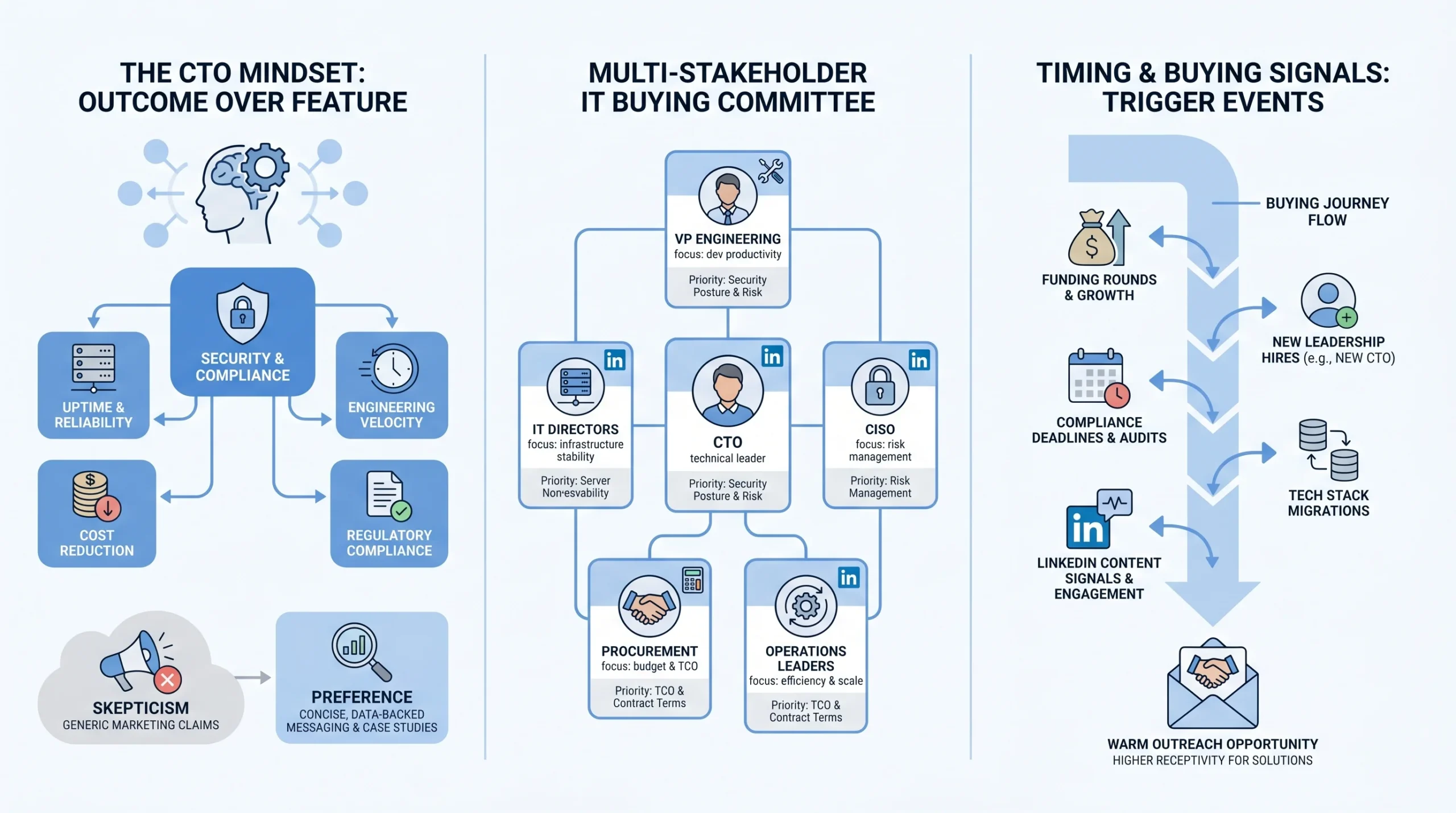
Before writing a single message, you need a clear mental model of who you are actually trying to reach. CTOs and IT buyers are not a monolith, and treating them as one is one of the most expensive mistakes software vendors make.
The CTO Mindset
The CTO’s entire professional identity is built around solving hard technical problems and protecting organizational systems from risk. This shapes how they receive outreach in a very specific way.
- They buy outcomes, not features. A CTO does not care that your platform has 400 integrations. They care whether those integrations will reduce their team’s on-call burden, eliminate a compliance gap, or shave three weeks off a migration timeline. Every message you send should lead with a business result — security improvement, cost reduction, engineering velocity, system uptime — and arrive at the feature only as supporting evidence.
- They are skeptical by professional training. A CTO has spent their career evaluating claims, reviewing architecture diagrams, and stress-testing assumptions. They approach vendor outreach the same way. Generic phrases like “industry-leading” or “best-in-class” register as noise. Specific, verifiable claims — ideally backed by metrics from companies they recognize — register as signal.
- Time is their scarcest asset. Sales reps spend, on average, only two hours per day actually selling. CTOs face the inverse problem: every hour spent with a vendor is an hour taken from engineering reviews, hiring decisions, and architectural planning. A long message signals that you don’t respect this reality. Brevity, in this context, is not laziness — it is a form of professional courtesy.
The IT Buyer Committee Reality
The idea that a CTO makes software purchasing decisions unilaterally is one of the most persistent myths in B2B sales. The data tells a very different story. Typical B2B purchases now involve teams of approximately 10 people, and this group size has stayed consistently large over multiple years. Furthermore, 72% of B2B purchases involve high-complexity buying groups spanning multiple functions — IT, operations, finance, and end users.
This has direct implications for LinkedIn outreach strategy:
- Map the full buying committee before you start. Your target account’s CTO is one node in a network that typically includes a VP of Engineering, IT Director, CISO, and Procurement lead. Each of these stakeholders has different priorities: the CTO cares about architecture and risk, the VP of Engineering cares about developer experience and velocity, and Procurement cares about TCO and contract terms.
- LinkedIn’s role is multi-stakeholder influence, not single-person conversion. The goal of your LinkedIn activity is not to convince one person — it is to become familiar and credible across the buying committee before a formal sales process begins.
- Engage each persona with a different value angle. The same message that resonates with a CTO about infrastructure resilience will feel tone-deaf to an IT Director worried about day-to-day operational load. Tailoring by role is not optional — it is the baseline.
When CTOs Are Actually Reachable
CTOs are not equally reachable at all times. There are specific windows when they are actively evaluating vendors, building their tech stack, or reconsidering existing solutions — and these windows represent dramatically higher response rates than cold outreach at a random moment.
- Post-funding rounds are the single most powerful buying signal. C-level executives at companies that just raised capital are actively selecting vendors, hiring teams, and building out their tech stack in the weeks immediately following a capital raise. A CTO at a company that closed a Series B three weeks ago is not in the same state of receptivity as one at a company with no growth catalyst.
- New leadership hires signal a re-evaluation of the existing stack. A CTO who joined six months ago is still assessing the tools they inherited and is far more open to conversations about replacement or augmentation.
- Tech stack migration and compliance deadlines create urgency that makes outreach feel timely rather than intrusive. If your software solves a problem they are actively being pressured to solve — a new regulatory requirement, a platform deprecation, a scaling crisis — your message arrives as a resource, not an interruption.
- Content signals are real-time indicators. A decision-maker posting about a specific pain point your software directly addresses is giving you explicit permission to reach out. This is the highest-quality signal available.
Your LinkedIn Profile Is a Sales Page (Not a Resume)
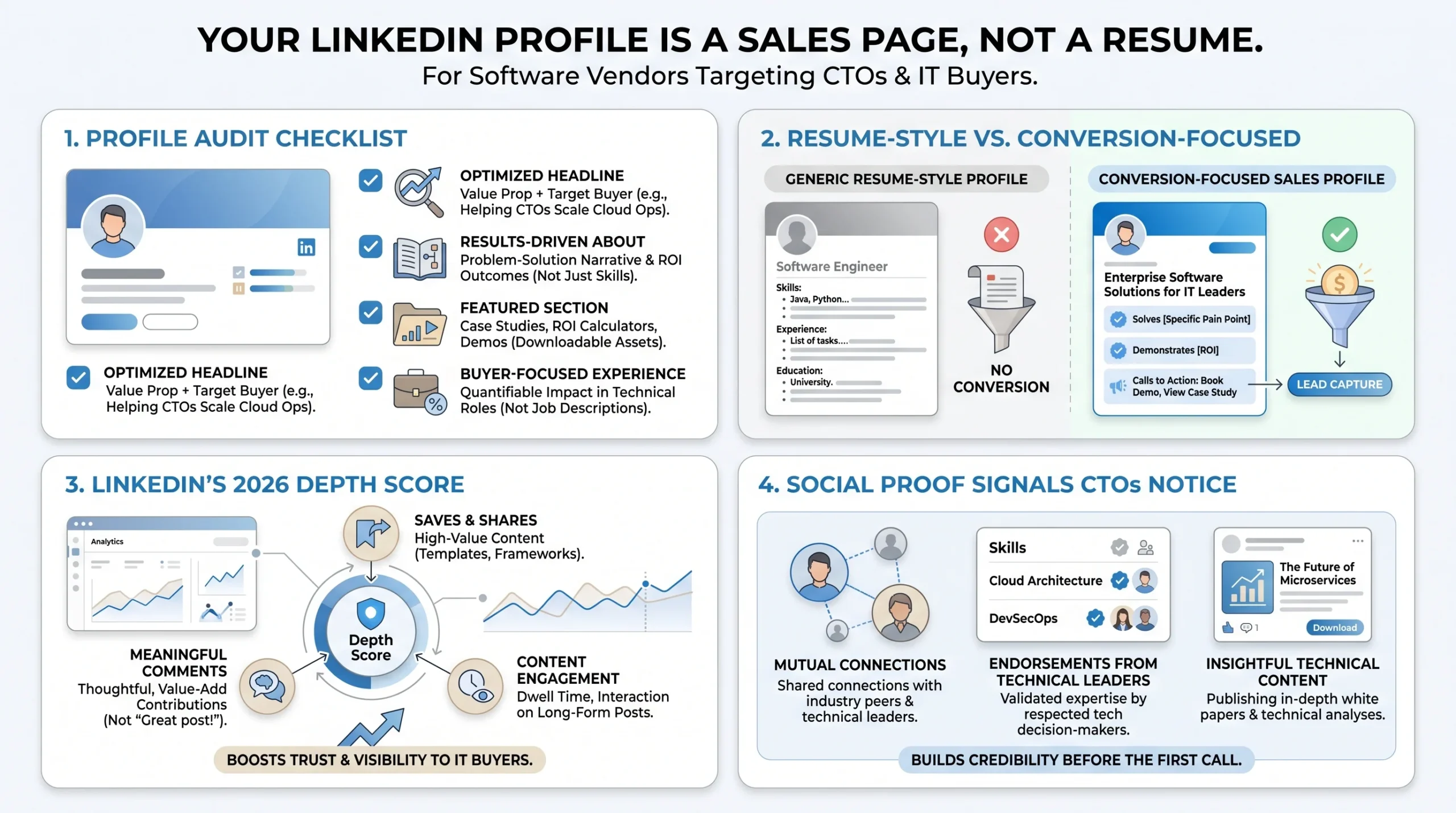
Most software vendors spend the majority of their time optimizing messages and almost no time optimizing the page that every prospect visits before deciding whether to accept a connection request or respond to a message. This is a fundamental strategic error. Your LinkedIn profile is not a resume — it is a sales page, and it is doing conversion work around the clock whether you pay attention to it or not.
The Profile Audit Checklist for Software Vendors
Every element of your profile sends a signal to a CTO or IT buyer. Here is how to audit each one with that audience in mind:
- Headline: Drop the job title entirely. Instead, write a buyer-facing value statement that speaks directly to the outcome you create. “VP of Sales at CloudStack Inc.” tells a CTO nothing about whether this connection is worth their time. “Helping CTOs at Series B SaaS companies eliminate DevOps bottlenecks — without rearchitecting their stack” tells them exactly why this person is relevant to their world.
- About section: Your About section should lead with results — specific numbers, named clients with permission, and concrete outcomes — not your career history. A CTO reviewing your profile is not interested in where you went to school or how long you have been in SaaS. They are asking one question: “Has this person solved a problem like mine before?” Answer that question in the first two sentences.
- Featured section: Use this real estate to link to a case study, ROI calculator, or technical whitepaper that is directly relevant to your ICP. A security vendor whose Featured section shows a case study about reducing mean time to detection by 63% at a FinTech company is doing conversion work passively, every time a CTO visits the profile.
- Experience section: Frame each role around what you delivered for clients, not internal responsibilities. “Led a team of 12 AEs” is an internal metric. “Helped 40+ mid-market SaaS companies reduce infrastructure costs by an average of 31% in the first year” is a buyer-relevant claim.
The 2026 Algorithm Change That Affects Outreach Visibility
In January 2026, LinkedIn overhauled how it weights content distribution. Profile completeness no longer drives reach. The platform now measures a “Depth Score,” which tracks how long people actually engage with your content, whether they save it, share it privately, or leave a substantive comment. Posts that generate quick likes or generic comments are actively deprioritized.
This matters for outreach in a direct and practical way. When a CTO visits your profile and sees that your recent posts have generated genuine, substantive discussion from credible professionals in your space, it signals that you are a real contributor to the field — not another vendor pumping out promotional content. Your content history is a trust signal that works silently in the background of every outreach interaction.
Social Proof Signals That CTOs Notice
Not all profile elements carry equal weight with technical buyers. The following three are the ones that move the needle:
- Mutual connections with credible names in their industry. A shared connection with someone the CTO trusts is worth more than any headline or About section copy. Before sending a connection request, always check for mutual connections you can reference or leverage.
- Endorsements from recognizable technical leaders. An endorsement from a well-known CTO or VP of Engineering in your space is a third-party validation that a self-written profile simply cannot replicate.
- Posts and articles that demonstrate genuine domain fluency. Not product announcements. Not company blog reposts. Original thinking about technical problems, architectural trade-offs, or industry trends — content that a CTO would find useful regardless of whether they ever became a customer.
Building Your Target List: Signal-Based Prospecting with LinkedIn Sales Navigator
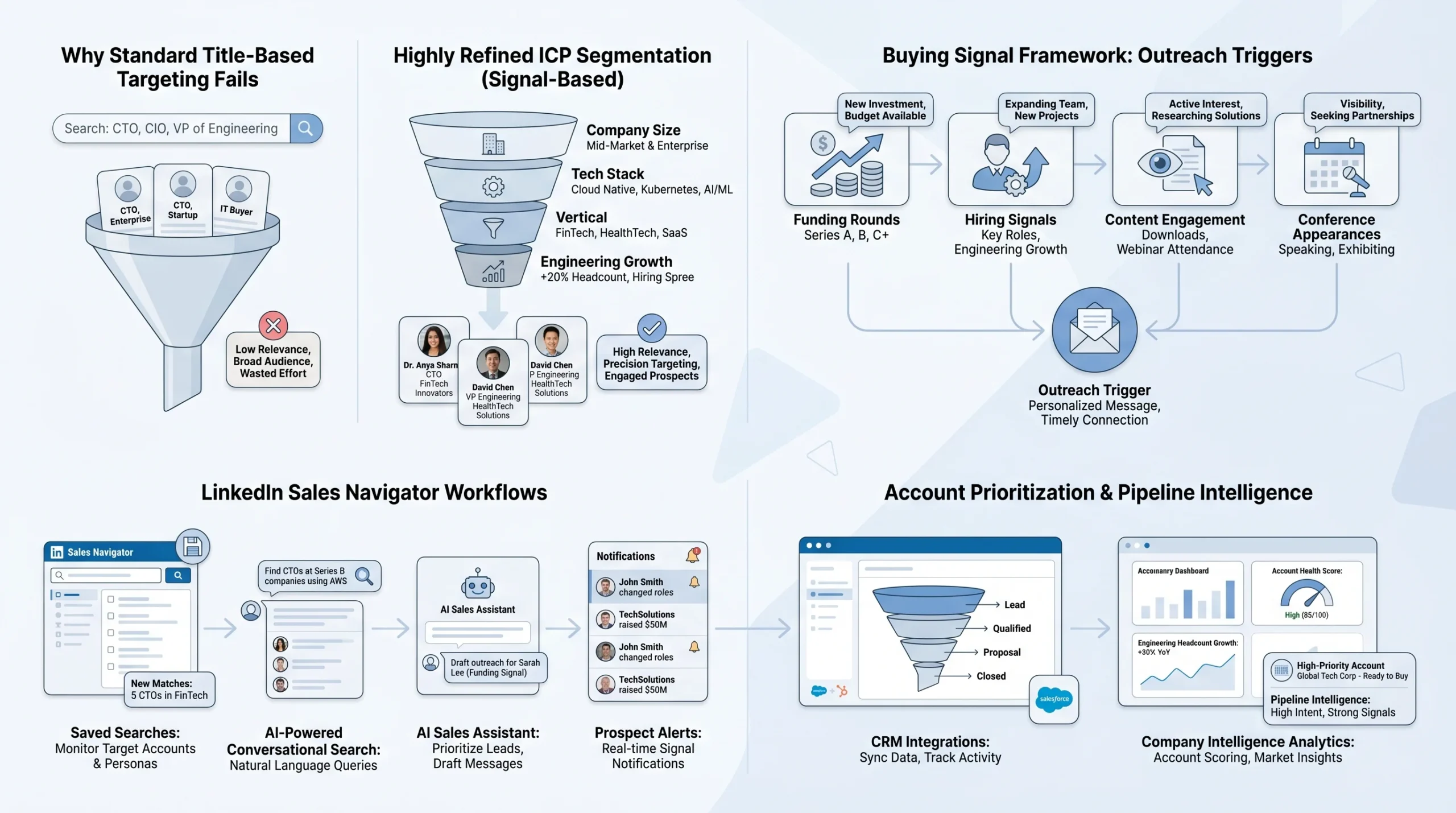
Even the best message in the world fails if it goes to the wrong person at the wrong time. Signal-based prospecting is the discipline of identifying prospects who are actively in a buying state, rather than reaching out to everyone who carries the right job title and hoping some percentage happen to be in-market.
Why Standard Search Filters Aren’t Enough
Title targeting is a blunt instrument. The title “CTO” spans a 10-person seed-stage startup to a 50,000-person enterprise. These two prospects have entirely different buying processes, budget cycles, decision timelines, and pain points. Treating them identically in your outreach is not just inefficient — it is actively harmful, because personalization is impossible when your targeting is too broad.
Build your Ideal Customer Profile (ICP) with precision across these dimensions before building any list:
- Company size: Define a specific headcount range where your software delivers its best ROI. If your product shines at 200–1,000 employees, say so explicitly in your targeting criteria.
- Tech stack signals: LinkedIn Sales Navigator allows filtering by technology used. If your product integrates with Snowflake or is built for AWS environments, prioritize accounts that already use those platforms.
- Vertical specificity: A cybersecurity vendor has very different conversations with a FinTech CTO than a retail IT Director. Specialize your list and your messaging by vertical.
- Engineering headcount growth: A company that has grown its engineering team by 40% in six months is almost certainly experiencing infrastructure pain. This is a buying signal hiding in public data.
The Buying Signal Framework
The shift from title-based to signal-based prospecting is the single most important tactical change a software vendor can make to their LinkedIn outreach in 2026. High-intent signals to watch for include: a prospect commenting on a competitor’s post, a company announcing a new funding round, a decision-maker posting about a specific pain point your software solves, or a target account hiring for a new leadership role. These are your outreach triggers.
Here is how to operationalize each signal type:
- Funding signals: Use Sales Navigator’s “Recent funding” filter combined with third-party tools like Crunchbase to identify accounts that have raised capital in the past 30–60 days. This is your highest-quality signal because it combines budget availability with active vendor selection.
- Hiring signals: A CTO posting a job for a VP of Engineering, a Head of Infrastructure, or a Platform Lead is signaling a scaling challenge. Your outreach should speak directly to the pain that scaling creates — not to your product’s feature set.
- Content signals: When a prospect engages publicly with competitor thought leadership — liking a post, leaving a comment, or sharing an article — they are demonstrating active interest in that problem space. This is your invitation to enter the conversation.
- Conference signals: A CTO speaking at AWS re:Invent or KubeCon has elevated their profile and is more open to peer-level conversations than at any other time of year. Reference the talk in your outreach — it shows genuine attention.
The 2026 Sales Navigator AI Features
LinkedIn made several significant platform changes in early 2026 that directly affect how software vendors should build and manage their prospect lists.
- AI-powered conversational search launched in January 2026, overhauling how users find prospects inside Sales Navigator. Instead of manually building Boolean search strings, users can now describe their ICP in natural language and the platform generates a refined prospect list. This dramatically accelerates list-building and improves targeting precision.
- AI Sales Assistant inside Sales Navigator: LinkedIn launched an AI Sales Assistant directly inside Sales Navigator to help manage prospecting workflows and outreach sequencing. The focus is on reducing the admin load on SDRs working through large lists and multi-touch follow-ups.
- Company Intelligence API: LinkedIn’s Company Intelligence API connects LinkedIn engagement data to CRM outcomes through certified partners. In February 2026, early beta results showed a 287% increase in companies reached, 75% more marketing qualified leads, 96% more sales qualified leads, and a 43% drop in acquisition costs. For account-based outreach, this level of pipeline visibility changes how you prioritize which accounts to go after.
The practical implication: set up saved search alerts inside Sales Navigator for your exact ICP so you are notified the moment a new signal appears. The first vendor to reach a newly funded CTO has a structural advantage over every vendor who reaches them three months later.
The Pre-Outreach Warm-Up: Become a Familiar Face Before the First Message
This is the step that the overwhelming majority of software vendors skip. It is also the step that most clearly separates vendors with high response rates from vendors who blame their tools, their lists, or their market. The pre-outreach warm-up is not a nice-to-have — it is the mechanism that determines whether your connection request gets accepted or ignored.
The Content-First Authority Strategy
The data on this is unambiguous. Inbound outreach — where a prospect messages you after consuming your content — converts at 14.6%. Traditional outbound outreach converts at just 1.7%. That is not a marginal difference. That is a near-nine-times performance gap driven entirely by the presence or absence of pre-existing credibility.
The goal of a content-first authority strategy is simple: when your connection request arrives in a CTO’s inbox, they already recognize your name. They have seen your thinking. They have formed a view that you are someone worth talking to. And so the connection request is not an intrusion from a stranger — it is an expected next step from a familiar professional.
- Post consistently on topics that live at the intersection of your buyer’s world and your domain expertise. If you sell cloud cost optimization software, write about FinOps principles, the real cost of idle compute, and how engineering teams can build cost-awareness into their development culture. Do not write about your product. Write about the problem.
- Use LinkedIn’s Depth Score algorithm to your advantage. Because LinkedIn now prioritizes content that generates substantive comments and dwell time over content that generates quick likes, your goal is depth of engagement — not breadth. One post that sparks a five-comment technical discussion with credible practitioners beats ten posts that get 50 generic thumbs-ups.
- Frequency matters, but consistency matters more. Companies posting at least once per week see two times higher engagement. Establish a sustainable cadence and maintain it. Three high-quality posts per week consistently outperforms five posts in a burst followed by three weeks of silence.
Strategic Engagement Before You Connect
Posting content is only half of the pre-warm-up strategy. Active engagement with your target prospects’ content is equally important. Like their posts, leave thoughtful comments, and be visible before your connection request arrives — a prospect who recognizes your name is far more likely to accept.
The distinction between a “thoughtful comment” and a generic one is significant:
- Generic comment: “Great post! Really resonates with what we’re seeing in the market.”
- Thoughtful comment: “The point about observability tooling often preceding infrastructure incidents by 48–72 hours aligns with what the Honeycomb team published last quarter. The challenge is getting engineering teams to act on those signals without creating alert fatigue. Have you experimented with tiered severity thresholds?”
The first comment could have been written by anyone. The second one demonstrates domain knowledge, references a credible third party, and adds something to the conversation. Over 70% of B2B buyers consume content and read comments before accepting a connection request. Your comment section is a live audition — it is showing every prospect who reviews your profile what kind of professional you are before you ever send them a message.
The 90-Day Passive Nurture Effect
There is a compounding dimension to content and engagement activity that most vendors underestimate because it is invisible in the short term. A 90-day repeated exposure to an individual’s content on the LinkedIn feed boosts purchase intent by 47%. This means the consistent content and commenting activity you do in month one is not paying off in week two — it is paying off in months three and four, when your connection requests start arriving with dramatically higher acceptance rates and your outreach messages land with dramatically higher response rates.
The strategic implication is to start before you need results. If your Q3 pipeline goal requires booked meetings in July, your content and engagement program needs to start in April. The vendors who understand this compounding effect build sustainable pipelines. The vendors who only engage when they need pipeline experience the feast-and-famine cycle that characterizes most B2B outreach programs.
Crafting LinkedIn Messages That CTOs Actually Respond To
Getting a CTO’s attention through content and engagement is the prerequisite. Keeping it through a well-constructed message sequence is the conversion mechanism. Most vendors who have done the pre-warm-up work correctly then lose the opportunity by defaulting to message formats that were designed for a different medium and a different era.
The Core Principles of High-Converting Outreach Copy
Before looking at specific templates, it is worth establishing the principles that separate messages CTOs respond to from messages they delete:
- Lead with their world, not your product. The opening sentence of every message should be about a problem, trend, challenge, or signal in their world — not about your company’s founding story or product capabilities. A message that opens with “I noticed your engineering team has grown 40% in the last six months” is immediately more relevant than one that opens with “We’re a Series A-funded DevOps platform.”
- One clear ask per message. Never bundle the pitch with the request for a meeting with an offer for a free trial in the same message. Each message should have exactly one action you want the prospect to take. Stacking asks creates cognitive load that results in the default action: no response.
- Keep messages under 80 words. Busy technical executives are more likely to reply to a concise question from their mobile devices. Most LinkedIn messages are now read on mobile, where long-form text becomes a wall of characters that triggers an immediate scroll-past. A message that can be read in 15 seconds and responded to in 30 seconds has a dramatically higher chance of generating a reply than one that requires sitting down at a laptop.
- Reference a specific signal. The post they wrote, the role they are hiring for, the funding round their company just closed — something that proves this message was written for them specifically, not pasted from a template with a name-merge field.
The Three-Message Framework (Connection → Value → Ask)
This framework is the structural backbone of all effective LinkedIn outreach for technical buyers. Each message has a specific purpose, a specific length constraint, and a specific timing requirement.
Message 1 — The Connection Request (under 300 characters):
The connection request message has one job: give the prospect a credible, non-threatening reason to accept. There is no pitch here. There is no ask. There is a single, relevant observation that signals you are not a stranger and that this connection could be valuable.
Example for a cloud security vendor targeting a FinTech CTO:
“Hi [Name] — saw your comment on the post about zero-trust architecture last week. I work with FinTech engineering teams on exactly that problem. Thought it would be worth connecting.”
This message works because it references a specific behavior (a comment they made), establishes relevance without selling, and proposes a connection — not a meeting.
Message 2 — The Value Drop (sent 3–5 days after acceptance):
Once the connection is accepted, wait three to five days before sending your first direct message. Sending immediately after acceptance signals that the connection request was a pretense — the sales pitch was always coming. The delay signals patience and confidence.
The second message’s job is to deliver genuine value with no strings attached. This can be a benchmark report relevant to their industry, a specific case study from a company similar to theirs, or a non-promotional insight that demonstrates you understand their world at a peer level.
Example for a DevOps platform vendor targeting a VP of Engineering at a Series B SaaS company:
“Hi [Name] — we recently benchmarked deployment frequency across 80 Series B engineering teams. The ones with the highest release velocity shared three specific CI/CD configurations that most teams skip. Happy to send over the summary if useful — no strings attached.”
This message works because it leads with something the recipient can use, names a specific peer group they belong to, and makes a soft, low-commitment offer.
Message 3 — The Soft Ask (7–10 days later):
The third message is where the ask lives. But notice: by the time this message arrives, the prospect has already seen your content, engaged with your thinking, accepted your connection, and received a piece of genuine value. The ask, therefore, arrives in a context of accumulated credibility — not cold.
Example:
“Hi [Name] — glad the benchmark was useful. We work with a few FinTech teams on exactly the pipeline fragmentation issue you mentioned last month. Would a 15-minute call be worth it to see if there’s a fit? Happy to share what we’ve seen work.”
What to Never Say to a CTO (With Examples)
Understanding what to avoid is as important as understanding what works. The following patterns reliably kill response rates with technical buyers:
- “I wanted to reach out because…” — This is passive filler that delays the actual message. CTOs are scanning for signal. Start with it immediately.
- Leading with company awards or history — “We’ve been recognized by Gartner as a Leader for three consecutive years” may matter in a sales deck. In a cold message, it reads as insecurity masquerading as credibility.
- “Quick question” followed by a paragraph — If your question requires a paragraph of context to make sense, it is not a quick question. Set up the context first, ask the question second, and keep both under 80 words total.
- Vague value propositions — “Our platform helps companies improve efficiency” is not a value proposition. It is a placeholder for a value proposition. Be specific: “We reduce mean time to recovery by an average of 47% for engineering teams running microservices on Kubernetes.”
InMail vs. Connection Message: When to Use Which
Both mechanisms have legitimate strategic roles, and choosing between them depends on where the prospect sits in your warm-up sequence.
LinkedIn InMail achieves response rates between 18–25%, while traditional cold email struggles to break 1–5%. For SaaS and Software specifically, InMail response rates average 4.77% — the lowest of any industry — because the target audience receives overwhelming volumes of automated outreach. This reinforces the imperative of the pre-warm-up strategy: InMail without prior engagement is fighting against structural inbox saturation.
- Use InMail for high-value accounts where you cannot reach organically due to second- or third-degree distance, where the prospect’s connection settings are restrictive, or where you are running an account-based campaign at scale and need to reach multiple stakeholders simultaneously.
- Use connection requests when you have pre-warmed the prospect through content engagement, have a mutual connection, or can reference a specific trigger event that makes the outreach feel timely.
- Use Sponsored InMail for account-based campaigns targeting defined lists at scale. LinkedIn Event Ads, as of 2026, now drive 31 times viewership compared to organic event posts alone, making them particularly effective for warming audiences before a direct outreach sequence begins.
Multi-Channel Sequencing: LinkedIn + Email + Intent Data
LinkedIn outreach does not operate in isolation. The most effective software vendor campaigns in 2026 treat LinkedIn as one layer in a coordinated multi-channel sequence — not as a standalone channel that either works or doesn’t.
Why LinkedIn Alone Isn’t Enough
The data here is decisive. Sequences that combine LinkedIn and email see a two times higher response rate than email-only campaigns, because “social proximity” — the trust built through shared connections or professional engagement — warms the prospect before you ever send a direct pitch. Omnichannel outreach that combines email with a LinkedIn touchpoint and a targeted ad impression sees a 287% lift in conversion compared to email-only campaigns.
The mechanism behind this lift is straightforward: a CTO who has seen your LinkedIn content, connected with you on the platform, and then receives a personalized email is not encountering a stranger — they are hearing again from a familiar professional across a second channel. The cumulative effect of multiple touchpoints across multiple channels creates a sense of familiarity that a single-channel campaign cannot replicate.
A Sample 8-Touch Sequence for IT Buyers
The following sequence reflects the real-world benchmark that booking a first meeting requires an average of 8 touchpoints, with top performers often hitting that mark in 5. Most vendors abandon the sequence after one or two touchpoints, which means they are giving up precisely when the relationship is beginning to develop.
- Touch 1 — Follow + engage with content (Day 1): Follow the prospect’s company page and leave a substantive comment on their most recent relevant post. This is purely a visibility play — no connection request yet.
- Touch 2 — Connection request with personalized note (Day 3): Reference the content you engaged with or a specific signal. Keep the note under 300 characters and make no ask.
- Touch 3 — Value message post-connection (Day 6): Send the second message in the three-message framework — a piece of genuine value with no explicit ask attached.
- Touch 4 — Cold email referencing LinkedIn (Day 8): Send a brief email that acknowledges the LinkedIn connection and reinforces the value offer with a slightly different framing. Subject line should be plain-text and reference their company or a specific challenge.
- Touch 5 — LinkedIn comment on their recent post (Day 12): Re-engage publicly. If they have posted anything in the interim, leave a thoughtful comment. This maintains visibility without direct messaging pressure.
- Touch 6 — Follow-up email with a case study (Day 15): Send a second email that leads with a case study from a company in their vertical, headcount range, or tech stack — whichever is most relevant to their specific situation.
- Touch 7 — LinkedIn soft ask message (Day 18): Send the third message in the framework — the soft ask, framed as a natural next step given everything that has come before.
- Touch 8 — Final breakup email (Day 22): Send a short, direct email acknowledging that the timing may not be right and offering to reconnect in the future. This message often generates responses from prospects who have been following the sequence passively.
Account-Based Targeting: Going Wide Within a Single Account
In enterprise deals, winning a single stakeholder’s interest is rarely sufficient. The goal of account-based targeting on LinkedIn is to build familiarity across the full buying committee simultaneously.
- Map all relevant stakeholders within your target account using LinkedIn’s Sales Navigator org-chart features: CTO, VP Engineering, IT Director, CISO, and Procurement lead represent the core buying committee for most enterprise software deals.
- Engage different personas with different value angles simultaneously. Your CTO content engagement should emphasize architectural risk and scalability. Your messaging to the VP of Engineering should focus on developer experience and velocity. Your outreach to the IT Director should address operational stability and support burden.
- Over 80% of B2B buyers involve four or more stakeholders in technology purchasing decisions. This means a deal that starts with a single CTO conversation will almost certainly require additional stakeholder conversations before it can progress. Building multi-threaded familiarity across an account before the formal sales process begins dramatically reduces the friction of those conversations when they happen.
Tools Stack for Software Vendors in 2026
The right tools amplify an intelligent strategy. The wrong tools give a false sense of activity while undermining account health and brand reputation. This section provides a practical, category-by-category breakdown of the tools that genuinely support signal-based, authority-first LinkedIn outreach.
Prospecting & Signal Detection
The foundation of every effective outreach campaign is the quality of the underlying prospect list and the accuracy of the buying signals that trigger outreach.
- LinkedIn Sales Navigator remains the mandatory foundation layer. Its saved search alert functionality, AI-powered conversational search, and Company Intelligence API integrations make it the single most important tool in any software vendor’s outreach stack. There is no effective substitute for the platform-native data it provides.
- Crunchbase and Fundraise Insider serve as the funding signal layer. Both platforms provide near-real-time alerts when target accounts close funding rounds, allowing your outreach to reach newly funded CTOs in the first two to four weeks after a capital event — when they are most actively building their stack.
- Bombora and G2 Buyer Intent surface accounts that are actively researching solution categories relevant to your product, based on content consumption patterns across the web. These signals indicate in-market behavior before a prospect has engaged with you or any of your competitors on LinkedIn.
Outreach Sequencing & Automation
The safest and most effective way to use automation is not to automate messaging to cold prospects, but to automate your visibility so prospects come to you. This principle should guide every tool decision in this category.
- Expandi, Reply.io, and Lemlist are the three most widely used platforms for LinkedIn outreach sequencing in 2026. Each supports multi-channel sequences that combine LinkedIn touchpoints with email follow-ups in a single workflow. All three provide safety features — gradual ramp-up limits, randomized send times, and human behavior simulation — that reduce the risk of account restriction.
- AI SDR agents that create tailored outreach sequences and handle responses are now available in tools like Reply.io. These agents can be useful for managing high-volume prospecting lists, but they should be supervised and not fully autonomous for CTO outreach. The higher the seniority of the prospect, the more human judgment should be applied to every message.
- The critical safety rule: Never ramp from 10 connection requests per week to 150 abruptly. Increase gradually over weeks. LinkedIn’s algorithm detects sudden behavior pattern changes and treats them as automation signals. A gradual ramp — starting at 20 requests per week and increasing by 10–15 per week over a month — maintains the appearance of organic human behavior.
CRM Integration
Every LinkedIn touchpoint — connection request accepted, message sent, message replied to, comment made on a prospect’s post — should be logged in your CRM alongside email and call activity. Without this integration, you have no visibility into the cumulative multi-channel history of each prospect relationship, which makes effective follow-up impossible.
LinkedIn’s Company Intelligence API now connects LinkedIn engagement data to CRM outcomes through certified partners. This means that for teams using certified CRM integrations, LinkedIn activity data flows directly into account records — enabling sales teams to see the full picture of how a prospect has engaged with the brand across every channel before picking up the phone or drafting the next email.
Content & Visibility Tools
Content creation and amplification tools are not traditionally considered part of the “outreach stack,” but in 2026 they are inseparable from it because pre-warm-up depends on content visibility.
- LinkedIn Newsletter is one of the most underused tools available to software vendors. Subscribers receive direct notifications when a new issue is published — making it a push channel that bypasses the standard feed algorithm. For vendors selling to CTOs, a newsletter covering technical leadership topics creates a recurring touchpoint with every subscriber in the target audience.
- LinkedIn Event Ads have become dramatically more powerful following the 2026 event integration update. LinkedIn reports that Event Ads now drive 31 times viewership compared to organic event posts alone. For software vendors running webinars, product launches, or technical deep-dives for their ICP, Event Ads represent one of the most cost-effective ways to put the company in front of the exact audience they are trying to reach through outreach.
Measuring What Actually Matters: KPIs for LinkedIn Outreach Campaigns
Measuring LinkedIn outreach effectively requires resisting the pull of vanity metrics and focusing exclusively on indicators that connect to pipeline and revenue. Here are the metrics that matter, the benchmarks that define performance, and the metrics that don’t.
- Connection acceptance rate is your first filter. A rate below 20% signals a targeting or profile problem. A 30–45% connection acceptance rate is the 2026 benchmark for well-targeted outreach. Below 20% means either your ICP definition is too broad, your targeting filters are catching the wrong audience, or your profile is not credible enough to justify the accept.
- Response rate to first message is your personalization filter. A 10–25% reply rate is the 2026 benchmark for well-targeted, signal-based outreach. Below 10% indicates a messaging problem — either the value proposition is unclear, the message is too long, or the trigger event referenced is not relevant enough to the recipient.
- Reply-to-meeting conversion rate is your qualification filter. This metric tells you whether the conversations your outreach is generating are with the right people about the right problems. A high response rate paired with a low reply-to-meeting rate often indicates your messaging is attracting curiosity without surfacing genuine pain.
- The elite benchmark for managed outreach in 2026 is a 99% delivery rate and a 2.5% meeting booking rate. Achieving this requires a balanced combination of technical discipline — clean lists, safe sending behavior, verified account health — and humanized, signal-based messaging.
- Pipeline generated per LinkedIn sequence is the ultimate accountability metric. Divide total pipeline attributable to LinkedIn-originated conversations by the number of sequences run. This tells you the actual business return on your LinkedIn outreach investment and allows you to compare LinkedIn’s pipeline contribution against other channels.
What not to optimize for: connection count in isolation, profile views, post likes, and generic comment volume. These are activity indicators, not outcome indicators. An account with 15,000 connections that has never generated a qualified pipeline opportunity is not more successful than an account with 800 connections that books five meetings per month.
Compliance, Account Safety, and LinkedIn’s 2026 Rules
LinkedIn’s enforcement of its terms of service has become significantly more rigorous in 2026. Understanding the rules and building compliant habits into your outreach process is not optional — a restricted or permanently banned account erases everything you have built.
- Weekly connection request limits are dynamic, not fixed. Most accounts can safely send approximately 100 connection requests per week. High-trust accounts with strong Social Selling Index scores and acceptance rates above 40% may be able to send more. Accounts with poor acceptance rates or past restriction history may be limited to fewer. The safest approach is to keep weekly volume below 100 and monitor acceptance rate as your leading indicator of account health.
- Ramp gradually when starting a new campaign. Ramping from 10 connection requests per week to 150 looks suspicious. Increase gradually over weeks. LinkedIn’s behavior analysis systems flag sudden volume spikes as automation signals even when the outreach is manual.
- Vary your message templates. Even manual outreach can look automated if every message uses an identical structure. Rotate opening phrases, vary sentence length, and personalize beyond the prospect’s name and company. Structural variation is a signal of human authorship.
- Maintain human browsing behavior. Real LinkedIn users browse profiles before connecting, spend time reading feed content, and engage with posts before sending messages. Pure send-and-move-on activity patterns flag accounts as automated. Build browsing and engagement time into your daily LinkedIn routine — not as a performance, but as genuine platform participation.
- GDPR considerations for EU-based IT buyers add an additional compliance layer for software vendors selling into European markets. You must have a legitimate interest basis for processing the personal data of individuals you contact through LinkedIn, and you must be able to honor deletion and access requests. This means maintaining clear records of how you identified each prospect and the legal basis for outreach. When in doubt, consult a data protection specialist before scaling outreach into EU territories.
Conclusion
The thread running through every section of this guide is the same: the software vendors winning on LinkedIn in 2026 are building systems, not running campaigns. A campaign is a time-bound burst of activity. A system is a set of interconnected habits, processes, and tools that compounds value over time — and that is the only model that works in an environment where CTOs are ignoring cold messages by default and rewarding genuine familiarity with attention.
The shift from spray-and-pray volume to signal-based, authority-first outreach is not a minor tactical adjustment. It is a fundamental change in how you think about pipeline generation. Content builds trust before outreach begins. Buying signals ensure your messages arrive when receptivity is highest. Precise targeting means every touchpoint is a conversation worth having. Multi-channel sequencing creates the cumulative familiarity that converts attention into meetings. And compliant, sustainable sending behavior ensures the account health needed to run this system month after month without disruption.
Every post you publish, every comment you leave, and every warm connection you build makes the next outreach easier. The CTO who has seen your thinking for 90 days and accepted your connection two weeks ago is not the same conversation as a cold InMail to a stranger. The gap between those two conversations — in response rate, in quality of engagement, in likelihood of converting to a qualified opportunity — is the gap this guide is designed to help you close.
FAQs
Is LinkedIn still the most effective channel for reaching CTOs and IT buyers in 2026?
Yes — and by a significant margin over alternative outreach channels. LinkedIn drives 80% of all B2B leads generated from social media, and no other platform comes close for professional audience targeting. The platform’s unique advantage is its built-in professional context: when a CTO receives a message on LinkedIn, they can immediately see the sender’s professional background, mutual connections, recent content, and headline — trust signals that a cold email to a corporate inbox simply cannot replicate.
The performance data reinforces this. LinkedIn InMail achieves response rates of 18–25%, while traditional cold email struggles to break 1–5%. For SaaS and software specifically, the response rate is lower (4.77%) due to inbox saturation — but this reflects the importance of the pre-warm-up strategy described in the blog, not a failure of the channel itself. Vendors who engage with prospects’ content before reaching out, build visible authority, and use signal-based targeting consistently outperform cold-outreach benchmarks across every channel.
The short answer: for software vendors selling to technical decision-makers in 2026, LinkedIn is not optional. It is the operating environment where CTOs form opinions, consume relevant content, and decide who is worth their attention before any formal sales process begins.
How many LinkedIn connection requests can a software vendor safely send per week in 2026?
LinkedIn’s weekly connection request limit in 2026 is dynamic rather than fixed, and it is determined by your account’s trust signals — specifically your Social Selling Index (SSI) score and your historical acceptance rate. Most accounts can safely send approximately 100 connection requests per week. High-trust accounts with SSI scores above 65 and acceptance rates consistently above 40% may be able to send more. Accounts with low acceptance rates or any prior restriction history may be limited to fewer.
The critical variable is not the absolute number — it is the ratio of accepted to ignored requests. Sales representatives who send fewer than 25 highly targeted, personalized connection requests per week are nearly twice as likely to achieve acceptance rates of 40% or higher compared to high-volume senders. This is the “Volume Tax”: when a high percentage of your requests are ignored, LinkedIn’s algorithm treats the account as a spam risk and throttles future visibility accordingly.
The safe approach for software vendors is to begin any new campaign at a conservative volume — around 20 requests per week — and increase by 10 to 15 requests per week over the following month. This gradual ramp signals organic human behavior and protects account health as volume scales. Jumping from 10 to 150 requests in a single week will trigger LinkedIn’s detection systems regardless of the quality of the outreach.
What is the difference between a connection message and an InMail, and when should software vendors use each?
These are two distinct outreach mechanisms with different requirements, costs, and strategic applications:
Connection messages are free and are sent alongside a connection request to prospects you are not yet connected with. They are limited to 300 characters. Connection messages work best when you have pre-warmed the prospect through content engagement, have a mutual connection to reference, or can cite a specific trigger event — such as a funding announcement or a post they recently published — that makes the outreach feel timely and relevant. Because there is no monetary cost, they are appropriate for high-volume, well-targeted campaigns.
InMail is a premium paid feature available through LinkedIn Sales Navigator and allows you to message members outside your network without a prior connection. InMail achieves open rates of 50–85%, compared to cold email’s average of approximately 27%. Sales Navigator Core includes 50 InMail credits per month, with unused credits rolling over to a maximum of 150. InMail is most effective for high-priority accounts where organic connection is not practical, for prospects whose connection settings are restricted, or for multi-stakeholder account-based campaigns where you need simultaneous access to several decision-makers.
The practical rule for software vendors: use connection messages for prospects you have pre-warmed through content engagement, and use InMail for high-value accounts where direct access is required and the relationship has not yet been established through organic activity. Messages under 400 characters receive 22% higher response rates regardless of which mechanism you use — keep both formats concise.
How long should a LinkedIn message to a CTO actually be?
Short — considerably shorter than most software vendors default to. Messages under 400 characters receive 22% higher response rates than longer ones, with 50–70 words representing the optimal range for InMail. The reason is practical: the majority of LinkedIn messages are now read on mobile devices, where long-form text becomes a wall of characters that triggers an immediate scroll-past. A message that can be read in 15 seconds and responded to in 30 seconds has a dramatically higher chance of generating a reply than one that requires the recipient to sit down at a laptop.
The structure of a high-performing short message to a CTO follows three components: a single sentence establishing why this message is relevant to them specifically (referencing a post, a hiring signal, or a shared connection), one sentence introducing the value angle without pitching a product, and one clear, low-friction ask. The ask should never be a demo request on the first contact. A question they will want to answer, an offer to share a useful resource, or a soft check-in on whether a topic is relevant to their current priorities — these are appropriate first asks.
The discipline required here is resisting the temptation to include everything in a single message. One goal per message. One ask per message. Everything else belongs in a follow-up.
How many follow-up messages should a software vendor send before moving on?
More than most vendors currently send. Booking a first meeting requires an average of 8 touchpoints, with top-performing sequences often achieving this in 5. Yet 48% of sales representatives never send a second message after their first contact goes unanswered, abandoning nearly half of all possible responses. The data is consistent: follow-up messages account for 50–70% of total responses in LinkedIn outreach campaigns. Prospects often reply after the second or third touchpoint, not the first.
The key constraint is that each follow-up must add new value — not repeat the previous message or include a generic “just checking in” note. A case study relevant to the prospect’s industry, a benchmark report, a specific insight about a challenge they mentioned in a recent post, or a reference to a piece of news about their company — these are legitimate reasons to send a follow-up. A bare acknowledgment that you are still waiting for a reply is not.
The eight-touch sequence outlined in the blog is designed so that every touchpoint delivers something the prospect finds useful regardless of whether they ever become a customer. This is the design principle that separates persistent outreach from harassment: value at every step.
Do I need LinkedIn Sales Navigator to reach CTOs effectively, or can I use the free version?
LinkedIn Sales Navigator is not strictly required, but it represents a significant performance advantage for software vendors running systematic outreach to CTOs and IT buyers. The free version of LinkedIn limits search filters, restricts how many profiles you can view per month through the “commercial use limit,” and does not provide real-time alerts when prospects change jobs, post content, or meet your saved search criteria. For a vendor sending 20–30 highly targeted connection requests per week, the free version may be sufficient. For anyone running a structured pipeline generation program, the limitations quickly become binding.
Sales Navigator Core costs $119.99 per month (or $1,079.88 annually, a 25% saving) as of March 2026. It includes 50+ advanced search filters, 50 InMail credits per month, saved search alerts, and real-time notifications when prospects change jobs or are mentioned in the news — all critical inputs to the signal-based targeting framework described in this blog.
According to a Total Economic Impact study by Forrester Consulting, LinkedIn Sales Navigator delivers a 312% ROI over three years and pays for itself in less than six months for teams using it systematically. That ROI, however, is contingent on deal size: Sales Navigator justifies its cost most clearly when your average contract value exceeds $6,000 and your sales cycle is 60 days or longer. For software vendors selling enterprise or mid-market solutions to CTOs — where average deal values typically exceed this threshold significantly — the investment is well justified. For teams with smaller deal sizes, a combination of the free LinkedIn account and a lower-cost prospecting tool may deliver better returns.
What are the most important buying signals to watch for before reaching out to a CTO on LinkedIn?
Buying signals are behavioral or situational indicators that a prospect is in an active or near-active purchasing state. Reaching out when a signal is present dramatically increases response rates because your message arrives as a timely resource rather than a random interruption. The highest-value signals for software vendors targeting CTOs are:
- Recent funding rounds: C-level executives at companies that have just raised capital are actively selecting vendors, hiring teams, and building out their tech stack. A CTO at a company that closed a Series B three weeks ago is in a fundamentally different state of receptivity than one at a company with no growth catalyst. Crunchbase, Fundraise Insider, and LinkedIn’s own funding alerts in Sales Navigator all surface this signal.
- New CTO or senior engineering hire: A CTO who joined a company six months ago is still evaluating the inherited tech stack and is far more open to vendor conversations than a long-tenured CTO who has already locked in their architecture decisions.
- Engineering team headcount growth: A company that has grown its engineering team by 30–40% in the past six months is almost certainly experiencing infrastructure, security, or tooling pain. This signal is visible through LinkedIn’s hiring activity data.
- A prospect posting publicly about a problem your software solves: This is explicit intent. When a CTO writes a post about observability challenges, DevOps bottlenecks, or cloud cost overruns — and your product addresses exactly that problem — your outreach has implicit permission to engage.
- Engagement with competitor thought leadership: When a prospect publicly likes, comments on, or shares content from a company in your competitive space, they are demonstrating active interest in that problem domain. This is your opening to enter the conversation from a position of genuine relevance.
Should I send the same LinkedIn message to a CTO and a VP of Engineering at the same company?
No — and treating them as interchangeable is one of the most common mistakes in account-based LinkedIn outreach. While both roles may be part of the same buying committee for an enterprise software decision, their priorities, success metrics, and day-to-day concerns are meaningfully different, and the same message will resonate with one while alienating the other.
A CTO’s primary concerns in 2026 center on architectural risk, long-term scalability, security posture, and the total cost of ownership of the technology stack. They are evaluating whether your software fits into a multi-year infrastructure strategy. Your message to a CTO should address business outcomes, risk reduction, and strategic alignment.
A VP of Engineering cares about what happens to their team on a daily basis — developer experience, release velocity, mean time to recovery when things break, and the operational burden your software either adds to or removes from their engineers. Your message to a VP of Engineering should address these practical, team-level concerns with specificity.
Typical B2B purchases now involve approximately 10 stakeholders, with 72% spanning multiple functions including IT, operations, finance, and end users. This means your account-based outreach program needs to treat each stakeholder as a distinct persona with a distinct message — not a single unified pitch distributed across multiple titles.