


Two sales reps. Same company. Same product. Same territory. One gets four or five inbound messages from warm prospects every single week. The other gets none.
The difference has nothing to do with their product knowledge, their pitch deck, or their closing skills. It has everything to do with their LinkedIn profile.
Most sales reps treat their LinkedIn profile the same way they treat their business card — something you hand over when asked and forget about the rest of the time. It sits there, static, doing absolutely nothing while opportunities walk past it every day.
The reps who consistently generate inbound leads on LinkedIn have figured out something their peers haven’t: your profile is not a resume. It’s the first sales presentation you give to every prospect who looks you up. And in 2026, every prospect looks you up.
B2B buyers research sales reps before accepting calls. Decision-makers scan your profile before accepting connection requests. Prospects read your posts before deciding whether to respond to your outreach. Your LinkedIn profile is working for you or against you twenty-four hours a day — the only question is which one.
This guide gives you a complete, step-by-step framework for building a LinkedIn profile for sales reps that functions as an active lead magnet — attracting, educating, and qualifying prospects before you ever send a single message.
How LinkedIn Actually Works as a Lead Generation Channel for Sales Reps
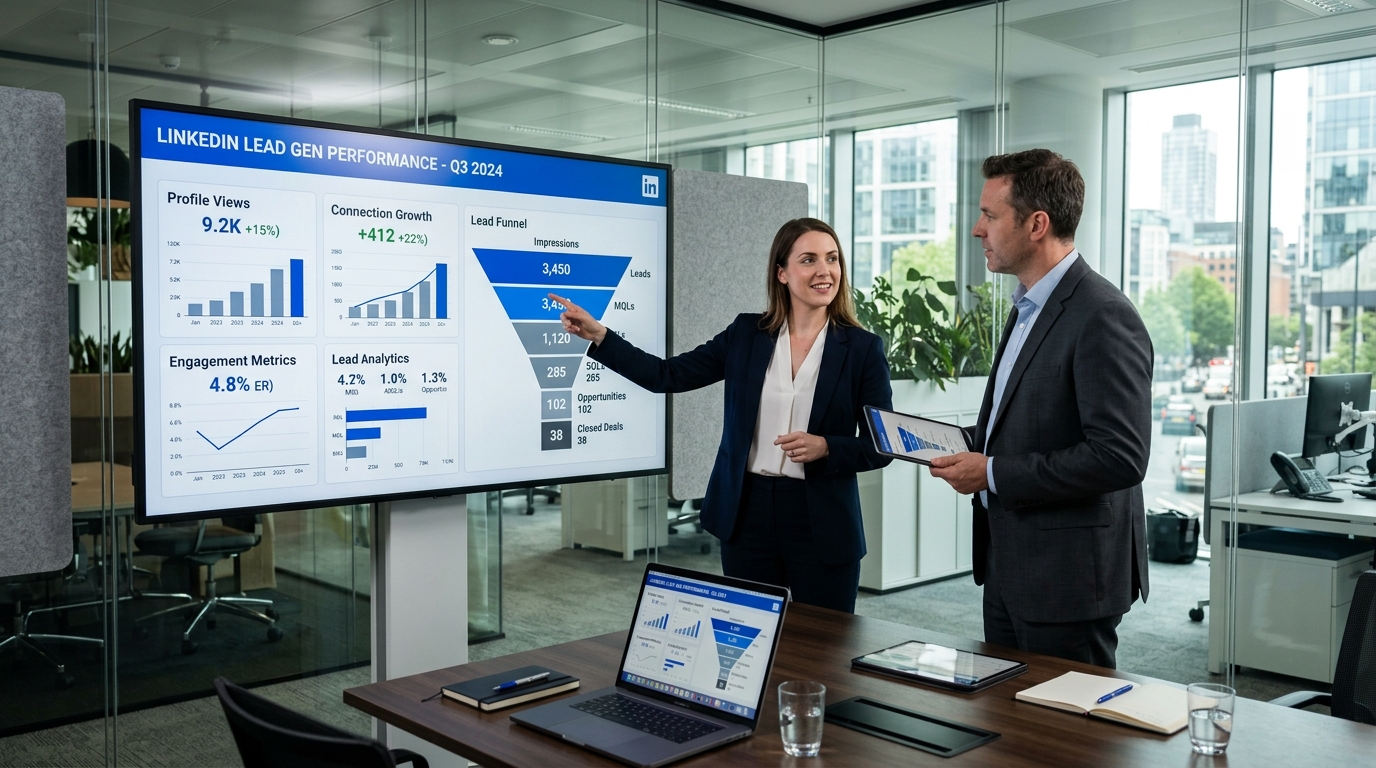
Before getting into the setup, it helps to understand the mechanics of why a profile-as-lead-magnet approach works.
LinkedIn is not a job board with a social feed attached. For B2B sales professionals, it’s the single highest-leverage prospecting channel available — and your profile is the center of gravity for everything that happens on it. Every comment you leave, every post you publish, every connection request you send directs traffic back to one place: your profile page.
Here’s how the platform’s lead generation mechanics actually work:
| Mechanism | How It Generates Leads |
|---|---|
| Search visibility | Prospects and buyers search for expertise a keyword-rich profile gets found |
| Content distribution | Posts reach your network and beyond, warming prospects before you message them |
| Profile visits | Every touchpoint drives profile visits; your profile must convert that attention |
| Social proof | Recommendations and endorsements build trust before a conversation starts |
| Featured section | Acts as a landing page housing lead magnets, resources, and CTAs |
| Activity signals | Regular posting and engagement raise your visibility in your network’s feed |
The concept of a lead magnet — traditionally a guide, checklist, or template offered in exchange for contact information — applies directly to your LinkedIn profile. The difference is scale. When your entire profile is optimized — your headline, your About section, your Featured section, your content — it becomes the lead magnet. Prospects who visit your profile after seeing your content and find something credible, specific, and value-focused are warmer than any cold prospect you’ll ever contact manually.
LinkedIn also tracks your effectiveness through something called the Social Selling Index (SSI) — a proprietary score from 0 to 100 that measures four things: how well you’ve established your professional brand, how effectively you find the right people, how consistently you engage with insights, and how well you build relationships. Sales reps with SSI scores above 70 consistently appear higher in LinkedIn search results and receive more profile views. Profile optimization directly improves your SSI score — every section you improve is a signal to the algorithm that you’re an active, credible professional worth surfacing.
5 Proven Ways to Optimize Your LinkedIn Profile for Sales Reps to Attract More Leads

Your LinkedIn profile can be much more than an online resume; it can become a powerful tool for generating consistent B2B leads. In this guide, we’ll explore five proven ways to optimize your LinkedIn Profile for Sales Reps so it attracts the right prospects, builds credibility, and encourages potential clients to start conversations. From crafting a compelling headline to showcasing social proof and clear value propositions, these strategies will help sales professionals turn profile views into real sales opportunities.
Shape Your Lead Magnet Offer
The first and most important strategic decision you’ll make is this: what do you offer profile visitors that’s genuinely valuable before they know what you sell?
This is the foundational question most sales reps skip. They think about their product. They don’t think about what they can give away for free that demonstrates they understand the problems their buyer faces every day.
The best lead magnets for a LinkedIn profile for sales reps are specific enough to feel tailored, practical enough to use immediately, and closely enough adjacent to what you sell that the right people self-select to engage with them.
| Lead Magnet Type | Example | Best For |
|---|---|---|
| Practical guide | “10-step playbook for [ICP’s specific challenge]” | Thought leadership positioning |
| Checklist | “Pre-sales audit checklist for [relevant process]” | Problem-aware prospects |
| Template | “[Specific document type] template for [ICP role]” | Practitioners in your ICP |
| Data report | “Benchmark report: [industry metric]” | Data-driven buyers |
| Case study | “How [Company] achieved [result] using [approach]” | Late-stage consideration |
| Video resource | “15-minute walkthrough of [relevant topic]” | Busy executives |
Your lead magnet should be so relevant to your ICP’s daily professional challenges that seeing it makes them think “I need this” — before they’ve read a single line about what you actually sell. LinkedIn’s Featured section is where you house it. It’s the native lead magnet showcase, and it appears prominently on every profile.
Choose the Right Topic
The topic you choose for your lead magnet and your content determines the quality of prospects you attract. Get this wrong and you’ll build an audience that doesn’t match your ICP. Get it right and the people who engage with your content are pre-qualified buyers before you’ve said a word about your solution.
Three criteria matter:
- It must be something your ICP cares about deeply — not something you find interesting or something your product team finds compelling
- It must be adjacent to your product’s value without being a product pitch — educational, not promotional
- It must be specific enough to signal genuine expertise — “sales tips” signals nothing; “how Series B SaaS ops teams reduce manual reporting without adding headcount” signals everything
A useful topic selection framework:
| Question | What It Reveals |
|---|---|
| What does your ICP Google at 11pm when they can’t sleep? | Their deepest professional anxieties |
| What questions appear on every discovery call? | The gaps between their knowledge and yours |
| What does your product solve that they didn’t know was solvable? | Your unique education opportunity |
| What does your ICP struggle with that your competitors ignore? | Your differentiation angle |
Practical exercise: pull your last 20 discovery call notes and identify the three questions that appear most frequently. Those are your content topics.
Promote Your Lead Magnets the Right Way
Creating the lead magnet is half the work. The other half is making sure the right people see it through consistent, strategic promotion.
Promotion channels that actually work:
- Post content that references the resource without requiring a click to get value. The post should stand completely alone as useful content. The lead magnet is the depth option for people who want to go further.
- Connection requests that reference a piece of your content as the reason for connecting — not a cold pitch.
- Comments on ICP-adjacent posts that naturally reference your expertise area and build familiarity before you connect.
- A LinkedIn Outreach tool or InMail campaign that offers the resource as the opening value rather than a product pitch. Leading with your guide or checklist in a direct message converts significantly better than leading with a request for a meeting.
- Email signature linking to your LinkedIn Featured section — every email you send becomes a low-friction touchpoint.
What not to do: posting “DM me for my free guide” as your primary content format. It reads as transactional. It underperforms dramatically compared to organic, value-first content. Lead publicly with the insight. Gate the full resource behind a conversation or email capture.
Measure Your Lead Magnet’s Performance
You can’t optimize what you don’t measure. Here’s the complete measurement framework:
| Metric | What It Tells You | How to Track |
|---|---|---|
| Profile views | How many people are finding your profile | LinkedIn analytics |
| Content impressions | How broadly your posts are reaching | Post analytics |
| Content engagement rate | Whether content resonates | Likes + comments ÷ impressions |
| Featured section clicks | How many visitors engage with your lead magnet | LinkedIn analytics |
| Connection request acceptance rate | Whether your profile builds trust | Manual tracking |
| Inbound messages from cold prospects | Whether the lead magnet is actually working | CRM or manual log |
| SSI score change | Overall LinkedIn effectiveness | LinkedIn SSI dashboard |
Review weekly. Adjust monthly. What good looks like: profile views trending up week-over-week, consistent inbound connection requests from ICP-matched profiles, and at minimum three to five inbound messages per month from prospects who found you through your content.
Use Native LinkedIn Tools for Lead Generation
LinkedIn provides native tools that dramatically amplify your lead magnet profile — and most sales reps either don’t know they exist or use them inconsistently.
| Native LinkedIn Tool | How It Supports Lead Generation |
|---|---|
| Creator Mode | Replaces “Connect” with “Follow” — builds audience without connection limits |
| LinkedIn Newsletter | Sends content directly to subscribers’ email inboxes |
| LinkedIn Live | High-visibility events that attract your network and beyond |
| LinkedIn Audio Events | Lower-friction alternative to live video |
| LinkedIn Articles | Long-form content that ranks in LinkedIn and Google search |
| Profile Link (Custom URL) | Clean URL to share in email signatures and other platforms |
For sales reps building a lead magnet profile, the core trio is Creator Mode, Newsletter, and Articles. Together they form a sustainable inbound system that compounds over time.
Step-by-Step LinkedIn Profile Setup for Sales Reps
Setting up a strong LinkedIn Profile for Sales Reps is essential for building credibility and attracting potential clients. This step-by-step guide walks you through how to optimize every key section of your profile, from your headline and summary to your experience, skills, and profile visuals. By following these simple steps, sales professionals can create a profile that not only looks professional but also helps generate meaningful connections and new business opportunities.
Step 1 — Optimize Your Profile Photo and Banner Image
Your profile photo and banner are the first things every visitor sees. They form an immediate impression before a single word is read.
Profile photo best practices:
- Professional but approachable — not a passport photo, not a casual selfie
- Good lighting, clear face, neutral or clean professional background
- Smile — profiles with genuine, friendly photos receive meaningfully higher connection request acceptance rates
- Resolution of at least 400 x 400 pixels
Banner image — 1584 x 396 pixels of prime real estate most reps waste:
| Banner Content | Why It Works |
|---|---|
| “I help [ICP] achieve [outcome] — see how” with an arrow pointing right | Clear value proposition + directional CTA |
| Company logo + role + one-line value proposition | Professional, credibility-building |
| Lead magnet preview image + “Free download in featured section” | Direct lead magnet promotion |
Use Canva’s free LinkedIn banner templates. A well-designed banner takes fifteen to twenty minutes and signals professionalism immediately.
Step 2 — Write a Headline That Functions as a Value Proposition
Your headline is the most visible element on your profile. It appears everywhere your name appears — in search results, in the feed when you comment, in connection requests, in “People You May Know.” It is doing constant work on your behalf, or it isn’t.
For a LinkedIn profile for sales reps specifically, the headline needs to do two things simultaneously: signal credibility and communicate value to the buyers who matter.
The sales rep headline formula:
[Who you help] + [Outcome you create] + [Credibility signal or niche]
| Generic Headline | Lead Magnet Headline |
|---|---|
| “Account Executive at Acme Corp” | “Helping SaaS CFOs reduce software spend by 30%+ |
| “Sales Representative | B2B” |
| “Senior SDR at TechCo” | “Booking meetings for Series B–D SaaS companies |
Notice the pattern: the best headlines mention the featured section directly. Something as simple as “Free resource in featured section below” creates awareness that there’s something worth clicking — which meaningfully increases engagement with your lead magnet.
Step 3 — Write an About Section Designed for Your ICP, Not Your Resume
This is where most sales reps make their biggest and most costly profile mistake. They write a career summary instead of a value statement addressed directly to the person they want to attract.
Nobody visiting your profile from a cold context cares where you went to school, how many years of “proven experience” you have, or how “passionate” you are about building relationships. They care about one thing: whether you understand their problem and whether you’re worth their time.
Structure for a lead-magnet-optimized About section:
| Section | Content | Word Target |
|---|---|---|
| Opening hook | Start with the problem your ICP faces — not your job title | 2–3 sentences |
| Who you help | Specific description of your ICP | 1–2 sentences |
| What you do | The outcome you create, not the product you sell | 2–3 sentences |
| Proof points | Specific results, metrics, or recognition | 2–3 bullet points |
| What makes you different | Your specific approach or perspective | 1–2 sentences |
| CTA | Point to your Featured section or invite connection | 1 sentence |
Before (resume-style):
“Experienced sales professional with 7 years in B2B SaaS. Proven track record of exceeding quota. Passionate about building client relationships and driving revenue growth.”
After (lead magnet style):
“Most B2B ops teams spend 15+ hours per week on reports that could be automated in under two hours. That’s the problem I solve.
I work with Operations Directors and RevOps leads at Series B–D SaaS companies who are scaling faster than their manual processes can handle.
In the last 18 months, my clients have collectively reclaimed over 40,000 hours of ops team time — without adding headcount.
What I do differently: I start with a 20-minute ops audit before recommending anything. If I can’t find you 10+ hours per week, I’ll tell you.
Free ops audit template in my Featured section below — no email required.”
Write as much of the About section in second person as possible — “you” and “your team” rather than “I” and “my clients.” The psychological shift from resume to value statement makes an enormous difference in how prospects respond.
Step 4 — Build Your Featured Section as a Lead Magnet Showcase
The Featured section is the single most underutilized element in the average sales rep’s LinkedIn profile — and the single most powerful for lead generation. It appears prominently after your About section and is the first clickable element most profile visitors encounter.
What to put in your Featured section:
| Content Type | Why It Works | How to Add |
|---|---|---|
| Lead magnet PDF | Direct value exchange — download for email | Link to landing page or Google Drive |
| Best-performing post | Shows social proof of your expertise | Pin your most engaged post |
| Case study or testimonial | Builds trust before conversation | Link to external page or LinkedIn article |
| Video introduction | Personal, memorable, differentiating | Upload directly or link to YouTube |
| Free tool or template | High perceived value, low friction | Google Sheets or Notion link |
| LinkedIn article | Demonstrates depth of knowledge | Link to your LinkedIn article |
Featured section optimization rules:
- Lead with your highest-value resource. Visitors rarely scroll past the second item.
- Use custom thumbnail images for every item. Default gray boxes get ignored. A well-designed thumbnail communicates value instantly.
- Write compelling titles that explain the value, not just the content type. “Free Ops Audit Template” beats “Featured Post.”
- Review and update quarterly. A stale Featured section signals an inactive profile.
Step 5 — Optimize Your Experience Section for Credibility, Not History
Your experience section serves one purpose in the context of a lead magnet profile: building credibility with prospects who are deciding whether you’re worth trusting. That’s it. It’s not a job history. It’s not a list of responsibilities. It’s a credibility engine.
Experience entry framework for sales reps:
| Element | What to Include |
|---|---|
| Title and company | Current and accurate |
| Company description | One line — what the company does and for whom |
| Your specific achievement | One metric-backed result per role |
| Relevant expertise demonstrated | Skills shown in context, not listed abstractly |
| Media (optional) | Case study, article, or project |
Before: “Responsible for managing a territory of 150 accounts. Conducted discovery calls, demos, and managed deals through the sales cycle.”
After: “Managing a 150-account territory in the Mid-Market SaaS segment. Achieved 127% of quota in 2024, including the company’s largest single-quarter net new ARR. Specialize in complex multi-stakeholder deals with 3–6 month sales cycles.”
One specific, metric-backed result per role is all you need. Specificity does more credibility work than any number of generic capability claims.
Step 6 — Build Social Proof Through Recommendations and Skills
LinkedIn Recommendations are the closest thing the platform has to verified testimonials. For sales reps, the most powerful recommendations come from customers — not colleagues — who can speak to specific business outcomes you helped create.
How to get recommendations that actually help your lead magnet profile:
- Ask for specific content: “Could you mention the specific result we achieved together and what made the process valuable for you?”
- Give a framework: “I’m specifically trying to highlight [outcome] in my profile — anything along those lines would be incredibly helpful.”
- Reciprocate: offer to write a recommendation for them first. It lowers the friction of the ask considerably.
Skills section: LinkedIn allows up to 50 skills. Prioritize the ones your ICP would search for. Your top three pinned skills should be directly relevant to the problem you solve. Encourage customers to endorse those specific skills — endorsements add a credibility signal that visitors notice even if they don’t consciously register it.
Step 7 — Activate Creator Mode and Build Your Network Strategically
Creator Mode switches your profile from connect-first to follow-first, unlocks enhanced analytics, and gives you access to LinkedIn Live and Newsletter features. For any sales rep posting content consistently, this is a no-brainer activation.
Strategic network building principles:
- Connect with intention. Every connection is a seed for future visibility. Low-quality connections dilute your feed relevance.
- ICP-first connecting. Prioritize connecting with people in your target buyer persona — their engagement signals tell the algorithm your content belongs in front of people like them.
- Engage before connecting. Leave a thoughtful comment on someone’s post before sending a connection request. Acceptance rates are significantly higher when there’s prior engagement.
Connection request note template:
“[Specific observation about their content, company, or role] — thought it was worth connecting given [specific reason]. No pitch — just find your perspective on [topic] genuinely interesting.”
Short. Specific. No ask.
The Content Strategy That Makes Your LinkedIn Profile an Active Lead Magnet
An optimized profile is passive infrastructure. A profile paired with a consistent content strategy is active — it creates the ongoing visibility that drives profile visits, connection requests, and inbound messages from prospects who’ve never heard of your company.
Content framework for sales reps
| Content Type | Frequency | Purpose | Example |
|---|---|---|---|
| Insight posts | 2–3x/week | Demonstrate expertise | “The most common reason B2B ops teams plateau at $10M ARR is…” |
| Customer story posts | 1x/week | Build trust through proof | “A client came to us with 15 hours of manual reporting per week. Here’s how that changed…” |
| Behind-the-scenes | 1x/week | Build personal connection | “What I learned from my 200th discovery call…” |
| Opinion/hot take | 1–2x/week | Drive engagement and debate | “Unpopular opinion: your ops team doesn’t need more tools…” |
| Lead magnet post | 2x/month | Direct lead generation | “I’ve been getting this question a lot — I put together a guide. Drop a comment and I’ll send it.” |
The content-to-profile-visit flywheel
Post content → Prospect sees it in feed → Engages (like, comment) → Visits your profile → Reads your About section → Clicks your Featured section → Downloads your lead magnet → Sends an inbound message → Discovery conversation.
Every step in that sequence either works or breaks. Profile optimization ensures that when someone arrives, they stay — and take action.
Topic frameworks that generate ICP engagement:
| Topic Category | Example Post Angle |
|---|---|
| Industry trends | “Three things changing how [ICP] buys in 2026…” |
| Common mistakes | “The biggest mistake [ICP title] makes when evaluating [solution category]…” |
| Decision frameworks | “How to evaluate [relevant tool/process] — the 5 questions I’d ask…” |
| Data and benchmarks | “We analyzed 200 [ICP] companies — here’s what the top 10% do differently…” |
| Lessons from customers | “What a [ICP title] taught me about [relevant challenge]…” |
Posting schedule: optimal is four to five posts per week for consistent feed presence. Minimum viable is two to three posts per week. Best times are Tuesday through Thursday, 8–10am in your primary audience’s timezone. Critically — engage with comments within the first sixty minutes. Early engagement signals drive algorithm amplification.
How Top Brands Use LinkedIn And What Sales Reps Can Learn From Them
The most effective individual LinkedIn strategies mirror what the best B2B brands do at scale. Three examples worth studying:
Adobe consistently publishes educational content for creative professionals — tutorials, design insights, industry trends — before any product mention appears. The lesson for sales reps: lead with what your ICP wants to learn, not what you want to sell. Make your content so useful that following you becomes a professional advantage for your buyer.
Samsung uses customer success stories and real-world outcome demonstrations to build credibility at scale. The lesson: a single specific, metric-backed customer story outperforms a dozen general capability claims. Frame your experience section and Featured section around outcomes, not responsibilities.
Netflix maintains a distinctive, recognizable voice that feels genuinely human even at brand scale. The lesson: in a sea of generic “thought leadership,” personality is a competitive advantage. Developing a consistent perspective — a characteristic way of framing problems, a recognizable tone — builds the kind of familiarity that makes prospects feel they know you before you ever connect.
How to Measure Whether Your LinkedIn Profile Is Actually Generating Leads
| Metric | What It Measures | Target Benchmark | Where to Track |
|---|---|---|---|
| Weekly profile views | Profile discoverability | Growing week-over-week | LinkedIn analytics |
| Post impressions | Content reach | Growing month-over-month | Post analytics |
| Content engagement rate | Content resonance | 2–5%+ | Post analytics |
| Connection acceptance rate | Profile trust and relevance | 40–60%+ | Manual tracking |
| Featured section clicks | Lead magnet interest | Track per item | LinkedIn analytics |
| Inbound messages from cold prospects | Direct lead generation | 3–5+/month | CRM |
| SSI score | Overall LinkedIn effectiveness | 70+/100 | LinkedIn SSI |
Monthly review questions:
- Did profile views increase compared to last month?
- Which content generated the most profile visits?
- How many inbound conversations started from LinkedIn this month?
- Which Featured item gets the most clicks?
- Are the people visiting my profile matching my ICP?
Your 7-Day LinkedIn Profile Lead Magnet Action Plan
| Day | Action | Time Required |
|---|---|---|
| Day 1 | Update headline with value-focused formula | 30 minutes |
| Day 2 | Rewrite About section for ICP, not resume | 60 minutes |
| Day 3 | Create or update banner image | 45 minutes |
| Day 4 | Build Featured section with lead magnet | 90 minutes |
| Day 5 | Update experience entries with outcomes | 45 minutes |
| Day 6 | Request 3 recommendations from customers | 30 minutes |
| Day 7 | Activate Creator Mode + publish first post | 60 minutes |
Seven days. Seven hours total. A profile that actively generates leads instead of passively sitting there.
Conclusion
A high-performing LinkedIn Profile for Sales Reps is no longer optional—it’s a critical part of modern B2B selling. In a world where buyers research people before responding to outreach, your profile acts as your first impression, your credibility builder, and often your first sales conversation. When optimized correctly, it works around the clock to attract prospects, build trust, and start meaningful business discussions.
The difference between sales reps who struggle for replies and those who consistently receive inbound messages often comes down to how strategically they use LinkedIn. A strong headline, a value-driven About section, a well-designed Featured section, and consistent content can transform your profile from a static resume into an active lead magnet.
By implementing the strategies in this guide—creating a valuable lead magnet, optimizing every profile section, building social proof, and publishing relevant insights—you position yourself as a trusted resource in your industry rather than just another salesperson. Over time, this approach compounds: more visibility leads to more profile visits, more conversations, and ultimately more opportunities.
Start small. Spend a few focused hours improving your LinkedIn Profile for Sales Reps, publish helpful content consistently, and engage genuinely with your network. With the right setup and a little consistency, LinkedIn can become one of the most powerful and reliable lead generation channels in your sales toolkit.
Frequently Asked Questions
Should sales reps use personal LinkedIn profiles or company pages for lead generation?
Both serve different functions, but for lead generation, the personal profile consistently outperforms the company page. Buyers connect with people, not brands. Your personal profile enables one-to-one relationship building at scale in a way no company page can replicate. Use your company page for brand awareness. Use your personal profile — optimized as a lead magnet — for actual lead generation.
How often should a sales rep post on LinkedIn to generate leads?
Consistency matters far more than frequency. Posting three times per week consistently for six months dramatically outperforms posting seven times per week for three weeks and then stopping. The LinkedIn algorithm rewards consistent activity with sustained visibility. Start with three posts per week — quality, relevant content — and increase frequency only when you can maintain content quality.
What is the LinkedIn Social Selling Index (SSI) and does it matter?
The SSI is LinkedIn’s proprietary metric measuring four dimensions of social selling: establishing your professional brand, finding the right people, engaging with insights, and building relationships. Scores range from 0 to 100. Sales reps with SSI scores above 70 consistently appear higher in LinkedIn search results and receive more profile views. Monitor it monthly as a directional indicator of overall LinkedIn effectiveness.
How long does it take for a LinkedIn lead magnet profile to generate inbound leads?
Expect a four to eight week runway before seeing consistent inbound results. The first four weeks are for profile optimization and establishing a content rhythm. By weeks five through eight, with consistent posting and genuine engagement, most sales reps see measurable increases in profile views and inbound connection requests from ICP-matched prospects.
Can a poorly optimized LinkedIn profile hurt outbound outreach performance?
Yes — and this is one of the most underappreciated risks in outbound sales. When a prospect receives a connection request or an outreach message and visits your profile to decide whether to respond, a weak profile reduces your response rates significantly. Every cold message you send drives traffic to your profile. A generic headline, a resume-style About section, and an empty Featured section tells the prospect there’s nothing worth engaging with. Optimize your profile before scaling any outbound activity — the two work together.
Is a LinkedIn Outreach tool necessary for lead generation on LinkedIn?
A LinkedIn outreach tool can amplify what you’re doing manually — helping you send personalized connection requests at scale, track message sequences, and monitor responses in one place. But it only works if the profile behind the outreach is already optimized. Sending volume through a LinkedIn outreach tool into a profile with no lead magnet, no content, and no credibility signals is the fastest way to burn through your connection allowance without results. Build the profile first. Then scale the outreach.