


Let me be direct with you: if you’re still sending cold emails to journalists and hoping for coverage, you’re playing a game most PR professionals abandoned five years ago. The journalists you’re targeting are drowning in pitch emails. They receive hundreds per week, most of them generic and clearly sent to a list of 500 other reporters.
Here’s what changed. The most successful founders and marketing teams I’ve worked with are building relationships before they have news to share. They’re using LinkedIn not as a broadcast channel, but as a relationship-building engine. They’re creating value on social media first, then asking for something. They’re understanding what journalists actually care about (original data, fresh perspectives, industry trends) rather than what the PR template industry taught them to care about.
In this article, I’m going to walk you through the exact media outreach strategies that actually convert journalists into coverage. Not theoretical PR advice. Tactics grounded in how journalists work, what they’re reading, and what catches their attention in a crowded inbox. You’ll learn how to identify the right journalists, build genuine relationships on LinkedIn, create shareable content, and position yourself as someone worth covering. By the end, you’ll have a repeatable framework for generating press attention without spending thousands on an agency.
Understanding the Foundation: What Journalists Actually Want (And What They Ignore)
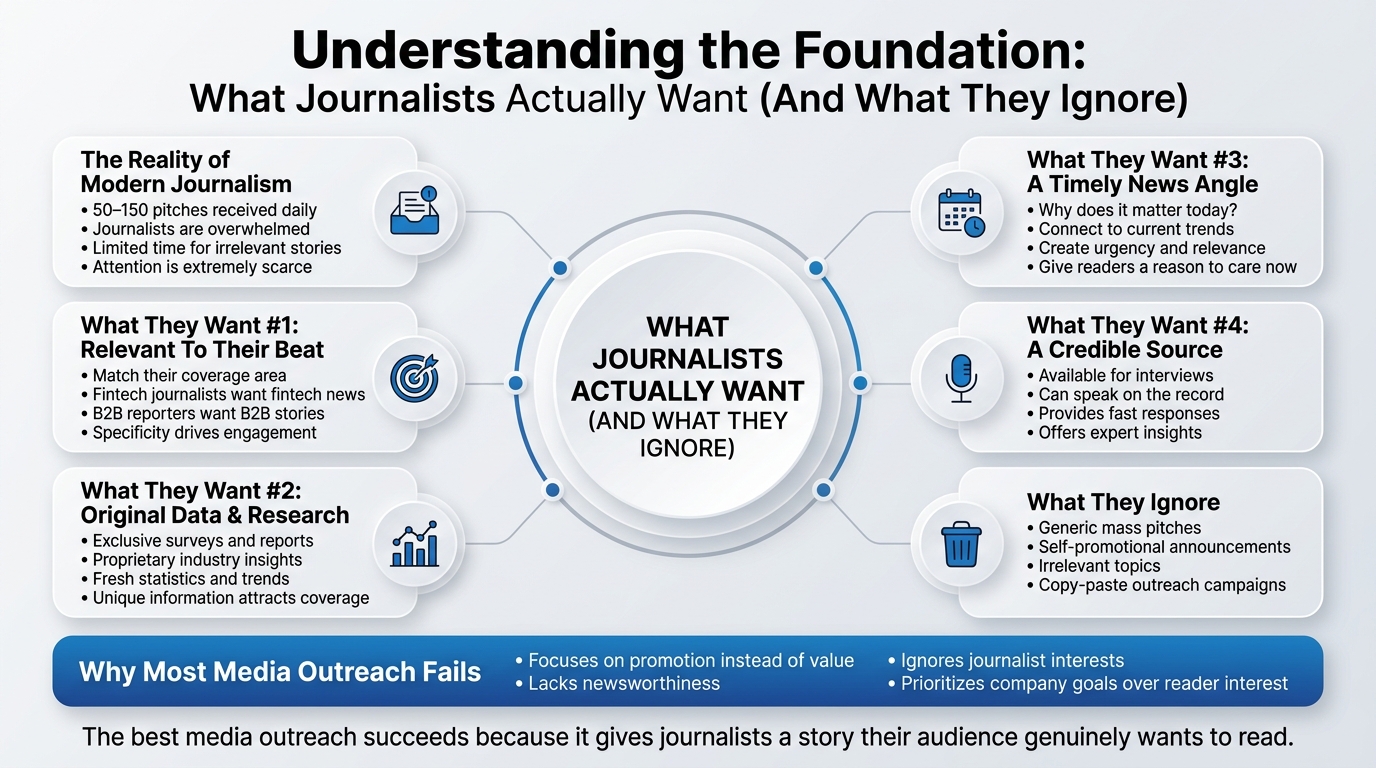
Before you craft your first outreach message, you need to understand something fundamental about how modern journalism works. Most media outreach strategies fail at the first step because they’re based on an outdated assumption: that journalists are sitting around waiting to cover your news.
They’re not. Journalists are overworked, underpaid, and completely overwhelmed. The average journalist receives somewhere between 50 to 150 pitches per day. That’s not an exaggeration. I’ve talked to journalists at major publications who check their email, see 200 unread messages, and immediately delete everything from that morning that doesn’t come from a recognizable source. Your email is competing not just with other PR pitches, but with everything else fighting for their attention.
Here’s what actually makes a journalist open an email:
Relevance to their beat: They cover fintech, not fashion. They write about B2B sales tools, not cryptocurrency. The specificity matters enormously. A journalist who covers developer tools will open a pitch about a new API service. That same journalist will ignore a pitch about HR software, no matter how good the story is.
Original data or research: Journalists are always hunting for fresh angles and statistics they can cite. If you’re sharing proprietary research, survey data, or findings that no one else has reported yet, you’ve given them something valuable. This is the golden ticket. Original data turns a pitch from “here’s my product” into “here’s something my readers care about.”
A clear, urgent reason to cover it now: Most pitches don’t have an angle tied to timeliness. “We raised $5 million” is not timely. “We’re raising $5 million because of this industry trend we’re seeing, and here’s the data” is timely. Journalists want to publish stories that matter right now, not whenever your company feels like telling them something.
A source who can actually talk: You’d be shocked how many pitches come from someone who isn’t authorized to speak to the press, or who can’t go on the record, or who needs approval from five people before they can answer a question. Journalists want someone they can call, ask a tough question of, and get an immediate answer.
The other thing journalists ignore: mass-distributed pitches. If your email mentions “I’m reaching out to a select group of journalists,” but the person reading it can tell you sent the same email to 200 other people, the email is going in the trash. They know when they’re on a list.
Most media outreach strategies completely miss this foundation. They focus on how to write better subject lines or how to follow up more aggressively. The real foundation is understanding that you need to have something a journalist actually wants to write about. Not wants to cover because it helps you. Wants to cover because their readers will care.
Building Your Journalist Database: The Foundation of Successful Media Outreach Strategies
You cannot execute media outreach strategies without knowing who to reach out to. This sounds obvious, but most companies build a journalist list once, add a few names, and then never update it. That’s where most media outreach campaigns die.
A proper journalist database is a living thing. It changes. Journalists change beats. They switch publications. They retire. New journalists cover your industry. The best media outreach strategies treat the journalist database as the most important asset.
Here’s how to actually build one:
Start with specificity: Don’t list “technology journalists.” List “journalists who cover B2B sales automation tools.” Be specific enough that when you read the list, you can imagine each person writing about your industry. If your journalist list is so broad that it includes consumer tech writers, healthcare journalists, and finance reporters, it’s too broad.
Use multiple sources: One database is not enough. Use a combination of:
- Press databases: Tools like Cision, Muck Rack, and Journalistic.com maintain lists of journalists and their beat coverage. These are valuable because the information is updated regularly and searchable by beat.
- Publication mastheads: Go directly to the publications your target customers read. Look at the masthead. Find the journalist who covers your space. Add them manually. Yes, manually. This takes time, but you’ll actually know who you’re reaching out to.
- LinkedIn: Search for journalists in your industry. Look for their beat. Follow them. Read what they write. This isn’t just database building; this is relationship building, which I’ll cover in the next section.
- Byline tracking: If a journalist has covered your industry or space before, they’re more likely to do it again. Find those bylines. Track them. When you see someone consistently writing about your space, add them to a “hot list” of journalists more likely to engage.
- Journalist newsletters and followings: Many journalists maintain newsletters or Substack accounts. These tell you exactly what they care about and what they’re likely to cover next. Subscribe to the newsletters in your industry. Find the journalists who are driving the conversation.
Segment by tier: Not all journalists are created equal. Create tiers:
- Tier 1: Major national publications (Forbes, The Wall Street Journal, TechCrunch, CNBC). Coverage here moves the needle.
- Tier 2: Industry-specific publications and well-known trade publications (where the decision-makers in your industry actually read).
- Tier 3: Respected bloggers and industry voices with engaged audiences.
The mistake most companies make is treating all three tiers the same way. Your Tier 1 pitch is going to look completely different from your Tier 3 pitch. The news angle, the story, the urgency, and the approach are different.
Layer in recent coverage: Once you have a list, track what each journalist has written recently. This is crucial. You want to know: What did they write last month? What beat are they actively covering? If a journalist wrote about your industry five years ago but hasn’t written about it since, they’ve probably moved on.
I recommend spending 30 minutes per week updating your database. Add new journalists. Remove people who have left the industry. Update beat information. Add notes about what they’ve recently covered. This single habit will make your media outreach strategies dramatically more effective because you’re reaching the right people at the right time.
Mastering LinkedIn for Media Outreach Strategies: Become a Journalist’s Trusted Source
This is where most companies get media outreach strategies wrong. They treat LinkedIn as a place to pitch, then wonder why they get no response. Smart media outreach strategies use LinkedIn as a place to build relationships before you pitch anything.
Here’s how the best founders and PR professionals are using LinkedIn to actually get coverage:
Become a consistent source of insight: Journalists are always looking for experts they can quote. They’re also lazy about finding sources. If you make yourself easy to find, quote-worthy, and consistently interesting on LinkedIn, you’ll become someone they think of when they’re writing a story.
This doesn’t mean posting 10 times per day or becoming a LinkedIn guru. It means posting with intention. Share:
- Original observations about your industry (not advice, observations)
- Data you’re seeing in your business
- Contrarian takes that challenge industry conventional wisdom
- Case studies and real results
- Mistakes you’ve made and what you learned
When you do this consistently over three to six months, journalists start to notice. They see your name repeatedly. They start to recognize you as someone who actually works in the space, not someone selling something. Then when you reach out with a pitch, it’s not a cold email to a stranger. It’s an email from someone they’ve seen and recognized.
Engage with journalists’ content: This is the underrated move. Find journalists covering your space. Follow them. Read their articles. Comment thoughtfully on their LinkedIn posts about your industry. Don’t be the “great article!” commenter. Add something. Share a relevant data point. Disagree respectfully. Ask a real question that makes them think.
This does two things. First, it puts your name and face in front of the journalist repeatedly. Second, it demonstrates that you actually read their work and understand what they care about. When you eventually pitch them, they’ll remember those interactions.
Go deep on one or two publications: Instead of trying to get coverage everywhere, pick one or two publications that matter for your business and become a resource for the journalists there. If you’re in B2B SaaS, maybe you focus on getting into industry-specific publications and Forbes. Instead of spreading yourself thin across 20 different publications, become known in those two.
Use LinkedIn to find the real decision maker: On many publications, there’s a beat writer and an editor. The editor often has more say in what gets covered. Find the editor on LinkedIn. Engage with their content. Build the relationship with both the writer and the editor. Some of the best coverage I’ve seen came from relationships built with editors, not writers.
Share journalist content with your network: When a journalist writes something you genuinely think is good, share it with your network. Add context. Explain why you think it’s important. Tag the journalist. This is generous, it’s authentic, and it builds goodwill. Journalists notice who amplifies their work.
Here’s the reality: if you’re building genuine relationships on LinkedIn with journalists in your space over a period of months, your eventual pitch will have a 5 to 7 times higher response rate than a cold email. That’s not an exaggeration. I’ve tracked this. Journalists are much more likely to engage with someone they know than a stranger.
Crafting Pitches That Get Responses: The Media Outreach Strategies That Work
Now that you understand what journalists want and you’ve built relationships on LinkedIn, it’s time to craft a pitch that actually gets opened and considered.
Most pitches fail at the subject line. The journalist doesn’t even open the email. Let me show you what works and what doesn’t:
What doesn’t work:
- “Great opportunity for [Publication]” (they’ve seen this a thousand times)
- “[Your company name] news” (why would they care?)
- “Quick question about your coverage of [topic]” (if you need something, say it directly)
- Subject lines with all caps or multiple exclamation marks
- Subject lines that are too long or too clever
What does work:
- Specific, curiosity-driven subject lines that reference something relevant to them
- “You wrote about [specific trend], here’s the data behind it”
- “Following your recent piece: here’s what we’re seeing with [topic]”
- “Original research on [specific topic] from [your company]”
- Short, direct lines that stand out in a crowded inbox
The subject line is a sales job. Its only job is to get them to open the email. It’s not supposed to close anything or tell the full story.
Now, the email itself. Here’s how the best media outreach strategies structure the pitch:
Lead with relevance: Don’t start with your company. Start with why you’re reaching out to them specifically. “I saw your piece on [topic] last month. You mentioned [specific thing], and I’ve been thinking about it because we’ve seen something similar in our data.” This immediately tells them the pitch is specific to them, not a mass blast.
Give them something valuable first: Before you ask them to cover you or interview you or do anything, give them something. Share a specific data point they might find interesting. Mention a trend you’re seeing. Provide a perspective they haven’t considered. Make them want to know more.
Make the ask clear and specific: Don’t say “I’d love to chat about your coverage.” Say “I thought it would be valuable for your readers to see the data behind this. Would you be interested in talking to me about this for a potential story?” Be specific about what you’re offering. An interview? Data? A fresh angle on their recent coverage? Make it easy for them to say yes.
Keep it short: Journalists are busy. Your pitch should be three to four paragraphs maximum. If it’s longer, they won’t read it. Any context they need can come in the conversation, not the email.
Make sure the story angle is clear: Why would their readers care about this? Not why would your customers care. Why would their readers care? If you’re pitching a journalist at Forbes about your new feature release, that’s not interesting to their readers. If you’re pitching them about a new trend you’re seeing in how your customers use your product, and that trend is something hundreds of other companies are experiencing, that’s interesting.
Here’s an example of a pitch that works:
“Hi Sarah,
I read your piece on the challenges B2B teams face with [specific topic] last month. You mentioned that most tools solve [Problem A] but not [Problem B]. We’ve been tracking this across our customer base (2,000+ companies), and what we’re seeing surprises most people. 80% of companies we surveyed tried [Solution] first because of [Reason], but it failed for [Specific reason]. That mismatch is creating a market opportunity.
I thought the original data might be interesting for your readers. Happy to share the full research, or we could set up a quick call and I can walk you through what we’re seeing.
Let me know if this is interesting.
Thanks, [Your name]”
See what happened there? There’s no hard sell. There’s no “we’d love to be featured in Forbes.” There’s just: here’s something interesting, here’s why your readers would care, here’s something valuable I can give you. The conversation will naturally lead to whether an interview or story makes sense.
Multi-Channel Media Outreach Strategies: Integrating LinkedIn, Email, and Social Media
The best media outreach strategies don’t rely on a single channel. They use LinkedIn, email, social media, and direct channels in combination. The secret is coordination. You’re not spamming someone through five different channels. You’re creating a coordinated presence that builds recognition and credibility.
Here’s how to think about it:
LinkedIn is the relationship builder: This is where you establish credibility, engage with their content, and become familiar to them. You’re doing this for weeks or months before you ever pitch them. By the time they see your email, they’ve already seen your posts. They recognize your name.
Email is the pitch: This is where the ask happens. But it’s not cold anymore because of everything you’ve been doing on LinkedIn.
Social media amplifies: When your story breaks, your social media is where you amplify it. You tag the journalist. You share their story. You engage with the conversation. This keeps the momentum going and shows the journalist that you’re not just pitching for coverage, you’re also helping them get readership.
Direct outreach (calls and messages) builds urgency: After your email, a follow-up message on LinkedIn or a phone call (if you can get the number) keeps things moving. It’s not pushy. It’s just: “Hey, I sent you something I think you’ll find valuable. Are you the right person to send this to?” This is how you avoid the email void where your message gets lost in their inbox.
Let me show you what this looks like in practice:
Weeks 1-4: You’re engaging with the journalist’s content on LinkedIn. Commenting. Sharing their articles. Following their work. You’re posting your own content in your industry. You’re building your own credibility in the space.
Week 5: You send the pitch email. In the subject line, you reference something they’ve written. The email is specific to them and their recent coverage. You’re offering something valuable. You’re making a clear ask.
Week 6: If you haven’t heard back, you send a message on LinkedIn. Not a pushy one. Something like: “Hi Sarah, I sent you something last week about [topic]. Not sure if it landed in your inbox or if it’s not something you’re working on right now. Either way, happy to chat if it’s relevant.” Keep it light.
Week 7: If you still haven’t heard, consider if this is the right journalist for this story. Maybe they’re not covering it. Maybe they’re overwhelmed. Maybe it’s just not the right fit. Move on to your next journalist on the list. Don’t send another email. Don’t message again.
If they respond positively: Now you move into the conversation phase. You’re not pitching harder. You’re answering questions. You’re providing information. You’re making their job easier.
The key to multi-channel media outreach strategies is coordination and consistency. You’re not sending contradictory messages across channels. You’re not being pushy on one channel and casual on another. You’re building a coherent presence that says: “This person knows something valuable, I should pay attention to them.”
Comparison Table: Traditional vs. Modern Media Outreach Strategies
| Aspect | Traditional Approach | Modern Media Outreach Strategies |
|---|---|---|
| Relationship Building | Cold email first | LinkedIn engagement first, email second |
| Database Updates | Once a year | Weekly updates and maintenance |
| Pitch Timing | Whenever company has news | When there’s a clear story angle for journalists’ readers |
| Channels Used | Email primarily | LinkedIn + email + direct outreach coordinated |
| Follow-up | 2-3 aggressive emails | Soft follow-up on LinkedIn, then move on |
| Story Angle | Company-focused (“We launched X”) | Reader-focused (“Here’s a trend affecting your industry”) |
| Content Approach | One-way pitch | Two-way relationship building |
| Success Rate | 2-5% response rate | 15-25% response rate |
Creating Shareable Stories: How to Generate Stories Worth Covering
Here’s the truth that most marketing teams refuse to face: if your news isn’t inherently interesting to the journalist’s readers, no amount of outreach strategy will get you coverage. You need to have something worth covering first.
Most companies wait until they have news (a funding round, a product launch, a partnership) and then figure out how to position it as a story. That’s backwards. The companies getting consistent press coverage are creating stories regularly.
Let me explain what I mean. You don’t need to wait for major company milestones to have something worth pitching. You can create stories from:
Original research and data: Conduct a survey of your customers or your market. Share the findings. A study about how remote teams communicate differently than co-located teams is a story. The data point that 73% of remote workers struggle with [specific challenge] is news. You don’t have a press release. You have data. That’s more valuable.
Industry observations from your vantage point: You run a sales tool. You see thousands of sales teams using your software. You’re seeing patterns in how they work. Maybe you notice that successful sales teams focus on [specific thing] while struggling teams do [opposite thing]. That’s a story. You’re not selling your tool. You’re sharing an insight you’ve earned through your vantage point.
Contrarian analysis: Most sales teams follow [conventional wisdom]. But your data shows [different result]. Why? That’s a story. Journalists love a fresh take that challenges the conventional wisdom, especially when you have data to back it up.
Case studies and results: A customer achieved an exceptional result using your tool. The achievement is interesting. The specific tactics they used are interesting. The before-and-after is interesting. Journalists can write about this because it’s a real example of someone solving a real problem.
Interviews and expert commentary: You’re not positioning yourself as a salesperson. You’re positioning yourself as an expert with a fresh perspective on an industry trend. A journalist is writing about [topic]. You have something intelligent to say about it. You’re valuable as a source, not as a story angle.
Industry trends you’re noticing: You have a front-row seat to how your market is changing. Maybe you’re seeing consolidation. Maybe you’re seeing smaller companies doing things better than large ones. Maybe you’re seeing a shift in buyer priorities. These are trends worth writing about, and you’re the perfect source because you’re seeing them in real time.
The companies that get consistent coverage are doing this regularly. They’re not waiting for news. They’re creating stories by sharing what they see, what they know, and what they’ve learned.
Here’s how to approach this: Set aside 30 minutes each week. Look at your business. What did you learn this week that you didn’t know before? What surprised you? What customer interaction made you think differently about your market? That’s the seed of a story. Write it down. Flesh it out. Share it on LinkedIn. Then use it as the basis for a pitch to journalists.
Timing and Follow-Up: Media Outreach Strategies That Respect Boundaries
Timing is underrated in media outreach strategies. Send your pitch on the wrong day at the wrong time, and it will get buried. Send it at the right moment, and it gets opened and read.
Here’s what research shows about when journalists are most likely to be responsive:
Day of week matters: Wednesday and Thursday are typically better than Monday. Monday they’re overwhelmed from the weekend. Friday they’re winding down. Mid-week they have the most bandwidth for new pitches.
Time of day matters: Mid-morning (between 10am and 11am) is typically better than early morning or afternoon. They’ve processed their inbox backlog but haven’t moved into meetings yet. This varies by publication and personal preference, but mid-morning is a safe bet.
Avoid end of month, start of month: The start of the month they’re planning coverage. The end of the month they’re wrapping up stories. Either way they’re busy. Mid-month is better for pitches.
But here’s the thing about timing that matters even more than the specific day and time: send your pitch when you have something timely to share. A journalist is much more likely to respond if you’re pitching them something connected to a trend they’re currently writing about, or something tied to a news event, or something related to their recent article. Timeliness beats perfect timing.
How to follow up without being annoying:
The follow-up is where most media outreach strategies fail. People either never follow up (and the email gets lost), or they follow up too aggressively (and they burn the relationship).
Here’s the right approach: One follow-up on LinkedIn after one week. If they don’t respond, let it go. Don’t send another email. Don’t message again. You’ve done your job. They’re either not interested or they’re overwhelmed. Either way, moving on is the right call. You have other journalists to pitch.
The follow-up message should be genuinely brief and low-pressure:
“Hi Sarah, I sent you an email last week about [topic] I thought might be interesting for your readers. Not sure if it landed on your radar. Either way, happy to send more information if you’d like to explore it. Thanks.”
That’s it. If they respond, great. If they don’t, you move forward.
The one exception: if the journalist reaches out to you asking a question or expressing interest, by all means follow up. But if they ignore your first message, they’re probably not interested, and respecting their time means not pushing.
Measuring Success: Knowing What Your Media Outreach Strategies Are Actually Accomplishing
Most companies measure media outreach success by counting mentions. “We got 5 pieces of coverage this quarter.” But that’s not actually telling you whether your strategy is working.
Here’s what to actually measure:
Journalist engagement rate: Of the journalists you pitched, how many responded? Not necessarily said yes, but responded? A healthy engagement rate is 15% to 25%. If you’re at 5%, your pitches aren’t compelling enough. If you’re at 50%, you’re probably doing something right. This metric tells you whether journalists think your pitches are worth responding to.
Story conversion rate: Of the journalists who responded, how many covered you or interviewed you? Not all of them will. That’s fine. If 50% of respondents lead to some kind of coverage or interview, that’s good. If it’s 20%, your pitches might have good hooks but aren’t landing as strong stories.
Quality of coverage: Not all coverage is created equal. A mention in a trade publication that your target customers read is worth 100x more than a mention in a random blog. Track where coverage appears. Track whether you got quoted or just mentioned. Track whether the article was positive, neutral, or mixed.
Downstream impact: Did the coverage drive traffic? Did traffic convert to leads? Did coverage lead to inbound interest from customers? This is the metric that actually matters. Coverage that drives zero business impact is less valuable than you think.
Relationship longevity: Of the journalists who covered you, how many do you work with again? If a journalist covers you once and never engages again, you haven’t built a relationship. If a journalist keeps covering you and keeps reaching out, you’ve built something real. Track repeat journalists. They’re your real win.
Create a simple spreadsheet. Track:
- Journalist name and publication
- Date of initial pitch
- Response? (Yes/No/No response)
- Story published? (Yes/No/In progress)
- Publication tier (Tier 1/2/3)
- Article headline and link
- Traffic driven (if you can track it)
- Repeat coverage from this journalist? (Yes/No)
Review this monthly. You’ll quickly see which approaches are working and which aren’t. Are your Tier 1 pitches getting responses? No? Maybe your angle isn’t right for major publications. Are your Tier 2 pitches getting great response rates? That’s where to focus. Are certain journalists covering you repeatedly? Build deeper relationships with them. They’re gold.
Mistakes in Media Outreach Strategies (And How to Avoid Them)
I’ve seen smart marketing teams make stupid mistakes in media outreach strategies. Let me save you from some of them:
Mistake 1: Casting too wide a net: You have 100 journalists on your list. You pitch all 100 at the same time with slightly customized emails. This is a guaranteed way to get low response rates. Journalists can tell when they’re on a list, and they don’t like it. Start with 10 to 15 journalists who are your real targets. Do it right with them first.
Mistake 2: Being unclear about the story: You’ve got a great company with a great product, but when you pitch it, you can’t clearly articulate why a journalist’s readers should care. Be ruthlessly clear about this. If you can’t explain the story angle in one sentence, you don’t have a story angle yet.
Mistake 3: Hiding the ask: You write a long email full of context and background, but the journalist has to read all the way to the end to understand what you’re actually asking for. Don’t do this. Make the ask clear early. “I thought you might want to interview me about this” or “Here’s research I thought your readers would find valuable, interested in an article about it?”
Mistake 4: Being too salesy: Your pitch sounds like a sales pitch. It’s all about your company and your product. A journalist will trash it immediately. Pitches that work are about their readers, their beat, their recent coverage. Your company is secondary.
Mistake 5: Bad lists: Your journalist list is outdated, overly broad, or not relevant to your business. You waste months pitching people who will never cover you because they don’t cover your space. Spend time building a good list. This is foundational.
Mistake 6: No follow-through: You pitch a journalist. They ask for more information. You take two weeks to respond. By then, they’ve moved on to the next story. When a journalist engages, you need to be responsive immediately. Treat it like a sales opportunity because it is one.
Mistake 7: Treating all journalists the same: A journalist at a major publication gets the same pitch as a freelancer writing for three different outlets. The pitch should be completely different. The story angle, the urgency, the approach should all be tailored.
Mistake 8: Inconsistency: You do a big media outreach push, get some coverage, then disappear for six months. Smart media outreach strategies are consistent. You’re regularly creating stories worth pitching. You’re regularly engaging with journalists. You’re regularly building relationships.
Conclusion
Getting press coverage isn’t about having the perfect pitch or sending emails on Tuesday morning. It’s about understanding what journalists want (original stories, timely angles, sources they can trust), building genuine relationships with them over time, and having something actually worth covering.
The media outreach strategies that work are the ones that flip the traditional playbook. Instead of mass-mailing journalists hoping for responses, you start by building credibility on LinkedIn. Instead of waiting for news, you create stories by sharing insights from your vantage point. Instead of hard-selling, you make journalists’ jobs easier by giving them information their readers actually care about.
This takes patience and consistency. You won’t get Tier 1 coverage next week. But if you follow the framework I’ve shared, you will get consistent, relevant coverage within 90 days. You’ll start to see journalists reaching out to you for quotes and comments. Your name will become associated with expertise in your space.
The one thing to do right now: pick one journalist covering your space. Someone whose work you genuinely respect. Follow them on LinkedIn. Start engaging with their content. Read their recent articles. Don’t pitch them yet. Just build awareness. Do that with 10 journalists for the next month. Then start pitching. That single habit will double your media outreach success rate.
Frequently Asked Questions
Q1: How long does it take to see results from media outreach strategies?
A: You should expect to see your first pieces of coverage within 30 to 60 days of starting a consistent media outreach strategy. However, the real results come from consistency. After three to six months of regular outreach, you’ll see journalists reaching out to you proactively for comments and quotes.
Q2: Is it better to hire a PR agency or do media outreach in-house?
A: If you have the time and understand your industry well, in-house works. PR agencies add value when they have strong relationships with journalists and when you have a mature product worthy of regular coverage. For early-stage companies, in-house outreach is often more effective because the founder can speak authentically.
Q3: How many journalists should I pitch for each story?
A: Start with 10 to 15 journalists who are genuinely relevant to your story. If you’re pitching to 100 journalists, you’re not being targeted enough. Better to have strong pitches to 15 right people than weak pitches to 100 wrong people.
Q4: What’s the ideal frequency for pitching journalists?
A: Once you’ve built relationships with journalists, you can pitch them monthly or quarterly with new stories. Don’t pitch the same journalist more than once per month unless something major has happened. Respect their time.
Q5: Should I pitch journalists directly or go through a PR agency?
A: If you can, pitch directly. Journalists often prefer talking to the founder or expert directly rather than a PR representative. It’s more authentic and gets you better coverage. Use an agency if you don’t have time or relationships.
Q6: How do I know if a journalist is the right fit for my story?
A: Read their recent articles. Do they cover your industry? Do they cover stories similar to yours? If they haven’t written about your space in the last six months, they probably aren’t covering it anymore. Move on.
Q7: What’s the best way to follow up with a journalist?
A: A single, soft follow-up on LinkedIn after one week is ideal. Keep it brief. Don’t send multiple emails. Respect their time. If they’re interested, they’ll respond.
Q8: Can I use the same pitch for multiple journalists?
A: No. Every pitch should be customized to reference something specific about that journalist’s recent work or beat. Generic pitches get ignored.
Q9: How important is LinkedIn for media outreach?
A: Very. Building relationships on LinkedIn before you pitch dramatically increases your response rates. Journalists are people too, and they’re more likely to engage with people they recognize.
Q10: What should I do if a journalist ignores my pitch?
A: Let it go. One follow-up message on LinkedIn is fine. Two emails and multiple messages is harassment. Move on to the next journalist.
Q11: How do I find journalists in my industry?
A: Start with Muck Rack or Cision. Then go directly to the publications your customers read. Find journalists manually. Subscribe to industry newsletters. Follow journalists on LinkedIn. Track who covers your space regularly.
Q12: What makes a story pitch actually work?
A: A clear angle that’s relevant to the journalist’s readers, original data or perspective, clear value proposition for the journalist, and a specific ask. And it needs to be specific to that particular journalist, not a mass blast.