


Real estate agents get pitched constantly. Mortgage lenders want their referrals. CRM platforms want their subscription fees. Coaching programs want their weekends. Proptech startups want their attention. ISAs want a partnership. By the time your outreach message lands in their inbox, they have already deleted six just like it this morning.
That is the real problem with most real estate agent outreach message templates floating around online. They were written assuming the agent has not seen this before. They have. And when an agent recognizes a template in the first sentence, the response you get is silence.
What actually changes that is not better copywriting. It is better targeting. The agents who reply to cold messages are not responding to eloquence. They are responding to relevance. A message that feels like it was written specifically for their market, their deal flow, and their current situation will always outperform a polished pitch aimed at everyone.
This article is not a listicle of generic scripts. It covers why most real estate agent outreach fails at the structural level, how to segment agents before you write a single word, and then gives you the templates by channel: LinkedIn, cold email, and SMS. It also covers the follow-up sequence most vendors skip, and how to personalize at scale without losing what makes personalization work in the first place. Everything here is built for the person selling to real estate agents, not the agent selling to buyers.
Why Most Outreach to Real Estate Agents Gets Ignored (And What Changes That)
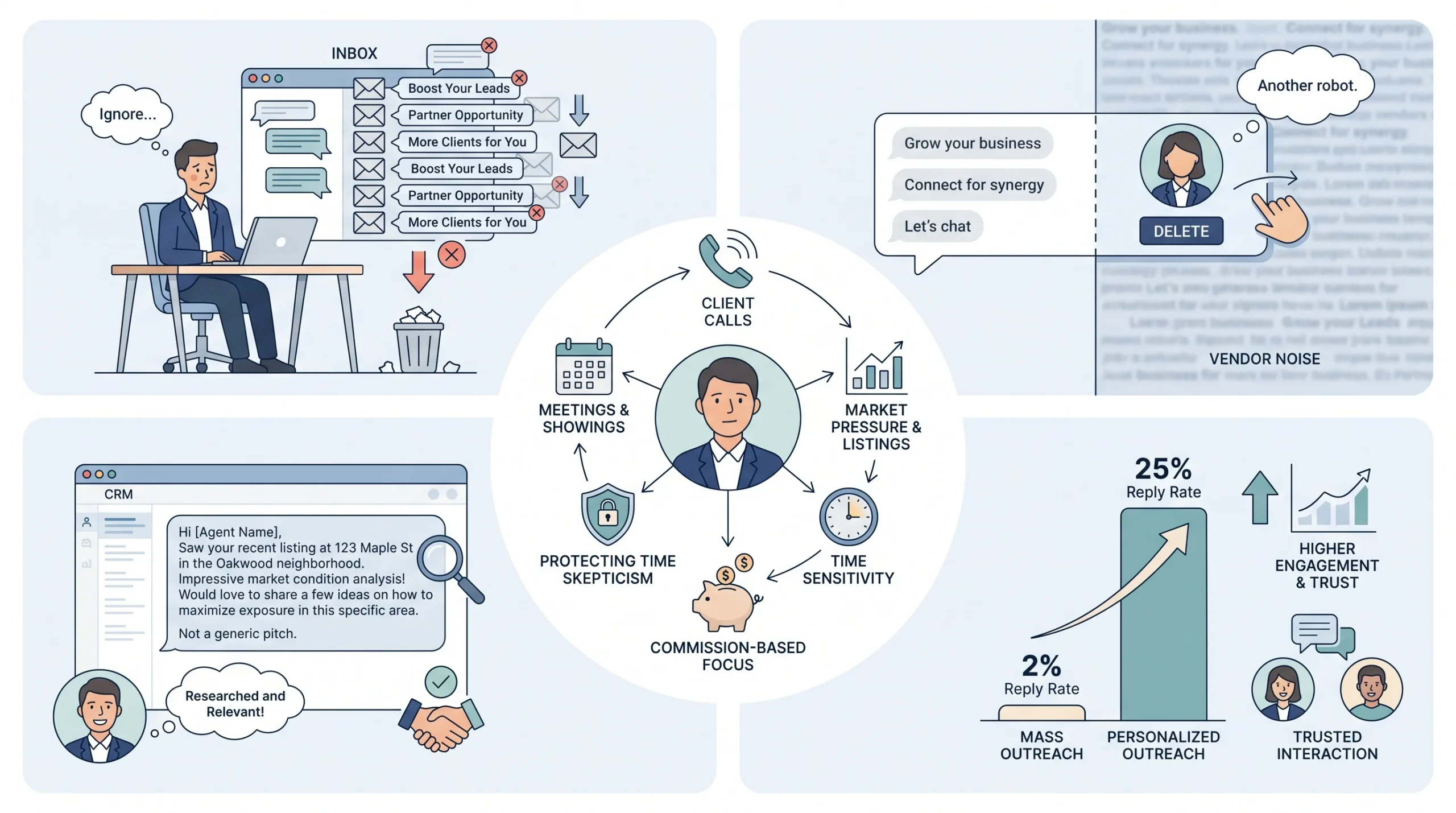
The failure in most real estate agent outreach is not the subject line. It is not the call to action. It is that the message could have been sent to any agent, in any market, on any day, and it reads exactly like that. Relevance is the problem, and templates alone cannot fix it.
The Volume Trap
Most vendors and sales reps approach real estate agent outreach as a numbers game. Build a list of 500 agents. Load them into a sequence. Send the same message to all of them. Then track what percentage replies. According to LeadHaste’s 2026 outbound data, real estate professionals receive between 30 and 100 vendor emails per week. Running a generic sequence into that environment produces reply rates below 1% on a good day.
The volume trap is self-reinforcing. Low reply rates lead to sending more messages, which leads to more noise, which drives reply rates further down. The agents who do respond to cold outreach are not responding more because you sent more. They are responding because something in one specific message caught their attention for a reason specific to them.
Agent Psychology 101
Real estate agents are self-employed and commission-only. Their time is not abstract. A bad week of wasted meetings is a bad week of lost income. They are acutely sensitive to anything that wastes either. Cold messages that open with a company name, a product category, or a vague offer to “grow their business” register immediately as vendor noise. The pattern is too familiar. They have trained themselves to delete it.
What breaks through is specificity. A message that references their recent listing in a specific neighborhood. A message that speaks to a market trend they are actively dealing with. A message that comes through a mutual connection. These messages do not feel like templates because they are not. They feel like someone who did their homework.
The Personalization Benchmark
Personalization tied to a specific property, market condition, or recent transaction lifts reply rates 2 to 3 times compared to generic outreach, according to LeadHaste’s outbound research on real estate campaigns. This is worth sitting with for a moment, because 2 to 3 times is the difference between a sequence that books zero meetings and one that books three or four from the same list size.
The practical implication is that you need to build the personalization into the outreach process before you write the first template. Research first. Segment next. Write templates last. The agents who get a lot of cold outreach have a very accurate radar for detecting when personalization is genuine versus when it is a merge field with their city name in it.
Segment First, Template Second (The Agent Type Framework)
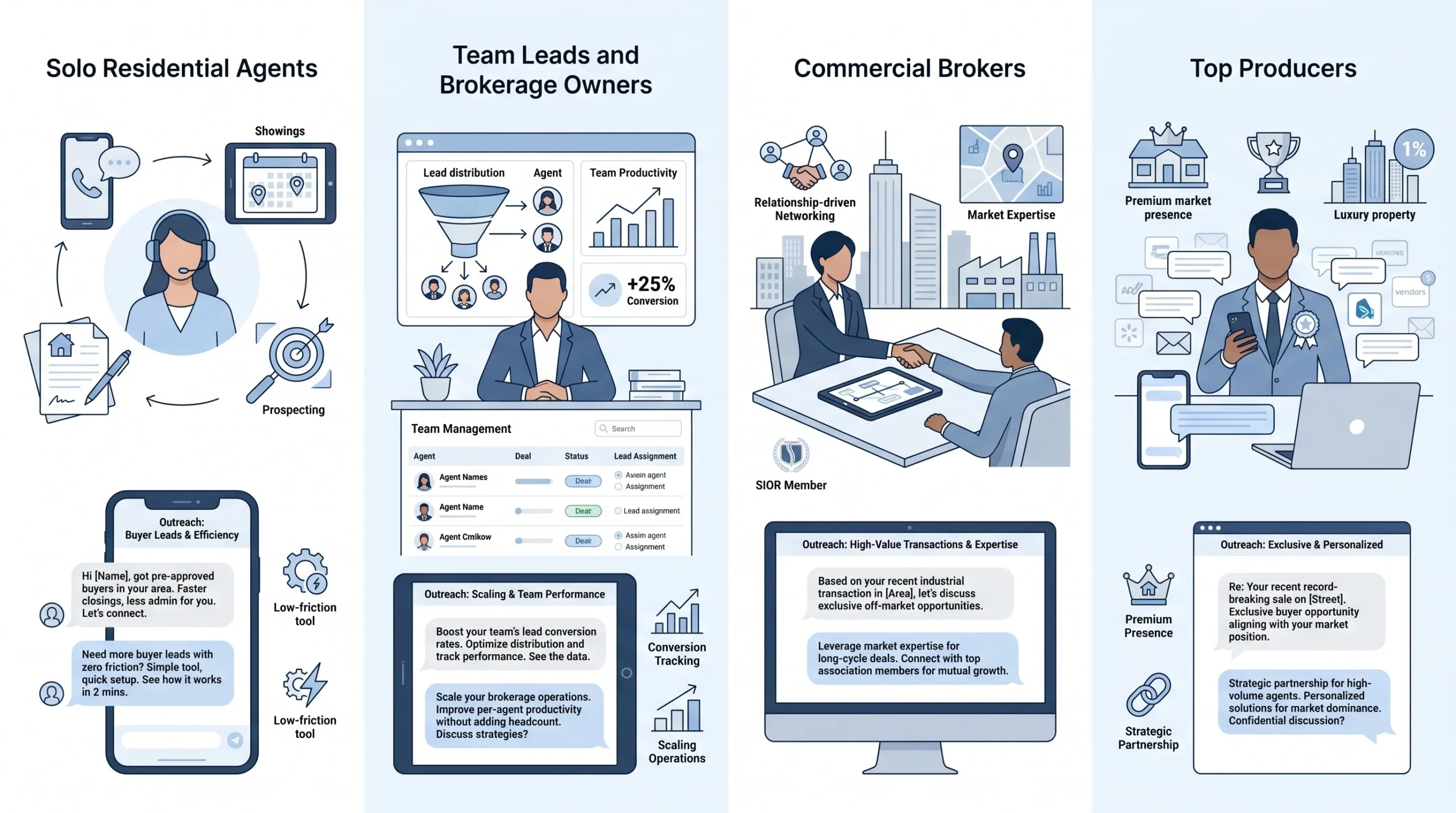
One of the most costly mistakes in real estate agent outreach is treating all agents as a single audience. A message built for a solo residential agent in a suburban market will land wrong with a commercial broker who closes nine-figure deals. A message positioned around leads and deal flow will miss a team lead whose actual problem is agent retention. The templates in the next sections only work if they go to the right segment.
Solo Residential Agents
Solo agents are the most common outreach target and the most overloaded with vendor pitches. They run their business alone, handle their own prospecting, marketing, closings, and client management, often without staff. Their core motivations are leads, faster closings, and anything that reduces admin without adding complexity.
- They respond well to messages that lead with a specific, tangible outcome: more buyer leads, faster pre-approval, fewer deals falling through.
- They are skeptical of anything that sounds like it requires a learning curve or a long onboarding process.
- Keep messages short. They are usually in their car, at a showing, or between calls.
- Lead with the outcome in the first sentence. Put the ask at the end.
Team Leads and Brokerage Owners
Team leads think differently than solo agents. Their problem is not their own production. It is their agents’ production. They are worried about recruitment, retention, lead distribution, follow-up systems, and whether their team is actually converting the leads they are already paying for.
- Messages to team leads should speak to scale, not individual deals.
- Reference agent count or team structure where you can find it publicly. “I help teams of 10 to 20 agents” signals you understand their situation.
- The best hook for this segment is anything tied to agent productivity, lead conversion rates, or technology that makes managing a team easier.
- They respond to specifics. What did another team of similar size gain? What changed in their conversion rate or per-agent output?
Commercial Brokers
Commercial real estate operates on completely different timelines and relationship dynamics than residential. Deal cycles run 12 to 36 months. Relationships built over years carry more weight than any cold message. Cold outreach to commercial brokers underperforms significantly compared to the residential side.
- If you must reach commercial brokers cold, lead with your credibility in their specific asset class. “We work with industrial brokers in the Southeast” is more useful than “we work with commercial real estate professionals.”
- Warm introductions through mutual contacts, industry events, and association memberships (CCIM, SIOR) will consistently outperform cold sequences for this segment.
- Longer messages are more acceptable here than in the residential space, but only if every sentence is substantive.
Top Producers (Top 1% by Volume)
Top producers are the hardest segment to reach and the most valuable to land. They receive more vendor pitches than any other agent type, and they have the highest tolerance for ignoring them. They also have the least time, the most options, and the shortest patience for anything that wastes either.
- The standard pitch is invisible to this segment. They have seen it thousands of times.
- Your message needs to signal that you know who they are and what they are actually dealing with at their volume. Reference their specific production, their market position, or a challenge that is unique to high-volume operations.
- The shorter and more direct, the better. One clear hook. One specific ask. Nothing else.
- Social proof matters more here than in any other segment. If you have worked with agents at their production level, lead with that. If you have not, do not pretend you have.
LinkedIn Outreach Message Templates for Real Estate Agents
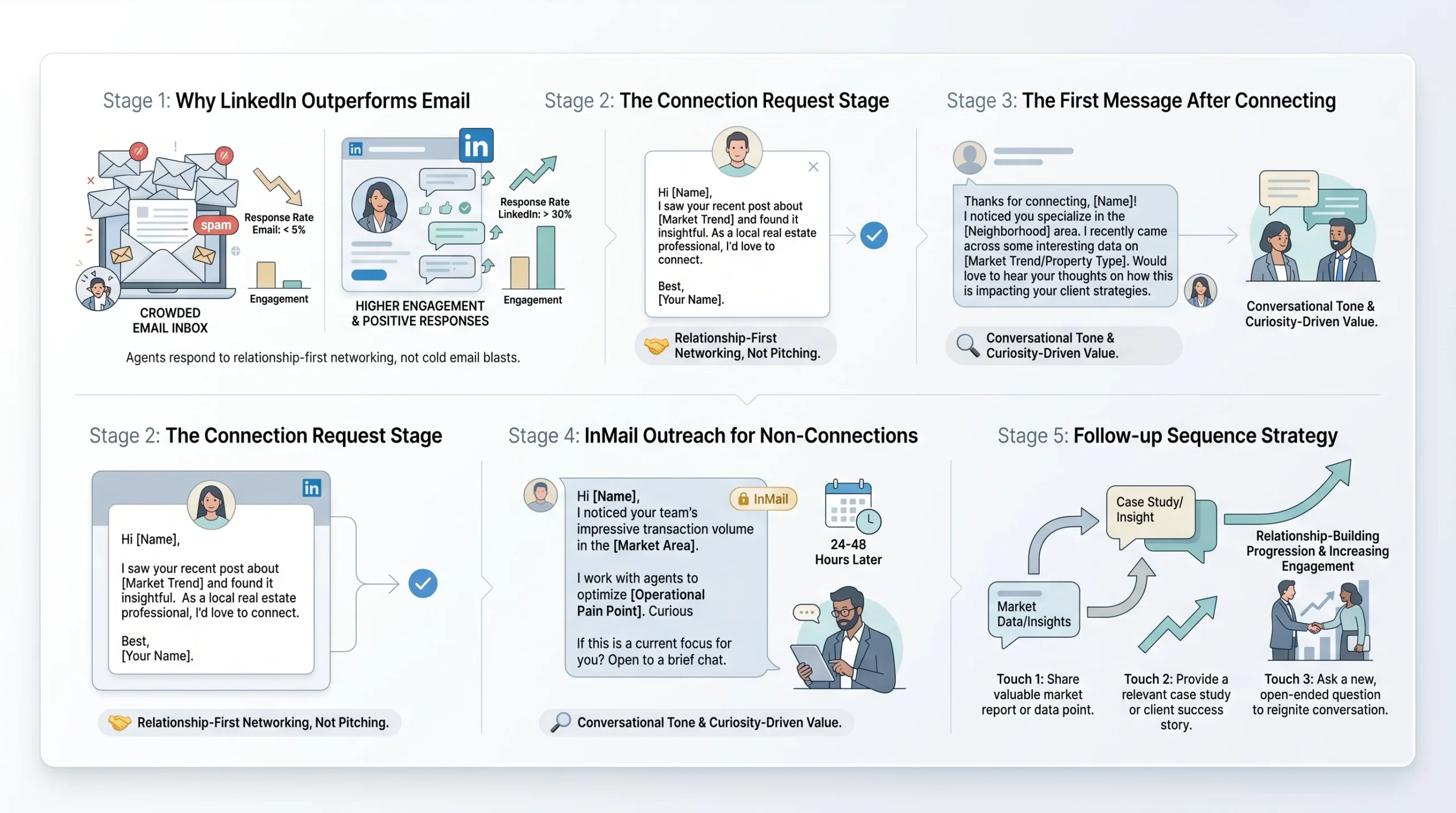
LinkedIn InMails in the real estate sector generate response rates between 18% and 25%, according to data cited by Closely HQ’s industry benchmarks. Cold emails in the same sector average around 3%. That gap is why LinkedIn should be the primary channel for most B2B outreach to real estate agents, not a supplement to email. Most vendors treat it as an afterthought. That is an opportunity.
The Connection Request (Do Not Pitch Here)
The connection request is the most misused touchpoint in LinkedIn outreach to real estate agents. It is not a place for a pitch. It is a door opener. A connection request with a sales message attached gets declined because it signals immediately that your intention is to sell, not connect. Agents who have been on LinkedIn for more than six months have developed a strong reflex for this.
The connection note should be one sentence. It should reference something real: a post they wrote, a market they work in, a mutual connection, or a topic relevant to their business. The goal is to get the connection accepted. That is the only goal of this message.
Template: Connection Request (No Pitch)
“Saw your recent post on the [City] inventory shortage. Working with a few agents in that market and would value connecting.”
Template: Mutual Connection Angle
“[Name] mentioned your name when we were talking about referral-based growth. Would love to connect.”
The First Message After Connecting
Wait 24 to 48 hours after the connection is accepted before sending the first message. Sending a pitch within minutes of being accepted is the LinkedIn equivalent of handing someone a brochure the moment they shake your hand at a networking event. It is technically possible. It is also why people avoid you.
The first message should open with something of value or a genuine question. The goal here is a reply, not a meeting booked. One question is better than a paragraph of context. Reference their market, their recent activity, or a challenge that is common for their segment.
Template: Value-First Opener (Vendor or Lender)
“Thanks for connecting, [Name]. Noticed you’re covering [Neighborhood]. We’ve been seeing a lot of [specific trend] in that market lately. Curious if that’s been affecting your buyer conversations at all?”
Template: Tool or Platform Outreach
“[Name], saw you run a team of [X] agents. Most team leads I talk to are losing deals in the follow-up gap after open houses. We built something specifically for that window. Worth a 15-minute call to see if it applies to your setup?”
InMail Templates (For Non-Connections)
LinkedIn InMails go directly to a prospect’s inbox without requiring a connection first. They perform best when they stay under 150 words, open with a specific reference to the recipient’s profile or market, and close with a single low-friction ask. The mistake most people make with InMail is treating it like an email. It is not. It is a LinkedIn message. The platform creates a different context and a lower tolerance for length.
Template: InMail for Lender Prospecting Real Estate Agents
“Hi [Name], I noticed you closed [X] transactions in [Market] last year. I’m a [lender/product type] working with top-producing agents in that corridor. Our [specific differentiator] has helped agents like you cut time-to-close by [X] days. Happy to send over a quick breakdown if that’s relevant to what you’re working on right now.”
Template: InMail for Proptech or Tool Vendors
“Hi [Name], came across your profile while looking at agents covering [specific area]. Noticed you’re running [specific team structure or volume]. We’ve been helping agents in similar setups reduce [specific problem, e.g., lead response time, fallout rate] by [specific outcome]. If that’s something on your radar, I can share a two-minute breakdown of how it works.”
Follow-Up Sequence on LinkedIn
According to outbound data from multiple B2B sales research sources, 50 to 70% of total responses in outreach campaigns come after the second or third touch. Most vendors send one LinkedIn message, hear nothing, and move on. The agents who would have responded are still there. The sequence just ended too early.
LinkedIn follow-ups should always introduce something new. A new question, a new piece of information, a market stat, or a brief case study relevant to their segment. Sending the same message twice signals you have nothing new to add.
- Follow-up 1 (Day 3 after first message): Add a new data point or a question approaching the topic from a different angle.
- Follow-up 2 (Day 7): Share a brief resource, a market stat, or a specific result from a similar agent.
- Follow-up 3 (Day 12): Short message, reference the previous touchpoints, one final ask.
Cold Email and Text Outreach Templates That Get Real Estate Agents to Reply
LinkedIn should anchor your outreach to real estate agents, but email and SMS fill the gaps in a multi-touch sequence. Each channel has different expectations, different acceptable lengths, and different response triggers. Using them correctly means understanding what each one is good at, not just adding more touchpoints.
Cold Email Subject Lines That Work for Real Estate Agents
The subject line is the entire first impression in cold email. Real estate agents in high-production markets have inboxes that are already overloaded. Subject lines that reference a specific neighborhood, a recent market event, or a mutual connection consistently outperform generic ones. The subject lines that consistently fail are: “Quick question,” “Partnership opportunity,” “Following up,” and any variation of “I’d love to connect.”
Working subject line formats that reference specificity:
- “[City] agents and [Specific Problem]: what we’re seeing”
- “Your listing at [Address]”
- “[Mutual contact] suggested I reach out”
- “What happened with [recent local market event]”
- “[Name], thought you’d want to see this [City] data”
Cold Email Templates (Short-Form)
Cold emails to real estate agents should stay under 150 words for the first touch. That is not arbitrary. Agents read their email on their phone between showings. A long email requires a decision about whether to invest time in reading it. A short one with a clear point gets read immediately.
Template: Lender Outreach to Agent
“Hi [Name],
I work with residential agents in [City] on purchase financing. One thing I’ve seen cost agents deals lately: buyers getting pre-approved too broadly and losing offers to tighter, more specifically qualified competitors.
I’ve built a process that tightens that up, and it’s translated to faster accepted offers for agents I work with in [Market].
If you have two minutes, I’d be happy to share how it works. Would a quick call this week make sense?”
Template: Proptech or Tool Vendor to Team Lead
“Hi [Name],
I help real estate teams in [Market] cut lead response time from hours to under two minutes. Based on what I’ve seen with similar-size teams, that alone tends to add 2 to 3 deals per quarter per agent.
Worth a 15-minute call to see if the numbers work for your setup? I can show you specifically what changed for a team of [similar agent count] in [comparable market].”
Template: Expired Listing Vendor to Agent
“Hi [Name],
I noticed [Address] came off the market last month. Most agents I work with in [Area] run into the same issue when listings expire: the follow-up process breaks down before the seller is ready to re-list.
I can share what’s worked for agents in your market to re-engage those sellers without a long re-pitch. Would a quick call this week be useful?”
SMS and Text Templates for Real Estate Agent Outreach
Text messages work best in real estate agent outreach for two specific scenarios: warm re-engagement with agents who have already interacted with you, and event-triggered outreach tied to something specific (a listing going live, a conference you both attended, a market shift you can reference by date). Cold SMS to agents who have no prior relationship with you carries legal risk under TCPA regulations in the United States, which requires prior express consent for marketing texts. Confirm opt-in status before texting anyone cold.
For warm or re-engagement contexts, SMS performs well because real estate agents almost always have their phones with them. According to Text Request’s SMS marketing data, text messages carry a 98% open rate compared to the 20 to 25% average for email, and most texts are read within three minutes.
Template: Warm Re-Engagement Text
“Hi [Name], [Your Name] here. Last time we spoke you were weighing [specific topic]. [Market stat or development] just came out for [City]. Worth revisiting? Happy to send over the numbers.”
Template: Post-Event or Conference Follow-Up
“Great meeting you at [Event], [Name]. Sending over the [resource we discussed] now. Let me know when you have 10 minutes to connect.”
Template: Triggered Outreach After Market Event
“Hi [Name], [Your Name] from [Company]. Saw [specific local market development]. Thought it might be relevant to what you’re working on in [Area]. Happy to share what we’re seeing from agents in that corridor.”
The Follow-Up Sequence: When to Send, What to Say, When to Stop
Most real estate agent outreach fails not at the first touch but in the follow-up. The first message either lands or it does not. The follow-up sequence is where the relationship either gets built or abandoned. According to outbound research data, 50 to 70% of all responses in cold outreach campaigns come after the second or third touchpoint. Most vendors stop after one and call the sequence a failure.
The 5-Touch Sequence Framework
A 14 to 21 day sequence across LinkedIn and email gives you enough contact without becoming a noise source. Each touch should feel like a natural progression, not a repetition of the first message.
- Touch 1 (Day 1): LinkedIn connection request, no pitch. One sentence referencing something specific about them or their market.
- Touch 2 (Day 3): First LinkedIn message after connection. Value-first, one question, no pitch in the opener.
- Touch 3 (Day 7): Email with a specific market insight, a case study relevant to their segment, or a short data point tied to their market.
- Touch 4 (Day 12): LinkedIn follow-up referencing the email. New angle or new piece of value. Do not repeat what you already sent.
- Touch 5 (Day 18): Break-up message. Short, no pressure, leaves the door open.
This structure keeps the outreach active across two channels without flooding either one. It also gives you a natural progression from connection to value to ask, rather than opening with the ask and hoping for the best.
The Break-Up Message
The break-up message is one of the highest-performing touchpoints in a cold outreach sequence when written correctly. It removes pressure. It creates a final moment of contact that either closes the loop entirely or prompts a reply from agents who were interested but never found the right moment to respond.
The break-up message should be short, genuinely non-pushy, and specific enough to feel personal rather than templated.
Template: Break-Up Message
“Hi [Name], I’ve reached out a few times and haven’t heard back. I’ll take that as a no for now, which is completely fair. If your situation changes around [specific pain point you referenced], I’m easy to find. Wishing you a strong close to the quarter.”
This works because it does not guilt-trip the agent, it does not ask for one more chance, and it signals that you are not going to keep showing up in their inbox. Agents who were interested but never replied often respond to this message specifically because the pressure is gone.
What Not to Do in Follow-Ups
The most common mistakes in real estate agent follow-up outreach are easily avoidable once you see them clearly.
- Never start a follow-up with “Just checking in.” It signals no new value and teaches the agent to skim or delete future messages from you.
- Do not resend the same message with a different subject line. Agents notice, and it damages your credibility.
- Do not send follow-ups at high-traffic times. Early morning on weekdays, during active showing hours (typically 11am to 5pm), and Sunday evenings tend to get buried.
- Every follow-up must carry something new: a stat, a case study, a question you have not asked before, or a shift in approach. If you have nothing new to add, wait until you do.
Personalizing at Scale Without Losing What Makes It Work
Personalization that actually moves reply rates is not a first name in a subject line. It is a message where the agent reads the first sentence and thinks: “They looked at my profile. They know my market. They understand what I am dealing with.” That kind of personalization does not have to be manual for every single prospect, but it does have to be real.
What to Research Before Sending
Five to ten minutes of research per prospect changes the quality of a message completely. For high-value targets like team leads and top producers, that time investment is worth it every time. For mid-tier volume outreach, the research should inform which template variant you use and which three or four variable fields you customize.
- Recent listings or closings (available on Zillow, Realtor.com, or their brokerage website)
- Their LinkedIn activity in the last 30 days, including any posts they wrote or commented on
- Local market trends in their specific ZIP code or neighborhood, particularly inventory levels, days on market, or notable sales
- Their team size and structure, which is often visible on their brokerage profile
- Any shared connections, events, or professional groups you both belong to
The Personalization-to-Template Ratio
Not all real estate agent outreach deserves the same depth of personalization. Distributing your research effort based on prospect value is how you stay productive at scale.
- High-value targets (top producers, team leads with 10 or more agents): Spend five to ten minutes on research. Write a partially custom message where at least two or three details are specific to that individual. The template is the skeleton. The research is the flesh.
- Mid-tier volume outreach (solo agents in target markets): Use a segmented template with three to four variable fields: market, recent context, agent type, and specific pain point. Done well, these feel specific even when the underlying structure is consistent.
- Broad list-based outreach: The template quality needs to be significantly higher to compensate for lower personalization depth. If you cannot personalize, you need a first sentence that is so directly relevant to their segment that it functions as personalization.
Using Automation Without Killing the Relationship
Automation in real estate agent outreach carries a specific risk that other B2B verticals do not face as directly: agents talk to each other. Real estate is a community business. If the same message lands in the inboxes of 200 agents in the same MLS board and someone notices, it circulates. The vendor becomes a joke. That reputation is hard to recover from.
- Segment by market before running any automated sequence. Do not let the same exact message go to competing agents in the same submarket.
- Vary timing within your sequences. Sending every message at 9:00am on a Tuesday is a pattern that agents and email providers both detect.
- Make sure automated follow-ups do not read like automated follow-ups. The easiest tell is a follow-up that ignores anything that happened since the first message.
The most important rule for automation in this context is this: when an agent replies, automation stops immediately. The reply is where the deal lives. Most outreach tools send the next message in the sequence regardless of whether someone replied, which is how you burn a warm lead. A system that handles replies with the same speed and intelligence as the first touch, whether that is a human or an AI built to manage real conversations, is what separates vendors who book meetings from vendors who generate complaints.
Conclusion
The templates in this article are built to work, but only if the targeting is right. Personalization, segmentation, and channel selection are doing more of the heavy lifting than the copy itself. Real estate agents do not respond to effort, they respond to relevance.
The single highest-leverage change you can make to your outreach is to stop treating real estate agents as one audience. Solo agents, team leads, top producers, and commercial brokers each have different motivations, different communication habits, and different thresholds for what earns a reply. A message built for a solo agent chasing buyer leads will land completely flat with a team lead whose entire focus is agent retention.
Pick one segment. Write one sequence built specifically for them. Send it to a focused list in one or two markets. Measure the reply rate. Adjust one variable at a time. That discipline, applied consistently, is where pipeline comes from. Not volume. Not better subject lines. Not a longer template library.
The agents who respond are the ones who felt like you actually knew who you were talking to before you hit send.
FAQs
1. What is a good response rate for real estate agent outreach?
A positive reply rate for B2B cold email to real estate professionals in the range of 1.5% to 3% is considered strong, according to LeadHaste’s outbound research on real estate campaigns. Top-performing campaigns with tight targeting and genuine personalization can exceed that. LinkedIn InMails in the real estate sector generate response rates between 18% and 25%, which is why LinkedIn consistently outperforms email as a first-touch channel for this audience.
2. Is LinkedIn or email better for reaching real estate agents cold?
LinkedIn outperforms cold email significantly for real estate agent outreach. LinkedIn InMails in the real estate sector average 18% to 25% response rates, compared to roughly 3% for cold email, according to benchmarks published by Closely HQ. LinkedIn also gives you profile context, mutual connections, and activity signals (recent posts, comments, job changes) that make personalization easier and more natural than email alone.
3. How long should a cold message to a real estate agent be?
First-touch messages to real estate agents should stay under 150 words, ideally under 100. LinkedIn messages under 300 characters get 19% more responses than longer alternatives, according to outreach benchmark data published by Martal Group. The shorter the message, the lower the friction to read and reply. Real estate agents read their messages between showings, often on their phones. A long message requires a decision to invest time in reading it. A short one gets read immediately.
4. How many follow-ups should I send before stopping?
A five-touch sequence spread over 14 to 21 days is a reasonable standard for real estate agent outreach across LinkedIn and email. Fifty to seventy percent of all replies in outbound campaigns come after the second or third touchpoint. Most vendors stop after one. The break-up message at touch five should close the loop cleanly and leave the door open without pressure.
5. What should I never say in an outreach message to a real estate agent?
Never open with your company name, a product category, or a vague offer to “help them grow their business.” Never use “Just checking in” in a follow-up. Avoid “partnership opportunity,” “quick question” as a subject line when there is no actual question in the preview, and any phrasing that signals the message went to 500 people. Agents have pattern recognition built from years of vendor pitches. The first sentence that sounds templated ends the message.
6. Can I send cold texts to real estate agents?
Cold SMS outreach to real estate agents carries legal risk in the United States under TCPA regulations, which require prior express consent for marketing text messages. Without confirmed opt-in, cold texts expose you to significant liability. SMS works well for warm re-engagement (agents who have already interacted with you), post-event follow-ups, and trigger-based outreach where the agent has given some form of prior consent.
7. How do I personalize outreach at scale without it looking automated?
Segment your list before you write any template. Personalization at scale works by having different templates for different agent types (solo agents, team leads, commercial brokers, top producers), with variable fields tied to specific research: recent listings, market activity, team size, or shared connections. The difference between personalization that works and personalization that fails is whether the specific details you include could be found only by looking at that individual agent’s actual profile and market. Personalization tied to a specific property, market condition, or transaction lifts reply rates 2 to 3 times compared to generic outreach, according to LeadHaste’s real estate outbound research.
8. What is the best time of day to send outreach to real estate agents?
Real estate agents are most active and responsive outside of peak showing hours. Showing traffic typically runs between 11am and 5pm on weekdays and most of Saturday. Early morning outreach (7:00am to 9:00am local time) or early evening (5:30pm to 7:00pm) tends to land when agents are between activities rather than mid-transaction. Tuesday through Thursday outperforms Monday and Friday for cold email across most B2B verticals.
9. How do I reach top-producing agents who never respond to cold outreach?
Top producers receive more vendor outreach than any other agent segment. The standard cold message is invisible to them. Your best paths are: warm introductions through mutual connections, presence at events where top producers gather (luxury real estate conferences, REALTOR association events, top producer award ceremonies), and outreach that demonstrates you already work with agents at their production level. If you go cold, the message needs to be under 75 words, reference something specific about their production or market, and make a single narrow ask.