


The way B2B companies sell has changed more in the last five years than in the two decades before it. Buying committees have grown larger, sales cycles have grown longer, and modern buyers now complete the majority of their own research before ever speaking to a sales representative. Yet despite this seismic shift in buyer behavior, the majority of sales teams are still equipped with training built for a market that no longer exists. The result is predictable: reps show up to conversations underprepared, content sits unused in folders nobody opens, and managers coach based on gut feel rather than data.
Sales enablement is the function designed to fix exactly that. And in 2026, it has never been more critical — or more frequently misunderstood. Organizations with formal sales enablement programs report up to 49% higher win rates on forecasted deals compared to those without one. Yet the global market for sales enablement platforms sits somewhere between $5.0 billion and $7.8 billion, with every major analyst projecting 18–20% annual growth through at least 2031, and a significant portion of that investment is not yet delivering the results it should.
This guide breaks down what sales enablement actually is in 2026, what a modern program looks like across its core pillars, what the data says about the current state of the field, and how your organization can build or strengthen an enablement function that actually moves revenue.
What Is Sales Enablement?
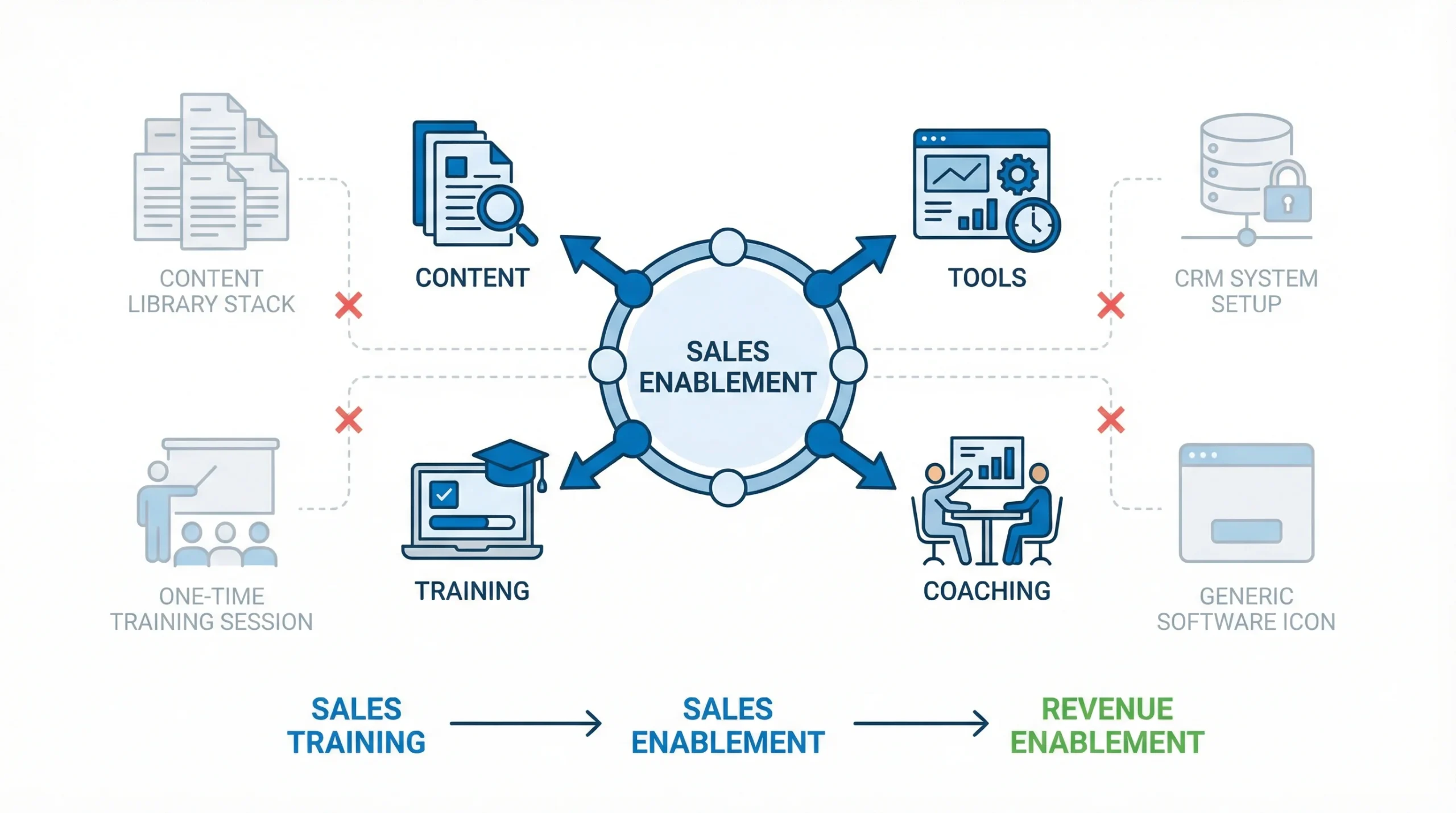
Sales enablement has a definition problem. Ask ten practitioners to define it and you will get ten different answers. Some will describe it as content management. Others will say it is onboarding and training. A few will equate it entirely with the technology stack. None of them are wrong, but none of them are complete.
The working definition that holds up across organizations of every size is this: sales enablement is the strategic process of providing revenue teams with the content, training, tools, and coaching they need to engage buyers effectively at every stage of the sales cycle, and to do so consistently, at scale, and in direct service of measurable business outcomes.
That definition matters for what it includes, but it matters just as much for what it implies. Enablement is not a one-time event. It is not a content library. It is not a quarterly training session. It is an ongoing system that connects strategy to execution — a function that ensures every seller, in every region, in every conversation, has what they need to add genuine value to the buyer sitting across from them.
How Is Sales Enablement Different from Sales Training?
Sales training is a component of sales enablement, not a synonym for it. Training refers to structured, time-bound learning initiatives: onboarding programs, skills workshops, certification courses. These events have a beginning and an end. Sales enablement, by contrast, is continuous. It encompasses content management, coaching, technology adoption, cross-functional alignment, and performance measurement — all of which persist long after a training session ends. The simplest way to think about it is that sales training teaches reps what to do, while sales enablement ensures they can actually do it, day after day, across every deal.
How Is Sales Enablement Different from Sales Operations?
Sales enablement and sales operations are complementary functions that are often confused with each other, and occasionally combined under a single team — but their focus is fundamentally different. Sales enablement is people-focused: it concentrates on improving individual sales reps’ knowledge, skills, and effectiveness. It asks the question “How do we make our salespeople better at their jobs?” Sales operations, on the other hand, is process-focused: it concentrates on the systems and infrastructure that allow the sales organization to run efficiently. It asks the question “How do we make the process itself more scalable and measurable?”
A useful illustration: when a company rolls out a new CRM system, sales operations is responsible for configuring the platform, setting up the dashboards, and defining the workflows. Sales enablement is responsible for ensuring that reps actually know how to use it, understand why it matters, and adopt it consistently. One function builds the track. The other ensures the train knows how to run on it.
The Evolution: From Sales Training to Sales Enablement to Revenue Enablement
The terminology has shifted across three distinct eras, and each shift reflects a genuine change in how organizations think about driving revenue.
In the 1990s and early 2000s, the dominant model was sales training. It was largely transactional: bring the team together for a product update, run a skills workshop, send everyone back to their desks. Knowledge transfer was the goal, and it was measured primarily by attendance and completion.
By the early 2010s, it became clear that front-loaded training was failing. Knowledge decays rapidly, and by the time a rep encountered a specific objection or competitive situation in a live deal, the training was a distant memory. The concept of sales enablement emerged to address this gap — to provide reps with the right information not just at onboarding, but at the right moment throughout the entire sales cycle. Content management, just-in-time resources, and ongoing coaching became the new pillars.
In 2026, the field is undergoing another evolution. Both Gartner and Forrester now recommend that organizations transition to a revenue enablement model that broadens the scope beyond the sales team to include all customer-facing roles — marketing, customer success, solutions engineers, and partner teams. The shift is a fundamental reframe: from enabling “sales” as a team to enabling “revenue” as an outcome driven by multiple functions. The wall between sales and customer success is crumbling. Expansion and renewal are now treated as just as critical as net new business. Enablement no longer stops at the point of sale — it carries the customer journey forward.
What Sales Enablement Is NOT
Misconceptions about sales enablement are not harmless. They misdirect resources, undermine program credibility, and lead organizations to invest in platforms before they have solved the foundational problems those platforms are supposed to support.
- Sales enablement is not a content library. A repository of decks and one-pagers is not an enablement program. Only 3% of sales content crosses 1,000 uses — the vast majority of what organizations create is never meaningfully used by the teams it was built for. Enablement is about ensuring the right content reaches the right rep at the right moment in a deal, not about storing assets in a shared drive.
- Sales enablement is not a training department. The traditional L&D model — front-loaded bootcamps followed by annual refreshers — is one of the patterns that enablement exists to replace. A team that runs onboarding and nothing else is operating as a training function, not an enablement function.
- Sales enablement is not the same as sales operations. The two functions collaborate closely, but their objectives diverge. Enablement focuses on developing people. Operations focuses on optimizing processes and systems.
- Sales enablement is not a buzzword for software. Buying a platform before nailing the strategy is one of the most common and costly mistakes in the field. The platform should support the program — the program should not be defined by the platform.
Why Sales Enablement Is at an Inflection Point in 2026
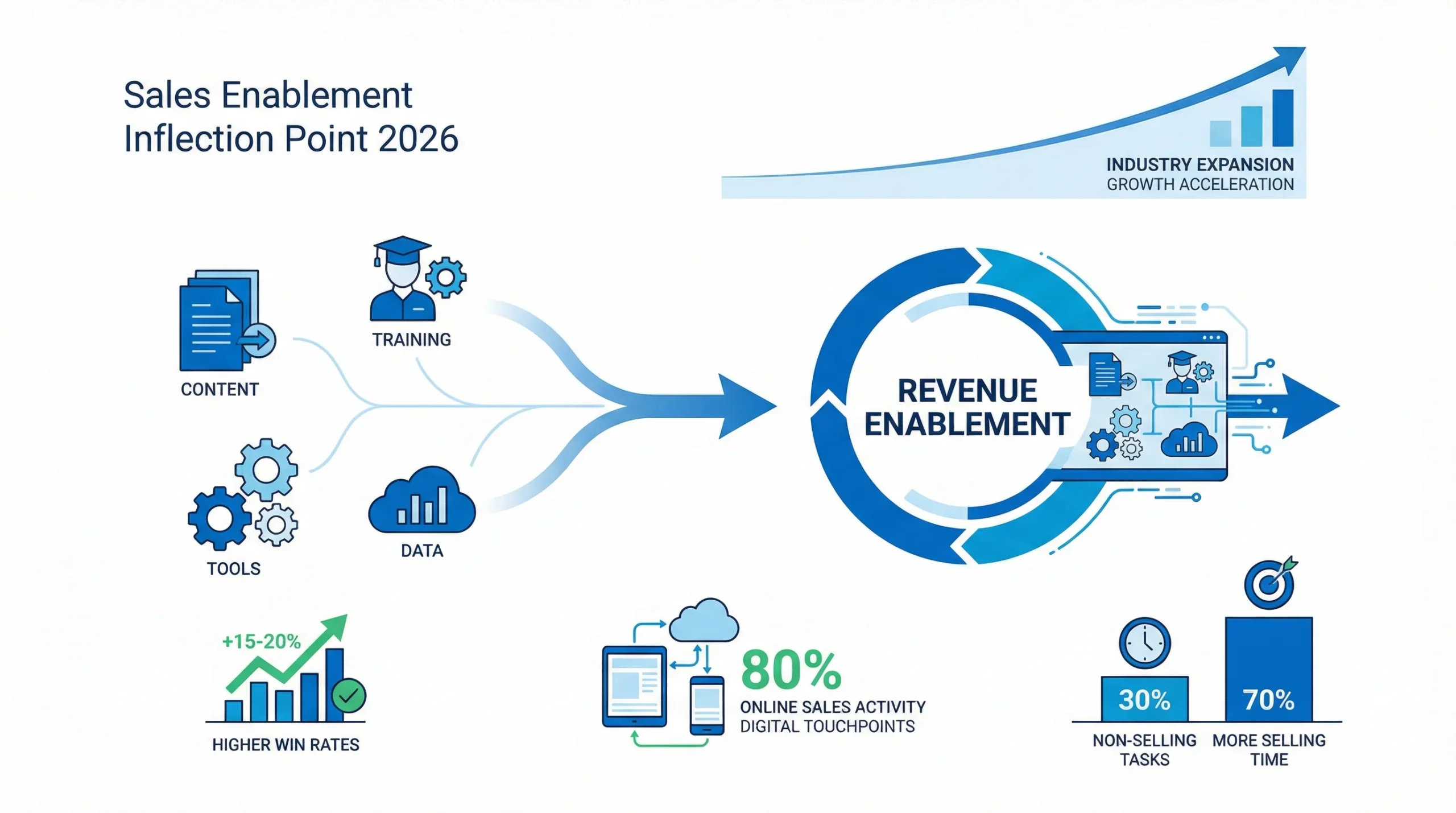
Sales enablement has been growing for years, but 2026 represents something qualitatively different from past growth cycles. The function is not just expanding — it is being fundamentally redefined by a convergence of buyer behavior changes, AI maturation, and organizational pressure to demonstrate hard revenue outcomes.
The most critical context is this: organizations with formal sales enablement programs report up to 49% higher win rates. But the key word in that statistic is “formal.” As one analysis of the data put it, “a team without structured programs and metrics alignment doesn’t move the needle.” Having a person with “sales enablement” in their title is not the same as having a formal program. Having a platform is not the same as having a strategy. The gap between having enablement and having effective enablement is where most of the industry’s value is currently leaking.
The buyer context makes this gap increasingly costly. Gartner reports that 80% of B2B sales interactions now occur in digital channels. Buyers arrive at conversations having already researched competitors, read reviews, and formed preliminary conclusions. Reps who show up without deep product fluency, relevant insights, and a clear understanding of the buyer’s specific situation no longer get a second chance. Enablement is what prepares them to show up that way, consistently.
Reps currently spend 60% of their time on non-selling tasks. Administrative overhead, content searches, CRM updates, and internal coordination consume the majority of a seller’s week, leaving less than a third of their time for actual buyer-facing work. Enablement’s job in 2026 is to reclaim that time — to remove friction from the selling process so that reps can spend it where it counts.
64% of organizations now say their enablement strategy spans all revenue teams. But fewer than one in four describe themselves as truly unified and AI-powered. The parts are there. The system is not. Most organizations have invested in enablement elements — a platform here, a training program there, a content library somewhere — without integrating them into a coherent, measurable function. That is the inflection point: the distance between scattered enablement investment and a unified revenue enablement engine.
The C-suite is also watching more closely than ever. 73% of CSOs now prioritize growth from existing customers over new logos, which fundamentally changes the brief for enablement teams. It is no longer enough to ramp new BDRs quickly and arm them with cold outreach cadences. Enablement must now support account managers, customer success teams, and expansion motions with the same rigor it has historically applied to new business selling.
The $5B+ Market That Is Still Maturing — What Gartner’s First Magic Quadrant for Revenue Enablement Platforms Signals
In late 2025, Gartner released its inaugural Magic Quadrant for Revenue Enablement Platforms — a move that carries significant implications for the field. The creation of a dedicated Magic Quadrant signals that Gartner formally recognizes the category as mature enough to evaluate, differentiate, and recommend to enterprise buyers. The market has moved past “nice to have” into an established function with recognized vendors, defined capabilities, and measurable outcomes.
Analyst estimates for the global market range from $5.0 billion to $7.8 billion in 2026, depending on scope definitions. Cloud deployment accounts for over 82% of that market. North America holds 43.5% of global share, while Asia-Pacific is the fastest-growing region at 21.8% CAGR. The top five vendors — Seismic, Highspot, Bigtincan, Salesloft, and Drift — hold roughly 45% of global revenue, which matters for organizations evaluating switching costs. Gartner projects that enablement budgets will increase by 50% by 2027 as organizations recognize its impact on revenue growth. The market signal is clear: this is no longer a discretionary investment for forward-thinking companies. It is becoming a standard infrastructure cost for competitive B2B organizations.
The Core Pillars of a Modern Sales Enablement Program
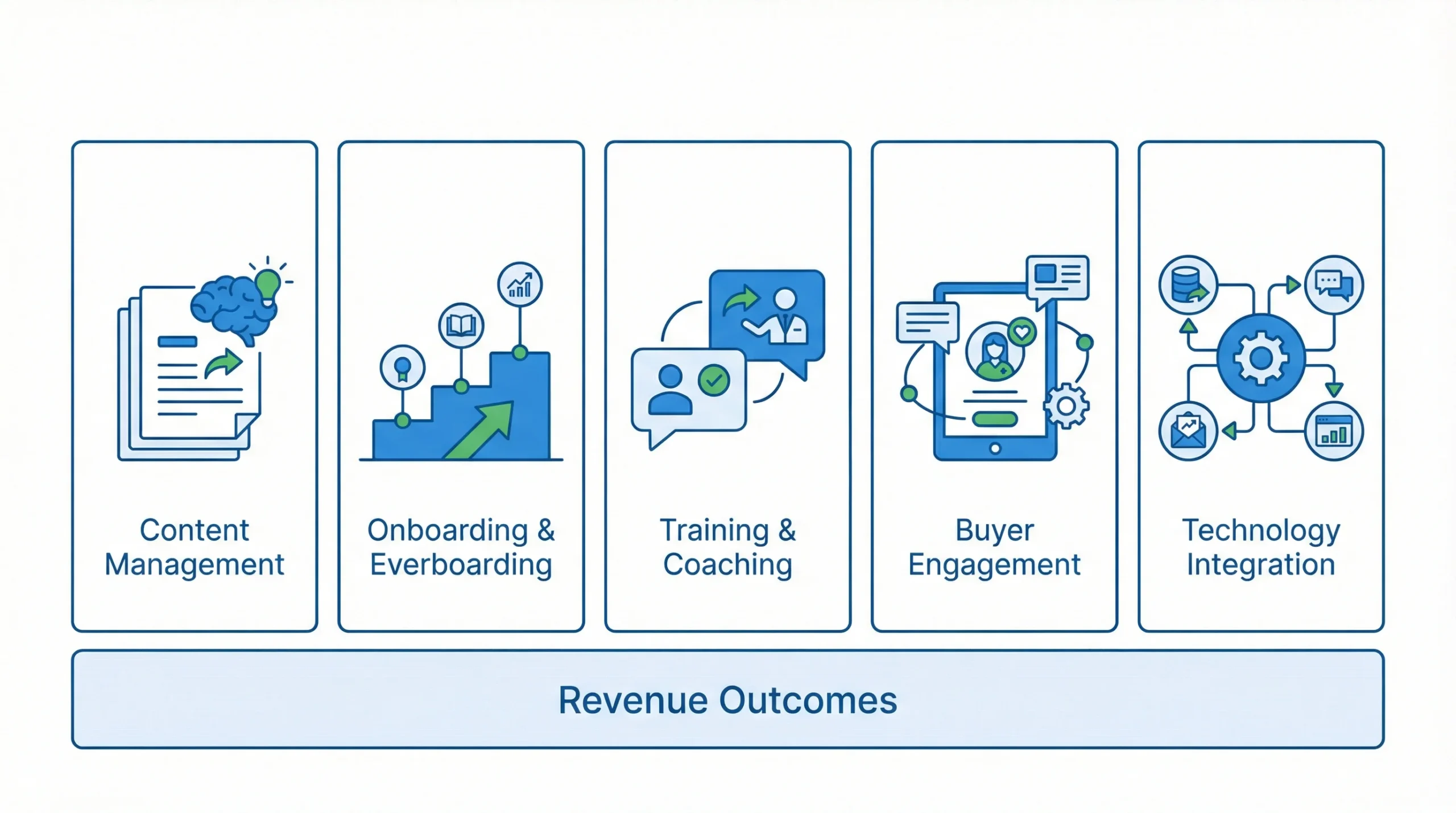
A modern sales enablement program is not defined by the tools it uses or the content it houses. It is defined by the outcomes it enables. The five pillars below represent the functional areas that every mature enablement program must address, and each one should be evaluated not by what is being put in, but by what is coming out.
Content Management — From Repository to Intelligent Delivery
Content is still the most visible output of any enablement function, but the way it is managed and delivered has changed dramatically. The old model — create content, upload it to a shared drive or CMS, tell the sales team it exists — has failed comprehensively. Only 3% of sales content crosses 1,000 uses. Most assets are created, published, and forgotten. 65% of marketing content never gets used by sales at all.
The failure is not a people problem. It is a design problem. Reps cannot use content they cannot find, and they will not use content that is not relevant to the specific conversation they are having. The shift in 2026 is toward intelligent content delivery — AI-powered systems that analyze deal context, buyer industry, sales stage, and competitive situation, and surface the most relevant assets automatically, inside the tools reps are already using.
Effective content management in a modern enablement program involves two types of content. Internal content equips the seller: product guides, competitor battlecards, objection-handling frameworks, buyer personas, and market trend reports. External content equips the buyer: case studies, ROI calculators, product comparisons, and reference materials that help prospects navigate their own internal buying process. The key distinction is that both types must be governed — regularly reviewed, updated, and retired — rather than simply accumulated.
- Governance matters as much as creation. Content without a review cycle becomes a liability. Outdated pricing decks and obsolete competitive claims do more damage than no content at all.
- Findability is not optional. If a rep cannot locate the right asset within 60 seconds during a live conversation, it will not be used. Intelligent surfacing, not search, is the current standard.
- Usage data closes the loop. Modern platforms track which content is used, by which reps, at which deal stages, and correlate that usage with win and loss outcomes. That data should inform every content creation decision.
Sales Onboarding and Everboarding
Onboarding is the most universal element of any sales enablement program, and it is also the most commonly misunderstood. Nearly half of companies treat onboarding as the only time they provide any meaningful training to their sales team. This model — intense bootcamp, certification, and then radio silence — is responsible for one of the most persistent performance problems in B2B sales: slow ramp times, inconsistent messaging, and high early-tenure attrition.
A well-designed onboarding program reduces the time it takes for a new rep to become fully productive by 40–50%. That is a meaningful financial impact. If a fully ramped rep generates $500,000 in annual revenue, every month of ramp time they save translates directly to recoverable pipeline. For a team of 20 reps, the difference between a 6-month and a 4-month ramp is the equivalent of adding a full headcount of productive selling capacity.
But the more significant evolution is what comes after onboarding: a model called everboarding. Everboarding replaces the front-loaded bootcamp with continuous, contextual learning touchpoints that reinforce, refine, and expand a seller’s skill set throughout their entire tenure. Rather than treating ramp as a finite period with a fixed endpoint, everboarding recognizes that the market, the product, the competitive landscape, and the buyer’s expectations are all constantly changing — and that seller readiness must keep pace.
- Structured onboarding gives new hires a clear sequence: product knowledge first, then messaging, then live deal shadowing, then independent pipeline work with coaching support.
- Everboarding adds regular reinforcement: product update training ahead of new releases, messaging refreshes when GTM priorities shift, competitive coaching when new players enter the market, and skill development based on individual performance gaps identified through deal data.
- Role-specific tracks matter more than one-size-fits-all programs. A BDR who books meetings needs different preparation than an AE who runs discovery calls, who needs different preparation than a customer success manager who handles renewals.
Ongoing Training and AI-Powered Coaching
In 2026, high-performing reps are not developed through static courses and checkbox certifications. They develop through immersive, AI-driven training scenarios that mimic live deals — complete with buyer objections, competitive pressure, and product nuance. This shift is not simply about making training more efficient. It is about making practice more realistic so that when reps encounter difficult situations in real deals, their responses are calibrated and confident rather than improvised.
AI role-play tools now simulate the full complexity of a B2B sales conversation: a skeptical economic buyer who questions ROI, a technical evaluator who challenges integration feasibility, a champion who is trying to build an internal business case. Reps who practice these edge cases outperform those who only train on theory. As B2B sales cycles become more technical and buying committees grow larger, the reps who can navigate complexity under pressure are the ones who close.
Coaching has undergone an equally significant transformation. Historically, sales coaching has relied on gut feel, inconsistent frameworks, and anecdotal input from managers who were also expected to run pipeline reviews, handle escalations, and carry their own quota. That approach is no longer sufficient. AI-powered coaching tools now automate feedback delivery based on conversation intelligence data, generate personalized development plans for individual sellers, and create manager-centric workflows that tie coaching activity to observable revenue outcomes.
- Skill-based development has replaced role-based training. Different reps need different competencies depending on their territory, product line, and buyer personas. A blanket training curriculum ignores the individual variation that actually drives performance differences.
- Coaching frequency matters more than coaching duration. Multiple short, targeted coaching sessions grounded in specific deal data produce better outcomes than quarterly review meetings.
- Manager enablement is the highest-leverage move available to most enablement teams. Reps leave; managers stay and perpetuate culture. Training the people who coach the sellers multiplies enablement’s impact across every rep on their team.
Buyer Engagement — Personalized Collateral and Plays at Scale
The nature of buyer engagement has changed in ways that make generic outreach not just ineffective, but actively counterproductive. Tired email templates and over-engineered cadences are being filtered, blocked, and ignored. Buyers who receive a one-size-fits-all pitch from a rep who clearly did not read their annual report or understand their industry challenges do not give that rep a second meeting. They move on to a competitor who arrived prepared.
In 2026, personalization at scale is a legitimate capability, not a contradiction. AI-powered tools can now help reps customize messaging, talking points, and collateral to specific accounts, personas, and deal stages without going rogue on brand or requiring hours of individual preparation. The operative word is “personalized” — not just inserting a company name into a template, but delivering content and conversation that reflects genuine understanding of the buyer’s specific situation.
- Digital sales rooms have become a significant buyer engagement tool. Rather than sending attachments over email, reps can create a shared, persistent space where all deal materials — proposals, case studies, mutual action plans, and product demos — live in one place that the buyer can access and share internally. This gives enablement teams visibility into which stakeholders are engaging with which materials, which is intelligence that can change how a rep prioritizes their next conversation.
- Mutual action plans align buyers and sellers around a shared timeline with explicit milestones and accountabilities on both sides. They reduce the ambiguity that causes deals to stall in the “dark” period after a proposal is sent.
- Competitive plays need to be current, specific, and accessible. Teams with regularly updated battlecards win 23% more competitive deals than those with outdated or nonexistent competitive materials. Only 29% of sales reps currently feel they have adequate information about competitors — closing that gap is one of the highest-return investments any enablement team can make.
- Personalized outreach requires more than good intentions. Reps need account intelligence, clear personas, and a defined message framework that they can adapt to individual conversations without starting from scratch every time.
Technology and Workflow Integration
The sales technology market has created a paradox: the more tools organizations adopt, the less productive many of their reps become. Sales teams with integrated tech stacks see 24% higher productivity than those with fragmented, disconnected point solutions. Yet 43% of tools in the average sales tech stack have adoption rates below 50%. Nearly half of technology investment is being actively ignored by the people it was purchased to help.
The root cause is not laziness. It is friction. When a rep must navigate between a CRM, a content management system, a learning platform, a conversation intelligence tool, and a sales engagement platform — each with its own login, interface, and data model — the cognitive overhead of tool-switching eats into the time that should be spent on selling. Reps will default to whatever requires the least effort, which is usually not the most sophisticated or compliant option.
The 2026 imperative is consolidation — not as a cost-cutting measure, but as a performance measure. The organizations showing up at the top of win-rate benchmarks are the ones that have moved toward platforms where content, coaching, conversation intelligence, and analytics actually work together, integrated into a single workflow rather than existing as separate systems that sales reps must consciously switch between.
- Enablement must come to the rep, not the other way around. If reps must leave their working environment — the CRM, the email composer, the deal room — to access training or content, adoption will be low. Modern enablement is embedded in the flow of work.
- Tech stack consolidation is not the same as capability reduction. The goal is to do more with fewer, better-connected tools — not to eliminate functionality, but to eliminate the friction between systems.
- Adoption is the real metric for technology ROI. A tool that reps do not use is not an asset. It is a line item. Every technology decision in an enablement program should be evaluated against the question: “Will reps actually use this, and will they use it correctly?”
The State of Sales Enablement in 2026 — What the Data Says
The numbers that define the current state of sales enablement in 2026 tell two different stories simultaneously. The first is a story of significant growth, accelerating AI adoption, and expanding organizational scope. The second is a story of persistent gaps between investment and outcome, between strategy and execution, between what enablement teams are asked to do and the resources they are given to do it.
Both stories are true, and understanding both is necessary to build a program that actually performs.
68% of sales leaders plan to increase investment in AI and automation tools in 2026, recognizing that manual sales activities carry hidden costs that compound over time as teams grow. Virtually all enablement teams are now using AI in some form, and 78% of enablement professionals describe themselves as either optimistic or very optimistic about AI’s role in the function. The question in 2026 is no longer whether to adopt AI, but how to deploy it strategically — as an operational discipline rather than a collection of disconnected features.
The most common ownership structure for sales enablement has shifted significantly. According to the Sales Enablement Landscape Report 2025, RevOps now leads enablement in 39.4% of organizations, followed by Sales at 25.4% and the C-Suite at 16.6%. This represents a meaningful shift from prior years, when sales leadership was the default home for the function. The migration toward RevOps reflects the broader trend of treating enablement as a cross-functional revenue discipline rather than a sales-only support function.
The competitive intelligence gap remains one of the most underaddressed problems in the field. Only 29% of reps feel they have adequate information about competitors, leaving them vulnerable during evaluations where 47% of deals involve three or more vendors being assessed simultaneously. Teams with regularly updated battlecards win 23% more competitive deals than those with outdated or absent competitive materials. The investment required to close this gap — regular competitive research and timely distribution of battlecards — is modest relative to its win-rate impact.
From Sales Enablement to Revenue Enablement — What the Name Change Signals
The shift in terminology from “sales enablement” to “revenue enablement” is not semantic. It reflects a genuine expansion of scope and accountability that has real implications for how programs are structured, measured, and resourced.
Sales enablement historically focused on the pre-sale motion: equipping BDRs and AEs with the content, training, and coaching they needed to open and close new business. Revenue enablement expands that mandate to cover the entire customer lifecycle — including the customer success teams responsible for onboarding, adoption, expansion, and renewal. This is not simply a change in language. It requires different content, different training programs, different coaching frameworks, and different metrics than those traditionally used to measure sales enablement success.
The business logic is straightforward: 73% of CSOs now prioritize growth from existing customers over new logos. If the majority of an organization’s revenue growth is expected to come from expansion within the existing customer base, then an enablement function that stops at the point of initial sale is leaving the majority of its potential impact on the table.
The Human Element Returning — Why “Data Over Everything” Is Being Corrected
One of the more nuanced shifts in the 2026 enablement landscape is a growing recognition that the function’s recent fixation on hard metrics has come at the expense of the human factors that drive seller performance. Over the past several years, as global B2B sales declined and revenue leaders demanded quantifiable justification for enablement investment, many enablement teams overcorrected — building dashboards full of activity data while losing sight of the individual sellers sitting behind those numbers.
There is a growing appetite for broader metrics that reflect what actually drives rep success: psychological safety within the team, coaching quality, personal growth, and a sense of purpose in the role. These factors have historically been dismissed as “soft” or intangible, but their impact on seller effectiveness is real. More enablement leaders in 2026 are incorporating these dimensions into their standard KPIs, creating a more complete picture of rep development that complements, rather than replaces, the hard revenue metrics that leadership expects.
Key Benefits of a Formal Sales Enablement Strategy
The case for sales enablement is well-supported by data, but the strongest organizations do not treat enablement as a cost center to be justified — they treat it as a revenue function to be invested in. The five categories of benefit below represent the documented outcomes that formal, structured enablement programs consistently deliver.
Higher Win Rates and Pipeline Conversion
Organizations with formal sales enablement programs report up to 49% higher win rates on forecasted deals compared to those without one. Companies with dedicated enablement functions are 2.2 times more likely to have a consistently strong sales pipeline. These are not marginal gains — they represent the difference between a team that converts pipeline reliably and one that depends on exceptional individual performance to make up for systemic preparation gaps.
The mechanism is straightforward. When reps arrive at every conversation with the right content for that specific buyer, have practiced handling the objections most likely to arise, and can access competitive intelligence relevant to the deal they are working, they close at a higher rate. Enablement removes the variables that cause deals to stall or die — outdated information, missed objections, generic pitches that fail to land — and replaces them with preparation that scales.
Faster Rep Ramp Time and Productivity
The productivity impact of sales enablement operates at two levels: getting new reps to full productivity faster, and recovering selling time from administrative overhead for the entire team.
Structured enablement programs reduce onboarding ramp time by 40–50%. For organizations hiring at scale, this is one of the most direct and measurable financial benefits of the function. Every month saved in ramp time is a month of productive selling capacity added to the organization without adding headcount.
For established reps, the productivity lever is time reclamation. Reps currently spend 60% of their time on non-selling tasks. Content searches, manual CRM updates, preparing for meetings, and responding to internal requests consume hours that should be spent with buyers. Enablement — through better content organization, AI-assisted workflows, and process design — can meaningfully shift this ratio, returning selling time to the sellers.
Cross-Functional GTM Alignment
One of the most undervalued benefits of a formal enablement function is its role as the connective tissue between sales, marketing, product, and customer success. In organizations where these teams operate in silos — each with their own priorities, messaging, and metrics — GTM execution becomes fragmented. Marketing campaigns do not land because sales does not have the supporting content. Product launches fail to generate pipeline because reps are not trained on the new positioning. Customer success struggles with renewals because the expectations set during the sale did not match the product reality.
Sales and marketing alignment alone can help an organization become 67% better at closing deals. A formal enablement function enforces that alignment structurally — creating shared content governance, cross-functional training cycles, and unified messaging that ensures every customer-facing team is telling the same story in the same language at the right moment in the buyer journey.
Stronger Coaching and Rep Development Culture
The shift from anecdotal, gut-feel coaching to data-driven, behavior-based development is one of the clearest dividing lines between high-performing and average-performing sales organizations in 2026. Enablement is the function that makes this shift operational — providing managers with the deal data, conversation intelligence, and skill assessment frameworks they need to coach based on what they observe rather than what they remember.
Regular coaching translates directly into measurable performance improvements. A 29% improvement in win rates has been documented among reps who receive consistent coaching versus those who do not. The compounding effect of a coaching culture — where skill development is continuous, feedback is immediate, and managers are themselves developed to coach effectively — creates a team that improves every quarter rather than plateauing after initial onboarding.
Beyond the hard performance metrics, enablement also shapes the less-visible factors that determine long-term seller effectiveness: psychological safety, team cohesion, and individual sense of growth. Reps who feel equipped, coached, and supported stay longer, perform more consistently, and advocate more authentically for the products they sell. Organizations with highly effective sales training programs report significantly lower turnover — 33.8% compared to 45.5% at companies without effective programs.
Better Customer Experience and Retention
The benefits of enablement do not stop at the point of sale. They extend through the entire customer relationship. When reps are trained to conduct thorough discovery conversations, to set accurate expectations about product capabilities and implementation timelines, and to connect buyers to the right resources at the right moments, the post-sale experience is meaningfully better. Customers who were well-informed during the buying process arrive at onboarding with realistic expectations, adopt the product more completely, and renew at higher rates.
79% of B2B companies currently neglect customer success enablement despite an increased focus on customer retention. With 73% of CSOs now prioritizing growth from existing customers, this is a gap that has a direct revenue impact. Enabling customer success teams with the same rigor applied to sales — relevant playbooks, renewal conversation frameworks, expansion play guides, and objection-handling resources — is one of the highest-return investments available to organizations whose growth model depends on customer lifetime value.
Who Owns Sales Enablement in 2026? Team Structures and Reporting Lines
The question of who owns sales enablement has never had a clean, universal answer — and in 2026, the answer is shifting in ways that reflect the broader transformation of the function from a sales support role to a revenue-wide strategic discipline.
The Historical Ownership Debate: Sales vs. Marketing vs. Operations
For most of the function’s history, sales enablement reported into the sales organization. This made intuitive sense: the primary beneficiaries of enablement were sellers, the metrics that mattered most were sales metrics, and the credibility of the function depended on being seen as directly connected to revenue. According to research from 2022, the Chief Sales Officer owned the sales enablement function in 35% of organizations, with CROs and Chief Growth Officers representing another 25%.
Marketing ownership has also been common, particularly in organizations where enablement grew out of a product marketing function. The logic here is that marketing creates the content and messaging that enablement distributes — so the functions should sit together. In practice, this model often creates tension, because marketing-aligned enablement can become too focused on content production and too disconnected from the actual field challenges that sellers face.
The Current Reality: RevOps as the Emerging Home for Enablement Leadership
The most significant shift in ownership over the past two years has been the migration of enablement toward Revenue Operations. According to the Sales Enablement Landscape Report 2025, RevOps now leads enablement in 39.4% of organizations — a significant increase from prior years. Sales ownership has declined to 25.4%, while C-Suite ownership accounts for 16.6%.
This shift reflects the broader maturation of RevOps as a function. As organizations have invested in unifying their go-to-market operations under a single revenue leadership structure, enablement has followed — moving from its historical home in sales to a cross-functional function that sits within the team responsible for the entire revenue engine. The appeal of RevOps ownership is structural: RevOps already governs the processes, systems, and data that enablement depends on, and the function’s accountability to all revenue teams rather than just sales makes it a natural home for an enablement program that has expanded to cover the full customer lifecycle.
Common Team Structures: Embedded, Centralized, and Hybrid Models
There is no single team structure that works for every organization. The right model depends on the size of the sales team, the number of products and markets, the maturity of the GTM motion, and the organization’s capacity for centralized versus distributed decision-making. Three models dominate in practice.
- Centralized model: A single enablement team serves all revenue functions under one leader. This model works best for organizations with a single, consistent sales motion — one product, one segment, one methodology. It provides consistency, eliminates duplication, and makes alignment straightforward. A common planning benchmark is one enablement FTE per 20 to 40 sellers. The centralized model struggles at scale: as the organization grows and adds products, segments, or geographies, a single team cannot maintain the depth of contextual knowledge that each audience requires.
- Hub-and-spoke model: A central enablement center of excellence sets strategy, standards, and shared programs, while embedded enablement specialists work directly within specific business units, regions, or product lines. This model preserves strategic consistency while allowing for the contextual depth that different parts of the organization need. It is the most common structure in multi-product or multi-geography organizations, and the one most frequently recommended for mid-market and enterprise companies.
- Decentralized model: Individual business units or regions run their own enablement functions with minimal central coordination. This model maximizes local responsiveness but creates significant risk of messaging inconsistency, duplicated effort, and difficulty measuring performance across the organization. It is more common in very large enterprises where the cost of centralization is seen as outweighing the benefits of consistency.
When Should You Hire Your First Dedicated Enablement Person?
Most organizations do not make their first dedicated enablement hire at the right time. They either hire too early — before they have a documented ICP, a content governance process, or a defined sales methodology — or too late, after years of inconsistent rep performance have already created habits that are difficult to change.
The most practical signal is sales team size and sales complexity combined. When a sales team reaches a size where a manager can no longer individually coach every rep, when onboarding new hires is taking more than three months to produce measurable pipeline activity, or when reps are consistently losing deals to competitors at stages they should be winning — these are the indicators that the function needs a dedicated owner. Most organizations benefit from a dedicated enablement resource once they have a sales team of more than ten people and are experiencing visible friction in the handoffs between marketing, sales, and customer success.
What Does a Mature Enablement Org Look Like at Scale?
A mature enablement function at scale looks significantly different from the single-person program that most organizations start with. It includes functional specialization — roles focused on content management, learning and development, technology and operations, and performance analytics — all connected by a shared strategy and measured against shared revenue outcomes. It has formal governance processes for content creation and review. It has a defined measurement framework that connects enablement activity to business outcomes. And it has a seat at the strategy table — contributing to GTM planning, not simply executing against plans that others have already made.
5 Sales Enablement Best Practices for 2026
1. Start with Business Outcomes, Not Tools or Content
The single most common failure mode in sales enablement is starting in the wrong place. Organizations purchase a platform, hire an enablement manager, and begin producing content — before anyone has clearly defined what they are trying to achieve or how they will know if they have achieved it. The result is a program that generates significant activity with minimal measurable impact.
Effective enablement begins with a clear definition of the specific business outcomes the program is expected to drive. “Improve sales performance” is not a business outcome. “Reduce average ramp time from 6 months to 4 months for enterprise AEs” is a business outcome. “Increase win rate on competitive deals from 24% to 35% within two quarters” is a business outcome. These specific, measurable targets determine which programs to build, which content to create, which metrics to track, and how to allocate the team’s time and budget.
Only 51% of sales enablement professionals report being aligned with their C-suite on which success KPIs matter most. That misalignment is not a communication problem — it is a strategy problem. When enablement does not have clear, agreed-upon business outcomes, every subsequent decision about the program becomes harder to make and harder to defend.
- Map every program to a specific revenue outcome. If you cannot articulate how a training initiative, a content asset, or a technology investment will move a measurable metric, that is a signal to reconsider the investment.
- Do not buy a platform before nailing the fundamentals. A documented ICP, a content governance process, and a defined sales methodology are prerequisites for platform investment — not outputs of it.
- Define your measurement framework before launching programs. Establishing baselines for win rate, ramp time, quota attainment, and deal velocity before enablement interventions begin makes it possible to isolate and demonstrate the program’s impact.
2. Build Tight Alignment Between Sales, Marketing, Enablement, and RevOps
Sales enablement programs fail at the seams — in the handoffs between teams, in the gaps between what marketing creates and what sales uses, in the distance between what RevOps measures and what enablement optimizes for. Alignment is not a cultural aspiration. It is a structural requirement.
Sales and marketing alignment can help an organization become 67% better at closing deals. But alignment does not happen organically when teams have different leaders, different KPIs, and different calendars. It requires explicit structural mechanisms: shared planning cycles, shared content governance, shared definitions of key metrics, and regular cross-functional reviews that create accountability for the gaps.
- Shared language is non-negotiable. When sales, marketing, and RevOps define “qualified lead,” “closed-won,” or “deal stage” differently, every conversation about performance becomes a debate about definitions rather than a discussion about outcomes.
- Content creation must be demand-driven. Marketing should create content based on the questions and objections that reps are encountering in the field, not based on what the marketing team believes is strategically important. Regular feedback loops — structured conversations between enablement, sales, and marketing about what is working and what is missing — are how this demand signal gets translated into effective content.
- Shared metrics close the loop. When sales, marketing, and enablement are accountable to the same pipeline and revenue metrics, they have aligned incentives to cooperate rather than compete.
3. Map All Enablement Materials to the Actual B2B Buyer Journey
One of the most persistent design flaws in enablement programs is building materials around how sellers prefer to sell rather than how buyers actually make decisions. The B2B buyer journey in 2026 does not follow a linear sequence of stages that neatly align with CRM pipeline stages. Buyers conduct independent research, involve multiple stakeholders, revisit their evaluation criteria, and make decisions through internal consensus-building processes that a single seller may have limited visibility into.
Effective enablement maps content, training, and plays to the buyer’s journey — addressing the questions buyers are asking at each stage, equipping reps to facilitate internal selling on the buyer’s side, and providing materials that buyers can use to build their own business cases and navigate their procurement processes.
- Buying committee complexity requires specific preparation. 47% of B2B deals involve three or more vendors being evaluated simultaneously. The buying committee for a typical enterprise deal now includes multiple stakeholders with different roles, different concerns, and different definitions of success. Enablement must train reps to identify committee members, understand each stakeholder’s priorities, and adapt their approach accordingly.
- Champion enablement is buyer enablement. In complex deals, the rep’s most important job is often not to sell to the economic buyer directly but to equip the internal champion with the arguments, evidence, and materials they need to sell internally on the rep’s behalf. Content designed to help champions build business cases is among the highest-value investment any enablement team can make.
- Buyer-facing content should be designed for sharing. Case studies, ROI models, and comparison frameworks created for external audiences need to be readable and compelling to people who have never spoken to a rep — because they frequently will be shared internally with stakeholders who have not.
4. Replace One-Time Training with Continuous, Skills-Based Development
The shift from one-time training events to continuous, skills-based development is one of the most consequential changes in sales enablement practice in 2026. It is also one of the most operationally demanding, which is why many organizations acknowledge it in principle without making the structural changes required to implement it.
Skills-based enablement has replaced role-based training as the standard for high-performing programs. Rather than designing training based on job title — “this is the AE training program, this is the BDR training program” — effective programs identify the specific skills that drive performance in each type of deal, territory, or buyer segment, and build development paths tailored to individual skill gaps. A rep who excels at prospecting but struggles with multi-stakeholder deals needs different development than a rep who closes well but cannot generate their own pipeline.
- Continuous reinforcement is not optional. Research on learning retention shows that 70% of training content is forgotten within a week without reinforcement. Programs that invest in creating training content without building in reinforcement mechanisms are spending money on knowledge that will not be retained.
- Just-in-time learning increases relevance and retention. Delivering a 5-minute module on handling a specific objection when a rep is preparing for a deal where that objection is likely to arise produces better outcomes than delivering the same module in a scheduled training session with no immediate application.
- Performance data should drive development priorities. Deal data from lost opportunities, conversation intelligence from recorded calls, and skill assessments tied to rep outcomes should collectively determine where the enablement team focuses its development investment. Programs built on assumptions about what reps need, rather than evidence from what is actually causing deals to be lost, will never optimize.
5. Measure, Iterate, and Let AI Surface What Is Actually Working
Measurement is where most enablement programs lose credibility. 67% of enablement leaders cite “proving ROI” as their top challenge. Only 29% of sales enablement teams can directly tie their programs to revenue impact. The problem is not that enablement does not generate return — the data strongly suggests it does. The problem is that most organizations are measuring the wrong things and attributing the wrong outcomes.
The fundamental ROI formula for sales enablement is the same as for any investment: Revenue Attributed to Enablement minus Enablement Investment, divided by Enablement Investment, multiplied by 100. The challenge is attribution. Revenue is influenced by product quality, market conditions, pricing, marketing spend, and dozens of other factors alongside training and enablement programs. Isolating enablement’s contribution requires a structured approach that connects specific interventions to specific performance changes.
- Win rate is the most important business metric to track. The gap between organizations with formal enablement programs (49% win rate) and those without (42.5%) represents the clearest evidence available that enablement changes outcomes. Tracking win rate by segment, by rep cohort, and by deal stage provides the data needed to identify where enablement is working and where it is not.
- Ramp time and quota attainment are the talent metrics that matter most. How quickly new reps generate pipeline and close deals, and what percentage of the team consistently hits quota, are the two indicators most directly tied to the financial value of the enablement function.
- Content adoption data closes the attribution gap. When platforms can show that reps who used a specific battlecard in competitive deals won at a higher rate than those who did not, the ROI of creating and maintaining that content becomes demonstrable.
- Moving past completion rates is non-negotiable. Training completion rates, attendance numbers, and satisfaction scores are useful directional indicators, but they do not answer the question that leadership actually cares about: is this investment generating more revenue than it costs?
How to Make the Business Case for Sales Enablement Investment
Getting executive investment for a sales enablement program — or for expanding an existing one — requires a different approach than most enablement leaders currently take. The default approach is to present a set of statistics about the potential benefits of enablement, describe the program being proposed, and ask for budget. This approach rarely works well because it asks executives to take a leap of faith on abstract outcomes rather than connecting the investment to specific problems they are already losing sleep over.
A more effective approach starts with the problem, not the solution. Before presenting a single statistic about win rates or ramp time, the conversation needs to be anchored in the specific revenue challenges the organization is facing right now: why deals are being lost, where pipeline is stalling, which segments are underperforming, and what the quantified cost of those failures is. Enablement then becomes the answer to a problem the executive already recognizes, rather than a solution in search of a problem.
Only 51% of sales enablement professionals are aligned with their C-suite on which KPIs matter most. That misalignment is the root cause of most failed investment conversations. If the CFO cares about cost per acquisition and the CRO cares about win rate and the VP of Sales cares about ramp time, a proposal that speaks only to one of those concerns will fail to build the coalition necessary to secure full investment.
The Three Statistics That Do the Heavy Lifting in a Budget Conversation
Three data points, presented in the right sequence, consistently move investment conversations forward.
- 49% higher win rates from organizations with formal enablement programs. This is the outcome metric — it answers the question “what do we get?” Put this on slide two, before any budget ask, and anchor the conversation in what winning looks like before discussing what it costs.
- 60% of rep time spent on non-selling tasks. This is the efficiency metric — it answers the question “where is the gap?” It gives the C-suite a concrete picture of where current performance is leaking, and it frames enablement as a productivity investment rather than a training expense.
- 40–50% reduction in ramp time. This is the talent metric — it answers the question “what does this do to our people?” For organizations that are hiring and experiencing early-tenure attrition, this single data point often justifies the investment on its own.
Framing Enablement as a Revenue Driver, Not a Cost Center
The language used to present enablement investment matters as much as the data. Programs framed as training initiatives or support functions are evaluated as cost centers — measured against a cost budget rather than a revenue contribution. Programs framed as revenue engines are evaluated differently.
The correct comparison is not “how much does this enablement program cost?” but “what would it cost to achieve the same revenue outcomes through hiring, and how does that compare to developing the team we already have?” Replacing an underperforming sales rep costs 1.5 to 2 times their annual salary, according to research from DePaul University. If enablement improves performance for existing reps, the cost avoidance alone frequently justifies the investment — before accounting for the revenue generated by the improved performance.
Aligning Your Ask to What Each Executive Cares About
Different members of the C-suite evaluate the same investment proposal through different lenses, and the most effective budget conversations speak directly to each one.
- The CFO cares about cost efficiency, predictability, and return on investment. Frame enablement in terms of cost per revenue dollar generated, cost avoidance from reduced turnover and faster ramp, and measurable improvement in pipeline conversion efficiency.
- The CRO or VP of Sales cares about win rate, quota attainment, pipeline velocity, and the consistency of team performance. Frame enablement in terms of the specific metrics where current performance is falling short and the documented gap that formal programs close.
- The CMO cares about content utilization, message consistency, and the alignment between campaign investment and sales execution. Frame enablement in terms of closing the gap between what marketing creates and what sales actually uses, and the impact of consistent messaging on conversion rates.
Common Objections and How to Address Them
Executive objections to enablement investment tend to cluster around four concerns, and each has a data-backed response.
- “We already have training. Why do we need enablement?” Training is a component of enablement, not a substitute for it. Content management, coaching, technology integration, and performance measurement are not provided by training alone.
- “How do we know this will actually improve revenue?” Use conservative attribution. Claim 25–50% of measured improvement and say so explicitly. “Even attributing only 30% of our win rate improvement to enablement — which is conservative — the ROI is positive and significant.” This builds trust and preempts the correlation-versus-causation objection.
- “We don’t have budget for a full program right now.” Offer a tiered proposal with three investment levels and show the trade-offs at each level. This empowers executives to choose an investment level without feeling pressured while maintaining control over priorities.
- “This is a good quarter. We’ll revisit next cycle.” The cost of doing nothing compounds. Reps who are underperforming this quarter will continue to underperform without systematic intervention. The gap between what your current win rate is and what it could be with formal enablement is real revenue that is being left on the table every month the conversation is deferred.
FAQs
What is the difference between sales enablement and revenue enablement?
Sales enablement traditionally focused on equipping sales teams — BDRs, SDRs, and AEs — with the content, training, and tools they need to win new business. Revenue enablement expands that scope to cover all customer-facing roles across the entire customer lifecycle, including customer success, solutions engineering, partner teams, and account management. The shift reflects the recognition that revenue is driven by multiple functions, not just the initial sale, and that expansion and retention deserve the same level of systematic support as new business acquisition.
What does a sales enablement manager actually do?
A sales enablement manager is responsible for ensuring that every seller in the organization has what they need to engage buyers effectively and perform at a consistently high level. In practice, this means designing and delivering onboarding programs for new hires, managing the content library and ensuring materials are current and accessible, building and running ongoing training and coaching programs, measuring the impact of enablement initiatives on sales performance, and working cross-functionally with marketing, product, and RevOps to align messaging and programs with GTM strategy. In smaller organizations, one person may do all of this. In larger organizations, these responsibilities are distributed across a team with functional specializations.
What tools make up a modern sales enablement tech stack?
A modern enablement tech stack typically includes a sales enablement platform or revenue enablement platform for content management, training delivery, and performance analytics; a CRM for pipeline management and deal data; a conversation intelligence tool that records and analyzes sales calls; a sales engagement platform for outreach automation and sequencing; and an AI coaching tool for rep development. The most important principle for tech stack decisions is integration: tools that cannot share data with each other create friction and reduce adoption. The consolidation trend in 2026 is toward fewer, more deeply connected tools rather than a larger collection of point solutions.
How do you measure the ROI of sales enablement?
The core ROI formula is: Revenue Attributed to Enablement minus Enablement Investment, divided by Enablement Investment, multiplied by 100. In practice, the most reliable metrics to track are win rate improvement over time, reduction in average ramp time for new hires, quota attainment percentage across the team, deal velocity (how quickly deals move through the pipeline), and content adoption rates correlated with deal outcomes. Because revenue is influenced by many factors, conservative attribution — claiming 25–50% of measured improvement — is more credible and more defensible than claiming full credit for performance changes.
How long does it take to build a sales enablement program from scratch?
A basic enablement program — onboarding curriculum, content library, and measurement framework — can be operational within 90 days with dedicated resources. A more mature program with ongoing training, AI-powered coaching, and full cross-functional alignment typically takes 6–12 months to establish and 12–24 months to optimize. The speed of maturation depends on organizational complexity, the quality of existing sales data, and the degree of executive support for the function. The most common mistake is attempting to build a fully comprehensive program in the first 90 days, which leads to overextension and poor execution. Starting with the highest-impact interventions — usually onboarding and competitive enablement — and adding complexity over time produces better results.
Is sales enablement only for large enterprise teams?
No. Sales enablement is relevant at any scale where more than one person is selling. The specific programs, tools, and team structures that are appropriate vary significantly based on company size and go-to-market complexity, but the fundamental principles — equipping sellers with the right content, training, and coaching to engage buyers effectively — apply to a five-person startup sales team as much as they do to a global enterprise. Smaller organizations typically start with the fundamentals: a structured onboarding process, a content library organized by deal stage and buyer persona, and a coaching cadence for the sales manager. These foundations can be built without dedicated headcount or expensive platforms, and they create the organizational habits that make more sophisticated programs effective when the team is ready to invest in them.