


Most companies arguing agency vs in-house are fighting about the wrong variable.
The real question is not “who can send more emails?” It is about relationship capital, process maturity, and whether your team is starting from zero or inheriting ten years of publisher trust. Speed of link acquisition depends on all three, and most in-house teams do not lose on effort. They lose on cold-start time, and nobody puts that in the budget.
This article gives you real timelines, actual cost comparisons by stage, and a direct verdict, not a balanced list of pros and cons that leaves you exactly where you started. The decision of SEO outreach agency vs in-house is worth making clearly, with a 12-month horizon in mind.
The Cold-Start Problem: Why In-House Link Building Is Slower Than You Think
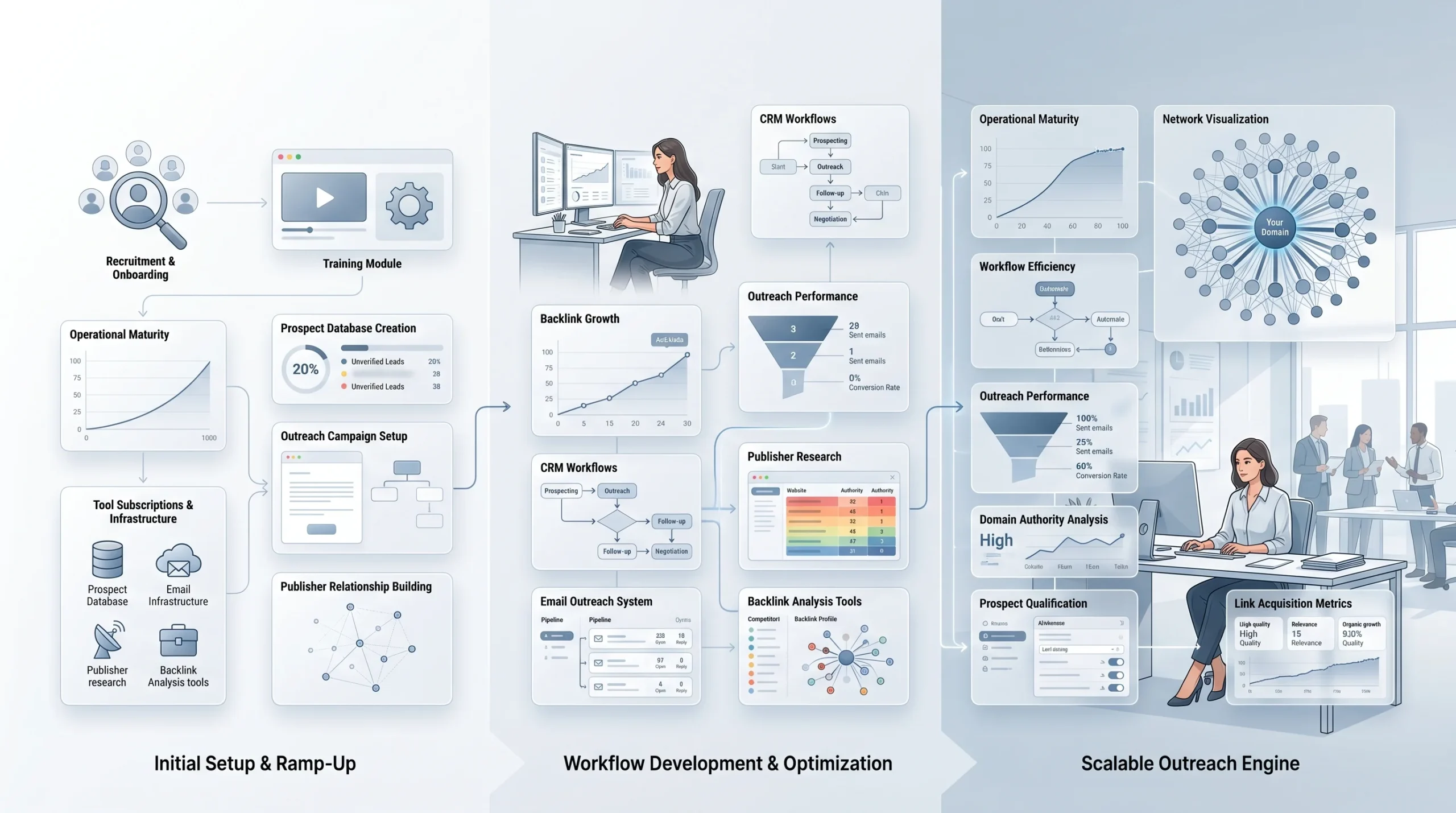
Most decision-makers calculate in-house link building costs by looking at a salary and a couple of tool subscriptions. That math misses the most expensive part: the first 90 days, where an in-house hire produces almost nothing while the clock keeps running.
This is not a knock on in-house teams. It is a structural reality. Building a link acquisition operation from scratch requires prospecting databases that do not exist yet, relationships that have not been warmed up, templates that have not been tested, and send volumes that are not yet calibrated. All of that takes time regardless of how skilled the person is.
The Ramp-Up Timeline (Month by Month)
Here is what the first six months of an in-house link building hire actually looks like, based on typical onboarding timelines for SEO specialists:
- Month 1 to 2: The hire is setting up tools, building a prospecting database, writing outreach templates, and testing send volumes. Link placements are near zero. The occasional win during this period is typically from low-hanging fruit like supplier links or existing partner relationships, not genuine outreach.
- Month 3 to 4: First real outreach placements start appearing. Most are low-to-mid DA sites (DA 20-40 range), because those editors respond faster and have lower vetting standards. A skilled hire running organized outreach at this stage delivers roughly 3 to 8 links per month.
- Month 5 to 6: The process starts maturing. A publisher pipeline is forming. Templates have been refined through actual reply data. Volume climbs to 8 to 20 links per month depending on the niche and the quality threshold the team is maintaining.
Compare that to an established agency with an existing publisher network: most mid-tier agencies can deliver 15 to 40 links in month one because the relationships are already built. They are not warming up cold inboxes; they are sending placements to editors they have worked with for years.
That six-month head start from an agency is real. Whether it justifies the cost depends on your timeline and budget, which is where the next section matters.
The Hidden Costs Nobody Puts in the Spreadsheet
A link building hire is not just a salary. When you add up the full cost of running an in-house outreach operation, the numbers shift considerably:
- Tool stack: Ahrefs or Semrush for prospecting and backlink analysis runs $200 to $500 per month depending on plan. An outreach automation platform like Pitchbox or Respona costs another $300 to $500 per month. Email warmup services add $50 to $150 per month on top. That is $550 to $1,150 per month before anyone sends a single email.
- Recruiter fees and onboarding: A standard recruiter commission is 15 to 20% of first-year salary. For a mid-level SEO link builder at $60,000 to $80,000 per year, that is $9,000 to $16,000 upfront. Onboarding time, manager attention, and ramp-up supervision add to that cost in ways that rarely appear in the initial budget.
- Opportunity cost: While the in-house hire ramps over six months, your competitors are building links. In competitive niches where domain authority directly affects ranking speed, a six-month gap in link velocity has measurable consequences.
The economics of in-house link building do eventually flip. By month 9 to 12, a productive in-house hire running 20+ links per month at a $65,000 salary works out to a cost-per-link that most agencies cannot match. The problem is getting there without losing ground in the process.
What a Link Building Agency Actually Gets You (And What It Doesn’t)
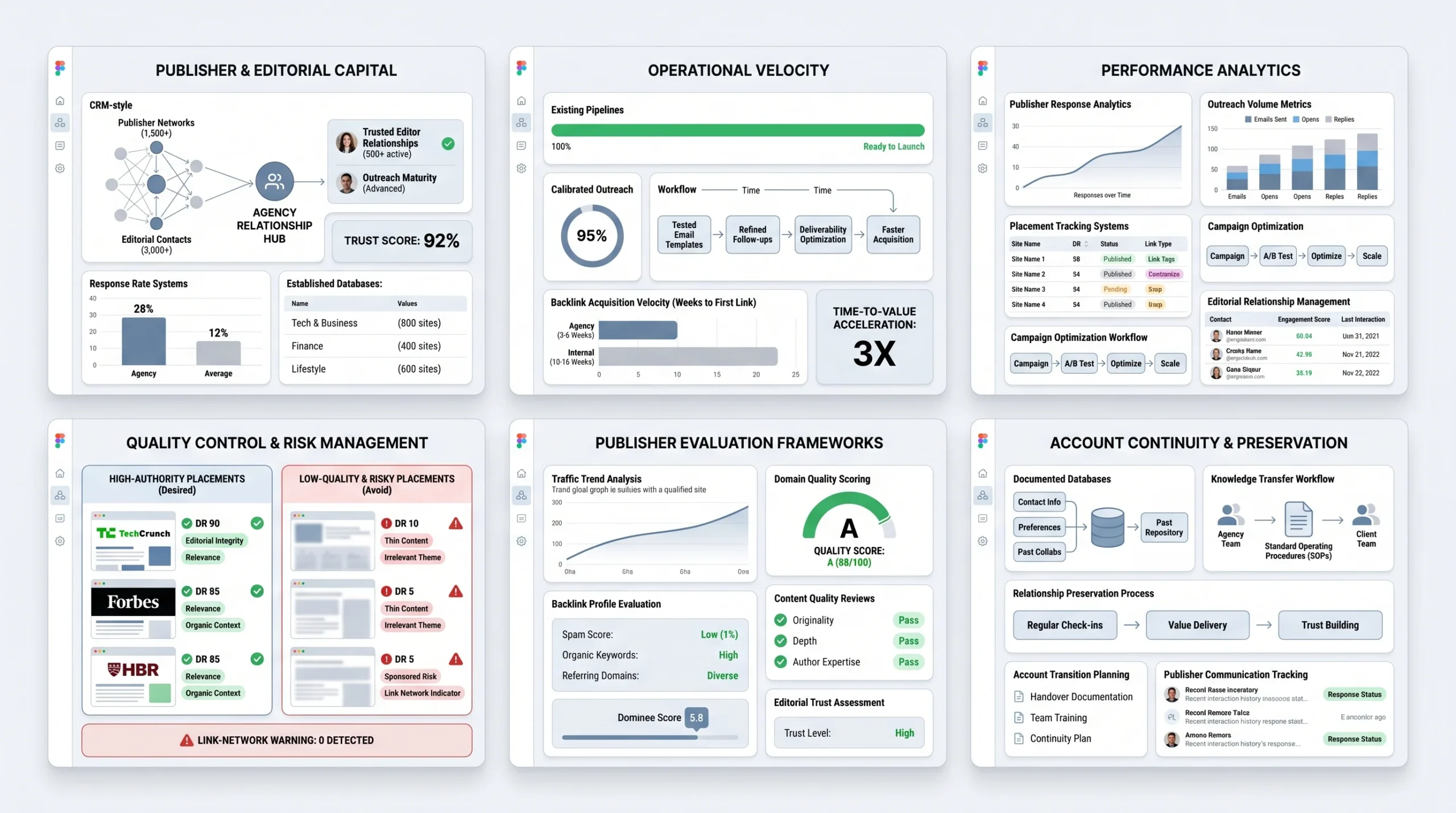
An agency’s value is almost entirely relationship capital and process maturity. They have already done the cold-start work. Their outreach specialists have calibrated send volumes, tested subject lines across thousands of sends, and built real editorial relationships with site owners and content managers who pick up their emails.
That is not a small thing. The difference between an outreach email from an unknown sender and one from someone the editor has worked with before is often the difference between a placement and silence.
Where Agencies Win on Speed
A credible mid-tier link building agency with an established publisher network can typically place 20 to 50 links per month by week three. That volume is possible because of three structural advantages:
- Existing publisher relationships: An agency running outreach for two or three years has a list of editors who respond, place links, and invoice predictably. A new in-house hire has none of that.
- Dedicated outreach volume: Agencies run high-volume outreach daily. Their specialists send hundreds of emails per week across multiple clients, which means their deliverability, personalization, and follow-up sequences are continuously refined by real data.
- Tested systems: Template structure, send cadence, personalization depth, and follow-up timing have all been pressure-tested on real campaigns. An in-house hire starts from theory and refines through trial and error.
The Quality Control Problem
Volume and quality do not always move together. When an agency’s KPI is number of links delivered per month, there is structural pressure to favor placements that are easy over placements that are valuable. That pressure produces a few recurring problems:
- Low-quality placements: Sites with thin traffic, weak topical relevance, or no real editorial standards are easier to get links from. Agencies optimizing for volume will populate their reports with these.
- Link farms and private blog networks (PBNs): Some agencies use link networks that look like real sites but exist only to sell links. Google’s link spam updates have repeatedly targeted these, and links from them either carry no value or actively harm rankings.
- “Sponsored content” sold as editorial: Some agencies pitch placements as earned editorial links when the site is actually paid placement dressed up to look organic.
Before signing with any agency, ask for a sample publisher list. Run 10 to 15 of those domains through Ahrefs to check traffic trends, check the “referring domains” graph for sudden spikes (a sign of link scheme activity), and look at the content on the site to verify it has real editorial value.
What Happens When Your Account Manager Leaves
This risk is real and almost never discussed in agency comparison articles. Link building relationships are personal. An account manager who has spent two years building rapport with 50 publishers carries those relationships in their network, not in a CRM field.
When that person leaves, their replacement starts from a colder position with those same publishers, even if the contact information is documented. The placement rate tends to drop for two to four months while the new account manager re-establishes trust.
Before signing with an agency, ask these questions directly:
- What is your average account manager tenure?
- Is your publisher database documented and transferable if my account manager changes?
- How do you handle account transitions so placements do not drop during the handoff?
An agency that struggles to answer these questions is one where your link velocity depends on one person staying employed.
Link Type Breakdown: Which Model Wins for Each Strategy
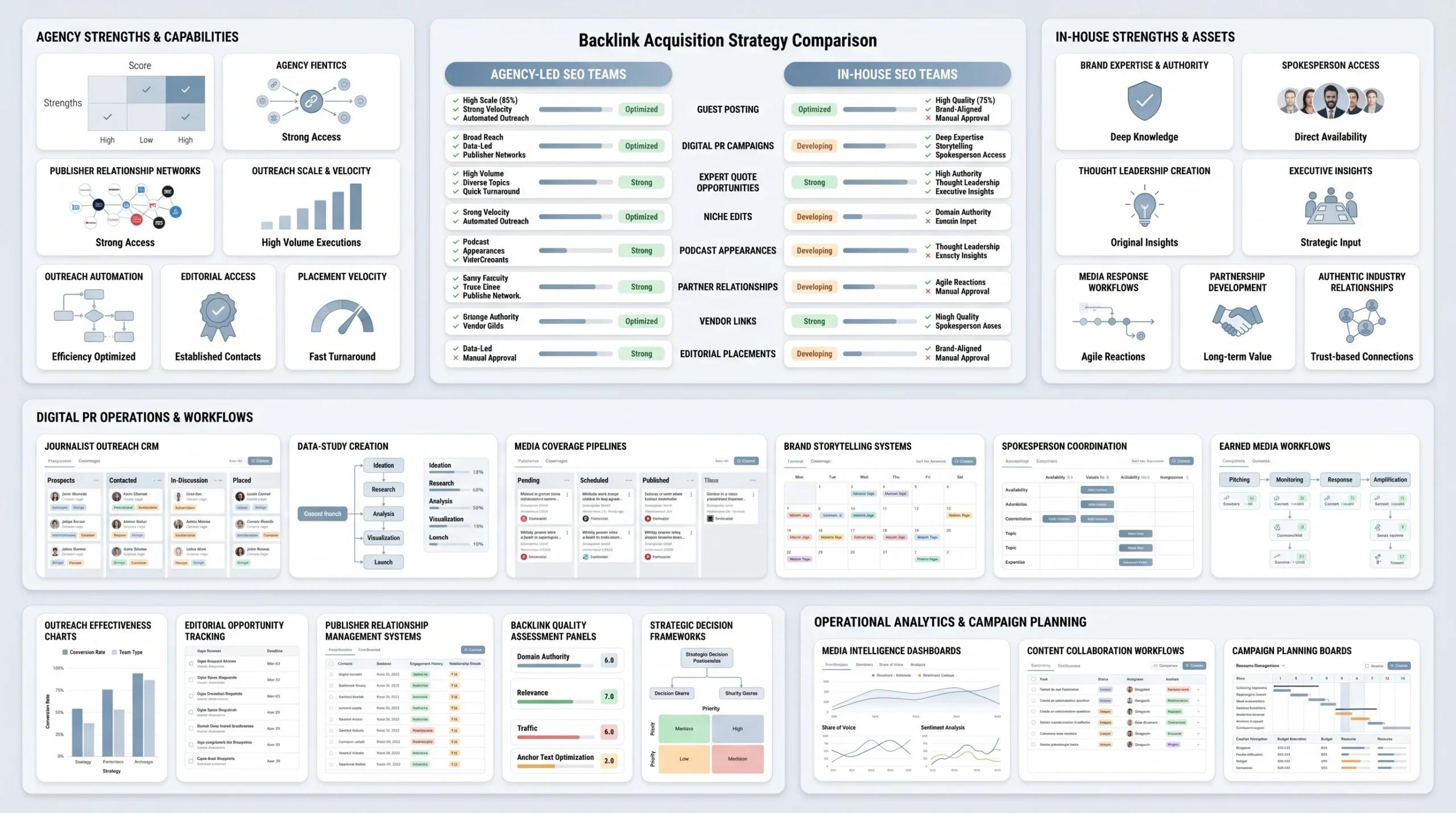
Not all links are the same, and not all links require the same acquisition model. An agency that is excellent at scaling guest post outreach may be genuinely bad at digital PR. An in-house team that cannot run high-volume outreach may be the only option for partnership and vendor links.
The decision of agency vs in-house is better made at the link type level, not as a blanket policy.
| Link Type | Agency Wins? | In-House Wins? | Why |
|---|---|---|---|
| Guest Posts (volume) | Yes | No | Relationship scale and email volume |
| Digital PR / Data-driven campaigns | No | Yes | Requires deep brand context |
| HARO / Expert Quotes | Toss-up | Slight edge | Speed vs authenticity |
| Niche Edits | Yes | No | Publisher access to live articles |
| Podcast / Video mentions | No | Yes | Brand voice matters |
| Partner / Vendor links | No | Yes | Internal relationship only |
The pattern here is consistent: agencies win where volume and publisher access are the primary inputs. In-house wins where brand knowledge, spokesperson access, and long-term relationship authenticity are what actually get the link.
The Digital PR Exception
Digital PR links, meaning links earned through original data studies, expert commentary in major publications, product announcements with genuine news value, and creative campaigns that earn organic coverage, are almost always better executed in-house or through a specialist PR firm.
Standard link building agencies are not set up for this. Digital PR requires real-time media relationship management, spokesperson availability, fast turnaround on journalist requests, and a deep understanding of what the brand can credibly claim. A generalist agency handling 20 clients simultaneously cannot provide any of that reliably.
If your link building strategy includes digital PR as a meaningful channel, budget for it separately from volume outreach and treat it as a brand function, not an SEO task.
The 2026 Factor: How AI Outreach Is Changing Link Building Speed
The speed benchmarks from 2023 and 2024 are not fully applicable anymore. AI-assisted outreach tooling has changed the output a single skilled operator can achieve, and Google’s continued algorithm updates have changed what that output is worth.
AI-Powered Prospecting and Personalization
The prospecting phase of link building has traditionally been the most time-intensive part of the in-house model. Finding relevant sites, qualifying them against DA and traffic thresholds, finding the right contact, verifying email addresses, and writing personalized pitches used to require hours per batch.
AI tooling has compressed that significantly. Platforms like Clay combined with AI enrichment workflows can now automate prospect qualification, pull relevant site context, and draft personalized opening lines at scale. Outreach platforms like Respona have built AI discovery directly into their prospecting workflow. The result is that a single in-house operator in 2026 can run outreach at volumes that would have required a three-person agency team two years ago.
This matters for the agency vs in-house calculation because the agency’s speed advantage was partly built on volume capacity. That gap is narrower now. An in-house operator with the right AI stack can reach comparable outreach volume within the first 30 to 60 days, even without an existing publisher network.
Google’s Evolving Stance on Scaled Outreach Links
The value of high-volume scaled outreach links has been under pressure from Google since the Helpful Content Update in 2022 and the subsequent link spam updates through 2024. Google’s systems have become better at identifying links placed through mass outreach versus links earned through genuine editorial interest.
The practical consequence: agencies running spray-and-pray guest posting on low-traffic, low-authority sites are seeing those placements devalued faster than they used to be. In some cases, clients of low-quality link building agencies have seen manual actions or algorithmic demotion directly tied to unnatural link patterns.
This does not mean outreach link building is dead. It means the quality threshold has moved. A link from a relevant, traffic-bearing site with real editorial standards is worth more than it was three years ago, and a link from a thinly-trafficked blog that publishes five guest posts per week is worth considerably less.
For agencies competing on price and volume, this is a structural problem. For in-house teams willing to go slower and target fewer, better placements, it is an advantage.
AI-Assisted In-House: The New Competitive Baseline
A single skilled in-house link builder in 2026, working with a tool stack that includes Clay for prospecting enrichment, Instantly or Smartlead for sending infrastructure, Ahrefs for qualification, and a solid outreach CRM, can run campaigns that would have cost $5,000 to $8,000 per month from an agency two years ago.
This changes the ROI math for companies with a 9 to 12 month horizon. The investment in tooling and salary pays off faster than it did, and the quality control stays in-house where it belongs.
The Decision Framework: Which Model Is Right for Your Growth Stage
The agency vs in-house question does not have one answer. It has a stage-dependent answer, and the mistake most teams make is treating it as permanent when it should be reviewed every six months.
Early Stage (0 to 6 months, limited budget)
At this stage, neither a full agency engagement nor an in-house hire is the right move for most companies.
Founder-led outreach targeting 5 to 10 high-value links manually is more effective than either. The reason is simple: early-stage link building is more about who you know and what you have to offer (a genuine product, a real perspective, a data set worth linking to) than about outreach volume. A founder who can get a genuine editorial link from a relevant DA 70 site has done more for rankings than an agency that places 20 links on DA 30 blogs.
If you are considering an agency at this stage, the minimum budget for a credible agency engagement that delivers links worth having is $2,500 per month. Below that threshold, most agencies are either operating at razor-thin margins or compensating with low-quality placements.
Growth Stage (Series A or equivalent traction, $3,000 to $8,000 per month budget)
At this stage, an agency as a short-term catalyst combined with a parallel plan to hire in-house by month six is the right structure for most companies.
The agency builds domain authority quickly while the in-house hire ramps. The key contractual detail: before signing with any agency, negotiate access to their publisher list and documentation of all placements. When you eventually bring the function in-house, you need to know which publishers have already placed your links, what content performed well, and which editors are warm to your brand.
An agency that refuses to provide this is one that is making it deliberately difficult for you to leave. That is a red flag.
Scale Stage (established brand, competitive niche, $10,000 or more per month)
A hybrid model is the right answer at this level, and it is how the most effective SEO teams at companies like Zapier, HubSpot, and Atlassian have structured link acquisition at scale.
The split looks like this:
- In-house team: Handles digital PR campaigns, partnership and integration links, expert commentary placements, and any link acquisition that requires brand voice or spokesperson access
- Agency: Handles volume guest posting in relevant verticals and niche edits on existing high-authority articles
This separation keeps quality control in-house for the highest-value links while using agency capacity for the volume work that does not require brand intimacy.
The One Situation Where In-House Always Wins
Brand-sensitive industries are the clearest case where in-house link building is the only credible option regardless of stage or budget.
Finance, legal, and health are the three categories where this matters most. Regulatory compliance, editorial accuracy, and brand reputation are all on the line with every piece of content associated with your links. A generalist agency placing your links on a financial blog that also publishes crypto pump content is a brand risk, not just an SEO risk.
Highly technical niches face the same problem from a different angle. If your product requires deep domain knowledge to write about credibly, a generalist agency cannot write the outreach pitch, the contributed article, or the guest post without getting things wrong. Editors in technical niches notice.
How to Evaluate a Link Building Agency Before You Sign
Most agencies look similar on a sales call. The differentiation shows up in the details, and those details are worth asking about directly before any contract is signed.
Here is the due diligence checklist that separates agencies worth hiring from agencies that will waste your budget:
- Ask for 3 live examples of links placed for clients in your niche in the last 90 days. Not case studies. Not screenshots. Live URLs you can verify in Ahrefs right now. If the agency hesitates or offers to send them later, that is the answer.
- Check link decay on past clients. Pull two or three domains the agency has worked with through Ahrefs and look at the referring domains graph over the last 12 months. A healthy link profile builds gradually. A profile that spikes and then loses links at the same rate suggests low-quality placements getting deindexed or removed.
- Ask for the average DA of placed links and what percentage are dofollow. A legitimate agency can answer this from data. An agency that gives a vague range or has to check is not tracking placement quality systematically.
- Request a sample outreach template. This tells you immediately whether they personalize by site and audience or send the same pitch to every editor with the site name swapped in. Generic templates produce generic results.
- Ask about their publisher vetting process. Do they check traffic before targeting a site? Do they verify the site is indexed? Do they assess topical relevance? A serious agency has a documented vetting process. A volume shop does not.
- Any agency guaranteeing a specific number of links per month before a discovery call is a red flag. Legitimate link building agencies qualify your niche, your content, and your existing authority before projecting what they can deliver. Volume guarantees made without that context are a sign that the links will come from somewhere, but not necessarily somewhere valuable.
Conclusion
Here is the direct answer: agencies win on speed in the first six months. In-house wins on cost-per-link and quality control after month nine.
The mistake that costs most companies time and money is treating this as a permanent decision rather than a phase decision. An agency is the right catalyst when you need domain authority fast and do not have the runway to wait for an in-house hire to ramp. In-house is the right long-term structure when you have the budget, the timeline, and the link types that require brand context an agency cannot fake.
The action worth taking today is this: audit your current link velocity against your domain authority growth over the last six months. If you are building links without seeing authority movement, the problem is link quality, not quantity, and adding more agency volume will not fix it. If you have not started building links at all, start with 5 to 10 high-quality manual placements before committing to any model at scale.
Pick the structure that fits your stage. Review it in six months.
FAQs
1. How long does it take a link building agency to deliver the first links?
Most established agencies with an existing publisher network deliver the first links within two to four weeks of campaign launch. The timeline depends on your niche competitiveness, the quality threshold you have set, and whether the agency needs to develop new publisher relationships or can pull from existing ones. Agencies that promise links in under a week are almost certainly pulling from low-quality, pre-arranged placements rather than genuine editorial outreach.
2. What is the average cost per link from an SEO outreach agency in 2026?
Cost varies significantly by quality. Links from DA 20 to 40 sites through volume-focused agencies run $100 to $250 each. Links from DA 50 to 70 sites with real traffic and editorial standards run $300 to $800 each. Digital PR links from major publications are rarely priced per link since that work is scoped as a retainer; expect $3,000 to $8,000 per month for a specialist digital PR agency. Any agency offering DA 60+ links at $150 each is sourcing from a network, not from genuine outreach.
3. How many links per month can an in-house link builder realistically produce?
A skilled in-house link builder in months one and two produces near zero links while setting up systems and warming outreach infrastructure. By months three and four, a realistic output is 3 to 8 links per month from genuine outreach. By months five and six, that grows to 8 to 20 links per month depending on niche, content assets available, and the quality threshold being maintained. With AI prospecting tooling, those numbers are higher in 2026 than they were two years ago.
4. Is it worth hiring an in-house link building specialist vs outsourcing?
It depends entirely on your timeline and volume needs. If you need meaningful link velocity within 90 days, an agency delivers faster. If you have a 9 to 12 month horizon and a niche where quality and topical relevance matter more than raw volume, an in-house hire becomes more cost-effective around month 9 to 12 as the cost-per-link drops below what an agency charges. The hybrid model (agency for volume, in-house for brand-sensitive placements) works well at scale.
5. What should I look for when vetting a link building agency?
Ask for live URLs of links placed for clients in your niche in the last 90 days, not case studies. Check those domains in Ahrefs to verify traffic and link permanence. Ask what percentage of placed links are dofollow and what the average DR of placed sites is. Request a sample outreach template to assess personalization quality. Ask how they vet publishers before targeting them. Any agency that cannot answer these questions with specific data is not tracking placement quality systematically.
6. Can AI tools replace a link building agency?
AI tools can close the volume gap between an in-house operator and an agency team, but they cannot replace the relationship capital an established agency brings. Prospecting, personalization, and follow-up sequences can all be AI-assisted effectively. What AI cannot do is substitute for an editor who already knows and trusts the person pitching them. In practice, AI tools make in-house link building more competitive with agencies on volume, but the publisher relationship advantage agencies hold still matters for placement rates with higher-authority sites.
7. How do I know if an agency is building low-quality links?
Pull your domain in Ahrefs after three months of working with an agency. Look at the traffic trends on the referring domains. Sites with under 500 monthly organic visitors are generally low-value regardless of their domain rating. Look for sudden spikes in referring domains on the linking sites themselves, which often indicate link network participation. Check whether the content surrounding your link is topically relevant or is generic filler. If your referring domain count is growing but your organic traffic and rankings are not, the links are not carrying the weight the reports suggest.
8. What is the difference between a link building agency and a digital PR agency?
A link building agency focuses on placing links on existing websites through outreach, guest posting, and niche edits. Their output is measured in number of links placed per month. A digital PR agency focuses on creating content or stories worth linking to and pitching those to journalists and publications that cover your industry. Their output is earned media coverage that happens to include links. Digital PR links tend to come from higher-authority, higher-traffic publications. They are harder to earn, they cannot be guaranteed in advance, and they typically carry more ranking weight than outreach-placed guest post links.
9. How does Google’s spam update affect scaled link outreach in 2026?
Google’s link spam updates from 2022 through 2024 have progressively improved the algorithm’s ability to distinguish between links placed through mass outreach and links earned through genuine editorial interest. Sites with thin traffic, low topical relevance, or patterns suggesting link scheme participation are being discounted or flagged at higher rates than three years ago. For agencies running high-volume outreach at low quality thresholds, this means clients are getting fewer ranking benefits per link placed. For in-house teams targeting fewer, better placements, the relative value of quality links has increased.