

There is a specific kind of frustration every sales rep knows well. You wrote a strong first email. You followed up with something valuable. And then — nothing. No reply. No decline. Just silence. The prospect has vanished, and you’re left staring at a CRM record that refuses to move.
Before you write off that lead or send a desperate “just checking in,” stop. The third touch is not where outreach dies — it’s where most deals are actually won or lost. The problem isn’t that your prospect has said no. The problem is that most reps don’t know what to say at this stage, and they either give up too early or repeat themselves and get ignored.
This guide exists to fix that. It covers the psychology behind prospect silence, the strategic difference between touch 3 and everything before it, four scenario-based frameworks for what to say, ready-to-use templates, subject line swipes, timing guidance, multi-channel tactics, and the mistakes that destroy deals and sender reputation at this stage. Everything here is backed by data. Nothing is filler.
Why Prospects Go Silent — and What It Actually Means
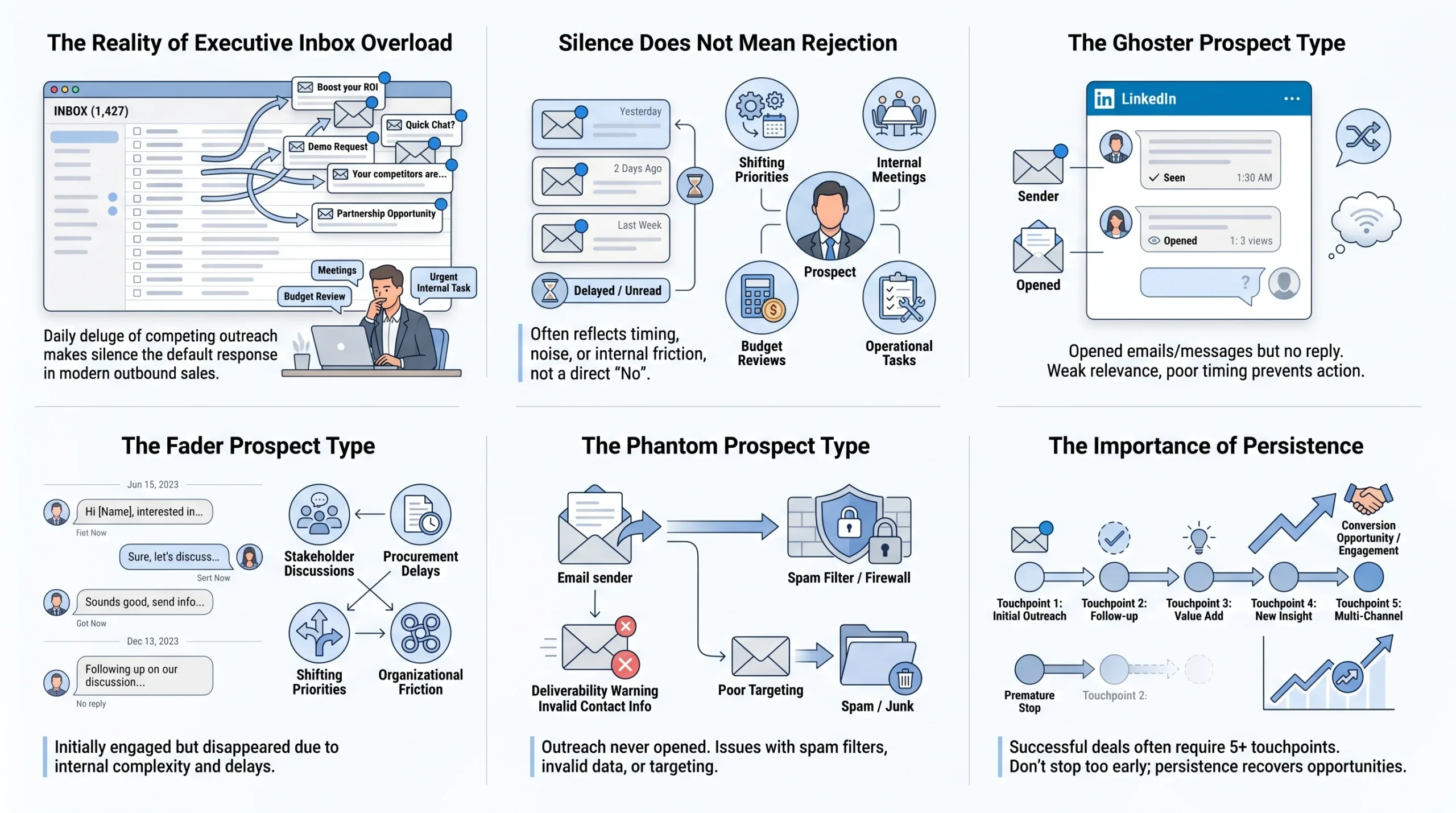
The first thing to understand about silence is that it almost never means “no.” It means something got in the way. That something could be a packed inbox, a shifting priority, a budget freeze, a pending internal conversation, or simply the sheer volume of sales messages competing for the same attention.
The numbers make this concrete. According to Sopro’s 2026 outreach report, the average B2B buyer receives over 120 sales-related emails every week — roughly 25 per business day. Your outreach isn’t sitting in a quiet inbox waiting to be noticed. It’s competing against two dozen other reps who are all claiming to help companies like yours. In that environment, silence is the default. It doesn’t signal rejection; it signals noise.
To respond intelligently to silence, you first need to identify which type of silent prospect you’re dealing with. There are three distinct categories, and each one calls for a different approach at touch 3:
- The Ghoster: This prospect opened your first or second email — sometimes both — but never replied. They saw it, they just weren’t compelled enough to act. The problem is relevance or timing, not awareness.
- The Fader: This prospect actually replied at some point — maybe asked a question, said they’d check with their team, or expressed mild interest — and then disappeared. The problem is usually internal friction on their side, not disinterest.
- The Phantom: This prospect has never opened anything. Either your emails are landing in spam, you have the wrong address, or the targeting is off. Sending a third touch here without verifying deliverability is a waste of effort and a risk to your domain reputation.
Knowing which type you’re dealing with changes everything about how you write your third touch.
Research published by Growleads shows that 44% of sales reps stop outreach the moment a prospect goes silent, despite data showing 80% of B2B deals require five or more touchpoints before conversion. That means nearly half of all reps are abandoning prospects who could still be won. The sixth email closes deals the first five couldn’t. Giving up before touch 3 means walking away from the majority of winnable opportunities in your pipeline.
What Makes the Third Touch Different from Touch 1 and Touch 2
Most salespeople treat follow-up emails as repetition — the same pitch, slightly reworded, nudged a little harder. That’s the wrong mental model entirely, and it’s the reason most follow-ups get ignored.
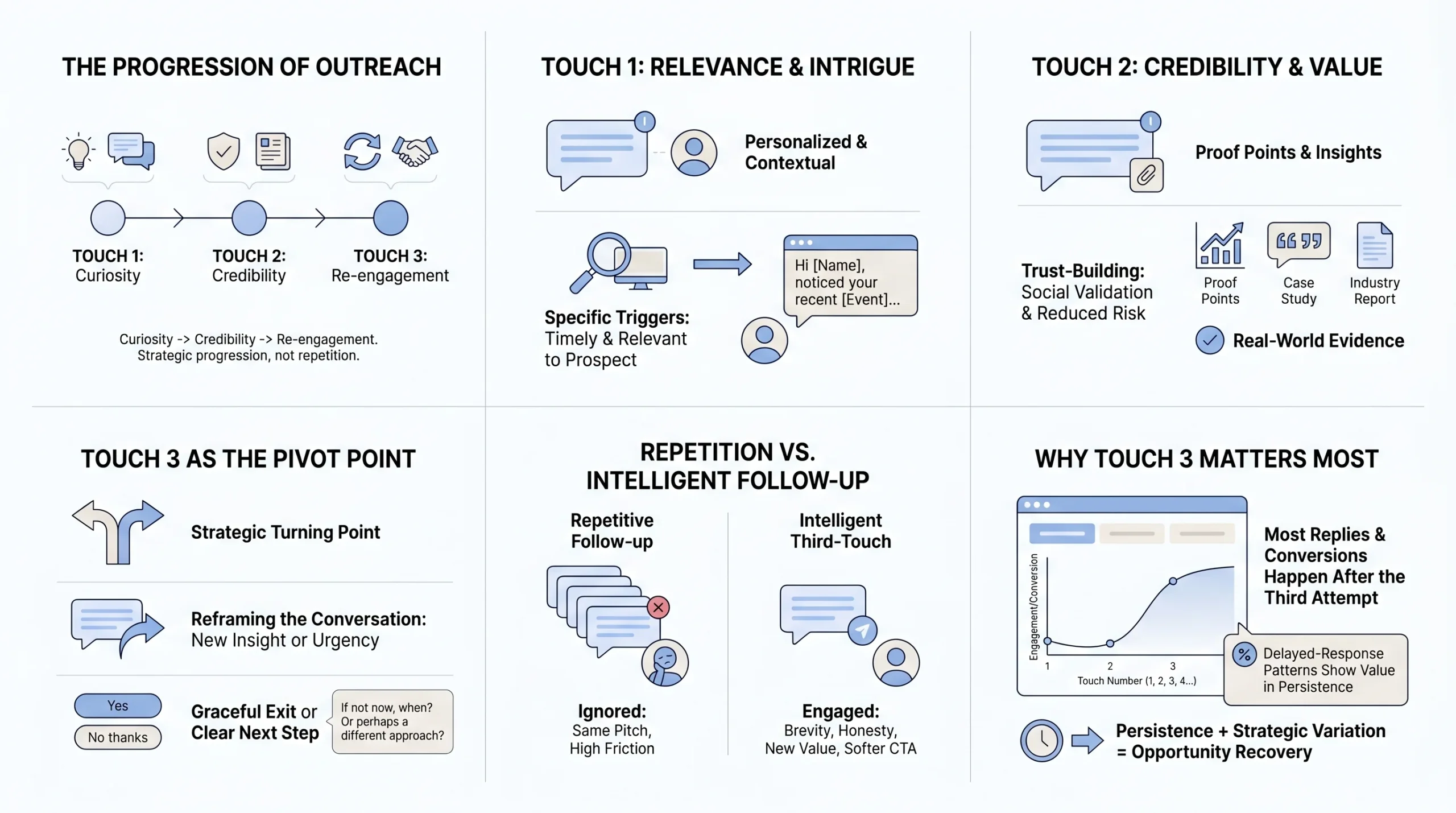
Each touch in a sequence has a distinct job. Touch 1 is about relevance and intrigue: make the prospect curious enough to keep reading, establish why you’re contacting them specifically, and create a reason to reply. Touch 2 is about added value or social proof: reinforce that you understand their world, back your claim with evidence, and lower the perceived risk of engaging. Touch 3 is different from both. It’s a pivot point — either you re-engage the prospect with a new angle or a different offer, or you close the loop gracefully and give them a decision to make.
As Prospeo’s 2026 email sequence research puts it clearly: each follow-up should address a different “bucket.” If touch 1 pitched value and touch 2 built credibility, the third touch should create urgency or offer a clean exit. Repeating the same angle three times isn’t persistence — it’s spam.
The data on why this matters is striking. According to Strategy Ladders’ analysis of outbound sales research, more than 60% of responses from cold outreach occur after the third attempt. That makes touch 3 the highest-leverage moment in the entire sequence — not touch 1. Most reps treat it as an afterthought. The reps who treat it as a deliberate strategic move win deals others leave behind.
There’s another important distinction: the tone, length, and call-to-action of touch 3 must be fundamentally different from what came before. By this point, the prospect has had two chances to respond and hasn’t. A longer pitch will not fix that. A softer ask, a new frame, a different piece of value, or an honest acknowledgment of the silence will. The third touch is where personality, brevity, and psychological intelligence matter most.
The 4 Third-Touch Strategies (Choose Based on Their Behavior)
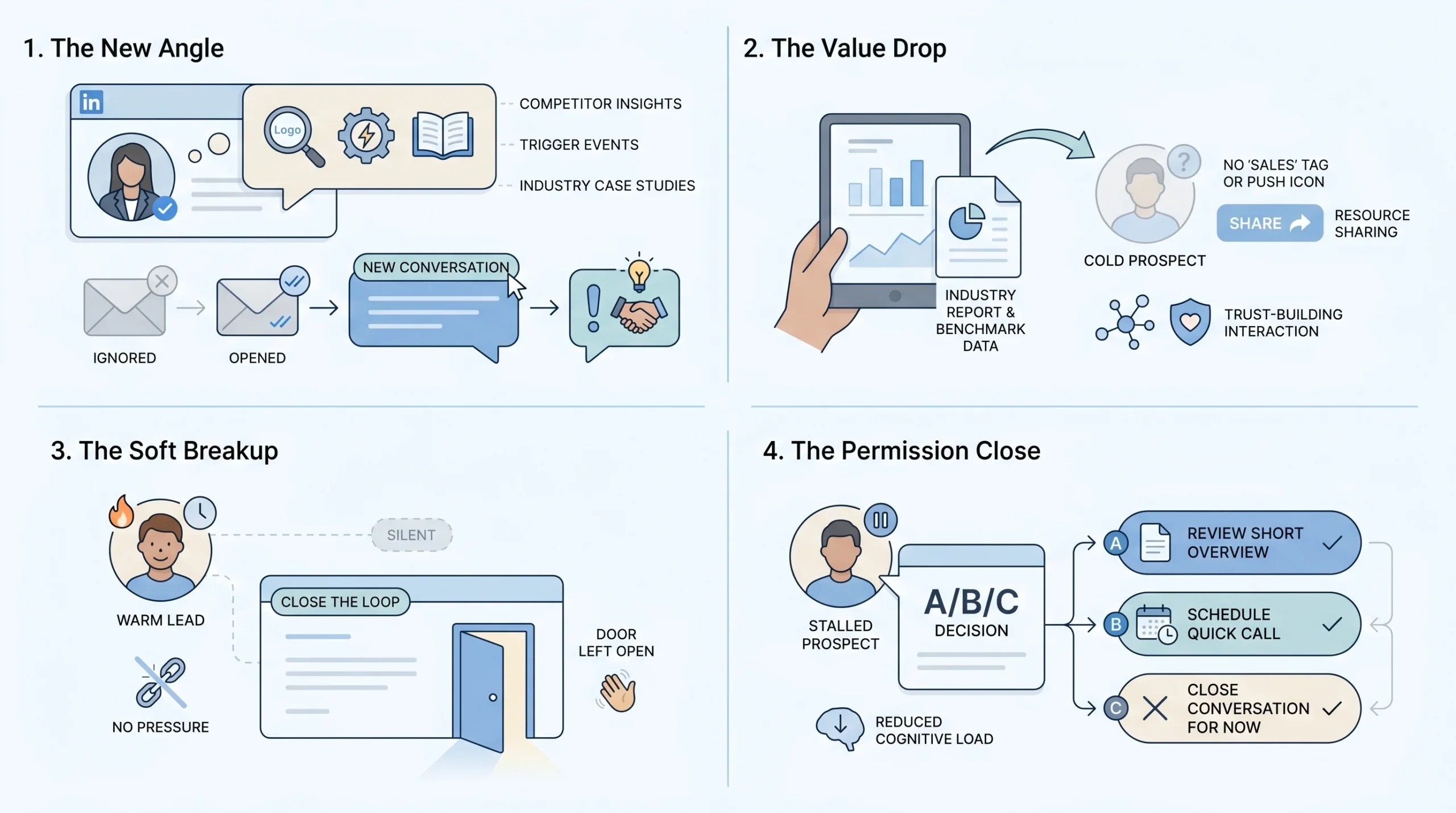
There is no single “right” third touch template because the right approach depends entirely on how the prospect has behaved up to this point. The framework below gives you four distinct strategies mapped to four distinct scenarios. Match the strategy to the behavior, and your third touch becomes a precision instrument rather than a generic nudge.
Strategy 1 — The New Angle (They Opened but Didn’t Reply)
When a prospect opened one or both of your previous emails but never replied, you have confirmation that the message reached them and caught enough attention to be read. The problem isn’t awareness — it’s that the angle, timing, or ask didn’t land.
The response is not to send more of the same. It’s to come from a completely different direction. Lead with something they haven’t seen from you yet: a relevant case study from their specific industry, a recent statistic that reframes the problem you solve, a competitor insight that makes the stakes feel real, or a trigger event — funding news, a new hire, a product launch — that gives you a fresh and timely reason to reach out.
As Reachinbox’s 2026 analysis of high-converting sequences describes it, the prospect should recognize the same core offer across your sequence, but each touch must add a new angle, a new detail, or a lower-friction next step. Recognition without repetition is the goal.
Template:
Subject: What [Competitor/Peer Company] did differently in Q1
Hi [First Name],
Noticed [Company] recently [trigger event — e.g., expanded into a new market / posted three new ops roles].
We helped [similar company] navigate that same stage — they cut [specific outcome, e.g., onboarding time by 40%] in the first 90 days.
Worth a 15-minute conversation to see if any of that applies here?
[Your Name]
Why it works: The trigger event makes the outreach timely rather than generic. The peer reference makes the outcome tangible. The ask is small and low-commitment.
When to use it: When email tracking data confirms the prospect opened but didn’t reply to either of your first two emails.
Strategy 2 — The Value Drop (Cold Lead, No Engagement)
When a prospect has never opened anything, or your data suggests genuine deliverability uncertainty, repeating your pitch is pointless. Instead, lead with something genuinely useful — something they’d want even if they never buy from you.
This approach shifts the frame entirely. Instead of “here’s what I’m selling,” the message becomes “here’s something worth your time.” That might be an industry benchmark report, a short checklist, a piece of original research, or a counterintuitive insight relevant to their role.
HubSpot’s analysis of high-performing sales follow-ups captures this well: the best follow-ups don’t ask for something — they offer something. A fresh resource, an industry update, a relevant use case, or a thoughtful check-in that signals the prospect is still on your radar without applying pressure. Most deals don’t close on the first touch, or the second, or even the third. But delivering value consistently builds the familiarity that eventually converts.
Template:
Subject: [Industry] benchmark data you might find useful
Hi [First Name],
Sharing this without any agenda — [specific resource, e.g., “our 2026 B2B outreach benchmark breakdown”] came out this week and has some data points relevant to [their role/challenge].
[Link or one-sentence summary of the insight]
Happy to chat if anything in there is relevant to what you’re working on.
[Your Name]
Why it works: There is no pitch and no pressure. The email delivers genuine value on its own terms. Prospects who ignored the previous two emails often respond to this because it asks nothing of them.
When to use it: When you have no engagement data from previous touches, or when you suspect your earlier emails may have underdelivered on relevance.
Strategy 3 — The Soft Breakup (Warm Lead Gone Cold)
When a prospect showed genuine interest — replied once, attended a call, downloaded a resource, asked a specific question — and then disappeared, the dynamic is different. They were interested. Something changed. The soft breakup acknowledges the silence without pressure, creates a moment of decision, and opens the door to an honest reply.
This approach works because of a well-established psychological principle. Kahneman and Tversky’s Prospect Theory, as applied to sales by Growleads, explains the mechanism: people feel losses roughly twice as strongly as equivalent gains. When you signal that you’re stepping back and closing the conversation, the prospect feels the option slipping away — not being pushed toward something. That feeling of potential loss, applied gently and professionally, often prompts the reply that three “just checking in” emails never could.
The critical word here is “gently.” A soft breakup is not passive-aggressive. It doesn’t guilt-trip. It doesn’t announce “I guess this isn’t a priority.” It simply acknowledges that timing may be off, offers a clean out, and leaves the door open for a future conversation.
Template:
Subject: Closing the loop on [topic]
Hi [First Name],
I’ve reached out a couple of times and haven’t heard back — completely understand, timing isn’t always right.
I’ll stop following up after this, but if [specific pain point or goal] becomes a priority down the line, feel free to reach back out anytime.
[One-sentence reminder of the core value you offer.]
Best, [Your Name]
Why it works: It respects the prospect’s time and autonomy. It creates low-key urgency through the signal of withdrawal. And it leaves a professional impression that keeps the door open for future engagement.
When to use it: When the prospect previously engaged — replied, attended a demo, showed intent — but has since gone silent for two or more weeks.
Strategy 4 — The Permission Close (Previously Engaged)
When a prospect has been in active conversation but stalled, sometimes the most effective thing you can do is remove the friction entirely by giving them control. Instead of making a single ask, you offer a simple set of choices that lets them tell you exactly what they want — including “nothing right now.”
Apollo’s breakup email template research shows why this works: offering multiple simple choices lowers friction, respects the prospect’s time, and invites an honest reply — even if that reply is “not right now.” The A/B/C format is particularly effective because it reduces cognitive load. The prospect doesn’t need to compose a thoughtful response. They can reply with a single letter.
Template:
Subject: Next step?
Hi [First Name],
Quick one — which of these fits best right now?
A) Send over a short overview you can review on your own time B) Set up a 10-minute call to check if there’s a fit C) Close this for now — you can reach back out when the timing’s better
Happy with any answer.
[Your Name]
Why it works: The prospect is given agency. Option C explicitly gives them permission to say no, which paradoxically makes them more likely to choose A or B. The email is under 60 words and requires almost no effort to answer.
When to use it: When a prospect has been actively engaged in a conversation that has recently stalled, or when previous follow-ups have been met with partial engagement but no forward movement.
6 Ready-to-Use Third Touch Email Templates
The four strategies above form the tactical framework. Below are six complete, copy-ready templates that apply those strategies across the most common third-touch scenarios. Each includes the scenario it fits, a subject line with an A/B variant, the email body, and the specific reason it works.
Template 1: The Insight Drop
Scenario: The prospect has gone cold and your previous messages were pitch-forward. This resets the tone by leading with intelligence rather than a sales ask.
Subject A: The stat that changes how most [their role]s think about [problem] Subject B: Data point worth 30 seconds
Hi [First Name],
[Specific industry stat or counterintuitive insight — e.g., “80% of B2B deals require 5+ touches, but 44% of reps quit after one.”]
We work with [role type] who run into exactly this pattern. Sharing in case it’s useful — no agenda.
If it sparks anything worth talking through, I’m easy to reach.
[Your Name]
Why it works: It educates before it sells. The prospect gets something useful whether or not they reply, which builds credibility and goodwill.
Template 2: The Peer Proof
Scenario: The prospect matches your ideal customer profile but hasn’t responded. A concrete peer result changes the framing from “you might benefit” to “companies like yours already are.”
Subject A: What [Similar Company] achieved in 90 days Subject B: [Their industry] result worth seeing
Hi [First Name],
[Similar company in their space] was dealing with [specific challenge]. In 90 days, they [specific, quantified result].
Given what [Prospect’s Company] does in [their space], it seemed worth sharing.
Would a quick overview make sense?
[Your Name]
Why it works: Social proof from a peer company removes the “this might not apply to us” objection. A named, specific result is far more persuasive than a generic benefit claim.
Template 3: The Honest Check-In
Scenario: You’ve sent two thoughtful emails and heard nothing. Rather than escalating pressure, this template lowers it completely.
Subject A: Still on your radar? Subject B: Timing off?
Hi [First Name],
No follow-up agenda here — just wanted to check if the timing on [topic] is still relevant for you, or if priorities have shifted.
Either way is fine. Happy to reconnect whenever it makes more sense.
[Your Name]
Why it works: It’s short, pressure-free, and human. The lack of a pitch is itself a differentiator. Prospects who have been ignoring sales emails often reply to this one precisely because it doesn’t feel like one.
Template 4: The Soft Breakup
Scenario: The prospect previously showed interest, went quiet, and hasn’t responded to a follow-up. This is the clean, professional close.
Subject A: Closing the loop on [topic] Subject B: Should I close this out?
Hi [First Name],
I’ve followed up a couple of times and completely understand if the timing isn’t right.
I’ll leave it here — but if [core pain point] moves up the priority list, feel free to reach out anytime.
[One-line value reminder.]
Best, [Your Name]
Why it works: It signals closure without burning the relationship. The explicit “I’ll leave it here” creates the loss aversion effect that prompt-checks-in never achieve.
Template 5: The Pivot Offer
Scenario: Your previous emails led with a specific ask (demo, call) that hasn’t landed. This template switches the format entirely, reducing friction by offering a different way to engage.
Subject A: Different format — would this work better? Subject B: No call needed — other options
Hi [First Name],
I realize I’ve been suggesting a call, and that’s not always the easiest ask.
If it’s easier, I can send a 2-minute video overview, a one-page summary, or a short case study — whichever is less friction for you.
What would be most useful?
[Your Name]
Why it works: It acknowledges that the problem may be the format of the ask, not the interest level. Offering asynchronous options removes the commitment required by a live call.
Template 6: The Trigger-Based Re-Opener
Scenario: You’ve spotted a recent, specific event at the prospect’s company — a new hire, a funding round, a product launch, a public announcement — that creates a fresh and timely reason to reach out.
Subject A: Congrats on [trigger event] — quick thought Subject B: Saw [trigger event] — relevant to what I’d shared
Hi [First Name],
Noticed [specific trigger event] — congrats on that.
Companies at this stage often run into [specific challenge you solve]. Wanted to reconnect in case the timing is better now.
Worth a quick conversation?
[Your Name]
Why it works: Trigger-based outreach is timely and personal in a way that generic templates never are. According to Salesmotion’s 2026 cold outreach analysis, the highest-performing sales teams anchor every touchpoint to a real business signal — a leadership change, funding round, or earnings commentary — and achieve 3–5x higher reply rates compared to purely template-based outreach.
Third Touch Subject Lines That Actually Get Opens
By the time you reach touch 3, you are a known sender. The prospect has seen your name in their inbox twice before. That creates a specific problem: familiarity combined with no prior reply means your email is at risk of being dismissed on autopilot before it’s even opened. The subject line at touch 3 carries more weight than it did at touch 1 — it has to break the pattern.
The core principle is simple: if your subject line looks and sounds like the first two, it will be treated like the first two. Touch 3 subject lines need to interrupt the mental category of “that sales email” and trigger genuine curiosity, empathy, or a sense of something new.
Based on analysis of breakup and third-touch email performance, subject lines that work at this stage tend to fall into four categories:
- Curiosity and pattern interrupts: “Did I miss something?”, “This is awkward”, “Am I wrong about this?” — these create a low-pressure open loop the reader wants to close.
- Empathy and timing acknowledgment: “I get it — timing’s off”, “Still relevant?”, “Should I close this out?” — these acknowledge reality without guilt or pressure.
- Value-forward exits: “Before I go — [resource]”, “One thing I forgot to mention”, “Found this and thought of you” — these offer something even in the closing moment.
- Direct and honest: “Closing the loop on [topic]”, “Next step?”, “Worth 30 seconds?” — these are clear, respectful of the prospect’s time, and signal you’re not going to drag things out.
Ten subject line swipes worth testing at touch 3:
- “Closing the loop on [topic]”
- “Did I miss something?”
- “One last thought before I stop reaching out”
- “Is [pain point] still on your radar?”
- “Worth 30 seconds?”
- “Saw [trigger event] — changed my thinking”
- “Before I close your file”
- “Honest question for you”
- “Not sure if this is still relevant”
- “I’ll stop — but wanted to share this first”
What to avoid at touch 3: any subject line that opens with “Following up on my last email” (zero new value), guilt-trip language like “I’ve tried to reach you several times” (off-putting), or a re-pitch of your offer in the subject line (treats the prospect like they’ve never heard of you).
On the question of threading: reply in the same email thread for your first and second follow-ups — it gives the prospect context without requiring them to re-read. For touch 3, especially if you’re changing the angle entirely or sending a soft breakup, starting a fresh thread often performs better. A new thread signals a new direction rather than another bump on the same ignored chain.
Timing and Cadence — When to Send Your Third Touch
How long you wait between touches matters as much as what you say. Too soon and you signal desperation; too long and the prospect forgets the context of your earlier emails entirely.
The data-backed cadence for most B2B outreach sequences, as detailed in Prospeo’s 2026 follow-up timing analysis, is as follows: send your first follow-up (touch 2) at 2–3 business days after the initial email, send your second follow-up (touch 3) at 5–7 days after touch 2, which typically places touch 3 around day 10–14 from the start of the sequence. After three touches, if there is still no response, switching channels frequently outperforms sending a fourth email.
There is an important exception to this baseline cadence. As Growleads’ 2026 breakup email research notes, if a prospect previously opened emails, attended a demo, or showed earlier engagement before going silent, you should accelerate the timeline. In that case, send your third touch after 3–4 touches rather than waiting for a complete sequence, because the relationship stage matters more than a raw email count.
Spacing under 48 hours between any two touches signals desperation and can trigger spam complaints. Gaps beyond five days allow the prospect to forget the thread’s context entirely. The sweet spot between 3–5 business days per step is where most B2B sequences perform best.
On timing within the day: research from cold email platform data across 2025–2026 consistently shows that Tuesday through Thursday, between 8–11 AM in the recipient’s timezone, delivers the strongest engagement. Monday mornings are high-competition windows; Friday afternoons see sharp drops in open and reply activity.
One final timing consideration that competitors rarely address: before sending touch 3, verify that your previous emails weren’t landing in spam. If your emails are bouncing or filtering, no subject line or template will save you. Confirm deliverability before you invest in crafting the perfect third-touch message.
Beyond Email — Multi-Channel Third Touch Options
Email is where third-touch conversations begin. It isn’t always where they should stay. By touch 3, you have reasonable evidence that email alone is not breaking through — and that means the most strategic move may be to shift the channel rather than send another inbox message.
The data supports this emphatically. According to Sendspark’s B2B sales outreach research, multi-touch sequences that combine email, video, LinkedIn, and phone outperform any single-channel approach by a significant margin, with research consistently showing it takes 8–12 touchpoints to book a meeting with a cold prospect. A separate analysis from Martal’s 2026 cold email statistics report found that outreach combining email with LinkedIn and phone in a coordinated omnichannel sequence can boost results by over 287% compared to email-only sequences.
Here is how to deploy each supporting channel as part of your third-touch strategy:
- LinkedIn: Before you send touch 3 by email, warm the inbox by taking action on LinkedIn first. Comment genuinely on a post the prospect recently published, or like a piece of content they’ve shared. This creates a pre-email awareness signal that makes your name slightly familiar when your email arrives. A brief, connection-level LinkedIn message can also serve as the third touch itself if your email sequence has stalled.
- Phone/voicemail: A 20–30 second voicemail referencing your email thread creates a human moment that text alone cannot replicate. It doesn’t need to be a hard pitch. Saying “I sent you a short note — wanted to put a voice to the name and see if the timing might be better now” is enough to re-open a conversation.
- Video message: A 60-second personalized Loom or Vidyard recording used as the third touch is one of the most differentiated moves available in modern outbound. Most prospects have never received a personalized video from a sales rep. The novelty alone drives higher open rates, and a face and voice build trust faster than text.
- Direct mail: For high-value, high-fit accounts, a physical note, a relevant book, or a small thoughtful item sent after two unanswered emails creates a touchpoint no inbox filter can block. According to verified.email’s B2B email marketing forecast data, direct mail is most effective when reserved for the third through fifth touch after email engagement has been demonstrated — not as a first-touch cold move.
Modern B2B buyers use an average of 2.5 channels in their decision-making process, according to Leads at Scale’s 2025 B2B prospecting analysis, and 88% prefer hearing from suppliers during their active research phase. Single-channel outreach is no longer sufficient to reach buyers the way they actually make decisions.
Third Touch Mistakes That Kill Your Chances (And Your Domain Reputation)
There are a specific set of errors that are uniquely damaging at the third touch — more damaging than the same mistakes made at touch 1, because by this point your prospect’s patience is thinner and your domain’s reputation is at greater risk. Avoiding these is as important as executing the positive strategies above.
- Sending the same message with a different subject line. If the body of your third email is substantively identical to touches 1 and 2, you are confirming that you have nothing new to offer. It reads as desperation, not persistence, and almost never generates a reply.
- Opening with “I just wanted to follow up on my last email.” This phrase adds zero value, signals a lack of creativity, and wastes the first line of the email — which is the second thing the prospect reads after the subject line. Every third touch should open with something new: a data point, a peer result, an honest acknowledgment, or a direct question.
- Being passive-aggressive or using guilt. The single most cited complaint from B2B buyers about late-sequence outreach is the tone of guilt-tripping follow-ups. Phrases like “I’ve tried to reach you several times,” “I guess this isn’t a priority for you,” or “I’m not sure if my emails are getting through” are perceived as manipulative. As Prospeo’s 2026 research notes, one buyer on Reddit described receiving an aggressive breakup email as “completely disrespectful, borderline insulting” — and walked away from the deal entirely. That tone kills current deals and future goodwill in the same moment.
- Sending a “breakup” email after only two touches. A breakup email earns its authority by coming after genuine, varied, value-adding effort. Using it as your second or third message cheapens the signal entirely and reads as theatrical rather than strategic.
- Making the call-to-action too big. Asking for a 30-minute demo call on the third touch — when the prospect hasn’t replied to two prior emails — is a significant friction mismatch. By touch 3, the ask should be smaller, not larger. A 10-minute conversation, a one-page overview, or a simple yes/no question removes more barriers than a formal meeting request.
- Ignoring deliverability risk. According to Prospeo’s 2026 email sequence data, spam complaint rates by the fourth email in a sequence are more than three times higher than they are on the first touch — rising from 0.5% to 1.6%. At touch 3, you are already in elevated-risk territory. Sending to unverified addresses, using spam-triggering language, or over-automating without human review can damage your domain’s sender reputation in ways that affect all future outreach — not just this one sequence.
How to Know if Your Third Touch Is Working — Metrics to Track
Measuring the effectiveness of your third touch requires a clear-eyed understanding of what the realistic benchmarks are — not the inflated figures that circulate on sales content sites, but what the actual data shows across large volumes of real outreach.
Reply rate is the metric that matters most at this stage. According to Instantly.ai’s 2026 Cold Email Benchmark Report, the overall average reply rate across all cold email outreach is 3.43%, with top-performing sequences exceeding 10%. A reply rate of 5–10% is considered good, and 10–15% is excellent. These numbers apply to the whole sequence — individual touch-level rates will vary, but they give you a calibration baseline.
Some sources claim breakup email reply rates of 60% or higher. According to Prospeo’s research, those figures are not representative of broad campaign benchmarks. A well-crafted third touch will lift your reply rates relative to your baseline — but your baseline matters. If your sequence averages a 3–4% reply rate, a strong third touch might push that touch specifically to 6–8%. That’s meaningful improvement, not a silver bullet.
Open rate has become a less reliable metric for cold outreach since Apple Mail Privacy Protection began preloading tracking pixels automatically for Apple Mail users, which account for roughly 49% of all email opens. A reported open on touch 3 does not definitively mean the prospect opened your email intentionally. Prioritize reply rate, positive reply rate, and meeting booked rate as your primary performance indicators.
Positive reply rate vs. total reply rate is a distinction worth tracking. At touch 3, you will receive some replies that say “not interested” or “please remove me.” These are not failures — they are pipeline hygiene signals. A negative reply at touch 3 is information you can act on: tag the contact in your CRM, mark the appropriate outreach status, and if appropriate, schedule a re-engagement attempt in 60–90 days when circumstances may have changed. According to Instantly.ai’s benchmark data, 58% of all replies in a cold email campaign come from the first touch; the remaining 42% are generated by follow-up persistence. That means every third-touch reply represents a deal that would have been lost to a rep who quit earlier.
When a non-reply at touch 3 signals it’s time to move on: not every silence is recoverable, and spending indefinitely on a single prospect is not a strategy. If touch 3 generates no response and there has been no prior engagement across any channel, the appropriate action is to move the contact to a passive nurture list, mark the outreach status in your CRM, and shift active effort toward warmer pipeline. A no-response at touch 3 from a truly cold, never-engaged prospect is not a failure — it’s a signal to stop pushing and let time do the work.
Where the Third Touch Fits in Your Full Sales Outreach Sequence
Understanding the third touch in isolation is useful. Understanding where it sits in the broader arc of a well-built sequence is what turns individual tactics into a systematic outreach machine.
Below is a representative 5–7 touch sequence with the third touch highlighted as the pivot point:
| Touch | Channel | Timing | Purpose |
|---|---|---|---|
| Touch 1 | Day 1 | First impression — relevance and intrigue | |
| Touch 2 | Day 3–4 | Add value — social proof or insight | |
| Touch 3 | Email + LinkedIn | Day 8–10 | Pivot — new angle, soft breakup, or permission close |
| Touch 4 | Phone/voicemail | Day 12–14 | Human voice — re-open after email silence |
| Touch 5 | LinkedIn message | Day 17–19 | Channel shift — low-pressure connection |
| Touch 6 | Day 22–25 | Re-engagement or final breakup | |
| Touch 7 | Email (optional) | Day 35–40 | Long-tail nurture — trigger or value drop |
The third touch is the fork in the road. Prospects who respond at this stage move into active pipeline — they get faster follow-up cadences, meeting scheduling, and proposal-stage handling. Prospects who don’t respond after touch 3 should be routed differently: tagged in your CRM with the appropriate status, moved to a slower nurture cadence, and reconsidered for active outreach only when a trigger event or change in their circumstances creates a legitimate new reason to engage.
Importantly, a non-response at touch 3 is not the permanent end of the relationship. According to Martal’s B2B outreach research, 80% of prospects say no or stay silent until at least the fourth outreach. The third touch often seeds the response that comes at touch 5, 6, or even in a re-engagement campaign 60–90 days down the road. The goal of touch 3 is not just to generate an immediate reply — it’s to keep the door open for future engagement while respecting the prospect’s time and attention right now.
Tools That Help You Send and Track the Third Touch
Executing a thoughtful third-touch strategy at scale requires the right infrastructure. Manually tracking who to follow up with, when, and with which message across a large pipeline is not sustainable.
CRM sequencing tools are the foundation. Platforms like Apollo, Outreach, Salesloft, and HubSpot Sequences allow you to build multi-step cadences, automate task creation for manual touchpoints like calls and LinkedIn, and track engagement data (opens, clicks, replies) at the individual email level. Most will flag prospects who opened touch 2 but didn’t reply — which is exactly the signal you need to trigger the right touch 3 strategy.
Email verification is non-negotiable before any touch 3 send, particularly for lists that have been in your CRM for several months. Sending touch 3 to invalid or inactive addresses inflates your bounce rate and damages your sender domain. Tools like Prospeo, Hunter, and NeverBounce can verify email validity and catch outdated addresses before they cause deliverability damage.
Video prospecting tools — Loom, Vidyard, and Sendspark — are increasingly used as the primary medium for third-touch outreach rather than as supplementary content. A personalized 60-second video is one of the most differentiated moves available in modern outbound and creates a format switch that email-fatigued prospects often engage with when text messages no longer land.
LinkedIn automation tools — tools like Expandi, Lemlist, and Salesflow — allow coordinated multi-channel sequences where LinkedIn profile visits, post engagements, and connection messages are timed alongside email touches. These platforms can trigger a LinkedIn action automatically when a prospect opens touch 2 but doesn’t reply, warming the relationship before touch 3 lands.
Setting up automation triggers specifically for touch 3 is one of the highest-leverage configuration moves available: an email opened but not replied to within 48 hours should automatically queue a task for touch 3, ensuring that no warm prospect falls through the cracks while active pipeline demands your attention.
Conclusion
Most salespeople treat the third touch as the last desperate attempt before giving up. The data tells a completely different story. With more than 60% of responses coming after the third outreach attempt, this is not the end of the sequence — it’s the moment where a disciplined, differentiated approach separates reps who close deals from reps who abandon them.
The framework is straightforward. If the prospect opened but didn’t reply, use the New Angle — come from a different direction with fresh context or a trigger-based observation. If the prospect never engaged, use the Value Drop — deliver something genuinely useful without an ask attached. If a warm lead has gone cold after previous engagement, use the Soft Breakup — acknowledge the silence professionally and create a moment of decision through the psychology of withdrawal. If the conversation has stalled mid-dialogue, use the Permission Close — give them control with a simple A/B/C choice.
What all four strategies share is intentionality. The third touch is not a bump on an ignored thread. It’s a deliberate message built around the prospect’s specific behavior, tailored to their context, delivered with a new angle, and crafted to ask less rather than more. That combination — timing, specificity, new value, and reduced friction — is what turns silent prospects into live conversations.
The templates in this guide are starting points. The research behind them is what makes them work. Spend five minutes per prospect before you send touch 3. Find the trigger event, find the peer reference, find the one specific detail that tells them you’re paying attention. That investment of five minutes is what separates outreach that gets replied to from outreach that gets deleted.
FAQs
How many times should I follow up before giving up?
According to research from Strategy Ladders, more than 60% of responses from cold outreach occur after the third attempt. Most sales frameworks recommend a minimum of 5–7 touches before retiring a prospect from active outreach. Giving up at touch 2 or 3 means abandoning the majority of deals that could still convert. After touch 3 with no engagement across any channel, move the prospect to a slower nurture cadence rather than continuing aggressive outreach.
Is the third touch always a breakup email?
No. A breakup email is one of four strategies appropriate for the third touch — and it’s only the right choice when a prospect was previously warm and has since gone quiet. For cold prospects who never engaged, a value drop or new angle is more appropriate. For stalled conversations, the permission close often outperforms a breakup. Match the strategy to the prospect’s behavior, not to a rigid sequence rule.
Should I reference my previous emails in touch 3?
It depends on the strategy you’re using. If you’re staying in the same email thread, context carries over naturally. If you’re opening a new thread — which is often advisable for the new angle or soft breakup strategies — a brief acknowledgment (“I’ve reached out a couple of times”) is enough context without making the email feel like a complaint about being ignored.
What if the prospect opened every email but never replied?
This is the Ghoster scenario. Multiple opens without replies typically signal interest combined with friction — they’re curious but not convinced, or timing isn’t right. The correct response is a new angle that addresses a different concern, or a permission close that lowers the barrier to entry significantly. Do not repeat the same pitch a third time.
Can I use the same third-touch template for every prospect?
The structure of the template can be consistent; the content must not be. Specifically, the trigger event, the peer company reference, the insight, and the pain point framing must be tailored to each prospect’s specific industry, role, and recent context. According to Salesmotion’s 2026 cold outreach analysis, the highest-performing teams invest five minutes of account research before every send. That research is what differentiates a third touch that reopens a conversation from one that gets deleted on sight.
How do I follow up on LinkedIn after no email response?
The most effective LinkedIn approach after an unanswered email sequence is to engage with the prospect’s content first — a thoughtful comment on a post they’ve published or shared — before sending any direct message. This creates awareness without pressure. A direct LinkedIn message can then reference the email thread naturally: “I sent you a note a couple of weeks ago about [topic] — wanted to connect here as well in case email isn’t the best channel.”
What’s the difference between a soft breakup and a hard breakup email?
A soft breakup signals that you’re stepping back while leaving the door explicitly open for future contact. It’s warm, brief, and ends with a genuine offer to reconnect when timing improves. A hard breakup closes the loop more definitively — it signals that you’re closing the file and removes the prospect from active outreach, typically after five or more unanswered touches. For most third-touch scenarios, the soft breakup is the right choice; the hard breakup is better reserved for sequences where the prospect has been through a full 5–7 touch cadence with zero engagement across any channel.