


Most founders who reach out to angel investors on LinkedIn are doing it completely wrong. They spend weeks building a list of investors, crafting a pitch, and then firing off connection requests with some version of “Hi [First Name], I think you’d be a great fit for my startup.” The investor ignores it. Or worse, declines the request entirely. The founder takes it personally, assumes LinkedIn doesn’t work for fundraising, and goes back to blasting out cold emails that also don’t work.
Here’s the thing: LinkedIn absolutely works for angel investor outreach. But not the way most people use it. The founders who actually close rounds using LinkedIn aren’t the ones with the most polished profiles or the best pitch decks. They’re the ones who understood something pretty basic: investors don’t invest in strangers. They invest in people they’ve been watching, people they’ve engaged with, people who showed up in their feed over three months before ever saying the word “funding.”
This is a guide about building the right kind of presence before you ever send a message. About using LinkedIn the way investors actually use it. About angel investor outreach strategies that feel like relationship-building because they are, and about what to say when the time finally comes to make an ask. By the time you finish reading this, you’ll know exactly what a warm LinkedIn funnel looks like, how to engineer one, and why skipping any step in the process is the single biggest mistake early-stage founders make.
Why Angel Investor Outreach Strategies on LinkedIn Beat Cold Email
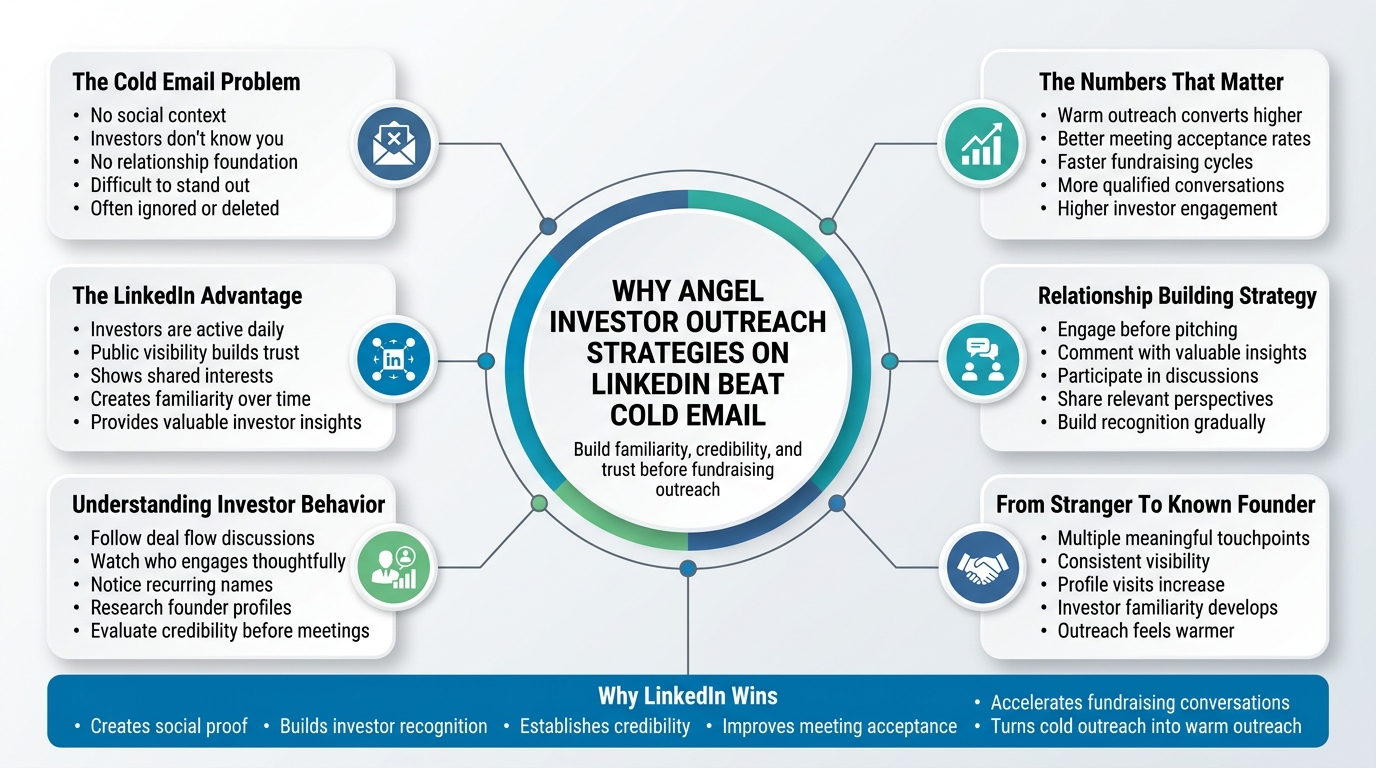
Cold email had a good run. It still has uses. But for angel investor outreach specifically, it has a structural problem: there’s no social context. An investor who gets your cold email has zero prior exposure to you. Your name doesn’t ring any bells. Your startup means nothing yet. And because investors at the seed and pre-seed stage are mostly making bets on people, not products, that missing context costs you the meeting before you even get to your subject line.
LinkedIn changes that calculus. Investors are on LinkedIn constantly. They’re posting about deal flow, sharing portfolio wins, commenting on market trends. The platform is essentially a live public diary of what they care about and how they think. That’s a massive, largely untapped information advantage for founders who pay attention.
The Numbers That Actually Matter Here
A 2023 DocSend study tracked 200 pre-seed startups through their fundraising processes. Founders who got meetings through warm introductions closed those meetings at roughly 3x the rate of cold outreach. The typical angel investor receives somewhere between 1,000 and 3,000 pitches per year. The acceptance rate for cold email pitches hovers around 1 to 3%. Warm LinkedIn outreach, when done with proper relationship groundwork, gets meeting acceptance rates in the 20 to 40% range depending on the investor and the signal quality.
Those aren’t small differences. They’re the gap between a founder who raises in four months and one who spends eighteen months burning savings trying to close a round.
How Investors Actually Use LinkedIn
Most angel investors use LinkedIn in a pretty passive way, at least from the outside. They post occasionally. They accept connection requests from people they recognize. They comment on deals that interest them. But behind that, a lot of them are quietly watching who engages with their content, who says smart things in the comments, and whose name keeps appearing in their notifications.
This is the mechanic that most founders completely miss. When you comment something genuinely useful on an investor’s post three times over six weeks, they start to recognize your name. When they click your profile and see you’re building something in their focus area, the mental association forms without you ever pitching anything. By the time you send a message, you’re not a stranger anymore. You’re that person who always says interesting things.
That’s the entire game. And it’s completely available to anyone willing to play it patiently.
Building the LinkedIn Profile That Makes Investors Stop Scrolling
Before any outreach, before any comments, before any connection requests: the profile has to work. This is where most founders lose the plot. They treat their LinkedIn profile like a resume, listing job titles and skills. Investors don’t care about your resume. They’re reading your profile to answer one question: is this person a real founder building something real, and do they actually understand the problem they’re solving?
Your profile is not where you pitch your company. It’s where you make the case that you’re worth paying attention to. There’s a difference.
The Headline Is Not Your Job Title
“Founder & CEO at [Startup Name]” is the most forgettable thing you can put in your LinkedIn headline. Every founder says that. Use the 220 characters you have to say something about what you’re building, who it helps, and why it’s interesting. Something like: “Building [what] for [who] | [traction signal or specific insight].” If you’ve hit $20k MRR, say it. If you have 500 beta users on a waitlist, say it. Specifics make people pause. Vague job titles make them scroll.
The About Section Is Your Hook, Not Your Biography
Write it like you’re explaining your startup to a smart friend who’s never heard of it. Lead with the problem. Make it visceral and specific. Then explain what you’re building and why now is the right time. Add one or two traction numbers if you have them. End with a single clear call to action: what you’re looking for, which in this case is conversations with angels who invest in [your space].
Keep the whole thing under 300 words. Investors skim. Dense paragraphs get skipped. Write short, punchy sentences with white space between them.
The Featured Section Is Real Estate You’re Probably Wasting
Most founders leave the Featured section empty or dump their website link there. Instead, pin three things: a short video explaining your product (60 to 90 seconds), a post where you shared a genuine insight about your market that got real engagement, and either a press mention or a well-crafted one-pager you don’t mind being public. This section loads before most of the rest of the profile on mobile. Use it.
Credibility Signals That Actually Work
Investors scan profiles fast. They’re looking for signals that tell them whether to read further. Strong signals include: specific traction numbers in your headline or about section, a photo that looks like a real person not a stock image, posts that demonstrate actual knowledge of your space, recommendations from people they might recognize, and a posting history that shows you’ve been thinking publicly about your domain for more than two weeks.
Weak signals, or missing signals, include: a profile created last month with three connections, no posts in the activity section, skills endorsements from people who are clearly just friends, and a company description that’s basically a mission statement with no substance.
The 90-Day Warm-Up System That Makes Angel Investor Outreach Strategies Work
This is the part nobody talks about in fundraising advice because it’s unglamorous and takes time. But it’s also the part that does 80% of the work. The goal of the 90-day warm-up is simple: by the time you send your first real message to a target investor, they should already know your name. Not necessarily know who you are, but at minimum, recognize the name as someone they’ve seen being smart somewhere.
Here’s how to actually do it.
Week 1 Through 3: Map Your Target Investors Precisely
Before you engage with anyone, build the right list. You want 20 to 40 angel investors who: actively invest at your stage (pre-seed or seed, not growth), have invested in your sector in the last 24 months, post or engage on LinkedIn with some regularity, and are not already connected to you (because the warm-up process only applies to people who don’t know you yet).
Use LinkedIn’s search to find investors who’ve mentioned your industry in posts. Look at the portfolios of seed funds in your space and find the angels who co-invest with them. Check Crunchbase for recent deals in your category and find those angels on LinkedIn. AngelList has filters for this too.
You’re not building a list of 500 names to mass message. You’re building a focused list of 30 or 40 real humans you’re going to spend three months building a genuine presence around.
Week 4 Through 8: The Comment Strategy
This is where most founders get lazy and blow the whole thing. They either don’t comment at all, or they write things like “Great post!” which actually harms your credibility. The comment strategy only works if the comments are genuinely worth reading.
Set a rhythm: five to seven substantive comments per week, spread across your target investor list. Check their recent posts. When they post about a portfolio company’s milestone, comment with something specific about that company or market. When they share an opinion about a sector trend, engage with the actual argument. Agree, disagree, or add a dimension they didn’t cover. Sign off comments naturally with what you’re building when it’s relevant: “Seeing this exact problem in [your market], which is partly why we’re building [Company].”
A good comment does three things: it’s obviously written by a real person, it adds something to the conversation, and it hints at your domain expertise without being promotional. You’re not asking for anything. You’re just being interesting.
Week 9 Through 12: Content That Shows You Know Your Space
While you’re commenting, you should also be posting. One or two posts per week. Not company announcements. Not product pitches. Market insights, lessons from customer conversations, data you found interesting, a contrarian take on something happening in your space.
Nailing Patel built an audience of millions partly by giving away everything he knew before asking for anything. The same principle applies at a much smaller scale in angel fundraising. When you post content that makes an investor think “huh, that’s a good point,” and they see it in their feed because you’ve been commenting on their posts and the algorithm is surfacing you to them, something shifts. You go from “random person” to “that founder who keeps saying smart things about [your space].”
This is the actual warm-up. Not email sequences. Not automated InMail. Just consistent, genuine public thinking that makes you recognizable.
The Role of Mutual Connections
While you’re doing the 90-day warm-up, you should also be mapping mutual connections. LinkedIn shows you exactly how you’re connected to anyone. Look at your target investor list and find your second-degree connections. Who do you both know? Can you reach out to that shared connection and ask for a direct introduction?
A warm intro from someone an investor trusts is worth three months of comment engagement. Not instead of it. In addition to it. The best position to be in when you finally reach out is: an investor has seen your name through content, has a mutual connection who has good things to say about you, and gets your message. That’s a meeting almost every time.
What to Actually Say: Angel Investor Outreach Messages That Get Replies
The message is step five in a five-step process. Most founders treat it like step one. That’s the real problem. But assuming you’ve done the 90-day work, the message itself becomes much less stressful because you’re not introducing yourself to a stranger anymore. You’re following up with someone who, on some level, already knows you exist.
The Structure of a LinkedIn Outreach Message That Works
Keep it under 150 words. This is non-negotiable. Long first messages signal that the sender doesn’t respect the reader’s time and is probably nervous. Neither of those is what you want an investor to feel.
Lead with the mutual context: reference something they posted, reference the mutual connection if you have one, or reference a specific event where you connected. One sentence. Then the actual pitch: what you’re building, who it’s for, and one concrete traction signal. Two sentences maximum. Then a specific, easy ask: a 20-minute call, not “I’d love to explore whether this might be a fit” (vague, puts all the work on them). End with a realistic timeframe.
Like this:
“[Name], I’ve followed your writing on [topic] for a while now, and [mutual contact] mentioned you’d been tracking the [space] market. We’re building [Company]: [one sentence on what it does]. We hit $18k MRR last month with six paying enterprise customers. Would you have 20 minutes this month to compare notes on where the market’s heading? No pressure either way.”
That message works because: the investor recognizes your name from previous engagement, there’s a mutual signal, the traction number is real and specific, and the ask is defined and low-pressure. It doesn’t read like a template. It reads like a person.
What Almost Always Kills the Message
Founders tank good outreach sequences by making a few predictable mistakes.
Attaching the pitch deck to the first message. Don’t. The first message exists to get a reply, not to share a document. If they reply, you can send the deck. Sending it upfront feels presumptuous and puts a huge cognitive load on the reader before they’ve decided they’re even interested.
Using first-name familiarity with zero earned context. “Hey Sarah, I’ve been meaning to reach out!” No you haven’t. She knows that. It reads fake. Be direct and professional without being stiff.
Explaining the vision before the traction. Investors at the angel stage have heard ten thousand visions. They’re looking for evidence that someone, somewhere, actually wants what you’re building. Lead with traction if you have it. Lead with a sharp problem statement if you don’t.
Following up more than twice. One message, wait a week, one follow-up, wait two weeks, one final note. Three touches total. After that, let it go. Pestering investors is a reputation problem that follows you.
The Right Ask Depends on Where You Are
If you have no traction yet, don’t ask for money. Ask for 20 minutes of feedback on your market thesis. Most angels will do that. It’s low-stakes for them and it’s how relationships start.
If you have early traction ($10k MRR, 100 paying users, something concrete), ask for a meeting to share where you are and get their perspective on the market. Frame it as a conversation, not a pitch.
If you’re actively raising and have a deck and financial projections ready, say so directly. “We’re raising a $750k pre-seed round and I wanted to see if you’d be open to a call this month.” Directness signals confidence. Vagueness signals you’re not sure what you want.
The Follow-Through System That Keeps Angel Investor Outreach Strategies Working Over Time
Fundraising with LinkedIn isn’t a one-time push. The founders who consistently close rounds from LinkedIn are the ones who treat it as an ongoing system, not a sprint before a raise. The pipeline you build over 12 months is worth ten times the pipeline you build in a panicked six-week push.
Tracking the Relationship, Not Just the Status
Use a simple CRM, Notion works fine, to track every investor you’ve engaged with. Log: what you’ve commented on, when you sent a message, whether they replied, what you talked about, what they said about their investment focus. Then set a reminder every 45 to 60 days to send a brief update. Not a pitch, an update. “Thought you’d find this interesting: we just hit [milestone]. Happy to catch up if you’re around.”
This does several things. It keeps you in their peripheral awareness. It shows traction over time, which is actually one of the most powerful fundraising signals (investors love seeing month-over-month momentum). And it keeps the relationship warm so that when you do open a formal round, they already feel like they’ve been watching you grow.
Sharing Milestones Publicly on LinkedIn
Every time you hit a real milestone, post about it. Not in a braggy way. In a useful, story-driven way. “We just hit 100 paying customers. Here’s the one thing that moved the needle after months of nothing working.” That kind of post does multiple things at once: it informs investors passively watching you, it demonstrates momentum, it drives engagement that surfaces you in the algorithm again, and it gives angels who follow you a concrete update they can share with co-investors if they’re interested in your deal.
Paul Graham has written about how one of the best signals for investors is seeing a startup make consistent progress. LinkedIn lets you make that progress visible to every investor in your network simultaneously, passively, over months. That’s a free fundraising tool that most founders are actively ignoring.
Asking for Introductions the Right Way
Once you’ve built some relationships with angels or early investors, the best thing you can do is ask them to introduce you to two or three other angels in their network. But ask specifically. “Do you know anyone who invests at pre-seed in B2B SaaS who might find what we’re doing interesting?” is a real ask. “Do you know any angels I could talk to?” is too vague to act on.
Be explicit about what a good intro looks like. Tell them you’ll send them a forwardable one-paragraph blurb so they can make the intro easily without having to write anything themselves. Make it frictionless. The harder you make it for someone to help you, the less likely they are to do it.
Angel Investor Outreach Mistakes on LinkedIn (And What to Do Instead)
Look, most founders are making the same handful of mistakes repeatedly. Naming them clearly is more useful than a vague warning about “being authentic.”
Connecting with 50 investors in one week with no context. LinkedIn’s algorithm flags this as spam-like behavior and can limit your account’s reach. Worse, the investors themselves sense the mass-connect energy. Spread connections over months, not weeks. Connect naturally after engagement, not before.
Treating LinkedIn like a broadcast channel. Posting your company updates once a month and calling that a LinkedIn strategy is not a strategy. The founders who raise from LinkedIn spend time on the platform every single day, commenting, reading, engaging. It’s a relationship platform. Treat it like one.
Assuming followers equal pipeline. Having 2,000 LinkedIn followers doesn’t mean you have 2,000 investors watching you. Most followers are passive. The ones who matter are the ones consistently engaging with your content. Focus on quality of engagement, not follower count.
Optimizing for the message before the profile. No message is good enough to overcome a profile that makes someone look like they started their company last week. The profile is the first thing an investor checks after getting a message. If it doesn’t tell a clear story, the message doesn’t matter.
Not using LinkedIn’s voice messaging feature. This one’s genuinely underused. If you’ve had a back-and-forth with an investor in the comments and they’ve already connected with you, a short 30 to 45 second voice message is far more memorable than a text message. Use it sparingly, but use it.
Conclusion
Getting investors to say yes on LinkedIn is not about having the perfect message. It’s about being the kind of founder investors have been watching long enough to feel good about. The angel investor outreach strategies that actually work, the ones that close rounds and build genuine relationships, are the ones built on months of showing up, thinking publicly, and earning trust before ever asking for anything. Do the 90-day work. Build the profile that makes people stop and read. Comment like someone who actually knows their space. And when you finally send the message, make it short, specific, and worth replying to. The funding follows the relationship. Build the relationship first.
Frequently Asked Questions
What are the best angel investor outreach strategies on LinkedIn for first-time founders?
The most effective approach for first-time founders is the 90-day warm-up: spend six to twelve weeks engaging with target investors’ content before sending any direct messages. Comment substantively on their posts, post your own market insights regularly, and map mutual connections for potential warm introductions. By the time you send an outreach message, your name should already be familiar to them. First-time founders who skip this preparation and go straight to messaging get ignored at extremely high rates because they have no social proof and no prior context with the investor.
How many investors should I contact on LinkedIn when raising a pre-seed round?
Keep your active outreach list to 30 to 40 investors at any given time. This isn’t a numbers game where more contacts equals better results. It’s a relationship game where the quality of your preparation for each conversation determines whether you get a meeting. Trying to manage warm relationships with 200 investors simultaneously means none of them actually get a warm relationship. Focus on a tight list, do the engagement work properly, and expand the list once you’ve worked through the first batch.
Is cold messaging an angel investor on LinkedIn ever worth it?
Yes, but only under specific conditions: you have strong, specific traction you can mention immediately, you have a mutual connection you can reference, or the investor has publicly posted about actively looking for deals in your exact space. Random cold messaging without any of these conditions is almost always a waste of time and can damage your reputation with that investor for future rounds. If you must cold message, keep it under 100 words, lead with traction, and make a very specific, low-commitment ask.
How long should my LinkedIn outreach message to an angel investor be?
Under 150 words, ideally under 100. One sentence of context showing you’ve done your research, two sentences on what you’re building and one traction number, one clear ask with a defined next step. Investors read messages on their phones, often in between meetings. Long messages don’t get read in full, they get closed. Short, specific, high-signal messages get responses.
Should I send my pitch deck in the first LinkedIn message?
No. Never attach the deck to the first message. The purpose of the first message is to get a reply and establish whether there’s any interest. If an investor replies positively, you can offer to share the deck before a call or bring it to the meeting. Sending the deck upfront creates unnecessary friction, looks presumptuous, and puts all the decision-making work on the investor before they’ve decided they care about your startup.
How do I find the right angel investors to reach out to on LinkedIn?
Use a combination of sources. Search LinkedIn for investors who’ve mentioned your industry in posts or articles. Check AngelList for angels who’ve backed companies in your sector in the last 18 to 24 months and find them on LinkedIn. Look at the portfolios of early-stage funds in your space and find the individual angels who co-invest with those funds. When you find a relevant investor, check whether you have any second-degree connections before reaching out, because a warm intro beats any cold message.
How often should I follow up if an angel investor doesn’t respond to my LinkedIn message?
Send the initial message, wait seven to ten days, send one follow-up that adds new information (a new traction milestone, a relevant article, a piece of context you didn’t include the first time), wait two to three weeks, send one final short note. Three touchpoints total. After that, move on. Over-messaging marks you as someone who doesn’t respect boundaries, which is exactly the wrong signal to send someone you want to trust you with capital.
What kind of content should I post on LinkedIn to attract angel investors?
Post market insights backed by specific data, lessons from customer discovery calls (with details but no confidential info), honest reflections on building challenges you’ve worked through, and milestone updates framed as stories, not press releases. Avoid: company announcements with no substance, motivational content, vague takes on industry trends that say nothing specific, and posts that are clearly written to get likes rather than start conversations. Investors respond to founders who clearly understand their market and have the intellectual honesty to discuss what’s hard about it.
Can LinkedIn Premium or Sales Navigator help with angel investor outreach?
Sales Navigator is worth it if you’re doing serious fundraising outreach at volume. The InMail credits let you message investors you’re not connected to, the advanced search filters help you find investors by company size, industry, and geography, and the CRM integration helps you track touches. The standard InMail message limits on regular LinkedIn can slow down outreach. That said, Sales Navigator doesn’t fix poor strategy. Sending better-targeted bad messages at higher volume still doesn’t work. Use it as a targeting tool after you’ve built the right approach.
What’s the biggest mistake founders make with angel investor outreach on LinkedIn?
Pitching too early. The most common pattern: a founder finds a promising investor, sends a connection request, and follows it immediately with a pitch message. The investor, who has never seen this person before, ignores it. The founder concludes LinkedIn doesn’t work for fundraising. What actually didn’t work was the sequencing. LinkedIn outreach works when there’s prior context, genuine engagement, and mutual visibility. The founders who consistently raise from LinkedIn treat the platform as a long-game relationship tool, not a cold outreach channel with a social network on top.