


If you have sent a cold outreach email in the past twelve months, you already know the uncomfortable truth: inboxes are more crowded than ever, editors are more selective than ever, and the days of blasting a templated “Hi [First Name], I loved your article” email and watching links roll in are firmly behind us. In 2026, webmasters and editorial teams are drowning in cold outreach — most of it generated or assisted by AI — and the bar for earning a response, let alone a backlink from a high-authority domain, has never been higher.
What has changed is not just volume. Google’s ongoing algorithm updates have made low-quality link acquisition actively harmful, not just ineffective. The shift in editorial expectations means that a well-timed, well-personalized, multi-touch outreach effort consistently outperforms mass email blasting. And increasingly, the outreach channel that’s breaking through to DR 50+ targets is not email at all — it’s LinkedIn. Relationship-led, conversation-first outreach is what earns placements in 2026, and the tools you use to execute that approach make all the difference.
This guide covers every stage of the outreach workflow: finding quality prospects, discovering accurate contact details, sending personalized sequences, managing follow-ups, tracking replies, and monitoring your placements once they go live. Whether you are an agency managing link building campaigns for ten clients, an in-house SEO team running quarterly campaigns, or a solo link builder trying to do more with limited hours, there is a tool combination in this guide built for your situation.
One trend is worth flagging before we dive into the tools: the best-performing agencies in 2026 are no longer running email-only outreach campaigns. They are pairing email sequences with LinkedIn relationship-warming — and one platform has built the infrastructure to make that LinkedIn layer completely autonomous, handling conversations from the first connection request to a booked call without any human input. We will get to that tool first.
The tools in this guide are grouped across three categories: all-in-one email outreach platforms, specialist outreach and sending tools, and prospecting and contact-finding tools. Together, they cover every role in the modern outreach stack.
What Is an SEO Outreach Tool?
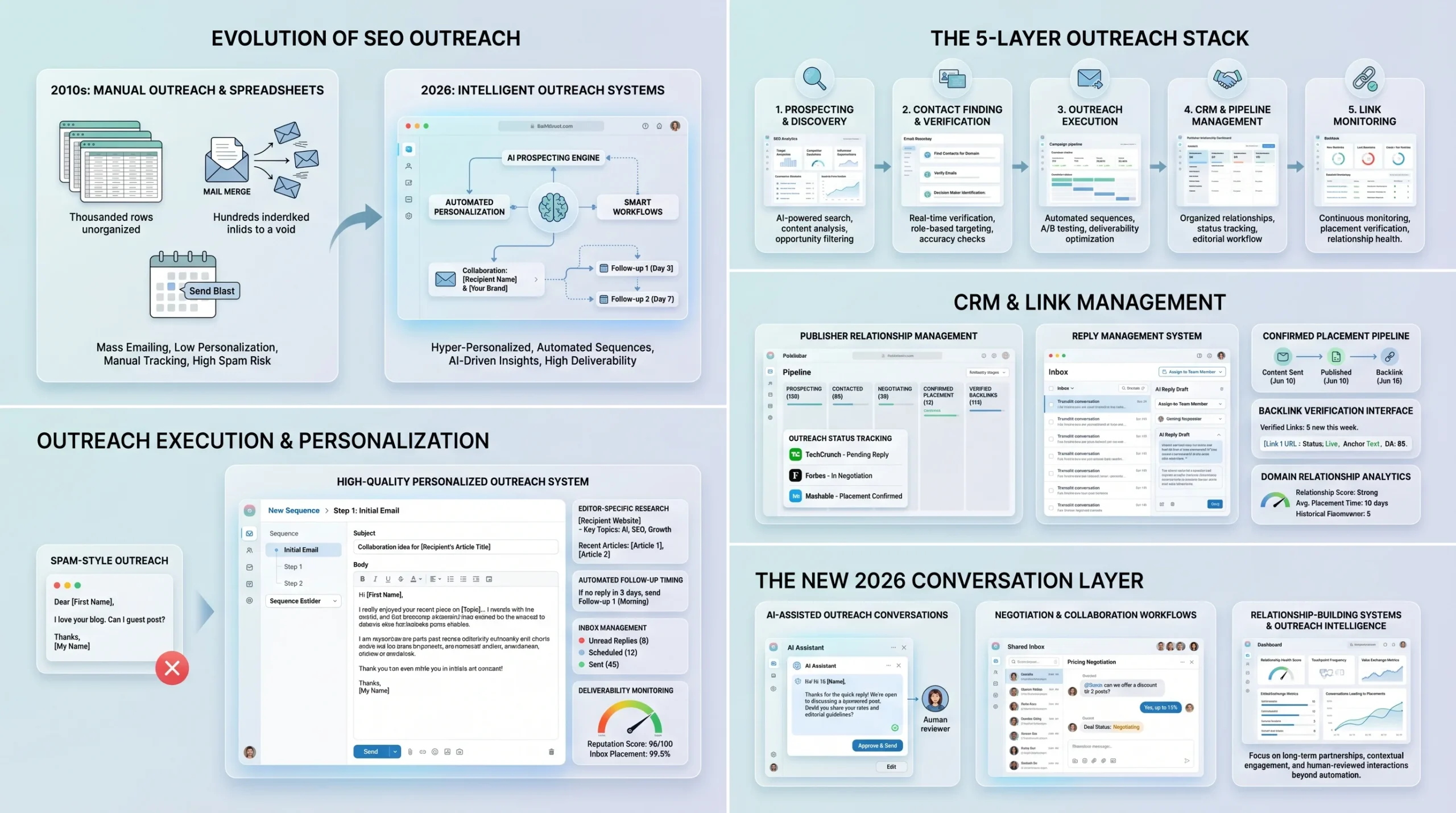
An SEO outreach tool is software designed to help link builders and SEO teams systematically identify backlink opportunities, find the right contacts at target websites, send personalized outreach messages, automate follow-up sequences, and track the outcome of every campaign. The best platforms bring several of these functions together under one roof. Others specialize in a single stage of the workflow and are built to integrate with the rest of your stack.
The definition has expanded considerably since the early days of link building. A decade ago, “outreach tool” meant an email sending platform with mail merge. You would export a prospect list from a spreadsheet, paste it into a campaign, fire off a templated email with a personalized first name, and hope for the best. That approach is effectively dead. Inboxes are better filtered, editors are more experienced at spotting templated outreach, and volume-first campaigns reliably end up in spam folders or on mental blocklists. What replaced that approach is a combination of smarter prospecting, genuine personalization at scale, multi-step sequences that respect a prospect’s time, and increasingly, multi-channel touchpoints that go beyond email entirely.
The modern outreach stack typically covers five stages. The first is prospecting and discovery — identifying websites that are relevant to your content, have genuine domain authority, and are realistically likely to link to you given their existing link patterns. The second is contact finding and verification — locating the right person at each target website and confirming their email address is deliverable. The third is outreach execution — sending personalized messages, scheduling follow-ups, and managing replies without letting anything fall through the cracks. The fourth is CRM and pipeline management — tracking where each prospect sits in the workflow, who has replied, who needs a follow-up, and which placements have been confirmed. The fifth is link monitoring — confirming that placed links remain live and notifying you when they are removed or changed.
The new frontier, specific to 2026, is the conversation layer. Most outreach tools automate the sending of messages. What they do not automate is what happens when someone replies — the back-and-forth that turns a cold introduction into a placed backlink. That conversation stage has traditionally required a human. The first tool on this list has changed that.
How We Evaluated These Tools
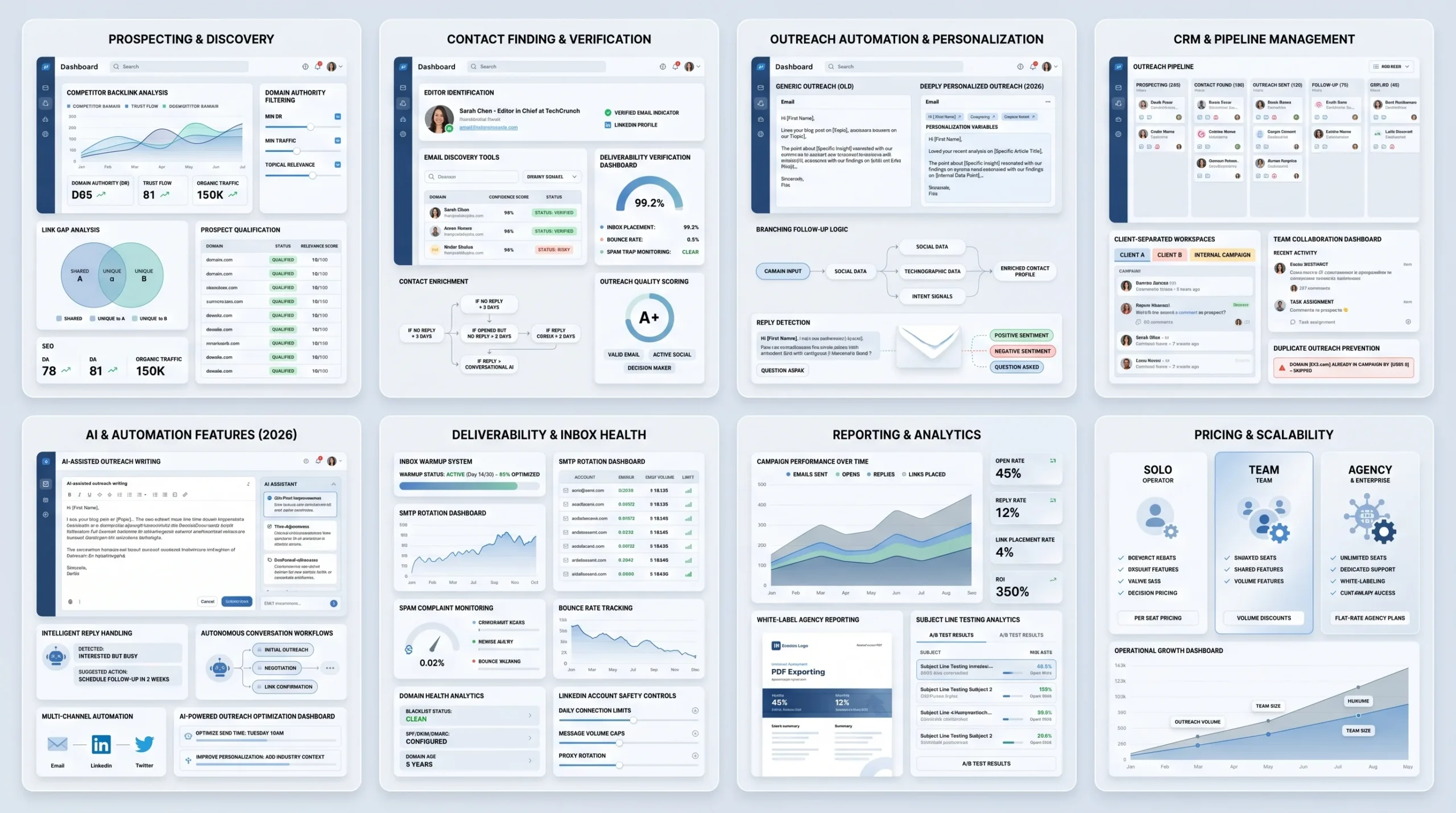
Every tool in this guide was evaluated against the same eight criteria. Understanding what each criterion means — and why it matters — will help you apply the comparisons to your own workflow.
Prospecting & Discovery
The quality of your outreach campaign is determined almost entirely by the quality of your prospect list. A tool that surfaces irrelevant, low-authority, or already-linked-to websites wastes your team’s most valuable resource: time. We assessed each tool’s prospecting capabilities by asking how deep its backlink index goes, how frequently it updates, whether it allows competitor backlink analysis, and whether it can surface link gap opportunities — sites linking to competitors but not to you. Tools with native SEO metric integration (Domain Rating, Domain Authority, organic traffic estimates) scored higher because they let you qualify prospects before adding them to a campaign.
Contact Finding & Verification
Finding the right website to pitch is only half the prospecting problem. Finding the right person at that website — and finding an email address that will actually reach them — is the other half. We evaluated tools based on the accuracy of their contact discovery, whether they verify deliverability before you send, and how they handle bulk operations for agencies managing large prospect volumes. A high bounce rate on outreach emails damages your sender reputation over time, which makes deliverability harder for every campaign that follows.
Outreach Automation & Personalization
The best outreach in 2026 reads like it was written specifically for the recipient. Tools that support dynamic personalization variables beyond “first name” — incorporating specific article references, link context, or publication-specific details — produce measurably better reply rates. We also assessed the sophistication of each tool’s sequence logic: can it branch based on whether an email was opened? Can it pause a sequence when a reply is detected? Does it support conditional follow-up logic, or does it just send pre-scheduled messages regardless of engagement signals?
CRM & Pipeline Management
For solo link builders, a simple inbox is a workable CRM. For agencies managing five, ten, or twenty simultaneous client campaigns, the lack of structured pipeline management is where campaigns collapse. We assessed each tool’s ability to track prospect status across campaigns, assign tasks to team members, separate client pipelines, and prevent duplicate outreach to the same contact across different campaigns. These are not glamorous features, but they are the operational backbone that determines whether a link building operation scales or stays stuck.
Deliverability & Inbox Health
Sending volume means nothing if your emails land in spam. We assessed each tool’s native deliverability infrastructure — whether it includes inbox warmup sequences for new sending accounts, supports SMTP rotation across multiple inboxes, monitors bounce rates and spam complaints, and provides guidance on sending limits. For LinkedIn-based tools, we assessed account safety features including daily limit controls and warmup protocols that protect account health.
Reporting & Analytics
An outreach campaign that cannot be measured cannot be improved. We assessed each tool’s reporting depth — whether it tracks open rates, reply rates, link placement confirmation, and campaign performance over time. For agency tools, we gave additional weight to white-label reporting capabilities and per-client data separation. The best tools give you the data you need to identify which campaign types, subject lines, and pitch angles are producing results and which are wasting spend.
Pricing & Scalability
Price matters differently depending on your scale. A solo link builder evaluates tools against a sub-$100/month budget. An agency running campaigns for fifteen clients needs to model the per-client cost. Per-seat pricing that looks reasonable for a two-person team becomes prohibitive at eight or ten users. We flagged tools where pricing structures create incentives against scaling and highlighted tools — particularly those with flat-rate agency pricing — that remain cost-effective as you grow.
AI & Automation Features (2026-Specific)
AI has moved from a marketing feature to a functional differentiator in outreach tooling. We assessed each tool’s AI capabilities across three dimensions: AI-assisted content generation (writing and personalizing outreach emails), AI-driven reply handling (interpreting incoming messages and generating appropriate responses), and multi-channel AI automation (conducting conversations autonomously across LinkedIn or email without human input for each exchange). This last category — autonomous conversation AI — is where the gap between tools has widened most significantly in 2026.
Quick Comparison Table — SEO Outreach Tools at a Glance
| Tool | Best For | Starting Price | Prospecting | Outreach | CRM | AI Features |
|---|---|---|---|---|---|---|
| DealsFlow | AI LinkedIn outreach for agencies | Free 14-day trial | ✅ Fully AI-driven | ✅ Strong | ✅ Arlo AI (best-in-class) | |
| Pitchbox | Large agency email campaigns | ~$165/mo | ✅ Advanced | ✅ Full | ✅ Yes | ✅ Yes |
| Respona | SMBs & solo SEOs | ~$99/mo | ✅ Good | ✅ Full | ✅ Yes | ✅ Moderate |
| BuzzStream | Relationship-led outreach | $24/mo | ✅ Moderate | ✅ Full | ✅ Strong | ❌ Limited |
| Semrush Link Building | All-in-one SEO teams | Add-on | ✅ Strong | ✅ Built-in | ✅ Yes | ✅ Moderate |
| Ahrefs | Backlink prospecting | $29/mo (Starter) | ✅ Best-in-class | ❌ No | ❌ No | ✅ MCP (2026) |
| Snov.io | Multi-channel cold outreach | $30/mo | ✅ Moderate | ✅ Email+LinkedIn | ✅ Yes | ✅ Yes |
| Hunter.io | Email finding & verification | Free / $34/mo | ❌ No | ✅ Basic | ❌ Limited | ❌ No |
| Mailshake | Cold email sending at scale | ~$58/mo | ❌ No | ✅ Full | ✅ Basic | ✅ Moderate |
| NinjaOutreach | Blogger/influencer outreach | $155/mo | ✅ Niche | ✅ Full | ✅ Yes | ❌ Limited |
| JustReachOut | PR-focused link building | ~$147/mo | ✅ Moderate | ✅ Full | ✅ Basic | ✅ Yes |
| Postaga | AI-powered campaigns | ~$84/mo | ✅ AI-driven | ✅ Full | ✅ Yes | ✅ Strong |
| LinkHunter | Beginner-friendly | ~$49/mo | ✅ Basic | ✅ Basic | ❌ Limited | ❌ No |
The 13 Best SEO Outreach Tools in 2026
The tools in this guide are organized across three categories. The first group — All-in-One Email Outreach Platforms — covers tools that handle multiple stages of the workflow from a single interface. The second group — Specialist Outreach & Sending Tools — covers platforms that focus on specific stages of execution, from email sending and cold outreach to blogger targeting and PR pitching. The third group — Prospecting, Contact Finding & Enrichment Tools — covers the research and data layer that feeds every campaign.
DealsFlow sits above all three categories as the #1 pick. The reason is straightforward: every other tool on this list automates the sending of outreach. DealsFlow’s Arlo AI is the only platform that autonomously holds the conversation — reading replies, handling objections, and progressing prospects toward a meeting without any human input per exchange. For DR 50+ editorial targets who have become effectively unreachable via cold email alone, LinkedIn is the channel that breaks through, and DealsFlow is built to operate that channel at agency scale.
1. DealsFlow — Best SEO Outreach Tool for Agencies in 2026
Every platform covered in this guide will help you send more outreach messages. DealsFlow is the only platform that removes the human bottleneck from what happens next. When a prospect replies to a LinkedIn message — asking a question, pushing back on your pitch, or expressing interest — every other tool requires a human to read that reply and decide how to respond. DealsFlow’s Arlo AI reads the reply, interprets the intent, formulates the appropriate response, and sends it. If the prospect raises an objection, Arlo handles it. If they ask for more information, Arlo provides it. If they agree to a call, Arlo books it. This happens across every active conversation, simultaneously, without human input per exchange.
For link builders and agencies targeting high-authority editorial publishers, this matters because high-DR targets are not won by a single well-crafted cold email. They are won through back-and-forth. The conversation stage — the follow-through after initial contact — is where most link building campaigns lose ground, because it requires consistent, timely, personalized communication that human teams cannot sustain at scale. DealsFlow solves this problem directly.
Overview
DealsFlow is a cloud-based LinkedIn outreach automation platform built around the Arlo AI conversational engine. It connects to your LinkedIn accounts, finds qualified prospects based on your defined ICP, and conducts real back-and-forth conversations on your behalf until the prospect agrees to a call or meeting. The platform is designed specifically for agencies running outreach across multiple clients and teams operating multiple LinkedIn accounts simultaneously — a use case that tools like Salesflow, Expandi, and Dripify serve in part, but where DealsFlow’s interface clarity, pricing transparency, and AI conversation capabilities give it a material advantage.
Key Features
- Arlo AI Engine: The core of the DealsFlow platform. Arlo reads every incoming reply, determines the prospect’s intent and emotional temperature, selects the appropriate response strategy, and sends a response that sounds natural and on-brand. It handles objections such as “we already have a tool” or “not interested right now,” answers factual questions about your offer or service, and progresses engaged prospects toward a booked call — all without requiring a human to review and approve each message.
- Multi-Account Management: Agencies managing outreach for multiple clients can connect up to 50 LinkedIn accounts and manage all of them from a single dashboard. Every account’s message volume, reply rates, connection acceptance rates, and booked calls are visible in one place. Accounts in warmup status are flagged separately, preventing premature high-volume sending that risks account restriction.
- AI Warmth Scoring: Every prospect in the CRM is automatically assigned a warmth score — Hot, Warm, Neutral, or Cold — based on their engagement signals. This scoring allows teams to prioritize follow-up attention on the highest-intent leads while Arlo continues managing the lower-priority conversations autonomously.
- Prospect CRM: Prospects can be imported from LinkedIn search URLs, lists of post commenters on relevant content, or CSV uploads. Once imported, each prospect has a full activity timeline, conversation history, warmth score, and status within the pipeline. Per-client pipeline separation makes it easy for agency teams to manage multiple accounts without cross-contamination.
- Campaign Builder: Setting up a campaign requires defining your ICP — the job titles, industries, company sizes, and geographies you want to target — along with a messaging direction for Arlo to work from. Once the campaign is live, Arlo handles prospecting, initial outreach, and all subsequent conversation management end-to-end.
- Full-Funnel Analytics: DealsFlow tracks every stage of the funnel: connection requests sent, requests accepted, replies received, conversations progressed, and calls booked. All data is exportable in full. There is no data lock-in, which is important for agencies that need to report campaign performance to clients in their own format.
- Account Safety Controls: LinkedIn’s terms of service prohibit automation that mimics human behavior at scale. DealsFlow manages this risk through automatic daily limit controls per account, warmup scheduling for new accounts, and activity pacing that keeps each account within safe operational parameters. Users report that first campaign setup takes under 30 minutes.
What’s New in 2026
The Arlo AI conversational engine launched in early access in 2026, representing the platform’s biggest capability expansion to date. DealsFlow has also crossed the milestone of 12,000 meetings booked through the platform and has earned three G2 recognition badges: High Performer, Best Results, and Easiest Setup. The 14-day free trial requires no credit card, allowing agencies to validate the platform against a real campaign before committing.
Pros
- The only outreach platform where AI manages the full conversation, not just message delivery
- Setup to first campaign in under 30 minutes — the fastest onboarding on this list
- Flat-rate pricing designed for agency scale, significantly more cost-effective than per-seat pricing for multi-client operations
- AI warmth scoring eliminates the manual work of prioritizing follow-up across large prospect volumes
- LinkedIn channel reaches editorial targets who have become effectively blind to cold email
- Account safety features built into the platform by default — no manual safety management required
- Full data export means no lock-in and clean client reporting
Cons
- Primarily a LinkedIn outreach platform — it complements email outreach tools like Pitchbox or BuzzStream but does not replace them
- Arlo AI performs best when the ICP and messaging direction are defined clearly upfront; vague campaign parameters produce less precise conversations
- As a newer platform, the ecosystem of third-party integrations is less extensive than legacy tools, though core functionality does not require them
Pricing
DealsFlow offers a 14-day free trial with no credit card required. Visit dealsflow.co/pricing for current plan details.
Best For
Lead generation agencies managing outreach for 10 to 50 clients simultaneously. SDR teams scaling LinkedIn campaigns without proportional headcount growth. SEO agencies targeting DR 50+ editorial publishers where email-first outreach has plateaued in effectiveness. Founders running outreach-led growth without a dedicated sales development team.
Why It Matters Specifically for Link Builders
Cold email response rates for editorial backlinks from high-authority domains have declined meaningfully as inbox filtering has improved and editorial teams have become more sophisticated at identifying templated outreach. LinkedIn creates a different dynamic. A connection request followed by a genuine, conversational message from someone who has engaged with the prospect’s content lands differently than a cold email. When Arlo handles the back-and-forth of that LinkedIn conversation — asking the right follow-up questions, handling the editor’s pushback about unsolicited pitches, and establishing enough credibility for the prospect to agree to a call — the link builder can then move the conversation toward the actual placement pitch from a warm foundation. Agencies that have built this two-channel approach — email sequences running through Pitchbox in parallel with LinkedIn relationship-warming through DealsFlow — report meaningfully better conversion on high-authority targets.
Verified Results (G2)
Users verified on G2 report 47 meetings booked in the first 30 days, a 3x improvement in reply rates versus previous outreach processes, and 6 calls booked within the first week of the first campaign.
Bottom Line
DealsFlow earns the #1 spot because it solves the problem every other tool on this list avoids: what happens after someone replies. Arlo handles the conversation. You take the calls.
2. Pitchbox — Best for High-Volume Agency Email Campaigns
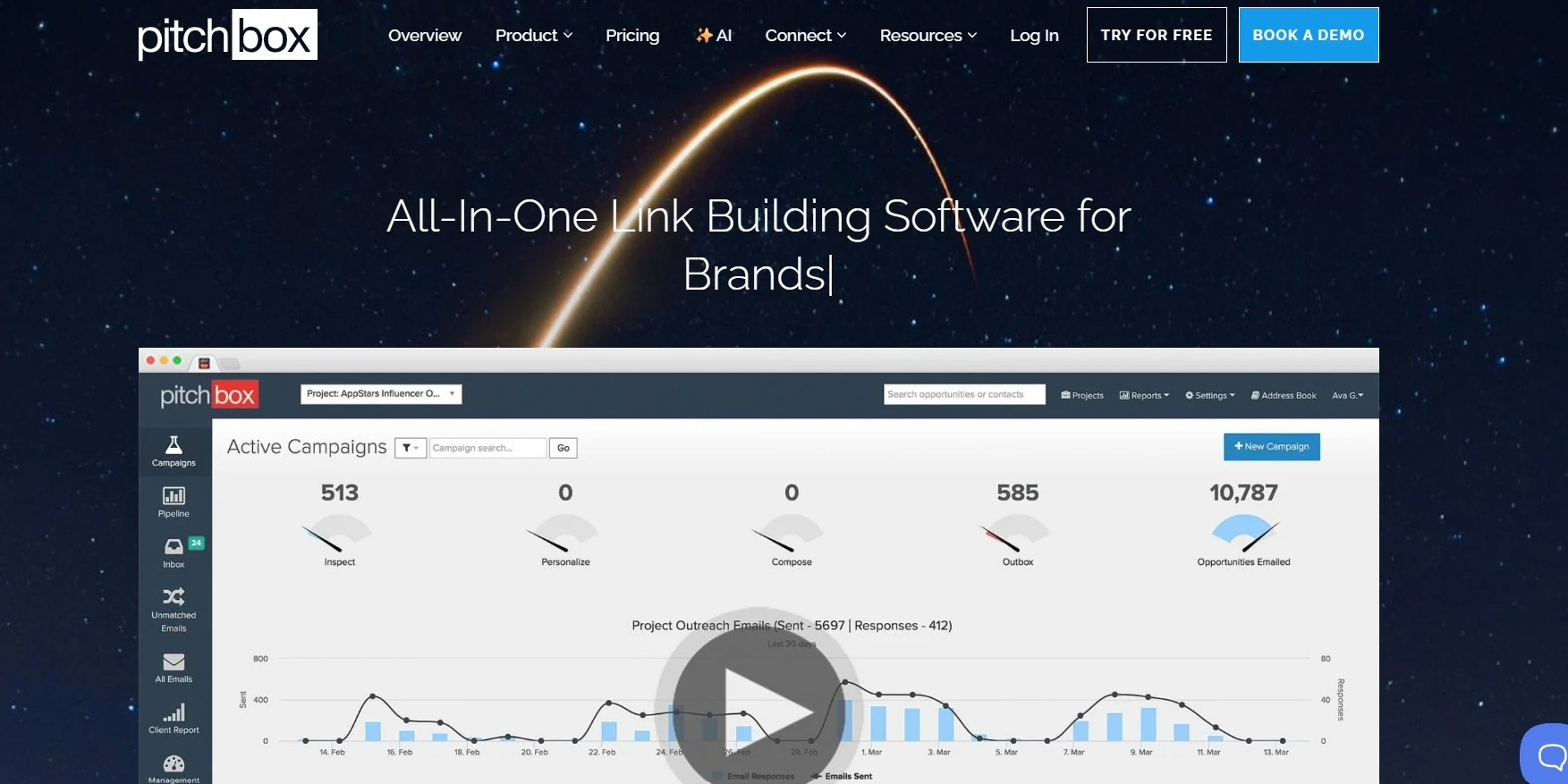
Pitchbox is the most feature-complete email-first outreach CRM available for SEO agencies and enterprise link building teams. It has held the #1 position in G2’s link-building software category for five consecutive years, a consistent track record that reflects both its capabilities and the breadth of its user base among professional link building operations.
The platform covers the full email outreach workflow from prospecting through to reporting. You can search by keyword or topic to surface relevant websites, pull their SEO metrics directly from Ahrefs, Semrush, Moz, or Majestic without leaving the interface, assign them to campaigns, build multi-step email sequences with conditional logic, automate follow-ups based on open and reply behaviour, and report on campaign performance in white-label format for client delivery. For agencies running 20 or more simultaneous campaigns across different clients and niches, this end-to-end workflow coverage is where Pitchbox earns its price premium.
Key Features
- Keyword-driven prospect discovery with real-time SEO metric scoring pulled from Ahrefs, Semrush, Moz, and Majestic integrations
- Fully automated multi-step follow-up sequences with conditional logic — sequences branch differently depending on whether an email was opened, clicked, or ignored
- White-label reporting dashboards configurable for client delivery
- Team collaboration features including SOP enforcement, approval workflows, and role-based access controls
- Deliverability monitoring with inbox health tracking across connected sending accounts
- Campaign templates pre-built for common link building use cases including guest posting, broken link building, resource page outreach, and unlinked mention campaigns
What’s New in 2026
Pitchbox has added AI-assisted pitch personalization, allowing the platform to generate customized opening lines based on each prospect’s recent content. Deeper CRM pipeline controls were also added in recent updates, giving campaign managers more granular status tracking across large prospect volumes.
Pros
- The most comprehensive email outreach CRM on the market for agency-scale operations
- Native SEO metric integrations mean prospect qualification happens inside the workflow, not in a separate tab
- Conditional sequence logic produces meaningfully better follow-up relevance versus simple time-based sending
- White-label reporting is well-executed and requires minimal configuration for client delivery
- Consistent G2 leadership rating validates the platform’s real-world performance among professional users
Cons
- The pricing structure is one of the most expensive on this list, starting at $165/month for only two users — agency teams scale quickly past this threshold
- Overkill for solo link builders or small teams running fewer than five simultaneous campaigns
- The learning curve is steeper than platforms like Respona or BuzzStream — expect a meaningful onboarding investment before the platform runs efficiently
- Email-only — there is no native LinkedIn outreach channel, which is why agencies combining Pitchbox with DealsFlow get the most complete two-channel coverage
Pricing
Pro plan at approximately $165/month for 2 users and 2,000 outreach emails per month. Advanced at approximately $420/month for unlimited users and 5,000 emails per month. Scale at approximately $675/month for unlimited users, 15,000 emails per month, and unlimited campaigns. A 15% discount applies on annual billing.
Best For
SEO agencies running high-volume email campaigns across multiple clients simultaneously. Enterprise in-house teams with structured outreach processes requiring SOP enforcement and audit trails. Teams for whom reporting quality is a client retention issue.
Pro Tip
Pair Pitchbox with DealsFlow for a full two-channel outreach stack. Pitchbox handles your email sequences while DealsFlow’s Arlo AI warms the same targets on LinkedIn in parallel — turning a cold email into the second touch rather than the first.
Bottom Line
The most powerful email-first outreach CRM on the market. If DealsFlow is your LinkedIn engine, Pitchbox is your email engine for high-volume agency operations.
3. Respona — Best All-in-One for Growing Teams & Solo SEOs
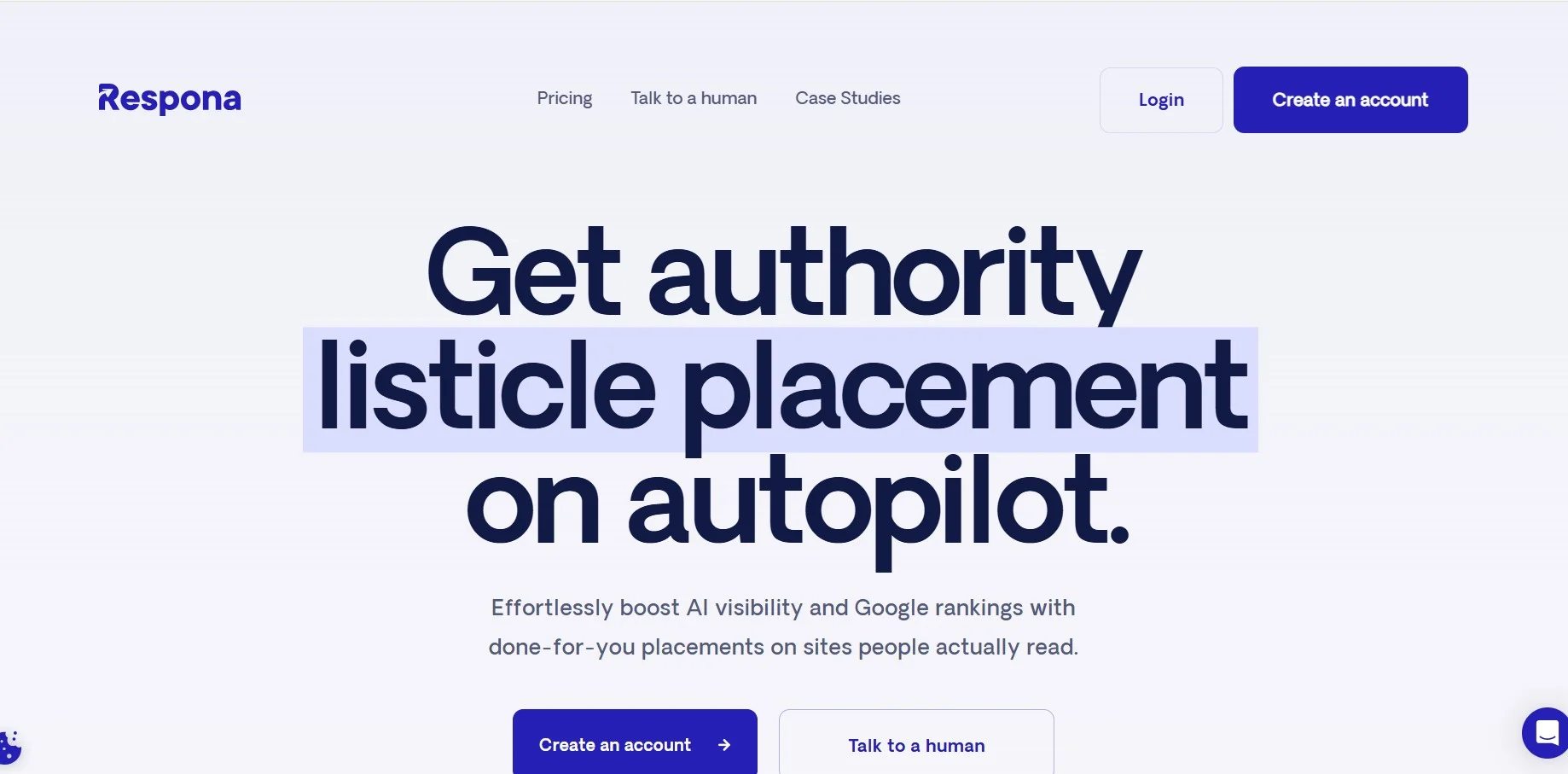
Respona launched in 2019 with the goal of combining prospect discovery, contact finding, and email automation in a single platform at a price point accessible to teams below the enterprise level. In 2026, it remains the most capable mid-market all-in-one outreach platform — delivering a large portion of what Pitchbox offers at a fraction of the cost.
The platform’s core differentiator is its content-first approach to prospecting. Rather than asking you to input competitor domains or keyword lists and then filtering raw results, Respona’s built-in search engine uses advanced operators to surface relevant content — articles, resource pages, and editorial posts — that match your campaign’s topic. It then automatically identifies the authors and editorial decision-makers behind that content, saving the manual research step that eats hours in other workflows. The result is a prospect list populated with the right person at the right publication, not just a domain and a generic contact form email.
Key Features
- Over 15 pre-built campaign templates covering the most common link building use cases: Guest Post, Skyscraper Technique, Resource Page, Broken Link Building, Podcast Outreach, Product Review, Unlinked Mention campaigns, and more
- Built-in search engine using advanced operators to find content matching your target keywords — surfaces specific articles and resource pages rather than just domains
- Automatic author and decision-maker discovery — Respona identifies who wrote the content you want to pitch and finds their contact information without manual research
- Sequence builder with personalization variables supporting dynamic content beyond basic first-name personalization
- Full campaign tracking from prospect discovery through to reply management and placement confirmation
What’s New in 2026
Respona has expanded its AI personalization capabilities, allowing the platform to generate contextually relevant opening lines based on the specific content each prospect has published. The template library has also been expanded based on user feedback, adding several new campaign types for niche link building strategies.
Pros
- The content-first prospecting approach surfaces higher-quality prospects than keyword-list-based tools — you target specific articles, not just domains
- Pre-built campaign templates substantially reduce setup time, particularly for teams new to structured outreach
- Pricing is accessible for solo SEOs and small agencies that cannot justify Pitchbox’s cost
- The free plan for one project allows genuine testing before any financial commitment
- Author auto-discovery removes a significant manual research bottleneck
Cons
- Team scaling features are less robust than Pitchbox — larger agencies with 10 or more concurrent campaigns will encounter friction
- Sequence automation logic is less sophisticated than Pitchbox’s conditional branching — follow-ups are primarily time-based
- No native LinkedIn outreach channel
Pricing
Starts at approximately $99/month for solo users. A free plan is available for one project. Paid plans scale with the number of campaigns and team members.
Best For
Solo SEOs, small agencies, and content-first link building teams building fewer than 100 links per month. Teams that want a structured all-in-one platform without the complexity and cost of enterprise software.
Bottom Line
Respona delivers approximately 80% of Pitchbox’s core functionality at a fraction of the price. It is the smart starting point for outreach operations that have outgrown basic email tools but are not yet ready to justify Pitchbox’s investment.
4. BuzzStream — Best for Relationship-Led & PR Outreach
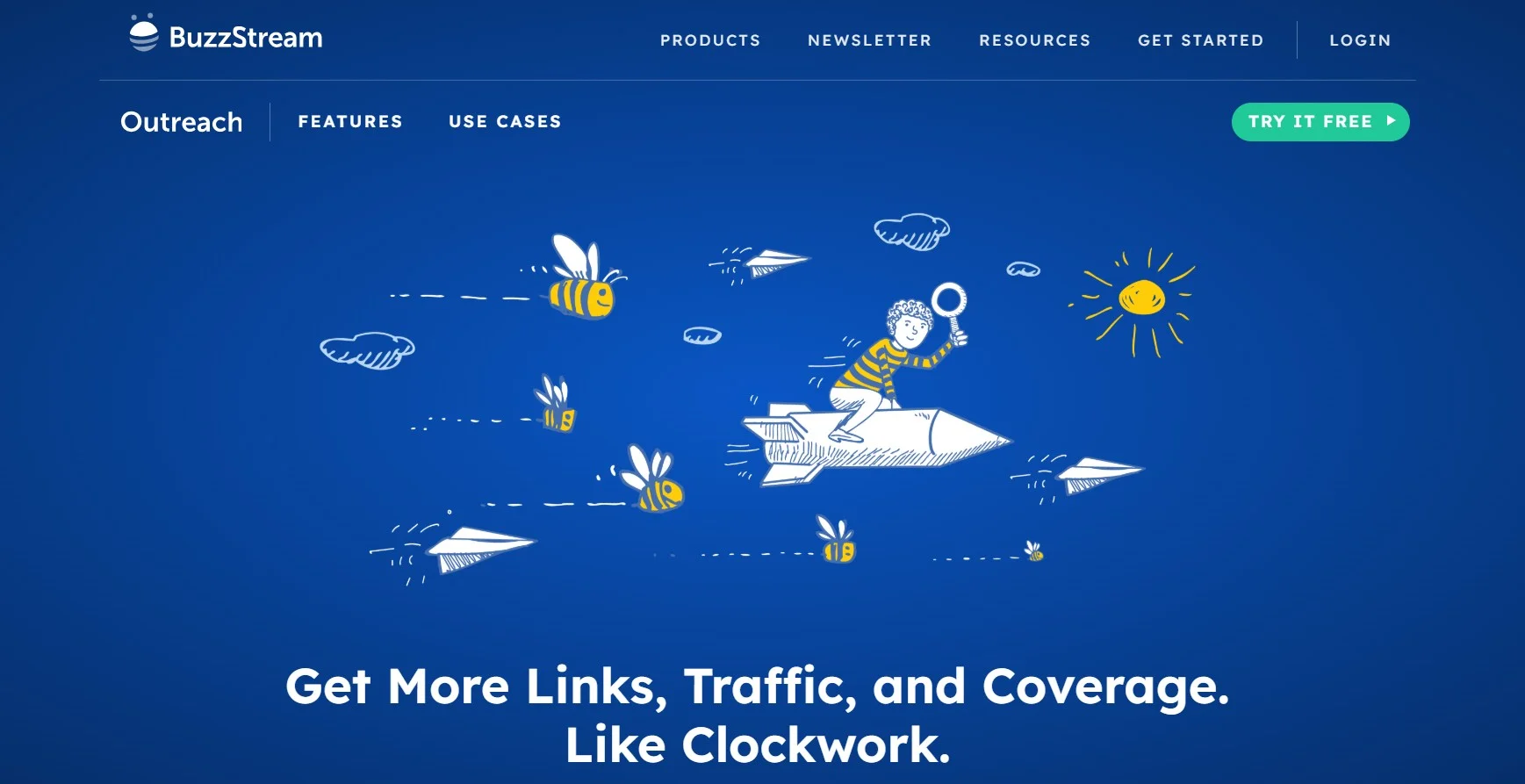
BuzzStream takes a different philosophical approach to outreach than most of the platforms on this list. Where tools like Pitchbox and Respona are built around campaign efficiency — optimising send volume, reply rate, and link acquisition per campaign hour — BuzzStream is built around relationship management. The distinction matters more than it sounds. For link building strategies that depend on genuine editorial relationships — digital PR, ongoing columnist or contributor relationships, niche community outreach — a relationship-first tool produces better long-term results than a campaign-first one.
The platform’s design reflects this. Every website in BuzzStream builds a relationship record over time: your outreach history, their responses, notes from conversations, social media activity, and contact details for multiple people at the same publication. When you return to pitch the same domain six months later, BuzzStream shows you the full history. For agencies doing the kind of outreach where the same editor matters across dozens of campaigns, this memory layer is genuinely valuable.
Key Features
- BuzzMarker Chrome extension allows you to add websites, contacts, and link notes to BuzzStream directly from your browser without leaving the page you are researching — a significant workflow accelerator for manual prospecting
- Built-in contact research and social profile tracking that enriches each prospect record with publicly available information
- Email template library with merge variables, campaign send management, and automated follow-up scheduling
- Tiered team plans with cross-account visibility, allowing agency managers to see activity and status across all client campaigns from one view
- Workflows specifically designed for guest posting, digital PR outreach, and broken link building with pre-configured status pipelines for each
What’s New in 2026
Recent updates have improved team collaboration features, including better cross-campaign duplicate detection and enhanced cross-account reporting dashboards for agency managers overseeing multiple client campaigns.
Pros
- The relationship record model is the best-executed approach to long-term outreach management on this list — invaluable for agencies with recurring campaigns to the same publication pool
- BuzzMarker Chrome extension is a genuine productivity tool, not just a convenience feature
- The most accessible professional outreach platform for teams new to structured outreach — the learning curve is substantially lower than Pitchbox
- Starter pricing at $24/month makes it viable for individual link builders without a team budget
- Well-suited for digital PR campaigns where the same contacts are pitched repeatedly across different client contexts
Cons
- Prospecting capabilities are more limited than dedicated backlink intelligence platforms like Ahrefs — BuzzStream works best when you bring your own prospect lists
- AI personalization features are limited compared to more modern platforms
- Sequence automation logic is simpler than Pitchbox’s conditional branching
Pricing
Starter plan at $24/month for individual users. Plans scale with team size and outreach volume. A free trial is available.
Best For
Agencies, in-house PR and SEO teams, and independent consultants managing multiple client campaigns with recurring editorial relationships. Specialists in guest posting, digital PR, and broken link building who return to the same publication pool across campaigns.
Bottom Line
BuzzStream is the most accessible professional outreach platform and the best relationship management tool on this list. It is the right starting point for teams that are not yet ready for Pitchbox but need something more structured than a spreadsheet and a Gmail account.
5. Semrush Link Building Tool — Best for SEO Teams Already on Semrush
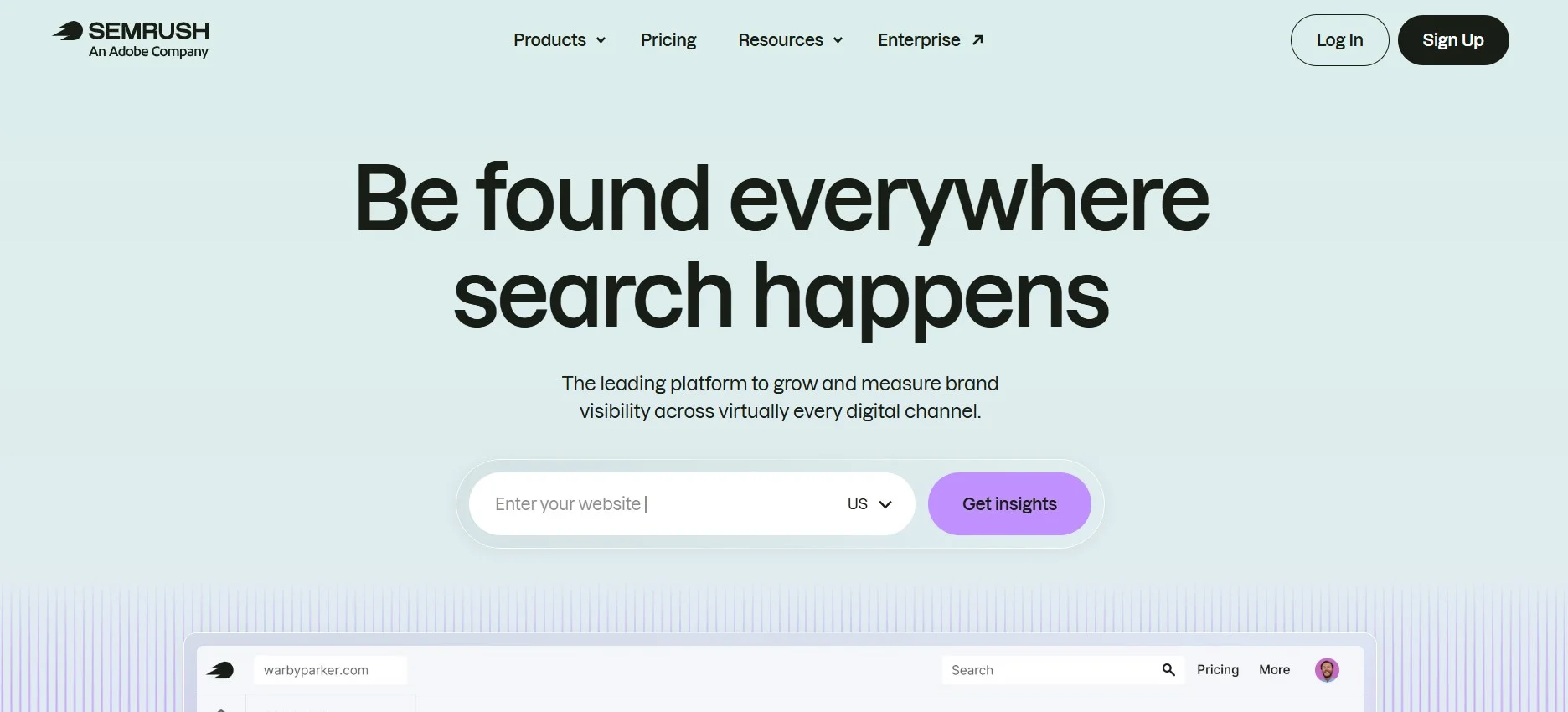
Semrush is one of the most widely used digital marketing platforms globally, with a reported user base spanning 35% of Fortune 500 companies. Its Link Building Tool is not a standalone product but an integrated module within the broader Semrush platform — which is both its greatest strength and its primary limitation. For teams already operating inside Semrush for keyword research, site auditing, and competitor analysis, the Link Building Tool eliminates the tool-switching overhead that fragments most outreach workflows. For teams not on Semrush, the cost of entry is higher than dedicated outreach platforms.
The workflow begins with the Backlink Gap tool, which lets you input your domain alongside up to four competitors and instantly surfaces the websites linking to them but not to you. Those targets can flow directly into the Link Building Tool’s prospect pipeline, where each domain is scored against SEO metrics and queued for outreach. Email sequences are managed within the same interface, and link status monitoring runs continuously once placements go live.
Key Features
- Backlink Gap tool for instant competitor link gap analysis — find domains linking to competitors but not to you
- In-platform prospect scoring based on domain authority, estimated traffic, and backlink profile quality
- Outreach email management with CRM-style tracking of prospect status from initial contact through to placement
- Disavow file management and anchor text distribution analysis for both proactive and defensive link building
- Semrush One bundle (launched October 2025) adds an AI Visibility Toolkit that tracks brand mentions and citations in ChatGPT, Claude, and Perplexity — extending the platform’s value beyond traditional Google-focused link building into AI search visibility
What’s New in 2026
The Semrush One bundle, launched in October 2025, represents a significant expansion of the platform’s relevance. By adding AI search visibility tracking alongside traditional backlink monitoring, Semrush is positioning the Link Building Tool within a broader context where links feed not just Google rankings but also AI search engine citation patterns.
Pros
- Eliminates tool-switching for teams already invested in the Semrush platform — research, outreach, and monitoring in a single environment
- Backlink Gap analysis is one of the fastest ways to build a qualified prospect list from a standing start
- Semrush One’s AI Visibility Toolkit adds genuine 2026 relevance beyond traditional SEO metrics
- Continuous link monitoring catches lost placements before they affect your backlink profile reporting
Cons
- Requires a Semrush subscription — the outreach functionality is not available independently
- Outreach features are less sophisticated than dedicated platforms like Pitchbox; conditional sequence logic and AI personalization are more limited
- Not the right choice for teams whose primary tool is Ahrefs or a non-Semrush SEO platform
Pricing
Semrush plans start at approximately $139/month. The Link Building Tool is available as an add-on to paid plans.
Best For
Marketing teams and agencies that need SEO, content marketing, keyword research, PPC intelligence, and link building managed within one platform. Teams where reducing the number of software subscriptions is a genuine operational priority.
Bottom Line
If you are already paying for Semrush, the Link Building Tool is a compelling addition that consolidates your outreach workflow inside an environment you already use. If you are not on Semrush, the entry cost makes dedicated outreach tools like Pitchbox or BuzzStream more practical.
6. Mailshake — Best for Cold Email Sending at Scale
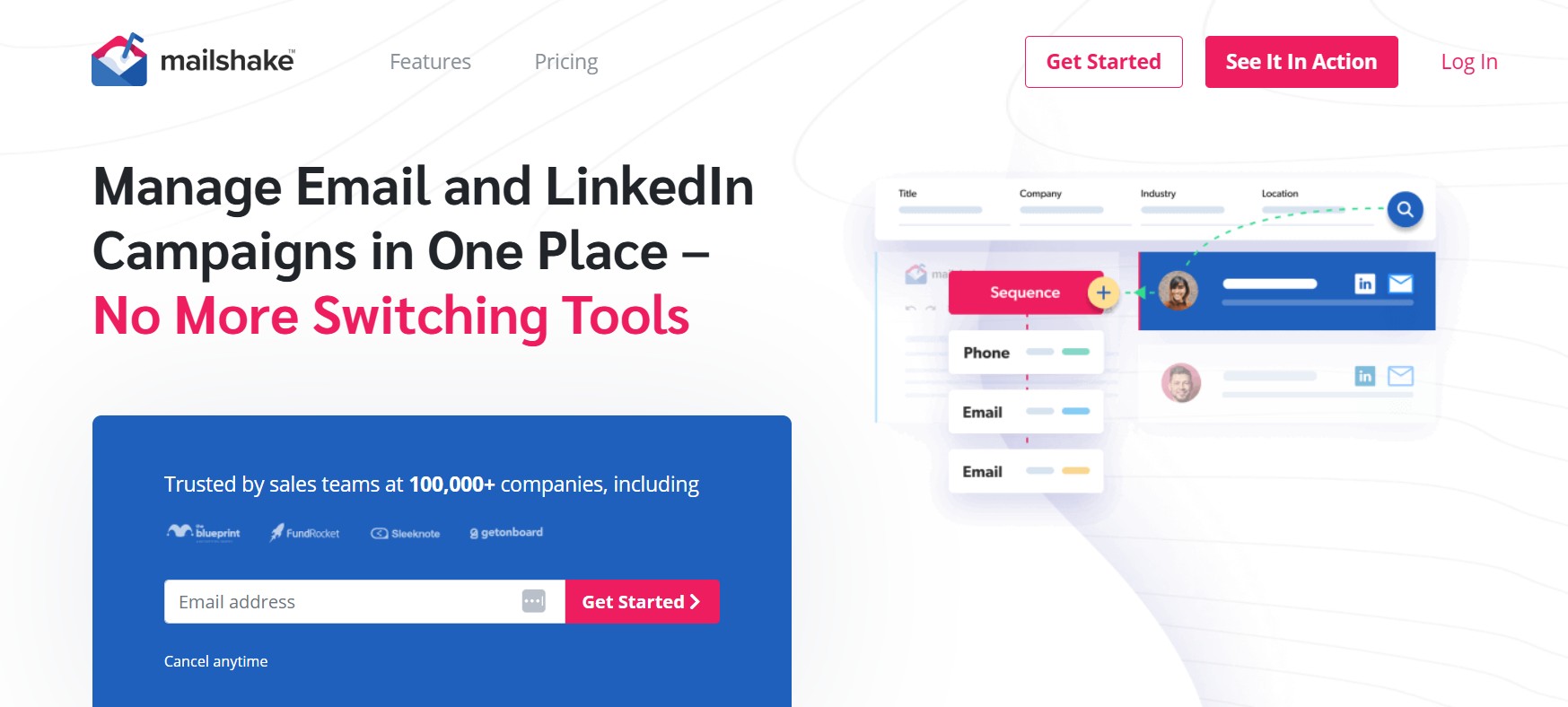
Mailshake is one of the longest-standing cold outreach platforms in this category, having built its reputation primarily among sales teams before becoming widely adopted by SEO professionals for link building email campaigns. Its focus is narrow and well-executed: send high volumes of personalized cold emails, manage follow-up sequences, track engagement, and report results. It does not attempt to be a prospecting tool or a comprehensive CRM, which keeps its interface clean and its core functionality reliable.
For link builders who have already built their prospect lists — through Ahrefs, Semrush, or another prospecting tool — and have verified their contact emails through Hunter.io or a similar service, Mailshake provides the sending infrastructure to execute campaigns at volume without the complexity overhead of a full-stack platform like Pitchbox.
Key Features
- Personalized email sequences with automated multi-step follow-ups — sequences pause automatically when a reply is detected, preventing follow-ups from being sent to prospects who have already responded
- A/B testing functionality for subject lines, email body copy, and send timing — allows systematic improvement of campaign performance across iterations
- Team collaboration features including shared campaign libraries, lead scoring, and team-level reporting dashboards
- Deliverability-focused sending infrastructure with sending limits and best practice guidance built into the platform
- Integrations with popular CRM platforms and prospecting tools, making it a natural fit in a multi-tool stack
What’s New in 2026
Mailshake has added AI-assisted copy generation for outreach email writing, allowing users to generate personalized opening lines and email body content within the platform before launching campaigns.
Pros
- Clean, focused interface with a shallow learning curve — teams can be operational with their first campaign on the same day they sign up
- Reliable deliverability infrastructure backed by years of sending volume data
- A/B testing is well-implemented and easy to interpret, making iterative improvement accessible without statistical expertise
- Integrates cleanly with the most common prospecting and email verification tools in the link building stack
Cons
- Not a prospecting tool — you must bring your own verified prospect list, which requires separate subscriptions to tools like Ahrefs and Hunter.io
- No native LinkedIn outreach channel
- Per-user pricing that scales less favorably for larger teams than flat-rate alternatives
Pricing
Approximately $58/month per user. Annual pricing offers a discount.
Best For
Teams with existing, verified prospect lists who need a reliable, clean email sending and sequencing platform. Link builders comfortable managing their prospecting in a separate tool and wanting an uncluttered outreach execution layer.
Bottom Line
Mailshake is a solid, well-maintained email sending engine. It needs to be part of a broader stack rather than a standalone tool, but within that stack it executes its role reliably.
7. Postaga — Best for AI-Powered Campaign Creation
Postaga approaches the outreach problem from the AI-first direction. Rather than asking users to manually build prospect lists, define contacts, and write outreach copy, Postaga uses AI to assist or automate much of that discovery and creation work. This makes it particularly attractive for founders, solo marketers, and small teams that want to launch campaigns quickly without the research overhead that more manual platforms require.
The platform supports a range of outreach campaign types beyond generic guest post requests. You can input a keyword or topic and have Postaga surface relevant resource pages, broken link opportunities, podcast shows, and competitor backlink targets along with suggested contact information and AI-generated email drafts for each. The speed from “campaign idea” to “first email sent” is faster on Postaga than on any other all-in-one platform on this list.
Key Features
- AI-powered campaign type selection and prospect generation — input a topic or keyword and the platform suggests campaign types, surfaces relevant targets, and pre-populates contact information
- Automated multi-step follow-up sequences with reply detection that pauses sequences for active conversations
- Pre-configured campaign workflows for guest posting, resource page outreach, broken link building, and podcast outreach
- AI email writing assistance that generates customized outreach copy based on each prospect’s content
- Campaign tracking with open rate, reply rate, and link placement monitoring
Pros
- Fastest path from campaign concept to active outreach — the AI-assisted setup substantially reduces the pre-campaign research time
- Good range of campaign types with pre-configured workflows for the most common link building strategies
- Accessible pricing for teams managing a moderate outreach volume
- Genuinely useful for beginners who need guidance on how to structure different types of outreach campaigns
Cons
- Less granular control over prospect qualification than platforms feeding from dedicated backlink intelligence tools like Ahrefs
- AI-generated prospect lists require quality review before sending — automated discovery is not a substitute for human qualification judgment
- Smaller user community and less extensive third-party review coverage than Pitchbox or BuzzStream
- No native LinkedIn outreach channel
Pricing
Approximately $84/month. Multiple plan tiers are available based on outreach volume.
Best For
Founders and solo marketers wanting fast AI-assisted campaign setup and launch. Teams new to structured outreach who benefit from the guided campaign type selection. Operators building outreach volume without a dedicated research team.
Bottom Line
Postaga is the most beginner-friendly AI-first email outreach platform on this list. The speed advantage is real. Pair it with a prospecting tool like Ahrefs for campaigns targeting higher-authority domains where list quality is critical.
8. NinjaOutreach — Best for Blogger & Influencer Link Building
NinjaOutreach occupies a specific niche in the outreach tool landscape. While most platforms on this list are optimized for editorial link building — pitching webmasters and content editors for guest posts, broken link replacements, or resource page inclusions — NinjaOutreach is designed around the influencer and blogger outreach use case. Its database is weighted toward content creators, social influencers, and niche bloggers rather than editorial publications and news sites, which makes it the right tool for a specific type of link building campaign and the wrong tool for others.
For eCommerce brands building links through product reviews, niche affiliate bloggers, and sponsored content placements, or for campaigns targeting personal blogs and niche community sites rather than institutional publishers, NinjaOutreach’s database and workflow are purpose-built for the task.
Key Features
- Large database of bloggers and content creators including SEO metrics (Domain Rating, organic traffic) alongside social metrics (follower counts, engagement rates) — allowing dual qualification by both link value and audience reach
- Email sequence automation with multi-step follow-up scheduling and reply detection
- CRM with relationship tracking, tagging, and campaign history per contact
- Search and filtering capabilities including niche topic, domain authority range, and geographic targeting
- Integration with email finding tools to supplement the platform’s native contact database
Pros
- Best blogger and influencer database available in a dedicated link building tool — the core use case is well-served
- Dual qualification by SEO and social metrics is genuinely useful for campaigns where audience quality matters alongside link authority
- CRM features are solid for managing longer influencer relationships beyond single campaign cycles
Cons
- Pricing is relatively high for the features offered when compared to all-in-one platforms serving broader use cases
- Not well-suited for editorial link building, news site pitching, or guest post campaigns targeting institutional publishers
- AI personalization features are limited compared to more modern platforms
- No LinkedIn outreach functionality
Pricing
Starts at approximately $155/month. Plans scale with database access and team size.
Best For
eCommerce brands and product marketers building links through niche blogger and content creator relationships. Campaigns where audience reach and social metrics matter alongside domain authority. Influencer marketing programs that intersect with SEO link building goals.
Bottom Line
NinjaOutreach is the right tool when your targets are bloggers and creators. For editorial publishers, news sites, and institutional link targets, use a different platform from this list.
9. JustReachOut — Best for PR-Style Link Pitching
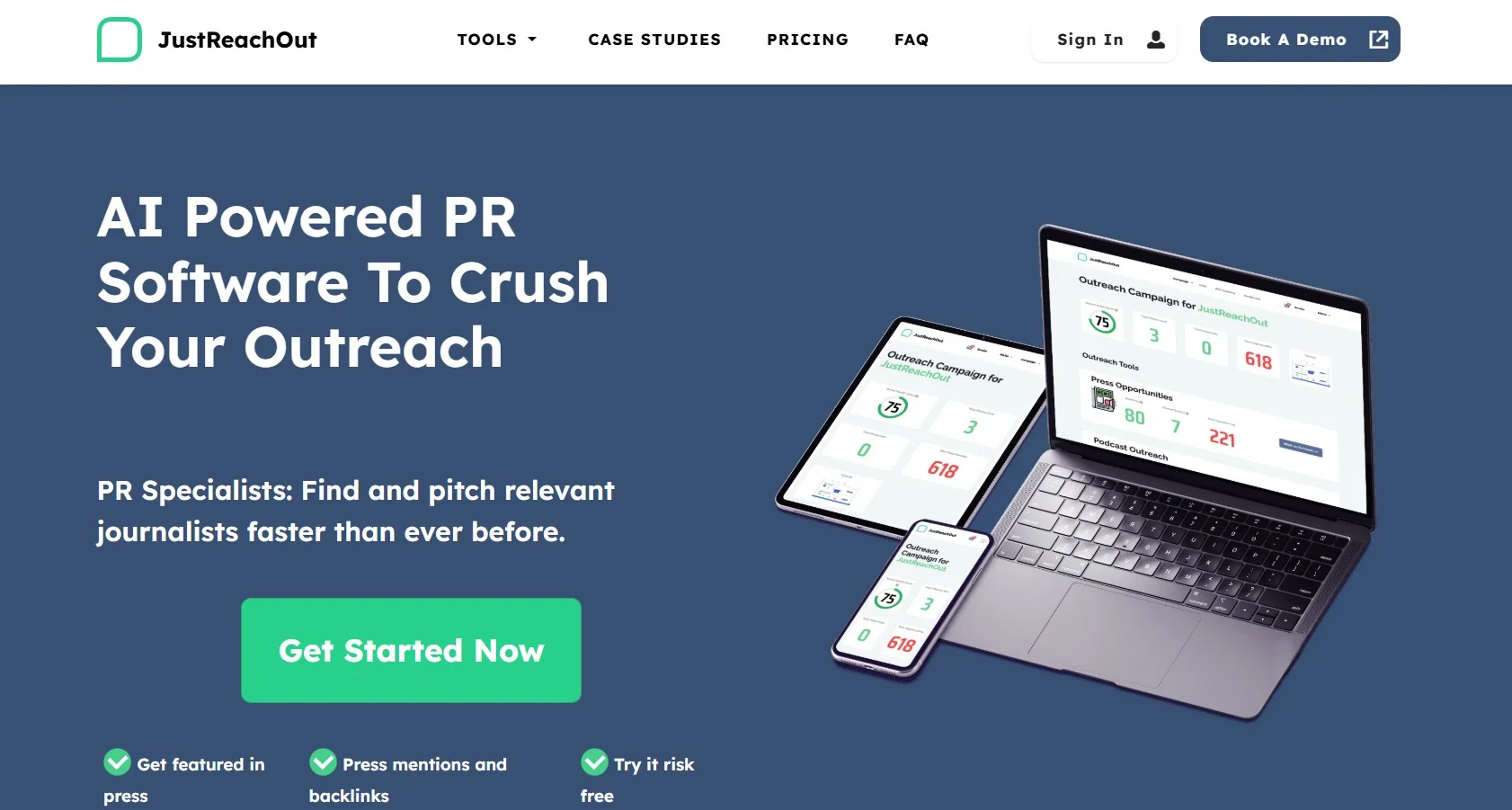
JustReachOut is positioned at the intersection of PR media outreach and SEO link building. While most platforms on this list treat link building primarily as an email sequence problem, JustReachOut approaches it as a storytelling and pitching problem — the primary question is not “how do I automate follow-ups” but “how do I craft a pitch compelling enough that a journalist or editor will actually place a link.”
The platform provides AI-assisted pitch writing, a database of journalists and bloggers organized by beat and publication, and campaign tracking designed for PR-style outreach where the relationship with the journalist matters as much as the technical mechanics of the email.
Key Features
- Pre-built pitch templates for media outreach covering news hooks, expert commentary pitches, data-driven story angles, and product announcement formats
- AI-assisted pitch writing and angle suggestions that help users identify the editorial framing most likely to resonate with a given journalist or publication
- Journalist and blogger database organized by topic beat, publication, and contact recency — reducing the research time required to identify the right media contacts
- Campaign tracking with open rates, reply tracking, and placement confirmation management
What’s New in 2026
AI pitch writing capabilities have been expanded, with the platform now offering more granular angle suggestions based on recent coverage patterns at specific publications.
Pros
- Strong for brands whose link building strategy involves genuine editorial storytelling rather than pure outreach volume
- AI pitch writing assistance helps non-PR professionals craft more media-relevant outreach
- Journalist and blogger database reduces the time cost of media research for teams without a dedicated PR function
Cons
- The PR-focused approach is a poor fit for high-volume, template-driven link building strategies
- Prospecting depth is more limited than dedicated backlink intelligence tools
- Pricing is relatively high given the specialist use case — teams running primarily email-based link building will get more value from Respona or BuzzStream at a lower cost
Pricing
Approximately $147/month. Plans vary by team size and outreach volume.
Best For
Brands where digital PR and SEO link building overlap — pitching journalists for editorial coverage that generates backlinks. Agencies with clients in newsworthy industries where a media relations approach to link building is viable. In-house SEO teams that want PR-style outreach support without hiring a dedicated PR function.
Bottom Line
JustReachOut is the right tool when your link building strategy depends on editorial storytelling and journalist relationships. For volume-first guest post and broken link campaigns, the other platforms on this list will serve you better.
10. Snov.io — Best for Multi-Channel Cold Outreach (Email + LinkedIn)
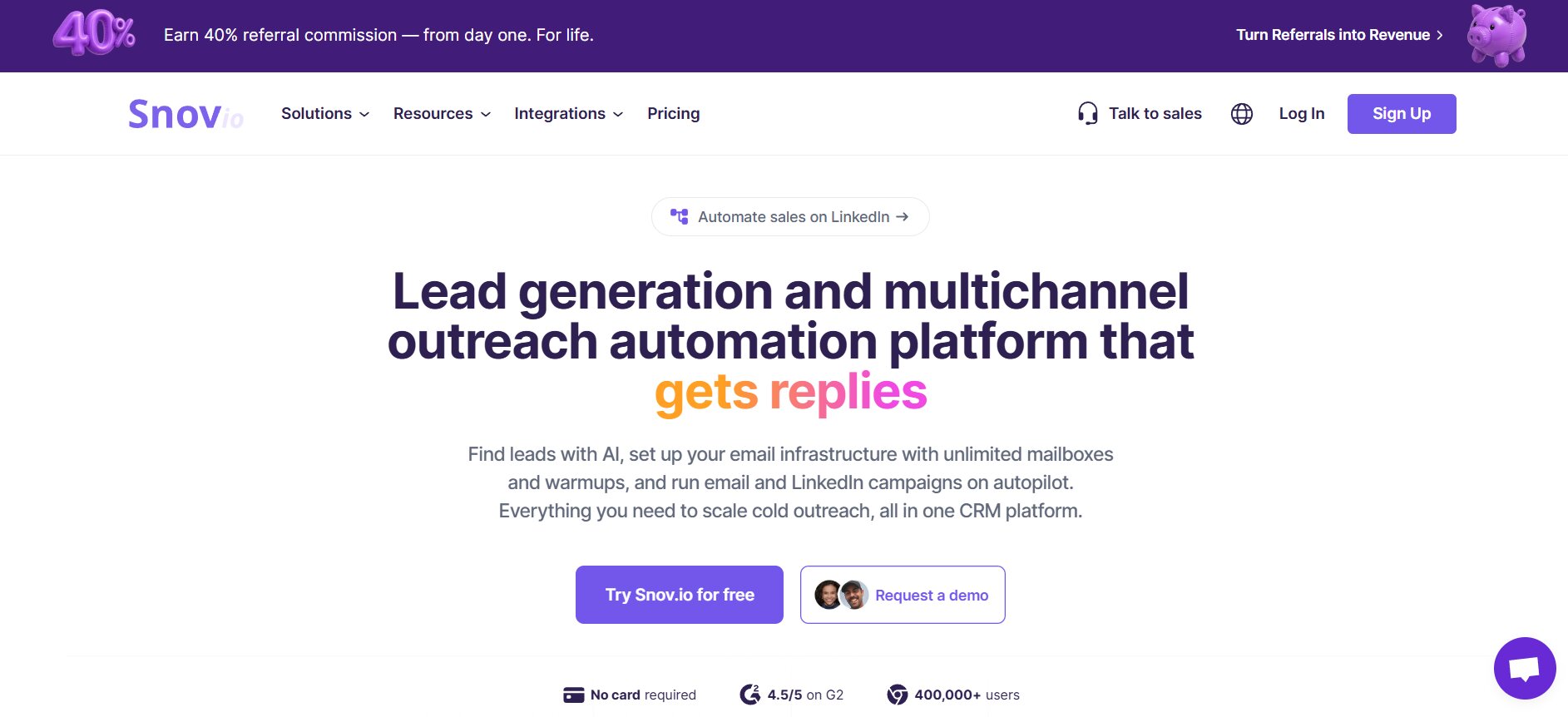
Snov.io is one of the most versatile tools on this list. Built originally as a contact finding and email verification platform, it has expanded into a full multichannel outreach automation suite that supports both email sequences and LinkedIn touchpoints within a single campaign workflow. This makes it the most capable tool at its price point for teams that want to combine email and LinkedIn outreach without managing two separate platforms.
The platform’s multichannel sequences allow you to set up campaigns that include LinkedIn connection requests, LinkedIn messages, and email touchpoints in a coordinated sequence — each step timed based on the previous step’s outcome. A prospect who connects on LinkedIn but does not reply to the first message can receive a LinkedIn follow-up, then an email, then a final LinkedIn message, all managed within one sequence workflow.
Key Features
- Email finder that locates professional email addresses by domain or by name and company combination, with bulk search capability for large prospect volumes
- LinkedIn prospecting integration that allows building prospect lists from LinkedIn search results directly within the platform
- Multichannel campaign sequences combining email and LinkedIn touchpoints in configurable order and timing
- Email warm-up functionality that gradually increases sending volume from new accounts to establish sender reputation before full campaign launch
- CRM with lead scoring, pipeline stage tracking, and contact activity history across both email and LinkedIn channels
- Backlink monitoring integration for teams managing link status alongside outreach campaigns
Pros
- True email and LinkedIn multichannel outreach in one platform at a price point significantly below enterprise alternatives
- Email finder and verification in the same platform as outreach execution reduces the number of separate subscriptions required
- Email warmup functionality is included without requiring a separate service
- Accessible pricing makes it viable for smaller agencies and solo SEOs who need multichannel capability
Cons
- LinkedIn automation is less sophisticated than DealsFlow’s Arlo AI — Snov.io automates the sending of LinkedIn messages but does not autonomously manage back-and-forth conversations
- Less SEO-specific than Pitchbox or Respona — the platform serves a broader cold outreach market that includes sales and marketing use cases, and its SEO-specific features reflect that
- The range of features means the interface has more complexity than more focused tools
Pricing
Starts at approximately $30/month. Plans scale with the number of email credits, LinkedIn actions, and team members.
Best For
Teams wanting combined email and LinkedIn outreach without managing two separate platform subscriptions. Budget-conscious agencies that need multichannel capability without enterprise pricing. SEO teams bridging outreach with a broader B2B sales and marketing function.
Bottom Line
Snov.io is the best value multichannel option on this list. For agencies that need more sophisticated LinkedIn AI conversations — where Arlo handles objections and books calls autonomously — DealsFlow is the step up. But for teams that want email and LinkedIn in one tool at an accessible price, Snov.io delivers.
11. LinkHunter — Best Budget Option for Beginners
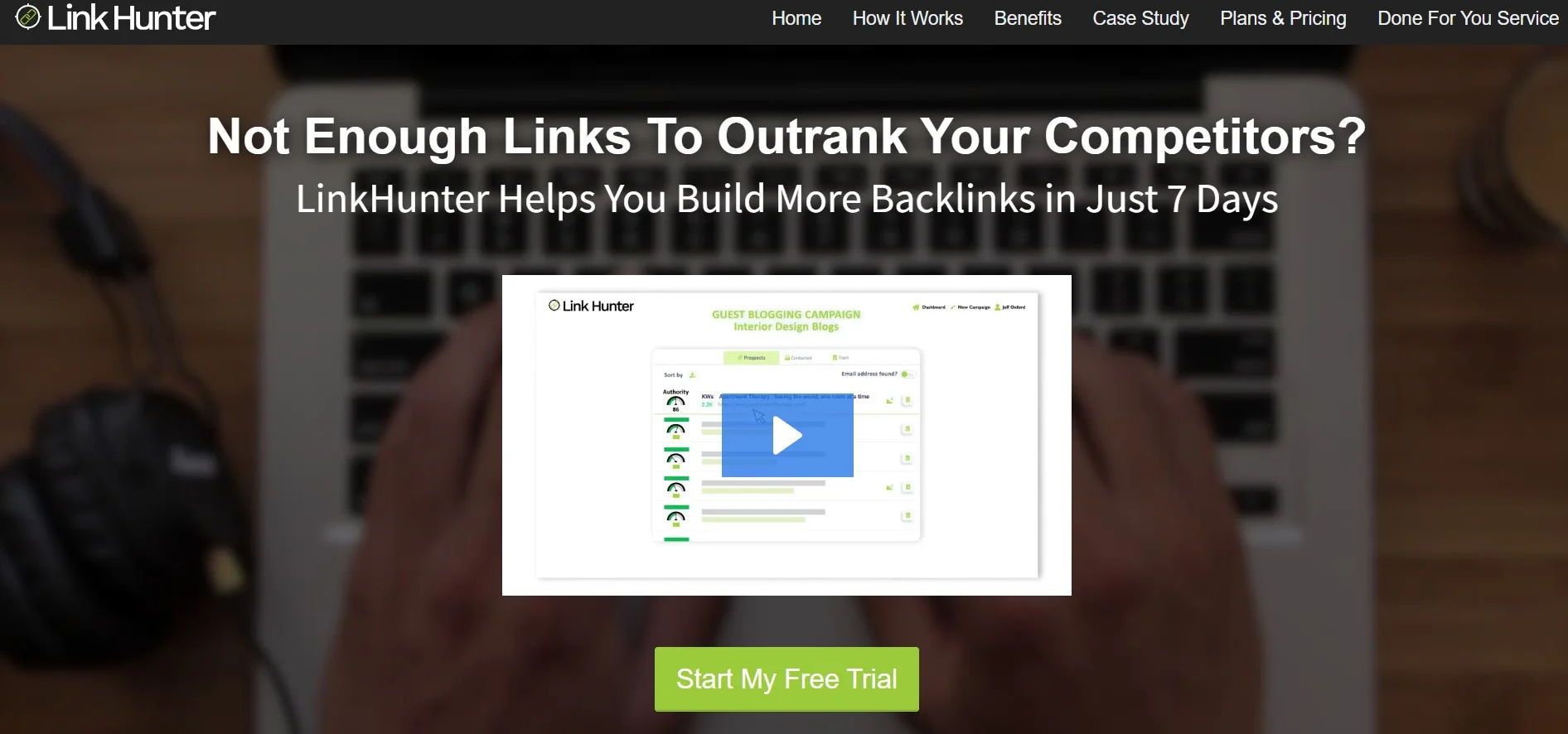
LinkHunter is an entry-level link building tool that bundles basic prospect discovery and email outreach in a single, simplified interface. It is designed for users who are new to structured link building and want a guided workflow that covers the basics without the complexity of professional-grade platforms.
The platform allows you to search for link opportunities by keyword, categorize targets by outreach type (guest post, resource page, broken link), and send email sequences from a connected inbox. The workflow is streamlined rather than powerful — you will not find the conditional sequence logic, deep SEO metric integration, or advanced team collaboration features of Pitchbox or even Respona. What you will find is a clear, accessible tool that teaches the fundamentals of structured outreach to users who are learning the discipline.
Key Features
- Prospect discovery by keyword with automated categorization of opportunities by link building type
- Basic email outreach with multi-step follow-up sequencing and reply detection
- Link opportunity organization with tagging and campaign management
- Simple reporting on campaign send volume and reply rates
Pros
- Affordable entry point that makes structured outreach accessible to solo site owners and early-stage bloggers
- Simplified interface removes the configuration overhead that slows beginners on more powerful platforms
- Good for learning the fundamentals of different link building campaign types before investing in more capable tools
Cons
- Prospecting depth and qualification capability are limited compared to tools feeding from professional backlink indexes
- Sequence automation and personalization features are basic — advanced users will encounter the platform’s ceiling quickly
- Not suitable for agency use or teams managing multiple simultaneous campaigns
- No LinkedIn outreach functionality
Pricing
Approximately $49/month. A free trial is typically available.
Best For
Individual site owners, bloggers, and beginner SEOs who are running their first structured link building campaigns. Teams at the learning stage of outreach who want a guided workflow before graduating to professional tools.
Bottom Line
LinkHunter is a useful starting point. Most users will outgrow it within six to twelve months of scaling their outreach volume, at which point migrating to Respona or BuzzStream provides a significant capability step-up.
12. Ahrefs — Best for Backlink Prospecting & Competitor Analysis
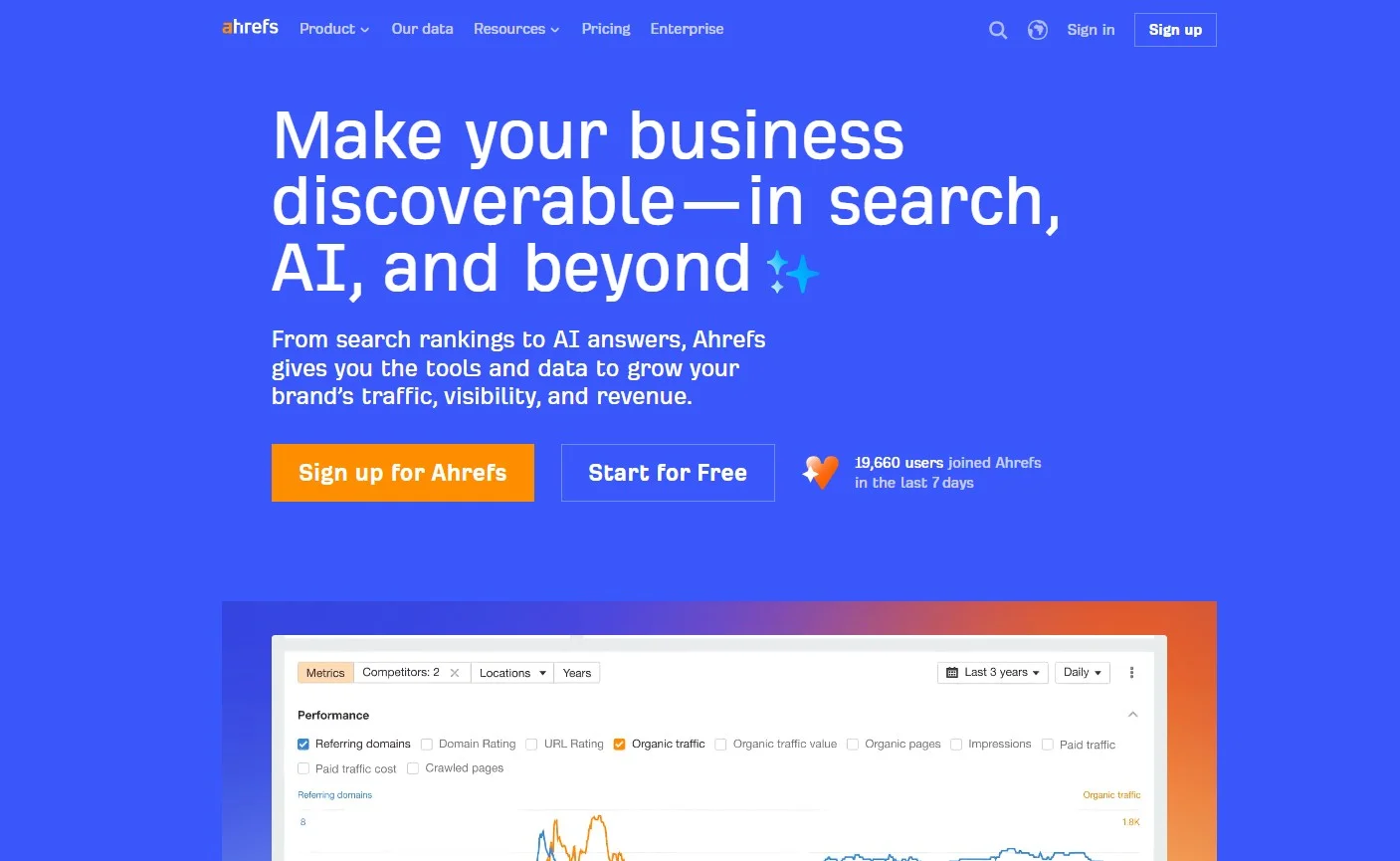
Ahrefs is not an outreach tool. It will not send a single email or LinkedIn message on your behalf. But it is the most important research tool that feeds every professional link building campaign on this list, and leaving it out of a guide to SEO outreach tools would misrepresent how serious outreach operations actually work. Every agency that uses Pitchbox, Respona, BuzzStream, or DealsFlow for outreach execution builds a significant portion of its prospect lists from Ahrefs data first.
The platform is built on AhrefsBot, which is the most active SEO crawler after the major search engine bots themselves, visiting over 8 billion pages daily and updating its backlink index every 15 to 30 minutes. This crawl frequency is what makes Ahrefs’ backlink data meaningfully fresher than many alternatives — you are working with a live picture of the link landscape rather than a snapshot from weeks ago.
Key Features
- Site Explorer provides a comprehensive view of any domain’s backlink profile, including referring domains, anchor text distribution, new and lost links, and Domain Rating history over time
- Link Intersect tool identifies domains that link to one or more of your competitors but do not link to you — the fastest way to build a qualified prospect list from a standing start, because you know these sites are already willing to link to content in your niche
- Content Explorer identifies content in your topic area that has attracted a large number of referring domains — useful for identifying what types of content earn links in your niche and for finding link-worthy content on your own site to pitch
- Ahrefs MCP (launched in early 2026) allows teams to query live Ahrefs SEO data directly inside AI assistants, removing the need to context-switch between the Ahrefs interface and other tools in an AI-assisted workflow
- 2026 Starter plan has made the platform accessible to smaller operators and solo link builders who previously could not justify the professional plan pricing
What’s New in 2026
The Ahrefs MCP integration is the most significant development for professional users. The ability to query live backlink data inside AI workflows means that AI-assisted prospecting and research processes can now access Ahrefs data without manual export steps.
Pros
- Best-in-class backlink index freshness — 15 to 30 minute update cycles mean you are working with current link data
- Domain Rating is the most widely trusted domain authority metric among SEO professionals globally, making DR-based prospect qualification straightforward across teams and clients
- Link Intersect is one of the highest-leverage features in link building research — competitor gap analysis consistently produces the highest-quality prospect lists
- The 2026 Starter plan has significantly improved affordability for solo operators and smaller agencies
Cons
- Not an outreach tool — you need a separate platform (Pitchbox, BuzzStream, DealsFlow, or similar) for execution
- Full professional functionality requires a plan significantly above the Starter tier
- The range of features means meaningful onboarding time before the platform runs at full efficiency
Pricing
Starter plan at $29/month providing access to core backlink intelligence features. Professional plans begin at approximately $179/month. Annual billing reduces the per-month cost.
Best For
Any team running serious link building campaigns where prospect list quality determines campaign outcomes. The research layer underpinning every other tool on this list.
Bottom Line
Ahrefs is non-negotiable for professional link building. Build your prospect list here, then execute with DealsFlow, Pitchbox, or BuzzStream depending on your channel preference and scale.
13. Hunter.io — Best for Email Discovery & Verification
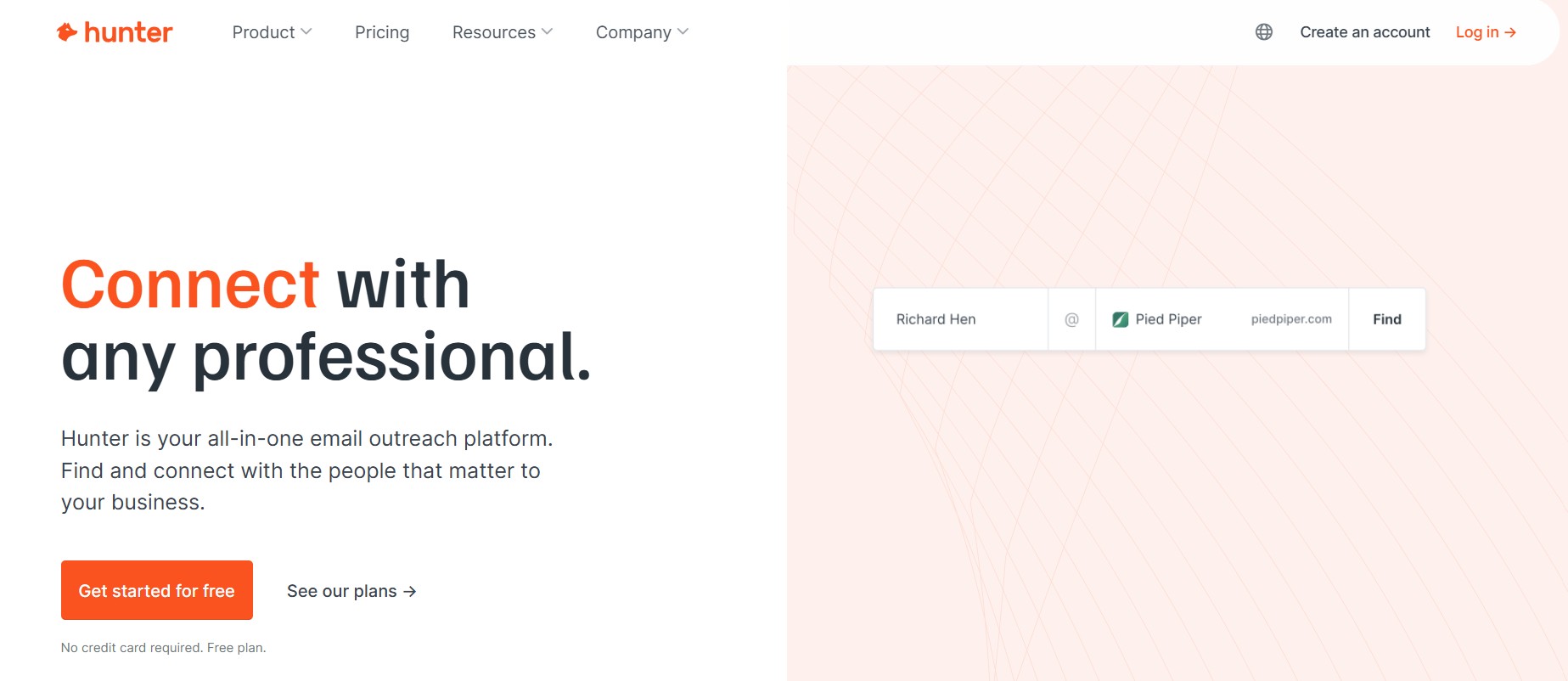
Hunter.io solves a specific, critical problem in the outreach workflow: you have identified the website you want to pitch and the person you want to reach, but you do not have their email address. Hunter finds it. More precisely, it finds the most likely professional email address associated with a given domain, person name, or combination of both, and it verifies that the address is deliverable before you use it.
The deliverability verification piece is more important than it might initially appear. Sending outreach emails to invalid or inactive addresses generates hard bounces. Hard bounce rates above approximately 2% trigger deliverability penalties from email service providers, which means your subsequent campaigns — even to valid addresses — begin landing in spam folders at higher rates. Hunter’s verification layer protects your sender reputation by filtering these addresses out before they enter your sending queue.
Key Features
- Domain search that returns all publicly accessible email addresses associated with a given domain, along with the most common email format pattern used by that organization
- Email finder that locates a specific person’s professional email address using their name and employer domain
- Email verifier that checks the deliverability of individual or bulk email addresses before campaign launch
- Chrome extension that surfaces email addresses and domain information while browsing target websites, enabling prospect enrichment without leaving the prospecting workflow
- Bulk operations via API for high-volume prospecting workflows requiring enrichment of large prospect lists
Pros
- Simple, fast, and accurate for the specific task of email finding — the core function is well-executed
- Generous free tier (25 searches per month) means beginners can test and use the service meaningfully before committing to a paid plan
- Chrome extension is a genuine workflow accelerator during manual prospecting research
- Integrates via API with every major outreach platform on this list, making it the natural contact-finding layer in any stack
Cons
- Not a prospecting tool — it finds contact information for domains and people you have already identified, but it does not help you identify which domains to target in the first place
- CRM features are minimal — Hunter is not designed to manage your outreach pipeline
- Database coverage is not universal; for less common domains and individuals, email discovery may return no results
Pricing
Free plan including 25 searches per month. Paid plans begin at approximately $34/month for higher search volumes. Enterprise API pricing is available for bulk operations.
Best For
Every link builder and outreach team regardless of platform preference. Hunter.io pairs with every outreach tool on this list as the standard email-finding layer.
Bottom Line
Hunter.io is the most universally useful tool in the link building stack. Whatever platform you use for outreach execution, Hunter provides the contact data that feeds it. Start with the free tier and upgrade once your monthly search volume justifies it.
How to Build the Right SEO Outreach Stack for Your Situation
Knowing which tools exist is useful. Knowing which combination of tools to use for your specific situation — your budget, team size, target domain authority, and campaign volume — is what turns that knowledge into a functional system. The four stacks below cover the most common link building operation profiles in 2026.
The Solo Link Builder Stack (~$60–100/mo)
A solo operator building links for one or two websites does not need enterprise software. The goal is adequate coverage across the three core workflow stages — prospecting, contact finding, and outreach execution — at a cost that makes sense against the value of the links being built.
The recommended stack at this level is Ahrefs Starter ($29/month) for prospecting and competitor backlink research, Hunter.io’s free tier for email discovery and verification of individual prospects, and either Respona’s entry plan or BuzzStream’s Starter ($24/month) for outreach sequence management. The Ahrefs Starter plan provides access to the Site Explorer and Link Intersect tools needed to build qualified prospect lists. Hunter’s free tier covers the contact-finding needs of campaigns pitching fewer than 25 new domains per month. Respona or BuzzStream provides the campaign management and sequence automation layer that keeps follow-ups running without manual tracking.
The workflow runs as follows: spend one dedicated session per week in Ahrefs identifying new prospects using Link Intersect and competitor backlink analysis. Export the prospect list to Hunter for email enrichment. Import the enriched list into Respona or BuzzStream, configure the outreach sequence, and let the platform manage the follow-up schedule. Review replies and manage active conversations manually at this scale — your volume does not yet justify AI conversation management.
When to add DealsFlow: once you are consistently targeting DR 40+ editorial sites and your email reply rates have plateaued below 5%, LinkedIn relationship-warming is the next lever. DealsFlow’s 14-day free trial is a low-risk way to test whether the LinkedIn channel moves the needle for your specific target set before committing to the subscription.
The In-House SEO Team Stack (~$200–400/mo)
An in-house SEO team of two to five people running campaigns for a single brand needs more campaign management depth than the solo stack, along with better team visibility and more sophisticated sequence automation.
The recommended stack is Ahrefs or Semrush (prospecting and keyword research), Hunter.io on a paid plan (email discovery for larger prospect volumes), and either BuzzStream or Respona on a team plan (outreach execution and campaign management). The choice between Ahrefs and Semrush at this level often depends on whether the team needs Semrush’s broader platform for keyword research, content marketing, and site auditing — if so, the Semrush Link Building Tool adds minimal incremental cost and keeps the workflow inside one environment. If the team’s primary SEO platform is Ahrefs, using it for prospecting and a dedicated tool like BuzzStream for outreach execution is the cleaner stack.
The workflow runs as follows: a weekly prospecting session in Ahrefs or Semrush builds a qualified target list for the current campaign cycle. Hunter enriches the list with verified email addresses. The enriched list flows into BuzzStream or Respona for campaign launch, with multi-step sequences configured and running automatically. Team members review the reply queue daily and handle active conversations manually, with the platform tracking which conversations are live, which have been won, and which need a final follow-up.
When to add DealsFlow: when the brand has identified a specific set of editorial publishers — high-authority domains with editorial standards where cold email rarely converts — and wants to build genuine relationships before pitching. DealsFlow’s LinkedIn layer works alongside the email stack, not instead of it.
The Agency Stack (~$600–1,100/mo) — The 2026 Two-Channel Stack
An agency running link building campaigns for multiple clients simultaneously needs the most complete coverage of the five-stage workflow, along with the per-client separation, reporting quality, and scale economics that support a profitable service delivery model.
The recommended stack is Ahrefs (prospecting and competitive research), Hunter.io on an agency plan (bulk email enrichment across multiple client campaigns), Pitchbox (email outreach CRM with white-label reporting and multi-campaign management), DealsFlow (LinkedIn relationship warming for high-authority targets), and Semrush (link monitoring and client reporting). This is the two-channel stack that defines the competitive benchmark for agency link building operations in 2026.
The reason this combination works is that Pitchbox and DealsFlow are not competing for the same job. Pitchbox handles email sequence management at scale — the automated multi-step follow-up logic, the conditional branching, the white-label reports. DealsFlow’s Arlo AI handles LinkedIn relationship warming for the same high-authority targets in parallel. A domain editor who receives your email through Pitchbox on Tuesday and a genuine LinkedIn conversation from Arlo on Thursday is not experiencing two cold outreach attempts. They are experiencing a warm, two-touch introduction where the LinkedIn side has already handled objections and established context. Agencies that have built this approach report meaningfully better conversion rates on DR 50+ targets where email-only outreach was underperforming.
The workflow runs as follows: the agency’s prospecting lead builds qualified target lists in Ahrefs each week, segmenting targets into standard targets (handled by Pitchbox email sequences) and high-priority editorial targets (handled by both Pitchbox email and DealsFlow LinkedIn in parallel). Hunter enriches all lists with verified email addresses. Pitchbox launches email campaigns across all clients. DealsFlow campaigns run simultaneously for high-priority targets, with Arlo managing LinkedIn conversations autonomously. Campaign managers review booked calls from DealsFlow and active email replies from Pitchbox each morning. Semrush monitors placed links across all client domains and generates the monthly reporting that goes to clients.
The AI-First Stack (2026 Edition)
The AI-first stack represents the direction the industry is moving rather than a configuration that every team is running today. It combines the autonomous conversation capability of DealsFlow’s Arlo AI with the AI personalization features of Pitchbox or Respona on the email side, and the Ahrefs MCP integration for AI-assisted prospecting research.
In practical terms, this means the following: a link builder uses an AI assistant with the Ahrefs MCP to query live backlink data and identify competitor link gap opportunities without switching between tools. Those prospects are exported to Hunter for enrichment, then split between Pitchbox (email, with AI-generated personalized opening lines per prospect) and DealsFlow (LinkedIn, with Arlo managing conversations end-to-end). The human’s role in this stack narrows to ICP definition, quality review of outreach copy, and taking calls with prospects that Arlo has warmed and booked.
The shift this represents is significant. Traditional link building required a human to be present at every stage — the research, the writing, the sending, the follow-up, the conversation. The AI-first stack removes the human from prospecting research, email personalization at scale, and LinkedIn conversation management. What remains are the judgment calls that AI genuinely cannot replace: deciding which publications are worth targeting, reviewing whether the AI-generated outreach reads authentically in your voice, and conducting the actual call or email thread that converts a warm lead into a placed link.
Key Features to Look for in an SEO Outreach Tool in 2026
Not every team needs every feature. But understanding which features matter most for your specific situation helps you avoid paying for capabilities you will not use while ensuring the tool you choose can handle the workflows that actually drive results for your campaigns.
Prospect Quality & Index Freshness
The quality of the backlinks you earn is directly determined by the quality of the domains you prospect. A tool that surfaces low-authority, low-traffic, or topically irrelevant websites wastes your team’s most limited resource — time — on targets that will not move the needle. When evaluating prospecting tools, ask how recently the backlink index is updated. A tool updated weekly will show you links that appeared and were removed days ago as current opportunities. Ahrefs updates every 15 to 30 minutes. The difference in data freshness translates directly into prospect list quality. Also assess whether the tool allows filtering by Domain Rating, organic traffic estimates, niche relevance, and geographic location — these filters are what separate a qualified prospect list from a raw domain dump.
Email Deliverability Infrastructure
Your outreach campaigns are only as effective as your emails’ ability to reach the inbox. In 2026, inbox providers — Gmail, Outlook, and others — use sophisticated filtering that assesses sender reputation, bounce rates, spam complaint rates, and sending patterns. A tool that does not actively help you manage these signals will degrade your sender reputation over time, making each successive campaign harder to deliver effectively. Look for tools that include inbox warmup sequences for new sending accounts, support SMTP rotation across multiple inboxes to distribute sending volume, monitor bounce rates per campaign, and flag sending patterns that risk triggering spam filters. For LinkedIn-based tools, equivalent account safety features — warmup schedules, daily limit controls, activity pacing — serve the same protective function.
Personalization at Scale
In 2026, the minimum personalization bar for editorial outreach has risen significantly. Static merge variables — inserting the recipient’s first name and publication name into a template — are table stakes, not personalization. Editors and webmasters receive hundreds of messages that do this. What distinguishes outreach that earns replies is specific, demonstrable familiarity with the recipient’s recent work: a reference to a specific article they published last month, a comment on a specific editorial position they have taken, or a pitch framed around a gap in their existing content coverage. Look for tools that support dynamic personalization variables beyond name and company, AI-generated opening lines based on each prospect’s specific content, and conditional sequence logic that adjusts follow-up messaging based on prior engagement signals.
CRM & Team Workflow
Outreach campaigns that lack structured pipeline management collapse under their own volume. When multiple team members are running campaigns simultaneously across multiple clients, without a structured system for tracking which prospects are active, which have replied, which have been won, and which are permanently cold, duplicate outreach happens, follow-ups are missed, and campaign performance becomes impossible to audit. Look for tools that support pipeline stages with clear status tracking, task assignment to team members, per-client campaign separation that prevents cross-contamination, and duplicate detection that flags contacts already in another active campaign. These features matter more at scale than almost any prospecting or sending capability.
Multi-Channel Capability
Email alone is no longer a sufficient outreach strategy for high-authority editorial targets in 2026. The decline in cold email response rates from DR 50+ domains is a documented pattern across the industry — editors at established publications receive high volumes of templated outreach and have developed strong filters against it, both technical (spam filtering) and behavioral (pattern recognition). LinkedIn outreach, when executed with genuine personalization and a conversational approach, reaches these targets through a channel they use for professional relationship-building rather than vendor pitching. When evaluating tools, ask whether they support outreach on multiple channels, whether the LinkedIn automation handles responses autonomously or just sends initial messages, and how the two channels can be coordinated within a single campaign strategy.
Reporting for Clients
For agencies, reporting quality is a client retention issue as much as a campaign management tool. Clients who cannot see clear evidence of campaign activity, outreach volume, and link placement progress are clients who question the value of the engagement. Look for tools that provide per-client reporting separation, exportable campaign data in formats that translate cleanly into client-facing reports, and ideally white-label dashboard options that present the data under your agency’s brand. Pitchbox’s white-label reporting and DealsFlow’s per-client analytics export are the strongest examples of agency-grade reporting on this list.
Pricing Transparency
Per-seat pricing structures that look reasonable for a small team become dramatically expensive as agencies scale. A tool priced at $50 per user per month looks manageable with three users. At twelve users, that same tool costs $600/month before any platform fees — potentially double the cost of a flat-rate agency tool that covers unlimited users. When evaluating pricing, model the cost at your current team size and at the team size you expect to reach in twelve months. Tools with flat-rate pricing — particularly those designed specifically for agency use cases — often deliver significantly better unit economics as you grow.
What’s Changed in Link Building Outreach in 2026?
Understanding the current environment is not just background context — it directly informs which tool features matter most and which outreach approaches are likely to produce results. The link building landscape has shifted on several dimensions simultaneously, and the tools that are performing best in 2026 are the ones that have adapted to these shifts rather than simply doing the same things faster.
Google’s ongoing algorithm updates have made the relationship between backlink quality and ranking outcomes clearer and more consequential than at any previous point. Links from low-authority, topically irrelevant, or clearly transactional sources now carry a negative signal rather than a neutral one in many contexts. The practical effect of this for outreach operations is that campaign efficiency measured purely by link volume is no longer the right metric. A campaign that earns twelve links from DR 60+ topically relevant publications is more valuable — and less risky — than one that earns sixty links from a mix of low-authority directories and private blog networks. Every tool on this list that improves prospect qualification contributes directly to this quality-over-volume shift.
The inbox environment for cold email has become more hostile at the same time. The rise of AI content generation tools has made it dramatically easier to produce high volumes of reasonably well-written outreach emails. The result is that editors and webmasters at established publications now receive substantially more outreach than they did two years ago, much of it AI-assisted and recognizably templated despite surface personalization. Their behavioral response — increased selectivity, faster deletion of suspected template outreach, stronger mental filters against unsolicited pitches — has raised the effective reply rate threshold for cold email campaigns targeting high-authority domains. This is the operational reality behind the growing adoption of LinkedIn as a supplementary outreach channel.
LinkedIn has emerged as the most effective relationship-building channel for high-authority editorial targets precisely because it is not primarily used for outreach. When a link builder or agency representative sends a LinkedIn connection request and a follow-up message to an editor at a high-DR publication, the context is professional networking rather than vendor pitching. The editorial target’s default frame is different from their email inbox, where vendor outreach expectations are high. This contextual difference — combined with the lower volume of LinkedIn outreach relative to email — produces meaningfully better engagement rates for the right targets. DealsFlow’s design is built around this insight: the LinkedIn channel is most valuable for the exact targets where email is least effective.
AI-driven search is changing the strategic context of link building beyond just Google rankings. ChatGPT, Perplexity, Google AI Overviews, and similar platforms are now generating significant volumes of branded and informational queries that never reach a traditional search results page. The citations and references that feed these AI-generated answers are influenced by the same authority signals — domain reputation, topical relevance, link patterns — that have always determined Google rankings. This means that link building investment in 2026 serves two parallel purposes: ranking authority for traditional search, and citation authority for AI-driven search. Semrush One’s AI Visibility Toolkit, which tracks brand mentions in ChatGPT, Claude, and Perplexity alongside traditional backlink metrics, is an early signal of how the industry is adapting to this dual-channel visibility environment.
The emergence of autonomous AI conversation tools — specifically DealsFlow’s Arlo AI — represents the most operationally significant change in outreach tooling. Previous generations of outreach automation addressed the sending problem: how do you send more messages, to more people, with better personalization, without proportional increases in headcount? Arlo addresses the conversation problem: how do you manage the reply volume, follow-through, and relationship development that follows successful initial contact, without proportional increases in headcount? The answer is AI that conducts the conversation — not simulating a human, but operating as a capable agent that handles the messaging workflow from first contact to booked call.
The broader direction of the industry — Ahrefs MCP enabling AI-assisted prospecting research, Semrush One integrating AI visibility tracking — confirms that the most significant tool developments in 2026 are at the AI integration layer rather than the core email-sending infrastructure. Teams that adopt these AI-native capabilities early are building an operational advantage that compounds as the tools mature and the competitive environment catches up.
Final Verdict
Choosing a single tool from this list and expecting it to handle every stage of your outreach workflow is the wrong frame. The highest-performing link building operations in 2026 are built on tool combinations — each platform doing what it does best, integrated into a workflow where the output of one feeds the input of the next.
With that context, here are the clearest recommendations by role and use case.
For agencies in 2026, DealsFlow is the single most impactful addition to an existing outreach stack. It is the only tool that autonomously manages LinkedIn conversations at scale, the only platform built specifically for multi-client LinkedIn account management, and the only outreach tool where AI handles the full conversation rather than just the sending. Its 14-day free trial with no credit card means the evaluation risk is zero. For agencies currently running email-only outreach and struggling with reply rates on high-authority targets, testing DealsFlow’s LinkedIn layer against those same targets is the most direct way to measure its impact.
For high-volume email campaign management, Pitchbox remains the market standard. Its five consecutive years at the top of G2’s link-building software category reflect a consistent track record among professional users. The pricing is the highest on this list, but for agencies running twenty or more simultaneous campaigns with white-label reporting requirements, the cost is justified by the capability.
For growing teams and solo SEOs that need a capable all-in-one platform without the enterprise price tag, Respona delivers approximately 80% of Pitchbox’s email outreach functionality at a fraction of the cost. The content-first prospecting approach, the pre-built campaign templates, and the author auto-discovery features make it the most productive starting point for teams building their first structured outreach operation.
For beginners running their first link building campaigns, BuzzStream’s $24/month Starter plan provides professional-grade relationship management and campaign tracking at a price point accessible to individual site owners. The learning curve is the gentlest on this list, and the CRM design teaches relationship-first outreach habits that serve link builders well as they scale.
For prospecting and competitive backlink research, Ahrefs is the non-negotiable foundation. No outreach campaign — regardless of which sending platform you use — performs as well when built on a weak or unqualified prospect list. Ahrefs’ Link Intersect, Site Explorer, and Content Explorer tools are the most reliable way to identify qualified, achievable link targets across any niche.
The most competitive agency stack in 2026 combines these three platforms: Ahrefs for prospecting, DealsFlow for LinkedIn relationship warming on high-authority targets, and Pitchbox for email campaign management across all clients. This three-tool combination covers every stage of the outreach workflow — research, LinkedIn conversation, email execution — and positions agency campaigns for the two-channel approach that is producing the best results on high-DR editorial targets.
Start with the free trials available on DealsFlow and any of the email platforms you are considering. The fastest way to know which tool fits your workflow is to run a real campaign segment through it. If you are targeting DR 50+ editorial sites and your current email-only approach is underperforming, DealsFlow’s 14-day trial is the most direct way to test whether the LinkedIn channel changes your results.
Frequently Asked Questions
What is the best SEO outreach tool in 2026?
The answer depends on your primary outreach channel and scale. For agencies wanting AI-driven LinkedIn outreach that manages conversations autonomously, DealsFlow is the strongest option. For high-volume email campaign management across multiple clients, Pitchbox has held the #1 position on G2 for five consecutive years. For growing teams and solo SEOs who need an affordable all-in-one platform, Respona delivers the best value. For beginners starting their first structured campaigns, BuzzStream offers the most accessible entry point. For most agencies running serious link building operations in 2026, the most competitive configuration combines DealsFlow for LinkedIn outreach with Pitchbox or BuzzStream for email — a two-channel approach that covers the full range of target domain types.
What makes DealsFlow different from other outreach tools?
Most outreach tools automate the delivery of messages. DealsFlow’s Arlo AI automates the conversation itself. When a prospect replies to a LinkedIn message — with a question, an objection, or an expression of interest — Arlo reads the reply, interprets the intent, formulates the appropriate response, and sends it without requiring human input per exchange. This is fundamentally different from tools that automate sending and leave all subsequent conversation management to the human team. DealsFlow is also the only platform on this list specifically built for managing up to 50 LinkedIn accounts from a single agency dashboard, with per-client pipeline separation and full-funnel analytics export.
What’s the difference between a link building tool and an outreach tool?
Link building tools — Ahrefs, Semrush — address the research and analysis stage of the workflow. They identify which websites link to competitors, which domains have the authority and relevance you want for your backlink profile, and which link opportunities represent the highest strategic value. They do not send messages or manage relationships. Outreach tools — DealsFlow, Pitchbox, BuzzStream, Respona — address the execution stage. They handle the contact, personalization, sending, follow-up, conversation, and tracking workflow that turns a prospect list into actual placed backlinks. Most serious link building operations use both categories: research tools to build and qualify lists, outreach tools to execute campaigns against those lists.
Can I do link building outreach for free?
At small scale, yes. Hunter.io’s free plan provides 25 email searches per month. DealsFlow offers a 14-day free trial with no credit card required. Semrush’s Link Building Tool includes a free tier for one project. Respona has a free plan for one project. A combination of Hunter.io’s free tier, Gmail for sending, and a spreadsheet for tracking can support 20 to 50 outreach emails per month without any tool cost. Beyond that volume, the organizational overhead of spreadsheet-based campaign management and the deliverability risks of Gmail-based bulk sending make dedicated outreach software cost-effective relative to the alternatives.
Is LinkedIn outreach effective for link building?
For the right target set, yes — and the effectiveness gap versus cold email has grown in 2026. High-authority editorial publishers — DR 50+ domains with active editorial standards — receive large volumes of cold outreach email. Their editorial teams have developed strong filters against it. LinkedIn outreach reaches the same people in a different context, one associated with professional networking rather than vendor pitching. This contextual difference, combined with the lower volume of LinkedIn outreach relative to email, produces meaningfully higher engagement rates for the specific targets where email is least effective. Tools like DealsFlow, which manage LinkedIn outreach with AI-driven conversation handling, make this channel scalable for agencies managing multiple clients simultaneously.
How many outreach messages can I send safely per day?
For cold email from a properly warmed sending account, the generally accepted safe range is 50 to 100 emails per day per inbox. Exceeding this threshold risks triggering spam filter penalties at email service providers, which degrade deliverability for all subsequent campaigns from that account. For LinkedIn, platform usage policies limit connection requests to approximately 20 to 30 per day per account. Tools like DealsFlow manage these limits automatically, applying daily caps and activity pacing that keep each connected account within safe operational parameters. For agencies managing multiple LinkedIn accounts, account safety management is handled at the platform level rather than requiring manual monitoring per account.
What’s the best free SEO outreach tool?
DealsFlow offers the most comprehensive free access of any tool on this list — a 14-day free trial covering the full platform including Arlo AI, with no credit card required. Hunter.io provides 25 free email searches per month on an ongoing basis. Semrush’s Link Building Tool has a free tier covering one project. Respona offers a free plan for one project. For teams at the very beginning of structured link building, these free tiers collectively provide enough capability to test the workflow before committing to paid subscriptions.
How do I track whether my placed backlinks are still live?
Placed links are not permanent. Editors update content, websites migrate, pages are deleted, and link attributes change — any of these can remove or alter a placed backlink without your knowledge. The most reliable monitoring approaches use Semrush’s backlink monitoring module, Ahrefs’ link alert functionality, or a dedicated link tracking tool like Linkody. Semrush and Ahrefs both send alerts when new links are detected or existing links are lost, allowing teams to identify and respond to lost placements — whether by requesting reinstatement or replacing the placement with a new target. Monthly audits of your active backlink profile are the minimum monitoring cadence for any serious link building operation.