
The modern B2B marketing landscape has fundamentally changed. Gone are the days when a company could rely solely on cold outreach, email blasts, or even organic social media presence alone. Today’s most successful B2B marketers recognize that the real power lies not in choosing between LinkedIn advertising and organic content—it’s in orchestrating both channels as a unified, cohesive strategy.
LinkedIn sits at a unique intersection in the professional world. With over 900 million users, the platform has become the de facto professional network where business decisions are made, relationships are built, and opportunities emerge. Yet most marketers treat LinkedIn advertising and organic content as separate silos. The company runs ads to drive leads and awareness while simultaneously posting organic content hoping for engagement, with little to no coordination between the two efforts.
This compartmentalized approach leaves significant value on the table.
When you integrate LinkedIn ads and organic outreach strategically, you don’t just add the results of both channels together—you multiply them. A prospect who sees your paid advertisement is far more likely to act if they’ve recently encountered your authentic, valuable organic content. Sales outreach that references specific posts you’ve published lands with greater impact than generic prospecting. Content that generates strong organic engagement becomes the perfect vehicle for paid amplification, ensuring your ad spend goes toward messaging that has already proven to resonate.
This comprehensive guide walks you through the strategic integration of LinkedIn ads and organic outreach, showing you exactly how to create a marketing ecosystem that builds authentic relationships, establishes credibility, and drives measurable business results. Whether you’re a startup trying to establish your brand, a scaling company looking to accelerate growth, or an established player seeking competitive advantage, these frameworks and tactics will help you unlock the full potential of LinkedIn as a revenue-generating channel.
Why LinkedIn Ads and Organic Outreach Work Better Together
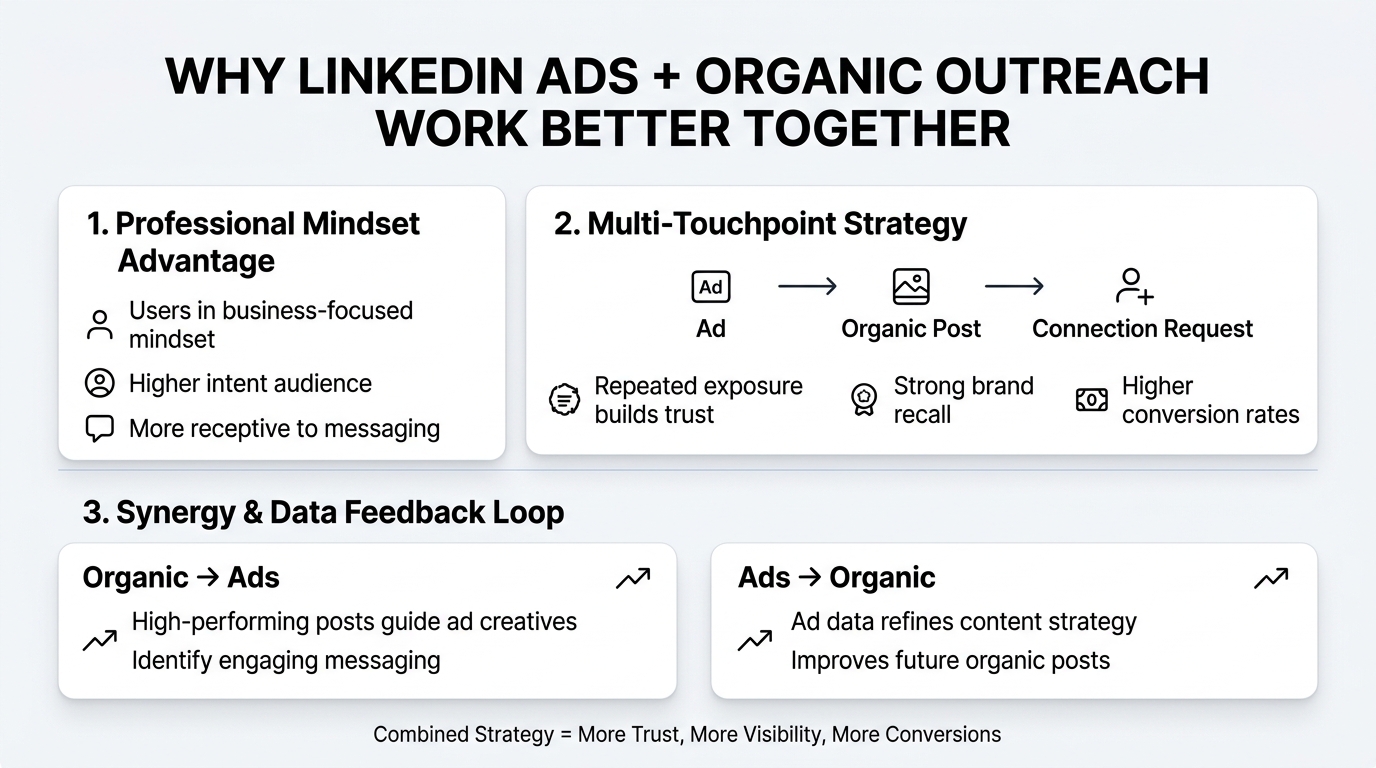
Before diving into the tactical implementation, it’s essential to understand the fundamental reasons why combining LinkedIn ads with organic outreach creates exponential results rather than merely additive ones.
LinkedIn users are inherently in a professional mindset when they visit the platform. Unlike social networks where people scroll for entertainment, LinkedIn users are actively thinking about business, career growth, industry trends, and professional solutions. This psychological state makes them exceptionally receptive to both paid messaging and organic interactions.
When you run LinkedIn ads simultaneously with organic outreach, you create multiple touchpoints with your ideal audience. A prospect might see your ad in their feed, then encounter your company’s organic post on their timeline, and finally receive a personalized connection request from your sales team—all within a week. This repetition builds brand recognition and credibility, making your message far more memorable and persuasive.
The synergy goes deeper than frequency. Organic content serves as social proof for your LinkedIn ads. When prospects see that your company posts regularly, engages authentically with the community, and shares valuable insights, they’re more likely to trust and respond to your paid advertisements. Conversely, your ads can amplify the reach of your best organic content, ensuring your most valuable messages reach the widest possible audience.
Moreover, the data from one channel informs optimization in the other. Insights from which organic posts generate the most engagement help you refine your ad creative. Similarly, performance data from LinkedIn ads reveals what messaging resonates with your target audience, guiding your future organic content strategy.
Setting Clear Objectives Before You Begin
The first critical step in building an integrated LinkedIn strategy is establishing clear objectives and success metrics. Success means different things depending on your business model, industry, company size, and current stage of growth. Taking time to define success upfront prevents wasted effort and creates clarity around resource allocation.
Defining Success Metrics for Your Integrated Campaign
The first critical step is establishing what success looks like for your integrated LinkedIn strategy. Success metrics vary significantly depending on your business model, industry, and current stage of growth.
For B2B SaaS companies, success might mean generating qualified leads at a cost-per-lead below a certain threshold. For service-based businesses, it might be scheduling consultations. For thought leaders and agencies, it could be brand awareness and establishing authority in a niche.
When integrating LinkedIn ads with organic outreach, you’ll want to track several interconnected metrics:
Lead Quality and Volume: Monitor not just how many leads you generate, but their quality. Are they from your target ICP (Ideal Customer Profile)? Are they likely to convert to customers? LinkedIn provides detailed demographic and firmographic data that helps you assess this.
Engagement Rates: Track both the engagement on your organic posts and the click-through rates on your ads. High organic engagement serves as validation of your messaging before you invest heavily in paid promotion.
Cost Per Result: Whether it’s cost per click, cost per lead, or cost per conversion, understanding your unit economics is crucial. Your integrated strategy should improve this metric over time as you optimize both channels.
Brand Lift and Awareness: Beyond direct conversions, measure how your integrated strategy affects brand perception. Conduct surveys among your target audience to assess whether they’re becoming more aware of and favorably disposed toward your brand.
Sales Cycle Impact: For longer B2B sales cycles, track how your LinkedIn efforts influence the overall pipeline. Are LinkedIn prospects moving faster through your sales process? Are they closing at higher rates?
Setting these metrics upfront creates clarity around resource allocation and allows you to make data-driven decisions as you execute your integrated strategy.
Strategy 1: Crafting a Cohesive Content Narrative Across Both Channels
The foundation of an effective integrated LinkedIn strategy is a unified content narrative. Your messaging should be consistent, your value propositions clear, and your brand voice recognizable whether someone encounters you through an ad or an organic post.
Begin by identifying your core value proposition and the key problems you solve for your target audience. This becomes your north star. Every piece of content—whether organic or paid—should either directly support this core message or provide supporting evidence for why your solution matters.
Your content narrative should tell a story that unfolds over time. For example, if you’re a project management software company, your core narrative might be “Teams waste 25% of their time on coordination overhead—here’s how to reclaim it.” Your organic content might include posts about the hidden costs of poor coordination, case studies of teams who improved their efficiency, tips for reducing meeting volume, and spotlights on best practices. Your ads might then take the strongest performing organic insights and promote them to a wider audience, or introduce your product as the solution to problems you’ve been highlighting organically.
This approach creates a virtuous cycle. Your organic content generates engagement and data about what resonates. You use this intelligence to craft ads that speak directly to proven pain points. Those ads drive people to your website or LinkedIn page, where your organic content (and its community responses) serves as social proof that you understand their challenges.
| Content Type | Organic Approach | LinkedIn Ads Integration | Expected Outcome |
|---|---|---|---|
| Educational Posts | Share industry insights, research, tips | Boost top-performing posts to larger audience | Increased visibility, lead awareness |
| Case Studies | Detailed LinkedIn article format | Create carousel ads with key results | Credibility, consideration phase engagement |
| Thought Leadership | CEO or founder perspectives | Sponsor content to relevant decision makers | Authority building, brand association |
| Problem-Focused Content | Identify audience pain points | Target ads to people experiencing those problems | Rapid problem-to-solution journey |
| How-To Content | Detailed guides and step-by-step posts | Create short-form ads directing to full content | Engagement boost, website traffic |
| Customer Testimonials | Share employee and customer stories | Use testimonials in video ads | Trust building, social proof |
Strategy 2: Running LinkedIn Ads Strategically to Complement Organic Efforts
One of the most efficient uses of LinkedIn advertising budget is amplifying your best-performing organic content. This approach ensures you’re investing in messaging that has already proven to resonate with your audience.
The process begins with identifying which organic posts generate the highest engagement rates. Look for posts with strong comment-to-view ratios, not just vanity metrics like total views. Comments indicate that your content sparked genuine interest and conversation—exactly the kind of content worth investing paid budget to expand.
Once you’ve identified high-performing posts, you can run sponsored content ads featuring that same content, but targeting a broader or different audience segment. For example, if your post about “The Future of Remote Work” generated strong engagement among marketing directors at mid-market companies, you might run a sponsored content campaign targeting the same demographic at enterprise companies, or the same company size but different industries or functions.
When amplifying organic content through LinkedIn ads, make minimal changes to the original post. The authenticity and real engagement it’s already generated are assets. However, you can adjust the targeting parameters, add a headline that highlights the value proposition, and optimize the call-to-action to suit your campaign objective.
How to Create Dedicated Ad Creative Aligned with Organic Themes
Beyond amplifying existing posts, you can create ad creative specifically designed to complement your organic strategy without being promotional. The most effective LinkedIn ads for B2B audiences offer genuine value rather than hard-selling products.
Video ads tend to generate particularly strong performance on LinkedIn. A 30-60 second video that demonstrates a principle related to your core value proposition, shares a customer success story, or walks through a solution to a common problem will outperform generic promotional content. These videos work best when they could credibly be posted as organic content—they’re so valuable that people wouldn’t resent seeing them in their feeds.
Carousel ads, which show multiple images or cards that users can scroll through, work exceptionally well for showcasing different aspects of a transformation or different use cases of your solution. Each card might highlight a different benefit, and the series tells a cohesive story.
The messaging in your ad creative should directly reference themes and insights from your organic content strategy. If you’ve been highlighting the concept of “coordination overhead” in your organic posts, your ad might use the same terminology and reference the research or insights you’ve been sharing organically. This creates a sense of continuity and reinforces your key messages.
LinkedIn Ads Budget Allocation: Finding Your Optimal Mix
How much should you spend on LinkedIn ads relative to your overall marketing budget? The answer depends on your goals, industry, and audience, but several principles apply universally.
Start with a clear understanding of your customer acquisition cost (CAC) and lifetime value (LTV). For B2B companies, a healthy ratio is an LTV:CAC of at least 3:1, and ideally 5:1 or higher. If you can’t achieve this ratio through LinkedIn advertising alone, it’s a sign that either your offer needs refinement, your messaging isn’t reaching the right audience, or your pricing model needs adjustment.
Many companies find that a 70/30 or 60/40 split (organic vs. paid) on LinkedIn works well. This allocation allows you to build a strong organic foundation and presence while using paid amplification to reach beyond your current network and accelerate results. However, this split might shift based on your specific situation:
- High-growth startups might lean more heavily paid (50/50 or even 40/60 organic/paid) to rapidly build awareness and pipeline
- Established thought leaders might skew more organic (80/20), using ads primarily to amplify their best content
- Product-focused companies might allocate more budget to paid to drive direct conversions
- Service and consulting firms might balance both equally, as relationship-building and authority are both critical
Rather than setting a fixed budget and hoping it works, many sophisticated marketers use a test-and-learn approach. They allocate a base budget to their integrated strategy, then run structured tests to determine what works best for their specific situation.
Strategy 3: How to Build an Organic Content Engine That Feeds Your Ads
An integrated LinkedIn strategy requires a consistent flow of high-quality organic content. The good news is that with proper systems and planning, this doesn’t require exponentially more work.
The most successful organic strategies on LinkedIn follow a repeatable framework. Rather than approaching each post as a blank canvas, establish content pillars aligned with your business objectives and audience needs. For a B2B SaaS company selling project management tools, these pillars might be:
- Productivity & Efficiency: Tips, research, and insights about working smarter
- Team Collaboration: Stories and best practices about team dynamics
- Industry Trends: Commentary on shifts in how work is done
- Customer Success Stories: How customers are using solutions to achieve their goals
- Thought Leadership: Perspectives from your leadership team on industry futures
By organizing content around these pillars, you create consistency that helps your audience know what to expect from your brand. You also make content creation more systematic—when you sit down to plan your content calendar, you’re choosing which pillar to address, not starting from scratch.
A practical cadence for sustainable content creation might look like:
- 3-4 primary posts per week: These are your main organic content pieces, typically 150-300 words, that share insights, pose questions, or tell stories
- Daily or near-daily engagement: Respond thoughtfully to comments, answer questions in your feed, and engage with content from your target audience and industry peers
- 1-2 longer-form pieces per month: LinkedIn articles (the native publishing platform) allow for 1,000-10,000+ word pieces that establish authority
- Repurposing and variations: Your best-performing posts can be adapted—turned into carousel posts, video versions, or articles
This cadence is achievable for a single person (typically a marketer or business development professional) while also providing enough material to fuel an effective paid amplification strategy.
How to Use Data to Refine Your Organic Content Strategy
LinkedIn’s analytics provide deep insights into what content performs best with your audience. Use this data systematically to improve your organic content strategy over time.
Track these metrics for every post:
Impressions: How many people saw the post. This is useful for understanding reach, but tells you nothing about resonance.
Engagement Rate: (Likes + Comments + Shares) / Impressions. This is more revealing than total engagement, as it shows what percentage of viewers found content worth interacting with.
Click-Through Rate: For posts that include links, what percentage of viewers clicked through? High CTR indicates strong interest and relevant messaging.
Comment Quality: Not all comments are equal. Comments that indicate someone understood and valued your point are more valuable than generic “Great post!” feedback.
Share Rate: Shares are particularly valuable on LinkedIn, as they indicate someone thought your content was valuable enough to show to their network. Track which posts generate the most shares.
Once you identify patterns in your high-performing content, adjust your strategy accordingly. If your team culture posts generate 2x the engagement of industry trend posts, shift your mix toward more team culture content while still maintaining variety.
Strategy 4: LinkedIn Ads Lead Generation Without Damaging Organic Credibility
The key is to separate lead generation campaigns from brand-building campaigns, while keeping them thematically connected. Your organic content builds trust and establishes thought leadership. Your ads can then invite engaged prospects to take a specific action—downloading a resource, registering for a webinar, or scheduling a consultation—without feeling incongruent with your organic messaging.
Lead generation ads on LinkedIn can take several effective formats:
Gated Content Ads: These ads promote valuable resources (whitepapers, research reports, templates, guides) that are only available to users who provide their contact information. The key is making the content genuinely valuable enough that trading contact information feels like a fair exchange. The best gated content solves a specific problem or answers a clear question related to your core value proposition.
Webinar Registration Ads: Webinars position you as an educator and subject matter expert. Ads promoting webinars perform well on LinkedIn, especially when the webinar promises specific, actionable takeaways. The webinar itself becomes an organic content experience where you can deliver value, mention your solution contextually, and nurture relationships with attendees.
Consultation or Demo Booking Ads: For companies with higher-ticket offerings, ads that drive calendar bookings for personal consultations or product demos can be highly effective, especially when paired with strong social proof and clear qualification criteria.
Newsletter or Resource Signup: Some of the most sustainable lead generation campaigns encourage people to join your newsletter or resource community. This builds a list of interested prospects you can nurture over time through organic content.
The most effective lead generation campaigns include strong social proof. Include testimonials, customer counts, case study results, or third-party validation in your ad creative. This reduces friction and increases the likelihood of conversion.
Nurturing Leads Generated Through LinkedIn Ads
Generating leads is only the beginning. The leads you capture through LinkedIn ads need to be nurtured effectively, and this is where your organic strategy becomes invaluable.
Create a sequence where leads who download your gated content or sign up for your webinar are automatically added to a nurture email sequence. This sequence should provide additional valuable content related to their area of interest, include invitations to follow your organic LinkedIn content, and gradually introduce your solution as a natural next step.
Meanwhile, your sales team can begin personalized outreach to leads, but with a key difference: they’re not cold outreach. These leads have already indicated interest by engaging with your ad or downloading your content. Your team can reference that specific action, mention a relevant piece of organic content, and position a conversation as a natural next step.
The leads who don’t immediately convert should be retargeted with organic invitations—asking them to follow your LinkedIn page, attend your webinar, or read your latest thinking on their challenge. This keeps them engaged without feeling overly sales-focused.
| Stage of Sales Cycle | Organic Content Focus | LinkedIn Ads Strategy | Outreach Approach |
|---|---|---|---|
| Awareness | Educational, trend-based, insight-driven posts | Brand building ads, awareness campaigns | Thought leadership positioning |
| Consideration | Problem-focused content, best practices, comparisons | Lead generation ads for deeper content | Personalized outreach referencing content |
| Decision | Case studies, testimonials, specific use cases | Retargeting ads, social proof-heavy creative | Consultative selling with proof points |
| Post-Sale | Customer success stories, user tips, community building | Testimonial and case study ads | Engagement, upsell, advocacy |
Strategy 5: How to Coordinate Sales Outreach with Your Advertising and Organic Strategy
Many B2B professionals view LinkedIn as purely a search and networking tool, underutilizing its capability to directly reach potential customers through connection requests and personalized messages. When executed thoughtfully, this channel complements both your ads and organic strategy.
The most effective approach uses a multi-touch outreach model. A prospect might first encounter your brand through a LinkedIn ad, then see your organic content in their feed over the coming weeks, and finally receive a personalized connection request that references something specific you’ve shared. When they accept the connection, a follow-up message can reference that same content and suggest a specific conversation.
This approach works because each touchpoint is contextualized. The connection request isn’t cold—it references an ad they saw or content you’ve posted that’s relevant to their role. The follow-up message offers specific value rather than immediately pitching your product.
For this to work at scale, many companies implement LinkedIn automation tools that are designed to work within LinkedIn’s terms of service. These tools can automate the sequencing of connection requests and messages while you customize the exact messaging for different audience segments.
The messaging in your outreach should directly reference or align with your organic content strategy. If you’ve been posting about how companies are transforming their approach to remote collaboration, your outreach might mention that you’ve published research on this topic and believe your target contact would find it valuable.
How to Build a Sales Development Infrastructure on LinkedIn
The most sophisticated B2B companies treat LinkedIn as a critical sales channel with dedicated infrastructure. This might include:
- Sales Development Reps (SDRs): Team members specifically trained in LinkedIn outreach, whose primary tool for initial prospecting is LinkedIn messaging and connection requests
- Sales Enablement: Your team equipped with your company’s top-performing organic content and ads, trained on messaging frameworks, and supported by CRM integration
- Messaging Templates: Frameworks and templates for initial outreach that feel personalized but enable rapid scaling
- Tracking and Attribution: Systems that track which prospects were reached through LinkedIn, in what sequence, and how they progress through your sales cycle
The key to avoiding the “spam” perception that plagues some LinkedIn outreach is maintaining a genuine value-first mentality. Before reaching out to someone, you should be able to articulate why your company, your content, or your solution is relevant to their specific role and situation.
Strategy 6: Advanced Tactics – Retargeting and Audience Building
LinkedIn’s retargeting capabilities allow you to keep your message in front of prospects across multiple visits and platforms. This creates a “presence” in their professional world that builds familiarity and trust.
The most valuable retargeting audiences include:
Website Visitors: Everyone who visits your website gets added to a retargeting pool. You can then show them LinkedIn ads relevant to the specific pages they visited. Someone who read your pricing page, for example, might be retargeted with ads emphasizing ROI or total cost of ownership.
Engaged Organic Content Viewers: LinkedIn allows you to create audiences of people who engaged with your posts or visited your LinkedIn page. These people have already indicated some level of interest, making them extremely valuable to retarget with more specific offers.
Lead Form Submitters: People who downloaded your gated content or registered for your webinar are prime candidates for retargeting with the next step in your journey—whether that’s an invitation to a demo or a discount on your product.
Event Attendees: If you host webinars, conferences, or virtual events, attendees should be retargeted with content, offers, and personal outreach.
The most effective retargeting sequences layer multiple messages over time:
- First touch (within 1-7 days): Remind them of the content or value they engaged with. Thank them for their interest and suggest a natural next step.
- Second touch (1-2 weeks later): Share related content that addresses the next logical question or concern they might have.
- Third touch (2-4 weeks later): Present a more explicit offer—a consultation, demo, or special deal. By this point, they’ve seen you multiple times and understand your value.
- Final touch (month 2-3): Make a final offer before moving them to a different pool. Offer something with urgency (limited-time offer, exclusive webinar) or take a different angle.
Retargeting audiences on LinkedIn tend to have very favorable unit economics because these are warm prospects who have already indicated interest. They’re much more likely to convert than cold audiences, and your cost per result tends to be significantly lower.
How to Build Custom Audiences Based on Your Best Customers
LinkedIn allows you to upload lists of your current customers and build lookalike audiences—people with similar characteristics who are more likely to be good fits for your offering. This is exceptionally powerful when combined with organic strategy.
Begin by analyzing your best customers. What do they have in common? What titles do they hold? What industries are they in? What company sizes? What specific challenges were they having before they came to you?
Create detailed profiles of these ideal customer segments, then use LinkedIn’s matching capabilities to find similar people. Run ads and organic outreach specifically targeted to these lookalike audiences.
Combine this with your organic strategy by also analyzing what content resonated most with these best customers when they were prospects. Were they more responsive to educational content or social proof? Did they engage more with video or articles? Create content specifically designed to appeal to new prospects who match your ideal customer profile.
Strategy 7: How to Create Synergy in Your Messaging Framework
To ensure your LinkedIn ads and organic content work together harmoniously, create a master message map that outlines your core themes, supporting claims, and evidence for each claim.
Your master message map might look like this:
Core Theme: “Modern teams are drowning in coordination overhead. There’s a better way.”
Supporting Claims:
- Knowledge workers spend 25% of their time on coordination activities
- Poor coordination creates context switching that reduces productivity
- Async-first collaboration is the future of high-performing teams
Evidence for Each Claim:
- Research from company X showing time spend breakdown
- Case study of customer Y who reduced meetings by 40%
- Expert interviews with successful remote-first companies
Every piece of content you create—organic or paid—should map to this framework. Your organic posts might dive deep into one piece of evidence. Your ads might make a supporting claim with quick proof. Your outreach might reference a specific insight from your research.
This creates a cohesive experience where multiple exposures to your brand in different channels feel like they’re part of the same message, building stronger comprehension and retention.
Seasonal and Campaign-Based Coordination
Beyond your always-on organic and advertising strategy, you can create seasonal campaigns and special initiatives that coordinate across channels for maximum impact.
A campaign might run for 4-12 weeks and have a specific objective—perhaps launching a new product, building awareness in a new industry vertical, or establishing thought leadership in a particular topic area.
The integrated campaign might include:
- Organic pre-work (weeks 1-2): Build awareness of the topic with educational, storytelling content that establishes the challenge you’re about to address
- Ad launch (weeks 2-6): Run a series of ads introducing your solution or perspective, with consistent creative and messaging
- Organic amplification (weeks 2-8): Post related organic content that reinforces and expands on ad themes
- Sales outreach (weeks 3-8): Your team begins targeted outreach to prospects who fit the campaign focus
- Engagement and nurture (weeks 4-12): Nurture the leads and interest generated through the campaign with follow-up content and offers
This coordinated approach generates exponentially more impact than running any one channel in isolation.
The Technical Integration: Tools and Systems
For your integrated strategy to function effectively, you need systems that track the journey of your leads and customers across channels.
A properly configured CRM (Salesforce, HubSpot, Pipedrive, etc.) should track:
- Which LinkedIn ads a contact interacted with
- When and how they connected with you on LinkedIn
- Which organic posts they engaged with
- Where they came from originally (through which ad, post, or outreach)
- How they’ve progressed through your sales cycle
This data allows you to understand which components of your integrated strategy are most effective and adjust accordingly.
LinkedIn provides conversion tracking through the LinkedIn Insight Tag, which you place on your website. This allows you to see what happens after someone clicks on your ads or engages with your content and then visits your website.
Integration Platforms
Several platforms help bridge the gap between LinkedIn, email marketing, and your CRM:
LinkedIn Ads Manager: LinkedIn’s native advertising platform where you create and manage campaigns Email Marketing Platforms (HubSpot, Marketo, ConvertKit): Send nurture sequences to leads generated through LinkedIn Zapier or Make: Connect LinkedIn to other tools so that leads generated through ads or forms automatically flow into your CRM Analytics Dashboards (Looker, Tableau): Create custom dashboards that show you the performance of your integrated strategy across channels
The exact tech stack you need depends on your company size and complexity, but all effective integrated strategies rely on some level of automation and integration between LinkedIn and your other marketing systems.
Real-World Example: Integrated Strategy in Action
Let’s walk through a realistic example of how these strategies work together in practice.
The Scenario: A B2B HR software company wants to increase awareness and pipeline among VP of HR roles at companies with 200-1000 employees.
Week 1-2: Content Strategy Setup
- Company identifies that their best customers consistently report wanting to reduce turnover and improve time-to-hire
- Marketing team creates a content calendar focused on HR efficiency, employee retention, and hiring speed
- First organic post highlights research showing the cost of turnover for mid-market companies
Week 3: LinkedIn Ads Launch
- They launch a video ad campaign showing quick wins a customer achieved with improved hiring processes
- Targeting: VPs of HR at 200-1000 person companies, in target industries
- Budget: $1,500/week
- Ads drive traffic to a landing page offering a guide to “Cutting Time-to-Hire by 40%”
Week 3-8: Organic Content Cadence
- Company posts 3x per week about HR challenges, best practices, and customer spotlights
- Posts reference themes from the ad campaign without being explicitly promotional
- Top-performing posts get amplified with additional ad spend (boosting)
- Comments and engagement are answered personally by team members
Week 4-12: Lead Nurture and Outreach
- Leads who download the guide are added to a 4-email sequence
- Sales team begins personalized LinkedIn outreach to leads, referencing their download and company organic posts
- Prospects who engage with organic content but haven’t converted yet are retargeted with ads
- Email sequences continue to send valuable content alongside gentle sales outreach
Measurement After 12 weeks:
- 150 qualified leads generated (cost per lead: ~$72)
- 23% of leads already familiar with the brand from organic content
- 35% higher conversion rate from leads who had engaged with organic content before outreach
- 18 customers closed with LTV of $48,000, creating a healthy 20:1 LTV:CAC ratio
- Content pieces from the campaign continue to drive inbound interest
This example shows how the channels work together. The ads drive awareness and lead capture, but the organic content makes the brand recognizable and trustworthy. The sales outreach has contextual hooks because the company has been sharing relevant insights. The nurture email reinforces themes from both organic and paid channels.
How to Avoid Common Pitfalls
Several mistakes can undermine an integrated LinkedIn strategy:
Inconsistency: Running ads with one message while your organic content conveys something different creates confusion. Ensure alignment.
Underestimating organic: Some companies cut back on organic content to fund ads, then wonder why their ads underperform. Organic content is the foundation that makes ads work.
Over-relying on ads: Conversely, some companies over-invest in ads while neglecting organic content creation. This leads to unsustainable unit economics and heavy reliance on paid spend.
Ignoring intent signals: Your team might reach out to everyone in your target audience equally, when in fact people who engaged with your organic content or clicked your ads are far more likely to convert.
Weak lead nurture: Capturing leads through ads without a proper nurture sequence wastes significant opportunity. Many leads need 5-7 touches before they’re ready to buy.
Data silos: When your ads team, organic content team, and sales team don’t communicate and share data, you lose the synergy that makes an integrated strategy powerful.
Violating LinkedIn’s terms: Some companies use aggressive automation or misleading tactics. This doesn’t scale and violates LinkedIn’s terms of service. Focus on genuine value and relationship-building instead.
How to Optimize Your Strategy Over Time
An integrated LinkedIn strategy isn’t static. As you gather data about what works, you should continuously refine your approach.
Conduct monthly reviews of your performance across channels:
- Which organic posts generated the most engagement? Why?
- Which ad campaigns generated the highest-quality leads? What was different about them?
- What messaging resonated most with your audience?
- Where did your most valuable customers come from? Which channels were involved in their journey?
- How is your cost per result trending? Is it improving?
Use these insights to shift your budget and creative focus. If certain types of organic content consistently outperform, create more of that. If ads to a particular audience segment are delivering exceptional results, expand budget there.
Test new approaches in a structured way. Try a new ad format or audience segment with a small budget first. Measure results carefully. If it works, scale it. If it doesn’t, move on.
As LinkedIn advertising becomes more competitive and saturated in your industry, your organic content strategy becomes even more valuable as a differentiator. Companies that focus exclusively on paid advertising may struggle to maintain their ROI, while companies with strong organic presences and engaged communities can leverage that advantage to negotiate better ad performance with LinkedIn’s algorithm.
Conclusion
The integration of LinkedIn ads and organic outreach represents a fundamental shift in how forward-thinking B2B marketers approach LinkedIn. Rather than viewing these as separate channels competing for budget and attention, seeing them as complementary parts of a cohesive strategy unlocks exponential results.
Your organic content establishes credibility, builds community, and provides the messaging foundation for your entire LinkedIn presence. Your LinkedIn ads amplify that content to a wider audience and accelerate the path from awareness to opportunity. Your sales team’s outreach, guided by the awareness and intent signals created through both channels, moves opportunities toward closure.
This integrated approach is becoming less of a “best practice” and more of a baseline requirement for successful B2B marketing on LinkedIn. Companies that continue to treat organic and paid as separate channels will find their unit economics deteriorating as LinkedIn’s advertising becomes more competitive. Those that embrace integration will find they can achieve more with less, as each channel multiplies the effectiveness of the others.
Your next step is to audit your current LinkedIn presence and strategy. Are you currently running separate organic and advertising strategies? Are they aligned? Begin integrating them using the frameworks in this guide. Start small—perhaps with one integrated campaign over 12 weeks—and measure results obsessively. You’ll likely find that the synergies far exceed what you get from either channel alone.
The businesses that will dominate their industries over the next few years are those that recognize LinkedIn not as a single advertising or networking channel, but as an entire ecosystem where authentic organic presence and strategic paid advertising work together to build brands, establish thought leadership, and drive pipeline. Build that ecosystem, and you’ll find that your entire go-to-market function becomes more effective.
Frequently Asked Questions
How much should I budget for LinkedIn ads if I’m also doing organic?
A common allocation is 60-70% organic content creation and 30-40% LinkedIn ads. However, this varies by business model. High-growth startups might allocate more to ads, while established thought leaders might allocate more to organic. Test different allocations and measure the results.
How often should I post organic content on LinkedIn?
For maximum algorithmic reach and consistency, aim for 3-4 high-quality posts per week. This is achievable for most businesses with a dedicated marketer. More frequent posting can work if the quality is maintained.
What’s the best way to repurpose content across both organic and paid channels?
Your best organic posts can be amplified through sponsored content ads. You can also create carousel ads or video ads based on the key insights from your best posts. However, ensure the messaging and format feels natural for the ad format—don’t force existing content into an ad format that doesn’t suit it.
How long does it take to see results from an integrated LinkedIn strategy?
Most B2B companies begin seeing meaningful results within 4-8 weeks, though the full impact of an integrated approach becomes clearer over 3-6 months. Organic content takes time to build momentum, but compounds in effectiveness over time.
Should my sales team use LinkedIn for outreach even if we’re running ads?
Yes, absolutely. Sales outreach is a distinct but complementary channel. The key is making sure the outreach is contextualized and leverages the awareness and interest already built by your ads and organic content.
How do I measure attribution when using both organic and ads together?
Use multi-touch attribution models that credit multiple touchpoints along a customer’s journey. Most CRMs and analytics platforms support this. At minimum, track which channel first brought someone to your attention, which channel they interacted with most, and which channel (if any) preceded their conversion.
What should I do if my organic engagement isn’t high enough to support an amplification strategy?
Focus first on building a strong organic foundation. Create more diverse content, experiment with different formats and topics, engage more authentically with your community, and focus on providing genuine value. Once your organic content is generating consistent engagement, you’ll have proven material to amplify through ads.
Is LinkedIn advertising worth it for B2C or consumer brands?
LinkedIn is primarily a B2B platform, and its advertising products are optimized for B2B use cases. For most B2C brands, Facebook, Instagram, or TikTok would be more cost-effective. However, B2C brands selling to businesses (business software, SaaS, professional services) or operating in professional categories (premium financial services, executive coaching) can see value in LinkedIn advertising.
How do I align my sales team with my marketing strategy on LinkedIn?
Regular communication is essential. Share your content calendar with your sales team so they know what themes you’re emphasizing. Brief them on your ad campaigns so they understand what messages prospects may have been exposed to. Create templates and frameworks for LinkedIn outreach that align with your overall positioning.