

You’ve sent the connection request. They accepted. And then… nothing.
Sound familiar?
Most professionals collect LinkedIn connections the same way people collect business cards at networking events — with great enthusiasm and zero follow-through. You build a network of hundreds, sometimes thousands, of people, and yet your inbox stays quiet, your pipeline stays dry, and those connections remain exactly that, just connections.
Here’s the truth nobody talks about: LinkedIn is not a numbers game. It’s a conversation game. The professionals who consistently win clients from LinkedIn are not the ones with the biggest networks. They’re the ones who know how to move a relationship from a simple “accept” click to an actual business conversation and eventually, a paying engagement.
This guide is going to show you exactly how to do that, step by step, with real strategies, practical scripts, and the mindset shifts that make all the difference.
Why Most LinkedIn Connections Never Turn Into Business
Before diving into the steps, it’s worth understanding why the vast majority of LinkedIn connections go absolutely nowhere. When you understand the problem clearly, the solution becomes far more obvious.
The “spray and pray” approach kills trust immediately. Most people send a connection request, wait 24 hours, and then blast a copy-paste pitch into the inbox. This approach has become so common that LinkedIn users are now trained to ignore it. The moment someone smells a pitch, they mentally check out — and you’ve lost them forever.
Generic messaging signals zero effort. “Hey [Name], I’d love to connect and explore synergies.” No. Nobody wants synergies. People want solutions to their actual, specific, pressing problems. When your message could have been sent to literally anyone, it means nothing to the person reading it.
There’s no relationship foundation. Asking someone you just connected with to jump on a sales call is the equivalent of proposing marriage on a first date. It’s jarring, it’s presumptuous, and it almost always backfires. A relationship — even a professional one — needs some warmth before a transaction can happen.
People don’t follow up. Research consistently shows that it takes multiple touchpoints before a prospect is ready to buy. Most LinkedIn outreach stops after one unanswered message. The follow-up, done correctly, is often where the deal actually lives.
Understanding these failure points is the first step. Now let’s talk about what actually works.
How to Turn LinkedIn Connections Into Customers Starts With the Right Foundation
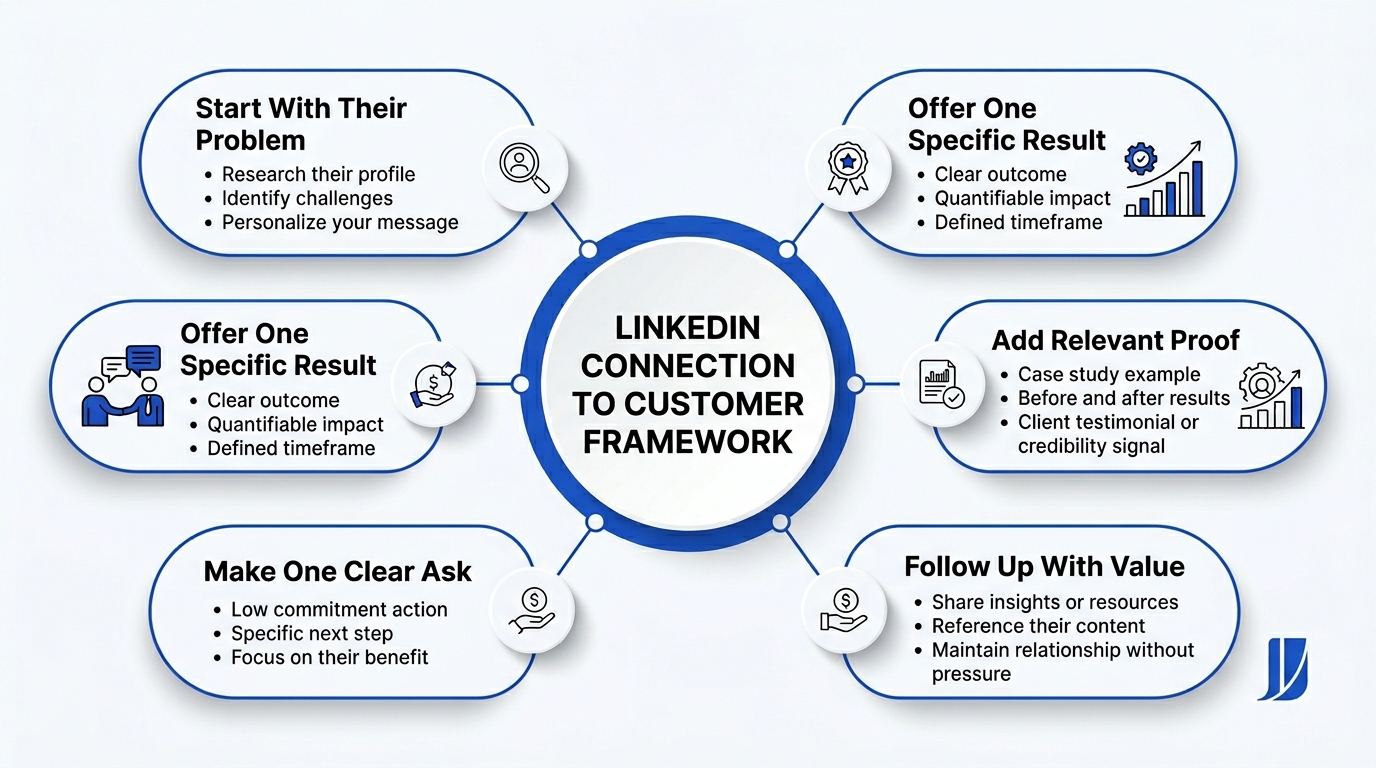
Here’s a framework that experienced consultants, coaches, freelancers, and B2B professionals use to consistently convert connections into clients. It’s not complicated. But it does require intention, patience, and a willingness to put the other person first.
Step 1: Start With Their Exact Problem Not Your Pitch
This is where 90% of LinkedIn outreach goes wrong. People lead with themselves — their services, their credentials, their offer. But the person on the other end of that message is thinking about one thing: themselves and their problems.
Before you send a single message, do your research.
Spend 5–10 minutes on their profile. What industry are they in? What’s their current role? Have they posted recently about a challenge they’re facing? Have they commented on industry discussions? Have they shared an article that hints at what they’re currently working through?
LinkedIn is essentially a public journal of someone’s professional life. Use it like one.
Look for signals like:
- Recent job changes (transition anxiety, new pressure to perform)
- Posts about challenges in their industry
- Comments expressing frustration or asking for advice
- Content they engage with that reveals their priorities
Once you’ve done that research, craft your opening message around their world, not yours. Here’s the difference:
| Pitch-First Approach | Problem-First Approach |
|---|---|
| “Hi Sarah, I help companies increase revenue through strategic marketing.” | “Hi Sarah, I noticed your recent post about struggling with content ROI — that’s something a lot of SaaS marketing leads are navigating right now.” |
| “I’d love to tell you about my services.” | “Are you finding that the attribution problem is getting harder as third-party cookies phase out?” |
| “Can we hop on a 30-minute call?” | “Would it be useful to share what’s been working for a few other companies in your space?” |
The problem-first approach does something powerful: it tells the other person that you actually paid attention. That alone separates you from 95% of the people sliding into their DMs.
Why this works psychologically: When someone feels understood, they lower their defenses. They stop categorizing you as “another person trying to sell me something” and start seeing you as someone who might actually get it. That shift is everything.
The research habit to build: Before reaching out to any new connection, spend five minutes writing down three specific things you noticed about them. This forces genuine attention and makes your message feel human.
Step 2: Offer One Clear, Specific Result
Once you’ve opened the conversation with a problem-focused message and they’ve responded, it’s time to show them what’s possible — but with precision, not vagueness.
The biggest mistake here is speaking in generalities. “I help businesses grow.” “I improve your online presence.” “I help you reach your goals.” These phrases mean nothing because they could mean anything. They offer no mental picture of what life looks like after working with you.
A specific result, on the other hand, creates a clear before-and-after image in the prospect’s mind.
Compare these:
| Vague Value Proposition | Specific Result |
|---|---|
| “I help companies with their marketing.” | “I help B2B SaaS companies reduce their cost per qualified lead by 30–40% within 90 days.” |
| “I work with executives on leadership.” | “I help first-time VPs build management systems so their teams stop depending on them for every decision.” |
| “I do financial consulting.” | “I help small business owners identify where they’re silently losing 15–20% of their revenue every quarter.” |
See how the specific version immediately prompts the reader to think: “Is that me? Do I have that problem?” That’s exactly the mental response you want. It sparks self-identification, which is the precursor to genuine interest.
How to craft your specific result statement:
Ask yourself these questions:
- Who exactly do I help? (Not “everyone,” get specific about industry, role, company size, situation)
- What specific change do I create? (Quantify it if possible: time saved, revenue gained, problem eliminated)
- In what timeframe? (This adds credibility and sets realistic expectations)
- Under what conditions? (This filters for the right prospects and makes it feel more trustworthy)
Your result statement doesn’t need to be fancy. It needs to be clear. When someone reads it, they should immediately know whether it applies to them or not.
Important note: Tailor your result statement to the individual you’re speaking with. If your research from Step 1 revealed that this person is struggling with team retention, and your work touches on that, lead with that angle even if your broader offer covers more ground.
Step 3: Add Proof That Actually Lands
You’ve identified their problem. You’ve offered a specific result. Now comes the moment of natural skepticism — because every professional on LinkedIn has heard promises before. Proof is what separates a convincing conversation from a forgettable one.
But here’s where many people go wrong: they dump a wall of credentials, case studies, and testimonials. This overwhelms the reader and ironically makes the proof feel less credible, not more.
One relevant proof point beats ten generic ones every time.
Think about what kind of proof is most powerful for the specific person you’re talking to:
| Type of Proof | Best Used When |
|---|---|
| Specific case study | You’ve worked with someone in their exact role/industry |
| Before-and-after stat | You have measurable results (revenue, time, growth rates) |
| Client testimonial | The testimonial speaks directly to their pain point |
| Process/methodology | They seem risk-averse and need to understand how you work |
| Third-party recognition | They’re in a space where authority markers matter (awards, press, certifications) |
Here’s how you work proof into a conversation naturally, not like a sales brochure:
“One of my clients, a marketing director at a mid-size fintech company, was dealing with the exact same attribution challenge. Within the first two months of restructuring their campaign tracking, they cut wasted ad spend by $18K a month. Happy to share how we approached it if that’s useful.”
Notice what that does:
- It’s conversational, not corporate
- It’s specific (fintech, two months, $18K)
- It offers value without demanding anything
- It ends with an invitation, not a push
Build your proof library now. Don’t wait until you’re in a live conversation to scramble for a case study. Write up 3–5 mini case studies (3–4 sentences each) for different client profiles and problems. Keep them in a document you can reference and adapt quickly.
If you’re newer to your field and don’t yet have client results, lean on:
- Process proof (“Here’s the exact framework I use and why it works…”)
- Personal experience (“I spent seven years doing this in-house before going independent, so I’ve seen firsthand how…”)
- Research and data (“Studies from McKinsey consistently show that companies who do X see Y result…”)
The goal is credibility, not perfection. People don’t need you to be flawless — they need to believe you can actually help them.
Step 4: Close With One Clear, Low-Friction Action
This is the step where good conversations die — not because the relationship wasn’t built, but because the ask was too big, too vague, or too many things at once.
Most people, when they finally feel ready to make an ask, overload it:
“Would you be open to a call? We could do a 30-minute discovery session, or I can send you a proposal, or maybe we start with a quick audit — whatever works best for you!”
This feels generous, but it’s actually paralyzing. When someone is given too many options, they often choose none of them. Decision fatigue is real, and your job is to eliminate friction, not create it.
One conversation. One next step. One ask.
The best closing asks on LinkedIn share three qualities:
- They’re low commitment. A 15-minute call is easier to say yes to than a 60-minute strategy session. A quick question is easier than a proposal request.
- They’re specific. “Are you free Thursday or Friday for a 15-minute call?” is more likely to get a yes than “Let me know when works.”
- They’re framed around the prospect’s benefit. “I’d love to share the three things I’d look at first in your specific situation” is more compelling than “I’d love to tell you about my services.”
Here’s a comparison of closing asks and their effectiveness:
| Weak Ask | Strong Ask |
|---|---|
| “Let me know if you’re ever interested.” | “Would it make sense to spend 15 minutes next week walking through how this might apply to your team?” |
| “Feel free to check out my website.” | “I can put together a quick breakdown of what I’d look at first in your situation — want me to send that over?” |
| “Let’s hop on a call sometime.” | “Are you free Thursday or Friday for a short call? No pitch — just want to understand what you’re working with.” |
| “I’d love to discuss further.” | “I have one question that would help me give you a more useful answer — mind if I ask?” |
The phrase “no pitch” deserves special attention. When you tell someone there’s no pitch coming, you immediately lower their defenses. It’s a bold claim — and it works only if you actually mean it. Don’t say it and then pitch. But if you genuinely want to understand their situation first, saying so up front changes the entire tone of the conversation.
What happens after the ask? Prepare for silence. Not every yes happens immediately. Which brings us to the most underestimated step of all.
Step 5: Follow Up With Value, Not Desperation
The fortune, as they say, is in the follow-up. But the way you follow up makes all the difference between landing a client and getting blocked.
Most follow-ups fall into one of two failure modes:
The desperate follow-up: “Hey, just checking in to see if you had a chance to think about what we discussed…” This puts the burden on them, implies impatience, and smells like a sales chase.
The silent ghost: Sending one message, getting no response, and giving up entirely. This leaves an enormous amount of business on the table.
The third way — the one that actually works — is the value-add follow-up. Instead of following up to remind them you exist, you follow up to give them something useful.
Examples of value-add follow-ups:
- Share a relevant article: “Saw this piece on [topic they mentioned] and immediately thought of our conversation — thought it might be useful.”
- Send a quick insight: “Was thinking about what you said about [problem]. One thing that’s worked well for others in your situation is [tip]. No need to respond — just wanted to share.”
- Reference something they posted: “Just saw your post about [topic] — that’s a really sharp observation. It actually connects to what we were discussing about [X].”
- Offer a free resource: “Pulled together a short breakdown on [relevant topic] that I’ve been sharing with a few people in your space. Happy to send it over if useful.”
Notice the pattern: every value-add follow-up gives first. It asks nothing. It adds to the relationship without creating pressure.
How many follow-ups is appropriate?
| Follow-Up Number | Timing | Approach |
|---|---|---|
| 1st follow-up | 3–5 days after initial message | Share a relevant resource or insight |
| 2nd follow-up | 1 week later | Reference something they’ve posted or engaged with |
| 3rd follow-up | 2 weeks later | Light check-in with a new question or observation |
| 4th follow-up | 1 month later | A fresh angle — new case study, relevant news, updated offer |
| After 4th | Quarterly | Move to long-term nurture; occasional value touches |
After four or five genuine, value-driven follow-ups with no response, it’s appropriate to send a graceful exit message: “I don’t want to keep reaching out if the timing isn’t right. If things change down the road, I’m always happy to reconnect.” This actually prompts a surprising number of replies — because people respect the self-awareness.
The Content Strategy That Makes All of This Easier
Here’s something the top LinkedIn earners know that most people don’t: you don’t have to rely entirely on one-to-one outreach. Your content does a huge portion of the selling for you — passively, at scale, while you sleep.
When your LinkedIn feed consistently shows you as someone who understands your target audience’s problems — through posts, articles, and thoughtful comments — two powerful things happen:
- Warm leads come to you. People who’ve been reading your content for weeks or months reach out already convinced. The trust is pre-built.
- Your outreach lands differently. When someone you’re messaging has already seen your content, you’re not a cold stranger. You’re a familiar face. That changes everything.
The content pillars that convert:
| Content Type | Purpose | Example |
|---|---|---|
| Problem-focused posts | Attract people experiencing that exact problem | “Three reasons your LinkedIn outreach is getting ignored (and what to do instead)” |
| Case study posts | Build credibility through real results | “How a career coach went from 0 to 3 clients a month using this DM approach” |
| Insight/opinion posts | Establish authority and spark engagement | “Hot take: The biggest LinkedIn mistake isn’t pitching too early. It’s not following up at all.” |
| Process posts | Show how you think and work | “The exact 5-message sequence I use to turn new connections into booked calls” |
| Community engagement | Stay visible and warm up connections | Thoughtful comments on posts by your target audience |
You don’t need to post every day. Posting two to three times per week with genuine, specific insight is more than enough to build a content presence that quietly does your selling for you.
Common Mistakes That Destroy Conversion And How to Avoid Them
Even with the right framework, a few common errors can derail an otherwise strong LinkedIn strategy. Here’s what to watch for:
Pitching too fast. If you lead with your offer before establishing any connection to their world, you’ll lose them. Most people need at least two or three exchanges before they’re open to hearing what you do in any detail.
Being vague about what you offer. “I help with marketing” is not a value proposition. If someone can’t immediately understand what you do and who it’s for, they won’t bother asking.
Ignoring the follow-up. A single unanswered message is not a rejection. People are busy. Inboxes are crowded. A well-timed, value-driven second message has converted more clients than any perfectly crafted first message.
Making it about you. Count the number of times you say “I” versus “you” in your messages. If “I” wins by a large margin, rewrite your messages.
Forgetting to engage publicly before reaching out privately. Commenting thoughtfully on someone’s post before sending a DM creates name recognition. By the time your message arrives, they already know who you are.
Conclusion
LinkedIn is genuinely one of the most powerful platforms on earth for building professional relationships that turn into real revenue. But it only works when you treat it like what it is — a human network, not a broadcast channel or a cold calling list.
The process of converting linkedin connections to customers is not complicated, but it does require consistency and care. Start with their problem. Offer a specific result. Back it up with relevant proof. Make one clear ask. Follow up with value. And let your content work quietly in the background, building trust with people before they even speak to you.
None of this requires a massive network, a blue checkmark, or a premium subscription. It requires attention, patience, and a genuine willingness to put the other person’s needs at the center of every conversation.
Do that consistently, and LinkedIn stops being a place where connections go to die — and starts becoming one of your most reliable sources of new business.
Frequently Asked Questions
How long does it typically take to turn a LinkedIn connection into a paying customer?
It varies significantly depending on your industry, deal size, and how well you execute the relationship-building process. For smaller B2C or freelance engagements, it can take anywhere from two weeks to two months. For B2B deals with larger companies, the sales cycle can extend to three to six months or longer. The key is to focus on consistent, value-driven engagement rather than rushing the timeline.
How many messages should I send before giving up on a prospect?
Four to five genuinely useful, spaced-out messages is a reasonable threshold. Beyond that, move them into a long-term nurture list and check in quarterly. Never burn the bridge — circumstances change, and a prospect who isn’t ready today might be ready in six months.
Should I use LinkedIn’s InMail or regular connection messages?
Regular messages after connecting are generally more effective because they feel more personal and less like a formal sales communication. InMail works best when you haven’t connected yet and want to reach someone outside your network — use it sparingly and make it highly personalized.
What’s the best time to send LinkedIn messages for higher response rates?
Tuesday through Thursday, between 8–10 AM or 5–7 PM in the recipient’s time zone, tends to get the best response rates. Avoid Monday mornings (inbox overwhelm) and Friday afternoons (mentally checked out). That said, relevance and personalization matter far more than timing.
Do I need a large LinkedIn following to convert connections into clients?
Absolutely not. Many consultants and service providers generate consistent clients from a network of just a few hundred people. Quality of relationships and clarity of your offer matter far more than follower count. A small, engaged, relevant network will outperform a massive, disengaged one every time.
How do I handle a conversation that goes cold after a promising start?
Re-engage with a value-first message that references something new — a piece of content, an industry development, a question that reconnects to their original problem. Don’t reference the fact that they went quiet. Just pick up as if the conversation is ongoing.
What should my LinkedIn profile look like to support this strategy?
Your profile should function like a landing page, not a resume. The headline should speak to who you help and what result you deliver. The About section should address your target client’s pain points directly before explaining what you do. Featured content should showcase proof — case studies, results, useful resources.