

Landing your first enterprise deal as a startup is one of the most critical milestones in your business journey. It validates your product, provides significant revenue, and opens doors to additional enterprise clients. However, getting there requires a strategic approach, and it all starts with effective LinkedIn outreach. In this comprehensive guide, we’ll explore proven strategies, templates, and tactics that will help you create meaningful connections with enterprise decision-makers and ultimately close your first major deal.
What is the Enterprise Sales Landscape for Startups
Before we dive into specific outreach strategies, it’s essential to understand what enterprise sales actually means. Enterprise deals typically involve companies with 1,000+ employees, substantial budgets, and complex decision-making processes. Unlike smaller businesses that might make purchasing decisions quickly, enterprise clients involve multiple stakeholders, lengthy sales cycles that can span 6-18 months, and rigorous evaluation criteria.
The challenge for startups is that you’re often competing against established competitors with larger teams, bigger budgets, and proven track records. However, you also have significant advantages: agility, innovation, personalization capabilities, and the ability to offer customized solutions. The key to leveraging these advantages lies in how you approach enterprise prospects through LinkedIn.
LinkedIn has become the go-to platform for B2B sales professionals because it provides direct access to decision-makers, allows for personalized outreach at scale, and creates a professional context for business conversations. With over 900 million professionals on the platform, your potential enterprise clients are already there—you just need to know how to reach them effectively.
Why LinkedIn is Your Most Powerful Tool for Enterprise Outreach
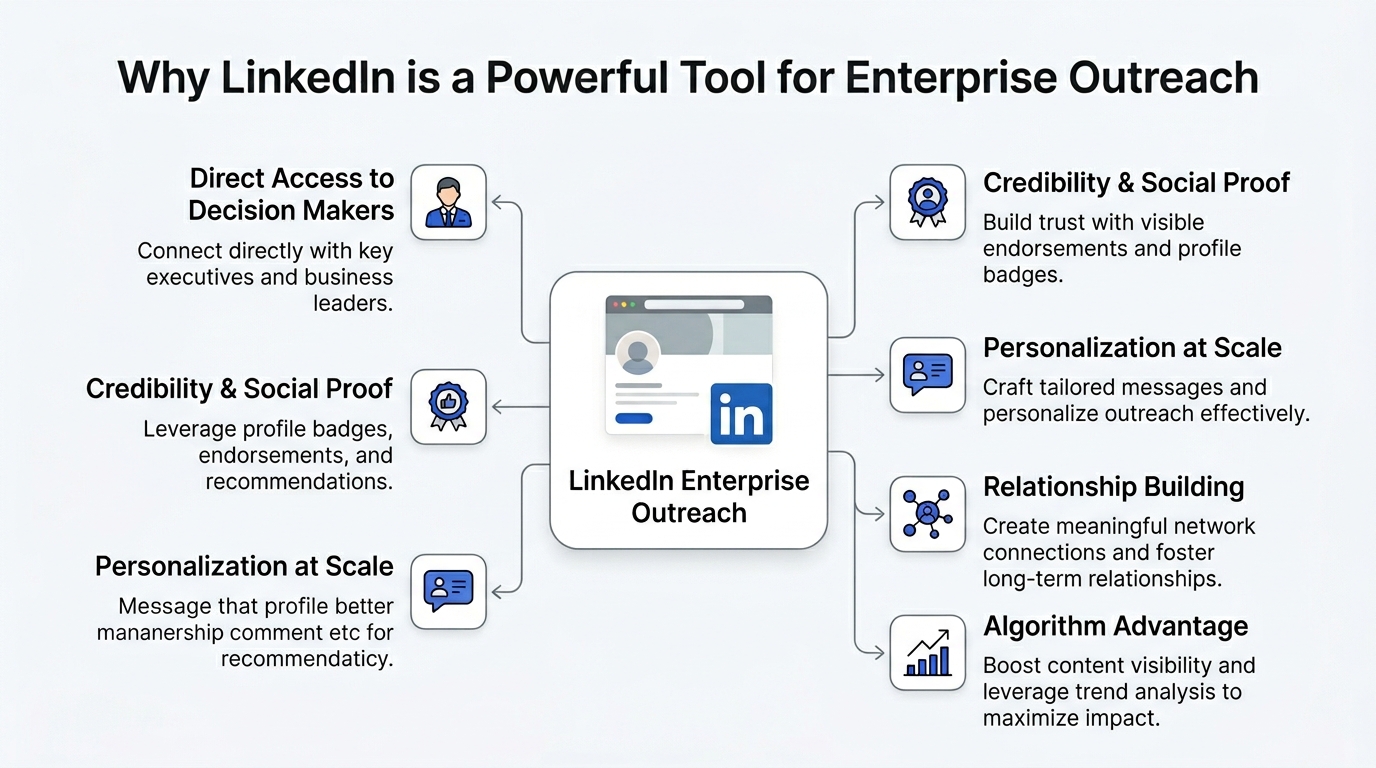
LinkedIn outreach has transformed how startups can access enterprise decision-makers. In the past, reaching a Fortune 500 CTO or VP of Operations required going through gatekeepers, cold calling, or expensive account-based marketing campaigns. Today, you can reach these individuals directly with a personalized message.
Here’s why LinkedIn is particularly effective for enterprise outreach:
Direct Access to Decision-Makers: LinkedIn allows you to identify and connect with the exact people who make purchasing decisions—CTOs, VPs, Directors, and C-suite executives. You can see their job titles, company information, and professional background without any intermediaries.
Credibility and Social Proof: When you reach out on LinkedIn, you’re operating within a professional context. Your profile serves as your resume and portfolio, and your network demonstrates your credibility. Enterprise decision-makers are more likely to engage with someone who has a complete, professional profile with solid social proof.
Personalization at Scale: Unlike cold emails, LinkedIn allows you to reference someone’s recent posts, achievements, or company announcements in your outreach message. This personalization dramatically increases response rates because it shows you’ve done your homework.
Relationship Building: Enterprise deals aren’t won on the first touchpoint. LinkedIn enables you to build relationships gradually through engagement—liking posts, commenting thoughtfully, and sharing valuable content—before you ever send a direct message.
Algorithm Advantage: LinkedIn’s algorithm favors meaningful connections and messages. When you send a personalized connection request or message, it’s more likely to be seen compared to generic outreach.
How to Develop Your LinkedIn Outreach Strategy for Enterprise Prospects
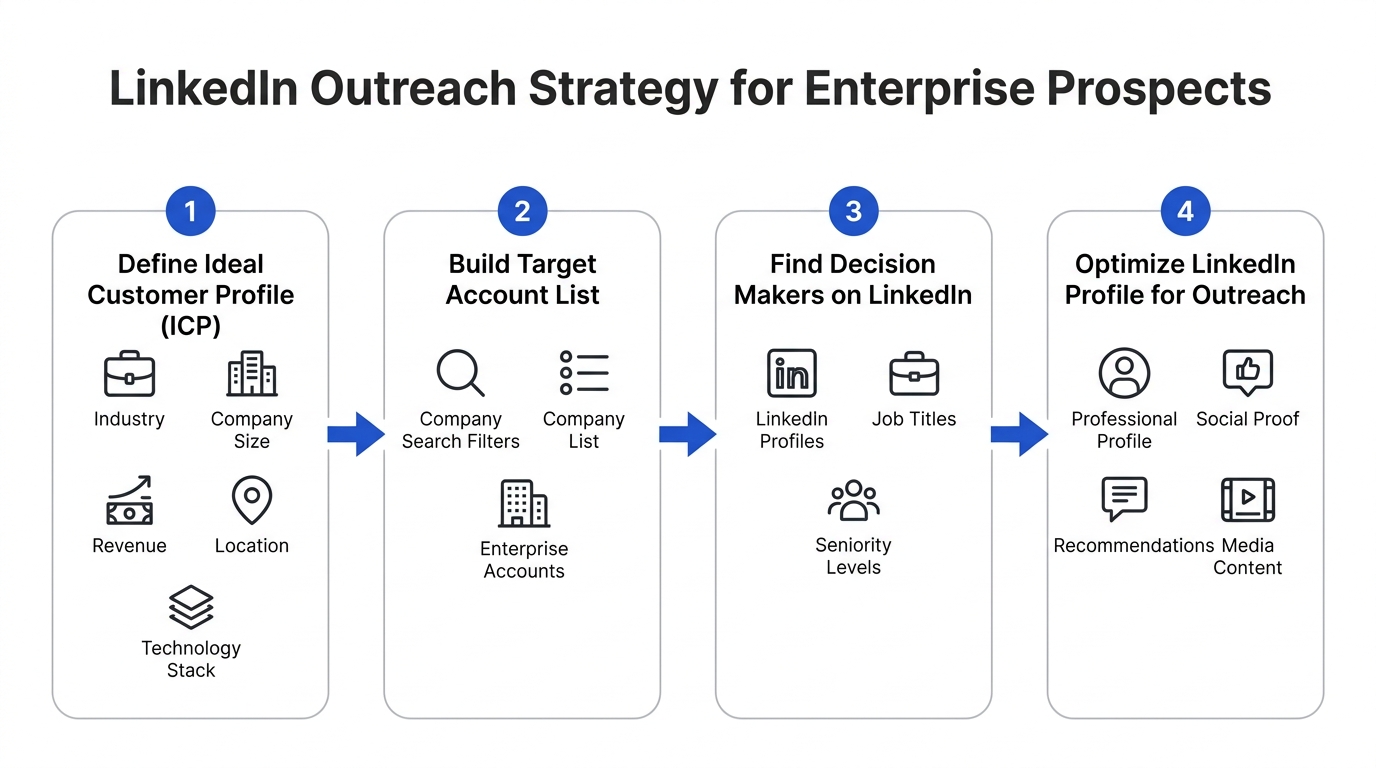
Before you send a single message, you need a solid strategy. This involves several interconnected components that work together to create a cohesive outreach program.
Identifying Your Ideal Enterprise Customer
The first step is defining exactly which enterprises you want to reach. This goes beyond simply saying “large companies.” You need to create an ideal customer profile (ICP) that includes:
- Industry vertical: Which industries have the greatest need for your solution?
- Company size: What’s the minimum company size, revenue, or number of employees?
- Use case alignment: Which business problems does your solution solve most effectively?
- Budget capacity: Are your target companies likely to have budget for your solution?
- Geographic location: Are you targeting companies in specific regions?
- Technology stack: Do they use certain technologies that complement your solution?
For example, if you’re a startup offering supply chain optimization software, your ICP might be mid-market to large manufacturing companies with 5,000+ employees, $500M+ revenue, that currently use legacy ERP systems, located in North America and Europe. This level of specificity allows you to target your outreach with precision.
Building Your Target Account List
Once you’ve defined your ICP, use LinkedIn’s search functionality to build a target account list. Create LinkedIn searches using filters like:
- Company industry and size
- Location
- Specific company names
- Job titles
- Seniority level
Save these searches so you can run them regularly and find new prospects. Many successful startups maintain a list of 50-100 target accounts and systematically work through them over several months.
Optimizing Your LinkedIn Profile
Your profile is your storefront. When someone receives your outreach, the first thing they’ll do is check your profile. An optimized profile dramatically increases acceptance rates and engagement:
- Professional photo: Use a high-quality, professional headshot where you’re smiling directly at the camera
- Compelling headline: Move beyond just your title. Include your value proposition (e.g., “Helping Startups Scale Supply Chains | Founder at TechCo”)
- Strong about section: Write a 3-4 sentence summary that explains what you do, who you help, and what makes you different
- Rich media: Add links to case studies, demo videos, or your website
- Recommendations and endorsements: Ask customers and colleagues for recommendations, as these provide social proof
- Regular engagement: Post and engage with content regularly to stay visible in your network’s feeds
An optimized profile increases your LinkedIn outreach response rates by 30-50% because prospects feel more confident connecting with someone who clearly knows what they’re doing.
LinkedIn Outreach Templates for Startups for Enterprise Success
Now let’s get into the practical templates you can customize for your enterprise outreach. These aren’t generic templates—they’re designed based on what actually works with senior decision-makers.
Template 1: The Connection Request Based on Research
This template focuses on showing that you’ve done genuine research about the prospect:
“Hi [First Name],
I’ve been following [Company Name]’s growth in the [industry] space, and I was particularly impressed by [specific achievement/recent news].
I work with companies like you on [specific problem], and I think there might be a valuable conversation about how [your solution] helps [similar company type] achieve [specific outcome].
Would you be open to a brief 15-minute call next week?”
Why this works: It demonstrates research, mentions a specific company achievement, and frames the conversation around their goals rather than your product. Enterprise decision-makers respond well to this because it shows respect for their time and genuine interest.
Template 2: The Value-First Message
This template prioritizes providing value before asking for anything:
“Hi [First Name],
I’ve been researching how [Company Name] is approaching [specific challenge], and I came across an article by [relevant researcher/analyst] that identified some industry benchmarks that might be relevant to your work.
The article shows that [benchmark insight], which is particularly interesting given [Company Name]’s position in [relevant context].
I thought you might find it useful. Happy to discuss further if you think it’s relevant.”
Why this works: This approach provides value upfront without asking for anything. It positions you as a knowledgeable resource and establishes goodwill. Enterprise buyers appreciate when someone contributes value before making an ask.
Template 3: The Problem-Focused Approach
This template emphasizes understanding their specific challenges:
“Hi [First Name],
I’ve been working with [Company Names] in the [industry] space, and we’ve noticed they often struggle with [specific problem]. The challenge usually manifests as [specific symptom], which impacts [business metric].
Does this resonate with what you’re seeing at [Company Name]?
If so, I’d love to share some insights we’ve discovered that might be useful.”
Why this works: This shows deep understanding of the prospect’s industry and common challenges. It opens with empathy and understanding rather than self-promotion. Enterprise decision-makers engage more readily with someone who clearly understands their world.
Template 4: The Referral or Social Proof Message
This template leverages existing relationships:
“Hi [First Name],
[Mutual connection name] recently mentioned your work on [specific initiative], and they thought we should connect. They know I work with companies on [specific solution area], and they thought there might be a fit.
I’d love to grab 15 minutes to explore if there’s mutual value here. Are you open to that?”
Why this works: Warm introductions carry significant weight in enterprise sales. If a mutual connection has vouched for you, the prospect is far more likely to engage. This works especially well with second-degree connections on LinkedIn.
Template 5: The Educational Content Approach
This template shares valuable insights:
“Hi [First Name],
I recently analyzed data from [number] companies in the [industry] space, and we found that [specific insight]. It challenges the conventional wisdom about [common assumption].
I’ve attached the summary—thought it might be interesting for your team’s [specific initiative/challenge].
Happy to discuss if you see anything worth exploring.”
Why this works: Enterprise leaders are constantly looking for competitive intelligence and industry insights. Sharing proprietary research or analysis positions you as a thought leader and creates a value exchange before you ever ask for a meeting.
Implementing LinkedIn Outreach Tool Strategies
While LinkedIn’s native platform is powerful, many successful startups supplement it with specialized LinkedIn outreach tools that automate and streamline the process. Understanding how to effectively use these tools is crucial.
What LinkedIn Outreach Tools Can Do
A LinkedIn outreach tool, whether it’s Dealsflow, Lemlist, Apollo, Hunter, or similar platforms, can help with:
Automated profile research: These tools can pull data about prospects from LinkedIn and enrich it with additional information like email addresses, company details, and industry data.
Sequence automation: You can set up automated sequences where the tool sends a connection request, waits a specific number of days, then sends a follow-up message, and eventually a final message. This creates a consistent touchpoint cadence without requiring manual effort.
Personalization at scale: These tools allow you to create templates with dynamic fields that pull in prospect-specific data, making messages feel personalized even when you’re reaching out to dozens of prospects.
Response tracking: You can see exactly who viewed your profile, who accepted your connection request, who replied, and who didn’t engage. This data is invaluable for refining your approach.
A/B testing: Many outreach tools let you test different subject lines, opening lines, or calls-to-action to see what resonates best with your audience.
Best Practices for Using a LinkedIn Outreach Tool
While these tools are powerful, they must be used carefully to maintain authenticity and avoid getting your account flagged:
Don’t overautomated: The more authentic and manual your outreach appears, the better. Even with a tool, vary your timing, personalization level, and message cadence so it doesn’t look robotic.
Warm up your account first: If you’re using a new account, don’t immediately start high-volume outreach. Spend time engaging authentically with content, making manual connections, and building credibility before you scale up.
Follow LinkedIn’s terms of service: LinkedIn doesn’t prohibit outreach tools, but they do prohibit behaviors like scraping, spamming, or buying email lists. Use reputable tools that respect these boundaries.
Quality over quantity: Sending 1,000 templated messages will get worse results than sending 100 highly personalized messages. Focus on quality targeting and personalization.
Monitor your metrics: Track response rates, meeting requests, and conversions for each approach. If your open rate drops, it might be time to adjust your messaging or targeting.
Creating Your Multi-Step Outreach Sequence
Enterprise deals are rarely won on the first outreach attempt. Instead, develop a multi-step sequence that gradually builds relationship and engagement:
| Step | Timing | Action | Purpose |
|---|---|---|---|
| 1 | Day 1 | Connect request with personalized note | Establish initial contact |
| 2 | Day 3-4 | Engage with their recent posts | Demonstrate genuine interest |
| 3 | Day 5-7 | First direct message with value | Introduce your value proposition |
| 4 | Day 10-12 | Share relevant insight or resource | Reinforce your expertise |
| 5 | Day 15 | Follow-up if no response | Gentle reminder without being pushy |
| 6 | Day 21 | Final touch-point | Last attempt before moving on |
This sequence respects the prospect’s time while maintaining consistent presence. Most enterprise deals require 5-7 touchpoints before a conversation begins, so persistence with professionalism is key.
Personalizing Your LinkedIn Outreach Templates for Enterprise Prospects
Generic templates rarely work for enterprise decision-makers. Here’s how to personalize effectively:
Research Beyond LinkedIn
Before you reach out to someone, spend 10-15 minutes researching:
- Recent company news: Check their company’s website, press releases, and industry news. Has their company recently launched a new product, expanded into new markets, or made significant hires?
- Professional social media: Beyond LinkedIn, check their Twitter, personal website, or speaking engagements. What are they interested in?
- LinkedIn activity: What articles have they written or shared? What causes do they care about?
- Industry context: What challenges is their industry facing? What trends are relevant to their role?
This research allows you to reference specific, timely information in your outreach, which dramatically increases response rates.
Craft Prospect-Specific Opening Lines
Instead of generic openers, use specific information to create tailored messages:
Generic: “I’ve been helping companies like yours…”
Personalized: “I noticed your company just announced the expansion of your [department], which aligns perfectly with [specific insight]…”
The personalized version shows you’ve done real research and aren’t just blasting out templates.
Address Their Specific Challenges
Rather than talking about your solution generically, address the specific challenges their company and role likely face:
If you’re reaching out to a VP of Operations at a manufacturing company, focus on operational efficiency, supply chain optimization, or cost reduction—challenges you know they face. If you’re reaching out to a CTO at a fintech company, discuss technical infrastructure, scalability, or security compliance.
This requires you to have deep industry knowledge, but it’s what separates successful enterprise outreach from unsuccessful attempts.
Measuring and Optimizing Your LinkedIn Outreach Campaign
To improve your results, you need to measure what’s working and what isn’t.
Key Metrics to Track
Connection acceptance rate: What percentage of your outreach attempts result in accepted connections? Enterprise decision-makers typically have acceptance rates between 20-40%.
Message open rate: Of the people who accept your connection, what percentage open your direct message? This should be above 50%.
Response rate: What percentage of people who receive your message actually respond? Typical response rates for well-targeted enterprise outreach range from 10-25%.
Meeting request acceptance rate: Of the people who respond, what percentage agree to a meeting or call? This typically ranges from 20-50% of respondents.
Conversion rate: Ultimately, what percentage of outreach attempts lead to a meeting, demo, or other meaningful conversation? This depends on your sales cycle, but aim for 2-5% of total outreach.
Analyzing and Improving Performance
If your response rates are lower than expected:
Check your targeting: Are you reaching the right people? Are your targets actually decision-makers for your solution?
Evaluate your messaging: Is your value proposition clear? Are you addressing their actual challenges? Test different approaches.
Examine your profile: If people aren’t responding, check that your profile is complete, professional, and credible.
Assess your timing: Are you reaching out at the right time in their buying journey? Sometimes prospects aren’t ready to engage even if they’re a perfect fit.
Review your follow-up: Are you following up appropriately, or are you either being too aggressive or not persistent enough?
Advanced Strategies for Enterprise LinkedIn Outreach
Once you’ve mastered the basics, implement these advanced strategies:
Account-Based Marketing (ABM) Integration
Rather than broad outreach to all matching prospects, focus intensively on your top 20-50 target accounts. Research each account deeply, reach out to multiple stakeholders across different departments, and create coordinated outreach campaigns. This requires more effort per account but dramatically increases success rates.
LinkedIn Article and Content Strategy
Publish thoughtful articles and insights on LinkedIn to build authority and attract inbound interest from your target accounts. When decision-makers see you’ve published valuable content, they’re far more likely to engage with your outreach.
Leveraging LinkedIn Groups
Join professional groups where your target customers congregate. Participate thoughtfully, answer questions, and establish expertise. This creates multiple touchpoints with prospects and can lead to organic outreach opportunities.
Building Your LinkedIn Network Strategically
Don’t just connect with prospects—build relationships with influencers, thought leaders, and connectors in your industry. These relationships can lead to warm introductions, partnership opportunities, and referrals.
Common Mistakes in Enterprise LinkedIn Outreach
Learning from others’ mistakes can accelerate your success:
Mistake 1: Pitching Too Quickly: Many startups jump immediately into selling in their first message. Enterprise decision-makers don’t want to be sold to—they want to understand if there’s a potential fit. Focus on discovery and understanding their challenges first.
Mistake 2: Ignoring Response Time: Enterprise professionals are busy. If someone responds to your outreach, respond within 24 hours. Delays can result in lost interest.
Mistake 3: Not Differentiating: If your outreach could apply to any company in an industry, it’s not specific enough. Enterprise prospects can smell generic outreach from a mile away.
Mistake 4: Failing to Follow Up: Many startups give up after one or two attempts. Most enterprise conversations require 5-7 touchpoints before someone engages.
Mistake 5: Inconsistent Branding: Your LinkedIn profile, your message, your follow-up emails, and your website should all be consistent and reinforce the same value proposition.
Mistake 6: Not Researching Before Outreach: Reaching out without understanding the prospect’s company, industry, and role is a waste of time and positions you as someone who doesn’t do homework.
Building a Sustainable Enterprise Sales Process
Landing your first enterprise deal is exciting, but it’s the beginning of an ongoing process. To scale, you need systems:
Create a database of targets: Maintain an organized list of prospects, their contact information, engagement history, and status in your pipeline.
Develop repeatable processes: Document your most effective outreach approaches, messaging templates, and follow-up sequences so they can be repeated and optimized.
Train your team: As you grow, other team members will need to execute outreach. Create training materials and guidelines.
Regularly refine your approach: Continuously analyze your results and test new approaches. What works today might not work next year.
Balance outreach with authenticity: Always remember that you’re building relationships with real people. Even with process and templates, maintain genuine interest in understanding their challenges and helping them.
Conclusion
Landing your first enterprise deal as a startup is absolutely achievable with the right LinkedIn outreach strategy. The combination of LinkedIn outreach templates for startups for enterprise, thoughtful personalization, consistent follow-up, and strategic use of LinkedIn outreach tools creates a powerful formula for success.
Remember that enterprise sales is a relationship-building process. Your LinkedIn outreach templates and sequences are the mechanism for initiating those relationships, but success comes from genuinely understanding your prospects’ challenges, providing value, and demonstrating how your solution can help them succeed.
Start by defining your ideal customer profile, building your target account list, and optimizing your LinkedIn profile. Then begin with a small cohort of 20-30 prospects, test your messaging, measure your results, and refine your approach based on what you learn. Scale gradually, maintain authenticity, and focus on quality over quantity.
The enterprise deals that will fuel your startup’s growth are waiting for you on LinkedIn—you just need to reach out strategically, add value, and build genuine relationships. With the frameworks, templates, and strategies outlined in this guide, you’re ready to make those first critical connections that will transform your startup’s future.
Frequently Asked Questions
How many LinkedIn connection requests should I send per day?
LinkedIn doesn’t publish strict limits, but conventional wisdom suggests 50-100 per day is safe. If you exceed 500 per week or send very high volumes, you risk account restrictions. Start conservatively and increase gradually.
Should I buy LinkedIn Premium to improve my outreach?
LinkedIn Premium provides features like InMail, the ability to see who viewed your profile more clearly, and better search filters. These can help, but they’re not essential. Your core strategy is more important than the tier of LinkedIn you use.
How long should I wait before following up with someone who hasn’t responded?
Wait at least 5-7 days before first follow-up. If still no response, wait another 10-14 days before a second follow-up. After 2-3 follow-ups without response, move on—they’re not interested.
Is it better to send a connection request or a direct message first?
If the prospect allows direct messages from non-connections, you can message directly. Otherwise, send a connection request with a personalized note in the message. Most enterprise professionals will accept if the note is genuine and relevant.
How do I handle rejection or lack of response?
Not everyone will be interested, and that’s okay. Stay professional, move on, and don’t take it personally. The goal is to reach the right people with the right message at the right time—sometimes the timing just isn’t right.
Should I connect with multiple people at the same company?
Yes, this is part of ABM strategy. Decision-making at enterprises involves multiple stakeholders. Connect with prospects across different departments and levels when appropriate.
How can I stand out from other startups reaching out?
Do more research, provide more value upfront, be more specific about how you can help them, and follow up more persistently but professionally. Most outreach is generic—standing out requires going the extra mile.