


In today’s competitive sales landscape, the ability to research and understand your prospects before reaching out can dramatically improve your outreach success rates. The traditional approach of manually researching each prospect is time-consuming, often incomplete, and fails to provide the depth of insight needed for meaningful conversations. This is where artificial intelligence transforms the game entirely.
Artificial intelligence has revolutionized how sales professionals approach prospecting. Rather than spending hours on each prospect, AI tools can analyze vast amounts of data in minutes, uncovering hidden patterns, company insights, and personal information that would otherwise require days of manual research. When combined with LinkedIn outreach strategies, AI-powered research creates a foundation for personalized, highly relevant messaging that resonates with your target audience.
The question many sales professionals ask is: how exactly can I leverage AI to research prospects before LinkedIn outreach? The answer involves understanding the capabilities of modern AI tools, knowing which platforms and data sources to tap into, and developing a systematic approach to prospect research that scales without sacrificing personalization.
What is the Power of AI in Prospect Research
Before diving into the how, it’s essential to understand why AI has become such a game-changer in prospect research. Traditional research methods rely on manual searches through company websites, LinkedIn profiles, news articles, and industry reports. This approach is limited by human capacity—even the most diligent researcher can only process a limited number of prospects per day.
AI, on the other hand, can process thousands of data points simultaneously. Machine learning algorithms can identify patterns in company behavior, growth trajectories, hiring trends, and decision-maker movements. Natural language processing can analyze articles, press releases, and social media posts to extract meaningful insights about a company’s current challenges, strategic initiatives, and industry positioning.
The real power emerges when you combine AI research with your existing knowledge of your ideal customer profile. AI doesn’t replace human judgment; it amplifies it. You still decide who your target prospects are, what problems you solve, and how to customize your approach. AI simply accelerates the research process and reveals insights you might otherwise miss.
How to Use AI to Research Prospects Before LinkedIn Outreach: Building Your Information Foundation
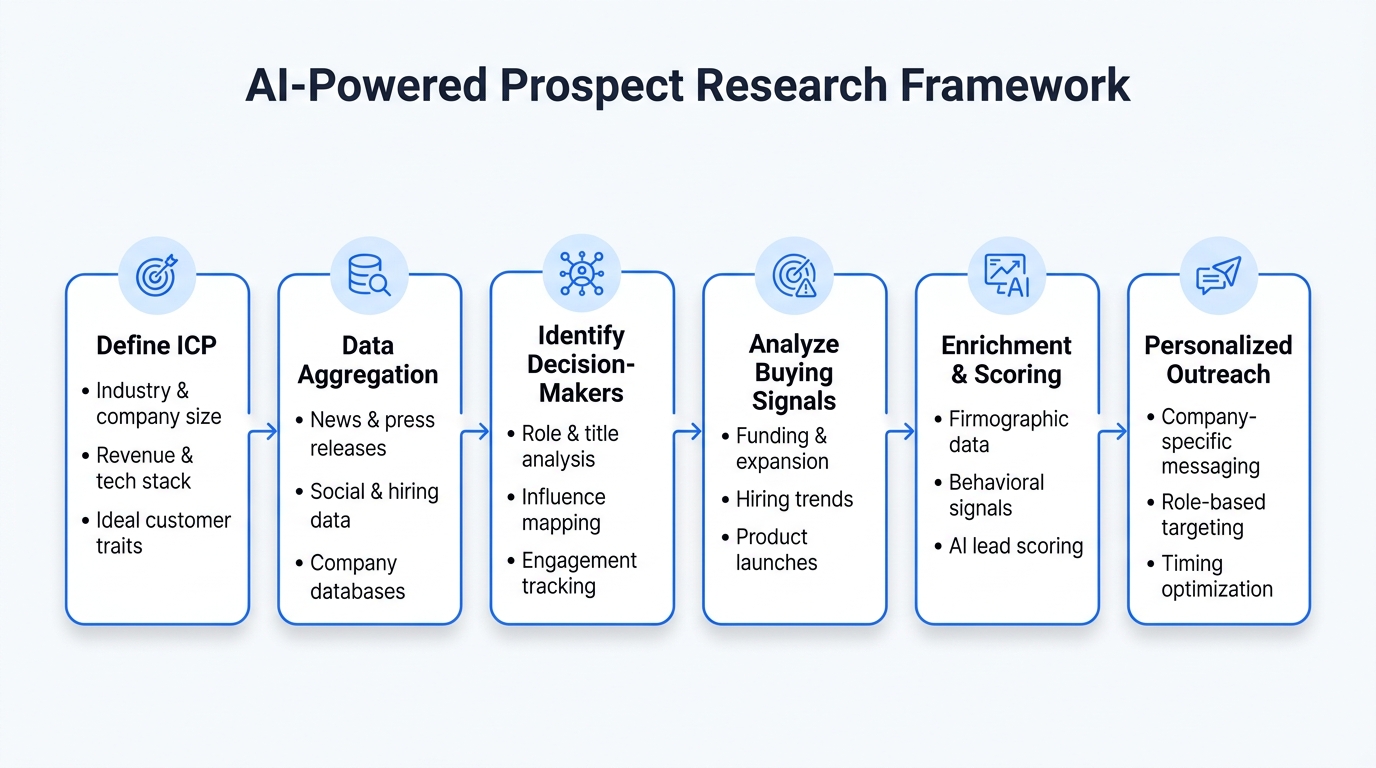
The foundation of effective prospect research starts with having the right information. When you use AI to research prospects before LinkedIn outreach, you’re essentially creating a multi-dimensional profile that goes far beyond what you’d find on a LinkedIn profile alone.
Start by feeding your AI tools with your ideal customer profile (ICP). This includes company size, industry, revenue range, technology stack, growth stage, and any other characteristics that define your perfect customer. The more specific you are with this criteria, the better your AI tools can identify matching prospects and reveal relevant insights.
Modern AI research platforms can automatically pull information from dozens of sources simultaneously. These include company databases, press releases, SEC filings, earnings calls, industry reports, social media platforms, and hiring announcements. The AI aggregates this information and presents it in an organized, actionable format.
For example, if you’re researching a potential prospect, AI can show you:
- Recent funding rounds and the companies involved
- New executive hires and their previous roles
- Product launches or pivots announced in the last quarter
- Industry recognition or awards
- News articles mentioning the company
- Hiring trends (expanded team size indicates growth)
- Social media sentiment and engagement
- Technology integrations and vendor relationships
This information provides context for your outreach. Instead of sending a generic message, you can reference specific events, changes, or initiatives happening at their company, immediately demonstrating that you’ve done your homework.
How to Identify the Right Decision-Makers with AI-Powered Intelligence
One of the most critical aspects of successful LinkedIn outreach is reaching the right person. Sending your message to someone without buying authority or influence over your solution is a wasted effort. This is where AI becomes invaluable in the prospecting process.
AI-powered tools can analyze organizational structures and identify decision-makers based on several factors. They examine:
Title Analysis
AI understands that “VP of Sales Operations” typically has different priorities than “Sales Development Manager.” The AI can categorize roles based on their likely influence over purchasing decisions related to your solution.
Historical Buying Patterns
When you feed AI data about past customers and their decision-makers, it learns which titles, departments, and seniority levels typically drive purchasing decisions in your industry.
Network Analysis
AI can map company organizational structures and identify key influencers even if they don’t hold the obvious titles. For instance, a senior analyst in the product department might have significant influence over a software purchase decision.
Engagement Patterns
On LinkedIn and other platforms, AI can identify who actively engages with content related to your solution’s topic area. Someone commenting on and sharing articles about sales productivity tools is likely more interested in solutions in that space than someone with zero engagement.
Recent Movement
AI alerts you when decision-makers change roles, get promoted, or join new companies. These moments represent significant opportunities. A former prospect who moves to a new company might suddenly have budget, authority, and need for your solution.
The combination of these factors helps you identify not just one decision-maker, but typically multiple stakeholders across different departments. You understand who the economic buyer is, who the user is, and who the champions might be. This multi-threading approach, informed by AI research, significantly increases your chances of navigating complex B2B sales cycles successfully.
How to Analyze Company Signals and Buying Intent
Beyond researching the company structure and finding decision-makers, AI excels at identifying buying signals and intent. These signals indicate that a company is more likely to have a need for your solution right now, rather than waiting until they contact you.
| Buying Signal | What It Indicates | How AI Detects It | Relevance to Outreach |
|---|---|---|---|
| Funding Announcement | New capital for growth initiatives | Press releases, SEC filings, news aggregation | High – indicates budget and expansion plans |
| Executive Hiring | Leadership changes and strategic focus shifts | Job posting analysis, LinkedIn scraping, press releases | High – new hires often evaluate vendor relationships |
| Expansion to New Markets | Strategic growth initiatives | News analysis, earnings call transcripts, website changes | Medium-High – need new tools and processes |
| Product Launches | Operational or product shifts | Product announcement monitoring, website analysis | High – indicates active development needs |
| Team Growth | Rapid hiring across departments | Job posting volume analysis, LinkedIn hiring tracking | High – growing teams need efficiency solutions |
| Technology Stack Changes | New tools or platforms adopted | Vendor announcement tracking, web technologies monitoring | High – indicates openness to change and available budget |
| Earnings Reports | Financial health and strategic direction | Earnings call transcripts, financial analysis | Medium – strong earnings indicate growth budget |
| Award and Recognition | Industry acknowledgment of growth | Award databases, press release monitoring | Low-Medium – ego-stroking angle for warm outreach |
| Negative News | Challenges that need solving | Sentiment analysis of news, social media monitoring | Medium – companies facing challenges seek solutions |
| Industry Trend Adoption | Adoption of emerging solutions | Industry report analysis, competitor tracking | Medium – indicates forward-thinking culture |
AI-powered intent data goes beyond simply identifying signals. It weighs these signals based on what you know about your customer acquisition. If your analysis shows that prospects funded in the last 90 days have a 40% higher conversion rate than other prospects, AI can prioritize companies fitting that profile.
Natural language processing analyzes the tone and content of company communications. When a CEO discusses challenges in a specific area during an earnings call, AI flags this as relevant context for your solution. If a company’s blog suddenly starts publishing content about a particular topic, it suggests internal focus and potential pain point alignment.
Some advanced AI platforms even use predictive analytics to score prospects based on likelihood to purchase, considering hundreds of factors simultaneously. These scores help you allocate your limited time to the highest-potential opportunities.
How to Gather Social Proof and Competitive Intelligence
When you’re researching prospects before reaching out, understanding their competitive landscape and social proof requirements is crucial. AI helps you gather this intelligence systematically.
First, AI can identify your prospect’s competitors and analyze what solutions those competitors are using. If your prospect’s competitor recently implemented a solution like yours, that’s valuable context. Your prospect either knows about it and chose not to switch (requiring a different approach), or they might not be aware of the latest market developments (your expertise positioning becomes valuable).
AI can also analyze customer reviews and testimonials across platforms. What are customers saying about solutions in your space? What problems do they emphasize most frequently? This intelligence helps you craft messaging that addresses the most pressing concerns in your industry.
Social proof gathering becomes automated through AI. Your tools can identify:
- Industry analysts’ reports and your positioning within them
- Customer case studies and their results
- Speaking opportunities and thought leadership presence
- Award nominations and recognitions
- Media mentions and earned coverage
This social proof isn’t just for your company—understanding your prospect’s preferred vendors, industry analysts they follow, and publications they read helps you pitch in language and frameworks they already respect.
How to Create Personalized Outreach Based on AI Research
The entire purpose of AI-powered prospect research is to enable hyper-personalized outreach at scale. Generic messages have abysmal response rates. Personalized, relevant messages that reference specific details about the prospect and their company dramatically outperform.
AI research provides the foundation for several types of personalization:
Company-Specific Personalization: You reference recent company news, hiring announcements, or strategic changes. Instead of “We help companies improve sales efficiency,” you write “Congrats on your Series B funding and expansion into EMEA. As you scale your sales organization across new regions, coordination across distributed teams becomes critical…”
Role-Based Personalization: Your message speaks directly to the challenges someone in their specific role typically faces. A VP of Sales has different priorities than a sales operations manager. AI ensures you’re addressing the right problems for their title and department.
Industry Personalization: You demonstrate understanding of their specific industry’s challenges and dynamics. Healthcare company prospects need different language than SaaS companies. AI can identify the industry and tailor messaging accordingly.
Timing-Based Personalization: When you use AI to research prospects before LinkedIn outreach, timing matters. AI research reveals when a prospect is most likely to be receptive. Someone who just got hired into a new role is often more open to vendor conversations than someone who’s been in their role for five years and has entrenched vendor relationships.
Need-Based Personalization: Rather than assuming all prospects need the same thing, AI reveals specific pain points. A company struggling with team coordination needs different messaging than one struggling with productivity. Your research shows which challenge they’re facing.
The combination of these personalization layers transforms your outreach from a generic broadcast to a conversation starter that demonstrates genuine interest and understanding.
How to Leverage Firmographic and Demographic Data
Firmographic data—information about companies—and demographic data—information about individuals—are both crucial for effective research. AI excels at compiling this information from disparate sources.
Firmographic data includes:
- Company size (employee count, revenue, growth rate)
- Industry classification and sub-verticals
- Geographic footprint and headquarters location
- Business model (B2B, B2C, marketplace, etc.)
- Funding history and investors
- Technology infrastructure and tools used
- Customer base and market position
- Growth trends and trajectory
This data helps you understand whether a prospect fits your ideal customer profile and what stage they’re at in their business lifecycle. A bootstrapped, self-funded company has different needs and buying behaviors than a well-funded venture-backed company.
Demographic data about individuals includes:
- Professional background and career progression
- Current and previous roles
- Skills and expertise areas
- Network size and influence
- Content they’ve published or engaged with
- Certifications and educational background
- Geographic location and languages spoken
Understanding that a prospect has five years of experience in your industry and has been in their current role for less than a year is valuable context. They have relevant expertise (reducing education needed in your pitch) but are also likely to be evaluating vendor relationships and processes.
AI compiles this data from dozens of sources, creating a unified profile. Rather than piecing together information from LinkedIn, company website, industry databases, and news articles yourself, AI does this aggregation, saving you hours per prospect.
How to Use Natural Language Processing for Sentiment and Content Analysis
One sophisticated way to use AI to research prospects before LinkedIn outreach is through sentiment analysis and content examination. This goes beyond factual data to understand emotion, emphasis, and priorities.
Natural language processing can analyze:
Website Copy Evolution: When a company changes the language on their website or homepage, they’re signaling new priorities. AI detects these shifts. If messaging moves from “Best-in-class automation” to “Enterprise security and compliance,” that’s a signal about what the company now emphasizes.
Press Release Tone: The language used in press releases reveals priorities and challenges. Defensive language about market position differs from confident expansion announcements. AI detects these tones and their implications.
Leadership Communications: Analyst calls, shareholder letters, and CEO communications contain strategic information. AI can extract key themes and priorities. If multiple executives mention “improving operational efficiency” in their recent communications, that’s a signal about company-wide focus.
Social Media Sentiment: While social media isn’t always a reliable indicator, AI can identify when company pages or leaders suddenly increase engagement around certain topics. Increased posts about a particular area often precedes strategic moves.
Employee Communications: Glassdoor reviews, employee social media activity, and internal communications (that become public) reveal company culture and emerging challenges. A spike in departures in a specific department might indicate problems that your solution could address.
Earnings Call Transcripts: The language used in earnings calls is particularly rich with insights. Words like “challenged,” “headwinds,” and “investing in” have different implications than “crushing it” or “dominating.” AI transcribes these calls and performs sentiment analysis to identify strategic emphasis areas.
This sentiment analysis helps you understand not just what’s happening at a company, but how leadership feels about it. That context helps you position your solution as addressing what keeps them up at night.
How to Build Prospect Profiles and Scoring Systems
As you gather information through AI research, the next step is organizing that information into actionable prospect profiles and implementing scoring systems.
A comprehensive prospect profile includes:
- Company Overview: Size, industry, funding status, growth rate
- Recent Activity: News, announcements, hiring, funding
- Strategic Direction: From earnings calls, press releases, and leadership communications
- Decision-Making Structure: Key stakeholders and their influence
- Technology Stack: Current vendors and tools
- Growth Indicators: Revenue trajectory, customer acquisition growth, market expansion
- Challenges and Pain Points: Inferred from news, industry benchmarking, and competitive intelligence
- Buying Signals: Identified from the data above
- Best Outreach Contact: Based on role, influence, and responsiveness likelihood
- Recommended Messaging Angle: Based on the prospect’s specific situation
Prospect scoring systems then use this information to prioritize outreach. Rather than treating all prospects equally, scoring helps you focus on the highest-potential opportunities first.
A basic scoring framework might look like:
| Criteria | Points | Rationale |
|---|---|---|
| Company is in target industry | 25 | Fundamental fit |
| Company is within target size range | 25 | Budget and complexity alignment |
| Recent funding (within 6 months) | 20 | Indicates active budget |
| Recent expansion announcement | 15 | Growth requires new solutions |
| Multiple buying signals identified | 20 | Higher purchase likelihood |
| Decision-maker identified and reachable | 20 | Ability to reach right person |
| Technology gap identified vs. competitors | 15 | Clear value proposition opportunity |
| Recent hiring in relevant department | 10 | Active expansion in that area |
| Positive sentiment in recent communications | 10 | Receptive company culture |
| Maximum Score | 160 | Prioritize 100+ first |
Rather than manually scoring each prospect, AI systems can automate this entire process. Every new prospect in your target market gets scored, and your system surfaces the highest-scoring prospects for immediate outreach.
How to Integrate AI Research with LinkedIn Outreach Strategy
Understanding how to use AI to research prospects before LinkedIn outreach is only half the equation. The other half is integrating that research into your actual outreach strategy.
After AI research reveals a high-potential prospect, several elements should be in place before you hit send on your LinkedIn message:
Connection Request Strategy: LinkedIn connection requests can include a 300-character note. Your AI research helps you craft a note that mentions something specific about them or their company, dramatically increasing acceptance rates versus generic connection requests.
Message Timing: AI can sometimes identify optimal timing based on when someone is most active on LinkedIn, when their company announces news (when they might be thinking about related solutions), or when they’ve just changed roles (onboarding period is often more receptive).
Message Content: Your message should reference specific research findings. “I noticed you recently expanded your operations team, and research shows coordination across distributed teams is one of the biggest challenges companies face. I work with rapidly growing teams on exactly this…” This is dramatically more effective than “Hi Sarah, I noticed we both follow TechCrunch…”
Continuity Across Channels: AI research often reveals multiple channels where you can reach prospects. While LinkedIn is the primary channel, email addresses might be available through research tools, or they might be active on Twitter or other platforms. A coordinated, omnichannel approach is more effective than relying solely on LinkedIn.
Follow-up Sequencing: If your initial LinkedIn message doesn’t get a response, AI research helps you determine if you should follow up and with what. If another connection request from someone with mutual friends is due soon, that’s an alternative follow-up avenue. Understanding their activity level helps you time follow-ups appropriately.
Group and Community Engagement: AI can identify what groups, communities, and forums your prospects are active in. Engaging authentically in these spaces before direct outreach increases the chances they recognize you and are receptive to your message.
Tools and Platforms for AI-Powered Prospect Research
While we’re not here to sell you any specific platform, understanding what capabilities exist in the AI research ecosystem helps you choose tools appropriate for your needs.
Data Aggregation Platforms: These tools pull information from dozens of sources and create unified company and contact profiles. They’re useful for accessing comprehensive information quickly without visiting dozens of websites.
Predictive Analytics Platforms: These systems use machine learning to score prospects based on likelihood to purchase, often considering hundreds of signals. They help prioritize your outreach.
Intent Data Providers: Specialized tools that track buying signals like website visits, content consumption, and technology stack changes. These are particularly valuable for identifying companies actively evaluating solutions.
Social Intelligence Platforms: Tools that monitor social media, track sentiment, and identify trending topics help you find recent company announcements and understand company culture.
Email Discovery Tools: When your AI research identifies a strong prospect, these tools help you find their email address so you can reach out across channels.
CRM Integration Tools: Modern research platforms integrate with CRM systems so that insights are automatically populated into your prospect records, making them accessible throughout your sales process.
Automated Email Warmup: Some platforms help warm up cold email addresses by automatically engaging with content, improving deliverability when you do outreach.
The most effective research workflows often combine multiple tools. You might use a data aggregation platform for firmographic information, an intent data provider for buying signals, and email discovery tools for contact information.
Best Practices for Effective AI Research
As you implement AI-powered prospect research, several best practices help maximize results:
Keep Data Fresh: Prospect information changes constantly. Someone’s job title might change, a company’s funding status might shift, or technology stacks might be updated. Implement a regular refresh schedule so your research is current.
Combine AI with Human Judgment: AI identifies patterns and surfaces information, but human judgment determines relevance and strategy. The best approach uses AI to accelerate research while maintaining human decision-making about approach and messaging.
Respect Privacy and Data: As you gather information about prospects, ensure you’re respecting privacy regulations like GDPR and being ethical about data sourcing. Legitimate, publicly-available information is fair game. Hacking or unauthorized access is not.
Test and Iterate: Your first outreach messages might not be perfect. AI research can help you identify what information resonates most with different segments, then iterate your messaging.
Build Context Layers: Rather than relying on a single research data point, build multiple layers of context. Company news combined with hiring announcements combined with industry trends creates a richer picture.
Automate Workflows: Once you’ve established an effective research and outreach process, automate the repetitive parts. This frees your time for strategy and personalization in messaging.
Document Insights: As you conduct research on individual prospects, document insights about patterns you’re noticing. These patterns often reveal which prospect characteristics correlate with successful conversions.
Measuring Research Effectiveness
To continuously improve how you use AI to research prospects before LinkedIn outreach, measure the effectiveness of your research strategy.
Key metrics include:
LinkedIn Connection Acceptance Rate: Do prospects who received personalized connection notes based on research accept at higher rates than those who received generic requests? They typically do.
Message Response Rate: Among connections, what percentage respond to your initial message? Research-backed messages referencing specific information typically outperform generic messages by 300-500%.
Qualification Rate: What percentage of prospects who respond are actually qualified? Better research should identify higher-quality prospects, so your conversation-to-qualified-lead ratio should improve.
Sales Cycle Length: Do prospects identified through AI research move through the sales cycle faster or slower? Companies identified through strong buying signals often move faster.
Deal Size: Do research-identified prospects represent larger opportunities? Strong research might correlate with higher-value deals.
Time Efficiency: How much time per prospect are you spending on research versus how much time it previously took? AI should dramatically reduce research time.
Win Rate: Ultimately, do prospects identified and researched through your AI process convert at higher rates? This is the ultimate measure of research effectiveness.
By tracking these metrics, you can refine your research approach and focus on the activities that drive results.
Advanced Techniques to Research Prospects
As you master basic AI research capabilities, several advanced techniques can further enhance your approach:
Account-Based Marketing (ABM) Integration
Instead of researching prospects individually, research entire accounts. Identify all the key stakeholders at target companies, understand the organization’s structure, and develop coordinated outreach plans addressing multiple stakeholders simultaneously.
Competitive Win/Loss Analysis
Use AI to analyze your past wins and losses. What characteristics did the prospects you won have in common? What differentiated companies that didn’t buy? This feedback loop helps refine your prospect research and targeting.
Predictive Churn Risk
Once you have customers, AI can identify churn risk. By analyzing similar prospects who became churned customers, you can identify and avoid similar prospects.
Market Expansion Analysis
When entering new markets, regions, or verticals, AI research helps you understand the playing field. Identify which companies in new verticals are most similar to your current customers.
Competitor Customer Identification
Analyze your competitors’ customer bases. Who are they selling to? Are there companies with the same characteristics that you’re not currently reaching?
Trend-Based Research
Beyond individual prospect research, AI can identify emerging trends and inflection points in markets. Companies adopting new technologies or entering new markets earlier often become your best customers.
Mistakes to Avoid in AI-Powered Prospect Research
As you implement these strategies, avoid common pitfalls:
Over-Relying on Single Signals: Just because a company received funding doesn’t mean they need your solution. Use multiple data points to build conviction.
Assuming Technology Adoption Means Readiness: A competitor using a solution doesn’t necessarily mean your prospect will. Understanding why they haven’t adopted it yet is important.
Neglecting Organization Context: Company-level research is important, but individual decision-makers matter. Research the individual as thoroughly as the company.
Ignoring Negative Signals: If you identify reasons why a prospect might not be a good fit, don’t ignore them. Better to move on than invest heavily in wrong prospects.
Failing to Update Research: Prospect situations change. A company that wasn’t a fit six months ago might be perfect now. Revisit research periodically.
Generic Personalization: “I saw you work at ABC Company” isn’t personalization. True personalization references something specific you learned through research.
Skipping Human Verification: Automated data can contain errors. Verify key information before referencing it in outreach.
Conclusion
Learning how to use AI to research prospects before LinkedIn outreach has transformed the prospecting landscape. What once required days of manual research now happens in minutes. Information that was previously inaccessible through traditional research methods is now available at scale.
The core benefits are clear: better targeting through prospect scoring, more personalized outreach that references specific company and individual details, identification of buying signals that indicate readiness to purchase, and dramatic time savings that let you cover more prospects effectively.
However, implementing these strategies successfully requires more than just subscribing to tools. It requires building a research methodology aligned with your sales process, establishing feedback loops that help you refine your approach, and maintaining human judgment about which insights matter for your specific business.
The sales landscape continues to evolve. Prospects are increasingly skeptical of mass messaging but highly receptive to intelligent, personalized conversations that demonstrate genuine understanding. By combining AI research capabilities with smart outreach strategy, you position yourself for that receptive conversation.
Start with a single high-value target account. Research it thoroughly using AI tools. Develop a coordinated outreach plan that references specific details uncovered through research. Measure the results. Then scale what works across your entire prospect universe.
The competitive advantage doesn’t go to those with the biggest list anymore. It goes to those who understand their prospects most deeply and can engage in conversations that feel personal, relevant, and timely. AI-powered research is your tool for achieving exactly that.
Frequently Asked Questions
Q: How much time does AI research actually save?
For a single prospect, the time savings might be an hour or two. But when researching hundreds of prospects at scale, AI research systems can save 50+ hours per month. This compounds across your sales organization.
Q: Is all AI research data accurate?
No. Like all data, AI-researched information should be verified, especially for critical claims you’ll reference in outreach. Most platforms have accuracy rates of 85-95%, which is good but not perfect.
Q: Can I get in trouble for using prospect research tools?
Not if you’re using legitimate tools that aggregate publicly available information. Always ensure you’re compliant with local privacy regulations and not using any unethical data sourcing methods.
Q: How do I choose between different AI research platforms?
Evaluate based on: the specific data sources they use, accuracy rates, integration with your existing tools, pricing structure, and customer support. Most offer free trials—test with your own prospect list.
Q: How far back should I research a prospect’s history?
For identifying buying signals, focus on the last 6-12 months. For understanding company trajectory, a 2-3 year view is helpful. Anything older is typically less relevant for current outreach.
Q: Should I research prospects before or after they accept my connection request?
Both approaches work. Research before lets you craft a smarter connection request. Research after lets you craft a more informed first message once you’re connected.
Q: How do I avoid sounding creepy or surveillance-y in my outreach?
Reference public information like news announcements or published information. Don’t reference private details or things that obviously required deep digging. “I saw your company just raised funding” sounds good. “I tracked your Twitter activity over the last three months” sounds creepy.
Q: Can AI research replace relationship networks and referrals?
No. Warm introductions are still more effective than cold outreach. Use AI research to build on warm relationships and make your cold outreach more effective, not to replace warm channels entirely.