


Cold outreach has changed dramatically in the past few years. What worked with simple email sequences in the early 2020s no longer delivers the same results in 2026. Buyers are harder to reach, inboxes are more crowded, and deliverability has become more complex than ever. While Instantly.ai is still a popular choice, many teams are now looking for better alternatives that offer multichannel outreach, transparent pricing, stronger deliverability, and more advanced AI capabilities.
In this guide, we break down the best Instantly.ai alternatives in 2026, helping you understand which tool fits your needs—whether you’re a solo founder, a growing sales team, or an agency managing multiple clients. From AI-powered LinkedIn automation to high-volume email infrastructure and all-in-one outreach platforms, you’ll discover the tools that can help you generate more replies, book more meetings, and scale your outbound strategy effectively.
Quick Summary — Top Instantly.ai Alternatives at a Glance
Before diving deep, here is a fast overview of every tool covered in this guide so you can orient yourself before reading the full breakdowns.
| Tool | Best For | Starting Price | Key Edge Over Instantly |
|---|---|---|---|
| Dealsflow | AI-native LinkedIn outreach & meeting booking | $59/month | Full AI conversation engine (Arlo) that books meetings autonomously |
| Saleshandy | Agencies & scaling teams | $25/month | 700M+ lead DB, built-in CRM, unlimited clients at no extra cost |
| Smartlead | High-volume email sending | $39/month | Unlimited mailboxes, true multichannel, white-label agency portal |
| Lemlist | Multichannel personalization | $69/user/month | Email + LinkedIn + WhatsApp + calls, custom image/video personalization |
| Woodpecker | Deliverability-first teams | $24/month | Adaptive sending, free catch-all verification, simple clean UI |
| Apollo.io | Prospecting + outreach bundled | Free / $49/month | 275M+ B2B contacts, built-in dialer, intent signals |
| Reply.io | AI SDR workflows | $59/month | Jason AI handles full conversation cycles autonomously |
| Snov.io | Budget all-in-one stack | $39/month | Email finder + verifier + sender + CRM in one platform |
| Mailshake | Small teams & simplicity | $25/month | Clean UI, built-in dialer, fast onboarding, no complexity tax |
| QuickMail | Deliverability infrastructure control | $49/month | Inbox rotation, Deliverability AI, free warm-up via Mailflow |
Why Are People Switching from Instantly.ai in 2026?
Instantly.ai remains one of the most recognized names in cold email. It grew fast, built a loyal following, and at its headline price of $37 per month, it still looks like a bargain at first glance. But in 2026, a growing number of teams, agencies, and solo founders are actively searching for alternatives. The reasons are not arbitrary. They are rooted in specific, documented patterns that affect outreach results and total cost.
Understanding these problems is essential before choosing any alternative. Here is what the data and real user reports consistently reveal.
1. Hidden Costs That Add Up Fast
Instantly’s advertised entry price of $37 per month is real, but it does not represent what you will actually pay. According to multiple independent pricing breakdowns published in 2026, the Growth plan at $37 per month limits users to just 5,000 emails per month and 1,000 active contacts. For any meaningful cold outreach operation, that is exhausted within days.
Most users who run real campaigns migrate to the Hypergrowth plan at $97 per month. But that is still only the sending cost. Instantly structures its product as three separate paid offerings: Outreach, Leads (SuperSearch), and CRM. Each carries its own subscription.
- The Growth Outreach plan is $37.60 per month (billed annually)
- SuperSearch for leads starts at $42.30 per month (billed annually)
- The CRM starts at $37.90 per month (billed annually)
- AI features require separate credits that do not roll over monthly
When you combine a functional sending plan with leads and basic CRM access, the total quickly reaches $180 to $241 per month. Independent analysis published in early 2026 found that real-world SDR teams using Instantly as their primary platform report spending $200 to $400 per month. Instantly’s own help documentation showed a first-month example totalling $544 when accounting for domains, mailboxes, lead cleaning, and a sending plan. The advertised number and the credit card statement are very different figures.
2. Deliverability Isn’t as Reliable as Marketed
Instantly built its reputation partly on inbox placement and warm-up capabilities. Those features are real, but they are not self-managing. Deliverability in 2026 depends on SPF, DKIM, and DMARC setup, domain reputation, bounce rates, and sending behaviour. Instantly provides warm-up automation but leaves the underlying infrastructure decisions to the user. If your domain gets flagged or your bounce rate spikes, the platform offers limited diagnostic visibility.
Multiple G2 and Trustpilot reviews flagged inconsistent campaign performance, including cases where emails showed as sent when they had not been, and one Trustpilot reviewer described an incident where an entire email sequence was deleted by the platform before a launch. When pipeline depends on emails going out at precise times, these are not minor inconveniences.
3. Email-Only — No Multichannel Support
The standard Instantly plans are fundamentally email tools. There is no native LinkedIn integration, no SMS capability, and no built-in dialer on the Growth or Hypergrowth plans. Only the highest-tier enterprise plan adds calling, and that is at a significantly higher cost.
This matters because cold email alone is increasingly difficult. According to Mailshake’s State of Cold Email 2026 report, based on responses from 508 outbound professionals, the average reply rate for cold email is only 1 to 4 percent. Meanwhile, research from McKinsey found that B2B buyers now use ten or more channels to interact with suppliers, compared to five in 2016. Teams running email-only outreach in 2026 are operating with one hand tied behind their backs.
4. Lead Data Quality Issues
Instantly’s SuperSearch database claims 450 million B2B contacts. But user reports and third-party testing in 2026 have flagged accuracy concerns, including bounce rates that affect sender reputation when campaigns are run directly off SuperSearch lists without additional verification. Since AI features and lead enrichment both draw from the same credit pool, heavy users burn through monthly allocations quickly and must purchase additional credits separately.
5. Domain Ownership Risk with DFY Setup
This is a lesser-known but significant issue. Multiple user reports and forum discussions document cases where domains set up through Instantly’s Done-For-You service were registered under Instantly’s control rather than the customer’s. If you stop using the platform or dispute a charge, you may lose access to domains that your campaigns have been sending from, which directly damages sender reputation built over months.
6. Rigid Pricing Model for Agencies
Agencies managing outreach for multiple clients face a structural cost problem with Instantly. The platform charges per workspace, and scaling to multiple clients means stacking subscription costs. Competing platforms like Saleshandy offer unlimited clients on a single plan at no extra cost. At scale, this single factor can mean thousands of dollars in annual savings for agencies.
How We Evaluated These Instantly.ai Alternatives
Every tool on this list was assessed across eight consistent criteria to ensure fair and useful comparisons:
- Deliverability infrastructure: Warm-up, inbox rotation, SPF/DKIM/DMARC automation, bounce protection, and inbox placement testing.
- Lead database quality: Size, verification accuracy, refresh frequency, and whether enrichment draws from multiple data sources.
- Multichannel capability: Whether the tool supports LinkedIn, SMS, phone, or WhatsApp natively or through integrations.
- Pricing transparency: Whether the published price is close to the real all-in cost, and whether credits, seats, or add-ons inflate the actual bill.
- AI features: Quality of AI sequence generation, personalization at scale, and autonomous reply handling.
- Agency suitability: Multi-client management, white-labelling, per-client reporting, and cost structure at scale.
- Ease of use: Onboarding speed, interface clarity, and time-to-first-campaign.
- Verified user sentiment: Reviews from G2, Capterra, and Trustpilot (June 2025 to March 2026) were weighted alongside published feature documentation.
10 Best Instantly.ai Alternatives for Cold Email in 2026
1. Dealsflow — Best Overall Instantly.ai Alternative for Cold Email Outreach
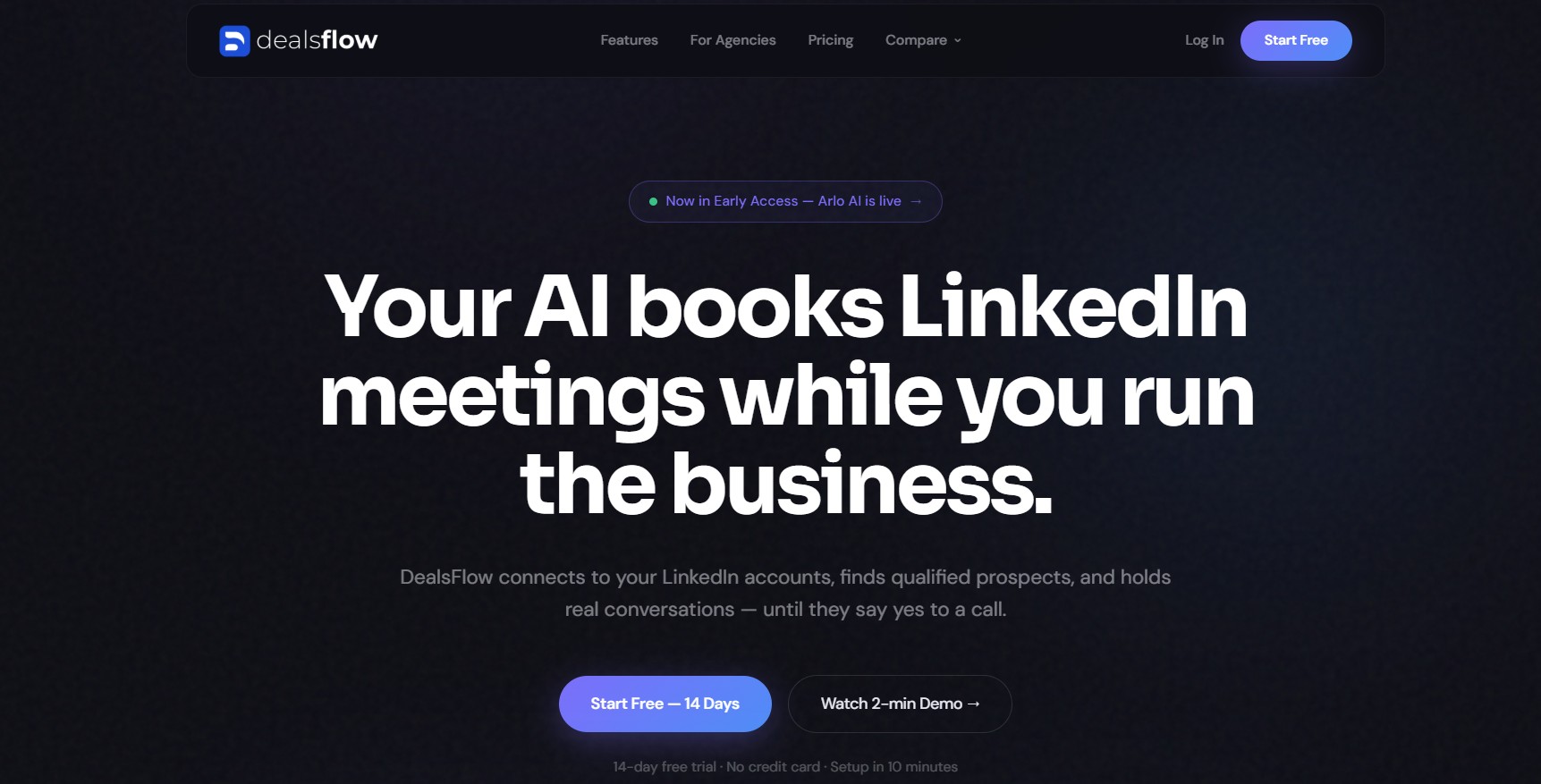
Dealsflow is an AI-native LinkedIn outreach platform built from the ground up with a single focus: getting meetings booked while you focus on running your business. Unlike most tools in this space that retrofitted AI features onto older email-sending infrastructure, Dealsflow was designed AI-first. Its core engine, called Arlo, does not just send templated messages. It reads prospect bios, recent LinkedIn posts, and company news to craft personalised first messages, and crucially, it continues the conversation after a reply arrives, handling objections, answering questions, and booking the meeting directly.
This distinction matters enormously in 2026. The average cold email or LinkedIn message gets ignored because it either never gets personalised beyond a first name, or the tool stops working the moment a prospect replies. Arlo fills that gap. According to data published on Dealsflow’s platform, users are seeing an AI reply rate of 23%, and the platform reports over 12,000 meetings booked across its user base.
Quick Verdict
Dealsflow is the standout choice for any team or agency that wants AI to handle the full outreach cycle on LinkedIn, from prospecting and first contact through to objection handling and meeting booking, without requiring a human to babysit every reply.
Key Features That Beat Instantly
- Arlo AI Engine: Arlo reads every reply, determines the most appropriate response, handles common objections professionally, and books meetings directly on your calendar. This is not a canned-reply system. It is a context-aware conversational AI operating in your voice.
- Multi-Account Dashboard: Dealsflow supports up to 50 LinkedIn accounts managed from a single dashboard. Every account, campaign, and inbox is visible in one place, with no switching between browser tabs or profiles. This is purpose-built for agencies and SDR teams running outreach at scale.
- AI Lead Research: Dealsflow includes AI-powered lead research tools that score prospects on warmth (Hot, Warm, Neutral, Cold) based on engagement signals. Leads can be imported from LinkedIn search URLs, post commenters, or CSV files, giving teams flexibility in how they source contacts.
- Built-in Prospect CRM: Every lead gets an AI warmth score, and the full pipeline from connection request to booked call is tracked natively. There is no need for a separate CRM subscription to manage the outreach pipeline.
- Full-Funnel Analytics: Dealsflow shows the complete conversion funnel from connections sent through acceptance rate, reply rate, and booked calls. Data can be exported freely. Nothing is locked in the platform.
- Account Safety Infrastructure: Dealsflow uses distributed cloud execution and randomised human-like timing to stay within LinkedIn’s safety thresholds. Daily limits are enforced automatically, and the platform provides a zero-ban guarantee for accounts following the recommended setup.
- Agency-First Architecture: Agencies can manage 10 to 50 clients, with unlimited accounts per client, per-client reporting, and flat-rate pricing that does not scale with the number of clients. This solves the exact pricing problem that makes Instantly expensive for agencies.
Where Dealsflow Stands Out
The single most important differentiation Dealsflow offers over Instantly and most other LinkedIn automation tools on this list is the completeness of the AI conversation cycle. Every other tool either sends outbound messages and stops, or offers an AI reply that generates a suggested response for a human to approve. Dealsflow’s Arlo actually continues the conversation end-to-end. A user quoted on Dealsflow’s platform noted: “The AI actually handles objections. I checked the conversations and I couldn’t tell it wasn’t a human.”
For founders doing outreach themselves, this means spending zero time managing LinkedIn inboxes. For agencies, it means running outreach at a scale that would otherwise require a team of SDRs.
Dealsflow vs Instantly — Head-to-Head
| Feature | Dealsflow | Instantly |
|---|---|---|
| Primary channel | ||
| AI conversation handling | Full end-to-end (Arlo) | Reply suggestions only |
| Multi-account management | Up to 50 accounts | Per-workspace billing |
| Lead database | AI-powered ICP research | SuperSearch (450M, extra cost) |
| Built-in CRM | Yes, included | Separate subscription |
| Agency pricing | Flat rate, unlimited clients | Per-workspace charge |
| Multichannel | LinkedIn-native | Email only (standard plans) |
| Free trial | 14 days, no credit card | 14 days |
Pricing Plans
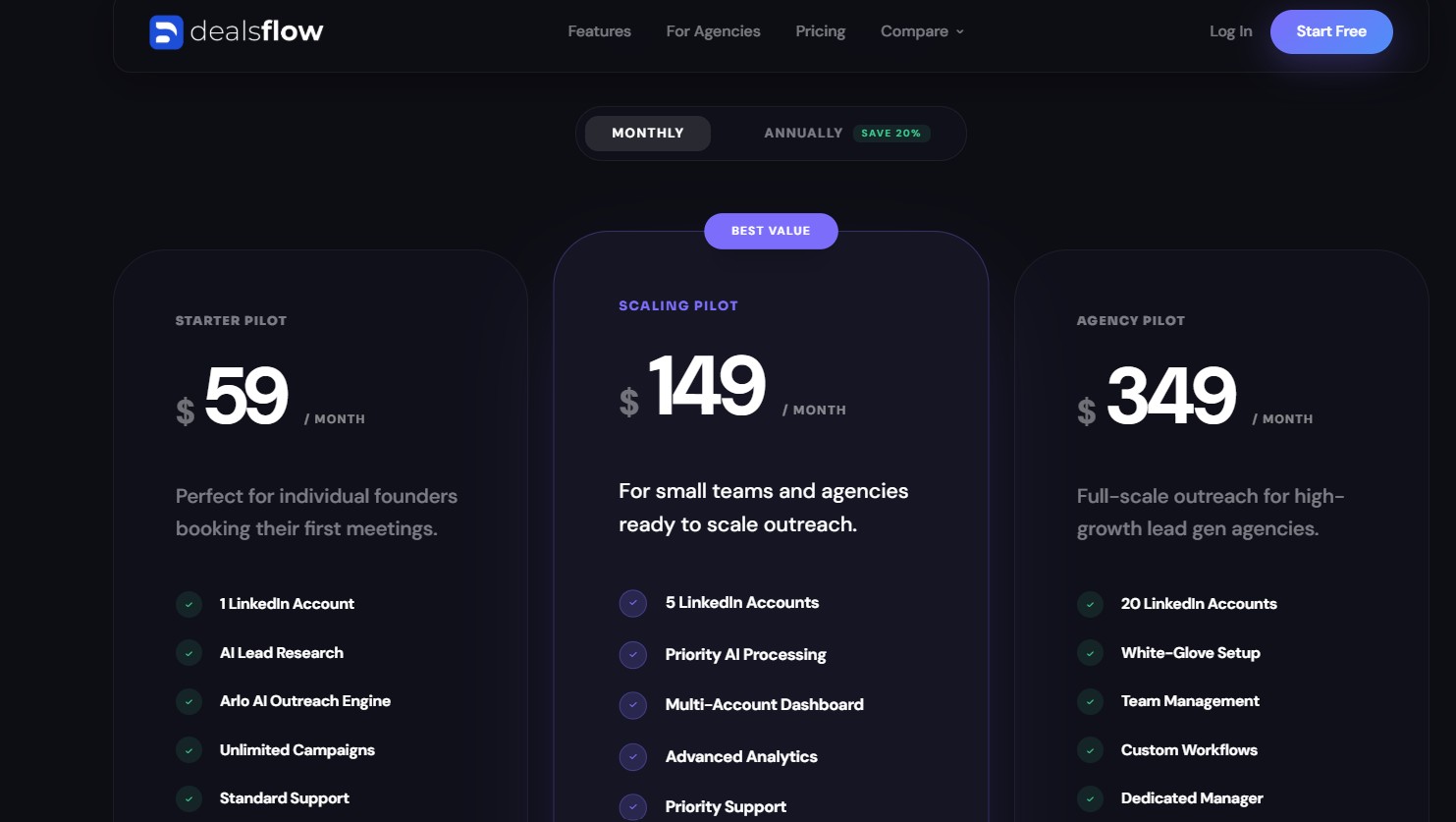
Dealsflow offers three plans, all with a 14-day free trial and no credit card required:
- Starter Pilot — $59/month: Covers 1 LinkedIn account, AI lead research, the Arlo AI Outreach Engine, unlimited campaigns, and standard support. Suited for individual founders and solo operators booking their first meetings.
- Scaling Pilot — $149/month: Covers 5 LinkedIn accounts, priority AI processing, the multi-account dashboard, advanced analytics, and priority support. Designed for small teams and agencies beginning to scale outreach.
- Agency Pilot — $349/month: Covers 20 LinkedIn accounts, white-glove setup, team management, custom workflows, and a dedicated account manager. Built for high-growth lead generation agencies running outreach for multiple clients simultaneously.
Annual billing offers a 20% discount across all plans.
Who Should Choose Dealsflow?
Dealsflow is the right choice for founders who want AI to book meetings without dedicating hours each week to managing LinkedIn conversations, SDR teams looking to multiply output without adding headcount, and agencies managing outreach for multiple clients who need a flat-rate, scalable platform with per-client reporting and white-glove support.
2. Saleshandy — Best for Agencies & Scaling Teams
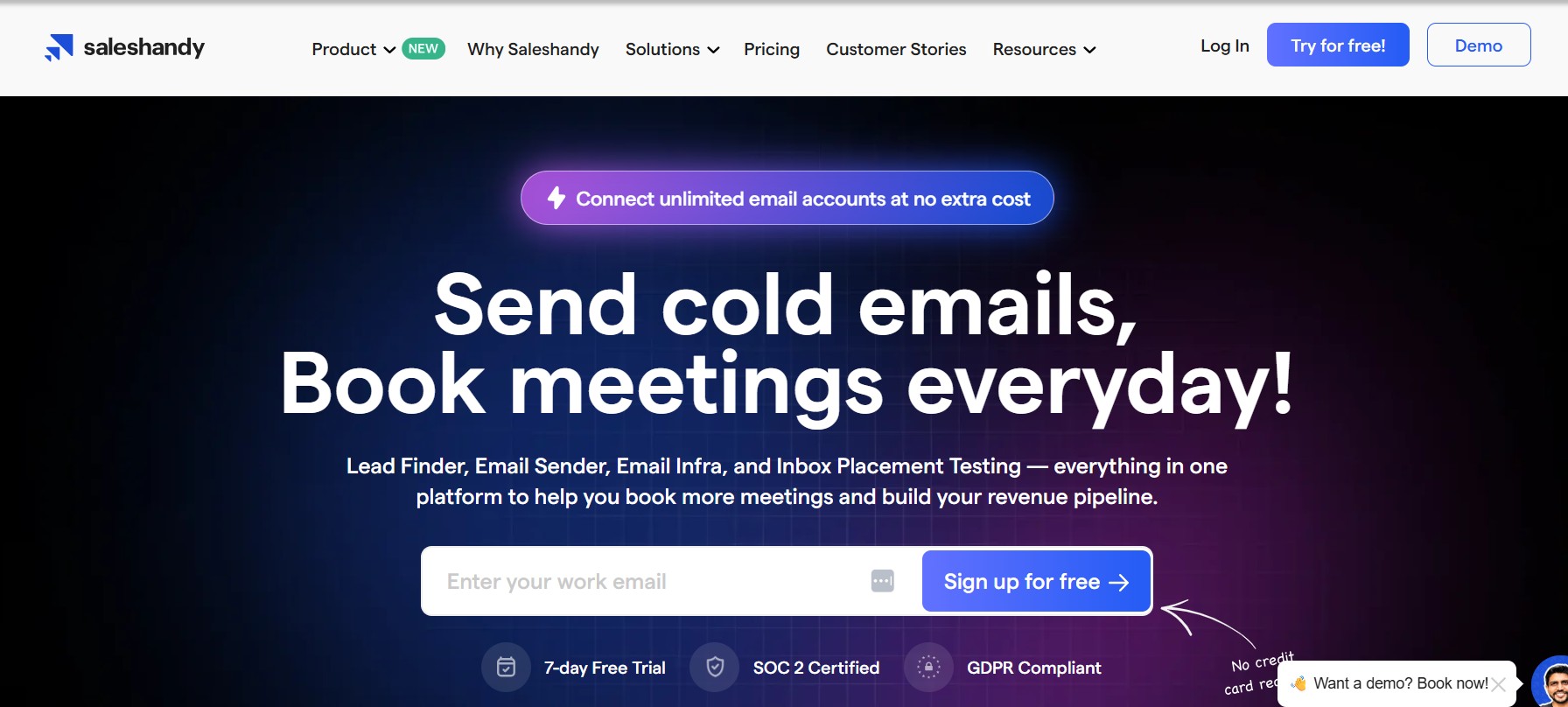
Saleshandy is one of the most comprehensive cold email platforms available in 2026. It has evolved from a basic email tracking tool into a full outbound stack that includes automated sequences, a 700 million-plus contact lead database, a built-in outbound CRM, and a complete deliverability suite. For agencies running cold email for multiple clients, it offers a structural pricing advantage that few competitors can match.
Quick Verdict
Saleshandy offers the strongest value proposition for high-volume cold email among all the email-only tools in this comparison. Its unlimited clients feature on a single plan is a genuine differentiator for agencies, and the AI Sequence Copilot significantly reduces campaign setup time.
Key Features That Beat Instantly
- AI Sequence Copilot: Instead of building multi-step sequences manually, Saleshandy’s AI Sequence Copilot generates personalised outreach sequences based on your ICP and offer. This includes subject lines, email body, and follow-up cadences, significantly reducing setup time for new campaigns.
- 700M+ B2B Lead Database: Saleshandy’s lead finder covers over 700 million professional contacts and 60 million company profiles, compared to Instantly’s 450 million through SuperSearch. Advanced search filters allow targeting by industry, role, company size, funding stage, and other firmographic signals.
- Built-in Outbound CRM: Unlike Instantly, which charges a separate subscription starting at $37.90 per month for CRM functionality, Saleshandy includes CRM features natively. Teams do not need a separate tool to track pipeline from prospect to meeting.
- Full Deliverability Suite: Saleshandy includes Bounce Guard for automated bounce protection, inbox placement testing, email warm-up, and a content guide that scores email copy for spam triggers before sending. These tools work together to protect sender reputation at scale.
- Unlimited Clients with Zero Extra Cost: Saleshandy allows unlimited client accounts on every plan. Saleshandy charges zero extra for adding the tenth or twentieth client. Competing platforms like Smartlead charge $29 per month per additional client. Instantly structures billing by workspace, meaning agencies pay for each client workspace separately.
- White-Labelling on Scale Plan: The Scale plan includes white-labelling, enabling agencies to present Saleshandy as their own proprietary outreach platform to clients.
Where Saleshandy Falls Short
- The Starter plan at $25 per month is limited to 6,000 emails per month and 2,000 active prospects, which is insufficient for any serious outbound operation. Most users need the Pro plan at $69 per month for meaningful volume.
- The Lead Finder database is a separate subscription starting at $24 per month. It does not come bundled with the core outreach plan, so the all-in cost is higher than the headline figure suggests.
- G2 reviews flag occasional deliverability issues with Outlook inboxes, including accounts being flagged or shut down during active campaigns. This is a known limitation worth monitoring.
- The platform’s support operates primarily in the India timezone, which creates response delays for US-based teams dealing with urgent campaign issues.
Saleshandy vs Instantly — Head-to-Head
| Feature | Saleshandy | Instantly |
|---|---|---|
| Lead database | 700M+ contacts | 450M+ (separate cost) |
| Built-in CRM | Included | Separate subscription |
| Unlimited clients | Yes, all plans | No, per-workspace billing |
| White-label | Scale plan | Not available |
| AI sequence builder | Yes (Sequence Copilot) | Yes (Copilot) |
| Multichannel | Email only | Email only (standard plans) |
| Starting price | $25/month | $37.60/month (annual) |
Pricing Plans (Billed Annually)
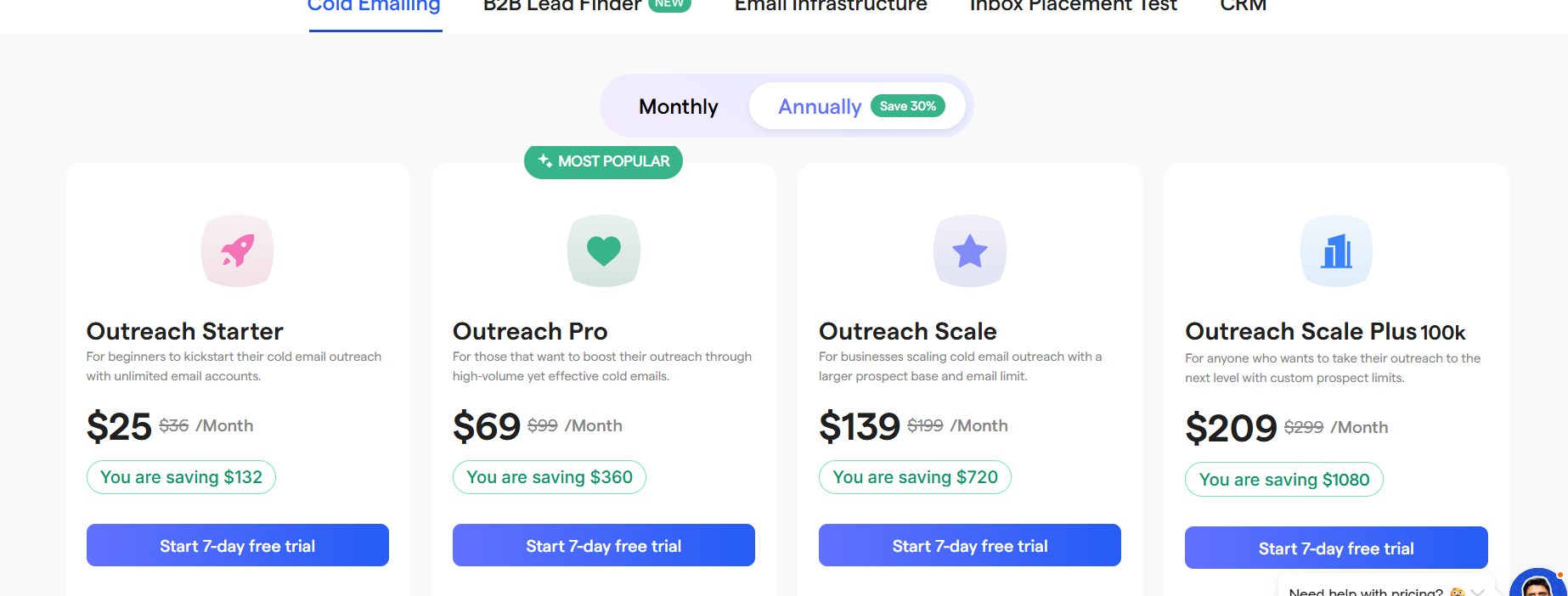
- Outreach Starter — $25/month: Unlimited email accounts, unlimited prospects, 6,000 emails per month, 2,000 active prospects, basic automation.
- Outreach Pro — $69/month: 150,000 emails per month, 30,000 active prospects, CRM integrations, unlimited team members, AI credits included.
- Outreach Scale — $149/month: 300,000 emails per month, 100,000 active prospects, white-labelling, SSO, unlimited teams, dedicated success manager.
- Outreach Scale Plus — Custom pricing: Up to 1.5 million emails per month with custom configurations.
- Lead Finder plans are sold separately, starting at $24 per month for the Lead Starter tier.
Who Should Choose Saleshandy?
Saleshandy is the best choice among email-only platforms for agencies running outreach for multiple clients, sales teams that need a full stack without paying for a separate CRM, and any team that sends high volumes of cold email and wants pricing that does not penalise growth.
3. Smartlead — Best for High-Volume Sending Without Deliverability Sacrifice
Smartlead is a cold email automation platform built specifically for teams that need to send at scale without sacrificing inbox placement. Its core value proposition is simple: unlimited mailboxes, automated warm-up, and deliverability infrastructure that holds up when campaign volume gets serious. According to multiple 2026 comparative tests, Smartlead achieved a 45.9% open rate in a 1,104-lead campaign, outperforming several competitors on deliverability metrics.
Quick Verdict
Smartlead is the best infrastructure-focused cold email tool for agencies and teams running tens of thousands of emails monthly across multiple client accounts. Its API-first architecture and white-label portal make it a strong platform for programmatic outreach workflows.
Key Features That Beat Instantly
- Unlimited Email Accounts: Every Smartlead plan includes unlimited sending accounts. There is no cap on how many mailboxes you connect, which is the single most important feature for agencies managing dozens of inboxes across multiple clients.
- SmartSenders Deliverability Automation: SmartSenders automates SPF, DKIM, and DMARC setup, eliminating the configuration errors that commonly cause deliverability failures. The AI-powered warm-up engine gradually builds trust with email providers, and inbox rotation is handled automatically.
- Master Inbox (Unibox): All replies across every sending account and every client campaign arrive in a single unified inbox. This makes reply management manageable at scale without hunting across dozens of individual email accounts.
- True Multichannel: Smartlead supports email, LinkedIn, and SMS within a single campaign sequence. This is a direct advantage over Instantly’s standard plans, which are email-only.
- White-Label Agency Portal: Smartlead offers a robust white-label client portal, allowing agencies to resell the software under their own branding. This is a significant value-add for agencies building proprietary outreach products.
- API-First Architecture: Smartlead’s API is fast and comprehensive, enabling programmatic campaign creation and deep integration with custom sales stacks. This makes it particularly well-suited for technical teams running automated outbound workflows.
Where Smartlead Falls Short
- Additional client workspaces cost $29 per month each. For agencies managing many clients, this cost stacks up quickly. Saleshandy’s unlimited-clients model is cheaper at scale.
- Many advanced features are gated behind higher-priced plans, so the $39 per month entry tier has meaningful limitations for complex workflows.
- Users on G2 and independent review sites report occasional UI bugs, workflow disconnections, and interface issues, particularly on the more advanced conditional sequence features.
- Smartlead does not include a built-in lead database. You need an external data source such as Apollo, Clay, or ZoomInfo to feed contacts into campaigns.
Smartlead vs Instantly — Head-to-Head
| Feature | Smartlead | Instantly |
|---|---|---|
| Unlimited email accounts | Yes, all plans | Yes |
| Lead database | Not included | SuperSearch (extra cost) |
| Multichannel | Email, LinkedIn, SMS | Email only (standard) |
| White-label portal | Yes | Not available |
| Per-client billing | $29/month per client | Per-workspace billing |
| AI warm-up | Yes (automated) | Yes |
| API access | Comprehensive | Basic |
Pricing Plans
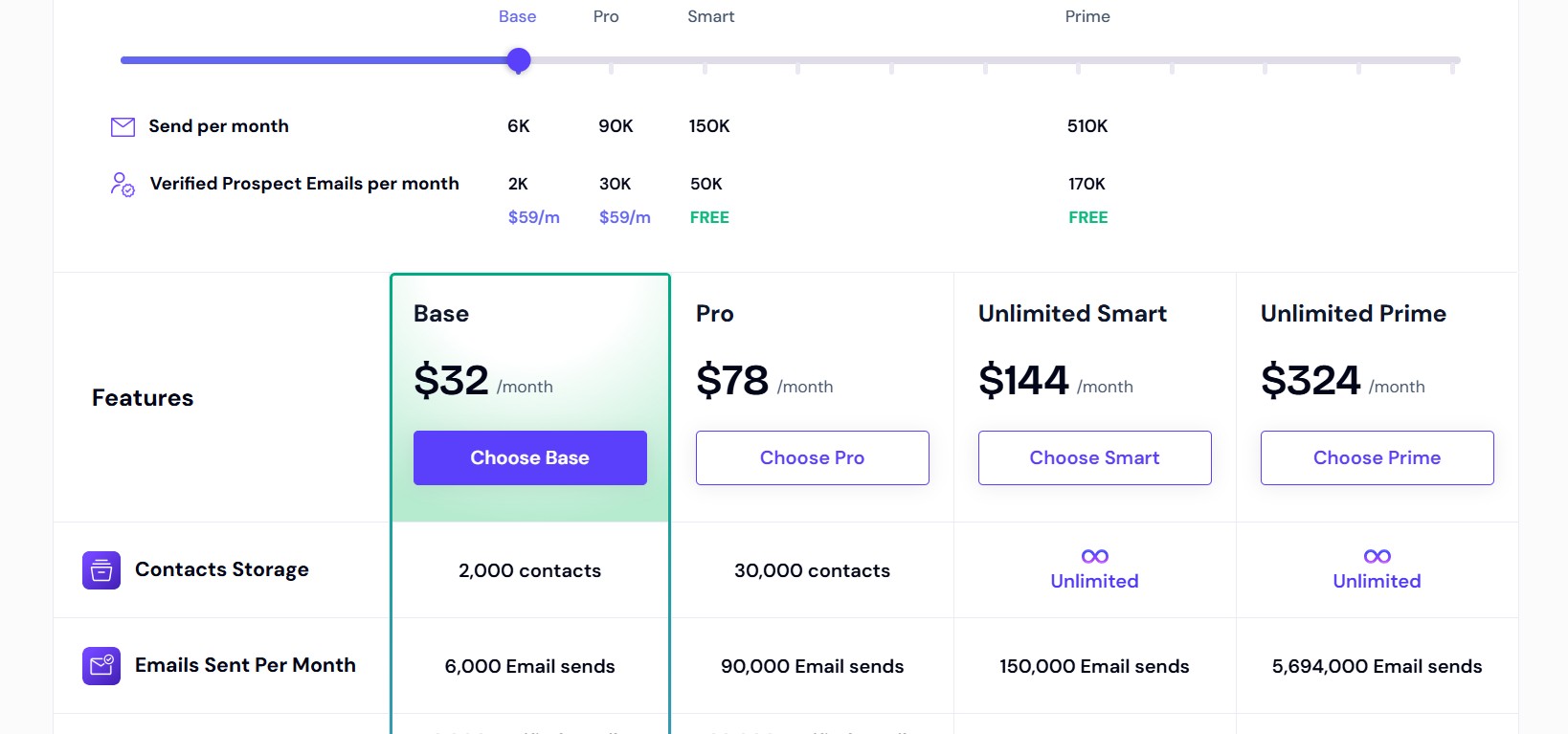
- Basic — $39/month: Unlimited email accounts and warm-ups, 2,000 active leads, 6,000 emails per month, basic campaign management.
- Popular — $79/month: 10,000 active leads, 40,000 emails per month, multichannel capabilities, global block list, subsequences.
- Pro — $94/month: 30,000 active leads, 150,000 emails per month, client workspaces, advanced API access, unlimited team members.
- Additional client workspaces are available at $29 per month each on the Pro plan.
Who Should Choose Smartlead?
Smartlead is ideal for technical teams that already have a lead source and want raw, reliable sending infrastructure at the lowest marginal cost per email. It is particularly strong for agencies that need a white-label portal and programmatic campaign creation via API.
4. Lemlist — Best for Multichannel Personalization & Creative Outreach
Lemlist is a sales engagement platform built around a simple belief: outreach should feel personal, even at scale. It was one of the first tools to introduce custom image and video personalisation in cold email, and in 2026 it has evolved into a full multichannel platform covering email, LinkedIn, WhatsApp, and calls. Its 450 million-plus lead database uses waterfall enrichment, cross-verifying contact data across multiple providers until it finds the most accurate information.
Quick Verdict
Lemlist is the best tool for teams whose competitive edge depends on creative, visually distinctive personalisation at the prospect level. If you are targeting a curated list of high-value accounts with bespoke outreach rather than blasting mass volumes, Lemlist justifies its per-user premium.
Key Features That Beat Instantly
- True Multichannel in One Sequence: A single Lemlist sequence can include email, LinkedIn connection requests, LinkedIn messages, WhatsApp messages, and manual call steps, all coordinated from one campaign builder. Instantly’s standard plans offer email only.
- Custom Image and Video Personalisation: Lemlist allows you to embed personalised images and videos in cold emails, including custom screenshots of prospects’ websites, personalised banner images with their name and photo, and dynamic video thumbnails. These features produce significantly higher engagement on targeted campaigns.
- Dynamic Landing Pages: Lemlist can generate unique personalised landing pages for each prospect, creating a consistent experience from the email through to the click destination. This level of personalisation is not available in any standard cold email tool.
- Waterfall Enrichment for Lead Data: Rather than pulling from a single data source, Lemlist’s enrichment cascades through multiple providers until it finds a verified contact. This produces higher data accuracy than single-source databases.
- Lemwarm Deliverability Engine: Lemlist’s native warm-up system includes sender reputation health checks, IP rotation, and DNS verification. It is designed to protect deliverability while running high-volume personalised campaigns.
- AI-Powered Sequence Generator: Lemlist’s AI builds complete multichannel outreach sequences from an ICP description, including message copy across every channel in the sequence.
Where Lemlist Falls Short
- Per-user pricing is Lemlist’s most significant limitation. At $69 per user per month for the email-only plan, and $99 per user per month for full multichannel, a five-person SDR team pays $345 to $495 per month just for the platform. Saleshandy Pro at $69 per month supports unlimited team members for context.
- Each user seat is capped at a limited number of sending addresses. On the highest self-serve plan at $99 per user per month, users get only five sending addresses per seat. Adding extra inboxes costs $9 each.
- Lemlist does not have the raw sending infrastructure depth of Smartlead. For teams running tens of thousands of emails monthly, Lemlist becomes constrictive on volume.
Lemlist vs Instantly — Head-to-Head
| Feature | Lemlist | Instantly |
|---|---|---|
| Multichannel | Email, LinkedIn, WhatsApp, calls | Email only (standard) |
| Custom image/video personalisation | Yes | No |
| Lead database | 450M+, waterfall enrichment | 450M+ SuperSearch |
| Per-user pricing | Yes (expensive at scale) | No (volume-based) |
| Email warm-up | Lemwarm (included) | Yes (included) |
| AI sequence builder | Yes | Yes |
| Starting price | $69/user/month | $37.60/month |
Pricing Plans
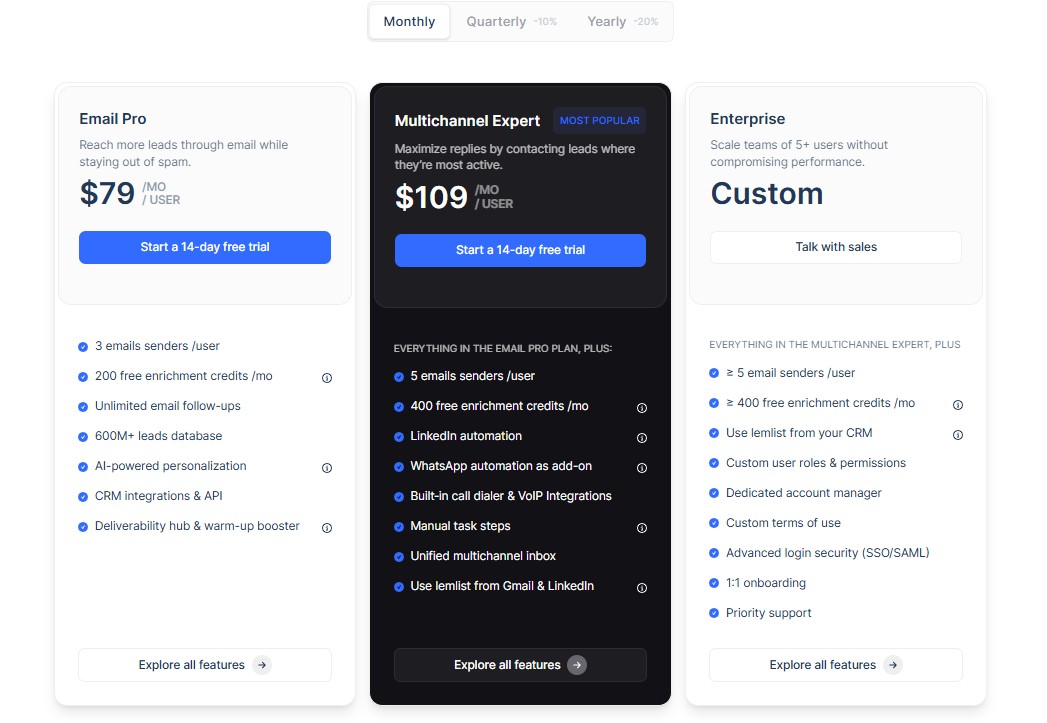
- Email Starter — $39/user/month: Unlimited email follow-ups, AI personalisation tools, access to the 450M+ lead database, Lemwarm deliverability.
- Email Pro — $69/user/month: Everything in Starter plus advanced email automation, inbox rotation, and CRM integrations.
- Multichannel Expert — $99/user/month: Full multichannel outreach across email, LinkedIn, WhatsApp, and calls, centralised inbox, 1,500+ enrichment credits per month.
- Enterprise — Custom pricing: Minimum five seats. Includes SSO/SAML, dedicated account support, and 2,500+ enrichment credits per month.
- All plans include a 14-day free trial.
Who Should Choose Lemlist?
Lemlist is the right tool for sales teams running highly targeted, account-based outreach where personalisation quality is more important than volume. If you are sending 500 highly personalised touches to enterprise accounts rather than blasting 50,000 generic emails, Lemlist is excellent.
5. Woodpecker — Best for Deliverability-First Teams
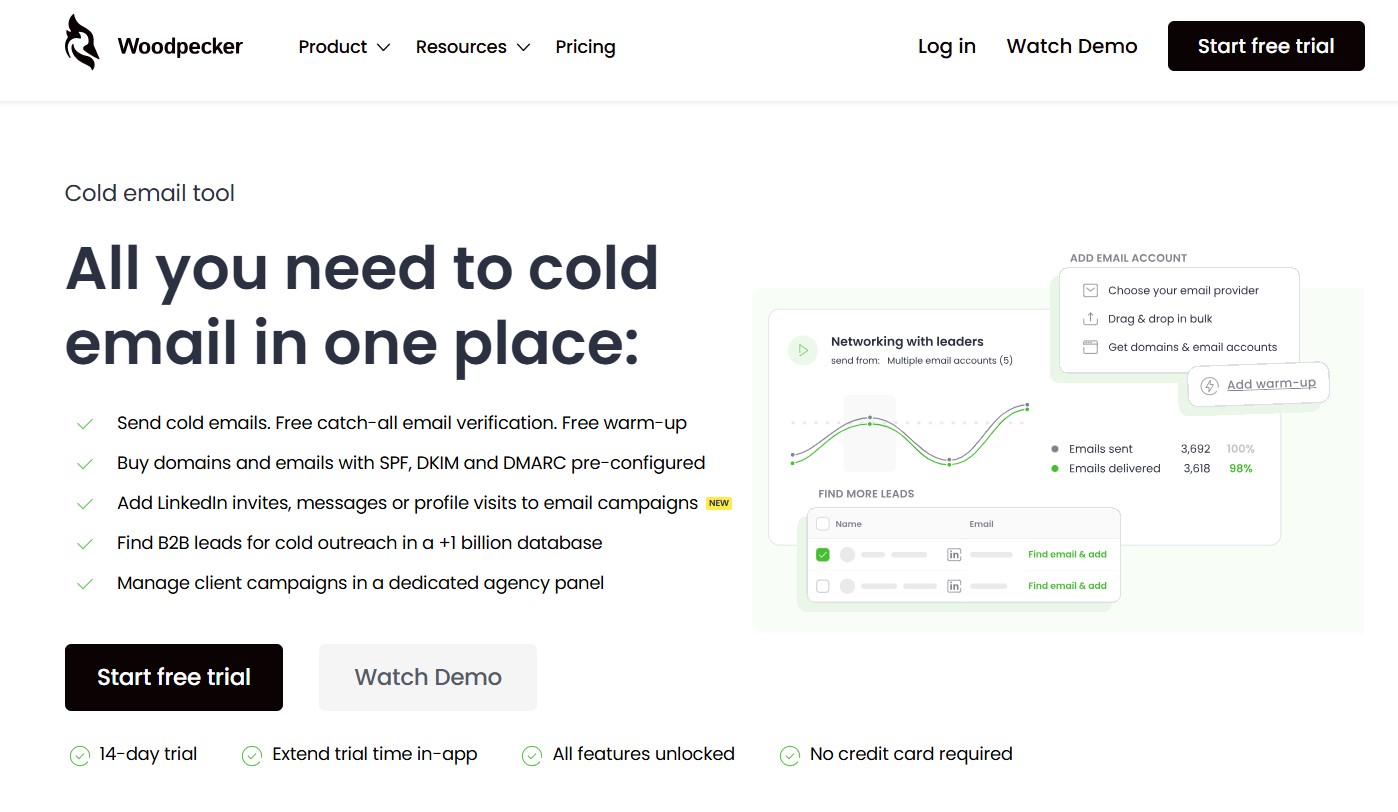
Woodpecker is a cold email platform that has consistently prioritised one thing above everything else: making sure your emails reach the inbox. It is not the flashiest tool on this list, and it does not have the largest feature set. What it does have is a clean, focused product that does the fundamentals exceptionally well, with built-in email verification, inbox warm-up, adaptive sending technology, and a simple campaign builder that most users can navigate within their first session.
Quick Verdict
Woodpecker is the best choice for teams that have been burned by deliverability issues before and want a tool that treats inbox placement as a core design principle rather than a marketing claim. It is beginner-friendly, reliable, and transparent in its pricing.
Key Features That Beat Instantly
- Adaptive Sending Technology: Woodpecker’s adaptive sending automatically adjusts campaign volume and timing based on engagement signals from each inbox. If a particular domain starts showing signs of spam scoring, the system responds before a deliverability problem escalates.
- Built-in Catch-All Email Verification: Woodpecker includes free catch-all email verification on all plans. This identifies and removes risky addresses before sending, protecting sender reputation and reducing bounce rates. Instantly requires separate credits for email verification.
- Recovery Mode: If a campaign’s deliverability drops below a threshold, Woodpecker’s recovery mode automatically pauses affected inboxes and prompts corrective action before damage compounds. This automated safety layer is not present in Instantly’s standard plans.
- Simple, Transparent Pricing: Woodpecker’s pricing is based on the number of prospects you are actively emailing, with no credit system for standard features. What you see on the pricing page is close to what you pay.
- Agency Panel: Woodpecker includes a dedicated agency panel for managing multiple client campaigns from a single interface. Client reporting is separated clearly, making it easier to present results without exporting data manually.
- LinkedIn Actions in Email Sequences: Woodpecker allows you to add LinkedIn actions, such as profile visits and connection requests, as steps within an email sequence. This creates a simple multichannel touch without requiring a separate tool.
Where Woodpecker Falls Short
- Woodpecker does not have a built-in lead database. You need to bring your own lists or use a separate prospecting tool.
- The feature set is intentionally limited. Teams needing advanced conditional sequences, deep CRM workflows, or sophisticated multichannel automation will find Woodpecker restrictive.
- Users on G2 note that the interface, while clean, can feel inflexible when building complex workflows with many conditional branches.
Woodpecker vs Instantly — Head-to-Head
| Feature | Woodpecker | Instantly |
|---|---|---|
| Adaptive sending | Yes | No |
| Catch-all verification | Free, built-in | Requires credits |
| Recovery mode | Yes | No |
| Lead database | Not included | SuperSearch (extra cost) |
| Agency panel | Yes | Per-workspace billing |
| LinkedIn actions | Yes (in sequences) | No (standard plans) |
| Starting price | $24/month | $37.60/month |
Pricing Plans
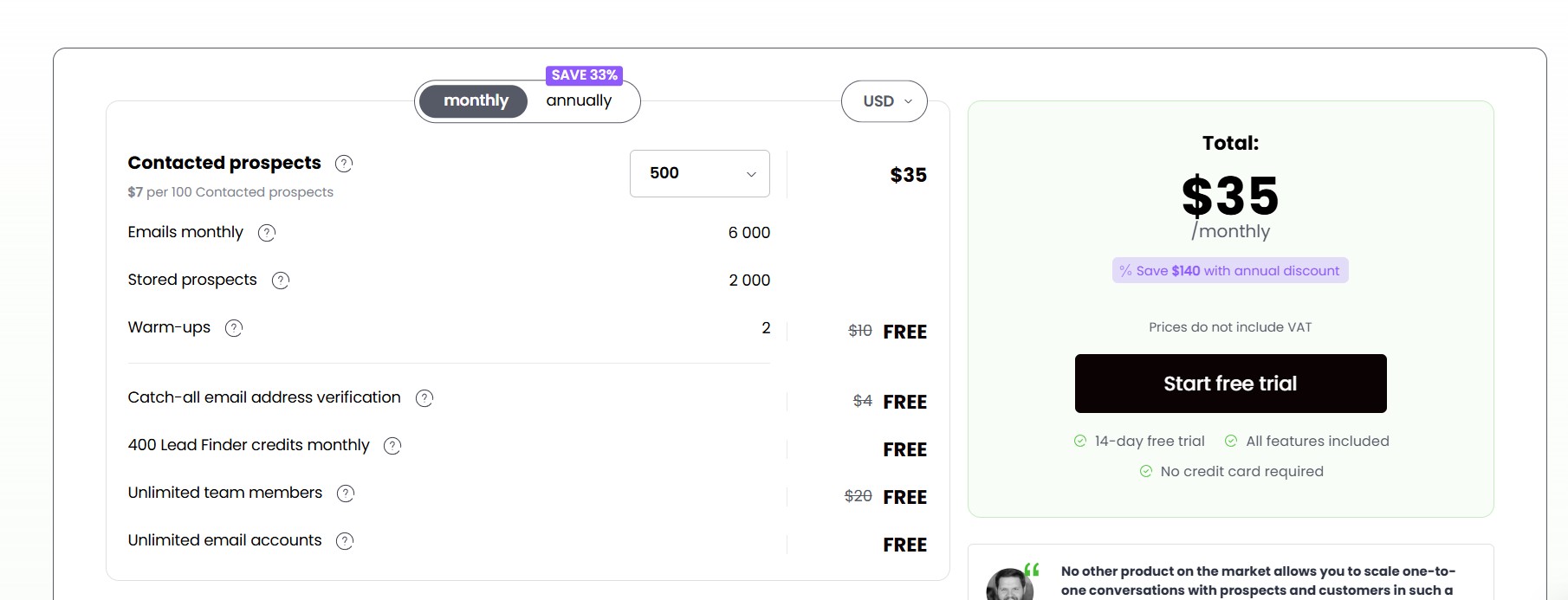
- Cold Email — $24/month: Up to 500 prospects contacted per month, unlimited email accounts, warm-up, verification, adaptive sending, recovery mode.
- Agency — $56/month: Multiple client workspaces, agency panel, expanded prospect limits, priority support.
- Custom: Available for high-volume senders with specific infrastructure requirements.
Who Should Choose Woodpecker?
Woodpecker is the right choice for small to mid-sized teams who have experienced deliverability problems before and want a clean, focused tool that prioritises inbox placement. It is also a strong option for agencies that need simple client management without the complexity overhead of larger platforms.
6. Apollo.io — Best for Prospecting + Outreach in One Platform
Apollo.io has become one of the dominant platforms in sales intelligence and outreach, combining a massive B2B contact database with multi-channel sequence execution, a built-in dialer, and intent signal tracking, all in a single platform. For teams that currently pay separately for a data provider and an email tool, Apollo offers a compelling consolidation play.
Quick Verdict
Apollo is the best choice for teams that do not have an existing lead database and want prospecting, email, LinkedIn, and calling in one tool without paying for multiple separate subscriptions.
Key Features That Beat Instantly
- 275M+ Contact Database with Deep Filtering: Apollo’s contact database includes over 275 million verified B2B contacts with more than 200 data attributes. Filters include job title, department, seniority, company size, industry, revenue, funding stage, technology used, and more. This level of granularity enables highly targeted list-building that Instantly’s SuperSearch does not match.
- Built-in Dialer: Apollo includes a native phone dialer for making cold calls directly within the platform, with call recording and automatic CRM logging. Instantly does not offer this on standard plans.
- Intent Signals and Buying Signals: Apollo’s Buying Intent feature monitors company activity online and flags when a target account appears to be in a buying cycle. This allows teams to prioritise outreach timing based on signals rather than arbitrary cadences.
- Job Change Alerts: Apollo tracks job changes for contacts in your database. When a key decision-maker moves to a new company, Apollo notifies you so you can reach out at the optimal moment of influence.
- Genuinely Usable Free Plan: Apollo offers a free tier with meaningful access to its database and outreach tools. This is one of the few platforms where the free plan is actually worth using for early-stage prospecting.
- Multichannel Sequences: Apollo supports email, LinkedIn, and phone within automated sequences, enabling true multichannel outreach without a separate tool for each channel.
Where Apollo Falls Short
- Apollo’s outreach tools are secondary to its data infrastructure. Users running complex, personalisation-heavy email campaigns often find the sequence builder less flexible than dedicated email platforms like Lemlist or Smartlead.
- The pricing model is credit-based. Credits are consumed for contact reveals, email verifications, and enrichment actions. Heavy prospecting quickly burns through monthly allocations, and credit overages are expensive.
- Apollo’s deliverability infrastructure is not as sophisticated as purpose-built cold email tools. Teams sending very high volumes may see lower inbox placement rates than they would achieve on Smartlead or Saleshandy.
- The interface is feature-dense and can be overwhelming for new users. The learning curve is steeper than simpler tools like Woodpecker or Mailshake.
Apollo vs Instantly — Head-to-Head
| Feature | Apollo.io | Instantly |
|---|---|---|
| Contact database | 275M+, 200+ filters | 450M+ (extra cost) |
| Built-in dialer | Yes | Enterprise only |
| Intent signals | Yes | No |
| Multichannel | Email, LinkedIn, calls | Email only (standard) |
| Free plan | Yes (usable) | 14-day trial only |
| Credit-based pricing | Yes | Yes |
| Starting price (paid) | $49/month | $37.60/month |
Pricing Plans
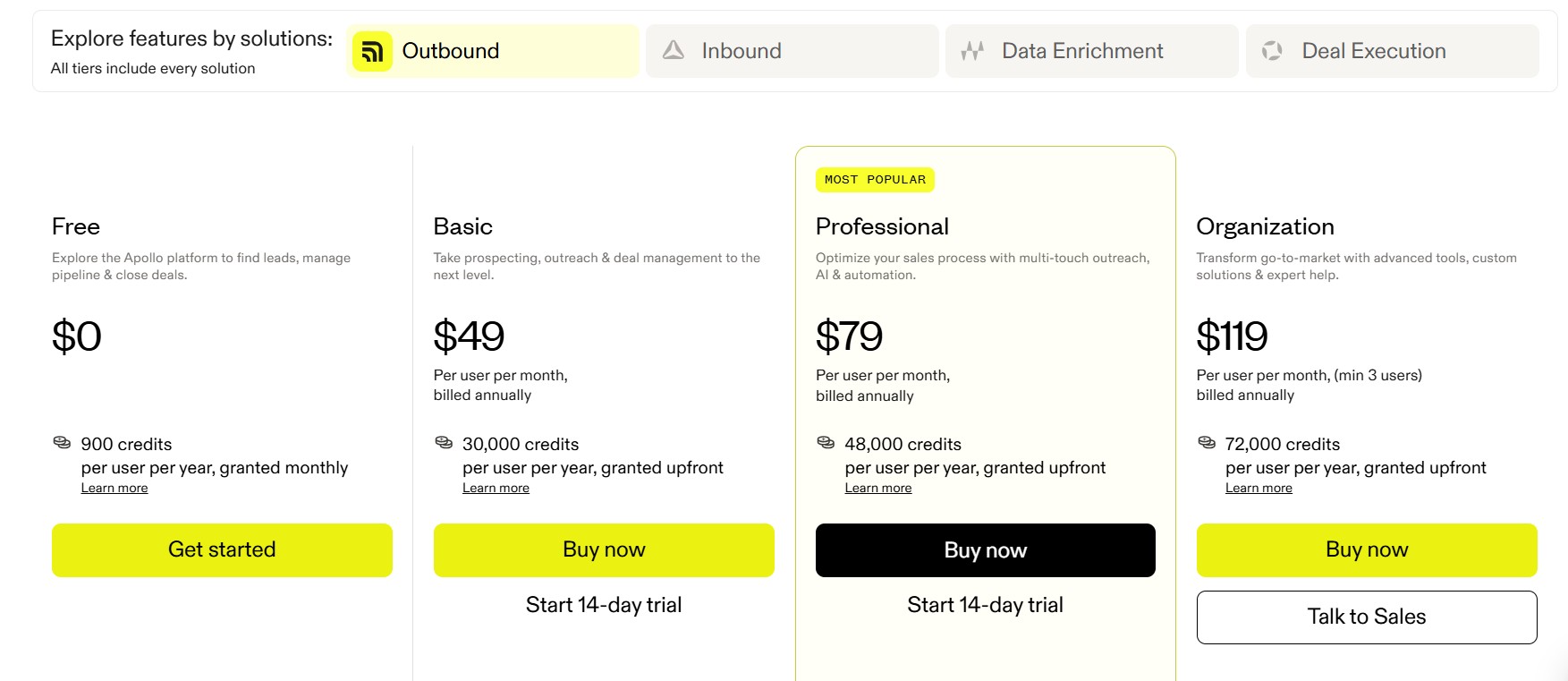
- Free: Limited credits, basic prospecting and sequencing, functional for early testing.
- Basic — $49/month per user: 10,000 email credits per year, 5 mobile numbers per month, basic sequences and dialer.
- Professional — $99/month per user: Unlimited email credits (with fair-use limits), 20 mobile numbers per month, advanced filtering, AI-assisted writing, intent data.
- Organisation — $149/month per user (minimum three users): Full platform access, advanced reporting, SSO, custom permissions.
- Annual billing provides a discount across all paid tiers.
Who Should Choose Apollo?
Apollo is the right choice for teams that do not have an existing contact database and want prospecting, email, and calling managed in one platform. It is particularly strong for sales teams targeting a specific set of accounts with intent-driven timing rather than pure volume.
7. Reply.io — Best for AI-Powered Multichannel SDR Workflows
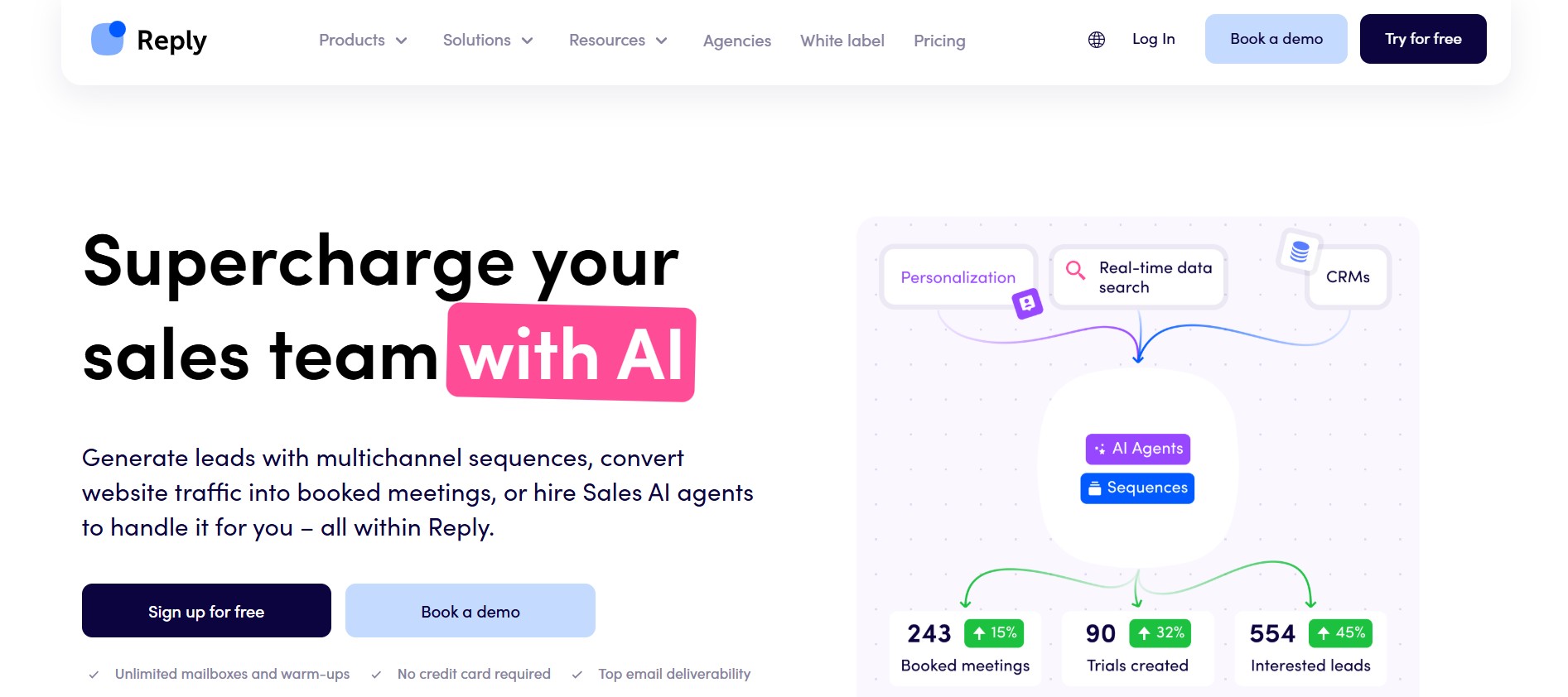
Reply.io is a sales automation platform that has invested heavily in AI capabilities, positioning itself as a tool where AI can handle significant portions of the SDR workflow autonomously. Its Jason AI feature is designed not just to help write emails, but to manage conversational replies across channels, handle objections, and move prospects through the pipeline toward a meeting.
Quick Verdict
Reply.io is the best choice for sales teams that want AI to handle a meaningful portion of the SDR workload across multiple channels simultaneously, with deep CRM integration ensuring no lead falls through the pipeline.
Key Features That Beat Instantly
- Jason AI for Autonomous Outreach: Jason AI can conduct the full prospecting-to-meeting workflow. It researches prospects, writes personalised first messages, handles replies, overcomes objections, and follows up until the prospect converts or opts out. This is not a writing assistant. It is a functioning AI SDR.
- True Multichannel Sequences: Reply.io supports email, LinkedIn direct messages and connection requests, SMS, WhatsApp, and phone calls within a single automated sequence. Teams can build complex multi-touch sequences that adapt based on prospect behaviour across channels.
- Deep CRM Integrations: Reply.io integrates natively and deeply with Salesforce, HubSpot, and Pipedrive. Bidirectional sync means that data from outreach campaigns flows into the CRM in real time, and CRM updates trigger corresponding sequence actions in Reply.io.
- Email Deliverability Suite: Reply.io includes a built-in warm-up system, spam monitoring, DNS optimisation, and Gmail API-based sending. These tools work together to maintain inbox placement across high-volume campaigns.
- AI Email Writing and Personalisation: Beyond Jason AI’s autonomous functions, Reply.io includes AI tools for generating personalised first lines, subject line suggestions, and full email drafts based on prospect data.
- Centralised Inbox for All Channels: All replies from email, LinkedIn, SMS, and other channels arrive in one unified inbox, so no conversation falls through the gap between tools.
Where Reply.io Falls Short
- Reply.io is among the more expensive options on this list. The Starter plan begins at $59 per month and is limited to 1,000 contacts per month. The Professional plan at $90 per month raises that to 3,000 contacts, which is still modest for high-volume teams.
- Plans enforce a minimum three-month commitment at some tiers, reducing flexibility for teams wanting to test before committing long term.
- The platform is complex. New users encounter a steeper learning curve than simpler tools, and some advanced features require understanding of how the various AI components interact with sequence logic.
- Some G2 reviewers note that the AI-generated content occasionally requires human editing before it sounds natural enough to send, particularly in highly technical or niche B2B verticals.
Reply.io vs Instantly — Head-to-Head
| Feature | Reply.io | Instantly |
|---|---|---|
| AI SDR capability | Jason AI (full conversations) | Reply suggestions only |
| Multichannel | Email, LinkedIn, SMS, calls, WhatsApp | Email only (standard) |
| CRM integrations | Salesforce, HubSpot, Pipedrive (native) | Basic integrations |
| Email warm-up | Yes | Yes |
| Contact limits | 1,000–3,000/month (standard plans) | 1,000–25,000/month |
| Complexity | High | Medium |
| Starting price | $59/month | $37.60/month |
Pricing Plans
- Starter — $59/month: Up to 1,000 contacts per month, multichannel sequences, AI email writing, basic reporting.
- Professional — $90/month: Up to 3,000 contacts per month, Jason AI, advanced analytics, full CRM sync, dialer.
- Ultimate — Custom pricing: Unlimited contacts, AI SDR, dedicated support, advanced team management.
- Annual billing offers a discount, and a 14-day free trial is available.
Who Should Choose Reply.io?
Reply.io is the right choice for sales teams that want AI to autonomously handle the full SDR workflow across multiple channels, and that have existing CRM infrastructure in Salesforce, HubSpot, or Pipedrive where seamless data synchronisation is a requirement.
8. Snov.io — Best Budget-Friendly All-in-One Stack
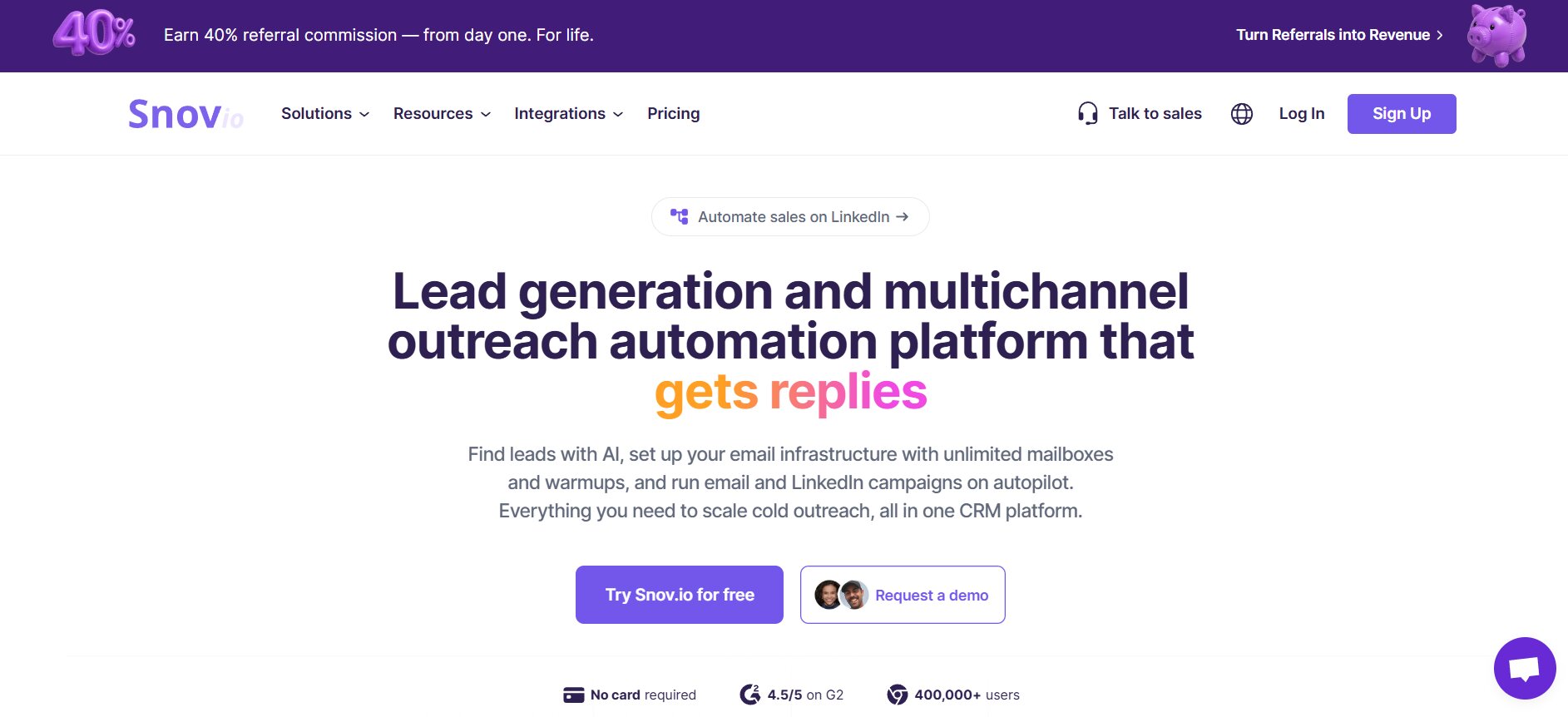
Snov.io started as an email finder and verifier, and that foundational focus on data quality and deliverability still shapes everything the platform does. Over time it has expanded into a full outreach suite that includes email finding, multi-step verification, cold email sequences, LinkedIn automation, and a built-in CRM, all available without the credit complexity or multi-product billing that defines competitors like Instantly.
Quick Verdict
Snov.io is the best budget option for solo operators, small teams, or businesses at early stages of building an outreach programme who want a functional all-in-one stack without paying multiple separate subscriptions.
Key Features That Beat Instantly
- 7-Step Email Verification Process: Snov.io’s verification engine checks syntax, MX records, SMTP records, and more across seven verification steps. This deep verification process significantly reduces bounce rates compared to platforms where verification is a bolt-on credit purchase.
- Integrated Lead Finder and Verifier: Unlike Instantly, where lead finding (SuperSearch) and email verification are separate credit-consuming products, Snov.io combines finding, verifying, and outreach within a single subscription. The cost structure is simpler and more predictable.
- Free Built-in CRM: Snov.io includes a CRM with all plans at no extra cost. Users can create up to 20 pipelines with 100 stages each, manage deals, schedule tasks, and sync with Google Calendar. While it is basic compared to dedicated CRM tools, it removes the need for a separate CRM subscription for early-stage outreach operations.
- Condition-Based Sequences: Snov.io’s campaign builder supports condition-based sequences, meaning follow-up logic can branch based on whether a prospect opened, clicked, or replied. This behavioural automation helps avoid sending irrelevant messages to engaged prospects.
- Unlimited Email Accounts and Campaigns: All Snov.io paid plans support unlimited sending accounts and unlimited campaigns. Daily sending limits are governed by the accounts connected, not an artificial platform cap.
- Email Warm-up Included: All paid plans include email warm-up. The Starter plan warms up to three mailboxes, and the Pro plan unlocks unlimited warm-up across all connected inboxes.
Where Snov.io Falls Short
- Snov.io uses a hybrid pricing model where email search, prospect discovery, and verification all draw from the same monthly credit pool. Running heavy verification burns credits that would otherwise go toward finding new leads. Managing two quotas simultaneously is awkward for fast-scaling teams.
- LinkedIn automation is an add-on, not a native feature. Teams wanting serious LinkedIn outreach need to budget for the extra cost.
- The Starter plan’s limit of 1,000 credits per month is restrictive for anyone running meaningful prospecting volume. The Pro plan at $74.25 per month is where the platform becomes genuinely usable for most teams.
- Some G2 and Capterra users report UI clutter when managing many campaigns simultaneously, and there have been reliability reports about campaigns resending without user action.
Snov.io vs Instantly — Head-to-Head
| Feature | Snov.io | Instantly |
|---|---|---|
| Email finder + verifier | Built-in, same subscription | Separate product (credits) |
| Built-in CRM | Free, included | Separate subscription |
| Condition-based sequences | Yes | Yes |
| LinkedIn automation | Add-on | Not available (standard) |
| Credit sharing between tools | Yes (email + verifier share pool) | Separate pools |
| Email warm-up | Included (limits by plan) | Included |
| Starting price | $39/month | $37.60/month |
Pricing Plans
- Trial — Free: 50 credits per month, 100 email recipients per month, basic features for testing.
- Starter — $39/month: 1,000 credits per month, 5,000 email recipients, basic sequences, 3 inbox warm-ups.
- Pro — $74.25/month: 5,000 credits per month, 10,000 email recipients, unlimited warm-up, advanced reporting, API access.
- Managed Service — Custom pricing: For teams needing hands-on support and higher volume.
- Annual billing offers a discount across all paid tiers.
Who Should Choose Snov.io?
Snov.io is the right choice for solo operators and small teams at early stages of outreach who want email finding, verification, sending, and a basic CRM under one subscription without credit complexity or multi-product billing.
9. Mailshake — Best for Sales Teams Prioritising Simplicity
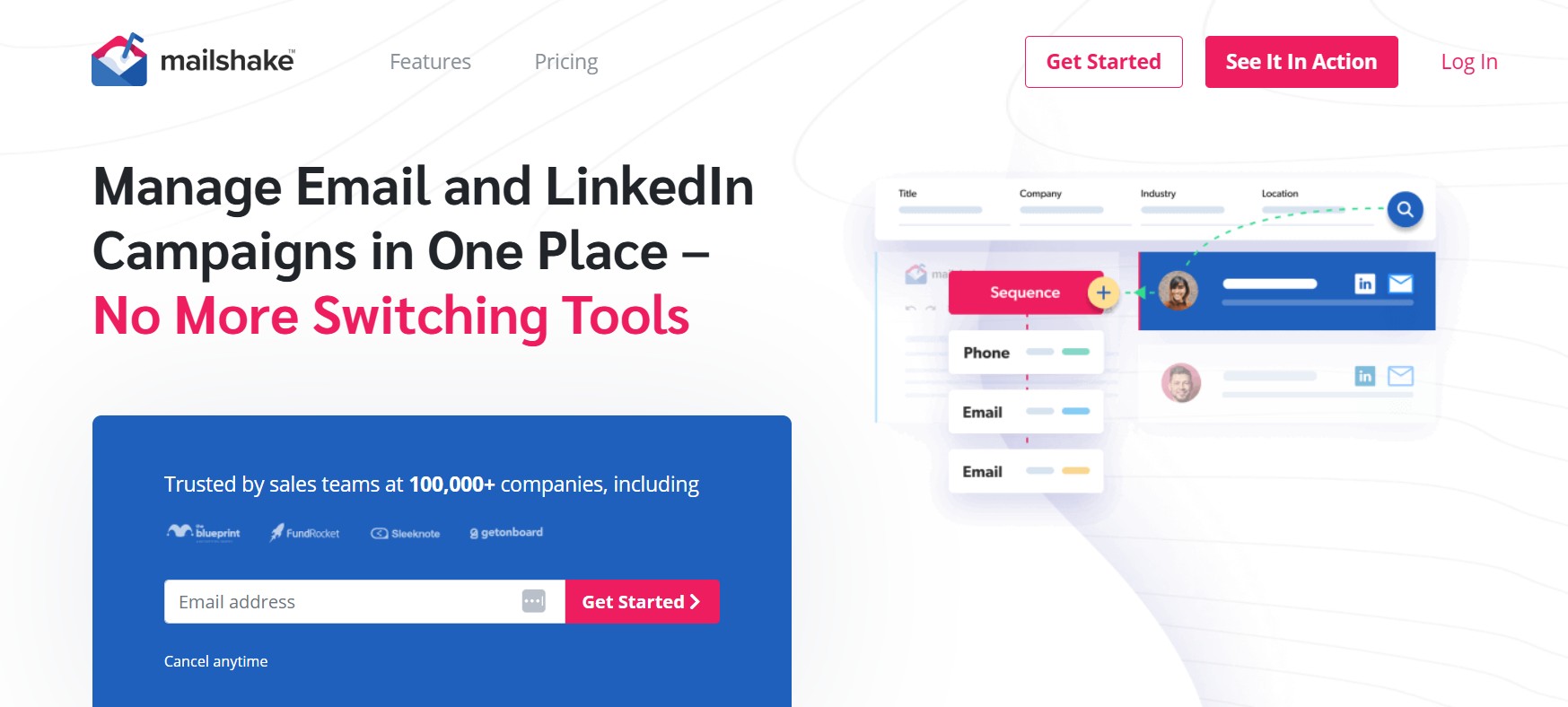
Mailshake was founded in 2015 and has grown to tens of thousands of users worldwide without traditional venture funding. It is a bootstrapped product built around a single principle: outreach tools should be simple enough that sales reps actually use them. The platform supports cold email, LinkedIn outreach, and cold calling within one dashboard, but its defining characteristic is that all of this is accessible without a steep learning curve or complex onboarding.
Quick Verdict
Mailshake is the right tool for small to mid-sized sales teams, solo consultants, and agencies that need reliable multichannel outreach with email, phone, and LinkedIn, and that want to be running campaigns within a day of signing up rather than configuring complex settings for weeks.
Key Features That Beat Instantly
- Truly Fast Onboarding: Mailshake is consistently rated for speed of implementation. According to user reviews on G2, most teams launch their first campaign within one day of signing up. There is no complex infrastructure setup, DNS configuration, or warm-up sequencing required before getting started.
- Built-in Phone Dialer: Mailshake includes a native phone dialer with call recording and automatic logging. Sales reps can move between email follow-ups and cold calls within the same interface without switching tools or re-entering contact information.
- Lead Catcher: Mailshake’s Lead Catcher feature automatically surfaces prospects who open, click, or reply to campaigns, prioritising them for immediate human follow-up. Rather than manually reviewing campaign analytics, reps see a live feed of warm prospects.
- Email Warm-up and List Cleaning: Mailshake includes email warm-up and list cleaning tools to protect sender reputation and reduce bounce rates. These are standard features but implemented cleanly without requiring separate credits or external tools.
- A/B Testing: All Mailshake plans include A/B testing for subject lines and email body copy. In Instantly, A/B testing is locked behind the Hypergrowth plan at $97 per month. Mailshake includes it at the $45 per month tier.
- Cold Email Academy: Mailshake provides structured training through their Cold Email Academy, which is particularly useful for sales teams new to outbound. This is a meaningful operational support feature that reduces ramp time for new reps.
Where Mailshake Falls Short
- Mailshake does not offer a free trial. Teams must commit to a paid plan before being able to test the product with real campaigns.
- The contact limits at lower tiers (5,000 recipients per month on the starter tier) constrain high-volume outreach and are tighter than comparable tiers from Saleshandy or Smartlead.
- Mailshake does not have a built-in lead database. Like Woodpecker, it expects users to bring their own contact lists or integrate with a separate data tool.
- Some users report that advanced features like conditional sequences and deep CRM workflow automation are less flexible than what competing platforms offer at similar price points.
Mailshake vs Instantly — Head-to-Head
| Feature | Mailshake | Instantly |
|---|---|---|
| Built-in dialer | Yes | Enterprise only |
| A/B testing | All plans | Hypergrowth ($97/mo) and above |
| Lead Catcher | Yes | No |
| Free trial | No | Yes (14 days) |
| Lead database | Not included | SuperSearch (extra cost) |
| Multichannel | Email, LinkedIn, calls | Email only (standard) |
| Starting price | $25/month | $37.60/month |
Pricing Plans
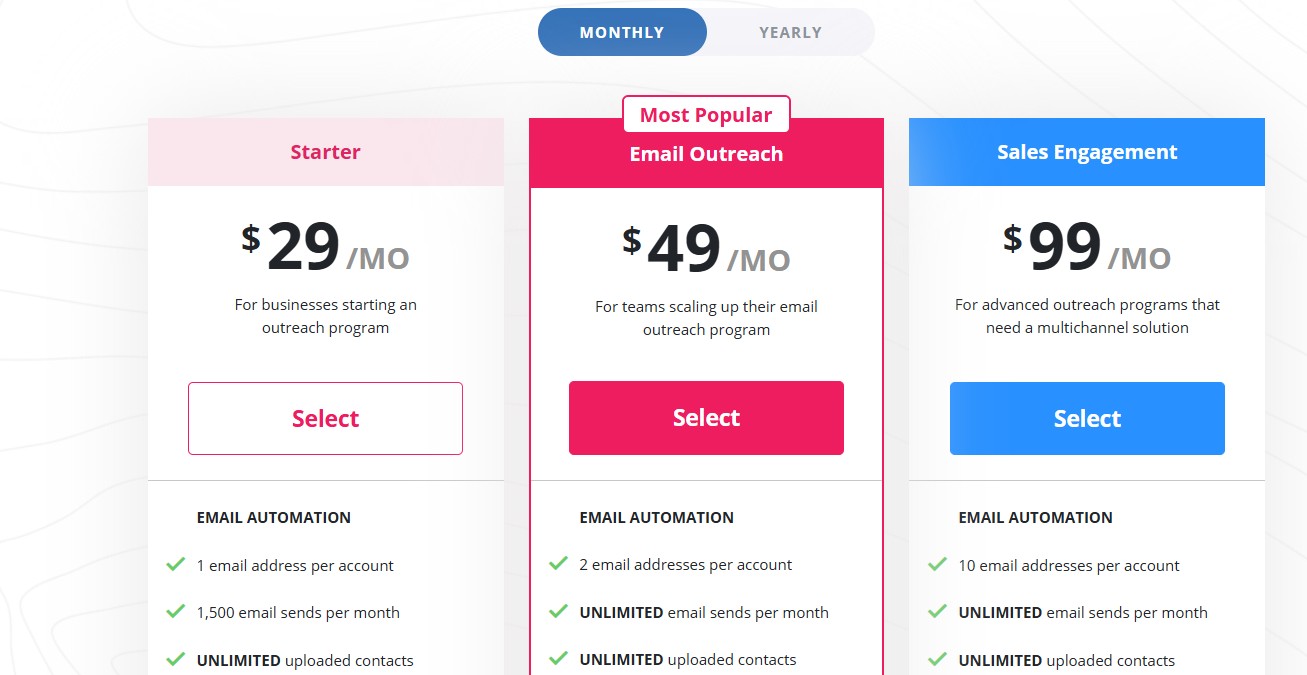
- Starter — $25/month per user: Basic email outreach, 500 contacts per month, email tracking, templates.
- Email Outreach — $45/month for two users: A/B testing, 5,000 recipients per month, CRM integrations, email warm-up.
- Sales Engagement — $85/month for five users: Full multichannel including LinkedIn and phone dialer, Lead Catcher, advanced analytics, team management.
- Annual billing reduces costs across all plans.
Who Should Choose Mailshake?
Mailshake is the right choice for small to mid-sized B2B companies, agencies, and solo consultants that need a clean, fast, multichannel outreach tool and want to be operational immediately without dedicated operations staff to configure complex infrastructure.
10. QuickMail — Best for Deliverability Infrastructure Control
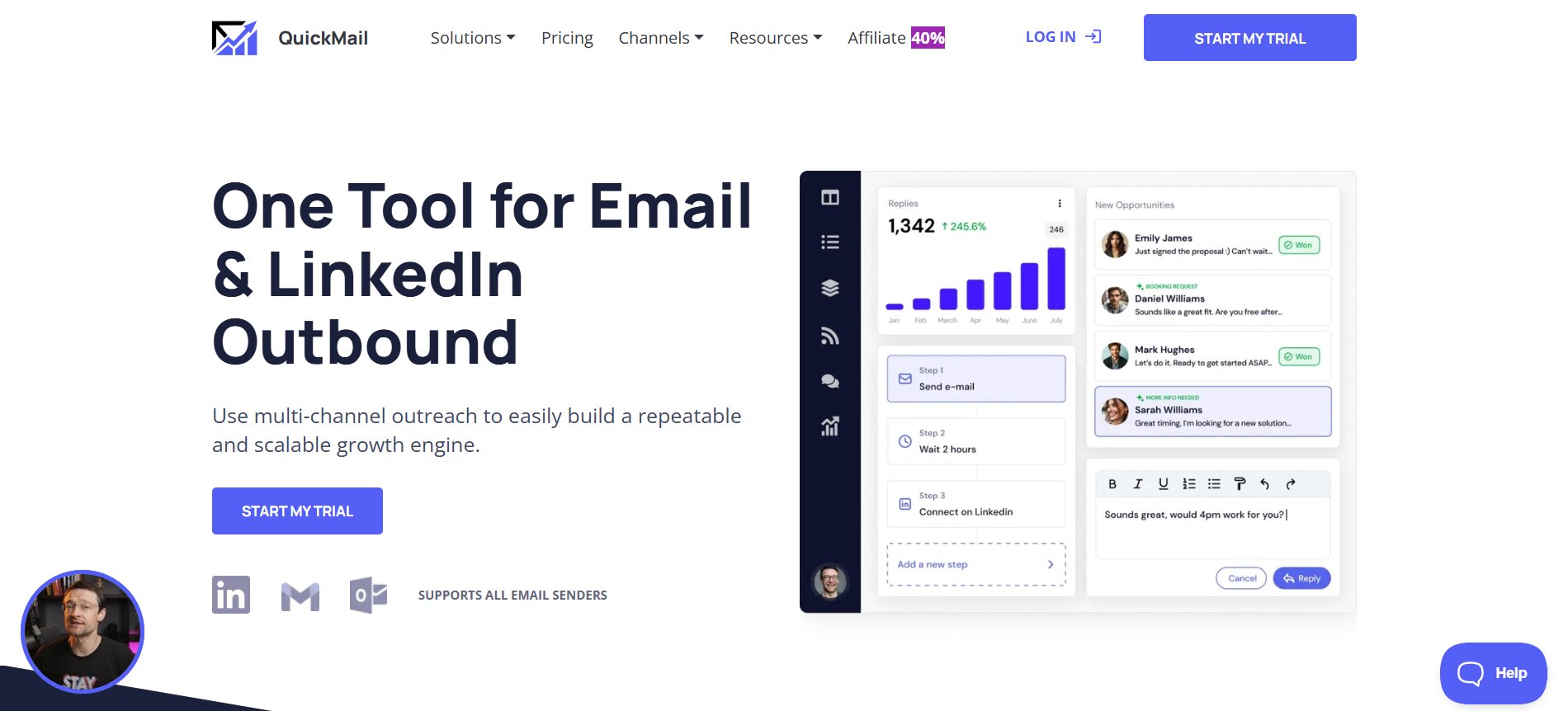
QuickMail has been operating since 2014, making it one of the more established platforms in cold email. Unlike tools that prioritise features or database size, QuickMail’s defining focus is giving users granular control over deliverability infrastructure: inbox rotation, sending schedules, bounce monitoring, and the Deliverability AI system that automatically optimises campaigns based on performance signals.
Quick Verdict
QuickMail is the best choice for experienced outbound practitioners who want maximum visibility and control over the technical variables that determine whether emails reach the inbox, and who do not need hand-holding on feature setup or campaign strategy.
Key Features That Beat Instantly
- Deliverability AI: QuickMail’s Deliverability AI system automatically monitors campaign performance and identifies deliverability issues before they escalate. It surfaces actionable recommendations, such as rotating inboxes, adjusting send volume, or pausing specific domains, based on real-time performance data.
- Granular Inbox Rotation: QuickMail allows you to connect unlimited email accounts and LinkedIn profiles, then configure exactly how sending volume is distributed across them. Campaigns can be scaled up or down by simply adding or removing inboxes, without creating new campaigns or rebuilding sequences.
- Free Email Warm-up via Mailflow: QuickMail offers free warm-up through its Mailflow network. Unlike Instantly, where warm-up is bundled but opaque, Mailflow operates as a transparent, free warm-up service with no upselling.
- LinkedIn + Email in One Sequence: QuickMail natively supports both email and LinkedIn steps within a single campaign sequence. Teams can orchestrate email and LinkedIn touchpoints from one tool, without a separate LinkedIn automation subscription.
- Unified Inbox: All email and LinkedIn replies arrive in a single shared inbox, so every team member can see the full conversation history regardless of which channel initiated the contact.
- Native HubSpot and Pipedrive Integration: QuickMail offers true bidirectional CRM sync with HubSpot and Pipedrive. Contact details, tags, and campaign events sync both ways, keeping data current across tools without manual reconciliation.
Where QuickMail Falls Short
- QuickMail is one of the more expensive tools on this list relative to its feature set. The Basic plan starts at $49 per month but limits users to 10,000 prospects and 30,000 emails per month. The Pro plan at $89 per month is where the tool becomes meaningfully useful for scaling teams.
- QuickMail does not have a built-in lead database. Like Woodpecker and Mailshake, it requires an external contact source.
- The interface, while functional, is noted by users across G2 and Capterra as feeling dated compared to newer platforms. New users unfamiliar with cold email infrastructure concepts may face a steeper setup learning curve.
- Advanced features like webhook integrations and API access are limited to the Expert tier at $129 per month, which means programmatic workflows require the highest plan.
QuickMail vs Instantly — Head-to-Head
| Feature | QuickMail | Instantly |
|---|---|---|
| Deliverability AI | Yes | No |
| Free warm-up (Mailflow) | Yes | No (bundled only) |
| LinkedIn in sequences | Yes, native | No (standard plans) |
| Lead database | Not included | SuperSearch (extra cost) |
| Inbox rotation control | Granular | Automated only |
| CRM sync | HubSpot, Pipedrive (bidirectional) | Basic integrations |
| Starting price | $49/month | $37.60/month |
Pricing Plans
- Basic — $49/month: Unlimited email accounts, 30,000 emails per month, 10,000 active prospects, free warm-up, Deliverability AI.
- Pro — $89/month: 100,000 emails per month, 50,000 active prospects, LinkedIn steps, advanced analytics, team collaboration.
- Expert — $129/month: 300,000 emails per month, 100,000 active prospects, full API access, webhooks, dedicated support.
Who Should Choose QuickMail?
QuickMail is the right choice for experienced outbound practitioners and agencies who need maximum technical control over deliverability infrastructure, who are comfortable managing inbox rotation and sending configuration, and who want free, transparent warm-up without hidden costs.
Side-by-Side Comparison: All 10 Alternatives vs Instantly.ai
The table below summarises the most important variables across all tools evaluated in this guide, including Instantly for reference.
| Tool | Lead Database | Multichannel | Warm-up | AI Features | Built-in CRM | Agency Tools | Starting Price |
|---|---|---|---|---|---|---|---|
| Dealsflow | AI-powered ICP research | LinkedIn-native | Account safety (LinkedIn) | Arlo AI (full conversation) | Yes | Yes (flat-rate) | $59/month |
| Saleshandy | 700M+ (separate plan) | Email only | Yes | Sequence Copilot | Yes | Yes (unlimited clients) | $25/month |
| Smartlead | Not included | Email, LinkedIn, SMS | Yes (automated) | AI reply draft | No | Yes (white-label) | $39/month |
| Lemlist | 450M+ (waterfall) | Email, LinkedIn, WhatsApp, calls | Lemwarm | AI sequence generator | No | Workspaces | $69/user/month |
| Woodpecker | Not included | Email + LinkedIn actions | Yes | Basic | No | Agency panel | $24/month |
| Apollo.io | 275M+ (200+ filters) | Email, LinkedIn, calls | Yes | AI writing, intent signals | Basic | Limited | Free / $49/month |
| Reply.io | Limited | Email, LinkedIn, SMS, calls | Yes | Jason AI (full conversations) | Basic | Workspaces | $59/month |
| Snov.io | Built-in (credit-based) | Email + LinkedIn (add-on) | Yes (limits by plan) | Basic | Free, included | Limited | $39/month |
| Mailshake | Not included | Email, LinkedIn, calls | Yes | AI writing | No | Basic | $25/month |
| QuickMail | Not included | Email + LinkedIn | Yes (Mailflow, free) | Deliverability AI | No | Agency tier | $49/month |
| Instantly | 450M+ (extra cost) | Email only (standard) | Yes | AI reply, Copilot | Separate cost | Per-workspace billing | $37.60/month |
Which Instantly.ai Alternative Should You Actually Choose?
Choosing the right tool depends on how your outreach operation works, what your current stack already covers, and what growth looks like for your business over the next six months. Here is a direct decision guide based on the most common use cases.
Choose Dealsflow if…
You want AI to handle the complete LinkedIn outreach cycle, from prospecting and first contact through to handling objections and booking meetings, without your team managing individual conversations. Dealsflow is also the right choice if you are an agency looking for a flat-rate platform that supports unlimited client accounts without per-workspace billing.
Choose Saleshandy if…
Your primary channel is email, you are running outreach for multiple clients, and you want the most competitive per-client cost in the market. Saleshandy’s unlimited-clients model and built-in CRM make it the strongest value proposition for email-focused agencies at any scale.
Choose Smartlead if…
You already have a lead source and want the most reliable cold email sending infrastructure at the lowest marginal cost per email. Smartlead is also the right choice if you need programmatic campaign creation via API, or if you want to resell outreach under your own brand using a white-label portal.
Choose Lemlist if…
Your campaigns are account-based, highly targeted, and rely on visual personalisation, custom images, or video to stand out in crowded inboxes. Lemlist is also the right choice if LinkedIn and WhatsApp are part of your outreach strategy alongside email.
Choose Apollo if…
You do not have an existing lead database and want prospecting, email, LinkedIn, and phone calling covered by a single subscription. Apollo’s intent signal feature is particularly valuable for teams doing demand-based prospecting.
Choose Reply.io if…
You want AI to autonomously manage the full SDR workflow across multiple channels, and you have existing CRM infrastructure in Salesforce, HubSpot, or Pipedrive that needs to stay in sync in real time.
Choose Woodpecker if…
Deliverability has been your main challenge and you want a clean, focused tool with adaptive sending, built-in verification, and a recovery mode that prevents problems before they compound. Woodpecker is also a strong choice for teams that want a simple setup with minimal configuration overhead.
Choose Snov.io if…
You are at an early stage of building your outreach programme and want email finding, verification, sending, and a basic CRM under a single subscription without managing separate credit pools across multiple products.
Choose Mailshake if…
You have a small SDR team that also makes cold calls and you want to be operational quickly. Mailshake’s Lead Catcher, built-in dialer, and fast onboarding make it the simplest complete outreach solution for teams without dedicated operations resources.
Choose QuickMail if…
You are an experienced outbound practitioner who wants maximum technical control over inbox rotation, deliverability monitoring, and sending schedules. QuickMail’s Deliverability AI and free Mailflow warm-up are particularly strong for teams that have been burned by opaque platform behaviour in other tools.
Final Verdict
After evaluating all ten tools across deliverability infrastructure, pricing transparency, multichannel capability, lead data quality, AI features, agency suitability, and verified user sentiment, the clearest overall recommendation for most teams in 2026 is this:
For LinkedIn-focused outreach and AI-driven meeting booking, Dealsflow is the standout choice. No other tool on this list offers a full AI conversation engine that books meetings autonomously, handles objections, and manages the entire middle-of-funnel without human intervention. For agencies in particular, its flat-rate pricing across unlimited client accounts eliminates the per-workspace billing problem that makes Instantly expensive at scale.
For email-focused outreach, Saleshandy offers the strongest balance of feature depth, pricing transparency, and agency scalability. Its 700 million-plus lead database, built-in CRM, and unlimited clients model make it the most cost-effective email outreach stack for teams sending at volume.
For teams that need high-volume email infrastructure with the lowest marginal cost per sent email and strong white-label capability, Smartlead is the right infrastructure choice.
For teams prioritising creative personalisation and multichannel sequences that genuinely stand out in crowded inboxes, Lemlist remains the most capable tool despite its per-user pricing premium.
The right tool is always the one that matches how your team actually works, not the one with the longest feature list. Start with the decision guide above, take advantage of the free trials each platform offers, and test with a real campaign segment before making a full migration.
Frequently Asked Questions
1. Why is Instantly.ai so popular if it has these problems?
Instantly.ai solved a real and important problem when it launched: making high-volume cold email accessible at a price that did not require enterprise budgets. Unlimited email accounts, automated warm-up, and a clean interface attracted a large user base quickly. Many of those users built successful outreach operations on Instantly before the limitations described in this guide began to affect them at scale. The platform is genuinely well-suited for established teams focused purely on email-only outreach at high volume. The problems emerge when teams try to expand beyond email, need leads included in their pricing, or are running multi-client agency operations where per-workspace billing compounds costs.
2. What features should I prioritise when switching from Instantly.ai?
When evaluating alternatives, the four most important features to assess are deliverability infrastructure, pricing structure, multichannel capability, and lead data quality. Deliverability infrastructure determines whether your emails reach the inbox. Pricing structure determines what your real monthly cost is once credits, add-ons, and per-seat charges are factored in. Multichannel capability determines whether email alone is sufficient for your outreach goals or whether LinkedIn, calls, or SMS are needed. Lead data quality determines whether your campaigns start with clean, accurate contacts that do not inflict bounce damage on your sending reputation from day one.
3. Can switching cold email tools improve my deliverability?
Switching tools can improve deliverability, but it is not guaranteed automatically. Deliverability is shaped by domain reputation, email authentication (SPF, DKIM, DMARC), sending volume and cadence, bounce rates, and engagement signals like replies and clicks. If your current deliverability problems stem from a weak warm-up process or missing authentication records, a tool with stronger defaults, such as Woodpecker’s adaptive sending or Smartlead’s SmartSenders automation, can resolve those issues. However, switching tools without addressing the underlying domain reputation or list quality will not improve outcomes.
4. Is Instantly.ai actually free to try?
Instantly offers a 14-day free trial with no credit card required. The trial includes access to the platform’s core sending features and a limited number of contacts. It is sufficient to test the interface and sequence builder, but it does not provide enough volume or duration to test real deliverability at scale. Seven to 14 days is not enough time to observe warm-up results or campaign performance in a way that predicts long-term deliverability reliability.
5. Which alternative is best for agencies managing multiple clients?
For agencies, the two strongest options are Dealsflow and Saleshandy, for different reasons. Dealsflow is best for agencies running LinkedIn outreach across multiple clients, offering a flat-rate Agency Pilot plan at $299 per month that covers 20 LinkedIn accounts, white-glove setup, team management, and a dedicated account manager. Saleshandy is best for agencies running email outreach, with its unlimited-clients model meaning there is zero extra cost for adding the fifth or fifteenth client, compared to competitors like Smartlead that charge $29 per month per additional client workspace.
6. Do I need a multichannel tool in 2026, or is email enough?
The data suggests multichannel outreach consistently outperforms email-only. Mailshake’s State of Cold Email 2026 report, based on 508 outbound professionals, found that the average cold email reply rate is 1 to 4 percent. McKinsey’s B2B research found that buyers now use ten or more channels to interact with suppliers. Platforms that combine email with LinkedIn report meaningfully higher reply rates than email-only campaigns running equivalent volume. Whether you need multichannel depends on your ICP, deal size, and outreach volume. For highly targeted account-based motions targeting senior buyers, multichannel is generally worth the additional tooling cost.
7. How do I migrate from Instantly.ai without losing campaign momentum?
Migrating from Instantly requires careful sequencing to avoid disrupting active campaigns or damaging domain reputation. The key steps to protect momentum are as follows. First, check domain ownership. If any domains were set up through Instantly’s Done-For-You service, confirm that those domains are registered in your name before beginning migration. Second, export all contact data and campaign history before downgrading or cancelling your Instantly subscription. Third, do not immediately transfer warm domains to the new platform at full sending volume. Run the new platform in parallel on fresh or rested domains while winding down Instantly campaigns gradually. Fourth, replicate your best-performing sequences in the new tool before pausing anything in Instantly. Finally, monitor bounce rates and open rates closely during the first two to four weeks on the new platform to confirm that deliverability is holding up before scaling volume.