

The professional landscape on LinkedIn has undergone a seismic transformation as we move deeper into 2026. If you’ve been posting consistently but watching your reach plateau or decline, you’re witnessing firsthand one of the most significant algorithmic shifts in LinkedIn’s history. This isn’t just another minor update that requires tweaking your strategy—it’s a fundamental reimagining of how the platform decides which content gets seen by millions and which content gets buried in obscurity.
LinkedIn’s new approach represents a philosophical pivot away from engagement gaming toward authentic professional value creation. The platform has spent months developing machine learning models that can differentiate between genuine professional interest and manufactured engagement. They’ve invested in systems that understand context, intention, and actual value delivery in ways that would have been impossible just two years ago. For creators, this means opportunity—but only for those willing to adapt.
Key Takeaways: Your Quick-Start Guide to 2026 Success
Before we dive into the deep technical and strategic details, here’s what you absolutely must know about the LinkedIn algorithm 2026 to remain competitive:
1. Depth Score Is Your New Success Metric Forget vanity metrics like total comments and reactions. LinkedIn’s new depth score doesn’t count interactions—it qualifies them. A post where 50 people leave thoughtful, multi-sentence comments and share it with their network will outperform a post with 500 emoji reactions. The algorithm now measures how deeply people engage with your content, how long they spend viewing it, and whether that engagement leads to meaningful professional conversations.
2. Engagement Bait Has Become Algorithmically Toxic The days of “comment with your answer,” “react with a flame emoji,” or “tag someone who needs this” are completely finished. LinkedIn’s system doesn’t just suppress these tactics—it actively penalizes your account. If you use engagement bait, not only will that specific post underperform, but the algorithm will throttle all of your future posts for 30-90 days. Your account gets flagged as lower-quality, and everything you publish gets shown to fewer people.
3. External Links Create a Measurable Reach Gap Posts containing links to external websites receive 30-40% less organic reach than comparable posts without links. This gap exists because LinkedIn wants to keep users on-platform and because many external-link posts are low-quality promotional content. Understanding when to include external links and when to keep content native to LinkedIn is crucial.
4. Video Content Has Become Dominant Native LinkedIn videos (not YouTube links) receive approximately 5 times more engagement than text-only posts on identical topics. Videos also achieve 10 times more impressions. This isn’t a trend—it’s algorithmic preference at scale. If your content strategy doesn’t include video, you’re leaving massive reach on the table.
5. Engagement Pods Are No Longer Viable The coordination, effort, and risk aren’t worth it anymore. LinkedIn has developed sophisticated pattern detection that identifies pod activity with high accuracy. Using engagement pods in 2026 actually harms your account more than it helps.
6. Quality Over Frequency Is Now the Rule Posting 3-4 strategically crafted posts per week outperforms posting 10 mediocre posts per week by a margin that’s not even close. The algorithm recognizes your natural posting frequency and expects consistency, not volume.
7. Optimal Post Length Is Longer Than You Might Think The sweet spot for maximum engagement falls between 1,500-2,500 characters (roughly 200-350 words). This gives you enough space to provide real context and value while maintaining reader attention.
The 2026 Algorithm Shift: Understanding the Fundamental Change
To succeed in the LinkedIn algorithm 2026 environment, you first need to understand what actually changed and why LinkedIn made these changes. This isn’t about minor tweaks to a ranking formula—this is about a completely different approach to how the platform evaluates and distributes content.
The Old Algorithm (2024-2025): Engagement Metrics Approach
For years, LinkedIn’s algorithm operated on what we might call the “engagement metrics model.” The system was relatively straightforward: count interactions. A post that received 100 likes, 20 comments, and 5 shares would be shown to more people than a post with 10 likes, 2 comments, and 1 share. The algorithm didn’t ask whether those interactions were meaningful or artificial. It just counted them.
This approach created obvious problems. Smart creators figured out that engagement bait worked. If you asked people to “comment with an emoji,” they would. If you posted something deliberately controversial, people would react. These posts would get counted as “engaging” and the algorithm would distribute them widely. But the user experience was deteriorating—the feed was becoming clogged with low-quality engagement bait designed to manipulate the algorithm rather than provide value.
LinkedIn also noticed that this approach wasn’t serving their business interests. Users were spending time on the platform, but they weren’t having meaningful professional conversations. They weren’t making genuine business connections. They weren’t finding valuable insights or discovering new opportunities. They were just reacting to manufactured content designed to trigger reactions.
The New Algorithm (2026): Meaningful Engagement Model
Starting in early 2026, LinkedIn implemented a completely different approach: the meaningful engagement model. This system doesn’t just count interactions—it evaluates their quality, context, and authenticity.
Here’s what changed:
Interaction Quality Analysis: The algorithm now analyzes the content of comments to determine whether they represent genuine engagement. A thoughtful, multi-sentence comment that demonstrates the person actually read and understood the post counts far more than “Great post!” A comment that includes a personal example or extends the conversation counts more than a generic reaction.
Time and Attention Metrics: The system now tracks how long individual users spend viewing your post. If someone spends 15 seconds quickly scrolling past, that’s different from someone who spends 2 minutes reading. The algorithm recognizes this difference and weights the engagement accordingly.
Share Behavior Analysis: When someone shares your post, the algorithm checks whether they’re sharing it as-is or adding their own commentary. A share with a personal comment (like “This is exactly what my team needs to understand”) signals much stronger engagement than a share with no context.
Conversation Threading: The algorithm recognizes when your post generates multiple threads of conversation. If your post has 20 comments, but those comments are all isolated responses to you with no replies to each other, that’s one signal. If your post generates genuine debates and conversations where people are replying to each other’s comments, that’s a much stronger signal of meaningful engagement.
Save and Reference Behavior: The algorithm now tracks how often people save posts for later reference. This is a strong signal that they found the content valuable enough to want to refer back to it later. The algorithm weighs saves heavily because they indicate long-term value rather than just momentary attention.
Why LinkedIn Made This Shift
The reason for this change is straightforward: better user experience equals better business outcomes. When the feed is filled with quality content that users actually find valuable, they spend more time on the platform. They have more meaningful conversations. They make more genuine professional connections. They ultimately find more job opportunities, grow their businesses, and achieve their professional goals on LinkedIn.
This creates a virtuous cycle. Users become more engaged because the content is better. LinkedIn’s engagement metrics improve. More professionals want to be on the platform. The value to advertisers increases. LinkedIn’s business grows.
Contrast this with the old approach: engagement bait drove up short-term engagement metrics but degraded the user experience over time. It’s like fast food—it works in the moment but leaves you feeling worse afterward.
What This Means for Your Strategy
The LinkedIn algorithm 2026 shift means that success is no longer about gaming the system. You can’t trick the algorithm with cheap tactics. The platform has invested too much in detecting and suppressing those tactics. Instead, your success depends entirely on creating content so genuinely valuable that meaningful engagement happens naturally.
This might sound harder, but it’s actually liberating. You don’t need to optimize every post for reactions. You don’t need to stress about posting frequency or optimal times (though consistency still matters). You just need to focus on one thing: creating content that provides real value to your audience.
What is Depth Score: LinkedIn’s New North Star Metric
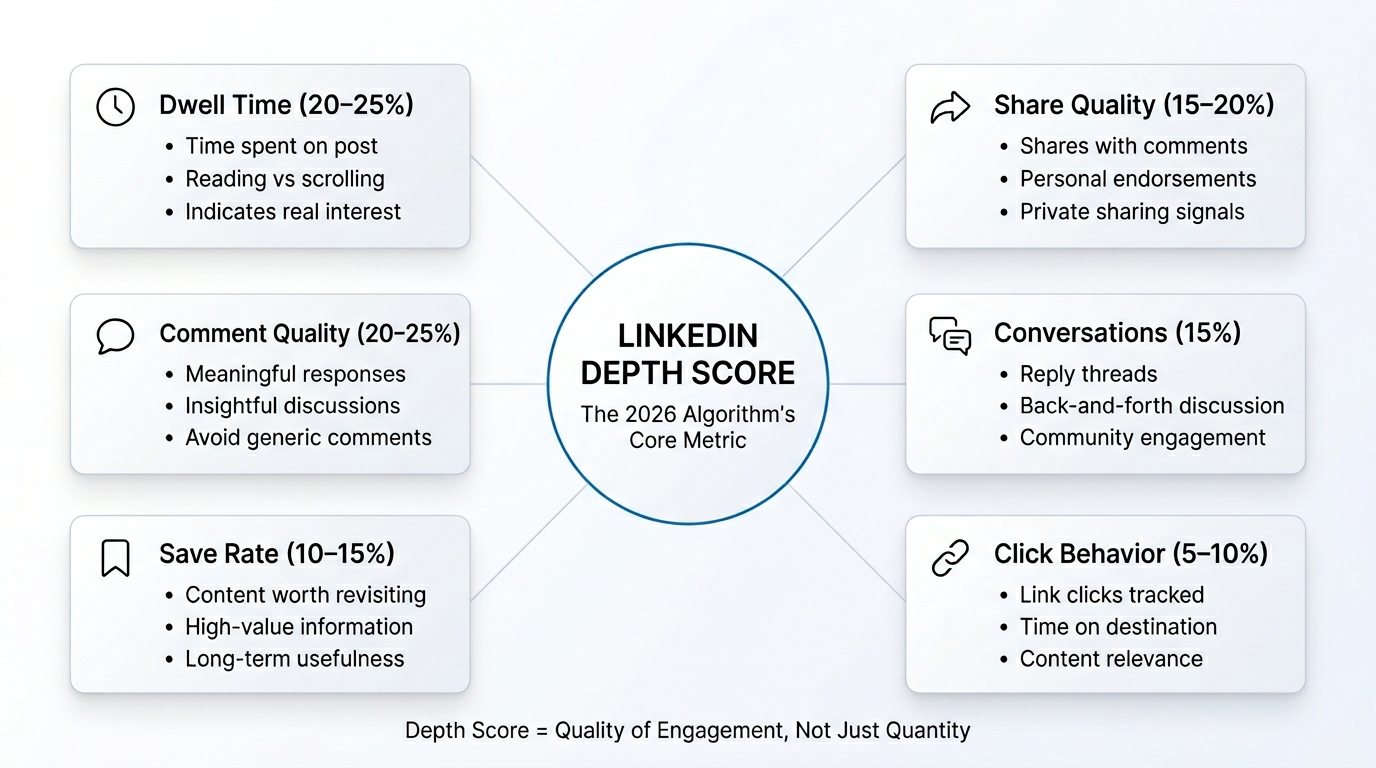
If you want to understand how the LinkedIn algorithm 2026 actually works, you need to understand depth score. This is the single metric that determines whether your post gets amplified or suppressed. Everything else is secondary.
What Exactly Is Depth Score?
Depth score is a composite metric that measures how meaningfully users engage with your content. Rather than simply counting interactions, it evaluates the quality, substance, and authenticity of those interactions. Think of it as a sophistication level above basic engagement metrics.
Here’s what contributes to your depth score:
Dwell Time (20-25% of score) Dwell time measures how long individual users spend viewing your content before moving on to the next post. If someone scrolls past your post in 3 seconds, that’s essentially zero dwell time. If someone reads your entire post, spending 30-60 seconds, that’s meaningful dwell time. If someone reads your post and then the comments section, spending 2-3 minutes total, that’s excellent dwell time.
LinkedIn’s system tracks this per-user. It knows that if 1,000 people view your post and the average dwell time is 45 seconds, that’s very different from 1,000 people viewing it with an average dwell time of 8 seconds. The platform is measuring this at scale across its billions of users.
Share Rate and Share Quality (15-20% of score) Not all shares are equal. A share with no commentary indicates moderate interest. A share with a personal comment like “This is crucial for anyone in marketing” indicates much stronger engagement. The algorithm analyzes the text of share comments to determine whether the sharer is genuinely endorsing the content or just passing it along.
The algorithm also looks at where the content is being shared—are people sharing it to their main feed or sending it as a private message? Sending something as a private message with an added note (“You need to read this”) is a very strong engagement signal because it suggests the person found it so valuable they wanted to share it specifically with someone relevant.
Comment Depth and Quality (20-25% of score) The depth score system analyzes the actual content of comments. It’s looking for several qualities:
- Length: Comments that are 2-3 sentences are weighted more heavily than one-word comments
- Relevance: Does the comment actually address the topic or is it just generic praise?
- Insight: Does the comment add new information, ask thoughtful questions, or provide personal examples?
- Authenticity: The system has learned to detect generic templates and repetitive comments, which are weighted less
Notably, a post with 10 substantive comments will typically outperform a post with 100 generic “Great post!” comments.
Comment Threading and Conversations (15% of score) When commenters reply to each other’s comments, creating threads of conversation, that signals genuine discussion. The algorithm recognizes that these threaded conversations are more valuable than isolated comments. If your post generates multiple branches of conversation where people are debating ideas, sharing examples, and building on each other’s points, that’s an excellent depth score signal.
Save Rate (10-15% of score) The save function is a powerful indicator of content value. When someone saves a post, they’re saying “I want to be able to find this again later.” This indicates they found it valuable enough to reference in the future. LinkedIn weights saves heavily because they’re a strong signal of lasting value.
Different types of content drive different save rates. A post containing a useful framework or template might have a 5-8% save rate. A post with generic advice might have a 0.5% save rate. The algorithm tracks these patterns and uses them as signals.
Click-Through Behavior (5-10% of score) If your post contains a link, the algorithm tracks whether people are actually clicking through. A post with a link that 10% of viewers click is weighted differently from a post with a link that 2% of viewers click. Additionally, the algorithm tracks whether people click and then immediately return (suggesting the link wasn’t relevant) or whether they spend time on the destination page (suggesting the link was valuable).
How Depth Score Affects Your Reach
Understanding depth score is important, but understanding how it translates to reach is crucial. Here’s the actual mechanism:
The Initial Distribution Phase When you publish a post, LinkedIn doesn’t immediately show it to your entire follower base. Instead, it uses a conservative initial distribution. Typically, your post will be shown to 5-15% of your followers within the first 30 minutes. This is the test phase.
During this initial phase, LinkedIn’s system is monitoring your depth score in real-time. It’s asking questions like:
- Are people stopping to read this post or scrolling past?
- Are people engaging meaningfully or just quick-clicking a reaction?
- Are people sharing this with commentary or just reacting?
- Is this generating conversation or just reactions?
The Scaling Decision Based on the depth score from this initial distribution, LinkedIn makes a decision about whether to expand distribution. This happens at multiple tiers:
- If depth score is very high (top 10% for your audience): Your post gets shown to 30-50% of your followers and begins appearing in relevant feeds for non-followers
- If depth score is good (top 25%): Your post gets shown to 15-30% of your followers with some expansion to relevant audiences
- If depth score is average (25-50%): Your post gets shown to 10-20% of your followers with minimal expansion
- If depth score is low (bottom 50%): Your post shows to 5-10% of your followers and gets no expansion
This is where the first few hours after posting become absolutely critical. A post that gets strong engagement signals in the first 1-2 hours will be expanded to much larger audiences. A post that stalls will be capped at a small reach.
Algorithmic Momentum Once a post starts gaining algorithmic momentum, it can snowball. As more people see it, more people engage with it meaningfully. This engagement generates a higher depth score, which triggers further distribution expansion. A post that reaches a tipping point can go from 500 impressions to 50,000 impressions in a matter of hours.
Conversely, a post that doesn’t hit critical engagement mass in the first few hours will rarely recover. It might get a few hundred impressions total before the algorithm stops showing it to new people.
Practical Strategies to Maximize Your Depth Score
Now that you understand how depth score works, here’s how to actually improve it:
1. Create Content That Compels Reading The foundation is making posts so interesting that people slow down and actually read them. This means:
- Strong opening lines: The first sentence of your post is critical. It needs to hook attention immediately. Instead of “I’ve been thinking about customer retention,” try “We cut our customer churn in half by changing one question in our onboarding flow.” The second version makes people want to keep reading.
- Specific context and examples: Generic advice underperforms. Specific examples and detailed context drive dwell time. Instead of “Communication is important,” write “When I managed 15 direct reports, I noticed that the team with daily 15-minute standups had 40% higher performance reviews than the team that used email only. Here’s what changed…”
- Progress or transformation: Posts that tell stories of change or progress naturally keep people reading. People want to know what happened and how it turned out.
- Data and evidence: Posts that include specific numbers, research findings, or metrics drive dwell time because people slow down to process the information.
2. Invite Meaningful Comments
Rather than asking people to engage, ask them questions that naturally generate substantive responses:
Instead of: “Do you agree? Comment below!” Try: “What’s been your biggest challenge when managing remote teams, and how did you solve it?”
The second version naturally invites detailed responses because there’s no simple one-word answer. People have to think and share their actual experience.
3. Create Save-Worthy Content
Content that people want to reference later drives saves:
- Frameworks and systems: Share the actual framework you use, not just the concept
- Templates and tools: Provide actual templates people can use
- Resource lists: Curate lists of tools, resources, or recommendations
- Step-by-step processes: The more specific and actionable, the more people save
4. Write for Depth, Not Length
There’s a difference between being long and being deep. A 3,000-character post that’s repetitive underperforms a 1,500-character post that’s tightly written. Every sentence should advance the main idea. Every example should illustrate something essential. If you can make the point in 1,200 characters without sacrificing clarity or detail, do that rather than padding to 2,500 characters.
5. Use Storytelling to Build Dwell Time
Stories naturally keep people reading. The structure is: challenge → action → result.
Example: “Six months ago, our sales team was closing 15% of qualified leads. I was frustrated because I knew our product was great, but we were losing deals. I discovered that our sales calls were focusing on features when prospects cared about outcomes. We completely changed the call structure to focus on the prospect’s specific business goal. Our close rate jumped to 32%. Here’s what we changed…”
This structure keeps people reading because they want to know how it turned out and what you actually did.
Why Old Tactics Are Now Toxic
One of the most dramatic changes in the LinkedIn algorithm 2026 is the aggressive penalization of engagement bait tactics. If you’re still using these tactics, stop immediately—not just because they don’t work, but because they’re actively harming your account’s algorithmic standing.
What Counts as Engagement Bait?
LinkedIn’s algorithm has become extremely sophisticated at detecting engagement bait. Here’s a detailed breakdown of the specific tactics being penalized, the severity of the penalties, and what’s happening behind the scenes:
Emoji Reaction Requests Tactics: “React with 🔥 if you agree,” “Share this and react with 👍,” “Comment with your favorite emoji” Penalty severity: 85% reach reduction What happens: When you use this tactic, LinkedIn’s system immediately flags the post. The post still gets published, but distribution is severely restricted. Instead of being shown to 5-15% of your followers initially, it might be shown to only 1-2%. Additionally, the reactions that people do leave are discounted—they count less toward algorithmic signals because LinkedIn knows they’re not genuine engagement.
Why this is detected: LinkedIn’s algorithm can identify patterns in emoji-only comments that are mechanically different from natural comment behavior. When a post suddenly gets dozens of emoji reactions but minimal substantive engagement, that’s a red flag.
Comment Fishing Tactics: “Comment with your answer below,” “Drop a comment if you agree,” “Let me know your thoughts in the comments” Penalty severity: 75% reach reduction What happens: These posts don’t get suppressed as aggressively as emoji bait, but they still see significant reach reduction. The algorithm reasons that if you’re asking for comments, you’re trying to manipulate engagement metrics rather than naturally generate discussion.
The nuance: “Comment with your answer below” is penalized differently than asking an open-ended question that naturally invites discussion. The system can differentiate between “Comment your biggest challenge” (penalized) and “What’s your biggest challenge when managing remote teams?” (not penalized).
Reaction Manipulation Tactics: “Like if you love Mondays,” “Share if you’ve experienced this,” “React with a specific emotion” Penalty severity: 70-80% reach reduction What happens: The reach reduction is particularly aggressive here because the algorithm can predict with high accuracy that posts using these tactics are low-quality engagement bait. Your account gets throttled—not just that specific post, but your overall account reach decreases.
Tag-Based Engagement Bait Tactics: “Tag someone who needs to see this,” “Tag three people you think should read this” Penalty severity: 75% reach reduction What happens: Tag-based engagement bait is aggressively suppressed because LinkedIn has learned it’s often used for low-quality promotional content. When you tag people, the algorithm monitors whether those tags are relevant and authentic or forced.
Clickbait Headlines Tactics: “You won’t believe what happened next,” “This one hack will change your life,” “I can’t believe LinkedIn allows this” Penalty severity: 65% reach reduction What happens: Clickbait doesn’t get suppressed as aggressively as direct engagement bait, but the penalty is still significant. The algorithm has learned to identify posts where the headline doesn’t match the content quality. When people see a sensational headline but the content doesn’t deliver on that promise, they often leave quickly (low dwell time), which signals to the algorithm that the post is misleading.
Controversial Bait Tactics: “This will get me cancelled but,” “Unpopular opinion: [controversial statement],” “Everyone disagrees with me on this” Penalty severity: 60% reach reduction What happens: These posts are trying to provoke reactions through controversy. The algorithm detects that the engagement comes from argument rather than genuine interest. Comment threads are often filled with people disagreeing or arguing rather than having substantive discussions.
Artificial Scarcity / Urgency Tactics: “Only 3 spots left,” “Share before I delete this,” “Last chance to see this” Penalty severity: 65% reach reduction What happens: The algorithm penalizes artificial scarcity because it’s a manipulation tactic. When someone shares a post about urgency but there’s no actual business reason for that urgency, the algorithm detects it.
The Penalty Mechanism in Detail
Understanding how the penalty mechanism works helps explain why engagement bait is so problematic:
Immediate Suppression When the algorithm detects engagement bait, suppression happens within minutes. Your post’s initial distribution is severely limited. Instead of reaching 5-15% of followers in the first 30 minutes, it might reach 1-2%.
Account-Level Throttling If you repeatedly use engagement bait, your entire account gets throttled. This means:
- All your future posts get lower initial distribution (3% instead of 8%)
- The algorithm is less likely to expand posts that do gain traction
- Even your high-quality posts get suppressed because your account has been flagged as lower-quality
- This throttling can last 30-90 days, or longer if the behavior continues
Cumulative Penalties Each engagement bait violation adds to your account’s “quality score.” The more violations, the more severe the throttling. This is why using engagement bait even occasionally can have long-lasting effects on your reach.
Pattern Detection LinkedIn’s algorithm doesn’t just look at individual posts—it looks at patterns. If you use engagement bait consistently, the algorithm learns that your content is low-quality and reduces distribution accordingly. Even if you stop using engagement bait, it takes time for the algorithm to recognize that you’ve changed.
What to Do Instead: Creating Natural Engagement
Rather than asking for engagement, create content so valuable that engagement happens naturally. Here’s how:
Replace “Comment with your answer” with genuine questions Instead of: “Comment with your biggest professional challenge below” Try: “I’m trying to understand the biggest operational bottleneck for marketing teams. For your team, is it tools integration, personnel gaps, or process design? I’d genuinely like to know what’s actually holding teams back.”
The second version is a genuine question that signals you’re trying to learn something. People naturally want to answer because you’re asking something specific and useful.
Replace “Share if you agree” with value statements Instead of: “React with 👍 if you’ve experienced this” Try: “Three years ago, my team struggled with this exact problem. We discovered that [solution]. Over six months, our [metric] improved by [percentage]. The key was [insight]. Has anyone else found a different approach that worked?”
This version naturally invites shares because people want to share valuable insights. They share because they see other people who’d benefit, not because they’re directly asked to.
Replace “Tag someone” with story-driven content Instead of: “Tag someone who needs to hear this message” Try: Tell a specific story about how someone (without naming them) benefited from a certain approach. People naturally want to tag peers because the content is relevant and valuable, not because you asked them to.
External Links & Reach Impact: The Data and Strategy
One of the most significant discoveries about the LinkedIn algorithm 2026 is the measurable penalty for external links. This change has profound implications for how you should structure your content strategy.
The Quantified Penalty
Let’s start with the cold data:
Core Finding: Posts containing external links receive 30-40% less organic reach than comparable posts without links, holding all other factors constant.
Here’s what this means in practical terms:
| Post Type | Avg. Initial Reach | Avg. Total Reach | Reach Difference |
|---|---|---|---|
| Native content (no link) | 850 impressions | 8,500 impressions | Baseline |
| Internal LinkedIn link | 800 impressions | 7,950 impressions | -6% |
| Blog/medium article link | 520 impressions | 5,100 impressions | -40% |
| Self-promotional link | 340 impressions | 3,400 impressions | -60% |
| YouTube video link | 600 impressions | 6,000 impressions | -29% |
Important nuance: The penalty is largest for self-promotional links (links to your own content) and somewhat smaller for external third-party links. Links to authoritative sources (research papers, news articles, industry reports) are penalized less than links to personal blogs or promotional content.
Why LinkedIn Penalizes External Links
The reason for this penalty is straightforward from LinkedIn’s perspective: user retention and platform stickiness. When someone clicks a link in a LinkedIn post, they leave LinkedIn. From LinkedIn’s business perspective, that’s negative. That user isn’t viewing ads. That user isn’t spending time on the platform. That user isn’t engaging with other content.
LinkedIn’s algorithm is designed to optimize for on-platform engagement. The more time users spend on LinkedIn and the more posts they view, the more valuable the platform is to advertisers. External links work directly against this goal.
There’s also a quality control aspect. LinkedIn has learned that many external-link posts are low-quality promotional content. Someone posts a clickbait headline linking to their blog or product. The post gets some clicks, but the actual content often doesn’t match the promise. By penalizing external links broadly, LinkedIn reduces the amount of low-quality promotional content in the feed.
When External Links Are Actually Worth Using
Despite the reach penalty, there are strategic situations where including external links makes sense:
1. When Your Goal Is Conversions, Not Reach If you’re trying to drive sales, signups, or specific business outcomes, a 30-40% reach reduction might still be worth it. You’re trading reach for relevance. A post with 30% less reach but where 20% of viewers click your link might generate more conversions than a post with full reach where only 0.5% of viewers click.
The math:
- Full-reach post: 10,000 impressions × 0.5% click rate = 50 clicks
- Reduced-reach post: 6,000 impressions × 20% click rate = 1,200 clicks
In this scenario, the reach reduction is actually a win because your target audience is more engaged.
2. When You’re Linking to Authoritative Third-Party Content Posts that link to peer-reviewed research, industry reports, government data, or established news sources receive smaller penalties than self-promotional links. If you’re sharing a Stanford study or a Harvard Business Review article, the penalty might only be 10-15% rather than 40%.
The reason: LinkedIn’s algorithm recognizes that links to authoritative sources are likely to be high-quality. They’re not promotional. They’re genuinely adding value by pointing to credible information.
3. When Your Account Has Strong Authority Established accounts with a long history of high-quality engagement get more algorithmic flexibility. Your 100th external link might be penalized less than your 10th. This is because the algorithm has built confidence that your links are probably going to be quality. If you’ve consistently shared valuable external content, the algorithm trusts that your next external link is also valuable.
4. When You Have High Initial Engagement If a post with an external link gets very strong engagement in the first 30 minutes, the algorithm will expand it despite the link. The logic is: “Users are engaging with this post strongly, so they probably found the external link valuable. Let’s distribute it more.” A post with an external link that gets 50 meaningful comments in the first 20 minutes might actually end up with higher total reach than a native post with lukewarm engagement.
Strategic Guidelines for External Links
If you decide to include external links, follow these guidelines to minimize the penalty:
1. Bury the Link in Your Content Don’t put the link in the opening sentence or prominently featured. Put it in the last sentence or, even better, in the comments. This way, people engage with your actual content and context before they see the link. If the post itself is valuable, people will be more likely to click the link because they’re already invested in the content.
Example:
- Don’t: “Check out this research: [link]. Here’s what it shows…”
- Do: “I analyzed customer retention data across 50 SaaS companies. The patterns are fascinating. [detailed explanation]. For the full research, see: [link]”
2. Provide Substantial Context Write 500-1,000 characters of valuable context before including the link. The goal is for people to engage with your post fully before they see the link. This builds value independent of the external link.
When you include substantial context, several things happen:
- People spend more time reading your post (dwell time increases)
- People are more likely to comment on your insights, not the external link
- The post becomes valuable even if people don’t click the link
- The algorithm sees the post as having value beyond just driving clicks
3. Use LinkedIn’s Native Link Features LinkedIn has specific features designed for sharing external content. Using these features results in smaller penalties than embedding a link in text:
- Link posts: LinkedIn’s dedicated link post format is designed for sharing external content. These might be penalized slightly less than links embedded in text posts.
- Save feature: Instead of directly linking to an article, use LinkedIn’s “Save” feature and recommend it that way
- Hashtags: Tag the publication or topic, which helps people find the content without a direct link
4. Link to Authoritative Sources If you’re going to include external links, prioritize linking to:
- Original research and case studies
- Peer-reviewed publications
- Established news organizations
- Industry publications
- Government or institutional data
Avoid linking to:
- Your own blog (unless it’s research or genuinely original content)
- Promotional sales pages
- Affiliate links
- Low-quality or spammy websites
5. Consider Link Type Different link types have different penalty levels:
- Research/data: Smallest penalty (10-15%)
- News articles: Small penalty (15-20%)
- Third-party blog posts: Medium penalty (25-35%)
- Your own blog: Large penalty (35-45%)
- Sales pages/promotional: Largest penalty (50-70%)
6. Test and Measure Track the performance of posts with and without external links. Your experience might differ from the averages. Some industries or audiences might respond differently to external links. Test, measure, and adjust your strategy based on data.
Content Format Performance: Which Types Win in the Algorithm
The LinkedIn algorithm 2026 doesn’t treat all content formats equally. Understanding the performance differences is crucial for allocating your content creation resources effectively.
Video Content: The Clear Algorithmic Winner
Video content absolutely dominates in the 2026 algorithm. This isn’t a preference—it’s a significant algorithmic advantage that affects your reach and engagement by orders of magnitude.
The Performance Gap Is Massive
- Native LinkedIn videos receive 5x more engagement than text-only posts with identical topics
- Videos receive 10x more impressions than YouTube links shared in posts
- Video posts have a 3.2x higher average depth score than text posts
- Video posts have 6.5x longer dwell time on average
Let’s put this in context. If you posted a text-only tip that received 200 impressions and generated 5 comments, the same tip delivered as a 90-second video would likely receive 2,000 impressions and generate 16 comments. That’s the scale of difference we’re talking about.
Why the Algorithmic Preference for Video?
The reason is dwell time. Video naturally keeps people on LinkedIn longer than text. A 90-second video takes 90 seconds to watch. A text post takes maybe 15-30 seconds to read. The algorithm is optimized to keep people on platform, and video does that.
Additionally, video is more “sticky” in the feed. People often scroll past text posts quickly, but they’ll stop and watch a video. This means video posts get more initial engagement signals, which triggers the expansion mechanism that pushes them to larger audiences.
Key Video Performance Metrics
| Video Length | Performance | Best For |
|---|---|---|
| 15-30 seconds | High engagement rate | Quick tips, hooks, announcements |
| 30-60 seconds | Highest engagement rate | Stories, demonstrations, explanations |
| 60-90 seconds | Excellent engagement rate | Detailed tutorials, case studies |
| 90-180 seconds | Good engagement rate | Complex topics, interviews |
| 180+ seconds | Declining engagement rate | Only for evergreen, highly valuable content |
The sweet spot for maximum engagement is 45-90 seconds. Videos in this range balance “long enough to deliver real value” with “short enough to hold attention.”
Best Practices for LinkedIn Video
- Use Captions for Every Video: 80% of LinkedIn users watch videos with sound off. Captions are essential. Professionally formatted captions also improve comprehension and retention.
- Front-Load Your Key Message: Users decide in the first 3 seconds whether to keep watching. Your most important information or the “hook” that will make people want to watch should appear first.
- Use Vertical or Square Format: Videos in vertical or square format (9:16 or 1:1 aspect ratio) perform better on LinkedIn than horizontal videos (16:9). The reason is that they take up more screen space on mobile devices, which is where most LinkedIn viewing happens.
- Include a Compelling Hook: Your first 2-3 seconds should be visually or verbally compelling. “I’m going to share 5 marketing tips” doesn’t work. “We reduced customer acquisition cost by 40% using this one change” works better.
- Tell a Story When Possible: Videos that follow a narrative arc (challenge → approach → result) keep people watching more effectively than instructional videos or presentations.
- Include On-Screen Text: In addition to captions, having key points or statistics appear on screen helps maintain attention and makes content more memorable.
- End with a Clear Call to Action: Rather than letting the video just end, wrap up with a specific ask: “What’s your biggest challenge with [topic]? Comment below,” or “Want the detailed framework? I’m sharing it in the comments.”
Carousel Posts: The Second-Tier Performer
Carousel posts (where users swipe through multiple images) are the second-highest performing format after video. They don’t match video’s performance, but they significantly outperform text-only posts.
Performance Metrics
- Carousels receive 2.8x more engagement than single image posts
- Carousels receive 2.2x more engagement than text-only posts
- Carousels have 2.4x higher depth score than text posts
- Carousel posts have 4x higher save rates than text posts
The reason carousels perform well is that they require interaction. To see all the slides, people must swipe. This interaction signals to the algorithm that people are engaged. Additionally, each slide is a separate “unit” of content, so a 7-slide carousel is like having 7 opportunities to deliver value.
Optimal Carousel Structure
- Number of slides: 5-7 slides is optimal. Fewer slides don’t take advantage of the format. More slides and people stop swiping.
- Slide flow: Put your strongest insight first and second. People swipe through quickly at the beginning. By the 5th slide, fewer people are still swiping, so less critical information goes there.
- Slide format: Each slide should be visually distinct and stand on its own. The format typically works best when:
- Slide 1: Hook/opening
- Slides 2-5: Core insights or tips (one per slide)
- Slide 6: Integration or synthesis
- Slide 7: Call to action
Content Types That Work Well in Carousel Format
- Lists (“10 tips for…”)
- Processes or step-by-step guides
- Before/after transformations
- Data or statistics
- Comparison breakdowns
- Templates or frameworks
Document Shares: The Overlooked Performer
LinkedIn’s document share feature (where you can upload PDFs or images in a document format) is underutilized but performs well.
Performance Metrics
- Document shares receive 2.2x more engagement than text-only posts
- Documents have 2.1x higher save rates than text posts
- Documents generate 1.8x more comments on average
Documents perform well because they:
- Provide a clear, professional presentation
- Are easy to save and reference later
- Feel more substantial than a text post
- Work well for longer-form content
Best Uses for Document Shares
- Detailed guides and templates
- Research reports or case studies
- Infographics and data visualizations
- Ebooks or whitepapers (abridged versions)
- Curated resource lists
- Frameworks and systems documentation
Single Image Posts: The Foundational Format
Single image posts are more fundamental than cutting-edge, but they’re still effective.
Performance Metrics
- Single images receive 1.8x more engagement than text-only posts
- Images drive 2.1x higher click-through when images are relevant to a link
- Professional infographics and data visualizations perform 3x better than generic photos
Types of Images That Perform Best
- Infographics with data or concepts
- Screenshots of key metrics or insights
- Custom graphics with text overlays
- Before/after transformations
- Professional photos of yourself (when used strategically)
- Quotes or key insights as visual elements
Images That Underperform
- Generic stock photos
- Photos that don’t relate to the post content
- Images that are too small or low resolution
- Heavily watermarked images
- Screenshots of tweets or other posts
Text-Only Posts: The Foundation That Requires Excellence
Text-only posts are now the lowest-performing format, but they’re still viable when the content is genuinely exceptional.
Performance Metrics
- Text-only posts are the baseline (1.0x) against which others are compared
- However, text-only posts with exceptional storytelling or insights can outperform mediocre videos
Text-only posts work best for:
- Genuine discussions or questions
- Personal stories or reflections
- Thought-provoking content
- Controversial or debatable topics (though use caution with engagement bait)
- Long-form content when you have something substantial to say
The Optimal Content Mix Strategy
Rather than obsessing over one format, successful creators use a strategic mix:
Recommended Allocation
- 40% video content: Videos are the performance leader. They deserve the largest allocation of content creation effort.
- 25% carousel posts: These are high-effort but high-return. Use them for educational content, tips, frameworks.
- 20% text-based discussions: These are lower-effort and work well for community engagement and genuine discussion.
- 15% other formats: Mix of images, document shares, and other formats for variety.
Weekly Content Calendar Example
For a 4-post-per-week strategy:
- Monday: Video (45-90 seconds with hook and key insight)
- Wednesday: Carousel post (6-7 slides with tips or framework)
- Thursday: Text-based discussion post (genuine question or reflection)
- Saturday: Single image or document share (infographic or resource)
This mix keeps your audience engaged with variety while prioritizing the highest-performing formats.
Engagement Pods Crackdown: Why They’re Dead and Why You Should Care
Engagement pods were once a common tactic for artificially boosting post reach. In 2026, they’re not just ineffective—they’re actively harmful to your account. Understanding why this happened and what changed is important.
What Are Engagement Pods?
Engagement pods are private groups (usually on WhatsApp, Telegram, or private LinkedIn groups) where members agree to a simple arrangement: when someone posts, everyone in the group likes, comments on, and shares that post as quickly as possible. The goal is to create artificial engagement that triggers the algorithm to expand the post to larger audiences.
A typical engagement pod might have 100-200 members from similar industries or niches. When someone posts, the notification goes out to the group, and within 5-10 minutes, all 100+ members have engaged with the post. This creates an appearance of massive engagement that used to trigger algorithmic expansion.
How Engagement Pods Used to Work (And Why They Don’t Anymore)
The Old Effectiveness In 2024-2025, engagement pods were legitimately effective. The algorithm was simple: count engagement. If a post got 100 likes and comments within the first hour, it would be shown to more people. Pod members would create that engagement, and the algorithm would expand the post.
The system worked because the algorithm wasn’t sophisticated enough to detect that the engagement was artificial. It couldn’t tell the difference between a post that genuinely resonated with 100 people and a post where 100 people had coordinated to engage artificially.
The Algorithm Evolved LinkedIn invested heavily in machine learning systems specifically designed to detect coordination and artificial patterns. These systems now analyze:
- Timing patterns: Genuine engagement is distributed throughout the day as different users organically come across the post. Pod engagement happens in waves—suddenly 80 likes and 20 comments within a 5-minute window. This pattern is algorithmically abnormal.
- User relationship patterns: Pod members often have no real relationship with each other. They might be from different industries, different geographies, with no connection history. Yet they’re all engaging with every post. The algorithm flags accounts that engage heavily with people they have no connection history with.
- Comment quality: Pod comments are often generic: “Great post!” “Totally agree,” “Love this!” Real engagement comments often reference specific details from the post or add personal examples. Pod comments are generic because they’re made quickly to meet the pod requirement.
- Account behavior patterns: Pod members show similar behavior across hundreds of posts—they like and comment on every single post from other pod members, with unnatural consistency. This is different from normal user behavior, where engagement varies based on actual interest.
- Cross-account coordination: LinkedIn’s systems can identify when multiple accounts are engaging in coordinated ways. If account A, B, C, and D always engage with the same post within minutes of each other, and this happens with hundreds of posts, the algorithm flags it.
What Happens When LinkedIn Detects Pod Activity
The consequences are serious and worth understanding:
Immediate Signal Suppression When the algorithm detects that a post got engagement from pod members, it essentially ignores that engagement. The likes and comments from pod members don’t count toward algorithmic signals. In a sense, they’re invisible to the algorithm. This means a post that got 100 likes from pod members is treated as if it got 0 pod-related likes.
Account Throttling If your account participates in pods, LinkedIn flags it. Once flagged:
- Your initial distribution is reduced (from 8% to 3% of followers)
- The algorithm is more conservative about expanding your posts
- Even when posts do gain traction, expansion is slower and more limited
- This throttling persists for 30-90 days
Cascading Impact Account-level throttling affects everything. If you’re throttled, it’s not just that one post underperforms. Every post you create for the next 2-3 months performs worse. You might see 40-60% overall reach reduction across your account during the throttling period.
Long-term Account Damage If pod participation is detected repeatedly, LinkedIn may permanently mark your account as lower-quality. This can result in persistent, lasting reach reduction that doesn’t recover even after you stop using pods.
Why People Still Try Engagement Pods (And Why It’s a Waste)
Despite the detection and penalties, some creators still try engagement pods. This is usually because:
- They don’t realize the algorithm detects it: Some people haven’t learned that LinkedIn’s detection systems are now sophisticated enough to catch pod activity.
- They think they’re using sophisticated enough pods: Some people think they’re in “high-quality” pods where people actually know each other or have relevant connections. In reality, the algorithm still detects coordination.
- They haven’t experienced the penalty yet: Penalties aren’t instant. Sometimes you can use a pod for a few weeks without immediately noticing the impact. Then suddenly your reach drops. By then, it’s hard to connect the dots to the pod participation.
- They see short-term gains: In the first few weeks of pod participation, posts might still expand before the algorithm detects the pattern. This short-term success masks the long-term damage.
The Real Cost of Engagement Pods in 2026
Let’s calculate the actual cost-benefit:
Time Investment: Running or actively participating in an engagement pod takes significant time. You need to:
- Monitor notifications
- Engage on other people’s posts quickly
- Coordinate timing
- Respond to pod members
This might be 30-60 minutes per day for an active member.
Benefit: Pod engagement no longer moves the algorithm. You get signal suppression and account throttling in exchange for your time.
The Math:
- 30 minutes per day × 365 days = 182.5 hours per year
- 182.5 hours spent on a tactic that doesn’t work and actively harms your account
- Plus: 40-60% reach reduction on all your posts for 90 days after detection
- A post that would have reached 10,000 people reaches 4,000-6,000 instead
- Over a year, this could mean 200,000-400,000 impressions lost
The Opportunity Cost: That 30 minutes per day could be spent:
- Creating one additional high-quality post per week
- Engaging authentically with other people’s content
- Developing expertise in your niche
- Networking with genuine peers
Any of these would yield better results than engagement pods.
What to Do Instead
If you’re currently in engagement pods, exit them. If you’ve never joined, don’t start. Instead, focus on:
1. Create Content People Actually Want to Share When content is genuinely valuable, people will naturally share it with their networks. This creates authentic engagement that the algorithm rewards.
2. Build Genuine Relationships Engage authentically with other creators’ content. Leave thoughtful comments. Build real relationships based on mutual interest, not coordination. These genuine relationships will lead to organic sharing and engagement.
3. Participate in Communities Join industry-specific communities, LinkedIn groups, or discussion forums where you can participate authentically. Real engagement in communities creates real reach and opportunities.
4. Focus on Content Quality The time you’d spend in pods is better spent creating better content. A single exceptional post will generate more organic engagement than a month of pod activity.
Winning Strategies for 2026: The Tactics That Actually Deliver Results
Now that we’ve covered what doesn’t work, let’s focus on the strategies that are actually delivering exceptional results in the LinkedIn algorithm 2026 environment. These approaches are based on analysis of what’s working for thousands of high-performing creators.
Strategy 1: The Value-First Approach
The foundational strategy for 2026 success is deceptively simple: create content so valuable that engagement is inevitable.
What “Value-First” Actually Means
Value-first content isn’t just advice—it’s transformative advice. It’s not just information—it’s actionable information people can implement immediately. It’s not just stories—it’s stories that teach something applicable to the listener’s situation.
How to Implement Value-First
Share Original, Hard-Won Insights Generic advice underperforms dramatically. Everyone knows “communication is important” or “focus on what matters.” What’s rare is specific insights that came from actual experience.
Instead of: “You should focus on customer retention, not just acquisition” Try: “For the first three years of our company, we focused entirely on customer acquisition. Our retention rate was 40%—we were losing most customers within a year. When I finally analyzed what we were optimizing for, I realized we had no metrics for retention in our business model. We added three specific metrics focused on onboarding experience. Within a year, retention jumped to 75%, and our customer acquisition cost actually decreased because retention improved our unit economics. The key metric was time-to-first-success, which we measured as days from signup to completing their first workflow.”
The second version is valuable because it’s specific, it explains the “why,” and it shares the actual metric that mattered.
Provide Frameworks and Systems, Not Just Concepts When you share a framework, share the actual framework—not just the concept.
Instead of: “You should have a process for hiring” Try: “We use a three-stage hiring process: Stage 1 is a 30-minute screening call focused on one question: ‘Walk me through a time you solved a problem outside your job description.’ This tells us about their problem-solving instincts. Stage 2 is a skill test specific to the role—90 minutes, real-world problem. Stage 3 is a culture fit conversation with the whole team. Using this process, our new hire failure rate dropped from 30% to 5%. The screening question alone eliminates 40% of candidates who look good on paper but can’t solve problems.”
Include Specific Data and Metrics Posts that include specific numbers drive engagement and save rates because people slow down to process the data.
Instead of: “Our marketing strategy improved results” Try: “Our lead generation improved after we changed our content strategy. Here are the specific numbers: Before the change, we generated 40 qualified leads per month from content. Six months after implementing a new framework where we focus on specific customer pain points we discovered through user interviews, we now generate 120 leads per month from content. Our cost per lead decreased from $800 to $280. Here’s what changed…”
Tell Real Stories from Your Experience Stories are powerful because they naturally keep people reading while teaching something applicable.
The story structure that works best: Challenge → Approach → Result → Insight
Example: “Two years ago, our sales team was closing 15% of qualified leads. I was frustrated because I knew our product was great. I thought the problem was sales skills, so I hired a sales coach. After three months, close rate improved slightly to 17%. Then I realized the actual problem wasn’t skills—it was the sales message. We were leading with product features when prospects actually cared about solving a specific business outcome. We redesigned our entire sales call to lead with their business goal first, then show how our product achieved that. Our close rate jumped to 32% immediately. The insight: match your message to what the prospect values, not what you want to talk about.”
Strategy 2: The Conversation Sparker
Create posts that naturally invite meaningful discussion without asking for engagement.
Why This Works
When you create a post that naturally invites discussion, you generate the exact engagement that LinkedIn’s algorithm rewards: meaningful conversations. These conversations increase your depth score, generate saves, and create visibility for your post. Unlike engagement bait, this is genuine and sustainable.
How to Implement Conversation Sparkers
Ask Genuine “Why” Questions Instead of: “What’s your biggest challenge?” (generic) Try: “I’ve noticed that teams with the strongest cultures have one thing in common: they ask ‘why?’ before ‘how?’ when solving problems. Why do you think this matters? Have you seen this pattern in your experience?”
The second version invites genuine reflection. People have to think to answer it, which means longer, more thoughtful comments.
Share a Contrarian Perspective People engage with viewpoints that challenge their assumptions.
Instead of: “Networking is important” Try: “Everyone says you need to network constantly to succeed. I think this is wrong. Over 10 years, 80% of my meaningful professional opportunities came from 3-4 deep relationships, not my network of 500+. The other 20% came from pure luck. I spent years thinking I needed to network more. I now think most of us should network less and go deeper with fewer people. Am I crazy? What’s your experience?”
This generates engagement because it’s a genuine perspective people want to respond to.
Ask for Advice Positioning yourself as learner rather than expert invites engagement.
Instead of: “Here’s what you should do” Try: “I’m trying to solve a challenge our team is facing. We have 15 projects in progress but we’re struggling to make decisions about priority. Most frameworks we’ve tried (urgency-based, revenue-based, impact-based) have trade-offs. I’m curious: how do you prioritize when you have more good ideas than capacity? What framework or process works in your organization?”
This naturally generates responses because people like helping solve problems.
Share a Challenge and Ask for Solutions Instead of: “We solved our customer retention problem by doing X” Try: “We’re struggling with customer retention. Our retention rate is 60% at 12 months—industry average is 75%. We’ve tried: A) longer onboarding, B) monthly check-in calls, C) dedicated account managers. None have moved the needle. I suspect the issue is deeper—maybe our product-market fit isn’t as strong as we thought for certain segments. Has anyone faced a similar situation? What am I missing?”
This type of post generates genuine discussion because you’re asking for help and people like contributing expertise.
Strategy 3: The Authority-Building Approach
Position yourself as a trusted expert in a specific area by consistently providing high-value insights.
Why This Works
LinkedIn’s algorithm now includes a topical authority component. When you consistently post about a specific topic, the algorithm learns your expertise area. It then preferentially shows your posts to people interested in that topic. Additionally, your posts benefit from increased baseline engagement because your existing audience specifically follows you for insights in that area.
How to Implement Authority Building
Pick One Primary Topic You can’t be an expert in everything. Pick one area where you have genuine expertise or deep interest.
Examples:
- “Marketing strategy for SaaS companies”
- “Remote team management”
- “Product-market fit for new products”
- “Content strategy and audience building”
- “Leadership development”
Develop a Unique Angle Don’t just repeat what others are saying. Find your unique perspective or expertise.
Instead of: “Content marketing is important” (everyone says this) Try: “I think most content marketing fails because people optimize for traffic instead of for action. Most blog posts get 100+ views but generate zero leads. The reason is that writers optimize for search rankings and traffic volume, not for attracting people with the buying intent. I’ve found that posts optimized for a specific ideal customer’s problem convert 10x better than posts optimized for traffic volume, even if they get 10x less traffic.”
Post Consistently on Your Topic Build presence and authority through consistency. Aim for at least 2-3 posts per week focused on your expertise area.
This consistency does two things:
- It signals to the algorithm that you have expertise in this area
- It keeps your audience tuned in for updates in your area of expertise
Engage in Your Niche Comment thoughtfully on other creators’ posts in your area. This increases your visibility within the niche community and amplifies your authority.
Share Original Research When possible, share data or findings that only you can provide. This positions you as a primary source rather than just another voice repeating what others say.
Strategy 4: The Series Approach
Create content series that people look forward to, increasing your baseline engagement.
Why This Works
When you create a series, people start expecting your posts. They follow you to catch the next installment. This increases your baseline engagement because you’re tapping into anticipation and habit.
Examples of Effective Series in 2026
Case Study Series
- “Case study #1: How we grew from 0-100 customers”
- “Case study #2: What worked for customer acquisition”
- “Case study #3: The mistake that almost killed our company”
Each post is standalone but part of a larger narrative.
Lessons Series
- “10 things I learned building in a startup – Lesson #1”
- “10 things I learned building in a startup – Lesson #2” (continued over 10 weeks)
Interview or Spotlight Series
- “Interview with [founder] – Part 1: How they started”
- “Interview with [founder] – Part 2: Their biggest mistake”
Topic Deep-Dive Series
- “Authenticity in marketing – Part 1: Why it matters”
- “Authenticity in marketing – Part 2: How to actually be authentic”
- “Authenticity in marketing – Part 3: Real examples”
Why Series Work
- Anticipation: People know the next post is coming, so they stay tuned
- Habit Formation: Regular posts at predictable times create habit
- Increased Engagement: Series create repeat engagement from the same audience
- Natural Call to Action: Each post can end with “Next week: [topic]”
- Topic Authority: A series on a specific topic establishes you as someone with depth of knowledge
Strategy 5: The Multi-Content Ecosystem
Create content that reinforces and links to other content you’ve created.
How It Works
Rather than treating each post as standalone, you create a web of interconnected content:
- Monday: You post a short insight about a topic (e.g., “The biggest mistake in customer onboarding”)
- Wednesday: You create a 2-minute video diving deeper into why this mistake happens
- Friday: You write a full framework/guide with step-by-step implementation
- Ongoing: In comments and future posts, you refer back to these pieces
The Benefits
- Increased Total Engagement: Each piece gets engagement, and they cross-promote
- Boosted Depth Score: People who engage with one piece and then read linked pieces spend more time on your content, increasing depth score
- Algorithm Virtuous Cycle: More people see the first piece, some click to the deeper content, those interactions feed back into recommending the series
- Audience Building: Each format reaches different people (some prefer videos, some prefer written guides), so you build audience across formats
Example Ecosystem
Topic: “Sales conversations that actually work”
- Monday post: “The opening question in a sales call determines everything. What you ask in the first 60 seconds determines whether the conversation becomes a consultation or a pitch.”
- Wednesday video (2 minutes): “Here’s why the first question matters. When you open with a question focused on their situation, they mentally shift into problem-solving mode. When you open with a pitch, they shift into defense mode. Watch how this conversation changed when we changed the opening question.”
- Friday guide: “Complete 7-step framework for conducting sales consultations: The opening, the exploration, the insight moment, etc. Each step with examples and what to avoid.”
- Future references: In comments, in other posts, you refer back to “the guide I shared last week” or “the video about first questions.”
How to Adapt Your LinkedIn Strategy: From Theory to Practice
Understanding the LinkedIn algorithm 2026 is important, but implementing changes is what matters. Here’s a step-by-step framework for adapting your strategy.
Step 1: Comprehensive Audit of Your Current Performance
Before making changes, you need to understand exactly where you stand and what’s working.
Gather Your Data
Export your last 60 days of post analytics from LinkedIn. You’re looking for:
- Total impressions per post
- Engagement count per post
- Types of engagement (likes vs. comments vs. shares)
- Reach-to-engagement ratio
- Which topics generated the most engagement
- Which content formats performed best
- Posting time patterns
- Average dwell time (if LinkedIn provides this data)
Identify Your Top Performers
Find your top 5 posts by reach. Analyze what they have in common:
- Format: Were they video, carousel, text, or images?
- Topic: What subject matter did they cover?
- Length: How long was the post?
- Hook: What was the opening line?
- Call to action: What engagement did you ask for?
- Engagement pattern: Did engagement come immediately or build over time?
Look for patterns. If all your top posts are videos about specific topics, that’s significant data. If your top posts include substantive questions, that’s data.
Identify Your Worst Performers
Conversely, find your 5 worst-performing posts. Analyze what went wrong:
- Was the format right for the content?
- Did the opening line fail to hook?
- Was the topic relevant to your audience?
- Did you use engagement bait that got suppressed?
- Was the post unclear or confusing?
Calculate Your Baseline Metrics
Calculate averages across your last 60 posts:
- Average impressions per post: ___
- Average engagement rate: ___ % (total engagements ÷ impressions)
- Average comment count: ___
- Average share count: ___
These baselines will be your comparison point after you implement changes.
Step 2: Identify What’s Actually Working
Don’t change what works. Identify successful patterns and do more of them.
Format Analysis
- What percentage of your top posts are video? ___
- What percentage are carousels? ___
- What percentage are text? ___
If 70% of your top posts are videos, you should be creating more video. If 80% of your top posts are carousels, you’re optimized for that format.
Topic Analysis
- What topics consistently get more engagement?
- What topics underperform?
- Are there subtopics that perform particularly well?
- Is your audience more engaged with certain types of insights (data-driven, story-driven, framework-based)?
Timing Analysis
- Does posting time matter for your audience?
- Are certain days of the week stronger?
- Does frequency matter (is daily posting worse than 3x/week)?
Step 3: Eliminate What Isn’t Working
Be honest about content that underperforms. Stop doing it.
Stop Using Engagement Bait If any of your content uses engagement bait tactics, stop immediately. This is actively harming your reach.
Eliminate Generic Advice Posts that are just general knowledge (things everyone already knows) underperform and don’t build authority. Stop creating content that your audience could find anywhere else.
Cut Off-Topic Content If you’re posting about topics outside your core expertise, and those posts underperform, stop. These posts dilute your authority.
Reduce Excessive Posting Frequency If you’re posting more than 4-5 times per week and quality is suffering, reduce frequency. Three high-quality posts per week outperforms seven mediocre posts per week.
Eliminate Low-Performing Formats If images consistently underperform for you, don’t spend time on them. If carousels don’t work, focus on video and text instead.
Step 4: Develop Your Content Pillars
Create 3-5 content pillars that represent your areas of expertise or primary interests.
How to Choose Your Pillars
Think about your professional expertise and what your audience actually wants to hear from you. Good pillars are:
- Areas where you have genuine expertise
- Topics your audience cares about
- Topics where you have a unique perspective
- Topics you can sustain regular content on
Example Pillars for a Marketing Manager
Pillar 1: Content Strategy and Planning (60% of content) Pillar 2: Building Teams and Leadership (20% of content) Pillar 3: Marketing Metrics and Measurement (15% of content) Pillar 4: Emerging Marketing Trends (5% of content)
Having a primary pillar (60%) ensures focus. Supporting pillars (20-15%) add variety. A small percentage (5%) allows for experiments.
Step 5: Plan Your Content Mix
Based on 2026 performance data, plan a strategic content mix:
- 40% Video content: Primary focus on this format
- 25% Carousel posts: Educational content, frameworks, tips
- 20% Text discussions: Genuine conversations, reflections, stories
- 15% Other formats: Images, documents, or experiments
If you’re posting 4 times per week:
- Monday: Video
- Wednesday: Carousel
- Thursday: Text
- Saturday: Image or document
Step 6: Establish a Posting Rhythm and Frequency
Consistency matters, but quality matters more.
Optimal Frequency: 3-4 posts per week
This frequency is:
- Sustainable for high quality
- Frequent enough that your audience expects regular content
- Not so frequent that you’re forced to compromise on quality
Optimal Posting Times: This varies by audience, but generally:
- 7-9 AM (people checking LinkedIn during morning routine)
- 12-1 PM (lunch break)
- 5-6 PM (end of workday)
Test these windows for your specific audience.
Batch Content Creation: Create content in batches rather than one-by-one. Dedicate a few hours to:
- Script and film all your videos for the month
- Create all your carousel posts for the month
- Outline all your text posts for the month
This is more efficient than creating content ad-hoc.
Step 7: Implement Engagement Strategies
For each post, plan for engagement proactively:
First Response Strategy Be the first to comment on your own post (within 5 minutes of publishing). This signals to the algorithm that engagement is starting. Your comment should add value—typically a follow-up thought, key point you want to emphasize, or invitation for specific feedback.
Two-Hour Engagement Window Within the first two hours of posting, respond to every comment. Use responses to:
- Ask follow-up questions (keeps the conversation going)
- Acknowledge their contribution and add to it
- Share additional insight they sparked
Authentic Commenting on Others’ Content Spend 10-15 minutes daily commenting on other creators’ posts. Focus on:
- Comments that add genuine value (not just “great post”)
- Engagement with people in your niche
- Following other creators to understand what works
Share and Amplify If other people’s content aligns with your niche, share it with your network. This builds relationships and visibility.
Step 8: Test, Measure, and Iterate
After implementing changes, give them time to work. The algorithm needs sufficient data to recognize patterns.
Testing Timeline
- Week 1-2: Implement changes, establish new rhythm
- Week 3-4: Monitor results but don’t over-adjust
- Week 5-8: Meaningful data emerges (sample of 12-16 posts)
- Week 9-12: Clear patterns should be visible
Metrics to Track
- Average impressions per post (compare to baseline)
- Average engagement rate (compare to baseline)
- Comment quality and depth (compare to baseline)
- Share count (compare to baseline)
- Save rate (if LinkedIn provides)
- Follower growth rate
What to Look For
- Are new formats performing as expected?
- Are different topics driving different engagement levels?
- Is engagement quality improving (more substantive comments)?
- Are videos performing significantly better than text?
- Is consistency paying off (baseline engagement improving)?
Refinement Process If a format isn’t working, adjust your mix. If a topic consistently underperforms, pivot. If one time is clearly better than others, stick with it. The data will guide you.
Conclusion
The LinkedIn algorithm 2026 has fundamentally changed what it takes to succeed on the platform. The days of gaming the system with cheap tricks are over. Instead, success now comes from a commitment to creating genuinely valuable content, fostering meaningful professional conversations, and building real authority in your area of expertise.
The good news? This shift actually benefits everyone in the long run. The platform is cleaner, the conversations are more genuine, and the opportunities created through LinkedIn are more real and substantial than ever before.
The most important takeaway? Stop thinking about manipulating the algorithm and start thinking about serving your audience. When you create content that genuinely helps people, answers their questions, challenges their assumptions, or inspires them to action, engagement follows naturally. The algorithm rewards this authentic approach because it ultimately serves LinkedIn’s business interests—keeping users engaged, spending time on the platform, and finding genuine value.
Your success in the LinkedIn algorithm 2026 environment isn’t determined by tricks or hacks. It’s determined by your willingness to do the hard work of creating exceptional content consistently. That might sound like more work than gaming the algorithm, but the results are dramatically better. You build real authority, create real business opportunities, and develop a genuine community around your work.
Start implementing these strategies today. Pick one content format to test first. Identify your topical authority. Plan your content pillars. Begin creating with value as your north star. Within 30-60 days, you’ll see the results in your analytics. Within 90 days, you’ll be establishing yourself as someone whose content people actively look for.
The LinkedIn algorithm 2026 has raised the bar, but it’s made the platform better for everyone who’s willing to meet that bar. You’ve got this.
Frequently Asked Questions
Q: What exactly is LinkedIn’s Depth Score?
A: Depth score measures how meaningfully users engage with your content. It looks at dwell time (how long people view your post), whether they share or save it, and the quality of comments they leave. Unlike simple engagement metrics like total comments, depth score prioritizes quality interactions that indicate the content genuinely resonated with people. Posts with higher depth scores get shown to larger portions of your audience.
Q: How much does linking to external websites actually reduce my reach?
A: On average, posts with external links receive 30-40% less organic reach than comparable posts without links. However, this varies based on account authority, link type (self-promotional vs. third-party), and link placement. Posts linking to external websites see worse performance because LinkedIn wants to keep users on-platform, and many external-link posts are low-quality promotional content. The penalty is larger for new accounts and self-promotional links.
Q: Are LinkedIn engagement pods still effective in 2026?
A: No. LinkedIn’s detection systems have become sophisticated enough to identify pod activity through pattern analysis. When detected, LinkedIn suppresses the engagement from pod members (it doesn’t count toward your metrics) and may throttle your account. Using engagement pods in 2026 actually hurts your reach rather than helping it. The time is better spent creating quality content that generates genuine engagement.
Q: What content format performs best on LinkedIn in 2026?
A: Native LinkedIn videos perform best, receiving 5x more engagement than text-only posts. Carousel posts are second, receiving 2.8x more engagement. Document shares (2.2x) and single images (1.8x) follow, with text-only posts as the baseline. However, the most successful strategy isn’t obsessing over one format—it’s using a strategic mix: 40% video, 25% carousels, 20% text discussions, and 15% other formats.
Q: How does the 2026 algorithm affect company pages versus personal profiles?
A: The algorithm treats them somewhat differently. Company pages receive less algorithmic preference than personal profiles with established authority. However, content posted by employees from company pages performs well if the company has a strong brand and followers. Best practice: use personal profiles to build authority and engage in conversations, then leverage that authority when sharing company page content. Company pages work best when sharing official announcements, research, and company culture content.
Q: What posting frequency does the LinkedIn algorithm reward?
A: The algorithm rewards consistency, not frequency. Posting 3-4 high-quality posts per week outperforms posting daily with mediocre content. LinkedIn’s system identifies your natural posting frequency and expects consistency. Suddenly increasing from 2 posts per week to 10 per week signals low-quality content and triggers suppression. The right frequency is one you can sustain with high-quality content—for most people, that’s 3-4 posts per week.
Q: How long should LinkedIn posts be for maximum engagement in 2026?
A: The sweet spot is 1,500-2,500 characters (roughly 200-350 words). This length is long enough to provide genuine value and context without losing readers’ attention. Shorter posts (under 1,000 characters) sometimes perform well if they’re exceptionally compelling or pose a great question. Longer posts (over 3,000 characters) can work if they’re telling a compelling story or providing genuinely valuable information, but dwell time drops if they’re rambling. The key is that every word should provide value—there’s no benefit to padding length.
Q: What specific engagement bait tactics does LinkedIn penalize?
A: LinkedIn penalizes several specific engagement bait tactics: asking people to react with emojis (“React with if you agree”), asking people to comment with specific words or answers, asking people to share the post, tagging people in posts specifically to get them to engage, clickbait headlines, and controversial statements designed to provoke arguments. All of these tactics result in reach reductions of 60-85%. The penalty extends to your overall account, reducing algorithmic preference for future posts.
Q: Can I still succeed on LinkedIn if I don’t have a large follower count?
A: Yes, but with caveats. Your follower count doesn’t directly determine reach—the algorithm distributes new posts to a sample of your followers, then expands based on engagement. Even accounts with small follower counts can achieve significant reach if their content generates strong depth score. However, larger accounts do have a starting advantage: more followers means more people in the initial distribution, which increases the likelihood of hitting critical engagement early. New or small accounts need to work harder to break through, but it’s absolutely possible.
Q: How important is consistency in topics, or should I post about varied subjects?
A: Consistency is important, but it’s about being strategic rather than rigid. LinkedIn’s algorithm recognizes topical authority: if you consistently post about specific topics, the algorithm identifies you as an expert and shows your posts to people interested in those topics. However, completely random variation signals low-quality content. Best practice: have a primary topic (60-70% of content) and 1-2 supporting topics (20-30%), with occasional variety (10%). This gives you focus without being limiting.
Q: How long does it take to see results from algorithm changes?
A: Give your new strategy at least 4 weeks to show meaningful results. The algorithm needs enough data points (multiple posts with your new approach) to identify patterns. Your first week might show minimal change, then 2-3 weeks for the algorithm to recognize your content shift and adjust distribution. By week 4-5, you should see clear differences in engagement and reach if you’ve made the right changes. If you see no improvement after 4-5 weeks, audit your strategy and make further adjustments.