

Your fingers hover over the keyboard. You’ve found the perfect prospect on LinkedIn. The company is right, the role is right, and you can feel this person needs what you’re selling. You start typing your cold message, but then you stop. You delete it. You rewrite it. You delete it again.
Here’s why: you’re not confident it will even be read, let alone generate a reply.
The truth is, most LinkedIn cold messages are forgotten within seconds. They land in a feed filled with sponsored content, event invitations, and half-hearted connection requests. A message that doesn’t immediately prove its relevance will be swiped away before your prospect finishes their first sip of morning coffee.
But here’s what most sales teams get wrong: the opening line isn’t just window dressing. It’s the mechanism that decides whether your entire message gets read or ignored. A well-crafted opening line does three things simultaneously. It captures attention through surprise, specificity, or curiosity. It establishes that you’ve done your homework. And it provides a clear reason why this person should care enough to keep reading.
This article breaks down 10 opening lines that consistently convert, explains the psychology that makes each one work, and shows you how to adapt them for your unique audience and ICP. By the end, you’ll understand not just what to say, but why it works. That distinction matters because templates without understanding lead to spray-and-pray outreach. Understanding without templates leads to analysis paralysis.
The Psychology Behind a High-Converting LinkedIn Cold Message
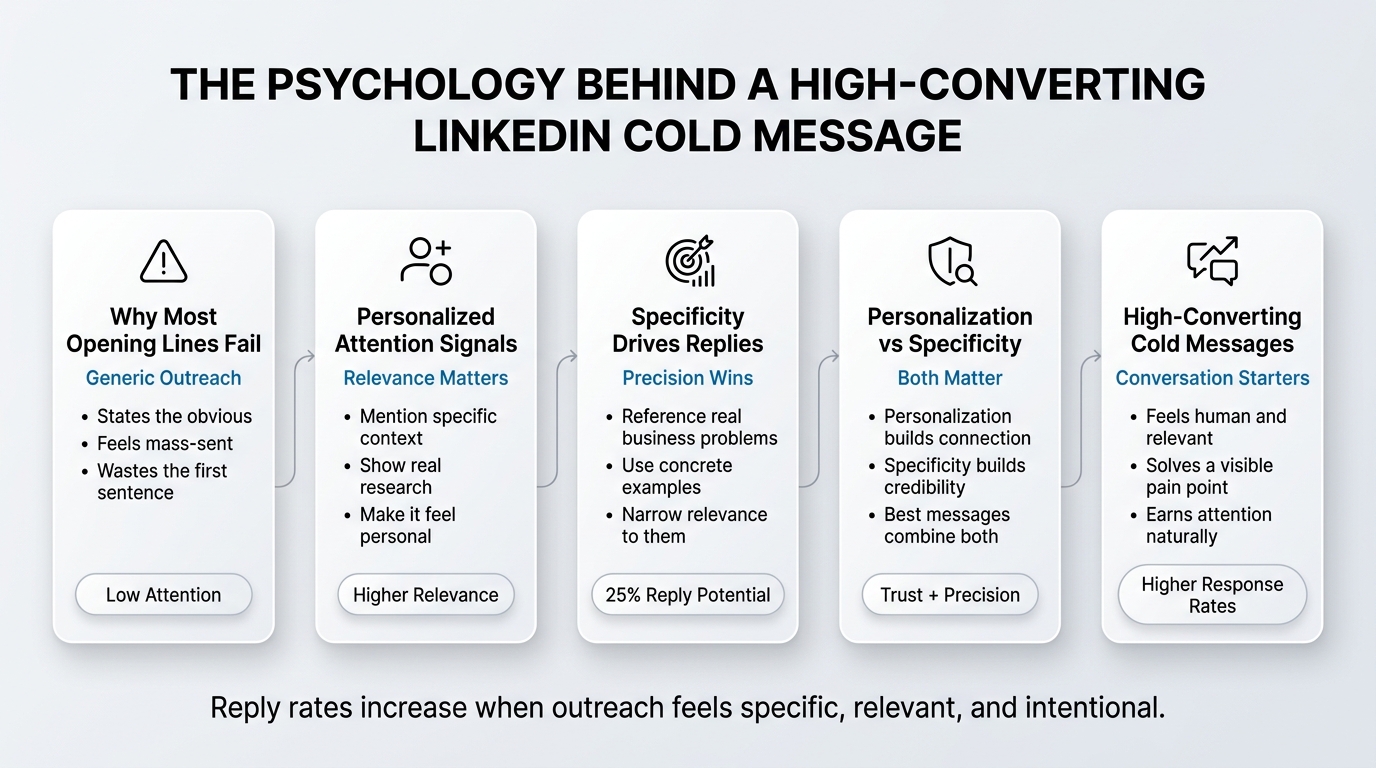
Before we get to the templates themselves, you need to understand the mechanics of why some cold messages land and others vanish without a trace. Most sales professionals jump straight to tactical advice, but if you understand the underlying psychology, you’ll be able to create and customize opening lines that work for your unique situation rather than blindly copying someone else’s template.
Why Most Opening Lines Fail
The average LinkedIn cold message opens with something generic. “Hi Sarah, I noticed you’re the VP of Sales at Acme Corp” or “I see you’re interested in sales automation.” These openers make a fundamental mistake: they state the obvious. Your prospect already knows they’re a VP of Sales. They already know what their own LinkedIn profile says. The opening line that begins with surface-level observation wastes the most valuable real estate in your entire message: the first sentence.
The failure happens because most opening lines try to do too much with too little. They attempt to show familiarity while simultaneously proving value while simultaneously asking for attention. It’s like trying to make a first impression by listing your accomplishments. It doesn’t work that way in person, and it doesn’t work on LinkedIn either.
Here’s what happens when someone receives a generic cold message: they make an instant judgment about whether this message is relevant to them personally or whether it’s part of a blast. They look for two signals. First, is there something in this message that only I would understand? Something specific enough that it couldn’t be sent to 50 other people in my role? Second, is there a clear reason given for why you’re reaching out to me specifically?
When both signals are weak or absent, the message gets dismissed. Not because your solution is bad, but because you haven’t justified the prospect’s attention investment yet.
What Separates a 25% Reply Rate From a 5% Reply Rate
The difference between a cold outreach campaign that generates a 25% reply rate and one that barely cracks 5% isn’t magic. It’s not even luck. It’s the depth of personalization embedded in your opening line combined with the specificity of your value claim.
Consider two opening lines to the same prospect:
Opening A: “I work with B2B SaaS companies to improve their sales efficiency.”
Opening B: “I noticed Acme just launched your product in three new European markets. Most teams see a 30% increase in sales ops complexity when scaling to new regions. I’ve helped companies like TechCorp simplify that process.”
Opening A makes a generic value claim. Opening B shows you understand a specific moment in this person’s business trajectory and you’ve seen companies face a specific problem at that exact moment.
Reply rates follow precision. The difference between a 5% reply rate and a 25% reply rate is typically the distance between generic and specific. High-performing opening lines include at least one element that makes the prospect believe you’ve looked at their account beyond just their job title.
That element might be a mention of a recent company announcement. It might be a reference to something they posted or commented on. It might be an acknowledgment of a specific business metric you found in their quarterly earnings. It might be a reference to someone they know. The key is that it narrows the scope of relevance from “all VPs of Sales” to “you specifically.”
The Role of Personalization and Specificity
Here’s a distinction that matters: personalization and specificity aren’t the same thing, though they often work together.
Personalization is about adapting your message to the individual. It means you’ve done research on them personally. You mention something from their profile, a post they made, a company milestone they were involved in. Personalization creates a moment where the prospect feels like you see them as a human, not a name on a list.
Specificity, by contrast, is about precision in your value claim. It means you’re not saying “sales teams struggle with retention” but rather “B2B SaaS companies with 50-200 employees typically lose 15% of their sales team annually due to burnout.” Specificity creates credibility because it proves you understand the exact problem, not just the general category of problem.
The most effective cold messages combine both. They personalize the outreach while being specific about the value. A message that personalizes but stays vague about value creates confusion. A message that’s specific about value but generic about personalization still feels like a blast.
When you understand this distinction, you can craft opening lines that do both simultaneously. The opening line becomes a proof point that you know this person’s situation well enough to have a worthwhile conversation with them.
What Makes a LinkedIn Cold Message Effective (The Science)
Psychology textbooks call it the “default to closure” phenomenon. When humans encounter something they don’t have context for, they stop processing and move on. It’s a survival mechanism. Your prospect’s brain is constantly evaluating whether continuing to read is worth the cognitive effort.
Every sentence in your cold message is an argument for why they should read the next sentence. Your opening line is the first argument in that series.
Curiosity Gaps and Pattern Interrupts
There’s a specific mechanism that makes someone keep reading something they didn’t ask for. It’s called a curiosity gap. Your brain notices a discrepancy between what it knows and what it’s being shown, and it tries to close that gap. A skilled opening line creates this gap intentionally.
Example of a curiosity gap: “Most B2B SaaS companies lose 30% of their new customer base in the first 12 months. But the companies we work with typically retain 85%.”
Why does this work? Because you’ve presented a reality that contradicts what the reader assumes is normal. Their brain wants to know how this is possible. That desire to understand creates forward momentum in the reading process.
A pattern interrupt is slightly different. It’s when you say or frame something in a way that breaks the established pattern of how cold messages usually work. Most cold messages follow a predictable structure: greeting, flattery, value claim, call to action. A pattern interrupt violates that expectation.
Example of a pattern interrupt: “I’m going to be blunt: most tools that claim to solve your problem will slow you down instead. Here’s why.”
Why does this work? Because it violates the expected politeness and indirectness of a typical cold message. The prospect isn’t expecting a cold outreach to be honest about limitations. That honesty creates a small moment of surprise that keeps them reading.
Addressing the “Who Are You” Objection Upfront
The moment someone reads your opening line, they ask themselves “who is this person and why should I care what they think?” This is the first objection your opening line needs to address.
You can address it in several ways. You can position yourself as someone with relevant experience (“I spent seven years as a VP of Sales before starting this company.”). You can position yourself as someone who works with similar companies (“I’ve helped 40+ B2B SaaS teams scale their sales operations.”). You can position yourself as someone who has studied the problem deeply (“I’ve analyzed hiring patterns across 500 B2B SaaS companies.”). You can position yourself as someone referred by someone they trust (“Sarah Chen suggested I reach out to you.”).
An opening line that skips this step makes it harder for your prospect to justify paying attention to you. They don’t yet have a reason to believe you have anything useful to say. In their mental framework, you’re just one of dozens of cold messages they receive every month.
The most effective opening lines address the credibility question without making it awkward or obvious. You’re not saying “trust me, I know what I’m talking about.” You’re showing it through specificity, through reference to shared experiences, through numbers that suggest you’ve done this before.
LinkedIn Cold Message Data: Reply Rates by Approach
The data on what works in LinkedIn cold messages comes from large-scale studies of outreach campaigns. Here’s what the research shows:
| Approach | Average Reply Rate | Industry Context | Key Insight |
|---|---|---|---|
| Generic value claim | 3-7% | All industries | Lowest performer. Feels like a blast to recipients. |
| Personalized but vague | 5-12% | All industries | Shows research but unclear why they should care. |
| Specific value + light personalization | 15-22% | B2B SaaS | Sweet spot. Combines proof of homework with clear relevance. |
| Curiosity-based opening | 18-28% | All industries | High performer. Creates momentum toward reading the full message. |
| Social proof + specific value | 20-32% | B2B SaaS | Strong performer. Addresses both credibility and relevance. |
| Reference-based (warm-ish) | 28-45% | All industries | Highest performer. Built-in credibility. Less “cold” technically. |
| Multi-message sequence | 35-55% | B2B SaaS | Sustained engagement. First reply rates lower but cumulative conversion higher. |
Notice that pure personalization without specificity typically underperforms. Many sales teams think they need to customize every element of the message, but the data suggests that specificity of value claim matters more than superficial personalization.
Also notice that reference-based outreach dramatically outperforms pure cold outreach. If you have any way to establish a warm connection, even a loose one, it’s worth finding before going with a pure cold message.
The sequence approach is interesting because it shows that the best results come from letting the conversation develop over multiple touches, not from perfecting a single message. The opening line’s job isn’t to close the deal. It’s to get a reply and start a dialogue.
The 10 Opening Lines That Convert (With Real Examples)
Now let’s look at 10 opening lines that consistently perform well. Each one is based on a different psychological mechanism. Each one has been tested and proven to work in real-world cold outreach campaigns. But more importantly, each one teaches you a principle you can apply to your own messaging.
For each opening line, I’ll show you the template, an example, explain the psychology, and give you a scenario where it works best.
1. The Value-First Cold Message
Template: “I’ve been working with [industry] companies on [specific problem], and I’m seeing something interesting: [insight]. Given [situation you know about their company], I thought you might find this relevant.”
Real Example: “I’ve been working with enterprise SaaS sales teams on rep burnout, and I’m noticing a pattern: the bottleneck isn’t training. It’s pipeline quality. The reps with high-quality leads stay 3x longer. I saw you recently scaled your team at Acme, so this might be worth a conversation.”
Why It Works: This opening establishes a pattern you’ve seen across multiple companies. You’re not selling; you’re sharing data. The prospect imagines themselves as part of your analysis, and they want to know if they’re following the pattern or if they’re an outlier. This taps into natural curiosity and the desire to understand their own situation compared to peers.
You’ve also addressed the credibility question by referencing work you’ve done with other companies. You’ve added a micro-reason why you’re reaching out to them specifically (their recent scaling). The value proposition is embedded but not aggressive.
Best For: Enterprise clients, established companies with measurable metrics, scenarios where you have industry data or benchmarks to reference.
Reply Rate Expectation: 15-20%
2. The Curiosity-Gap Cold Message
Template: “Most [commonly accepted belief] are actually backwards. Here’s why it matters for [their role/industry].”
Real Example: “Most marketing teams optimize for click-through rate first. But here’s the thing: your conversion rate matters 5x more. I was speaking with the CMO of TechFlow last week, and after we shifted their optimization lens, their cost per acquisition dropped 40% in two months.”
Why It Works: This opening reverses an assumption your prospect likely holds. It creates immediate dissonance. Their brain wants to know how you arrived at this conclusion because it contradicts their current understanding. The second sentence provides social proof (reference to another company) that makes it feel less like a provocative claim and more like a pattern you’ve actually observed.
The curiosity gap is powerful because it’s difficult to ignore. Your prospect doesn’t yet know if they agree or disagree with your statement, so they keep reading to gather information for that judgment.
Best For: Educational products, methodology-based services, scenarios where conventional wisdom is actually hurting your prospects.
Reply Rate Expectation: 18-25%
3. The Social Proof Cold Message
Template: “I work with companies like [name drop], and they’ve typically seen [specific result]. I noticed [something about your company that suggests you have similar goals], so I thought it might be worth a quick conversation.”
Real Example: “I work with companies like HubSpot, Notion, and Rippling on sales operations infrastructure. They’ve typically reduced their sales cycle length by 25% and ramp time for new reps by 40%. I saw that you’re scaling your sales team at Acme and recently opened three new regions, which usually creates operational friction. Might be worth a quick chat?”
Why It Works: This opening leads with proof. You’re not claiming you can help; you’re showing that similar companies have benefited from working with you. Social proof transfers credibility. Your prospect doesn’t yet trust you, but they trust the judgment of peers they respect. By naming specific companies, you’ve made your credibility verifiable.
The second part connects that social proof to their specific situation. It acknowledges that you understand their growth trajectory and the natural problems that come with it.
Best For: High-ticket services, B2B SaaS, scenarios where your customer roster includes recognizable names.
Reply Rate Expectation: 20-28%
4. The Problem-Recognition Cold Message
Template: “I’ve noticed [specific symptom that indicates the problem], which usually means [the underlying problem]. Most teams miss this until [negative consequence]. I wrote about this recently, here’s the link if you want the full breakdown.”
Real Example: “I’ve noticed your sales team has grown from 8 to 22 reps in the last 18 months, but your average deal size hasn’t increased. This usually means you’re scaling activity without scaling outcome. Most teams don’t realize this is a pipeline quality issue, not a team capability issue, until they’ve already spent 6 months and six figures trying to fix it the wrong way. I wrote about this pattern here.”
Why It Works: This approach puts your prospect in a specific diagnostic framework. You’re not saying “you have a problem.” You’re saying “I see these three symptoms, which typically point to this problem.” The prospect sees themselves in your description and becomes curious about whether they’re heading toward the negative consequence you mentioned.
The inclusion of a written resource gives them an easy way to engage further without committing to anything. It’s a soft ask that feels like value sharing rather than a pitch.
Best For: Consulting, strategic services, situations where the root cause of a problem is hidden or non-obvious.
Reply Rate Expectation: 16-22%
5. The Question-Based Cold Message
Template: “Quick question: when you hire a new sales rep, what’s your biggest bottleneck in getting them productive? Is it [option A], [option B], or [option C]?”
Real Example: “Quick question: when you’re scaling your sales team rapidly, what’s your biggest bottleneck in getting new reps productive? Is it (a) having the processes documented, (b) having someone trained to teach them, or (c) giving them a qualified pipeline to work?”
Why It Works: This opening is non-threatening. You’re asking a question, not making a claim. It invites the prospect to think about their own situation. The multiple choice options help guide their thinking while still leaving room for them to elaborate.
The beauty of this approach is that their answer to your question becomes the conversation. They’re not replying to your message. They’re participating in a diagnostic. The tone shifts from outbound sales to friendly consultation.
Best For: Educational programs, software tools, any scenario where understanding the client’s exact bottleneck is crucial to your pitch.
Reply Rate Expectation: 14-20%
6. The Reference-Based Cold Message
Template: “[Person they know] suggested I reach out to you. I was [working with/discussing with] them about [topic], and they mentioned you’d be a smart person to talk to about [angle]. The specific thing they thought was relevant: [detail].”
Real Example: “Sarah Chen suggested I reach out to you. I was discussing enterprise sales onboarding with her last week, and she mentioned you’d be a smart person to talk to about how they’re solving for distributed teams. The specific thing she thought was relevant: you’ve been experimenting with async training content.”
Why It Works: This approach is based on transferring trust from a known party to a stranger. Your prospect trusts Sarah’s judgment. That trust extends slightly to you because Sarah vouched for the conversation being worth Sarah’s friend’s time.
The specificity matters here. You’re not just saying “Sarah suggested I reach out.” You’re showing exactly what Sarah said and why she thought you two should talk. This proves it was a genuine recommendation, not a blanket “reach out to everyone in sales.”
Best For: Any situation where you have a warm introduction opportunity, high-ticket sales, scenarios where credibility is the main barrier.
Reply Rate Expectation: 28-45%
Note: This technically isn’t a pure “cold” message, which is why it has the highest reply rate. But many salespeople have access to warm introductions they don’t leverage.
7. The Scarcity-Based Cold Message
Template: “I typically work with [type of company], but I have one spot available this quarter for [specific type of project]. Given [research about their company], I thought you might be the right fit.”
Real Example: “I typically work with Series B and C SaaS companies on sales process optimization, but I have one spot available this quarter for someone scaling from $5M to $20M ARR. Looking at Acme’s trajectory, I thought you might be the right fit, but I wanted to check before the spot fills up.”
Why It Works: This approach works because it creates a reverse dynamic. Instead of you chasing them, it feels like they’re being selected. It invokes mild scarcity (you have limited spots) and creates a small sense of urgency (the spot might fill up).
The personalization is built into the statement that you thought they specifically were the right fit. It’s not a “are you interested?” It’s “I think you’re the type of client I actually want to work with.”
This approach works best when it’s truthful. If you claim you only take five clients a quarter but you’re reaching out to 100 people, it’s obvious and undermines your credibility.
Best For: Consultants, agencies, coaches, anyone with legitimately limited capacity.
Reply Rate Expectation: 16-24%
8. The Personalization-Depth Cold Message
Template: “I was looking at [specific thing on their profile or company], and I noticed [specific observation]. That’s pretty unusual because [insight about why it’s unusual]. I’m curious about [specific follow-up question].”
Real Example: “I was looking at the job descriptions on Acme’s careers page, and I noticed you’re hiring for three different variations of the same sales role with three different comp structures. That’s pretty unusual because most companies standardize comp at the same stage level to avoid internal friction. I’m curious about whether that’s intentional or if it’s just been a side effect of scaling quickly?”
Why It Works: This approach goes beyond surface-level research. You’re not mentioning something from their LinkedIn profile that 500 other salespeople could see. You’re showing that you’ve dug into details most people wouldn’t notice. You’re demonstrating that you actually care enough to understand their situation, not just their title.
The follow-up question is crucial. It’s not a yes-or-no question. It invites them to explain their thinking and share context you wouldn’t have access to otherwise. You’re positioning yourself as someone genuinely curious about their business, not someone trying to sell them something.
Best For: Complex B2B solutions, long-term partnership roles, scenarios where demonstrating genuine interest matters more than immediate conversion.
Reply Rate Expectation: 17-23%
9. The Contrarian-Take Cold Message
Template: “I know most people would tell you [common advice]. I’d actually push back on that, because [specific reason]. Here’s what I’m seeing instead: [alternative approach].”
Real Example: “I know most people would tell you to focus on hiring senior sales reps when you’re scaling. I’d actually push back on that, because senior reps often want autonomy and you can’t give them that when the process is still being built. What I’m seeing work better: hire hungry mid-market reps and build the process with them.”
Why It Works: This approach positions you as someone who thinks differently from conventional wisdom. It creates a moment of surprise because most cold messages agree with existing beliefs. Your disagreement, especially when backed by specific reasoning, stands out.
The contrarian take works best when you’ve identified something that actually contradicts conventional wisdom and where you have reasoning or experience to back it up. It doesn’t work as a pure attention grab if there’s no substance behind the contrarian position.
Best For: Thought leadership positioning, consulting, situations where you’re trying to shift how someone thinks about a problem.
Reply Rate Expectation: 16-24%
10. The Result-Focused Cold Message
Template: “I work with [type of company] specifically on [desired outcome]. The companies that usually see the biggest improvement are those [specific characteristic]. Since you [observation that suggests that characteristic], I thought we should talk.”
Real Example: “I work with B2B SaaS companies specifically on sales rep retention. The companies that see the biggest improvement are those willing to rethink their comp structure, not just tweak the existing one. Since you’ve scaled from 8 to 22 reps in 18 months and probably have some churn data you’re frustrated with, I thought we should talk.”
Why It Works: This approach leads with the specific outcome you deliver and the specific type of client who gets the best results. It narrows your focus rather than expanding it. Instead of “we help sales teams,” it’s “we help companies that are willing to make structural changes improve their retention.”
By stating upfront that the best results require a specific type of client characteristic, you’re self-qualifying the prospect. They either have that characteristic (in which case your message feels relevant) or they don’t (in which case they skip your message knowing it’s not for them). This is better for both parties than a generic pitch that might apply to anyone.
Best For: Professional services, any outcome-based business model, situations where you want to attract clients with specific mindsets or constraints.
Reply Rate Expectation: 15-22%
How to Personalize These LinkedIn Cold Message Templates for Your Audience
Having templates is valuable, but using the same template with every prospect will eventually plateau your results. The opening lines that work best are ones that you’ve adapted to your specific audience, industry, and ICP. Here’s how to customize these approaches without losing the core mechanism that makes them work.
Industry-Specific Customization
Every industry has different pain points, different KPIs, different growth patterns, and different vocabulary. A cold message that resonates perfectly with a SaaS CFO will fall flat with a CFO at a manufacturing company. They’re both CFOs, but they’re managing different constraints.
To adapt your opening line to an industry, you need to understand what success looks like in that industry and what the visible symptoms of struggle look like.
For example, “The Value-First” template works differently depending on industry:
For B2B SaaS: “I’ve been working with SaaS companies on customer expansion, and I’m seeing a pattern: the teams with the highest expansion revenue aren’t necessarily the ones with the smartest sales reps. They’re the ones who have sales and customer success actively aligned on expansion metrics.”
For Professional Services: “I’ve been working with consulting firms on utilization rates, and the pattern I’m seeing is clear: the firms hitting 80%+ utilization aren’t working harder. They’re working on better project selection and client fit upfront.”
For Healthcare: “I’ve been working with healthcare practices on patient acquisition, and what I’m noticing is that the growth bottleneck isn’t usually the marketing. It’s patient onboarding friction and retention.”
Notice that each version speaks to an industry-specific metric (expansion revenue, utilization rate, patient retention) and an industry-specific insight. The template structure remains the same. The content adapts to the world the prospect lives in.
To customize for your industry, ask yourself: What metric does this person’s boss care about most? What’s the one thing they stay awake worrying about? What does scaling look like for this company? What does failure look like? Use the answers to those questions to adapt your opening line.
Role-Based Variations
Even within the same company, a VP of Sales, VP of Operations, and VP of Customer Success have different priorities. A cold message that makes a VP of Sales lean in might make a VP of Operations tune out.
The same core insight can be presented differently depending on role.
For Sales Leadership: “I work with sales teams on rep retention, specifically helping you reduce early-career rep turnover. I noticed you’ve scaled your team significantly at Acme, which usually creates a retention challenge around months 6-12.”
For Operations Leadership: “I work with ops teams on sales process standardization, specifically reducing the ops overhead that comes with rapid sales team scaling. I noticed your team has grown quickly, and ops usually gets squeezed during that phase.”
For Revenue Leadership: “I work with companies on revenue predictability, specifically on the forecasting and pipeline quality issues that come with rapid scaling. I noticed you’re expanding your team, which usually creates visibility challenges.”
All three are reaching the same person about the same company, but the entry point differs based on what each role is responsible for. A VP of Sales thinks about retention and activity. Operations thinks about process and efficiency. Revenue thinks about predictability and forecasting.
To adapt your opening line by role, identify the specific metric or outcome that this role is measured on. What does success look like specifically for this person in their role? Use that as your frame.
Company Size and Growth Stage Considerations
A Series A startup and a public company have completely different operating constraints. A LinkedIn cold message that works for one won’t necessarily work for the other.
For early-stage companies, focus on growth speed and founder-led sales. These companies are moving fast, and they’re usually willing to try new approaches because they don’t have legacy processes yet.
Early-Stage Focus: “I work with Series A/B companies on the sales processes before they become scaling problems. At your stage, 90 days of process investment now saves 6 months of chaos later when you’re doubling your team.”
For mid-market companies, focus on scaling challenges and organizational complexity. These companies have built some process but often haven’t professionalized it.
Mid-Market Focus: “I work with 50-200 person SaaS companies specifically on the transition from founder-led sales to scalable sales operations. Most teams hit a ceiling around $10M ARR because their sales process hasn’t professionalized yet.”
For enterprise, focus on complexity, risk mitigation, and stakeholder alignment. These companies are more risk-averse and move more slowly.
Enterprise Focus: “I work with enterprise teams on complex B2B sales operations, specifically helping you align your sales, marketing, and customer success teams around common metrics. Most enterprises struggle with this alignment, which creates cost and cycle time issues.”
The growth stage determines what problems are actually top-of-mind. A Series A founder might be losing sleep over product-market fit. A VP of Sales at a Series C company is losing sleep over team scaling. An enterprise sales leader is losing sleep over complexity management. Adapt your opening line to the actual problem that keeps this person awake at their particular growth stage.
LinkedIn Cold Message A/B Testing and Optimization
Creating one great opening line is valuable. But your actual competitive advantage comes from testing multiple approaches, understanding which ones work for your specific audience, and continuously improving based on data. This is where most teams fail. They create a template, use it for six months, and never test variations.
What Metrics Actually Matter
Before you start testing, clarify what you’re measuring. Most teams track reply rate, but reply rate alone is misleading. You need to track several metrics simultaneously to get the full picture.
Reply Rate: The percentage of sent messages that receive a response. This is important, but it’s a vanity metric without context. A 20% reply rate means nothing if 90% of those replies are “not interested.”
Qualified Reply Rate: The percentage of replies that indicate genuine interest or engagement with your value proposition. This is more valuable than raw reply rate because it filters out politeness replies and automatic responses.
Meeting Booking Rate: The percentage of conversations that move to a scheduled call or meeting. This is your actual conversion metric. A message that generates a 25% reply rate but only converts 2% of replies to meetings is less effective than a message that generates a 15% reply rate but converts 15% of replies to meetings.
Cost Per Meeting: The total cost of your outreach campaign divided by the number of meetings booked. This is your ROI metric. It matters even more than reply rate because it accounts for your time or tool costs.
Quality of Booked Meetings: The percentage of booked meetings that actually convert to customers or advance in your sales process. This is the metric that actually determines whether your outreach works. A template that generates 100 booked meetings is useless if zero of them convert.
To set up meaningful testing, track at least reply rate, meeting booking rate, and cost per meeting. Track quality separately through your CRM.
Common A/B Test Mistakes
Mistake 1: Testing Too Many Variables at Once
If you change the opening line, the subject line, the body of the message, the call to action, and the send time all in the same test, you won’t know what caused the difference in results. You’ll just know that the new version performed differently.
Good A/B testing changes one variable and holds everything else constant. Test opening line against opening line. Then test body copy against body copy. Test sequencing separately. This takes longer, but it’s the only way to actually understand what works.
Mistake 2: Testing Without Statistical Significance
If you test two opening lines by sending 50 messages with each version, you might see a 20% difference in reply rates. But that difference could be random noise. Statistical significance requires volume. Most testing experts recommend at least 500 total messages across variations before drawing conclusions (250 per variation minimum).
Mistake 3: Testing Without Accounting for Audience Variation
Your ICP probably isn’t uniform. Founders have different pain points than VPs of Sales. Companies in different industries have different problems. If you test an opening line with a mixed audience and see mediocre results, you don’t know if the opening line is bad or if it’s just being wasted on the wrong audience segments.
Segment your testing by audience. Test the opening line with founders separately from VPs of Sales. Test with SaaS companies separately from professional services. This gives you insight into what works for specific segments, not just an aggregate number.
Mistake 4: Running Tests Sequentially Without Enough Time Per Test
Day-of-week matters for LinkedIn response rates. Monday might generate different reply rates than Friday. If you test an opening line for one week, switch to a different opening line for one week, and compare the results, the difference might be the day of the week, not the opening line.
Run tests for at least two weeks per variation. Better yet, run them in parallel with the same audience segments so timing effects cancel out.
How Long to Test Before Scaling
Once you’ve identified an opening line that outperforms your baseline, the question becomes: when do you scale it?
The answer depends on statistical confidence and on whether you’ve tested across your full audience segment.
If your baseline opening line has a 15% reply rate and you test a new opening line that generates a 20% reply rate with 300 total messages, scale it. The difference is meaningful enough and the sample size is large enough to have confidence.
If your new opening line has a 16% reply rate with the same sample size, it’s too close to call. The difference is within the margin of error. Run it longer before scaling.
The rule of thumb: you need a minimum of 5% absolute difference in your primary metric (reply rate or qualified reply rate) with at least 250 messages per variation before you should consider the test conclusive.
Also, test your winning opening line across different audience segments. An opening line that works for Fortune 500 companies might not work for mid-market. An opening line that works for technology companies might not work for professional services. Assume you need to adapt even your best performer for different segments.
When a LinkedIn Cold Message Isn’t Enough (The Full Sequence)
Here’s a truth that most cold outreach training skips: a single message almost never closes the deal. The best results come from a sequence of messages that builds on each other, each one adding information or creating a new reason to engage.
Most prospects need to see multiple touches before they convert. The opening line is the first touch. It’s important, but it’s just the beginning of a conversation.
Message 1: The Cold Open
This is your opening line in context. You’ve captured attention. Now you need to justify the prospect spending the next 30 seconds reading the rest of your message.
Your opening line did the work of getting attention. The rest of your first message does the work of proving relevance and credibility. It should be short, specific, and include a clear next step.
Structure:
- Sentence 1: Your opening line (8-12 words)
- Sentence 2-3: Context or proof (specificity about their situation or social proof)
- Sentence 4: Clear next step (a question, not a request)
Example: “Most B2B SaaS companies lose 30% of new hires within 12 months. But the ones we work with typically keep 85%. I’ve been talking to CTOs and VPs of Sales at companies like Figma and Notion about this. I know you’re scaling your team at Acme. Quick question: is rep retention something you’re actively working on right now, or is it on the back burner?”
That’s under 80 words and it does three things: opening line, credibility statement, and conversational next step.
Message 2: The Value Add
If they don’t reply to Message 1, most teams stop. That’s a mistake. Send a second message 3-5 days later that adds value without being pushy.
This message doesn’t reference the previous message. It stands alone. It offers something useful.
Structure:
- Open with a different angle or new information
- Provide value without asking for anything in return
- Soft call to action (usually just continuing the conversation)
Example: “I was thinking about your team’s growth trajectory at Acme, and I realized I have a resource that might be useful. We analyzed churn patterns across 50 SaaS companies and found three structural reasons why new reps leave in the first year. Most teams are only addressing one of them. If that’s useful, let me know and I’ll send it over.”
This message positions you as someone thinking about their problem even though they didn’t engage with your first message. It offers something concrete. It’s a soft ask.
Message 3: The Soft Close or Transition
This is your last message in the sequence before you move on. It acknowledges they haven’t replied (without calling them out for it). It either asks for a specific type of engagement or it transitions them to a different channel.
Structure:
- Acknowledge the lack of response without negativity
- Offer one more value point or ask one specific question
- Provide a clear path to continue the conversation
Example: “I realize I might have picked a bad time to reach out. No pressure at all. Before I let you go, I’ll leave you with this: the three biggest mistakes teams make during rapid sales scaling are usually locked in place before month three. If you’re thinking about this at all, I’m happy to spend 15 minutes on a call and share what we’re seeing.”
This message is honest. It acknowledges the lack of engagement. It offers one last reason to engage without being pushy. It provides a specific ask (15 minutes) rather than a vague “let’s talk.”
After Message 3, if they haven’t engaged, archive them and move on. Some prospects just aren’t in the market right now. Your job is to be visible when they are.
Tools and Workflows to Automate Your LinkedIn Cold Message Strategy
Once you’ve figured out which opening lines work for your audience, the question becomes: how do you deploy this at scale without turning every prospect into a templated message?
Manual vs. Automation
There’s a spectrum here, not a binary choice.
Pure Manual: You write every message individually for every prospect. This takes time (5-10 minutes per message), but every message is genuine and customized. Reply rates are typically 20-30% for skilled writers because the personalization is deep. It doesn’t scale well, but it works if your ICP is very small or your deal size is very large.
Hybrid Approach: You use templates with built-in customization fields. Your opening line is templated, but you customize the specific detail that makes it relevant to them. This takes 2-3 minutes per message and scales to 50-200 outreaches per week per person. Reply rates typically stay around 15-25% because the customization feels genuine even though the framework is templated.
Programmatic Automation: You use tools that automatically insert data about the prospect (company name, job title, recent hire, recent funding, etc.) into predetermined fields in your template. This takes 30 seconds per message and scales to thousands of messages, but reply rates typically drop to 8-15% unless your targeting is exceptionally tight. The automation is visible to prospects, and most people can detect when a message has been automatically populated.
Most high-performing teams use the hybrid approach. They’ve templated the core structure and the opening line, but they customize one or two data points that make it feel personal.
Account Safety and Compliance
LinkedIn has limits on how many messages you can send per day (roughly 40-50 personalized connection requests per day per account before you trigger rate limiting). They also monitor for spammy behavior patterns: identical messages, messages that get reported as spam, messages without genuine personalization, messages sent in rapid succession.
If you want to deploy a cold message strategy at scale without getting your account limited or suspended, you need safety mechanisms.
Basic Safety:
- Spread your outreach across multiple accounts (if you have them) rather than blasting from one account
- Space messages out across the day rather than sending them all at once
- Vary your message language and opening lines rather than using the same message for everyone
- Monitor your spam complaint rate and adjust messaging if it goes above 1%
- Include genuine personalization in every message, even if it’s just one fact about their company
Advanced Safety:
- Use warmup tools that mimic human behavior patterns (reply to messages, like posts, spend time on feed) before you send outreach messages
- Gradually increase message volume over time rather than going from 0 to 200 messages overnight
- Avoid messaging newly created accounts or people who have been inactive (LinkedIn sees those as likely spam targets)
- Don’t use LinkedIn’s direct mail feature for outreach; it’s monitored more closely
- Monitor LinkedIn’s own messaging for any warnings about unusual activity and ease back immediately if you see them
Account safety is the limiting factor for scaling cold outreach. Your message quality might be perfect, but if your account gets limited or suspended, none of it matters.
Scaling Personalization
The biggest challenge in scaling outreach is maintaining the personalization that makes messages work while increasing the volume you can handle.
Here’s the framework most professional teams use:
Layer 1: Tier Your Targeting Not every prospect in your ICP deserves the same level of customization. Your top 10% of targets (biggest logos, best fit for your product) get deep manual personalization. Your next 30% get hybrid personalization with customization on 1-2 key fields. Your bottom 50% get programmatic personalization with relevant targeting data automatically inserted.
Layer 2: Create Persona-Specific Templates Instead of one template for “VP of Sales,” create separate templates for “VP of Sales at funded startup,” “VP of Sales at public company,” and “VP of Sales at bootstrapped company.” Same core structure, different specific details and pain points referenced.
Layer 3: Use Enrichment Data Strategically Tools like Clay, Hunter, and Apollo can pull relevant data about a prospect automatically (recent job change, recent funding, recent company announcements, social media activity, employee count growth). Use this data to trigger different message templates.
Example: If someone just changed jobs to a new company, send a different opening line than someone who’s been in their role for 18 months. The opening line for someone who just started is about helping them ramp faster. The opening line for someone established is about optimizing what they’re already doing.
Layer 4: Personalization Workflows Use your CRM or automation tool to create conditional logic that adjusts your message based on available data.
If company size > 500: emphasize security and compliance If recent funding announcement: emphasize growth support If recently hired into role: emphasize ramp and productivity If established in role: emphasize optimization and efficiency
This approach scales personalization by being smart about which details matter most for different prospect segments.
Conclusion
A high-converting LinkedIn cold message isn’t magic. It’s not luck. It’s the result of understanding your prospect’s priorities, finding a specific reason they should care about your message, and delivering that reason in a way that makes them want to continue the conversation.
The 10 opening lines in this article each work because they solve a specific problem in the prospect’s mind: “Why should I read this instead of scrolling past it?”
The best opening line for your business is the one you test, measure, and continuously improve. Start with one template from the approaches above. Send 200-300 messages. Measure your reply rate. Compare it to your baseline. If it outperforms, scale it. If it underperforms, try another template.
The compound effect of using opening lines that convert is significant. If you improve your reply rate from 8% to 15%, you’ve effectively doubled the number of conversations you’re having without changing the volume of outreach. That difference compounds over weeks and months.
Your next step is to pick one opening line from the templates above that feels most natural for your ICP. Customize it for your specific situation. Send it to your next 20 prospects. See what happens. You’ll learn more from that small test than from reading another article about LinkedIn outreach.
Frequently Asked Questions
Q1: What’s the average reply rate for cold LinkedIn messages?
A: Industry benchmarks show that cold LinkedIn messages typically generate a 5-15% reply rate depending on targeting quality and message personalization. Messages with genuine one-to-one personalization and specific value claims typically perform at the 15-25% range. Messages that are obviously templated or mass-sent typically fall in the 3-8% range. Reply rate varies significantly by industry, company size, and the specific role you’re reaching.
Q2: How many cold messages can I send per day on LinkedIn without getting limited?
A: LinkedIn allows roughly 40-50 personalized connection requests per day per account before triggering rate limiting. This includes both connection requests and direct messages to existing connections. If you send more aggressively, LinkedIn temporarily restricts your ability to send messages (usually for 24-48 hours). To scale beyond this without getting limited, use multiple accounts, spread your sending across the day, and include genuine personalization in every message.
Q3: Should I connect first or message directly?
A: This depends on whether they’re already a connection. If you’re not connected, sending a cold message without connecting first won’t work because LinkedIn restricts direct messages to first-degree connections. Send a connection request with a personalized note first, then send your main message once they accept. If they’re already a connection, message directly without the connection request step.
Q4: How long should a cold LinkedIn message be?
A: Most effective cold messages are 50-150 words. Long enough to provide context and value, short enough to be scannable on mobile. Your opening line should be one sentence (8-15 words). Your opening line plus context should take no more than 3-4 sentences. If your message is longer than 200 words, you’ve lost the prospect. Shorter is better than longer, provided you’ve included the key elements: personalization, relevance, and a clear next step.
Q5: What’s better: connecting with a personalized note or sending a separate message after they accept?
A: Sending a personalized connection note is good because it explains why you’re reaching out. But the highest reply rates come from combining a personalized connection note with a follow-up message after they accept. The connection note gets them to accept. The follow-up message (which is longer and more detailed) makes them want to respond. Most teams skip the follow-up message, which is why they see low reply rates.
Q6: How do I know if my opening line is good without sending 500 messages?
A: Share your opening line with 10-20 people in your target role and ask for honest feedback. Send them the opening line in isolation and ask: “Would you read the rest of this message or skip it?” Also share it in your sales community or LinkedIn groups and ask for feedback. While this isn’t a perfect predictor, it gives you a gut check before you send at scale. The best test is still real-world data though, so create a small test batch (50 messages) to measure actual performance.
Q7: Does LinkedIn penalize automation tools or is manual outreach better?
A: LinkedIn doesn’t technically penalize the use of automation tools, but they do monitor for behavior patterns that look like mass spam. A properly configured automation tool that sends personalized messages with proper spacing and account warmup is virtually indistinguishable from manual outreach and performs similarly. The problem is that most automation tools are misconfigured and used at high volume without personalization, which triggers LinkedIn’s spam filters. If you use automation, configure it for proper personalization and account safety.
Q8: What’s the difference between a LinkedIn cold message and a LinkedIn connection request note?
A: A connection request note is the message that appears when you send a connection request. It’s limited to 300 characters. A cold message is sent after someone accepts your connection request and shows up in their main message inbox. The connection request note is your first pitch to get them to accept. The cold message is your opportunity to provide context and value once they’ve already decided to connect with you.
Q9: Should I mention my product or company in the opening line?
A: Generally no. Your opening line should focus on their problem or a relevant insight, not on your company or product. Mentioning your company or product name in the opening line makes the message feel sales-y and reduces the feeling that you’re reaching out as a human with a genuine observation. Mention your company later in the message or in the follow-up, once you’ve established relevance and credibility.
Q10: How do I handle objections in a cold message?
A: Don’t try to handle objections in your cold message. Your cold message’s job is to get a response and start a conversation, not to overcome every possible objection. If you try to address objections preemptively (“I know you’re probably thinking…”), it makes your message longer and less effective. Instead, wait for them to raise their specific objection in their reply, then address that specific concern. Cold messages that anticipate objections typically underperform compared to messages that focus on curiosity and relevance.
Q11: What’s the best day and time to send cold LinkedIn messages?
A: Tuesday through Thursday, between 9 AM and 11 AM in your prospect’s timezone, typically generates the highest reply rates. Monday morning is okay but not ideal because people are overwhelmed. Friday afternoon is weak because people are checked out. Early morning (before 8 AM) generates lower reply rates than mid-morning. Late evening generates lower reply rates because people aren’t actively checking messages. The variation between optimal timing and poor timing is usually 5-15% in reply rate, so while timing matters, a great message at a suboptimal time will still outperform a poor message at optimal time.
Q12: Should I personalize every message or use the same message for everyone?
A: Use the same message structure and opening line approach, but customize specific details for each person. This balance maximizes reply rates while remaining scalable. Every message should include at least one piece of personalization that couldn’t be sent to someone else: a specific company announcement, a recent job change, a reference to something they posted, a specific metric about their situation. This creates the feeling that you did research on them specifically, which is what drives high reply rates.
Q13: How many messages should I send before switching to a different opening line?
A: Send at least 50-100 messages with one opening line before evaluating whether it’s working. With fewer than 50, variance is high and you might abandon an opening line that’s actually good because of a small sample size. Once you’ve sent 100-200 messages with a consistent opening line, you have enough data to compare it against your baseline. If it outperforms, keep going. If it underperforms consistently, try a different approach.
Q14: What do I do if someone asks “Who are you and why are you reaching out?”
A: This is actually a good sign because they’re engaging with you. They’re asking a question, which means they read your message and want more context. Respond with a clear, honest answer: “I work with [type of company] specifically on [outcome]. The reason I reached out is [your specific reason].” Keep it to 2-3 sentences. This is where you can expand on credibility claims if you haven’t already.
Q15: Is cold messaging on LinkedIn still effective in 2026?
A: Yes, but with lower reply rates than 3-5 years ago because the platform is more saturated and people are receiving more cold messages. Well-executed cold outreach still generates 15-25% reply rates for quality messages sent to well-targeted prospects. However, the bar for “well-executed” has risen. Generic outreach that worked at 10-15% reply rates five years ago now generates 3-5% reply rates. The companies seeing the best results are those using more specific targeting, deeper personalization, and better opening lines. Cold messaging is still effective, but it requires more skill and precision than it used to.