


If you’re running a lead generation or sales development agency, you’ve hit this ceiling: more client revenue means you need more people. More people means more hiring, training, payroll overhead, and complexity. The economics break down fast. You either cap your growth or sacrifice margins.
But there’s another path. White label LinkedIn outreach changes this equation entirely.
Instead of hiring SDRs to run campaigns for your clients, you partner with a provider who handles the execution. You keep your client relationships, collect the revenue, and stay lean. Your clients think it’s your team. The provider does the work. The real magic is that you don’t have to choose between revenue growth and operational simplicity anymore.
This is not a new concept, but how agencies execute it has changed dramatically. The best performers are not just reselling commodity outreach anymore. They’re bundling white label LinkedIn outreach with strategy, positioning, list building, and follow-up orchestration. They’re treating it as a complete demand generation engine, not just a contact-to-connected tactic.
In this article, I’ll show you exactly how top-performing agencies are scaling without hiring, what systems they’re using, where the leverage actually comes from, and what mistakes kill most white label outreach partnerships. By the end, you’ll have a clear map for building your own white label outreach operation.
What Is White Label LinkedIn Outreach and Why Agencies Are Betting on It
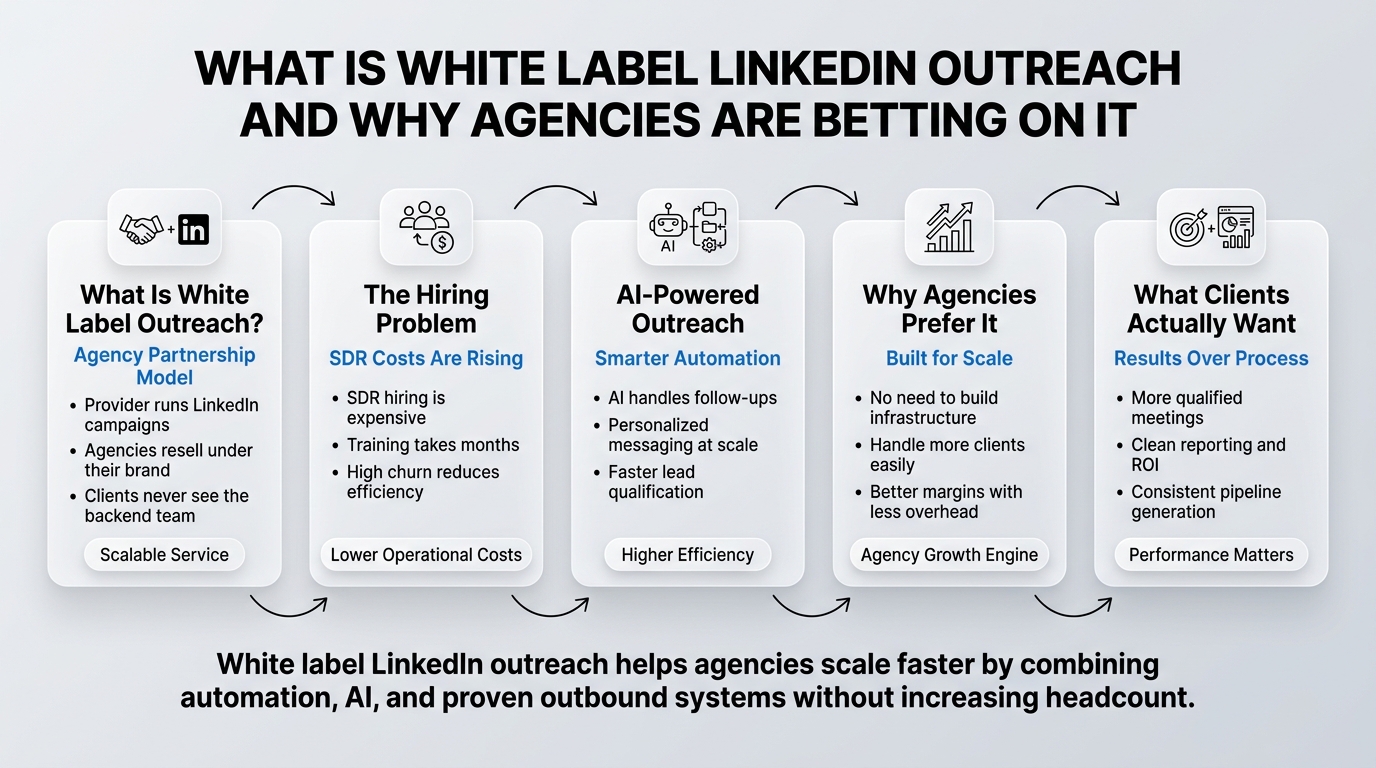
White-label LinkedIn outreach is a simple idea with complex execution: you partner with a service provider who runs LinkedIn prospecting campaigns on behalf of your clients, but under your brand. The client pays you. You pay the provider a fraction of what you charge. The difference is profit. The client never knows another company is involved unless you tell them.
The “LinkedIn outreach” part means connection requests, personalized messages, reply handling, and sometimes meeting booking, all executed through LinkedIn directly. It’s not email. It’s not a dialer. It’s LinkedIn-specific because LinkedIn is where decision-makers actually spend time and where cold outreach still works at reasonable scale.
Here’s why this model is gaining traction now, in 2026:
First, the hiring crisis is real. A competent SDR costs $50k to $80k annually in base salary plus $20k to $40k in benefits and overhead. You need 3 to 6 months to hire. Training takes another 2 to 4 months. Churn happens around 18 to 24 months. The all-in economics are brutal. A white label provider fronts all of that cost. You only pay for execution.
Second, AI-powered outreach has matured beyond hype. Three years ago, “AI outreach” meant templated messages that looked obviously automated. Now, tools handle follow-up conversations, personalization based on real prospect data, and even objection handling. A single person can oversee campaigns that would have required three SDRs six years ago. That efficiency compounds when you have 20 or 50 clients.
Third, scale creates pricing power. When a white label provider manages campaigns for 500+ clients across industries, they see patterns. They know what messaging works for SaaS. They know the reply rates for manufacturing. They can apply those patterns to your account. You get the benefit of that aggregated learning without doing any of the learning yourself.
Fourth, clients care about results, not who delivers them. A decade ago, clients wanted to see your team in the office. Now, they want proof that you booked meetings or generated SQLs. As long as the lead quality is there and your reporting is clean, nobody cares who hit the LinkedIn send button.
The result: agencies that adopt white label LinkedIn outreach are growing 2 to 3 times faster than those hiring SDR teams. They maintain higher margins because they’re leveraging a provider’s infrastructure instead of building their own. And they can take on clients of any size without proportionally scaling headcount.
The Economics Behind White Label LinkedIn Outreach: How Agencies Actually Profit
Let me walk through the math, because the profit model only works if you understand it clearly.
Baseline client contract: Let’s say you sign a client to a $3,000 per month LinkedIn outreach campaign. That’s a reasonable price point for B2B SaaS companies. You commit to running outreach for 60 prospects per week, tracking replies, and booking qualified meetings.
White label provider cost: You negotiate a rate with your white label partner. This varies widely. Budget between $600 and $1,500 per month depending on campaign complexity, volume, and how many accounts you’re running it from. Let’s use $1,000 for this example. That’s the outreach execution, tech platform, warmup, compliance handling, and basic reporting.
Your margin: $3,000 revenue minus $1,000 cost equals $2,000 profit. That’s 67% gross margin on each campaign. You’re not hiring. You’re not training. You’re just managing the relationship with the client and the white label provider.
The scale factor: Here’s where it gets interesting. Once you have five to ten clients running white label outreach, your operational overhead stays roughly the same. You still have one person reviewing reporting, maybe one person handling client strategy and weekly calls. Your time investment doesn’t scale linearly with client count.
At 10 clients generating $2,000 profit per month, you’re making $20,000 monthly profit on roughly 5 to 10 hours per week of actual management. At 20 clients, you might hit 40,000 monthly. At 50 clients (which is the practical ceiling for one operations person), you’re at $100,000 monthly profit.
Compare that to hiring SDRs: One SDR on your payroll costs $70k annually ($5,800 per month in full cost). One SDR can manage maybe 4 to 6 active client campaigns if they’re running full prospecting, messaging, and follow-up. That’s $5,800 in cost to generate maybe $12,000 to $18,000 in revenue (three to six campaigns at $3,000 each). Your margin drops to 50% to 68%, but now you have payroll risk, training costs, management overhead, and churn to deal with.
Here’s a comparison table showing the economics at different client volumes:
| Metric | 5 White Label Clients | 10 White Label Clients | 20 White Label Clients | 5 SDRs on Staff | 10 SDRs on Staff |
|---|---|---|---|---|---|
| Monthly Revenue | $15,000 | $30,000 | $60,000 | $18,000 | $36,000 |
| Cost of Outreach Execution | $5,000 | $10,000 | $20,000 | $29,000 | $58,000 |
| Gross Profit | $10,000 | $20,000 | $40,000 | -$11,000 | -$22,000 |
| Management Hours (per week) | 3 | 6 | 12 | 8 | 16 |
| Margin % | 67% | 67% | 67% | Negative | Negative |
| Payroll Risk | None | None | None | High | High |
The math makes the model obvious. White label is the lever that lets agencies grow without the overhead cliff of hiring. But there’s a hidden assumption here: you need to actually close and keep 20 to 50 clients. That’s the hard part.
Finding and Vetting White Label LinkedIn Outreach Providers: What to Look For
The quality of your white label LinkedIn outreach partner determines the quality of your client results. A bad partner makes you look incompetent. A good one makes you look like you have a world-class team.
Here are the core criteria you need to evaluate:
Campaign Execution and Reply Rates
Ask your potential provider for their average reply rates across client accounts. Real numbers. Not best-in-class. Not “up to 40%”. The average. A good provider should hit 8% to 15% reply rates on cold outreach campaigns across different industries. If they claim more than that, they’re either cherry-picking their best campaigns or lying. If they’re consistently under 5%, they’re not executing well.
Why this matters: reply rate directly drives pipeline. If a client expects booked meetings and you’re delivering 3% reply rates, you’ll lose them within two months. If you deliver 10%+ reply rates, they’ll stay and expand.
The second question is how they handle follow-up. Most white label providers run templated sequences. The good ones have frameworks for personalizing follow-up based on what the prospect said in their first reply. They understand that reply one is a yes or a no. Replies two through five are about handling objections. A provider that treats all replies the same is not doing this work.
Multi-Account Management and Scale
Can the provider manage campaigns across multiple LinkedIn accounts simultaneously? This matters because most platforms cap daily actions per account at around 50 to 80 connection requests. If you have a client who wants to reach 200 prospects per week, you need multiple accounts running in parallel.
Ask how many active accounts they run for clients. How do they rotate between accounts? How do they handle warmup? Can they spin up new accounts quickly if a client growth spikes? A provider that can easily handle 5 to 10 accounts per client has much more flexibility than one that caps you at a single account.
Compliance and Account Safety
This is non-negotiable. LinkedIn suspends accounts that look like bots or spam. Suspended accounts kill client campaigns and damage your reputation. Ask your provider:
- Do they use automated warmup before starting outreach?
- What daily and weekly limits do they enforce per account?
- How many campaigns can they run simultaneously per account without triggering flags?
- Have they had accounts suspended in the past month? How many?
- Do they have a playbook for re-activating suspended accounts?
A good provider treats account health like a critical metric. They should be able to tell you their suspension rate (mine sits at less than 1% per month across thousands of accounts). They should have clear rules about daily connection limits, message timing, and campaign pacing. They should never tell you “I can do 500 connections per day per account.” That’s a red flag for account risk.
Reporting and Transparency
You’ll be reporting these results to clients. You need a provider who gives you clean data you can understand and communicate. Ask for:
- Weekly campaign reporting including connections sent, acceptance rate, reply rate, and meeting bookings
- A shared dashboard where you can see live metrics
- Attribution: which prospects are which, what they replied, when meetings were booked
- Integration with your CRM so you’re not manually pulling data
Red flag: if the provider says they’ll send you a spreadsheet once a week and that’s it. You’re running client campaigns. You need visibility. A good provider integrates with HubSpot, Pipedrive, or the CRM of your choice.
Personalization Depth
The difference between “hi, let’s connect” and a message that shows you researched the prospect’s company is massive. Good providers can personalize based on: company size, industry, recent funding, job title, LinkedIn activity, and third-party data enrichment.
Ask if they use Clay, Apollo, or similar enrichment tools to pull in data. Ask how specific their personalization gets. Can they mention the prospect’s recent LinkedIn post or funding announcement? Can they acknowledge a specific pain point from their recent job change? This is what turns a 3% reply rate into a 12% reply rate.
Contract Flexibility and Minimum Commitments
Some white label providers lock you into 12-month contracts with high minimums. Others charge month to month. Neither is inherently better, but you need to understand the friction before committing.
If you’re new to white label outreach, start with a provider that lets you commit on a month-to-month basis for your first three to five clients. Once you understand the model and can predict client retention, you can negotiate longer contracts for better pricing.
Similarly, ask about setup fees, minimum monthly costs, and whether you pay per campaign or per month. A provider that charges $1,200 minimum per month with a $200 setup fee per client will put a floor on how lean you can operate early on. A provider that charges on a per-campaign basis gives you more flexibility.
Building Your White Label LinkedIn Outreach Service: The Operating System
Once you’ve chosen a provider, you need systems to manage the client side. This is where most agencies fail. They get a white label partner, sign some clients, and then chaos emerges. Someone forgets to send a strategy brief to the provider. A client asks for reporting and nobody knows how to pull it. Campaign messaging gets inconsistent.
Structure this like a product, not a service.
Client Onboarding Playbook
Before day one with your white label partner, you need a documented process for bringing on a new client. Document:
- What information you need from the client (ICP definition, target list size, company background, pain points, unique value prop)
- What you deliver to the provider (the brief, positioning, messaging templates, approval)
- What SLAs you’re committing to (turnaround time on campaign setup, how quickly you’ll respond to client requests)
- What success looks like (meeting bookings, reply rate targets, compliance expectations)
Put this in a Notion doc or a Loom video. When a new client signs up, you run them through it. No ad-hoc decisions. This prevents miscommunications that lose deals or blow up client relationships.
Weekly Reporting Dashboard
Create a simple dashboard your clients can see in real-time or that you send weekly. Include:
- Connections sent (cumulative and week over week)
- Acceptance rate (connections accepted as % of connections sent)
- Replies received (number and percentage)
- Meeting bookings (number and quality tier, if applicable)
- Average response time from prospect to reply
- Top performing messaging variations
Keep it simple. Clients don’t need 50 metrics. They need proof the campaign is working. Three to five metrics with a clear trend line do that.
Monthly Strategy Call Script
Have the same call structure every month. This gives clients confidence and makes your job repeatable. Here’s a template:
- Open with wins (specific meetings booked, deals closed if applicable, strong reply rates)
- Diagnose current performance (reply rate vs. target, meeting booking efficiency, list quality feedback)
- Iterate (adjust messaging, refine ICP, try new positioning, expand target list)
- Preview next month (what you’re changing, why, what results you expect)
This takes 30 minutes. It keeps clients feeling engaged. It also surfaces problems early, before they become reasons to cancel.
Compliance and Risk Management
Document your compliance standards with the white label provider. What happens if an account gets suspended? Who contacts the client? What’s the recovery plan?
Create a simple checklist for each campaign:
- Account warmup completed before outreach starts
- Daily connection limits set and monitored
- Messaging approved by compliance (no spam language, no urgency tactics that trigger filters)
- LinkedIn profile looks active (recent posts, profile picture, background, about section filled)
- Campaign pause triggers (suspension, negative client feedback, reply rate drop below threshold)
Compliance is boring until it’s not. One suspended account can tank a client relationship. Build systems that prevent it.
Scaling White Label LinkedIn Outreach Beyond 10 Clients: The Delegation Framework
At 10 clients, you can still run everything yourself. At 20, you’ll be frustrated. At 50, you’ll burn out. You need to delegate without losing quality control.
Here’s how the best agencies structure this:
Layer One: Campaign Manager (1 person, covers 15 to 25 clients)
This person owns the relationship with the white label provider and the client. They:
- Send weekly briefs to the provider (what clients need, any adjustments)
- Pull weekly reporting and forward to clients (sometimes with a personal note about wins)
- Jump on client calls and handle objections
- Monitor reply rates and flag campaigns that are underperforming
They’re not writing messaging or strategy. They’re a coordinator and relationship manager. A strong coordinator can manage 20 to 25 clients if they’re organized.
Layer Two: Outreach Strategist (1 person, part time, covers all campaigns)
This person owns messaging quality and campaign strategy across all clients. They:
- Review draft messaging from the provider before campaigns launch
- Suggest iterations based on client feedback or campaign performance
- Handle unusual requests (new targeting approach, pivot in positioning, competitive response)
- Build and maintain messaging templates by industry
This is a few hours per week once you have process. It scales across all clients.
Layer Three: White Label Provider (fully outsourced)
The provider executes campaigns. They’re not part of your team but are treated like a department. They report to your campaign manager. They receive weekly briefs. They have clear SLAs. The relationship is professional and bounded.
With this three-layer structure, you can manage 50 active white label LinkedIn outreach clients with two full-time people. The unit economics look like:
- 50 clients at $3,000 per month = $150,000 monthly revenue
- White label costs at $1,000 per client = $50,000 monthly cost
- Payroll (2 people at $60k + $30k) = $7,500 monthly
- Total cost = $57,500
- Gross profit = $92,500 monthly
- Margins = 62%
At that scale, you’re generating nearly a million dollars annually in gross profit with four people (two in-house, plus your white label provider team). That’s where the leverage comes from.
Mistakes That Kill White Label LinkedIn Outreach Partnerships
White-label LinkedIn outreach partnerships can fail quickly when there is poor communication, inconsistent lead quality, unrealistic expectations, or a lack of transparency between partners. This section explains the most common mistakes agencies make when managing white-label relationships, including weak onboarding, unclear reporting, overpromising results, and neglecting campaign personalization. It also provides practical strategies to build stronger partnerships that last long term and generate consistent client satisfaction.
Mistake One: Underpricing Your Service
Early on, you might charge $1,500 per month to get traction. You think it will be easy to raise prices later. It won’t be. Clients will resist. You’ll be stuck at low margins with high management overhead.
Price this like a product. $3,000 to $5,000 per month is the range for a real campaign that books qualified meetings. If you’re below that, either your white label costs are way lower than the market rate (unlikely) or you’ll bleed money.
Mistake Two: Not Defining Success Metrics Upfront
You start a campaign. Three weeks in, the client asks “are we on track?” You realize you never defined what “on track” means. Now you’re arguing about whether 5% reply rate is good or whether you need 10%.
Define success in the contract:
- We aim for X% reply rate (your benchmark based on industry)
- We’ll book Y qualified meetings per month
- We measure quality by Z (sales team feedback, sales cycle, close rate if you have visibility)
This prevents 80% of client disputes.
Mistake Three: Letting the Provider Communicate Directly With Your Clients
This is a subtle but critical mistake. If your white label provider talks to clients, the client relationship gets confused. The client starts comparing your provider to other vendors. They think about bringing the provider in-house. Your leverage disappears.
You own the client relationship. You own the communication. The provider talks to you. You talk to the client. This boundary is the whole white label model.
Mistake Four: Not Monitoring Campaign Quality
You sign the client. You hand it to your white label partner. You assume it’s working. Three months in, the client cancels because reply rates are 2%. You never caught it because you weren’t checking weekly.
Build a simple dashboard that flags red flags: reply rate below 7%, no meetings booked in two weeks, acceptance rate dropping below target. Check it every Friday. It takes 10 minutes. It will save you from losing clients to poor execution.
Mistake Five: Changing Messaging Too Frequently
Clients panic. Reply rate is 8% and they think it should be 15%. You change messaging. New campaign runs for a week. No improvement. You change it again. After six iterations, the campaign is a mess.
Messaging should run for at least two weeks, ideally a month, before you make major changes. The time lag between sending and getting replies means you need patience. Document this in your SLAs.
Mistake Six: Not Building Your Own Lead List Generation Capability
Most white-label outreach providers can find prospects, but they’re using standard databases (Apollo, Hunter, Clearbit, etc.). They’re not custom research. They’re not building targeted lists from industry associations or firmographic data.
As you scale, build a process to create custom target lists for clients. This becomes a competitive advantage. You can identify prospects that other vendors miss. Your reply rates improve. Your pricing power increases.
Hire someone or use a tool like Clay to enrich prospect data with company-specific insights. This might add $200 to $500 to your campaign cost, but it increases perceived value dramatically.
Mistake Seven: Treating White Label as a Commodity
The worst mistake is thinking white-label LinkedIn outreach is a commodity you can resell without adding value. It’s not. The client doesn’t care about white label. They care about getting meetings. Your job is to make sure the outreach campaigns actually work for their specific situation.
This means:
- Deep understanding of their ICP and buyer journey
- Testing and iteration on messaging
- Building lists smartly, not just using generic databases
- Learning from campaign data and feeding that back into strategy
When you add this layer, the white label becomes much more defensible. Competitors can’t undercut you because you’re not just executing campaigns. You’re strategizing.
Technology Stack for Managing White Label LinkedIn Outreach at Scale
Scaling white-label LinkedIn outreach requires a reliable technology stack that supports automation, reporting, collaboration, and campaign management. This section covers the essential tools agencies use for LinkedIn automation, CRM management, lead tracking, data enrichment, scheduling, analytics, communication, and workflow automation. Readers will learn how to build a scalable infrastructure that improves efficiency, maintains campaign quality, and supports multiple client accounts without operational bottlenecks.
Campaign Management and Reporting
Use your white-label provider’s dashboard as the source of truth for campaign metrics. If they don’t have a good dashboard, require them to build one or find a different provider. You need visibility into what’s happening without manually pulling reports.
If your provider doesn’t integrate with your CRM, build a simple pipeline using Zapier or Make to push campaign data into your system daily. This means your team sees campaign results alongside customer data.
Client Communication
Use Slack for quick communication with your white label provider. Use email for client communication and contract items. Use Loom for asynchronous video updates when you need to explain changes or celebrate wins.
Why Loom? Because a three-minute video showing campaign wins with real prospect names and reply excerpts is 10x more convincing than a spreadsheet.
Documentation and Process
Keep everything in Notion. Your onboarding checklist. Your campaign strategy template. Your client SLAs. Your provider brief template. Once something works, document it and reuse it. This is what lets you scale without custom processes for every client.
Meeting Scheduling
Use Calendly to let clients book monthly strategy calls with you. This reduces back-and-forth about scheduling and shows professionalism. It also creates a recurring touchpoint you can use to identify at-risk clients early.
Prospecting Data and List Building
Use Clay or Airtable to build custom prospect lists. Import from public sources (industry directories, funding databases, LinkedIn Sales Navigator, company websites). Enrich with Clearbit for company data and email finding tools like Hunter for contact info.
You don’t need to be fancy. A simple Airtable base with columns for: company name, decision maker, email, title, company size, industry, and notes is enough to work from.
Optional: Your Own White Label Platform
If you hit 50+ clients, consider building a very simple internal platform that clients log into to see their campaign metrics and request changes. You can build this in Webflow or use a simple Airtable form interface. The point is to create a branded experience that feels like yours, not like your clients are looking at generic provider software.
White Label LinkedIn Outreach vs. Building Your Own Team: When to Choose Each
This is the strategic question. Sometimes, white label is right. Sometimes, hiring is right. Most successful agencies eventually do both.
Choose white label if:
- You’re bootstrapped or early stage (less than $50k MRR). You can’t afford to hire and train an SDR team yet.
- You have fewer than 10 active campaigns. The operational overhead of hiring is not justified by volume.
- Your clients are highly variable in their needs (one wants B2B SaaS outreach, another wants real estate developer targeting). A white label provider can flex to different strategies faster than a team you trained for one approach.
- You want to test outreach as a service offering before committing payroll to it. White label is a lower-risk way to validate the market.
Choose hiring if:
- You’re profitable and ready to invest in building IP and differentiation. A team you build can learn your specific methodology and become a competitive advantage.
- You have consistent, repeatable campaign types. Once you’ve done 100 SaaS outreach campaigns, training an SDR to run your playbook is straightforward.
- You want to own the client relationship more directly. There’s less friction if the SDR is part of your team, not an external partner.
- You hit 30+ clients and margins are being compressed by white label costs. In-house becomes economics-competitive.
The hybrid model (most common at scale):
Run white label for 20 to 30 clients and hire one in-house SDR for 5 to 10 high-value clients where you want deep customization or IP development. The white label covers your revenue floor. The in-house team covers your differentiation ceiling. You get both leverage and control.
Conclusion
White label LinkedIn outreach is the most direct lever agencies have to scale revenue without scaling headcount proportionally. The economics are clear: 67% margins at scale, low operational overhead, and no hiring risk. But the execution is what separates agencies making $20k monthly profit from those making $100k+.
The difference is not the white label provider. It’s the systems you build around the partner. Your onboarding process. Your strategy rigor. Your reporting quality. Your ability to keep clients retained because results are consistently hitting target.
If you’re running an agency and want to grow beyond the ceiling of hiring salespeople, white label LinkedIn outreach is a proven path. Pick a provider that can execute reliably. Document your process. Hire one operations person to manage the client side. Then scale to 20, 30, 50 clients with predictable margins and sustainable growth.
Start small. Sign three clients on white label outreach. Run campaigns for three months. Review the economics. If client retention is above 80% and your margins are hitting the targets we outlined, expand to five clients. Then 10. Once you’ve proved the unit economics work, you can build the ops structure to scale to 50+.
The agencies winning right now are not the ones hiring the fastest. They’re the ones who figured out how to leverage partners, build repeatable systems, and let the model scale without them becoming a bottleneck. White label is how you do that.
Frequently Asked Questions
1. What’s the difference between white label LinkedIn outreach and reselling another tool?
White label outreach is a service you’re selling based on execution and results, not a software tool. You’re promising that campaigns will book X meetings or generate X pipeline, not that you’re giving them access to software. The provider handles execution. You own the relationship and the outcomes. Reselling software is giving them access to the platform and hoping they figure it out themselves.
2. How much can I mark up white label outreach services?
Mark up between 200% and 400%. If your cost is $1,000 per client per month, charge $2,500 to $4,000. The lower end works if you have high volume and low management cost per client. The higher end works if you’re adding strategy, custom list building, or AI-driven personalization on top of basic outreach. Avoid going below 2x markup or you’ll squeeze your own margins too tight.
3. How long does it take to see results from a white label outreach campaign?
Expect to see meaningful data by week two. The first five to seven days are typically low because prospects are still discovering the outreach. By day 10 to 14, you should see replies arriving and acceptance rates stabilizing. By week three to four, you’ll have enough data to assess whether reply rate is hitting target. Real meeting bookings usually start showing up in week three to six, depending on sales cycle length.
4. Can I run white label LinkedIn outreach campaigns for competitors?
Yes, unless your contract says otherwise. A good white label provider handles campaigns for competitors without issue because they’re using separate accounts and separate messaging strategies. The risk is client perception. If a prospect connects with both versions of the same outreach from two different agencies, it looks bad. Mitigate this by using different target lists, different positioning angles, or different messaging for competitor accounts.
5. What happens if a LinkedIn account gets suspended during a white label campaign?
A good provider has a recovery protocol. They pause outreach immediately, document what triggered the suspension (usually unclear, since LinkedIn rarely specifies), and wait 24 to 48 hours. Then they either reactivate the account or spin up a new one and resume the campaign. The campaign might lose a few days of momentum but should recover within a week. This happens to fewer than 1% of accounts per month with a quality provider.
6. How do I keep white label clients from wanting to hire the provider directly?
Keep the client relationship strong and yours. You own all communication. You own strategy. The provider is invisible. The client knows they’re hiring you for your expertise, not for access to an execution platform. If you stay strategically valuable and the provider stays invisible, the client has no incentive to disintermediate.
7. What metrics should I report to clients weekly?
Report five core metrics: connections sent, acceptance rate, replies received, reply rate, and meeting bookings scheduled. Include week-over-week comparison and cumulative progress toward monthly targets. Add a one-sentence insight like “reply rate increased 2 points this week due to messaging change.” Most clients need a three-minute dashboard review, not a 15-slide presentation.
8. Can I use the same white label provider for multiple client campaigns in the same industry?
Yes. The provider runs campaigns from different accounts with different messaging for different prospects. As long as you’re not targeting the exact same prospects with two different clients (which would look obvious and hurt your reputation), you can run parallel campaigns in the same industry. In fact, doing this lets the provider learn what messaging works for that industry and improve results over time.
9. What should I pay a white label LinkedIn outreach provider?
Negotiate between $600 and $1,500 per client per month. The lower end is for simple campaigns with provided prospect lists and templated messaging. The higher end is for complex personalization, multi-account management, and custom reporting. Most providers settle in the $800 to $1,200 range for mid-market deals. Always get a trial period of two to four weeks at a reduced rate before committing.
10. How do I know if a white label provider is taking shortcuts?
Watch reply rates. If they drop suddenly or are consistently below 5% across multiple client campaigns, something is wrong. Ask to see sample conversations or screenshot them yourself from LinkedIn. If messaging looks generic or the follow-up is templated without personalization, they’re cutting corners. A quality provider can show you high-engagement replies with real personalization and problem-solving in the follow-up.
11. Should I white label outreach myself or build an in-house team?
Start with white label if you’re early stage or testing the model. It’s lower risk and lets you validate client demand. Transition to in-house SDRs if you’re consistently profitable, have repeatable campaign types, and want deeper client customization. Most agencies do both: white label for scale and volume, in-house team for flagship clients and methodology development.
12. How do I prevent clients from canceling white label campaigns?
Set clear SLAs and hit them consistently. Deliver at least 70% of promised results by month two. Keep communication frequent and transparent. Celebrate wins, even small ones (first reply, first meeting booked). Address any performance gaps within 48 hours, not weeks. The number one reason clients cancel is radio silence combined with missing targets. Solve both of those and retention jumps above 85%.