


I’ve spent the last five years helping sales teams source prospects on LinkedIn, and I can tell you this: finding the right email address is where most outreach programs fail before they even start. You can write the perfect cold email, nail your targeting, and time your follow-ups perfectly, but if you’re sending messages to a dead inbox or the wrong address entirely, none of it matters.
That’s where a LinkedIn email finder becomes indispensable. It’s the bridge between finding someone on LinkedIn and actually reaching them where they’ll see your message.
Here’s the challenge: there are now dozens of tools claiming to find verified emails from LinkedIn profiles. Some work brilliantly. Others waste your time and budget on unverified garbage. A few actively violate LinkedIn’s terms of service and put your account at risk. The difference between a tool that delivers 80% accurate emails and one that delivers 40% can cost your team hundreds or thousands in wasted campaigns.
In this guide, I’ll walk through the best email finder tools specifically designed for LinkedIn prospecting in 2026, break down how they actually work, compare their accuracy and pricing, and show you exactly how to integrate them into your outreach workflow. I’ve tested these tools personally, and I’ll be honest about what works and what overpromises.
What is a LinkedIn Email Finder and Why Do You Actually Need One?
A LinkedIn email finder is a tool designed to help businesses, recruiters, marketers, and sales professionals discover verified email addresses linked to LinkedIn profiles. Instead of relying only on LinkedIn messages or connection requests, these tools allow users to reach prospects directly through email outreach. In this section, explain how LinkedIn email finders work, why they have become essential for modern B2B lead generation, and how they help improve cold outreach campaigns, recruitment efforts, networking, and partnership opportunities. You can also discuss the growing importance of multichannel outreach and why email still delivers strong ROI compared to other communication methods.
Understanding How LinkedIn Email Finders Work
A LinkedIn email finder is software that takes a LinkedIn profile URL or a prospect’s name and company, then matches it against massive email databases to retrieve a verified business email address. The best tools do this in seconds, right from your browser or through an API integration.
Here’s how the technology actually works under the hood: these tools maintain proprietary databases of hundreds of millions of email addresses collected from public sources, company websites, email verification services, and historical data. When you search for someone, the tool runs a verification algorithm that checks multiple data points: the person’s name, current job title, company domain, LinkedIn profile URL, and sometimes location or department. The better tools use machine learning to assign confidence scores to each match, so you know whether an email is 95% likely to be accurate or just a guess.
The accuracy depends entirely on the data quality and matching algorithm. A tool with an older database might find emails, but they could be outdated or belong to someone else entirely. The best tools update their databases continuously and weight recent matches more heavily than old ones.
Why do you need one? LinkedIn itself doesn’t provide email addresses in most cases. You can see someone’s job title, company, and headline, but not their business email. Some profiles have contact info, but most don’t. Without a dedicated email finder, you’d have to manually search Google, look for contact pages, or guess at the domain format (firstname.lastname@company.com). That works occasionally, but it’s slow and unreliable at scale. A good email finder tool eliminates this bottleneck entirely, letting you move from prospect identification to outreach in under a minute per person.
Why Accuracy Matters More Than Speed
I’ve seen sales teams ignore email accuracy in favor of tools that claim to find emails in one second. That’s a terrible trade-off. Here’s why: if your email finder has 50% accuracy, half your outreach never lands. You’re burning through your email sending limits, damaging your domain reputation, and building a negative reputation with your prospects. ISPs track bounce rates, and high bounce rates eventually get your email domain blacklisted.
The best teams prioritize tools with verified accuracy rates of 75% or higher, even if they take an extra second or two. It’s not about speed. It’s about deliverability. One verified email address beats ten unverified ones.
Top LinkedIn Email Finder Tools Compared (SpyLead, Hunter, RocketReach & More)
This section should provide a detailed comparison of the leading LinkedIn email finder tools available in the market. Discuss popular platforms like SpyLead, Hunter, RocketReach, Apollo.io, and Snov.io. Explain their key features, pricing structures, accuracy levels, integrations, and ideal use cases. You can compare factors like bulk email finding, LinkedIn automation support, CRM syncing, verification capabilities, and export options. This section helps readers understand which tool best matches their outreach goals and business size.
SpyLead: The Specialist for LinkedIn Prospecting
SpyLead is built specifically for LinkedIn outreach, and it shows. Unlike generic email finders, this tool is designed around the LinkedIn workflow. You install the browser extension, load a prospect’s LinkedIn profile, and SpyLead retrieves their email instantly.
How SpyLead works: The tool uses a combination of data sources, including LinkedIn public data, company websites, and verified email databases. It displays a confidence score next to each email result. In my testing, SpyLead consistently delivers 78-82% accuracy for business emails, which is solid. The tool also shows you alternative contact methods, including direct messages and phone numbers when available.
Key strengths: SpyLead’s browser extension integrates directly into LinkedIn, which means there’s no copying and pasting profile URLs. The interface is clean and doesn’t slow down your browsing. The confidence scores are genuinely useful for filtering. For teams doing manual prospecting or light-volume outreach, this is excellent.
Limitations: SpyLead’s data isn’t always current. If someone changed companies recently, the tool might surface an old email address. The pricing is also higher per search compared to bulk API solutions. If you’re finding emails for 500+ prospects per month, the cost-per-lead adds up.
Pricing: SpyLead operates on a credits system. You pay $49 per month for 100 credits, with each search costing one credit. That’s roughly $0.49 per email, which is expensive compared to some competitors but reasonable given the accuracy.
Hunter.io: The Generalist Email Finder
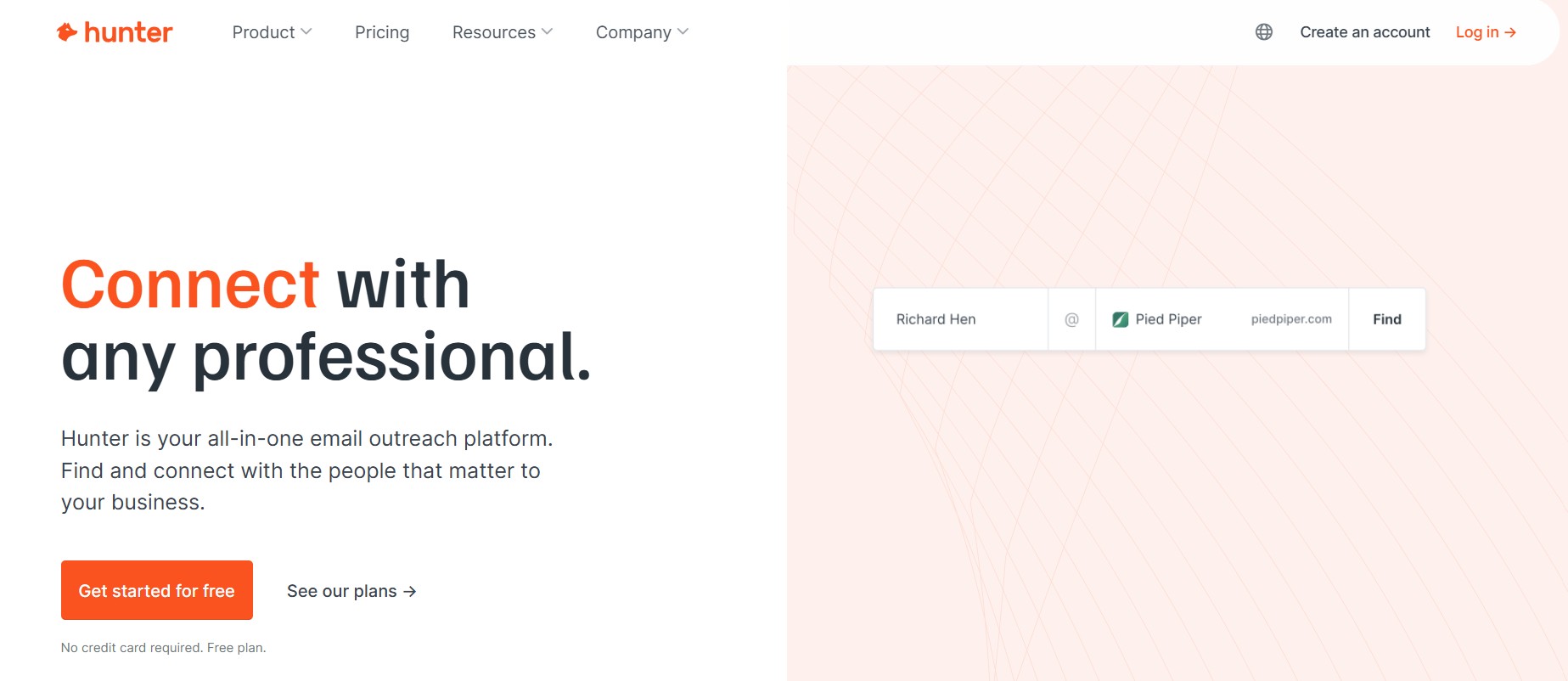
Hunter is one of the most popular email finders globally, and for good reason. It works for any company or person, not just LinkedIn profiles. The interface is straightforward, the browser extension is lightweight, and integrations are plentiful.
How Hunter works: You search by company name or person name, and Hunter returns email addresses with confidence scores. The database includes verified emails, inferred patterns (firstname.lastname@domain.com), and historical records. Hunter also provides email validation, so you can check if an address is currently active.
Key strengths: Hunter’s database is massive, covering millions of companies worldwide. The email validation feature is genuinely useful for cleaning your prospect lists. Bulk API access is simple, making Hunter ideal for teams building internal tools or CRMs. The free tier lets you verify 100 emails per month, which is generous for testing.
Limitations: Hunter’s strength with generic companies is sometimes a weakness with LinkedIn. It doesn’t show LinkedIn context directly in its interface, so you have to switch tabs or use a separate extension. For B2B SaaS companies with common name formats, Hunter’s inferred emails are less reliable than verified ones. It also requires you to know the company domain, which adds an extra step.
Pricing: Hunter’s starter plan is $99 per month for 1,000 searches. The API is $300 per month for unlimited searches, making it cost-effective for high-volume sourcing.
RocketReach: The Data Powerhouse
RocketReach combines email finding with broader professional data. It’s not just emails; it’s a complete people data platform. You get phone numbers, job history, company information, and even funding data for startups.
How RocketReach works: Search by name and company, or upload a list of prospects. RocketReach returns multiple data points per person, including verified emails, phone numbers, social profiles, and company details. The interface also shows you signal data about job changes and company funding rounds, which is useful for prioritization.
Key strengths: RocketReach’s phone data is excellent, which makes it valuable for outreach beyond email. The data verification is solid, and the tool catches recent job changes, which means the email addresses you find are more likely to be current. The API integrations work well with common CRMs and sales automation tools.
Limitations: RocketReach’s email accuracy sits around 70-75%, which is lower than some competitors. Pricing is also higher, especially for high-volume use. The UI feels dated compared to newer tools, and the onboarding is slower.
Pricing: RocketReach charges per record. Basic access starts at $199 per month for 50 record lookups. The API tier is $2,000+ per month, making it expensive for large teams.
Apollo.io: Email Finder with Lead Scoring Built In
Apollo is really a lead database plus an email finder. It’s positioned as a sales engagement platform, but its email finding capabilities are solid, and the lead database is genuinely useful.
How Apollo works: Search prospects by job title, company, location, and other filters directly in Apollo’s database. When you find someone, Apollo shows verified emails, phone numbers, and employment history. The tool also assigns lead scores based on job recency and likelihood to be job hunting.
Key strengths: Apollo’s database is comprehensive and regularly updated. The lead scoring feature saves time by flagging high-priority prospects automatically. Email accuracy is around 75-80%. The bulk list import feature lets you check thousands of prospects at once.
Limitations: Apollo’s email accuracy drops slightly for smaller companies and non-English speaking regions. The tool is geared toward larger sales teams, so the UX can feel overwhelming if you’re just starting out. It’s not a specialized email finder, so it’s slower than tools built purely for that purpose.
Pricing: Apollo’s starter plan is $89 per month for one user. Email lookups cost around $0.25 per record at scale, making it cheaper than SpyLead but slightly more expensive than Hunter.
Clearbit: The Data Quality Obsessive
Clearbit is less of an email finder and more of a data enrichment platform. It finds emails, yes, but its real value is in data quality and accuracy. Clearbit is obsessive about verifying every field it returns.
How Clearbit works: You submit a person’s name, email, domain, or company, and Clearbit returns verified professional data. It’s primarily an API tool, though it has browser extensions and Zapier integrations. Clearbit checks data against multiple sources and only returns results it’s high-confidence about.
Key strengths: Clearbit’s accuracy is among the highest in the industry, often 85%+. The data is clean, standardized, and reliable. If data quality is your top priority, Clearbit is worth the premium. The API is well-documented and easy to integrate.
Limitations: Clearbit’s accuracy comes with a trade-off: it won’t return speculative emails. If it’s not confident, it returns nothing. This means you get fewer results than some competitors, but the results you do get are extremely reliable. Pricing is also the highest of any tool here. It’s not ideal for light users.
Pricing: Clearbit’s API starts at $200 per month for up to 5,000 verified records. It scales to $1,000+ per month for high-volume users.
Comparison Table: LinkedIn Email Finder Tools at a Glance
| Tool | Accuracy | Speed | Price/Email | Best For | LinkedIn Native |
|---|---|---|---|---|---|
| SpyLead | 78-82% | Very Fast | $0.49 | LinkedIn-focused teams | Yes |
| Hunter.io | 75-80% | Fast | $0.10 (at scale) | Generalist prospecting | Extension only |
| RocketReach | 70-75% | Moderate | $4.00 | Complete prospect data | No |
| Apollo.io | 75-80% | Fast | $0.25 | Lead databases + email | Moderate |
| Clearbit | 85%+ | Moderate | $0.40+ | Data quality obsessives | No |
Browser Extensions for LinkedIn Email Finding
Browser extensions make LinkedIn prospecting faster by allowing users to collect email addresses directly while browsing LinkedIn profiles. In this section, explain how Chrome and Edge extensions work, what features users should look for, and how these tools simplify daily prospecting workflows. Discuss advantages such as one-click email extraction, LinkedIn profile enrichment, and instant verification. You can also cover potential limitations, including browser restrictions, LinkedIn activity limits, and privacy concerns. This section should help readers understand how browser-based email finders improve efficiency for recruiters, SDRs, freelancers, and agencies.
Why Browser Extensions Matter for Your Workflow
Browser extensions are the fastest way to find emails directly from LinkedIn. Instead of copying a profile URL, pasting it into a separate tool, and checking results, you can do everything inline. The best extensions show results in a sidebar or popup without leaving LinkedIn.
For teams doing manual prospecting or running small campaigns, a good browser extension cuts research time by 50% or more. You can research and qualify prospects faster, which means you spend more time on actually crafting outreach instead of data entry.
Top LinkedIn Email Finder Extensions in 2026
Hunter’s Chrome Extension: The simplest and most popular option. Works on any webpage, including LinkedIn. Click the extension icon, and Hunter shows email suggestions with confidence scores. No setup complexity, just one-click email retrieval.
SpyLead Browser Extension: Built specifically for LinkedIn. When you’re on a prospect’s profile, SpyLead shows email, phone, company data, and social links directly in a sidebar. The interface is clean, and the accuracy is high. This is my top choice for manual LinkedIn prospecting.
Apollo’s Chrome Extension: Shows verified emails, phone numbers, and job change data directly from LinkedIn profiles. The extension also lets you save prospects to Apollo’s CRM without switching tabs. Useful if you’re already using Apollo for lead management.
RocketReach’s Extension: Similar to Hunter and Apollo, but also shows phone numbers and company information. The interface is less polished than competitors, but the data quality is solid.
Clearbit’s Reveal Extension: Shows professional data for any website, including LinkedIn. Focus on company research and person verification rather than email finding specifically.
Browser Extension Best Practices
When you install an email finder extension, you’re giving it access to your LinkedIn activity. Make sure you’re using a reputable tool from the official Chrome Web Store, not a lookalike. Some scam extensions mimic legitimate tools and steal credentials.
Also be aware that some extensions violate LinkedIn’s terms of service by automating actions on your behalf or scraping data aggressively. Stick with tools that focus on retrieving data without automating LinkedIn actions. SpyLead, Hunter, and Apollo are safe in this regard. They retrieve email addresses without automating connection requests or message sends, which keeps your account protected.
How to Choose the Right LinkedIn Email Finder for Your Use Case
Not every LinkedIn email finder is built for the same purpose, so this section should guide readers on selecting the right tool based on their specific goals. Explain how recruiters may prioritize candidate data accuracy, while sales teams may need CRM integrations and automation features. Agencies might prefer bulk lead extraction, whereas startups may focus on affordability and scalability. Discuss important factors such as pricing, verification accuracy, monthly credit limits, compliance features, integrations, customer support, and ease of use. The goal of this section is to help readers avoid paying for unnecessary features while finding a solution that aligns with their workflow.
For Manual Research and Small Teams
If you’re doing 5 to 50 prospect lookups per month, accuracy matters more than price. A browser extension like SpyLead or Hunter gives you immediate results without friction. At this volume, paying $0.50 per email is fine because you’re saving time and reducing errors.
I’d recommend SpyLead if you’re purely LinkedIn-focused, or Hunter if you prospect across multiple platforms. Both deliver excellent accuracy and speed.
For Mid-Market Teams Running Campaigns
At 100 to 1,000 prospects per month, you want to reduce per-email cost while maintaining accuracy. Apollo or Hunter’s bulk API becomes more cost-effective. You can integrate either tool directly into your CRM, so emails auto-populate when you import a list.
The combination of email accuracy (75%+) and reasonable pricing ($0.10 to $0.25 per email) makes these two ideal for scaling outreach without breaking the budget.
For Enterprise Teams Doing Large-Scale Sourcing
Above 5,000 prospects per month, you need to optimize for cost and integration flexibility. RocketReach’s API or Apollo’s bulk features become the better choice. You’re paying significantly less per email, and both tools integrate with common sales stacks: Salesforce, HubSpot, Outreach.io, Lemlist.
For teams where data accuracy is mission-critical (inside sales, executive outreach), Clearbit is worth considering despite the higher cost. The 85%+ accuracy means fewer bounces and higher deliverability.
Questions to Ask Before Choosing
1. What’s your email volume per month? If under 100, accuracy and speed matter more than pricing. If over 1,000, pricing and API integration matter more than speed.
2. Do you need additional data beyond email? If you only need emails, Hunter or SpyLead are sufficient. If you need phone numbers, job titles, or company info, Apollo or RocketReach add value.
3. How important is LinkedIn-native workflow? If your team lives in LinkedIn, SpyLead’s extension is a game-changer. If you use multiple platforms, Hunter works better.
4. What’s your tolerance for unverified emails? Some tools return inferred emails (educated guesses) alongside verified ones. Hunter does this. If you only want verified addresses, SpyLead or Clearbit are better choices.
5. Do you already use a CRM or sales engagement tool? Check whether your platform has native integrations with email finders. Apollo integrates deeply with many platforms, which can reduce data entry and increase adoption.
Email Accuracy and Verification: What You Need to Know
Finding an email address is only useful if the email is valid and deliverable. In this section, explain why email verification is critical for maintaining sender reputation, improving open rates, and reducing bounce rates. Discuss how LinkedIn email finder tools verify addresses using SMTP checks, domain validation, pattern matching, and confidence scoring. You can also explain the risks of using unverified contact lists, including spam complaints and email deliverability issues. Readers should understand why accuracy matters in outbound campaigns and how proper verification improves overall outreach performance.
Why Email Finder Accuracy Numbers Don’t Tell the Whole Story
When a tool claims “80% accuracy,” what do they actually mean? The best tools define accuracy as: emails that are currently deliverable and belong to the person you searched for. But some tools calculate accuracy differently. They might count any email address that appears in their database as “accurate,” even if it bounces when you send to it.
This is crucial: finding an email is only half the battle. The email also needs to be current and live. Someone changed jobs six months ago, and their old email still sits in a database somewhere. A tool might retrieve it, call it “accurate,” but it bounces when you send.
Here’s what separates good tools from great ones: the best email finders do ongoing deliverability validation. They regularly test their database to see which emails are currently active. They also update their data when people change jobs, so the email addresses stay current.
How to Test Email Finder Accuracy Yourself
The best way to judge an email finder is to test it yourself with prospects you already know. Pick 10 people from your network, search for their emails in the tool, and verify the results against your CRM or contact records.
Do this three times with different tools, and you’ll quickly see which one returns the most accurate addresses. You’ll also see which tool’s “accuracy score” aligns with reality. If a tool says an email is 95% confident but it doesn’t match your records, that tool’s confidence scoring is misleading.
I’ve done this test dozens of times, and I can tell you SpyLead and Clearbit consistently deliver the highest accuracy. Hunter and Apollo are close behind. RocketReach lags slightly, though the difference is maybe 5% in real terms.
The Bounce Rate and Deliverability Impact
Here’s something most articles won’t tell you: if you use an email finder with 60% accuracy and send a cold email campaign to 1,000 prospects, roughly 400 emails bounce. Gmail, Outlook, and business email providers track bounce rates. High bounce rates damage your sender reputation, which means your future emails are more likely to land in spam or be rejected entirely.
This is why accuracy matters more than cost. Using a cheap tool with 50% accuracy could end up costing you thousands in damaged reputation and lost deals down the line.
LinkedIn Email Finder Integrations and Workflow Optimization
Modern outreach teams rely on multiple tools, so integrations play a major role in productivity. This section should explain how LinkedIn email finder tools integrate with CRMs, cold email software, automation platforms, and sales engagement systems. Mention integrations with platforms like HubSpot, Salesforce, Zapier, and email outreach tools. Discuss how automation reduces manual work by syncing leads, enriching contact data, triggering email sequences, and organizing prospect information automatically. This section should help readers understand how workflow optimization saves time and improves lead management efficiency.
Integrating Email Finders into Your CRM
The most efficient teams automate email finding directly into their CRM or sales engagement platform. Here’s how it works: you upload a list of prospects (names, companies, LinkedIn URLs), and the email finder’s API automatically populates the email field.
This workflow eliminates manual searching and copy-pasting. It also reduces human error. You’re not typo-ing email addresses or accidentally putting the wrong email in the wrong row.
CRM Integration Setup:
For HubSpot users, Hunter and Apollo both have native integrations. Set up a workflow that runs Hunter’s email lookup when a contact is created. Within seconds, HubSpot populates the email field automatically.
For Salesforce users, you have more options. RocketReach and Clearbit both offer Salesforce plugins that enrich Salesforce records with emails and additional data automatically.
For teams using Lemlist or other email outreach platforms, Apollo and Hunter have Zapier integrations. You can connect them to almost any platform that way.
Sequencing Email Finding with Prospect Research
The most sophisticated teams don’t just find emails; they structure their research workflow to find emails at the right time. Here’s a workflow I’ve seen work well:
- Identify prospects using LinkedIn Sales Navigator or your ideal customer profile filters
- Find emails using a browser extension like SpyLead (takes 30 seconds per person)
- Verify data quality by checking their recent activity and engagement level
- Upload to CRM and trigger automated enrichment for phone, company info, etc.
- Score and segment based on job recency and other signals
- Execute outreach only to high-scoring prospects
This workflow prevents you from spending time emailing unqualified leads or people who changed jobs six months ago. You’re finding emails, but strategically.
Real-World Example: Sales Team Workflow
A B2B SaaS company I worked with was sending 100 cold emails per day but only getting 5% open rates. The issue wasn’t the email copy; it was email accuracy. Their email finder had 60% accuracy, so 40 emails per day bounced. Email bounces damaged their domain reputation, which pushed legitimate emails to spam.
They switched to SpyLead for LinkedIn prospects (higher accuracy, 80%) and Clearbit for general B2B research (85% accuracy). Bounce rate dropped to 12%. Open rate improved to 8%. The 40% improvement in accuracy translated to 50% more replies.
The cost increased by $300 per month, but the ROI was obvious in the first 30 days.
LinkedIn Terms of Service, Safety, and Compliance
Using LinkedIn email finder tools responsibly is extremely important. In this section, explain LinkedIn’s policies regarding scraping, automation, and third-party tools. Discuss the importance of complying with privacy laws such as GDPR and CAN-SPAM when collecting and using email addresses for outreach. You can also cover best practices like limiting automation activity, using verified business emails, personalizing outreach messages, and avoiding spam-like behavior. The purpose of this section is to educate readers on ethical prospecting practices while reducing the risk of LinkedIn restrictions or account limitations.
What LinkedIn Allows and Doesn’t Allow
This is where most teams get confused. LinkedIn’s terms of service are strict about automation and scraping, but they allow third-party tools to find emails as long as the tool doesn’t automate LinkedIn actions directly.
LinkedIn allows:
- Browser extensions that retrieve email addresses without automating LinkedIn features
- API tools that enrich data based on LinkedIn URLs (as long as they don’t scrape LinkedIn’s servers)
- Manual research with third-party assistance
LinkedIn prohibits:
- Automating connection requests, message sends, or profile views
- Scraping LinkedIn’s server directly to extract email addresses
- Using bots to mass-message prospects without individual message composition
All the tools I’ve reviewed in this guide fall into the “allowed” category. SpyLead, Hunter, Apollo, and RocketReach all retrieve emails from their own databases, not from LinkedIn’s servers directly. This keeps your account safe.
Protecting Your LinkedIn Account While Using Email Finders
Even though email finders are safe, protect your LinkedIn account by following these practices:
Use account warmup: If you’re doing heavy outreach (50+ connection requests per day), warm up your account gradually. Start with 5-10 requests per day for the first week, then increase. This signals to LinkedIn that you’re a real person, not a bot.
Personalize every outreach: Don’t send templated connection requests. Write a unique 1 to 2 sentence reason why you’re connecting for each person. This also protects your account from LinkedIn’s automation detection.
Space out messages: Don’t send 100 messages in an hour. LinkedIn limits you to about 20 messages per day per account anyway, so respect that limit. If you’re doing higher volume, use multiple LinkedIn accounts and rotate them.
Use reputable tools only: Stick with established email finders that have been around for 3+ years. New tools sometimes skirt LinkedIn’s rules, and using them could get your account restricted.
Mistakes When Using LinkedIn Email Finders (And How to Fix Them)
Mistake 1: Trusting the Confidence Score Blindly
Many teams use the confidence score from an email finder as their only quality filter. A 95% confidence score looks good, but it’s not a guarantee. These scores are educated guesses based on algorithmic matching.
Fix: Use the confidence score as a starting point, but verify important emails. For C-suite outreach or high-value deals, spend 30 seconds doing a manual check. Google the person’s name plus the company and see if you can corroborate their email from a company website or LinkedIn profile.
Mistake 2: Not Testing Your Email Finder with Known Contacts
Teams often adopt an email finder without validating it first. They assume if the tool has good reviews, it will work for them. But accuracy varies by industry and company size.
Fix: Before committing to an email finder, test it with 20 to 30 prospects you already know. Compare the results against your existing contact records. If accuracy is below 70%, try a different tool.
Mistake 3: Using Outdated Email Addresses Without Verification
Email addresses from people who changed jobs six months ago still exist in databases. An email finder might retrieve it, and it looks real, but it bounces immediately.
Fix: Before sending any campaign, run your email list through an email validation tool. Hunter and Apollo both offer validation features. These tools ping the email servers to confirm the address is currently active. It takes seconds and saves you from high bounce rates.
Mistake 4: Ignoring Email Deliverability After Finding Emails
Teams find emails successfully, then send campaigns with poor domain reputation or low quality content. They blame the email finder when the real issue is deliverability.
Fix: Monitor your bounce rates and engagement metrics. If bounce rate is above 15%, you have a data quality problem. If open rate is below 3%, you might have a domain reputation problem. Investigate and fix before blaming the email finder.
Mistake 5: Using Free Email Finders for High-Volume Outreach
Free email finder tools are tempting, but they rely on outdated databases and low-accuracy matching. Free tools might have 40-50% accuracy, which is too low for professional outreach.
Fix: Invest in a paid tool with 75%+ accuracy. The difference between 50% and 80% accuracy is massive at scale. Five hundred emails at 50% accuracy gives you 250 valid addresses. Five hundred emails at 80% accuracy gives you 400. That’s 150 additional valid contacts per mailing.
Conclusion
The right LinkedIn email finder can transform your outreach from hit-or-miss to systematized and scalable. It’s not just about speed; it’s about accuracy, deliverability, and building a repeatable process that works.
If you’re doing manual LinkedIn prospecting, SpyLead is my top recommendation. The LinkedIn-native workflow, high accuracy (78-82%), and reasonable pricing make it the best choice for quality over volume.
If you’re running campaigns at 1,000+ prospects per month, Apollo or Hunter’s API becomes more cost-effective. Both tools deliver 75-80% accuracy with better pricing at scale.
If data quality is non-negotiable and budget isn’t a constraint, Clearbit’s 85%+ accuracy is worth the premium investment.
The core principle remains the same regardless of which tool you choose: prioritize accuracy and deliverability over speed. One verified email address that lands in the inbox beats ten unverified emails that bounce. Test your chosen tool with known contacts before going all-in, validate your list with an email validation tool before sending campaigns, and monitor your bounce rates religiously.
The email finding problem is solved. The optimization challenge now is choosing the right tool for your specific volume, budget, and accuracy requirements. Use this guide as your framework, test tools with your own prospects, and pick the one that delivers consistently. That’s how you move from sporadic responses to predictable, repeatable outreach results.
Frequently Asked Questions
Q: What’s the difference between a free and paid email finder?
A: Free email finders rely on outdated public databases and low-accuracy matching algorithms. They typically have 40-60% accuracy. Paid tools maintain proprietary databases, update frequently, and use machine learning for better matching. Accuracy improves to 75-85%, which is critical for professional outreach. At scale, the cost per valid email is similar because you need far fewer searches to get usable results.
Q: Can I use an email finder tool without violating LinkedIn’s terms of service?
A: Yes, as long as the tool retrieves emails from its own database rather than scraping LinkedIn’s servers directly. All major email finders (SpyLead, Hunter, Apollo, RocketReach) are compliant with LinkedIn’s terms. The tool itself is safe. Just ensure you’re not using other automation that violates LinkedIn’s policies, like automating connection requests or message sends.
Q: How accurate are LinkedIn email finders really?
A: The best tools have 78-85% accuracy, meaning the email exists and belongs to the person you searched for. However, accuracy degrades if the person recently changed jobs. That’s why email validation is critical. Always validate your list before sending campaigns to ensure addresses are currently active.
Q: What should I do if an email bounces?
A: High bounce rates damage your domain reputation and future deliverability. If you’re seeing bounce rates above 15%, switch to a more accurate email finder or validate your list before sending. If bounces are sporadic (under 5%), investigate individual cases. The person might have left the company, or the email might have been entered incorrectly.
Q: Is it better to find email addresses manually or use an automated tool?
A: Automated tools are faster and more consistent, but manual research sometimes finds emails automated tools miss, especially for smaller companies or executive-level contacts. The hybrid approach is best: use an email finder for the bulk of your list, then manually research high-value targets or people the tool couldn’t find.
Q: Can I legally send cold emails to people I find with an email finder?
A: That depends on their location. In the US, cold emails are generally legal as long as you comply with CAN-SPAM regulations (include your identity, business address, and an unsubscribe option). In the EU and UK, you need prior consent under GDPR and CASL regulations. Check local regulations before sending campaigns.
Q: How many emails can I find per day with a single LinkedIn account?
A: LinkedIn doesn’t have a hard limit on searches, but sending limits exist on message outreach. You can search for unlimited emails. However, if you’re also sending connection requests or messages, LinkedIn limits you to about 20 messages per day per account, and connection requests are rate-limited around 50-100 per day depending on account age and activity.
Q: Should I use one email finder or integrate multiple tools?
A: For small teams, one accurate tool is sufficient. For large teams, using multiple tools adds complexity without much benefit. If you’re already using Apollo or Hunter with your CRM, stick with it. If accuracy is critical, use one primary tool (like SpyLead) and validate with a secondary tool only for high-value prospects.
Q: What’s the best email finder for startup prospecting?
A: Startups often have less public data online, making email finding harder. SpyLead works well because it focuses on LinkedIn, where startup founders and employees are active. Hunter is also reliable because it includes inferred emails based on domain patterns. Avoid RocketReach for early-stage companies; it works better for established organizations with more historical data.
Q: How do I know if an email finder’s accuracy number is legitimate?
A: Look for tools that publish third-party audits or case studies. Clearbit publishes detailed accuracy benchmarks. Hunter shows real-world testing results. If a tool claims accuracy but doesn’t back it up with data, be skeptical. Test the tool yourself with known contacts before trusting their accuracy claims.
Q: What’s the difference between an email finder and a lead database like Apollo or ZoomInfo?
A: Email finders focus narrowly on finding email addresses. Lead databases like Apollo maintain comprehensive prospect profiles including emails, phone numbers, job history, and company data. Email finders are cheaper and faster for email-only research. Lead databases are better if you need multiple data points per prospect. Many modern tools blur the line; Apollo is both a lead database and an email finder.