


If you’ve been using Outreach.io and found yourself staring at an invoice that seems to grow every quarter while the platform gets more complicated, you’re not alone. Sales teams across the globe — from lean startups to mid-market companies — are actively looking for tools that deliver similar (or better) results without the enterprise price tag, the rigid contracts, and the months-long onboarding process.
The good news? The sales engagement landscape in 2026 has matured significantly. A new generation of tools has emerged that handles everything from LinkedIn automation to high-volume cold email to full multichannel outreach — often at one-fifth the cost of Outreach. Whether you’re a solo founder doing your own prospecting, an SDR team scaling outbound, or an agency managing campaigns for multiple clients, there is now a purpose-built tool designed exactly for your workflow.
In this guide, we break down the 8 best Outreach.io alternatives in 2026. We’ve researched each tool, pulled pricing data from verified sources, and compiled real user feedback so you can make a fully informed decision. Dealsflow leads the list as our top pick for LinkedIn-native outreach, followed by seven additional tools covering every major outreach channel and budget.
Best Outreach.io Alternatives at a Glance (Quick Comparison Table)
Before diving in, here’s a quick snapshot of all 8 tools so you can identify your best fit immediately.
| Tool | Best For | Starting Price | Free Trial | Key Channel |
|---|---|---|---|---|
| Dealsflow | LinkedIn outreach automation | $49/mo | ✅ 14-day | |
| Apollo.io | All-in-one data + outreach | Free / $49/user/mo | ✅ Free plan | Email + Data |
| Instantly.ai | High-volume cold email | $37/mo | ✅ Free trial | |
| Reply.io | Multichannel sequences | $49/user/mo | ✅ 14-day | Email + LinkedIn + Calls + SMS |
| Salesloft | Enterprise sales engagement | ~$140/user/mo | ❌ No | Email + Calls + CRM |
| Lemlist | Personalization-first outreach | $69/user/mo | ✅ 14-day | Email + LinkedIn |
| HubSpot Sales Hub | Teams in the HubSpot ecosystem | $20/user/mo | ✅ Free plan | Email + CRM |
| Smartlead.ai | High-volume agency cold email | $39/mo | ✅ 14-day |
What Is Outreach.io? (And Why Are Teams Walking Away in 2026?)
A Quick Overview of Outreach.io
Outreach.io is one of the original enterprise sales engagement platforms. It helps sales reps manage and execute activities across email, calling, LinkedIn, and SMS through a centralized workspace. Beyond sequencing, Outreach has expanded into conversation intelligence (powered by its Kaia AI tool), deal management, pipeline forecasting, and AI agents through its Amplify module. The platform is used by large organizations, with clients including SAP, Siemens, and Snowflake.
On paper, it is comprehensive. But that comprehensiveness comes at a steep price — and it’s increasingly difficult to justify for teams that don’t operate at true enterprise scale.
The Real Problems Teams Are Running Into
Despite its capabilities, Outreach.io is consistently one of the most complained-about platforms in the sales tech space. Here is what real users are flagging on G2, Capterra, Reddit, and third-party pricing analysis sites.
1. Pricing Opacity and Shock
Outreach does not publish its pricing. You must request a demo, speak to a sales rep, and negotiate before you ever see a number. Based on data from Vendr’s marketplace, MarketBetter’s analysis, and multiple independent review sites, a 50-user Outreach deployment lists at approximately $72,000 per year — or roughly $120 per user per month — before add-ons. The Standard Plan starts at around $100 per user per month, while the Professional plan is estimated between $120 and $140 per user per month. Enterprise plans can exceed $160 per user per month.
Additionally, Outreach’s Amplify credit system for AI features is consumption-based, meaning heavy AI users can see costs spike unpredictably month to month. There are also mandatory annual contracts — no monthly billing option — and implementation fees that range from $1,000 to as high as $8,000 depending on team size and complexity.
2. Brutal Learning Curve
Multiple G2 reviewers note that new SDRs take two to four weeks to become productive on Outreach. The platform has grown complex over the years, and the interface can feel overwhelming. One G2 reviewer wrote: “The interface is not intuitive — there are so many features that new hires get lost.” This learning curve has a real cost: it adds training hours, slows ramp time for new hires, and often requires a dedicated sales ops administrator to manage the platform.
3. Overkill for Non-Enterprise Teams
Outreach was built for enterprise. Modules like deal management, revenue forecasting, and the Amplify AI agents are powerful — but mid-market and SMB teams frequently pay for these features without ever using them. If your team’s primary need is running outbound sequences and booking meetings, you’re paying a significant premium for capabilities that won’t move your pipeline.
4. Poor Email Deliverability Controls
Compared to platforms built specifically around cold email (like Instantly.ai or Smartlead), Outreach has limited native warm-up and inbox management capabilities. There is no website visitor identification built in, meaning teams still need separate tools to identify who is engaging with their outreach — at an added cost of $500 to $2,000+ per month according to MarketBetter’s 2026 cost analysis.
5. Rigid Integrations and Walled Ecosystem
Outreach integrates natively with only five CRMs, which can create significant friction for teams not on Salesforce or HubSpot. Data enrichment, lead sourcing, visitor identification, and LinkedIn outreach all require separate subscriptions, inflating the true total cost of ownership well beyond the per-user license fee.
How We Evaluated These Outreach.io Alternatives
To ensure this comparison is genuinely useful — not just a list of tool names — we assessed each platform across five core criteria that matter most to outbound sales teams in 2026.
1. Cost Transparency and Value for Money
We looked at whether pricing is publicly available, whether the advertised price reflects the real total cost, and how the platform’s pricing scales as a team grows.
2. Email and LinkedIn Deliverability
We examined each tool’s built-in mechanisms for protecting sender reputation — including warm-up features, inbox rotation, dedicated IPs, and cloud-based versus browser extension-based LinkedIn automation.
3. Ease of Setup and Use
How long does it take to get your first campaign live? How steep is the learning curve for a new SDR? We looked at real user feedback from G2 and Capterra on onboarding experience.
4. AI and Personalization Capabilities
Does the tool help personalize outreach at scale? Does AI assist with writing, sequencing, or prospect research? We evaluated the depth and quality of AI features across each platform.
5. Multichannel Outreach (Email + LinkedIn + Calling)
In 2026, single-channel outreach is increasingly less effective. We noted which channels each tool covers natively versus which require additional add-ons or manual workarounds.
The 8 Best Outreach.io Alternatives in 2026
#1. Dealsflow — Best Outreach Alternative for Safe, Scalable LinkedIn Outreach
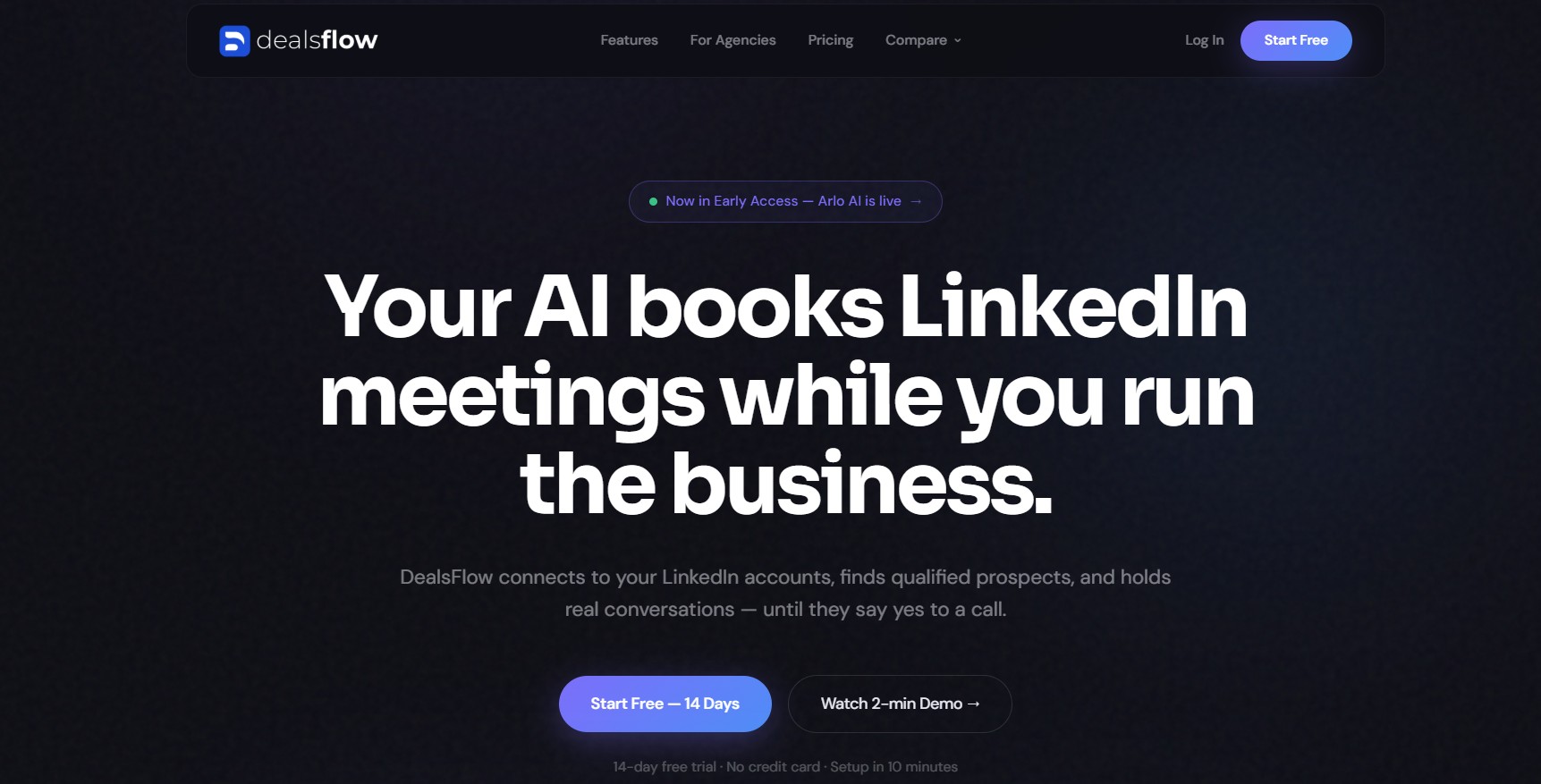
Dealsflow is a cloud-based LinkedIn outreach automation platform that describes itself as “the OS for modern LinkedIn outbound sales.” Where most Outreach alternatives focus on cold email, Dealsflow is purpose-built for LinkedIn — the channel where most B2B buyers are actually active and reachable in 2026.
The platform is trusted by hyper-growth sales teams across a wide range of industries and is used by professionals at companies including Amazon, Google, Microsoft, and Stripe. It takes a deliberately simple approach: connect your LinkedIn, import your target list, and let the AI do the rest. According to Dealsflow’s website, setup takes just three minutes, and the platform offers a 14-day free trial with no credit card required.
What makes Dealsflow stand out is its commitment to account safety. While most LinkedIn automation tools rely on browser extensions that mimic user behavior from your local machine (creating a high risk of LinkedIn account restrictions), Dealsflow runs entirely in the cloud with dedicated residential proxy IPs assigned per account — significantly reducing the risk of detection or banning.
Key Features of Dealsflow
- Advanced Drag-and-Drop Sequence Builder: Dealsflow’s campaign builder allows users to design complete LinkedIn outreach workflows through a visual drag-and-drop interface. You can set up profile views on Day 1, send a connection request one hour later, and follow up automatically once the connection is accepted — all on a precise, customizable timeline. This level of workflow control eliminates the manual clicking that typically consumes four or more hours per day for SDRs doing manual LinkedIn outreach.
- Dedicated Cloud IP Security: Every Dealsflow account is assigned a dedicated residential proxy IP that operates around the clock, even when your computer is off. This mimics genuine human behavior and stays within LinkedIn’s usage limits, protecting your account from warnings and restrictions. This is a fundamental advantage over browser extensions like older LinkedIn automation tools, where the automation only runs when the browser is open and the behavior patterns are far easier for LinkedIn to detect.
- AI Personalization (LinkedIn Copilot): Dealsflow’s AI reads each prospect’s LinkedIn profile — their bio, job history, recent activity, and experience — and automatically generates hyper-personalized icebreakers for connection requests and follow-up messages. According to customer testimonials on Dealsflow’s website, this AI-driven personalization has helped users improve their LinkedIn connection acceptance rates from 15% to nearly 40%. Generic “I’d love to connect” messages are replaced with context-aware openers that feel genuinely human.
- Unified Smart Inbox: When you’re running 100+ automated connections per day, managing replies across LinkedIn’s native inbox becomes chaotic. Dealsflow’s Smart Inbox consolidates all replies from active campaigns into a single, centralized view. It also automatically unenrolls prospects when they reply, preventing the awkward experience of a prospect receiving a follow-up message after they’ve already responded — a common problem with less sophisticated automation tools.
- Import Flexibility: Users can feed Dealsflow their target list in two ways: by dropping a Sales Navigator search URL directly into the platform, or by uploading a CSV of LinkedIn profile URLs. Dealsflow handles all prospect management, enrichment tracking, and sequencing from there.
Dealsflow Pricing
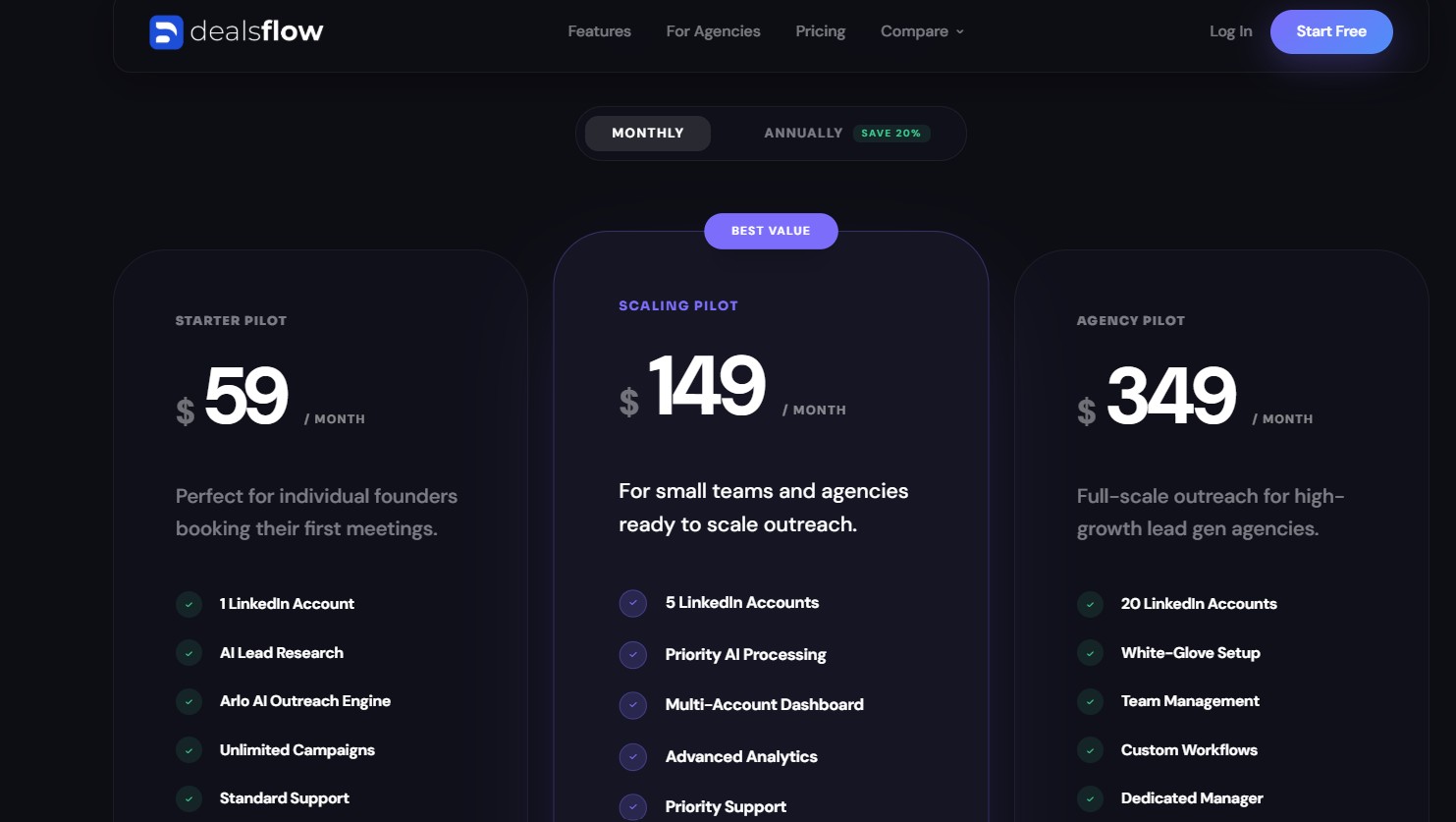
One of Dealsflow’s strongest differentiators versus Outreach is its pricing transparency. Unlike Outreach, there is no “contact sales for pricing” friction — all plans and costs are published openly.
- Starter Plan — $59/month: Covers one LinkedIn account with a dedicated cloud IP, the basic campaign builder, and standard analytics. Ideal for solo founders and individual SDRs.
- Professional Plan — $149/month: Expands to three LinkedIn accounts with the advanced campaign builder, AI-generated connection requests, detailed analytics and reporting, and priority email support. This is the recommended plan for most growing sales teams.
- Enterprise Plan — $349/month: Built for large teams and agencies, covering 10+ LinkedIn accounts along with white-label reports, the Smart Inbox Copilot, a dedicated success manager, and custom API access.
Annual billing saves 20% across all plans. There are no long-term contract lock-ins beyond the annual billing commitment — a stark contrast to Outreach’s mandatory annual contracts regardless of billing cycle.
Dealsflow vs. Outreach.io: Side-by-Side
| Factor | Dealsflow | Outreach.io |
|---|---|---|
| LinkedIn-native automation | ✅ Core feature | ❌ Requires manual tasks |
| Pricing transparency | ✅ Published openly | ❌ Demo required |
| Starting price | $49/mo | ~$100/user/mo |
| Free trial | ✅ 14-day, no card required | ❌ No |
| Cloud-based account safety | ✅ Dedicated residential IPs | N/A |
| AI personalization | ✅ Per-prospect icebreakers | Add-on (Amplify credits) |
| Contract flexibility | ✅ No lock-in | ❌ Annual contracts required |
| Setup time | ~3 minutes | Weeks of onboarding |
Who Should Choose Dealsflow?
Dealsflow is the right choice for founders, SDRs, B2B agencies, and mid-market sales teams whose primary outreach channel is LinkedIn. If you’re currently spending hours per day manually sending connection requests, copying and pasting messages, or worrying about LinkedIn restrictions from unsafe browser extensions, Dealsflow solves all three of those problems simultaneously — at a price point that is a fraction of Outreach.
#2. Apollo.io — Best All-in-One Alternative (Data + Outreach Combined)
Apollo.io is a sales intelligence and engagement platform that combines a massive B2B contact database with built-in outreach sequencing tools. The core value proposition is that it eliminates the need for separate data subscriptions — instead of paying for ZoomInfo or Lusha to find contacts and then paying for a separate tool to run sequences, Apollo handles both in one platform.
According to Apollo’s own documentation and verified third-party reviews, the platform’s database contains over 275 million contacts. Apollo has a G2 rating of 4.7 out of 5 based on more than 9,000 reviews as of early 2026, making it one of the most widely reviewed tools in the sales intelligence space.
Key Features of Apollo.io
- Contact Database with Advanced Filtering: Apollo’s 275M+ contact database supports highly specific filtering by job title, company size, industry, tech stack, location, revenue, and more. Users can build targeted lead lists directly inside the platform without exporting to a separate tool. The waterfall enrichment approach — pulling from multiple data providers to maximize coverage — results in solid email accuracy, though user reviews on G2 and Capterra consistently note that real-world email accuracy hovers around 65-70%, with bounce rates between 15-25%. Teams running high-volume campaigns may want to supplement Apollo data with a third-party email verification tool.
- Multichannel Sequences (Email, Calls, LinkedIn Tasks): Apollo allows users to build multi-step outreach sequences combining email, phone calls, and LinkedIn task reminders. However, it’s important to note that Apollo’s LinkedIn features are task-based reminders, not true automation — you still manually send connection requests and messages. This is safer for your LinkedIn account but does undermine the “multichannel automation” promise for LinkedIn-heavy workflows.
- AI Conversation Intelligence: Apollo includes AI-powered call summaries, conversation analysis, and prospect research features that help reps prepare for calls and review what happened during them. AI prompts can also be written to identify and automatically add hot prospects to outreach sequences.
- CRM Sync (Salesforce, HubSpot): Apollo integrates natively with Salesforce and HubSpot, syncing contact data and activity logs. However, each contact sync uses an export credit, which can become a significant cost factor for teams that rely heavily on CRM synchronization alongside their outreach workflows.
Apollo.io Pricing
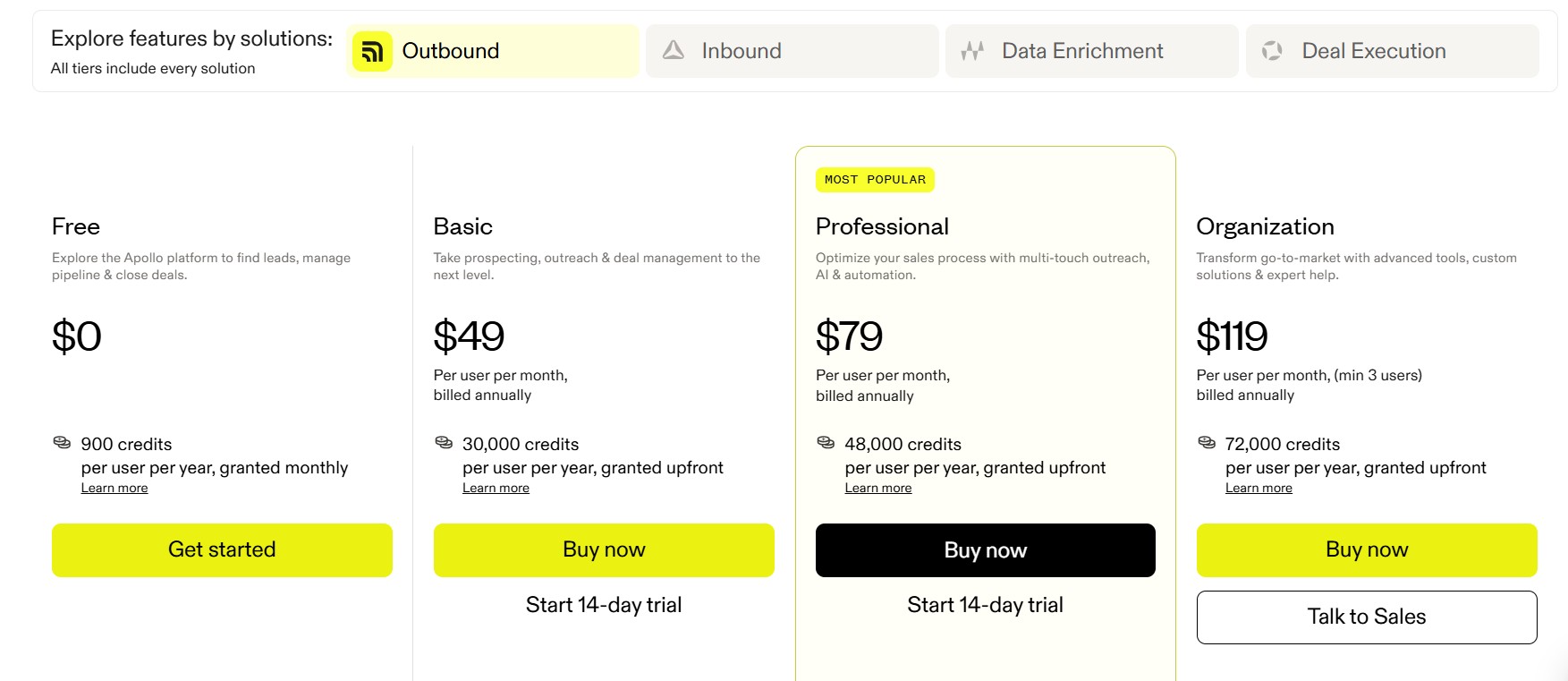
Apollo follows a tiered, per-user, per-month pricing model based on annual billing. Monthly billing adds 15-25% to each tier.
- Free Plan: Access to the database with very limited credits (5 mobile credits, 10 export credits per month) and two active sequences. Suitable for testing the platform.
- Basic Plan — $49/user/month (annual): Substantially increases prospecting capabilities with access to the dialer, call recording, and A/B testing for email sequences.
- Professional Plan — $79/user/month (annual): Adds the US dialer, more credits, and advanced reporting. Recommended for scaling SDR teams.
- Organization Plan — $119/user/month (annual), minimum 3 users: Adds the international dialer, custom reports, advanced API access, and stronger security settings.
An important caveat flagged by multiple 2026 pricing analyses (including Salesmotion and Persana AI): the credit system is the real cost driver. Credits expire at the end of each billing cycle with no rollover or refund. Overage credits cost $0.20 each with a minimum purchase of 250 credits. Teams that rely heavily on phone numbers (which cost 8 credits per contact vs. 1 credit for email) can see real-world costs run two to three times the advertised rate.
Apollo.io vs. Outreach.io: Which Wins?
Apollo wins for teams that need prospecting data and outreach in one tool, want a free entry point to test the platform, and are not ready to pay enterprise prices. It is particularly well-suited for startups and mid-market teams that do not yet have a dedicated data provider. Outreach wins for large enterprise teams that need deep Salesforce pipeline management, governance controls, and full revenue forecasting built into their engagement platform.
Summary Verdict
Apollo.io is the strongest all-in-one alternative for teams who want to consolidate their data and outreach stack. It’s accessible, scalable, and far more affordable than Outreach. Just budget accurately for credit consumption, and plan for supplemental email verification if your campaigns require high deliverability.
#3. Instantly.ai — Best Alternative for High-Volume Cold Email Deliverability
Instantly.ai is a cold email automation platform founded in 2021 that has grown rapidly to serve over 40,000 customers. Its core innovation is a flat-fee pricing model that includes unlimited email account connections — meaning instead of paying per seat or per inbox, you pay one monthly fee and connect as many sending accounts as you need, routing campaign sends across all of them simultaneously.
This model is transformative for deliverability. Rather than sending 2,000 emails from one domain (a fast path to spam folders), Instantly routes volume across 10, 20, or more connected inboxes, distributing the load and protecting sender reputation. For agencies running cold email on behalf of multiple clients, or SDR teams managing large outbound programs, this approach provides significant infrastructure advantages.
Key Features of Instantly.ai
- Unlimited Email Account Connections with Inbox Rotation: All paid plans allow unlimited email accounts to be connected. Instantly automatically rotates sending across connected inboxes to prevent any single domain from carrying excessive send volume. This is the platform’s defining feature and its primary competitive advantage for high-volume senders.
- Automated Email Warm-Up: Instantly’s built-in warm-up network runs automatically as soon as you connect an inbox. It gradually increases send volume and simulates genuine engagement activity to build sender reputation before campaigns go live. G2 reviewers consistently cite this as one of Instantly’s most valuable features, with one reviewer stating: “The most helpful is the email warmup, which is very useful to not go to SPAM.”
- Unibox (Unified Inbox): When running campaigns across dozens of connected inboxes, managing replies from each account individually is impractical. Instantly’s Unibox consolidates all replies into a single view, with AI Custom Reply Labels that categorize responses as Interested, Not Interested, Out of Office, or custom labels. The system automatically flags replies that need human attention and allows teams to triage large volumes of responses efficiently.
- AI Copilot and AI Reply Agent: Instantly’s AI Copilot assists with writing personalization variables and full email sequences inside the campaign builder. The AI Reply Agent (a separate add-on feature) automatically reads incoming replies and generates contextually appropriate responses within five minutes, configurable for Human-in-the-Loop review (where a team member approves the draft before sending) or full Autopilot mode.
- B2B Lead Database (SuperSearch): Instantly offers access to a 450 million+ contact database through its SuperSearch add-on. Filtering includes job title, company size, tech stack, industry, and location. However, SuperSearch is sold as a separate subscription, not bundled with the core outreach plan. Teams comparing Instantly to all-in-one tools should factor in the full stack cost, not just the base plan price.
Instantly.ai Pricing
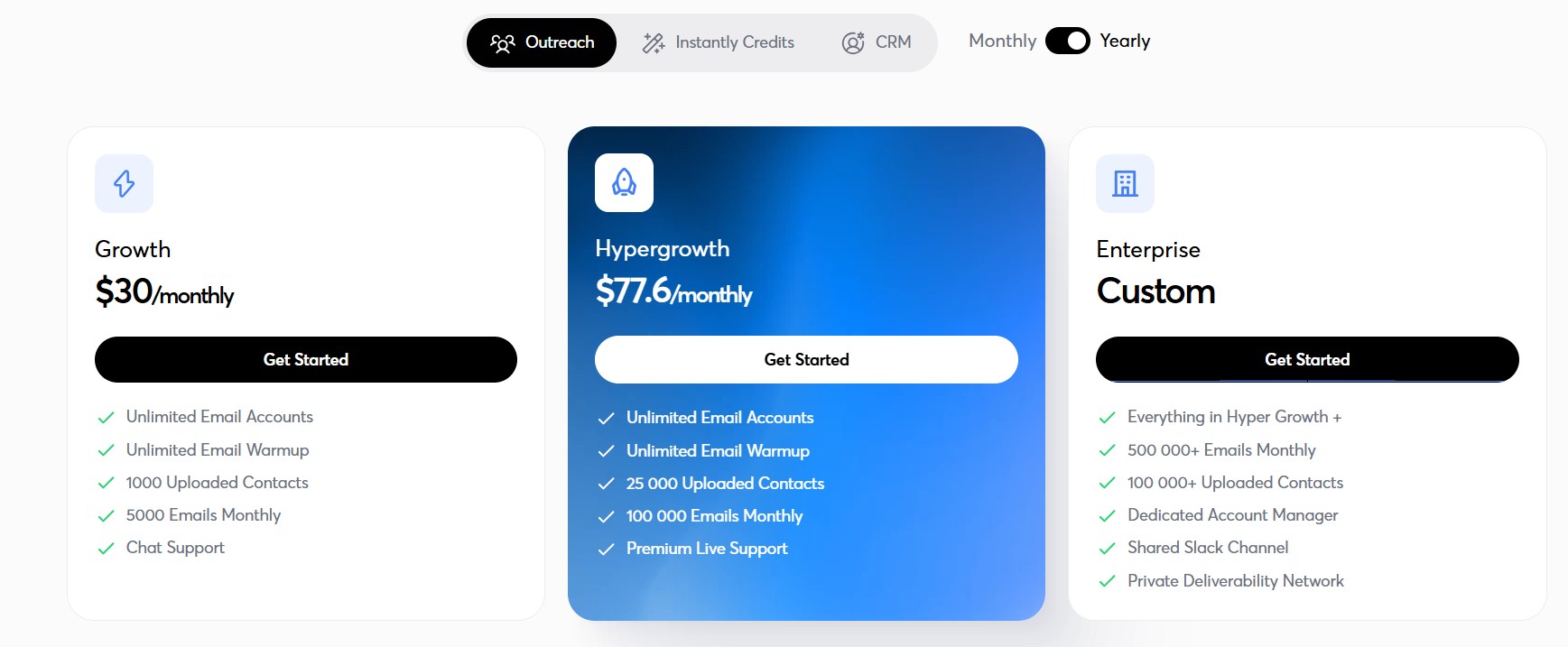
Instantly uses a flat-fee model rather than per-seat pricing:
- Growth Plan — $37/month: Unlimited email accounts and warm-up, 5,000 emails per month, 1,000 active leads. Entry-level for solopreneurs and small teams just starting with cold email.
- Hypergrowth Plan — $97/month: Supports up to 100,000 emails per month and 25,000 active leads. The most popular plan for scaling B2B companies.
- Light Speed Plan — $358/month: Designed for high-volume agencies, covering 500,000 emails per month and 100,000 leads. Also includes SISR (Server & IP Sharding and Rotation) for advanced deliverability control across dedicated private IP pools.
Note: The B2B lead database (SuperSearch) starts at an additional $47/month for 1,500 credits. AI features require a mid-tier or higher outreach plan. Building a fully functional all-in-one outreach system using Instantly’s full stack — outreach + leads + CRM — typically costs $180–$241/month.
Instantly.ai vs. Outreach.io: Which Wins?
Instantly wins for teams whose primary channel is email and who prioritize deliverability at scale. Its flat-fee model, unlimited inbox connections, and automated warm-up make it far more economical than Outreach for pure cold email workflows. Outreach wins for teams that need deep CRM integration, deal management, revenue forecasting, and a full sales engagement platform beyond email sequences.
Summary Verdict
Instantly.ai is the go-to platform for high-volume cold email at an accessible price. It handles deliverability infrastructure better than almost any other tool at its price point. The platform works best for email-first teams; if your sales process also requires LinkedIn automation or calling at scale, you’ll likely need to complement it with an additional tool.
#4. Reply.io — Best Alternative for True Multichannel Outreach (Email + LinkedIn + Calls + SMS)
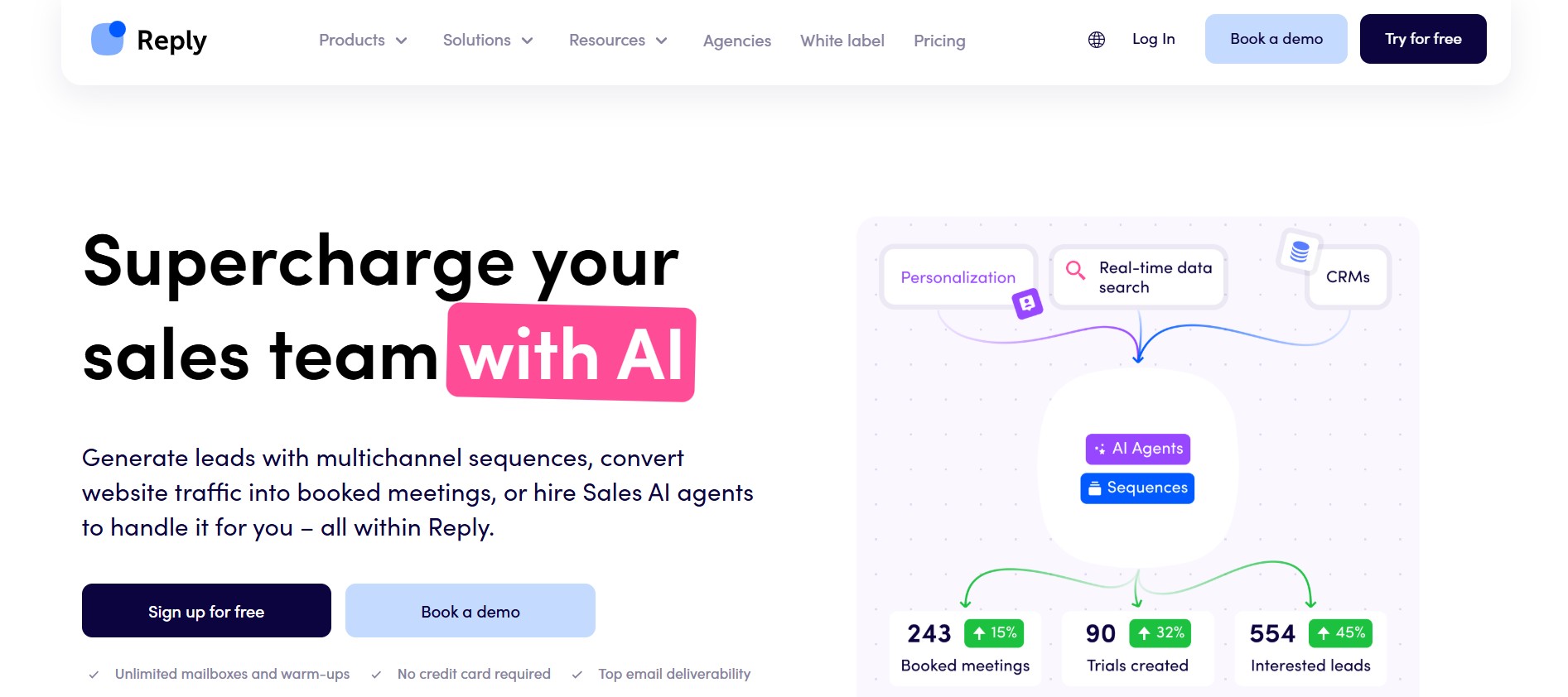
Reply.io is a multichannel sales engagement platform that unifies outreach across email, LinkedIn, phone calls, SMS, and WhatsApp into a single workflow. Unlike tools that treat LinkedIn as an afterthought (task reminders rather than native automation), Reply.io integrates all five channels into a single sequence builder with conditional branching logic. If a prospect opens an email but doesn’t reply, the next step can automatically trigger a LinkedIn connection request. If they accept on LinkedIn, the following step can be an SMS touchpoint.
Reply.io was founded with the vision of automating routine sales tasks, and has since evolved to include its flagship Jason AI SDR — an autonomous AI sales agent that finds prospects, writes personalized outreach, handles responses, and books meetings without human intervention. Jason AI runs on multiple AI models including Claude, Gemini, and GPT, supports over 50 languages, and operates in both Autopilot and Copilot modes.
Key Features of Reply.io
- Multichannel Conditional Sequences: Reply.io’s sequence builder allows users to create complex outreach workflows spanning email, LinkedIn, calls, SMS, and WhatsApp. Sequences branch automatically based on prospect behavior — for example, switching to a phone call step if an email goes unopened after three days. No other platform at this price point offers five-channel conditional logic with A/B testing across all message types, according to a 2026 review by Top Rated AI Software.
- Jason AI SDR: Jason is Reply.io’s autonomous AI sales development representative. It handles the full prospecting workflow — finding prospects, writing personalized messages, managing responses, and booking calendar meetings — with minimal human involvement. Case studies on Reply.io’s website cite teams generating significant pipeline through Jason, including one company reporting $15,000 in additional revenue during its first three months using the platform.
- 1 Billion+ Contact Database: Reply.io provides access to over one billion global B2B contacts across 60+ million companies in 150+ countries, with over 220 million US contacts. Filtering includes 16+ criteria: intent signals, tech stack, hiring activity, revenue, and more. This makes Reply.io one of the few platforms in this price range that bundles a large-scale data asset with outreach automation.
- Email Deliverability Suite: Reply.io includes an anti-spam and deliverability suite designed to ensure emails land in the primary inbox. Every connected mailbox gets unlimited email warm-up included. Accurate email placement data helps users optimize deliverability proactively, not reactively.
- CRM Integrations: Reply.io integrates natively with Salesforce, HubSpot, Pipedrive, and Copper, plus connections to over 700 apps via Zapier and Make. Customer support earns consistent praise — G2 rates Reply.io’s support quality at 9.3 out of 10, with users reporting under-15-minute response times via in-app chat.
Reply.io Pricing
Reply.io uses a per-seat pricing model:
- Free Plan: AI sequence generator and 200 data credits, limited to email automation testing.
- Starter Plan — $49/user/month (annual): Email automation, 1 mailbox, 5,000 data credits per month. Email-only outreach at the base level.
- Professional (Multichannel) Plan — $89/user/month (annual): Full multichannel outreach across email, LinkedIn, SMS, and calls, with 5 mailboxes per user, 10,000 data credits, unlimited email warmup, and unlimited emails to active contacts.
An important note on pricing: Reply.io’s value emerges at the Multichannel Plan level. At the Starter Plan ($49/user), Reply.io is overpriced compared to email-only alternatives like Instantly ($37/mo flat) or Smartlead ($39/mo). The compelling use case is specifically the $89 Multichannel Plan, where you get five channels in one tool. For a 5-person SDR team, that’s $445/month — a meaningful investment, but significantly less than Outreach’s equivalent per-seat cost.
Reply.io vs. Outreach.io: Which Wins?
Reply.io wins for teams that need genuine multichannel automation — not just email — at a sub-enterprise price point. The Jason AI SDR is a genuine differentiator for teams that want autonomous prospecting without hiring additional headcount. Outreach wins for large enterprise teams that need deep revenue forecasting, complex governance, and extensive Salesforce pipeline management alongside their engagement workflows.
Summary Verdict
Reply.io is the strongest true multichannel alternative on this list. If your sales process benefits from combining email, LinkedIn, calls, and SMS in coordinated sequences, it is the most capable tool at its price point. Best suited for SDR teams of three or more where the per-seat cost can be justified by the multichannel ROI.
#5. Salesloft — Best Enterprise-Grade Outreach Alternative
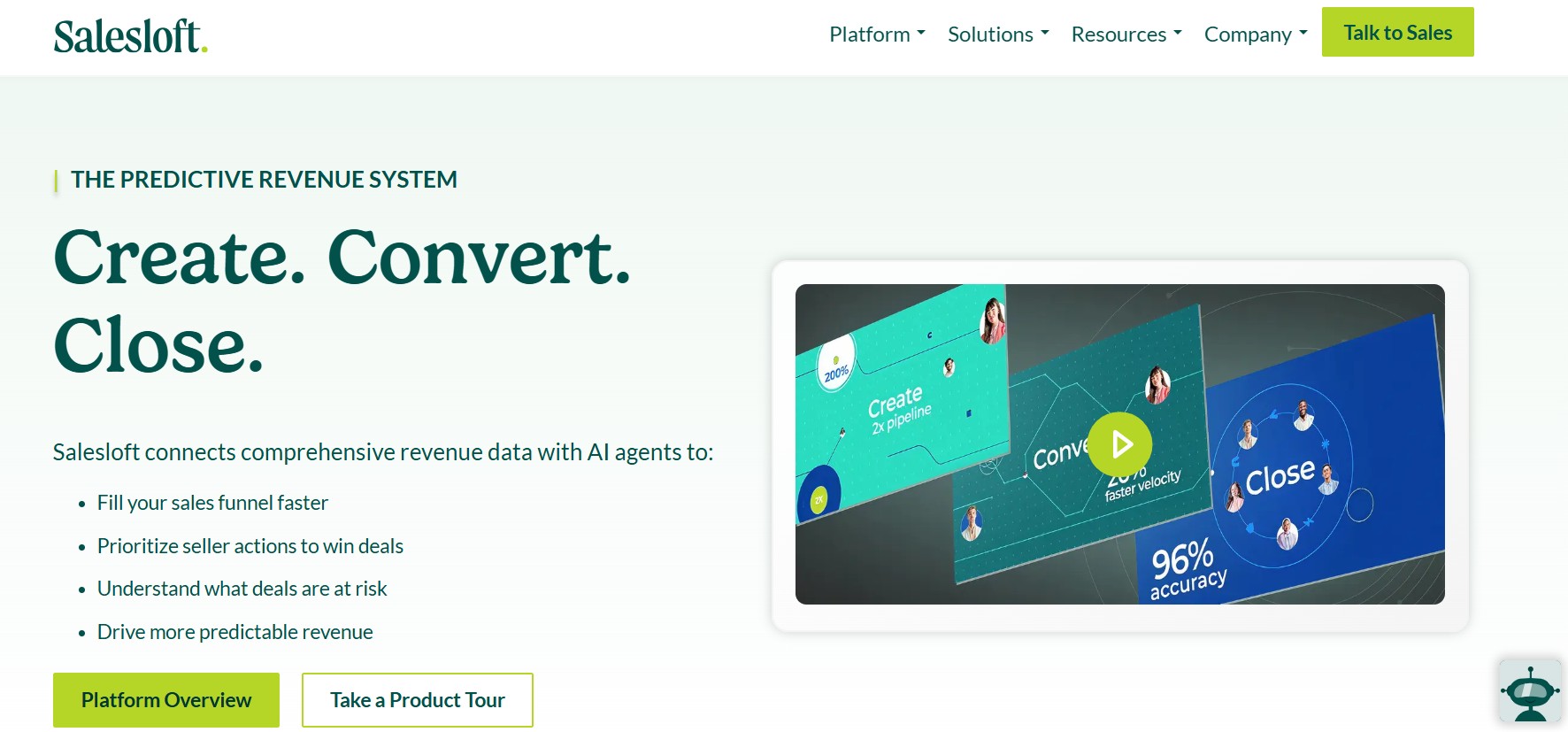
Salesloft is Outreach.io’s closest direct competitor — an enterprise-grade revenue orchestration platform used by more than 5,000 companies including Google, IBM, Shopify, Square, and Cisco. Like Outreach, it combines cadence management, conversation intelligence, deal management, and revenue forecasting into a unified workspace.
Where Salesloft differentiates from Outreach is in user experience. Multiple G2 reviewers note that Salesloft’s UI/UX is simpler and more intuitive than Outreach, with faster adoption for new reps. One mid-market sales manager wrote on G2: “The UI/UX is simple and intuitive for a sequencing tool. It is easier to adopt than Outreach.” Another user cited improved productivity: “It saves our team hours of administrative work each week.”
Salesloft has a G2 rating of 4.5 out of 5 based on 4,260+ reviews as of early 2026.
Key Features of Salesloft
- Cadence Management (Multi-Step Sequences): Salesloft’s cadence builder is widely regarded as one of the most polished in the market. Users can create complex sequences mixing emails, calls, social touches, and manual tasks with branching logic based on prospect behavior. The cadence feature is consistently the most praised aspect of the platform in user reviews.
- Rhythm (AI-Powered Task Prioritization): Rhythm is Salesloft’s AI feature that prioritizes daily tasks based on buyer signals, helping reps focus on the hottest leads first rather than working through sequences in arbitrary order. This signal-driven task management is designed to make each rep hour more productive.
- Conversation Intelligence: Salesloft provides AI-powered call and meeting analysis that extracts key insights from recorded conversations. Sales managers can use this data to coach reps more effectively, identify winning talk tracks, and understand where deals are stalling.
- Deal Management and Revenue Forecasting: The Premier plan adds pipeline tracking and AI-powered revenue forecasting, helping sales leaders anticipate quarterly outcomes and identify deal risk without relying on offline spreadsheets.
- Deep Salesforce Integration: Salesloft’s integration with Salesforce is widely cited as best-in-class, automatically logging all rep activity and keeping CRM data clean without manual entry.
Salesloft Pricing
Salesloft does not publish pricing publicly. Based on data from Dimmo.ai and industry pricing analyses:
- Essentials Plan — approximately $140/user/month: Covers basic automation, cadence management, and core analytics. Best for smaller teams or those beginning with sales automation.
- Advanced Plan — approximately $180/user/month: The most popular tier, adding conversation intelligence, deal management, and deeper reporting.
- Premier Plan — Custom pricing: Built for large enterprises requiring full revenue forecasting, governance, and SSO enforcement.
Annual contracts are standard, and there is no free trial. Implementation fees for enterprise deployments range from $5,000 to $15,000. A 50-seat Premier deployment can run $125,000–$140,000 per year even with negotiated discounts, according to MarketBetter’s 2026 pricing analysis. Vendr data shows discounts of 35–45% are achievable at negotiation.
Additionally, Salesloft’s dialer is an add-on on both the Advanced and Essentials plans — it is not included by default. This is a notable hidden cost for SDR teams that rely on cold calling as part of their outreach motion.
Salesloft vs. Outreach.io: Which Wins?
Salesloft wins on ease of use, faster rep adoption, and a cleaner UI experience. G2 reviewers consistently prefer Salesloft’s UX. Outreach wins on raw feature depth, more extensive forecasting customization, and broader market share in the largest enterprises. Both tools operate in a similar price band — the choice often comes down to whether your team prioritizes ease of use (Salesloft) or maximum configurability (Outreach).
Summary Verdict
Salesloft is the right Outreach alternative for enterprise teams who find Outreach’s complexity a barrier to adoption and want a more intuitive platform without sacrificing enterprise-grade capabilities. For SMB and mid-market teams, the price point still makes it prohibitive — in those cases, tools lower on this list provide substantially better value.
#6. Lemlist — Best Alternative for Personalization-First Cold Outreach
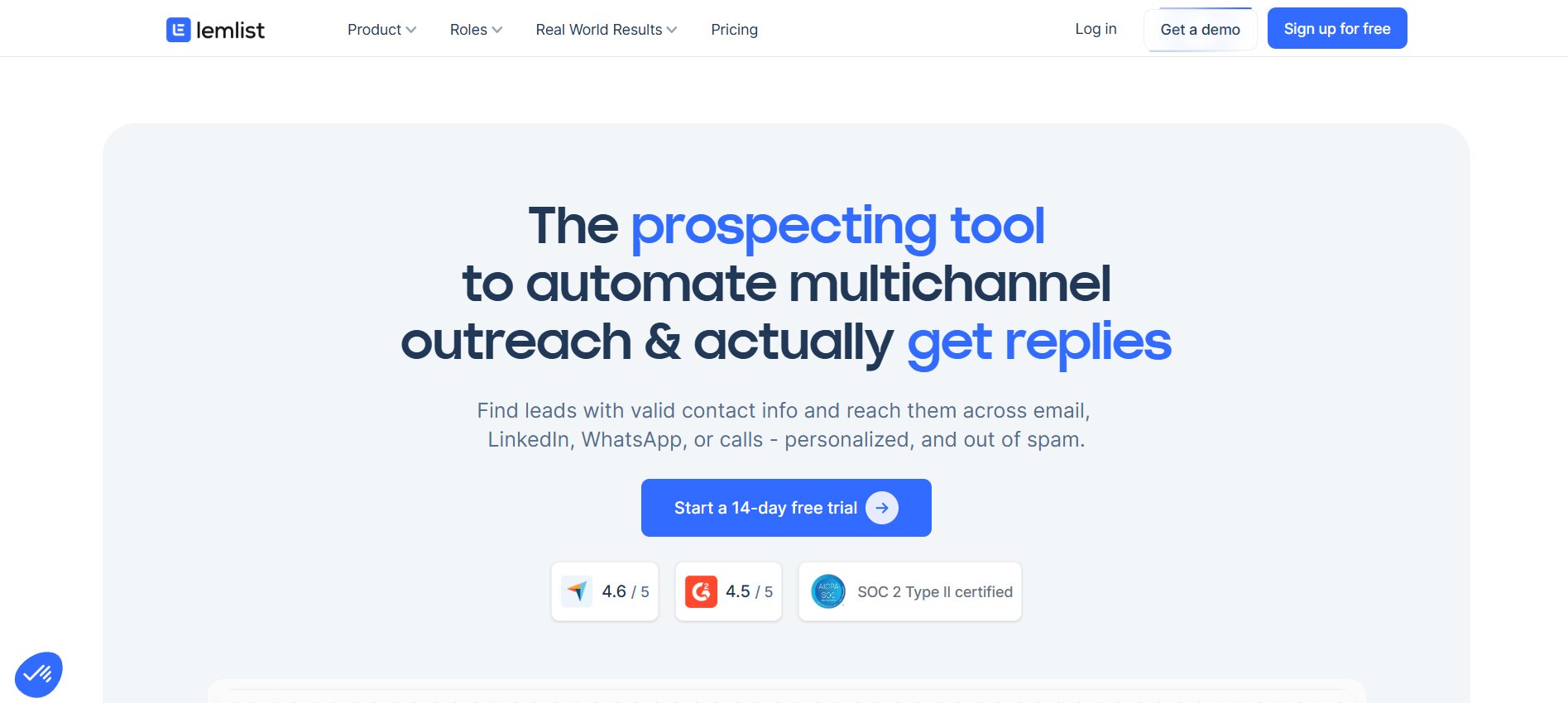
Lemlist is a multichannel sales engagement platform launched in 2018 that built its reputation on a single, genuinely differentiated capability: visual personalization at scale. While most cold email tools allow text-based merge tags (inserting a prospect’s name or company into a message), Lemlist takes personalization significantly further — allowing users to embed dynamically generated custom images and personalized landing pages into cold emails, where each image automatically populates with prospect-specific details pulled from LinkedIn profiles, websites, or uploaded data.
For example, a cold email sent through Lemlist can include a custom screenshot of a prospect’s website with a handwritten annotation overlaid on it — automatically generated for each recipient in the campaign. This kind of creative personalization creates a memorable first impression that generic outreach cannot replicate.
Lemlist has a G2 rating of 4.4 out of 5 based on 966 reviews, and a Capterra rating of 4.6 out of 5 based on 386 reviews.
Key Features of Lemlist
- Dynamic Image and Landing Page Personalization: This is Lemlist’s signature feature. Users create image templates in Lemlist’s editor, define personalization zones within the image, and when campaigns launch, Lemlist generates unique versions of each image for every recipient. The result is cold emails that contain personalized visuals — a prospect’s company logo placed inside a mock browser, their name written on a whiteboard — rather than generic stock images. According to lagrowthmachine.com’s 2026 review, “If you want to create visually customized emails at scale, few tools match this functionality.”
- Multichannel Sequences (Email + LinkedIn + WhatsApp + Calls): Lemlist enables users to build sequences combining email, LinkedIn actions (profile visits, connection requests, messages, voice messages), WhatsApp messages, and manual call reminders — all from one visual workflow builder. Advanced conditions allow sequences to branch based on prospect interaction: for example, triggering a LinkedIn message only if the prospect opened the email but did not reply.
- Lemwarm (Built-in Email Warm-Up): All paid Lemlist plans include Lemwarm, the platform’s native email warm-up tool. Lemwarm gradually increases send volume and generates engagement signals to build sender reputation before campaigns go live. This is included free on all paid plans — a genuine advantage since competitors like Smartlead charge separately for warm-up access.
- AI Campaign Generator: Lemlist’s AI assistant can generate complete email sequences based on your value proposition and target audience, pulling information from LinkedIn profiles and websites to create personalized icebreakers and follow-up messages. Experienced users note that AI output can be generic without customization, but the feature meaningfully accelerates campaign setup.
- 600M+ Lead Database with Enrichment: Lemlist includes access to a large contact database with an email finder that locates verified email addresses for imported prospects. Credits are used to find contact data — not to send emails. All paid plans include unlimited email sending. Additional enrichment credits can be purchased at $50 for 5,000 credits.
Lemlist Pricing
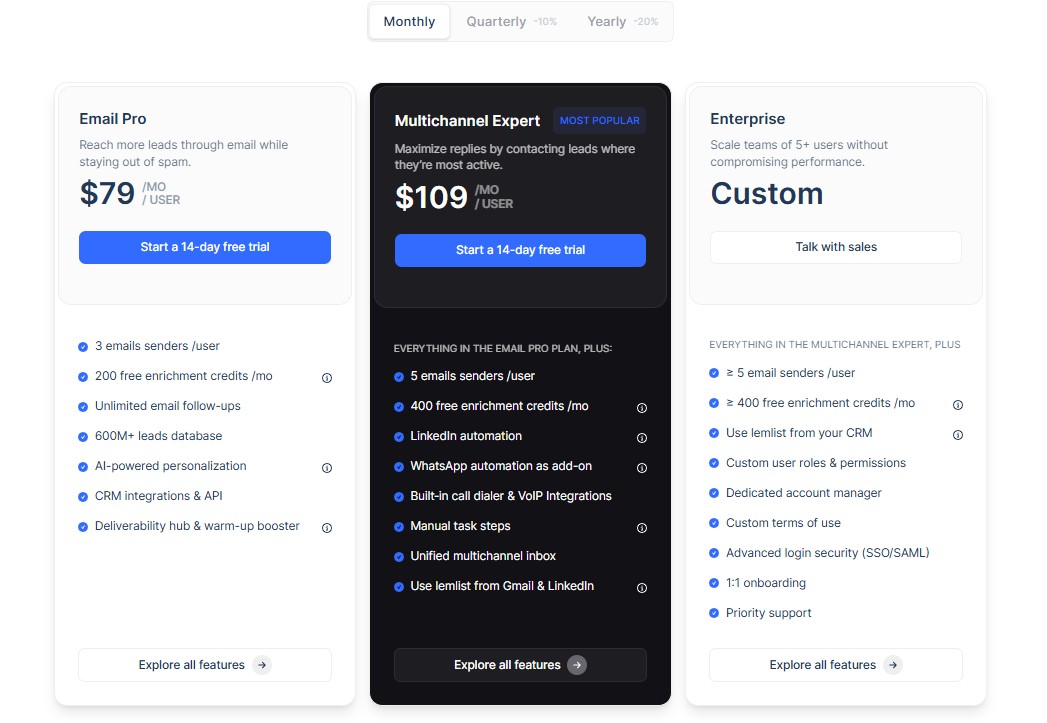
Lemlist offers three main paid tiers (with a 14-day free trial on all paid plans; no credit card required):
- Email Pro — $69/user/month: Includes 3 email senders per user, 200 free enrichment credits per month, unlimited campaigns and emails, AI personalization, CRM integrations (HubSpot, Salesforce, Pipedrive), and the deliverability hub with warm-up. Best for solo outreach or small teams focused on email-only.
- Multichannel Expert — $99/user/month: Everything in Email Pro, plus 5 email senders per user, 400 enrichment credits per month, LinkedIn automation, WhatsApp add-on, call dialer with VoIP, and the multichannel inbox. LinkedIn automation is only included in this tier and above.
- Enterprise — Custom pricing, minimum 5 seats: Advanced features and white-glove onboarding.
Annual billing saves 20%. An important pricing consideration for growing teams: per-seat costs compound quickly. A 5-person SDR team on the Multichannel Expert plan pays $495/month ($5,940/year). A 10-person team pays $990/month ($11,880/year) — approaching the cost of some enterprise tools without the associated governance and forecasting features.
Lemlist vs. Outreach.io: Which Wins?
Lemlist wins on creative personalization, deliverability tools (Lemwarm), and multichannel simplicity. It is significantly more affordable than Outreach and delivers better personalization capabilities for email-first workflows. Outreach wins on CRM depth, enterprise governance, deal management, and revenue forecasting that Lemlist simply does not offer.
Summary Verdict
Lemlist is the right choice for teams that prioritize standing out in crowded inboxes through creative, visual personalization. It is particularly well-suited for B2B teams whose sales process benefits from a “quality over quantity” outreach approach. Teams focused primarily on email — without a heavy LinkedIn or call motion — can consider the Email Pro plan. Teams needing full multichannel should budget for the $99/user Multichannel Expert tier.
#7. HubSpot Sales Hub — Best Alternative for Teams Already in the HubSpot Ecosystem
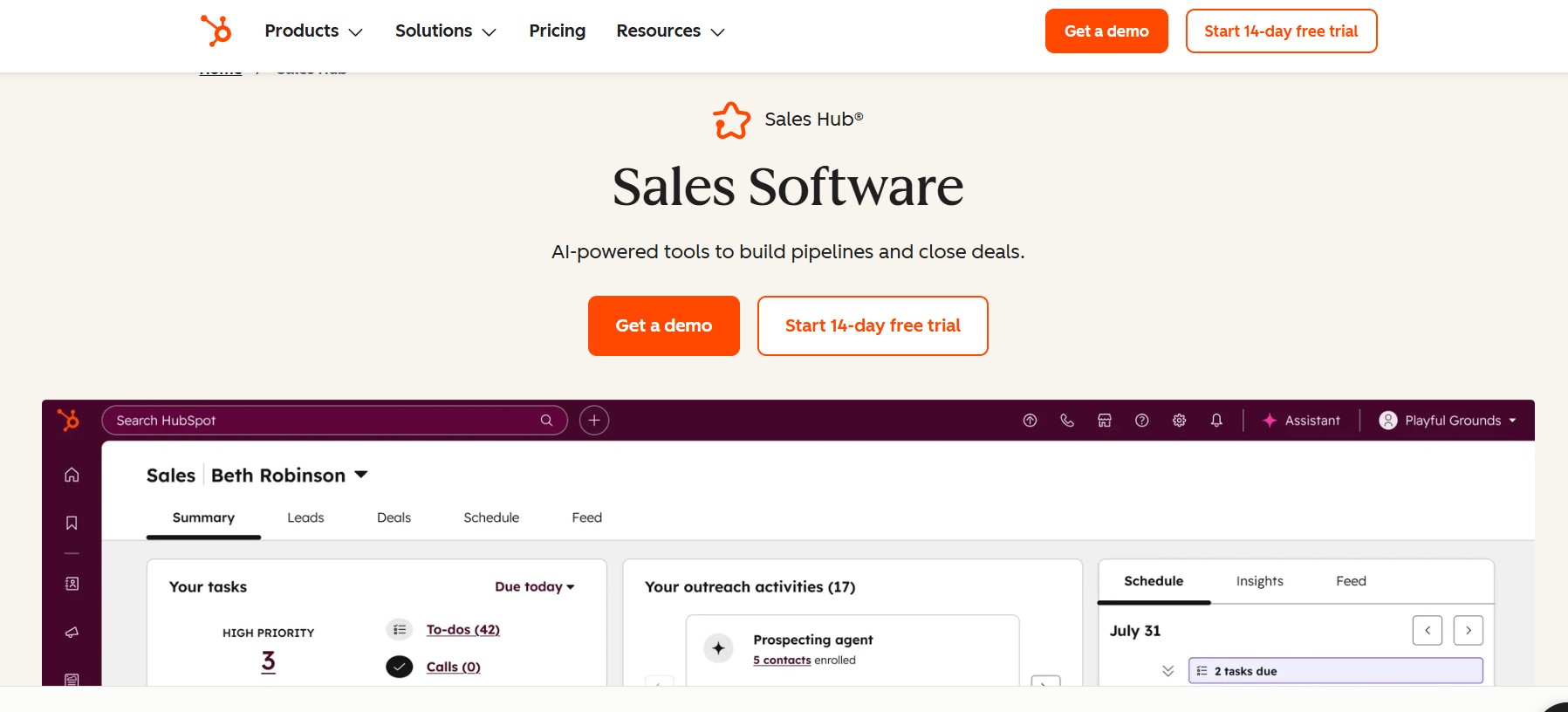
HubSpot Sales Hub is the sales engagement module built natively on top of HubSpot’s Smart CRM. For teams already using HubSpot for marketing, customer service, or CRM management, Sales Hub eliminates the need to add a separate sales engagement platform entirely — sequences, email tracking, calling, meeting scheduling, and deal management all live inside the same system.
Founded in 2006, HubSpot has grown into one of the most comprehensive business software platforms available. According to HubSpot’s own data, 84% of Sales Hub customers report increased revenue after implementation. HubSpot Sales Hub has a G2 rating of 4.4 out of 5 based on thousands of verified reviews.
Key Features of HubSpot Sales Hub
- Email Sequences and Automation: Sales Hub Professional and Enterprise users can build automated email sequences that enroll contacts and send personalized follow-ups based on engagement. Unlike mass marketing emails, sequences pause automatically when a contact replies — keeping communication feeling personal and human. Reps can include manual phone call tasks within sequences to blend automation with human touchpoints.
- Meeting Scheduler: HubSpot’s meeting scheduling tool lets prospects book time directly from a rep’s calendar via a shared link, eliminating the back-and-forth coordination that wastes selling time. Meetings sync automatically with the rep’s Google Calendar or Outlook.
- Built-In Calling with Transcription: HubSpot includes a native calling feature using HubSpot-provided phone numbers. On higher tiers, calls are automatically logged to contact records with call transcription, recording, and conversation intelligence analysis — no separate dialer subscription required.
- AI-Powered Productivity (Breeze AI Suite): HubSpot’s Breeze AI suite is included across all paid tiers and even the free plan. It automates repetitive tasks, suggests next actions based on deal context, and surfaces relevant customer insights to help reps focus on high-value activities. AI email generation helps reps draft personalized outreach faster.
- Deal Pipeline Management and Forecasting: Sales Hub includes visual deal pipelines, deal stage tracking, and AI-assisted forecasting on Professional and Enterprise tiers. This native CRM + forecasting combination means teams on HubSpot do not need to purchase a separate forecasting tool — a meaningful cost consolidation advantage.
HubSpot Sales Hub Pricing
HubSpot introduced a seat-based pricing structure in 2024 and has maintained it through 2026:
- Free Plan: Includes basic CRM features, unlimited contacts, and limited sales tools. No email sequences in the Free plan — automation requires a paid tier.
- Starter Plan — $20/seat/month: Removes HubSpot branding from sales emails and meeting pages, adds task queues, custom properties, and early-stage automation. Best for solo reps or very small teams testing the platform.
- Professional Plan — $100/seat/month (includes one sales seat; additional seats at $100/seat): Adds email sequences, deal forecasting, automated lead rotation, 1:1 video messaging, workflow automation, and call transcription. Requires a one-time onboarding fee of approximately $1,500.
- Enterprise Plan — $150/seat/month: The most powerful tier for large teams. Adds advanced governance, custom reporting, AI-powered deal scoring, and full conversation intelligence. Requires a one-time onboarding fee of approximately $3,500.
Teams scaling from small to mid-size should note that costs can increase significantly when adding users at the Professional tier ($100/seat). G2 reviewers flag this scaling cost as one of the platform’s key drawbacks: “The cost is manageable at the beginning, but once you start adding more users and building out a proper sales team, the price can jump significantly.”
HubSpot Sales Hub vs. Outreach.io: Which Wins?
HubSpot Sales Hub wins for teams already on the HubSpot CRM, for companies that want to consolidate their marketing and sales tools into one ecosystem, and for teams that value native CRM + engagement without adding another vendor. Outreach wins for teams that need a dedicated, outbound-focused engagement platform with deeper sequence complexity and more extensive multi-CRM flexibility beyond HubSpot.
Summary Verdict
HubSpot Sales Hub is the smartest Outreach alternative for existing HubSpot users. It eliminates a separate vendor, keeps all customer data in one system, and reduces total cost of ownership through ecosystem consolidation. For teams not on HubSpot, the switching cost and onboarding investment may reduce the advantage — in those cases, more purpose-built outreach tools may be a better fit.
#8. Smartlead.ai — Best Budget Alternative for Agencies Running High-Volume Cold Email
Smartlead is a cold email infrastructure platform founded in 2022 by Vaibhav Namburi, who previously founded a multi-seven-figure agency in Australia. The platform is built around one core principle: send high volumes of cold email without landing in spam. Over 100,000 businesses now use Smartlead, and it has become a default recommendation in sales tech communities for agencies and SDR teams running large-scale outbound.
Smartlead’s positioning is infrastructure-first. It focuses on the technical plumbing of cold email — unlimited mailbox connections, automatic inbox rotation, AI-powered warm-up, and advanced deliverability controls — rather than fancy UI features or built-in databases. Smartlead has a G2 rating of 4.7 out of 5 based on user reviews.
Key Features of Smartlead
- Unlimited Mailboxes with Inbox Rotation: Smartlead’s defining feature is unlimited email account connections on all plans. Users can connect Google Workspace accounts, Outlook accounts, and SMTP servers — as many as needed — and Smartlead automatically rotates sends across all of them. This distributes send volume, protects individual domain reputations, and prevents any single account from triggering spam filters. For agencies running campaigns across 50+ client domains, this is the most operationally efficient model available.
- AI-Powered Warm-Up (Unlimited, All Plans): Smartlead’s warm-up network is one of the largest in the industry. All plans include unlimited email warm-up at no extra charge — a significant differentiator vs. competitors that charge separately for warm-up or limit warm-up to a specific number of inboxes. Users consistently report improved sender reputation and inbox placement after two to three weeks of warm-up.
- Master Inbox (Unibox): When managing sends across hundreds of email accounts, a single centralized inbox is essential. Smartlead’s Master Inbox consolidates all replies from all connected accounts in one view. Users can tag conversations by status (Interested, Not Interested, Follow-Up, etc.), and Smartlead’s webhook integrations allow tagged conversations to trigger automations in CRMs or Zapier workflows automatically.
- White-Label Client Management: Smartlead offers white-label functionality for agencies — custom branding, your own login domain, and a separate client portal. This allows agencies to deliver a fully branded outreach experience to clients without exposing the underlying tool. Additional clients cost $29/month each, which is a significant add-on cost for agencies managing many clients simultaneously.
- Global Blocklist Monitoring: Smartlead tracks 400+ email blocklists and sends alerts if any of your sending domains appear on one. For agencies whose clients depend on deliverability as a service, this proactive monitoring protects revenue and reputation.
Smartlead Pricing
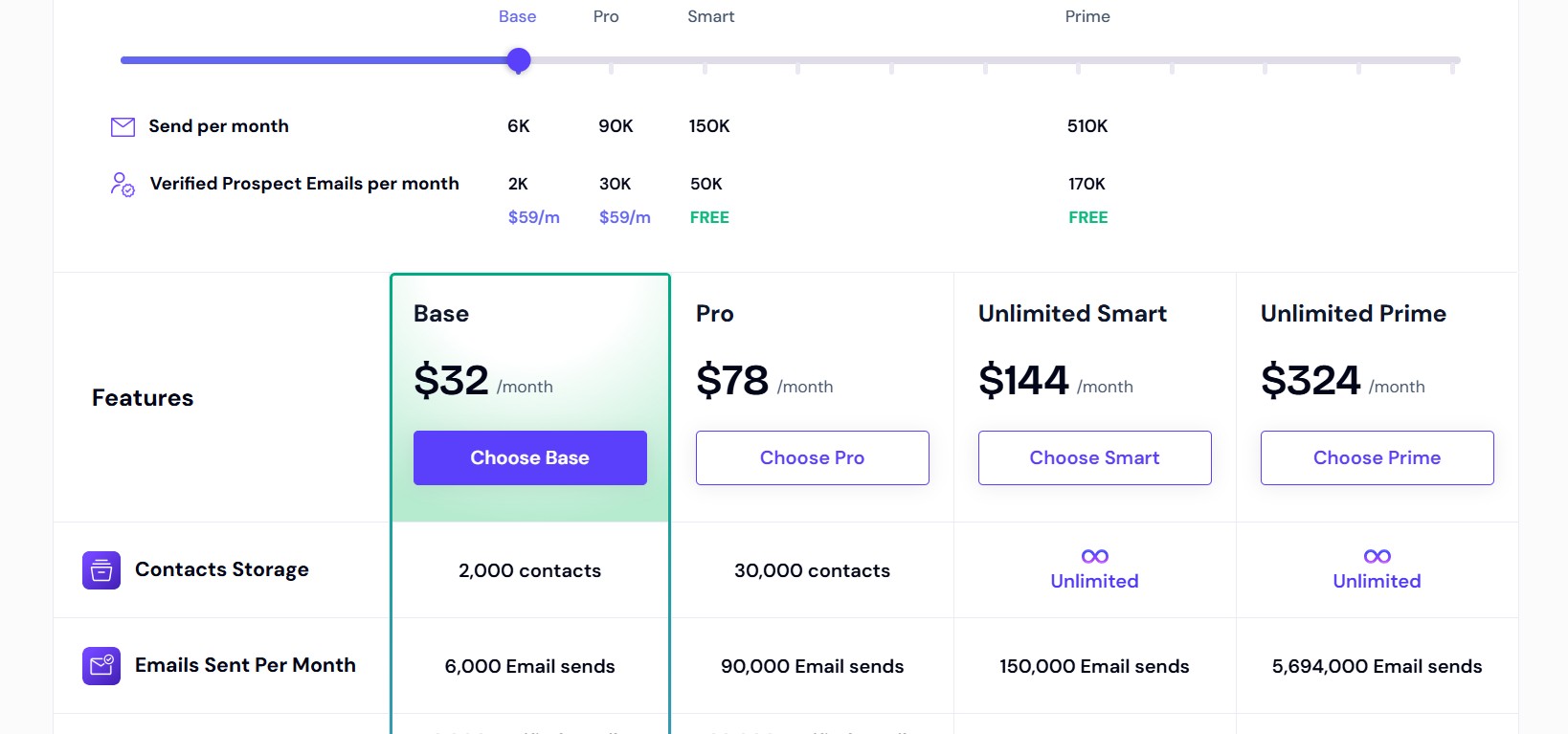
Smartlead offers volume-based, account-level pricing (not per-seat), making it cost-effective for teams of any size:
- Basic Plan — $39/month (or $32.50/month with annual billing): 2,000 active leads, 6,000 emails per month, unlimited email accounts and warm-up, basic reporting. Best for solopreneurs and small businesses testing high-volume cold email.
- Pro Plan — $94/month (or $78.30/month annually): 30,000 active leads, 150,000 emails per month, unlimited seats, ChatGPT-4 integration for AI email writing, webhooks, and API integrations. Best for growing teams and agencies with 1-2 clients.
- Custom Plan — starting at $174/month (monthly billing only): Up to 12 million leads and 60 million emails per month. Designed for large agencies and enterprises. White-label for one client is included; additional clients cost $29/month each.
A 14-day free trial is available with no credit card required. Annual billing saves approximately 17%.
Important caveat: Multiple pricing analyses note that Smartlead’s base plan pricing understates the true cost of operation. Domain purchases ($10–$15 per domain), email hosting ($6–$12 per mailbox per month for Google Workspace), and client add-on fees ($29/month per client) can push real costs to three to five times the advertised base plan price. Teams should budget for these infrastructure costs before committing.
Smartlead vs. Outreach.io: Which Wins?
Smartlead wins on: pure email deliverability infrastructure, flat account-level pricing (no per-seat penalties), agency scalability with white-label features, and sheer sending volume capacity. Outreach wins on: CRM integrations, multichannel beyond email, enterprise governance, rep coaching through conversation intelligence, and revenue forecasting.
Summary Verdict
Smartlead is the right tool for agencies and high-volume SDR teams whose primary motion is cold email at scale. If your outreach is email-first, your send volumes are high (10,000+ emails per month), and you need infrastructure that protects deliverability across many domains, Smartlead provides exceptional value at its price point. It is not the right choice for teams that need LinkedIn automation, a built-in data source, or multichannel sequences beyond email.
Outreach.io vs. Alternatives: The Master Comparison Table
The table below compares all eight alternatives against Outreach.io across the criteria most relevant to outbound sales teams in 2026. Pricing reflects published rates or verified third-party estimates.
| Tool | Starting Price | Free Trial | LinkedIn Automation | AI Personalization | Email Deliverability Tools | CRM Integration | Best For |
|---|---|---|---|---|---|---|---|
| Outreach.io | ~$100/user/mo | ❌ | Task-based only | Amplify (credit add-on) | Limited native | 5 CRMs | Large enterprises |
| Dealsflow | $49/mo | ✅ 14-day | ✅ Native, cloud-based | ✅ Per-prospect icebreakers | Dedicated IPs | Via API | LinkedIn-primary teams |
| Apollo.io | Free / $49/user/mo | ✅ Free plan | Task-based only | ✅ AI prompts | Basic | Salesforce, HubSpot | Data + outreach, all-in-one |
| Instantly.ai | $37/mo flat | ✅ | ❌ | ✅ AI Copilot | ✅ Automated warm-up | Via Zapier | High-volume cold email |
| Reply.io | $49/user/mo | ✅ 14-day | ✅ Native | ✅ Jason AI SDR | ✅ Deliverability suite | Salesforce, HubSpot, Pipedrive | True multichannel teams |
| Salesloft | ~$140/user/mo | ❌ | Task-based | ✅ Rhythm AI | Basic | Salesforce, HubSpot, Dynamics | Enterprise teams |
| Lemlist | $69/user/mo | ✅ 14-day | ✅ (Expert plan+) | ✅ Dynamic images + AI | ✅ Lemwarm included | Salesforce, HubSpot, Pipedrive | Personalization-first |
| HubSpot Sales Hub | $20/user/mo | ✅ Free plan | ❌ | ✅ Breeze AI | Basic | Native CRM (HubSpot) | HubSpot ecosystem teams |
| Smartlead.ai | $39/mo flat | ✅ 14-day | ❌ | Basic | ✅ Unlimited warm-up, rotation | Via Zapier/API | High-volume agencies |
How to Choose the Right Outreach.io Alternative for Your Team
With eight strong options covering different use cases, channels, and budgets, the right choice depends heavily on how your team actually sells. Use the decision guide below to identify your best fit.
Choose Dealsflow If…
LinkedIn is your primary outreach channel, you want safe cloud-based automation that protects your account, you’re spending hours per day manually sending connection requests, and you want transparent pricing starting at $49/month without a lengthy sales process or contract commitment.
Choose Apollo.io If…
You need prospecting data and outreach in one platform, you want to eliminate a separate data subscription (ZoomInfo, Lusha, etc.), your team is a startup or mid-market company, and you want a free entry point to test before committing to a paid plan.
Choose Instantly.ai If…
Cold email is your primary channel, you’re sending or planning to send at high volume (10,000+ emails per month), deliverability is your top priority, and you’re an agency running campaigns for multiple clients who need flat-fee pricing rather than per-seat costs.
Choose Reply.io If…
Your sales process benefits from combining email, LinkedIn, calls, SMS, and WhatsApp in coordinated sequences, you want a genuine AI SDR (Jason) to handle autonomous prospecting, and you have a team of three or more SDRs where the $89/user multichannel plan is justifiable by results.
Choose Salesloft If…
You’re an enterprise team that finds Outreach too complex or adoption too slow, you need the full suite of cadence management, conversation intelligence, deal management, and forecasting in one platform, and you have the budget and RevOps resources to support an enterprise implementation.
Choose Lemlist If…
Your differentiation strategy depends on personalization and creative outreach that stands out in crowded inboxes, you need multichannel automation across email and LinkedIn, and your team values quality over volume in every prospect interaction.
Choose HubSpot Sales Hub If…
Your team is already using HubSpot CRM and you want to add sales engagement without adding another vendor, you want to consolidate marketing and sales tools into one ecosystem, or your team is small and wants to start with a free CRM tier before investing in paid sequences.
Choose Smartlead If…
You’re an agency running cold email for multiple clients, your team sends very high email volumes (50,000+ per month), deliverability infrastructure is your primary concern, and you want flat account-level pricing without per-seat penalties as your team scales.
Final Verdict
The sales engagement market has fundamentally changed. In 2026, you no longer need a six-figure annual contract, months of onboarding, and a dedicated sales ops administrator just to run effective outbound. Specialized tools have emerged that do specific things better than Outreach at a fraction of the cost — and the right choice depends entirely on how your team sells.
For LinkedIn-native teams, Dealsflow delivers industry-leading automation, account safety through dedicated cloud IPs, and AI personalization that genuinely moves acceptance rates — all starting at $49/month with transparent pricing and a 14-day free trial that requires no credit card. It is the clearest upgrade for any team spending hours per day on manual LinkedIn outreach.
For all-in-one data and outreach, Apollo.io consolidates prospecting and engagement in one platform at a fraction of Outreach’s cost. For high-volume cold email, Instantly.ai and Smartlead.ai offer infrastructure-first solutions built around deliverability at scale. For true multichannel automation, Reply.io is the most capable tool in its price range. For personalization-driven outreach, Lemlist’s dynamic image and AI features are genuinely differentiated. For teams already on HubSpot, Sales Hub consolidates the stack without adding a new vendor. And for enterprise teams seeking a direct Outreach competitor with a better UX, Salesloft is the natural upgrade path.
The bottom line is simple: in 2026, paying Outreach prices is a choice — not a requirement. Start by identifying which channel drives the most pipeline for your team, then match that to the right tool on this list. Most of them offer free trials, so you can test before committing.
If LinkedIn outreach is in your stack at all, we recommend starting with Dealsflow’s free 14-day trial at dealsflow.co — three minutes to set up, no credit card required.
Frequently Asked Questions
What is the cheapest Outreach.io alternative?
Instantly.ai starts at $37/month flat — not per user — making it the most affordable option on this list for teams with multiple outreach users. Dealsflow starts at $49/month for one LinkedIn account. Apollo.io offers a free plan for teams that want to test the platform before spending anything. Smartlead.ai starts at $39/month with unlimited seats included.
Is there a free alternative to Outreach.io?
Apollo.io offers a permanently free plan that includes access to its contact database, two active sequences, and a limited number of credits per month. HubSpot Sales Hub also offers a free CRM tier with basic sales tools, though email sequences require a paid plan. Reply.io has a limited free tier with an AI sequence generator and 200 data credits.
Which Outreach alternative is best for LinkedIn outreach?
Dealsflow is the strongest LinkedIn-specific tool on this list. Its cloud-based automation with dedicated residential IPs is safer than browser extensions, and its AI personalization generates prospect-specific connection messages automatically. For teams that need LinkedIn as part of a broader multichannel sequence, Reply.io also offers native LinkedIn automation within its Multichannel Plan.
Can small businesses use Outreach.io alternatives?
Yes — most of the tools on this list are explicitly designed for small businesses and solo outreach. Dealsflow’s $49/month Starter plan is accessible for individual contributors. Instantly.ai’s $37/month flat fee is not per-seat, making it cost-effective for small teams. Apollo.io has a free entry point. HubSpot Sales Hub starts at $20/seat. All of these are dramatically more accessible than Outreach’s estimated $100/user/month starting price.
What’s the best Outreach alternative for cold email deliverability?
Instantly.ai and Smartlead.ai are the strongest specifically for email deliverability. Both offer unlimited inbox connections with automatic rotation, and both include robust automated warm-up tools. Instantly’s deliverability network warms up across 4.2M+ accounts. Smartlead tracks 400+ email blocklists and includes unlimited warm-up on all plans. For teams where getting into the primary inbox is the top priority, either of these tools outperforms Outreach significantly.