

In today’s fast-paced business environment, sales teams face an unprecedented challenge: breaking through the noise to connect with potential customers. Studies show that it takes an average of 5-7 touches before a prospect responds to outreach, yet many sales professionals give up after just one or two attempts. This disconnect between persistence and effectiveness is where a structured approach becomes invaluable.
Imagine your sales team operating with a clear, systematic plan for every prospect interaction. Instead of random, sporadic follow-ups that feel disorganized and unprofessional, every team member follows a consistent strategy that maximizes the chances of booking meetings and building meaningful relationships. This is precisely what a sales cadence delivers.
A sales cadence is more than just a sequence of outreach attempts—it’s a strategic framework that orchestrates multiple touchpoints across different channels at precisely timed intervals. Think of it as the backbone of a professional outreach operation, ensuring that no prospect falls through the cracks due to inconsistency or forgetfulness.
Throughout this comprehensive guide, we’ll explore what a sales cadence truly is, why it matters for your business growth, how to build one that actually works, and real-world examples you can implement immediately. By the end, you’ll understand why leading sales organizations consider their cadence a competitive advantage that directly impacts their ability to book more meetings and build stronger customer relationships.
What Is a Sales Cadence? Understanding the Foundation
Defining a Sales Cadence
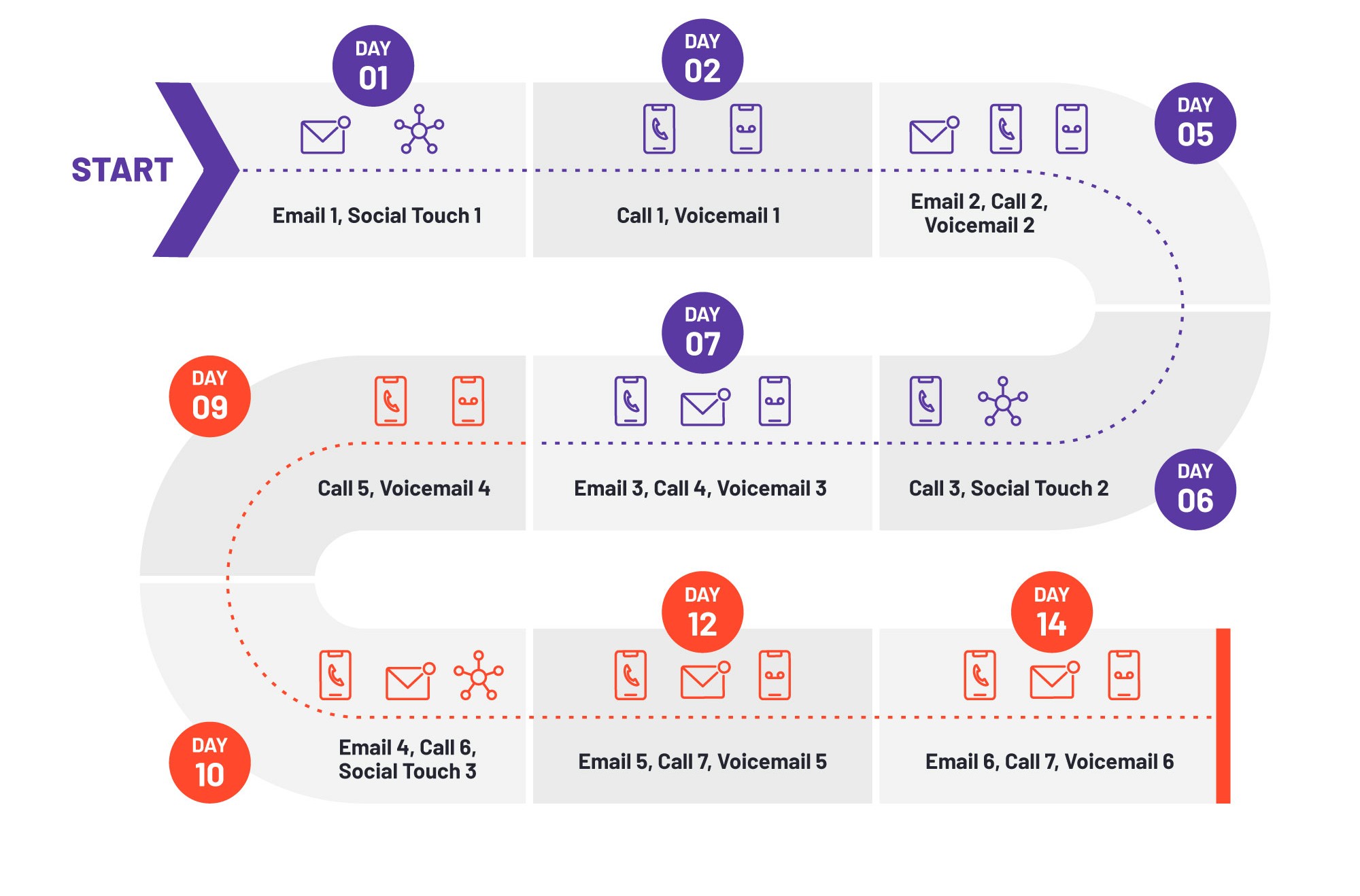
So, what is a sales cadence exactly? At its core, a sales cadence is a predetermined sequence of strategic outreach activities designed to engage prospects at optimal times through their preferred communication channels. It’s the orchestrated choreography of your sales engagement strategy—a structured plan that removes guesswork from the sales process.
Breaking this down further, a sales cadence serves as your team’s playbook for prospect engagement. Rather than leaving outreach decisions to individual preferences or daily mood, a well-designed cadence ensures that:
- Every prospect receives consistent communication
- Touchpoints follow a logical progression
- Timing maximizes the likelihood of engagement
- Your team maintains professional standards across all interactions
- Nothing falls through the cracks due to individual oversight
The power of what is a sales cadence lies in its ability to transform reactive sales into proactive, methodical engagement. Instead of hoping a prospect remembers your company or waiting for them to respond, you’re taking control of the narrative by maintaining consistent, strategic contact.
Key Components of a Sales Cadence
To truly understand what a sales cadence is and how it functions, we need to examine its essential building blocks:
1. Touchpoints
Touchpoints are the individual interactions within your cadence—each email sent, phone call made, LinkedIn message, or video shared. These aren’t random or haphazard; they’re carefully planned actions that serve specific purposes at different stages of the prospect engagement journey.
A touchpoint serves multiple functions:
- It reinforces your value proposition
- It provides a new angle or perspective
- It demonstrates different facets of your solution
- It creates multiple opportunities for the prospect to respond
2. Timing and Frequency
The spacing between touchpoints is crucial. Research suggests that prospects need to see your message 5-7 times before responding, but timing matters enormously. Send too many touches too quickly, and you risk overwhelming the prospect and appearing desperate. Space them too far apart, and you lose momentum and top-of-mind awareness.
Most effective cadences space touches 2-5 days apart, with the full sequence typically lasting 14-30 days for outbound prospecting. However, this varies significantly based on your industry, prospect type, and sales cycle length.
3. Channel Mix
Modern sales cadences leverage multiple communication channels, each serving a distinct purpose:
- Email: Often the first touchpoint; scalable and leaves a documented record
- Phone: Creates direct, personal connection; demonstrates confidence and commitment
- LinkedIn: Professional network touchpoint; shows you’ve done research
- Video: Personalized video messages create emotional connection
- SMS: Appropriate for established relationships; creates urgency
- Direct Mail: Stands out for high-value prospects; memorable and tangible
4. Messaging Strategy
Each touchpoint requires tailored messaging that’s relevant to where the prospect is in their awareness journey. Your first email introduces your company and value proposition. A follow-up phone call might reference something specific about their company. A LinkedIn InMail could share a relevant case study. A final email might create urgency around a limited-time opportunity.
The messaging evolves throughout the cadence, providing different reasons for the prospect to respond at different times.
Sales Cadence vs. Sales Sequence vs. Sales Automation
These three terms are often used interchangeably, but they have distinct meanings that affect how you approach your outreach strategy.
Sales Cadence: This is the overall rhythm and structure of your outreach. It defines how often you touch prospects and through which channels. Think of it as the framework.
Sales Sequence: This refers to the specific order of your touchpoints and the content/messaging within each step. If a cadence is the framework, a sequence is the detailed blueprint. A sequence specifies: Email #1 on day 1, Phone call day 3, LinkedIn message day 5, etc.
Sales Automation: This is the technology and tools that execute your cadence and sequence. Automation helps you deploy your cadence consistently across your entire prospect list without manual effort for every single touch.
These work together: You design your cadence (frequency/channels), create your sequence (specific steps and messaging), and implement it through automation tools (technology that ensures nothing is forgotten).
A Practical Example: The 7-Day Cold Outreach Cadence
To bring this to life, imagine you’re a B2B SaaS sales professional who’s just identified a qualified prospect at a mid-market company.
| Day | Channel | Action | Purpose |
|---|---|---|---|
| Day 1 | Personalized introduction email with value proposition | Introduce yourself and establish initial connection | |
| Day 3 | Send connection request with personal note | Engage on professional network; show you’ve researched them | |
| Day 5 | Phone | Call during business hours with clear objective | Direct connection; gauge interest; move toward meeting |
| Day 5 (if no answer) | Voicemail | Leave brief, benefit-focused voicemail | Reinforce your message; increase likelihood of callback |
| Day 7 | Follow-up email with relevant case study or article | Demonstrate results from similar companies; provide social proof | |
| Day 10 | Share a relevant article with personalized comment | Stay top-of-mind; provide value beyond your pitch | |
| Day 14 | Final email with urgency element and clear next step | Create decision point; don’t leave ambiguity |
This simple cadence ensures the prospect hears from you seven times over two weeks through different channels, with each touch serving a specific purpose and building toward a meeting.
Why Sales Cadences Matter: The Business Impact
Understanding what a sales cadence is sets the foundation, but grasping why they matter is what motivates implementation. Let’s examine the tangible benefits that make sales cadences essential to modern sales operations.
Increased Sales Efficiency
The most immediate benefit of implementing a structured cadence is a dramatic increase in sales efficiency. Consider what happens without a cadence:
Your sales team spends valuable time deciding what to do next with each prospect. “Did I email this person yet? How long ago? Should I call them? What should I say?” These micro-decisions consume mental energy that could be directed toward actual selling activities.
A well-designed cadence eliminates this decision fatigue. Every team member knows exactly what the next step is for each prospect. There’s no ambiguity, no second-guessing. This creates several efficiency gains:
Reduced Decision Time: Instead of spending 5-10 minutes per prospect deciding the next action, your team simply executes the predetermined next step.
Consistent Execution: Without a cadence, different reps follow different patterns, leading to inconsistency. One rep might call prospects immediately; another might wait weeks. A structured cadence ensures consistency across your entire team.
Faster Onboarding: New sales representatives can immediately follow the established cadence rather than spending weeks figuring out “how we do things here.”
Minimized Prospect Neglect: Without a cadence, prospects can languish in a “follow up later” status that never materializes. A structured cadence with defined follow-up timing ensures every prospect gets attention.
Think of efficiency gains this way: if a cadence saves your 10-person sales team just 30 minutes per day in decision-making and execution, that’s 5 hours daily—or 25 hours per week—of recovered selling time. Over a quarter, that’s significant capacity reallocation toward activities that directly drive results.
Improved Conversion Rates
The research is clear and consistent: prospects who receive multiple touches are significantly more likely to engage than those who receive single touches. This isn’t manipulation; it’s recognition of modern buying behavior.
Today’s prospects are busy. They receive dozens of emails daily, attend back-to-back meetings, and manage competing priorities constantly. Your initial outreach, no matter how compelling, often arrives at a moment when they’re distracted or not actively thinking about your solution.
A structured cadence accounts for this reality by:
Increasing Touch Frequency: A 7-touch cadence over 14 days means you’re creating 7 opportunities for the prospect to see your message at a moment when they’re receptive.
Reaching Prospects in Different Contexts: A voicemail might land when they’re driving and thinking about problems. An email might arrive when they’re reviewing their inbox. A LinkedIn message might appear when they’re networking. Different channels reach prospects in different mental states.
Demonstrating Commitment: When a prospect sees consistent, professional outreach over time, it signals that you’re serious about building a relationship—not just making a quick sale.
Creating Multiple Reasons to Respond: Rather than sending the same message repeatedly, a well-crafted cadence provides different reasons to respond at different times. Early touches focus on awareness. Middle touches provide social proof and specificity. Late touches create urgency.
Consider the difference in response rates:
- Single email outreach: 1-2% response rate is considered acceptable
- Two-touch outreach: 3-5% response rate
- Five-touch cadence: 8-15% response rate
- Seven-touch cadence: 15-25% response rate
These aren’t mythical numbers—they represent what professional sales organizations consistently achieve when they implement structured cadences properly.
Consistent Customer Experience
Your prospects don’t just want to be sold to; they want to be treated professionally. A structured sales cadence ensures that every prospect—regardless of which rep is assigned to them—receives consistent, professional communication.
Without a cadence, your outreach might feel scattered:
- One email with typos
- A follow-up call that’s too pushy
- A LinkedIn message that seems spammy
- Weeks of silence, then suddenly three emails in one day
With a cadence, the experience is:
- Professional, thoughtfully-written emails
- Well-timed phone calls that feel natural
- Personalized LinkedIn engagement
- Consistent, predictable communication frequency
This consistency builds confidence in your prospect that they’re dealing with a professional organization. It also creates a better perception of your brand. Prospects subconsciously associate professional outreach patterns with professional companies.
Additionally, a cadence prevents the “ignored prospect” feeling. When communication is structured and regular, the prospect doesn’t feel abandoned after their initial lack of response. Instead, they experience persistent, professional engagement that respects their time while maintaining presence.
Scalability and Reproducibility
One of the most underrated benefits of a structured cadence is its scalability. Imagine your top performer has a process that converts 20% of cold prospects into meetings. Without documenting and systematizing that process through a cadence, that success is trapped in one person’s head.
When you codify your best practices into a cadence structure:
Knowledge Transfer: New team members can immediately replicate your proven approach rather than spending months developing their own system.
Consistent Results: Instead of variable results based on individual rep performance, you can expect consistent, predictable outcomes from all team members following the same cadence.
Rapid Team Growth: You can confidently hire and onboard new sales professionals because you have a proven system they can execute.
Testing and Optimization: Instead of trying to improve 10 different individual approaches, you optimize one cadence structure that benefits the entire team.
Remote and Distributed Teams: A documented cadence makes it easier to manage distributed teams across different time zones and locations. Everyone follows the same playbook.
For example, if you’ve built a cadence that generates 15% meeting booking rate from cold outreach, you can replicate that across 5 new reps. That’s a 5x multiplication of your proven approach, rather than hoping each new rep independently develops something equally effective.
Building Your Sales Cadence: The 5-Step Framework
Now that you understand what a sales cadence is and why it matters, let’s build one. This framework applies whether you’re in B2B enterprise sales, SaaS, professional services, or any other field requiring strategic prospect engagement.
Step 1: Identify Your Target Audience
Before designing any cadence, you must understand exactly who you’re trying to reach. Vague targeting leads to vague cadences that work for nobody.
Define Your Ideal Customer Profile (ICP)
Your ICP is a detailed description of the perfect customer for your solution. It goes beyond demographics to include:
- Company characteristics: Industry, company size (revenue/employee count), growth stage, geographic location
- Role specifics: Job titles of decision-makers, responsibilities, challenges they face
- Behavioral traits: Technology they use, publications they read, communities they participate in
- Business challenges: Specific pain points your solution addresses, business goals they’re pursuing
- Buying patterns: Budget cycles, approval processes, decision timeline
For example, if you’re selling project management software, your ICP might be: “Mid-market SaaS companies ($10-50M ARR), with 50-200 employees, where the Director of Operations is struggling with team coordination across remote locations and wants to reduce project delays.”
Segment Your Audience
While you may have one general ICP, different segments within that ICP may require different cadences. Key segmentation variables:
- By industry: A software company and a manufacturing company may need different messaging approaches
- By company size: Enterprise prospects require longer sales cycles than mid-market prospects
- By business challenge: A prospect struggling with cost reduction needs different outreach than one focused on growth
- By buying stage: A prospect who’s already researching solutions needs different cadence timing than a prospect in early awareness
Research Your Prospect
Understanding your target audience also means research:
- What are their biggest challenges?
- What publications do they read?
- What industry events do they attend?
- Who are their competitors?
- What recent news might be relevant to them?
- What technology stack do they likely use?
This research informs your messaging and helps you personalize your cadence at scale.
Step 2: Decide on Your Sequence of Touchpoints
With your target audience clearly defined, you now determine the specific sequence of interactions that will comprise your cadence.
Choose Your Channels
Different channels serve different purposes and reach prospects in different ways:
Email: Typically your primary channel—scalable, leaves a record, allows detailed messaging
- Best for: Initial introduction, detailed value propositions, sharing resources, case studies
- Frequency: Can sustain 2-3 emails per person in a cadence without being excessive
- Advantages: Scalable, measurable, professional
Phone Calls: The most direct channel—creates personal connection and demonstrates confidence
- Best for: Qualifying interest, handling objections, moving toward commitment
- Frequency: Usually 1-2 calls per prospect in a 30-day cadence
- Advantages: Real-time conversation, immediate feedback, relationship building
LinkedIn: Professional network touchpoint—especially important for B2B selling
- Best for: Connection requests, sharing relevant content, direct messaging to warm prospects
- Frequency: 2-4 LinkedIn touches per 30-day cadence
- Advantages: Sees research, builds credibility, multiple format options
Video: Increasingly important for personalization at scale
- Best for: Personalized introductions, product overviews, demonstrating understanding of their business
- Frequency: 1 strategic video in a cadence
- Advantages: Creates emotional connection, high perceived effort (builds rapport)
SMS/Text: Appropriate for established relationships
- Best for: Appointment reminders, time-sensitive information, established prospects
- Frequency: Sparingly—1-2 texts only when appropriate
- Advantages: High open rates, creates urgency
Direct Mail: Often overlooked but highly effective for high-value prospects
- Best for: High-value prospects, executive outreach, standing out from digital noise
- Frequency: 1 piece per cadence for premium prospects
- Advantages: Memorable, tangible, stands out, great follow-up trigger
Determine Optimal Sequencing
The order of your touchpoints matters significantly. Different sequencing strategies:
The Warm-Up Approach (Email → LinkedIn → Phone):
- Starts with written introduction to establish context
- LinkedIn connection request shows you’ve researched them
- Phone call comes after you’ve established multiple touchpoints
- Best for: Cold outreach to senior leaders
The Direct Approach (Phone → Email → LinkedIn):
- Begins with direct contact to show confidence
- Follow-up email reinforces key points
- LinkedIn engagement maintains connection
- Best for: Lower-level contacts, warmer prospects
The Multi-Channel Approach (Email + LinkedIn simultaneously → Phone → Email + Video):
- Begins with coordinated outreach across multiple channels same day
- Phone call comes after multiple touchpoints
- Combination channels for final touches
- Best for: High-value prospects worth intensive effort
The Persistent Approach (Email → Email → Email → Phone → LinkedIn → Email):
- Multiple emails with different angles before phone contact
- More suitable for accounts where reaching the right person is difficult
- Best for: Complex B2B sales with multiple stakeholders
Most effective cadences follow this general principle: Start with lower-barrier touches (email, LinkedIn), build momentum, escalate to higher-touch activities (phone calls), then maintain engagement with strategic touches.
Determine Cadence Length
How long should your entire cadence last?
- Quick sales cycles (SaaS, SMB sales): 7-14 days
- Standard B2B sales: 14-30 days
- Complex enterprise sales: 30-60 days
- Inbound leads: May move faster due to existing interest
- Cold outreach: Typically longer (21-30 days minimum)
The general rule: Continue until you get a clear “yes,” a clear “no,” or the prospect shows no engagement signals over 2+ weeks.
Step 3: Set Your Timing
Timing is perhaps the most underestimated element of an effective sales cadence. Perfect messaging at the wrong time is still ineffective.
Determine Touch Frequency
How many days should separate each touchpoint?
2-day spacing: Fast-paced cadence, appropriate for:
- High-urgency opportunities
- Prospects in active buying phase
- Time-sensitive offers
- Risk: Can appear aggressive if not carefully personalized
3-day spacing: Moderate pace, appropriate for:
- Standard B2B outreach
- Cold prospecting
- Most common in top-performing organizations
- Balance: Maintains momentum without overwhelming
5-day spacing: Slower pace, appropriate for:
- Very senior executive outreach
- Heavily personalized cadences
- Prospects you’ve already contacted
- Risk: May lose momentum
7-day spacing: Extended pace, appropriate for:
- Relationship-focused approaches
- High-touch account work
- Prospects who’ve indicated “check back in a week”
The research suggests that 3-5 day spacing performs best for most outbound prospecting. It’s frequent enough to maintain momentum and top-of-mind awareness without being intrusive.
Consider Day of Week
Day of week matters more than most people realize:
- Monday-Wednesday: Best overall response rates (people are focused on work)
- Thursday: Good response rates (still business-focused)
- Friday: Lower response rates (people checking out mentally)
- Monday morning caveat: Inboxes are often full; emails sent Friday evening might have better timing
Consider Time of Day
Time of day impacts open rates and response rates:
- Tuesday-Thursday, 9-11 AM: Generally highest engagement
- After hours (6-9 PM): Often high open rates (people catching up on email)
- Early morning (6-8 AM): Good for executives
- Lunch time: Often ignored
- Friday afternoon: Lower engagement
For phone calls:
- Tuesday-Thursday, 2-4 PM: Best call connection rates
- Early morning (8-9 AM): Good for decision-makers
- Late afternoon (4-5 PM): Often better for reaching voicemail and leaving messages
- Monday morning, Friday afternoon: Generally lower connection rates
Adjust for Industry and Role
Timing varies by industry and role:
- Technology companies: Often respond better to evening emails (they’re reading after work)
- Financial services: Highly structured business hours; best contact during business hours
- Healthcare: Extremely time-constrained; may prefer earlier in the week
- C-level executives: Often check email outside business hours
Step 4: Script Your Messaging
This is where your cadence becomes truly powerful. Each touchpoint requires messaging that’s:
- Relevant to where the prospect is in their awareness journey
- Different from previous touches (giving new reasons to respond)
- Personalized enough to feel genuine
- Compelling enough to drive action
The Arc of Your Messaging
Rather than repeating the same message throughout your cadence, your messaging should follow a progression:
Touch 1 (Introduction Email): Establish credibility and relevance
- Personalized greeting with specific reference to their company or situation
- Clear statement of who you are and what you do (in terms relevant to them)
- Specific reason you’re reaching out (not generic)
- Single, clear value proposition
- Low-pressure call to action (“thoughts?” or “quick question?”)
- Example tone: “Hi [Name], I noticed [Company] recently [specific action/change]. Given that you’re focused on [their goal], I thought you might benefit from…”
Touch 2 (Phone Call or LinkedIn): Establish connection and gauge interest
- Reference your previous email (shows you’re systematic)
- Ask a genuine question about their business
- Listen more than you talk
- Qualify their situation
- Either move toward meeting or understand timing
- Example tone: “Hi [Name], this is [You] from [Company]. I sent an email earlier this week about [brief context]. Do you have 2 minutes?”
Touch 3 (Follow-up Email): Provide social proof or specific value
- Reference your recent conversation (even if they didn’t answer phone)
- Share a relevant case study or customer example
- Highlight specific value for their situation
- Make it about their success, not your solution
- Example: “Hi [Name], following up from my call earlier. I think you’d find it interesting that [Similar Company] faced the same challenge and saw [specific result]…”
Touch 4 (LinkedIn or Secondary Email): Different angle or perspective
- Share valuable content related to their industry or challenge
- Demonstrate expertise and thought leadership
- Provide value without asking for anything
- Create reason for them to want to stay connected
- Example: “Hi [Name], I came across this article about [industry trend relevant to them]. Thought it might be relevant given our earlier conversation about [their challenge]…”
Touch 5 (Video or Email): Personalized deep-dive
- Create a brief personalized video addressing their specific situation
- Or send a more detailed email with specific recommendations
- This is the “high effort” touch that shows real investment
- Demonstrates understanding of their business
- Example: “Hi [Name], I created this 2-minute video showing how companies like [peer company] are approaching [their challenge]…”
Touch 6 (Final Email): Create urgency and clear decision point
- Summarize the value and how you can help
- Create urgency (limited availability, upcoming deadline, etc.)
- Make the next step crystal clear
- Remove ambiguity about what you’re asking for
- Example: “Hi [Name], I’m giving you one last opportunity because I’m opening my calendar for [timeframe]. Given our conversation about [their goal], I think a quick call would be valuable. I have openings [specific times]…”
Personalization at Scale: The Framework
The key to effective messaging is genuine personalization without requiring 20 minutes per prospect:
Minimum Personalization (5 minutes per prospect):
- Use their name correctly
- Reference their company by name
- Mention something specific about their company (recent news, funding round, new product)
- Reference their specific role and responsibility
Enhanced Personalization (10 minutes per prospect):
- Include specific challenge related to their industry
- Reference a competitor or company similar to theirs
- Mention something specific about their LinkedIn profile (recent post, education, experience)
Deep Personalization (15+ minutes per prospect):
- Reference specific business situation (reviewed their website, annual report)
- Mention specific person they know in common
- Create custom case study showing similar company
- Develop custom video addressing their specific situation
The 80/20 rule applies: 80% of your personalization results come from 20% of the effort. Focus on minimum and enhanced personalization for all prospects, and save deep personalization for your highest-value targets.
Multi-threading Strategy
In B2B sales, decisions rarely involve just one person. A multi-threading strategy involves reaching multiple stakeholders within a prospect company with relevant messages for each role.
- Economic buyer (CFO, VP Finance): Focus on ROI, cost savings, bottom-line impact
- User buyer (Manager of relevant department): Focus on day-to-day pain relief, efficiency
- Technical buyer (IT, technical teams): Focus on integration, compatibility, implementation
- Coach (Internal advocate): Focus on how they benefit from success
Rather than one cadence to one person, you might run parallel cadences to 2-3 different people within the organization, each tailored to their specific interests and concerns.
Step 5: Test, Monitor, and Optimize
A sales cadence isn’t a “set it and forget it” system. The best performing cadences are constantly refined based on data and feedback.
Key Metrics to Track
Open Rate: Percentage of emails opened
- Indicates subject line effectiveness
- Shows if your timing is correct
- Benchmark: 25-35% for cold outreach is solid
- Poor open rate suggests: timing issue, subject line needs work, list quality problem
Response Rate: Percentage of prospects who respond to your outreach
- Indicates overall messaging effectiveness
- Benchmark: 1-5% for cold outreach, 5-15% for targeted outreach
- Poor response rate suggests: messaging not resonating, targeting off-base, cadence too short
Meeting Booking Rate: Percentage of prospects who book a meeting
- Most important metric—directly tied to pipeline
- Benchmark: 5-20% of responses becoming meetings (depends on sales process)
- Affected by: how effectively you ask for the meeting, how qualified your list is
Conversation Rate: Percentage of prospects you actually connect with by phone
- Indicates ability to reach the right person
- Benchmark: 15-30% of cold prospects will answer phone
- Poor rate suggests: wrong timing, wrong number, wrong person
Advance Rate: Percentage of initial conversations that move to next stage
- Indicates qualification and fit
- Benchmark: 50-70% of conversations should move forward
- Low rate suggests: poor qualification, targeting issue, need better discovery questions
Unsubscribe/Block Rate: Percentage of prospects who unsubscribe or mark emails as spam
- Indicates if cadence feels spammy
- Benchmark: Should be less than 0.5% per email
- High rate suggests: too aggressive, poor list quality, messaging misalignment
A/B Testing Framework
Test one variable at a time to understand what actually drives results:
Subject Line Testing:
- Test specific/personalized vs. generic subject lines
- Test question-based vs. statement-based subjects
- Test with/without emoji
- Track open rate differences
Messaging Testing:
- Test problem-focused vs. solution-focused angle
- Test social proof (case studies) vs. direct benefits
- Test different value propositions
- Track response rate differences
Timing Testing:
- Test 3-day spacing vs. 5-day spacing
- Test Tuesday morning sends vs. Friday afternoon
- Test early morning calls (8-9 AM) vs. afternoon calls (2-4 PM)
- Track connection/response rates
Channel Testing:
- Test email first vs. LinkedIn first
- Test video inclusion vs. text only
- Test LinkedIn InMail vs. regular LinkedIn message
- Track response rate differences
Cadence Length Testing:
- Test 7-day cadence vs. 14-day cadence
- Test 5-touch vs. 7-touch sequences
- Track meeting booking rates at different cadence lengths
- Identify point of diminishing returns
Implementation Cadence Review Cycle
Effective optimization requires structured review:
Weekly Review (15 minutes):
- Check open rates on recent emails
- Monitor response rates
- Identify if any touches are underperforming dramatically
- Make tactical adjustments (resend subject line, adjust timing)
Monthly Review (2 hours):
- Analyze full-month metrics against benchmarks
- Compare this month to previous month
- Identify trends in response rate, meeting booking rate
- Select one variable to test next month
Quarterly Review (4 hours):
- Deep dive analysis of full cadence performance
- Compare different cadence variations
- Get team feedback on what’s working/not working
- Redesign cadence based on 90 days of data
- Train team on updated cadence
When to Pause or Adjust
Not every cadence works indefinitely. Look for these signals that adjustment is needed:
- Declining response rates: If your cadence used to generate 5% response rate and now generates 2%, something has changed. Prospects may be fatigued with your approach.
- Increasing unsubscribe rates: If more people are opting out, your messaging or frequency may be off.
- Wrong types of responses: If you’re getting lots of “unsubscribe” responses but few “interested” responses, targeting or positioning may be wrong.
- Seasonal changes: B2B buying patterns change seasonally. Your summer cadence might need adjustment for fall/winter.
- Market shifts: If your industry changes significantly, your cadence should reflect that.
- Team feedback: If your reps consistently tell you something isn’t working, listen. They’re on the front lines.
Sales Cadence Best Practices to Drive Results
Beyond the basic framework, certain practices separate top-performing cadences from mediocre ones.
Personalize Your Messaging at Every Stage
Generic messages kill response rates. But personal touches don’t require hours per prospect:
Company-Level Personalization (2 minutes per prospect):
- Reference specific company news or achievements
- Mention their recent funding round or new product launch
- Reference industry trends specifically relevant to them
- Show you know something about their business beyond “we help companies like yours”
Role-Level Personalization (3 minutes per prospect):
- Address them by their correct title
- Reference challenges specific to their role
- Understand their responsibilities and what matters to them
- Tailor your value proposition to their priorities
Individual-Level Personalization (5 minutes per prospect, reserved for top targets):
- Reference something from their LinkedIn profile
- Mention a recent post they made
- Note their educational background or previous companies
- Reference a mutual connection
The Personalization Multiplier
Interestingly, personalization creates a compounding effect:
- Personalized first email gets 3x higher open rate than generic
- Personalization in second touch (phone call referencing email content) increases answer rate
- Personalization in final touch increases meeting booking rate
A fully personalized cadence doesn’t increase effort proportionally—it creates exponential results.
Know When It’s Time to Change Your Cadence
Markets evolve. Prospect preferences change. Your cadence can’t remain static if your business landscape is dynamic.
Signs Your Cadence Needs Updating:
- Response rates declining: If your cadence used to work well but response rates have dropped, the market has adapted. You need to evolve.
- Wrong types of meetings: If you’re booking lots of meetings but they’re with wrong people or wrong companies, your targeting or positioning in the cadence is off.
- Feedback from market: If prospects tell you they’re receiving too many of your emails or they prefer different timing, listen.
- Competitive changes: If competitors are using new channels or approaches, your cadence may need updating to stay competitive.
- Product or positioning changes: If you’ve updated your offering or changed how you position it, your cadence messaging should reflect that.
- Seasonal patterns: B2B buying follows seasonal patterns. Your Q4 cadence might need adjustment for Q1 when budget cycles change.
- List quality changes: If you’ve switched to colder, less qualified lists, your cadence may need to be longer or have more educational early touches.
The Update Process:
- Don’t overhaul everything at once
- Update one element at a time
- Test new version against old version
- Measure performance difference
- Implement changes across team only if improvement proven
Improve Efficiency with Automation
The right tools multiply the effectiveness of your cadence by removing manual execution burden.
What to Automate:
Email scheduling: Don’t manually send emails. Use automation to send at optimal times across time zones.
Follow-up reminders: If an email bounces or a call needs to be made, let the system remind you.
Basic data population: Let CRM tools automatically populate first names, company names, contact information.
Meeting scheduling: Use calendar integration to automatically show availability and schedule meetings without back-and-forth.
Tracking and logging: Automatically log activities, open rates, and responses to CRM.
What NOT to Automate:
Personalization: Never use truly generic merged fields. Personalization requires human thought.
Discovery calls: These need human conversation and listening. Never use chatbots for initial prospect conversation.
Complex problem-solving: If a prospect has questions or objections, a human needs to address them.
Relationship building: The warmth and genuine interest in building a relationship can’t be automated.
Strategic decisions: Decisions about whether someone is a good fit, how to position your solution, which prospects to pursue—these require human judgment.
Automation Tools Overview:
Outreach/Salesloft/Apollo: Full sales engagement platforms with email, phone, sequencing
- Best for: Teams wanting integrated cadence management
- Cost: $50-500+/month per user depending on features
HubSpot Sales: Integrated CRM with automation and cadence
- Best for: Smaller teams or organizations already using HubSpot
- Cost: Free for basic, $45-120/month for paid tiers
Email-specific (Mailchimp, Constant Contact): Email automation without phone/LinkedIn
- Best for: Email-focused cadences
- Cost: Free-$300/month depending on volume
LinkedIn automation (Dealsflow): LinkedIn-focused sequencing
- Best for: LinkedIn-heavy cadences
- Cost: $49-299+/month
The key: Invest in tools that automate execution while preserving personalization and human judgment.
Focus on Quality Over Quantity
The biggest mistake many organizations make is pursuing quantity of outreach over quality. A smaller list of highly targeted, genuinely personalized outreach beats a massive list of generic outreach.
Why Quality Wins:
- Reputation: High-volume generic outreach can damage your reputation. Recipients perceive it as spam.
- Conversion efficiency: A 1,000-person list at 5% response rate (50 responses) beats a 10,000-person list at 0.5% response rate (50 responses), and the first option requires 10x less effort.
- Data quality: Smaller, more carefully sourced lists have better email validity. Less bouncing and unsubscribing.
- Personalization ability: A team can personalize 50 prospects meaningfully. They can’t personalize 2,000 meaningfully.
- Results tracking: With a focused list, you can see what’s actually working and optimize accordingly.
Quality Indicators:
- Data accuracy: Are phone numbers, emails, and names correct? (Should be 95%+ accurate)
- Relevance: Does each prospect match your ICP? (Should be 100%)
- Decision-maker accuracy: Are you reaching the right person in the right role? (Should be 80%+)
- Intent data: Have they shown any signals of active interest? (Ideal but not always possible)
- Recency: Is the data current? (Data older than 6 months degrades 5% per month)
The Quality Over Quantity Formula: Instead of: 1,000 contacts × 1% response rate = 10 responses
Think: 100 contacts × 20% response rate = 20 responses (with higher conversion to meetings)
The second approach requires more effort per contact but delivers better results and is more sustainable for your reputation and team morale.
Implement Multi-threading
In B2B sales, decisions involve multiple stakeholders with different concerns and priorities.
Why Multi-threading Matters:
- Increases overall response rate (multiple chances to reach engaged decision-maker)
- Hedges against individual prospect changing jobs
- Addresses different decision criteria for different roles
- Creates more points of entry into the organization
Multi-threading Framework:
Map the Decision Committee: For a typical B2B sale, you might have:
- Economic buyer (has final say on budget)
- User buyer (will use the solution daily)
- Coach/champion (internal advocate for change)
- Potential blockers (technical team, procurement)
Research Each Role’s Priorities:
- Economic buyer cares about: ROI, budget impact, risk, implementation timeline
- User buyer cares about: Ease of use, efficiency gains, learning curve, daily workflow impact
- Coach cares about: How success benefits them, how change affects their role, career advancement
Create Role-Specific Messaging: Same solution, different angles:
- To CFO: “47% reduction in project delays, directly reducing contractor costs and improving margins”
- To Project Manager: “Simplified workflow reduces daily administrative tasks by 3 hours, giving time back for strategic work”
- To IT/Technical: “Single sign-on integration, requires <2 hours implementation, 99.9% uptime SLA”
Coordinate Cadences:
- Primary cadence: to economic buyer or champion
- Secondary cadence: to user buyer (slightly lighter touch)
- Tertiary cadence: to other stakeholders (as needed)
Timing: Stagger starts slightly. Don’t contact all three on same day. Spread over 3-5 days so it doesn’t feel coordinated spam.
High-Converting Sales Cadence Examples
Theory is helpful, but seeing concrete examples of what high-performing cadences look like is invaluable. These aren’t arbitrary examples—they’re based on real cadences that generate strong booking rates.
Example 1: The Traditional B2B Enterprise Cadence
Best For: Complex B2B sales, long sales cycles (60+ days), multiple decision-makers, high contract value
Cadence Duration: 30 days Total Touches: 7 touches Expected Response Rate: 8-15% Expected Meeting Rate: 15-25% of responses
| Day | Time | Channel | Touch # | Subject/Message | Objective |
|---|---|---|---|---|---|
| Day 1 | 9 AM | 1 | “Quick question about [Company]’s [specific initiative]” | Establish context and credibility | |
| Day 3 | 2 PM | 2 | Connection request with personalized note | Multi-channel engagement | |
| Day 5 | 10 AM | Phone | 3 | Call script: “Hey [Name], it’s [You] with [Company]…” | Direct conversation, gauge interest |
| Day 5 | 5 PM | Voicemail | 4 | (If no answer) “Hi [Name], this is [You]…” | Reinforce message via voicemail |
| Day 7 | 10 AM | 5 | Case study: “How [Similar Company] Approached [Challenge]” | Social proof and relevant example | |
| Day 12 | 2 PM | LinkedIn InMail | 6 | Detailed message about value fit | Personal touch beyond connection |
| Day 21 | 9 AM | 7 | “Final opportunity: [Specific date] opening in my calendar” | Create urgency and decision point |
Messaging Details:
Email 1 – Initial Outreach: Subject: “Quick question about [Company]’s expansion into [market/product]”
Body: “Hi [Name], I noticed [Company] recently [specific news/change]. Given that you’re focused on [their stated business objective], I came across something that might be relevant. Would you be open to a quick call? [Your name]”
Phone Call Script: “Hi [Name], this is [You] with [Company]. I sent an email earlier this week about [brief context]. Did you happen to see it? [If yes – continue; if no – very brief explanation] I actually wanted to ask you a quick question: when you think about [their main challenge], what’s your biggest concern? [Listen, take notes] That’s actually exactly why I was reaching out…”
Email 3 – Case Study: Subject: “[Company Name] case study – how they reduced [metric] by X%”
Body: “Hi [Name], following up from my call. I think you’d find it interesting that [similar company in their industry] faced a similar challenge with [specific pain]. Here’s how they approached it [link to case study]. I thought it might give you some ideas. Would be happy to discuss further if helpful. [Your name]”
Email 4 – Final Push: Subject: “Last chance: brief call Friday or Monday?”
Body: “Hi [Name], I’m giving myself to end of month to structure my calendar. I think a brief conversation about [specific topic] could be valuable for your team. I have 30 minutes available Friday at 2 PM or Monday at 10 AM. Does either work? [Your name]”
Example 2: The Digital-Native/SaaS Cadence
Best For: SaaS sales, shorter sales cycles (14-21 days), tech-savvy prospects, product-led approach
Cadence Duration: 14 days Total Touches: 5 touches Expected Response Rate: 10-20% Expected Meeting Rate: 20-30% of responses
| Day | Time | Channel | Touch | Content | Objective |
|---|---|---|---|---|---|
| Day 1 | 10 AM | 1 | Product-focused intro with link to demo | Product awareness | |
| Day 3 | 2 PM | 2 | “I sent you info on [product]—2 min video demo” | Multi-channel, demo preview | |
| Day 5 | 11 AM | 3 | “2-minute video showing your exact use case” | Personalized product demo | |
| Day 8 | 3 PM | 4 | Share relevant industry trend article | Thought leadership, re-engagement | |
| Day 12 | 9 AM | 5 | “Last spot: 15-min free consultation Thursday/Friday” | Urgency, low-commitment ask |
Messaging Details:
Email 1 – Product Introduction: Subject: “See how [product] saves teams 4+ hours/week”
Body: “Hi [Name], [Company] teams using [product] cut time spent on [specific task] from 2 hours to 20 minutes per day. Want to see how? [link to product demo or free trial]. Would take 2 minutes. Cheers, [Your name]”
LinkedIn Message 2: “Hi [Name], I sent you some info on [product] earlier. Rather than reading, I made a 2-minute video showing how it helps teams like [Company] with [specific challenge]. Want to check it out?
Email 3 – Personalized Demo: Subject: “[Name], custom 2-min demo of [product] for your workflow”
Body: “Hi [Name], based on what I know about how [Company] handles [specific process], I created this quick custom demo showing exactly how [product] would work in your workflow.
Pretty straightforward. [link to calendar to schedule call]. [Your name]”
Example 3: The Hybrid Cadence (Inbound + Outbound)
Best For: Organizations with both inbound and outbound efforts, account-based marketing, sales and marketing alignment
Cadence Duration: Triggered by inbound action Total Touches: 8 touches over 21 days Expected Response Rate: 25-40% (warmer because triggered) Expected Meeting Rate: 40-60%
| Trigger | Time | Channel | Touch | Content | Objective |
|---|---|---|---|---|---|
| Website visit | 0 min | 1 | Personalized based on pages visited | Identify intent | |
| Email 1 open | Day 0, 2 hours | SMS | 2 | “Noticed you checking out [product]. Quick Q?” | Test engagement quickly |
| No response to SMS | Day 2 | Phone | 3 | Call attempt during business hours | Direct connection |
| No answer | Day 2 PM | 4 | “Tried to catch you—quick question about [topic]” | Continue after phone attempt | |
| Email open | Day 4 | 5 | Connection request with note about website visit | Multi-channel, LinkedIn warm-up | |
| Engagement | Day 6 | 6 | Detailed asset (whitepaper, case study) based on pages visited | Provide value based on interest signals | |
| No response | Day 10 | 7 | Different angle, social proof from similar company | Reignite interest with proof | |
| Continued silence | Day 16 | 8 | “Quick conversation before we move on?” | Qualify or remove from list |
Key Advantage: This cadence is triggered by actual demonstrated interest (website visit), so timing is more relevant and personalization is easier due to known intent.
Example 4: The High-Intensity Cadence
Best For: Closing imminent opportunities, time-sensitive offers, short sales windows
Cadence Duration: 7 days Total Touches: 6 touches (heavily concentrated) Expected Response Rate: 20-30% Expected Meeting Rate: 40-50% (because these prospects are already engaged)
| Day | Time | Channel | Touch | Frequency | Content |
|---|---|---|---|---|---|
| Day 1 | 9 AM | 1 | Day 1 | Launch announcement + link to info | |
| Day 1 | 2 PM | SMS | 2 | Same day | Quick SMS reminder if phone exists |
| Day 2 | 10 AM | 3 | Day 2 | Different angle – success story | |
| Day 2 | 3 PM | Phone | 4 | Day 2 | Direct call – ask for commitment |
| Day 4 | 9 AM | 5 | Day 4 | Scarcity angle – limited availability | |
| Day 6 | 4 PM | 6 | Day 6 | Final deadline/last chance |
Messaging Tone: Urgency-driven, benefit-heavy, assumes interest already established
Use Cases:
- Limited-time offers or pricing
- Closing sales at end of quarter
- Prospects in active buying process
- High-interest prospects who’ve already engaged significantly
Risk Factor: This cadence can feel aggressive if used on cold prospects. Only use on warm, engaged prospects.
Example 5: The Value-Focused Cadence
Best For: Complex, longer sales cycles, trust-building required, expensive solutions, stakeholder education needed
Cadence Duration: 45 days Total Touches: 8 touches (spaced farther apart) Expected Response Rate: 5-10% (lower because less promotional) Expected Meeting Rate: 40-60% of responses (high quality because educated prospects)
| Week | Day | Channel | Touch | Content | Objective |
|---|---|---|---|---|---|
| Week 1 | Day 1 | 1 | Relevant industry problem/research | Establish thought leadership | |
| Week 1 | Day 5 | 2 | Share article on industry trend | Value without ask | |
| Week 2 | Day 8 | 3 | Deep-dive guide on [topic they care about] | Educational, position expertise | |
| Week 2 | Day 12 | 4 | Thought leader post/article | Continue positioning | |
| Week 3 | Day 15 | 5 | Research: “How companies like yours are approaching [challenge]” | Educational with implicit value | |
| Week 4 | Day 22 | 6 | Gentle introduction to solution, only after trust-building | Finally mention your offering | |
| Week 5 | Day 29 | Phone | 7 | Consultative call discussing their challenges | Discovery, not selling |
| Week 6 | Day 40 | 8 | “Thought about our conversation” + how you can help | Soft ask after conversation |
Key Difference: First 3-4 touches provide value with ZERO ask. You’re building credibility and trust before mentioning your solution.
Messaging Tone: Educational, consultative, advisory rather than sales-y
Expected Outcome: Prospects who ultimately engage are higher quality, more educated about their needs, and more receptive to solutions.
Sales Cadence Best Practices for Different Sales Models
Different sales approaches require different cadence strategies.
Best Practices for Outbound Sales Cadences
Outbound prospecting means you’re reaching out to prospects who haven’t raised their hands or indicated interest.
Critical Elements:
Entrance Criteria – Define who qualifies for your cadence
- Must match your ICP (ideal customer profile)
- Must have decision-making authority
- Must have budget capacity
- Must face the problem your solution addresses
- If you don’t match these, don’t include in cadence
Opening Cadence Must Establish Relevance
- First touch MUST explain why you’re reaching out specifically to them
- “I help companies like yours” is not relevant
- “I noticed [company-specific fact]” is relevant
Frequency Should Assume No Prior Relationship
- Space touches farther apart (3-5 days) than inbound
- More touches overall needed (6-8 vs. 3-5 for inbound)
- Account for people being busier/less inclined to respond
Phone Calls Are High-Impact
- Early phone call (day 3-5) increases response rates
- Voicemail is valuable (people callback)
- Purpose of call: qualify and move toward meeting, not full demo
When to Stop Pursuing
- If no response after 2 weeks of touches: prospect may not be right fit
- If clear “no thank you”: respect and document
- If wrong person: pivot to finding right person rather than continuing to wrong person
- If three separate attempts to reach = genuine disinterest
Personalization is Non-Negotiable
- Generic outreach kills response rates
- Minimal: name, company, one specific fact
- Enhanced: above + specific challenge + role understanding
- Deep: above + research on their situation
Best Practices for Inbound Sales Cadences
Inbound prospecting means prospects have shown interest through your website, content, events, or other actions.
Critical Elements:
Speed to First Contact Matters
- Contact within 1-2 hours if possible (initial response within 24 hours minimum)
- Faster response rates earlier in the day
- Prospects’ interest is hottest immediately after action
Different Cadence Timeline
- Inbound cadences can be shorter (7-14 days instead of 21-30)
- Fewer total touches needed (4-5 instead of 6-8)
- Phone call should come earlier (day 2-3 instead of day 5)
Personalization Based on Known Interest
- Reference the page they visited or content they downloaded
- Tailor to their stated interests or industry
- Acknowledge their action explicitly
Lower Barrier to Initial Meeting
- Ask for 15-minute call instead of 30-minute
- Provide specific calendar times instead of “let’s discuss”
- Reduce friction for saying yes
Qualification Still Matters
- Just because they visited your website doesn’t mean they’re qualified
- Use cadence to qualify (ask questions, understand needs)
- Move to opportunity-stage if qualified; remove if not
Acceleration Signals
- If prospect opens multiple emails, moves meeting timeline up
- If prospect engages on LinkedIn, call them sooner
- If prospect visits competitor pages, create urgency
Essential Elements of Your Cadence Infrastructure
Beyond the specific cadence design, certain infrastructure elements determine success.
Channels Overview: When to Use Each
Email: The foundation
- Use for: Initial outreach, detailed information, case studies, calls to action
- Frequency: 2-4 per 30-day cadence
- Advantages: Scalable, trackable, professional, leaves record
- Disadvantages: High volume means low open rates, easily ignored
- Best practices: Compelling subject line, short body, clear CTA
Phone Calls: The differentiator
- Use for: Real-time connection, qualification, overcoming objections, closing
- Frequency: 1-2 per 30-day cadence
- Advantages: Personal connection, immediate feedback, difficult to ignore
- Disadvantages: Requires more skills, lower connection rates, time-intensive
- Best practices: Call during business hours, leave compelling voicemail, prepare specific objective
Voicemail: The underutilized weapon
- Use for: Reinforcing phone call, leaving message if no answer
- Frequency: 1 per phone call attempt
- Advantages: High listen rate, creates curiosity, low effort
- Disadvantages: Requires phone number, limited detail possible
- Best practices: Keep brief (30 seconds), mention you sent email, give clear next step
LinkedIn: The professional touchpoint
- Use for: Connection requests, thought leadership sharing, InMail to established contacts
- Frequency: 2-3 per 30-day cadence
- Advantages: Shows you’ve researched them, professional platform, multiple contact options
- Disadvantages: Lower response rates than email, connection limit restrictions
- Best practices: Personalize connection request, add value before asking, use InMail strategically
LinkedIn InMail: The premium channel
- Use for: High-value prospects, established contacts, detailed messages
- Frequency: 1 per cadence (or reserved for high-value targets)
- Advantages: High response rates, visible, professional, direct inbox
- Disadvantages: Premium feature, limited number available
- Best practices: Use after establishing initial contact, use for important ask
SMS/Text: The emerging channel
- Use for: Time-sensitive information, appointment confirmation, re-engagement with warm leads
- Frequency: 1-2 maximum per cadence (on warm prospects only)
- Advantages: High open rates (98%), creates urgency, personal
- Disadvantages: Limited format, compliance requirements (TCPA), can feel intrusive
- Best practices: Use only on prospects who’ve shared phone number, keep message brief, include clear CTA
Video: The high-effort, high-reward channel
- Use for: Personalized product demos, explaining complex ideas, standing out
- Frequency: 1 strategic video per cadence
- Advantages: Creates emotional connection, perceived high effort, 80% higher engagement
- Disadvantages: Requires camera/setup, not all prospects will watch, takes time to create
- Best practices: Keep under 2 minutes, be authentic, specific to prospect’s situation
Direct Mail: The analog option
- Use for: High-value prospects (enterprise), physical reminder, standing out
- Frequency: 1 piece per high-value prospect
- Advantages: Stands out dramatically, memorable, perceived as high effort
- Disadvantages: Slow (days to arrive), expensive ($3-10 per piece), requires physical address
- Best practices: Coordinate with email (mail with timing of email), include clear next step/QR code
Tracking and Measurement Framework
Setup Proper CRM Tracking:
- Log all activities (calls, emails, meetings) in your CRM
- Track metrics automatically if possible
- Create dashboards showing key metrics
- Review metrics regularly (weekly and monthly)
Key Dashboards to Monitor:
- Response Rate Dashboard: Shows open rates, reply rates by email, by prospect type
- Pipeline Dashboard: Shows how many prospects in each stage of cadence, conversion rates between stages
- Team Performance Dashboard: Shows individual rep performance against cadence benchmarks
- Cadence Performance Dashboard: Shows overall cadence health, response rates, meeting rates
Quarterly Business Review (QBR) Template:
- Response rate trend (Is it improving or declining?)
- Meeting booking rate trend (How many cadence touches result in meetings?)
- Average sales cycle length (Has cadence changed how long deals take?)
- Cost per meeting booked (What’s the efficiency ratio?)
- Team feedback (What’s working/not working?)
- Recommended changes (What should we test next quarter?)
Common Mistakes to Avoid
Even with the best framework, certain mistakes derail cadence effectiveness.
The Mistake: Generic Outreach at Scale
The Problem: Sending truly generic emails to large lists might generate volume, but at terrible conversion rates.
Why It’s Wrong:
- Generic emails get 1-2% response rate vs. 10-15% for personalized
- Your sender reputation suffers (spam complaints)
- Damages your brand perception
The Fix:
- Start with smaller, more targeted lists
- Invest time in minimum personalization
- Track response rates—if below 3%, too generic
The Mistake: Too Many Touchpoints Too Fast
The Problem: Hitting prospects with 6 touches in 7 days can feel like harassment.
Why It’s Wrong:
- Overwhelms prospects
- Increases unsubscribe/spam complaint rates
- Feels unprofessional and desperate
The Fix:
- Space touches 2-5 days apart
- Have clear purpose for each touch
- Vary the channels so it doesn’t feel repetitive
The Mistake: Ignoring Engagement Signals
The Problem: Continuing to cadence contacts who’ve clearly disengaged.
Why It’s Wrong:
- Wastes time on unqualified prospects
- Damages sender reputation
- Angers prospects
The Fix:
- Track engagement (opens, clicks, replies)
- Remove unresponsive prospects after 10+ days of no engagement
- Re-engagement campaigns are separate from primary cadence
The Mistake: No Variation in Messaging
The Problem: Sending similar message through multiple channels in short time.
Why It’s Wrong:
- Feels spammy and repetitive
- Wastes the advantage of multi-channel approach
- Lowers response rates
The Fix:
- Different message for each channel
- Different angle in each touch (problem, social proof, value, urgency)
- Make each touch have reason to respond
The Mistake: Wrong Target List
The Problem: Perfectly designed cadence aimed at wrong people.
Why It’s Wrong:
- Even great cadence can’t convert disqualified prospects
- Wastes team time
- Creates bad data for optimizing
The Fix:
- Invest 20% of effort in list quality
- Define clear ICP upfront
- Validate list before launching cadence
- Remove poor fit prospects immediately
The Mistake: Setting It and Forgetting It
The Problem: Launching cadence and never reviewing/optimizing.
Why It’s Wrong:
- Response rates decline over time as market adapts
- You miss optimization opportunities
- Cadence becomes less effective over time
The Fix:
- Weekly review of metrics
- Monthly analysis of performance
- Quarterly optimization and testing
- Willingness to adjust approach
The Mistake: Poor Phone Call Execution
The Problem: Phone calls in cadence don’t achieve objective because execution is poor.
Why It’s Wrong:
- Phone calls are the highest-impact touch
- Poor execution wastes the opportunity
- Creates bad impression with prospect
The Fix:
- Script the opening (30 seconds)
- Prepare 3-4 discovery questions
- Practice before calls
- Track what works (which approaches succeed)
The Mistake: Expecting Immediate Results
The Problem: Abandoning cadence after 1-2 weeks because it’s “not working.”
Why It’s Wrong:
- Most prospects need 5-7 touches before responding
- You miss opportunities by quitting too early
- Takes 2-3 cadence cycles to see reliable patterns
The Fix:
- Run cadence for minimum 30 days before evaluating
- Set expectations with team (response rates, timeline)
- Track cumulative results, not daily results
Conclusion
A well-designed sales cadence is one of the most powerful tools a modern sales team can use to improve outreach effectiveness and build consistent pipeline. Instead of relying on random follow-ups or one-time emails that often get ignored, a structured cadence ensures every prospect receives thoughtful, strategic communication at the right time and through the right channels.
By combining multiple touchpoints—such as email, phone calls, LinkedIn interactions, and personalized content—sales professionals can create a consistent presence that increases the likelihood of engagement. More importantly, a cadence removes guesswork from the sales process. Your team always knows what to do next, when to do it, and how to approach each interaction professionally.
However, the most successful sales cadences are not rigid systems. They evolve. Sales teams that regularly track performance metrics, test different messaging strategies, and adapt their cadence based on real-world feedback will consistently outperform teams that stick to outdated outreach methods.
Ultimately, a strong sales cadence is about balance: persistence without being pushy, personalization without losing scalability, and structure without sacrificing human connection. When implemented correctly, it becomes a repeatable system that helps sales teams book more meetings, build stronger relationships, and generate predictable revenue growth.
Frequently Asked Questions
What is a sales cadence in sales?
A sales cadence is a structured sequence of outreach activities that sales professionals use to contact prospects over a defined period. It includes multiple touchpoints such as emails, phone calls, LinkedIn messages, and follow-ups that are strategically spaced to maximize engagement. The goal of a sales cadence is to maintain consistent communication with potential customers, increase response rates, and guide prospects toward booking meetings or starting meaningful sales conversations.
Why is a sales cadence important for sales teams?
A sales cadence is important because it creates a consistent and systematic approach to prospect outreach. Instead of relying on random follow-ups, sales teams follow a clear plan that ensures every lead receives timely and professional communication. This structured approach increases the chances of connecting with prospects, improves meeting booking rates, and helps sales representatives stay organized while managing multiple prospects simultaneously.
How many touches should a sales cadence include?
A typical sales cadence includes five to eight touchpoints spread across two to four weeks. Research shows that prospects usually need several interactions before responding to outreach, which is why a single email rarely works. By combining multiple touches through different channels—such as email, phone calls, and LinkedIn—sales teams increase the likelihood that prospects will notice the message and eventually engage.
How long should a sales cadence last?
The duration of a sales cadence usually ranges between 14 and 30 days, depending on the industry and sales cycle. For shorter sales cycles, such as SaaS or SMB sales, a two-week cadence may be enough. However, in enterprise or complex B2B sales environments, cadences can extend to 30–60 days to allow enough time for multiple touchpoints and stakeholder engagement.
What channels should be used in a sales cadence?
A successful sales cadence typically uses multiple communication channels to reach prospects where they are most active. These channels often include email for detailed communication, phone calls for direct interaction, LinkedIn for professional networking, and sometimes personalized videos or SMS for quick engagement. Using a multi-channel approach helps increase visibility and creates more opportunities for prospects to respond.
What is the difference between a sales cadence and a sales sequence?
A sales cadence refers to the overall structure and timing of prospect outreach, including how often sales representatives contact prospects and which channels they use. A sales sequence, on the other hand, refers to the specific order of actions within that cadence, such as sending an email on day one, making a phone call on day three, and sending a LinkedIn message on day five. In simple terms, the cadence defines the rhythm, while the sequence defines the exact steps.
How can you build an effective sales cadence?
To build an effective sales cadence, sales teams should start by clearly defining their target audience and ideal customer profile. Next, they should choose the right combination of communication channels and create a sequence of touchpoints that gradually build interest and trust. Each message should offer value, address the prospect’s challenges, and include a clear call to action. Finally, sales teams should monitor performance metrics such as open rates, response rates, and meeting bookings to continuously optimize the cadence.
What tools help automate sales cadences?
Several sales engagement platforms help automate and manage sales cadences by scheduling outreach activities and tracking interactions with prospects. Popular tools include Outreach, Salesloft, HubSpot Sales, Apollo, and LinkedIn automation platforms. These tools allow sales teams to send emails automatically, set reminders for follow-ups, analyze engagement metrics, and maintain consistent communication with large numbers of prospects while still enabling personalization.