

If you’ve ever sent 500 LinkedIn messages and booked exactly zero calls, you know what it feels like to run outreach without a strategy. You’re moving. You’re sending. You’re getting ignored. And somehow, everyone else’s pipeline is full while yours sits empty.
Here’s the thing that separates the operators who book consistent meetings from the ones who spray and pray: they have a working outreach strategy. Not a vague concept they heard about at some sales conference. Not a LinkedIn automation promise from a tool vendor who claims their AI will do all the work. Not a bunch of templates they bought from some guru’s course. An actual, step-by-step framework that turns cold connection requests into real sales conversations.
In 2026, the landscape of outreach has shifted fundamentally. Your prospect’s inbox is flooded. LinkedIn feeds are drowning in automated messages from people running the exact same spray-and-pray playbook. Connection requests arrive daily from salespeople they’ll never hear from again. “Personalized” opening messages all sound identical because they were generated from the same template library. The gatekeepers of decision-makers (executive assistants, recruiters, the prospects themselves) have become expert at spotting low-effort outreach in milliseconds. They see it and delete it instantly.
But here’s what most people miss: this is actually good news if you have a strategy, because 90% of your competition doesn’t. While the vast majority of salespeople are sending generic “I saw your profile and think we could add value” messages, you can stand out by doing the complete opposite. You can be specific about why you’re reaching out to this particular person. You can articulate what problem you solve in their exact context. You can be clear about what success looks like for them. You can build a conversion path that treats them like a real person, not a lead number.
The impact of a clear, executed outreach strategy is measurable and significant. Companies with a documented, ICP-focused outreach strategy typically see connection acceptance rates between 40-50% (compare that to the industry average of 28-35% for generic outreach). They see reply rates between 18-25% on their opening messages (instead of the 8-12% most people get). They see meeting booking rates between 4-8% of their initial outreach conversations (while others are stuck at 1-2%). Those numbers don’t happen by accident or luck. They happen because you know exactly who you’re targeting, you understand what your offer is and why it matters to them, and you’ve positioned yourself to get a response instead of a delete.
The reason most outreach fails is because people confuse activity with strategy. They think strategy means sending more messages, hitting more people, and hoping something sticks. That’s volume. Volume is the participation trophy of sales. Real strategy is ruthless clarity about three fundamental things. First, who is your ideal customer and why? Second, what is your core value proposition and how do you articulate it to make them care? Third, what is the exact conversion path from that first connection request to a booked meeting, and how do you measure success at each step?
In this article, I’m breaking down exactly what an outreach strategy is, why most people get it completely wrong, and how to build one that actually converts in 2026. If you’ve been struggling with reply rates stuck below 15%, booking rates that hover around 2%, or connection acceptance rates that make you wonder if your targeting is completely off, this is the framework that changes that. We’re going to walk through the step-by-step process to build your strategy from scratch or revamp one that’s not working. We’re going to look at real examples. We’re going to cover the mistakes that kill outreach strategies (so you can avoid them). And we’re going to give you the exact metrics you should be tracking so you know what’s working and what needs optimization.
By the end, you won’t just understand what an outreach strategy is in theory. You’ll have a working framework you can execute this week.
What Is an Outreach Strategy and Why It Matters More Than Ever
What is an outreach strategy? At its core, an outreach strategy is a deliberate, data-backed plan for reaching your target audience and converting them into qualified leads or customers. It’s not just sending messages. It’s defining who you’re reaching, why they should care about your offer, what you’re asking them to do, and how you’ll measure success.
The reason most outreach fails is because people confuse activity with strategy. They think “strategy” means sending more messages, hitting more people, and hoping something sticks. That’s volume, not strategy. Real strategy is ruthless clarity about three things: your ideal customer, your core value proposition, and the exact conversion path from connection request to meeting.
In 2026, outreach is more competitive than ever. LinkedIn feeds are flooded with automated messages, connection requests from people you’ll never hear from again, and “personalized” templates that all sound the same. The gatekeepers of decision-makers (recruiters, executive assistants, and the prospects themselves) have become expert at spotting and ignoring low-effort outreach. They delete it instantly.
This is actually good news if you have a strategy, because most of your competition doesn’t. While 90% of salespeople are sending generic “I saw your profile” messages, you can stand out by doing the opposite: being specific about why you’re reaching out, what problem you solve, and what success looks like for this prospect.
The impact of a clear outreach strategy is measurable. Companies with a documented, ICP-focused outreach strategy typically see connection acceptance rates between 40-50% (compared to the industry average of 28-35%), reply rates between 18-25%, and meeting booking rates between 4-8% of initial conversations. Those numbers don’t happen by accident. They happen because you know who you’re targeting, what your offer is, and how to position yourself to get a response.
What Is an Outreach Strategy Template and How to Structure Yours for 2026
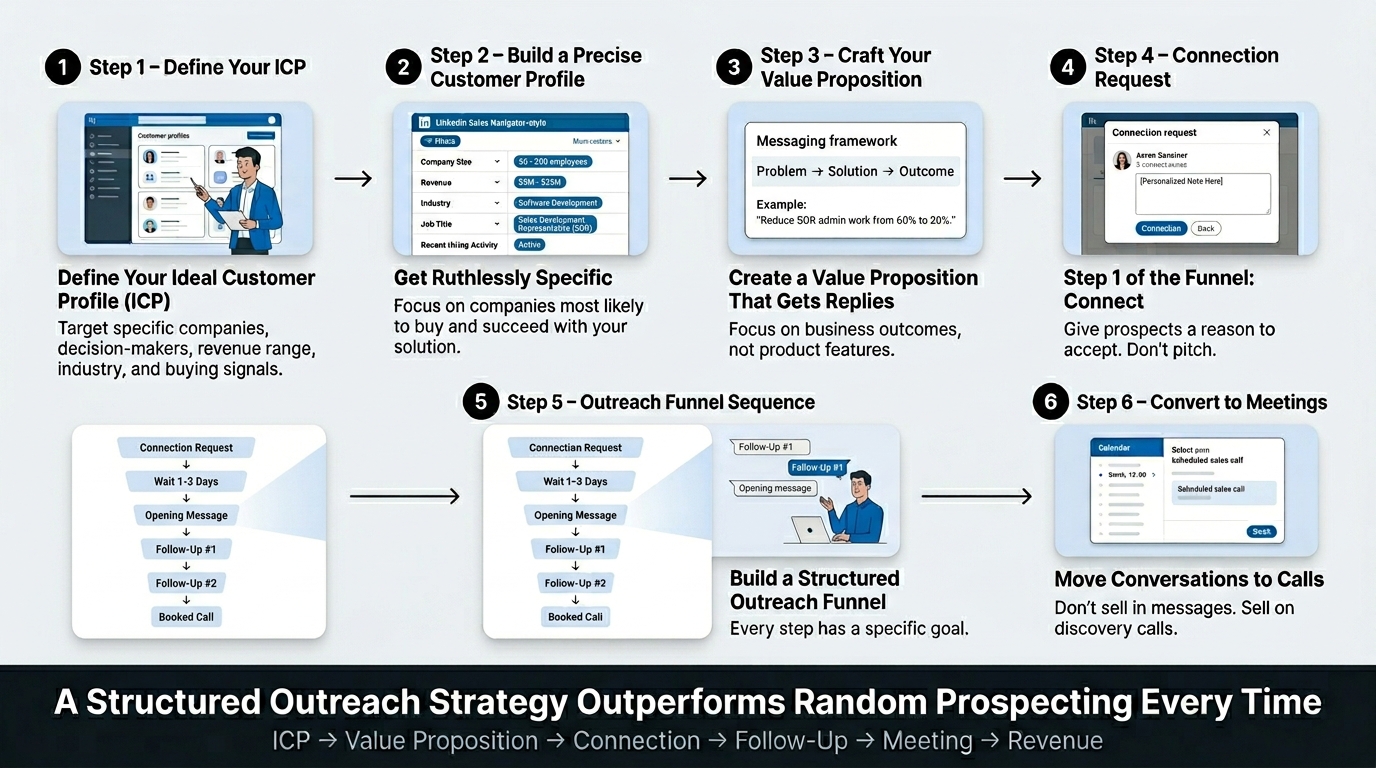
Building an outreach strategy starts with understanding that structure matters more than charisma. You can be the smoothest salesperson alive, but if you’re reaching out to the wrong people with the wrong value prop at the wrong time, you’ll still fail. The template below is what works consistently in 2026.
Define Your Ideal Customer Profile (ICP) with Ruthless Precision
Your ICP is not everyone who might benefit from your product. That’s a market. Your ICP is the specific profile of a company, decision-maker, and business situation where you have the highest chance of closing a deal quickly and profitably.
When you define your ICP, you need to go deep into specifics. Not “mid-market B2B SaaS companies.” Instead: “B2B SaaS companies with $5M to $20M ARR, who have just hired a new VP of Sales in the past 6 months, sell into enterprise, and currently use HubSpot.” Those specifics let you target precisely on LinkedIn, find the decision-maker (the VP of Sales), and know exactly what problem you’re solving for them.
The best way to define your ICP is to look backward at your existing customers. Who are the ones who adopted quickly, paid full price, and stayed? Work backward from there. If you don’t have customers yet, start with your hypothesis, test it, and refine it based on who actually responds.
In 2026, LinkedIn’s search filters and Sales Navigator let you get incredibly specific with ICP targeting. Use it. Build out 3-5 clear ICP profiles if you have different products or value props, but do not try to be everything to everyone. Specificity compounds.
Audit Your Core Value Proposition (What Makes Them Click Reply)
Your value proposition is not what you do. Your value proposition is what problem you solve and how you solve it better, faster, or cheaper than the alternative.
Here’s where most outreach strategies collapse: the salesperson leads with features. “We have AI-powered lead scoring,” “Our platform integrates with 200+ tools,” “We’re the #1 automation solution.” Nobody cares. Your prospect cares that their SDR team books 40 meetings per month and they want it to be 60. That’s the problem. That’s the value prop that makes them want to talk to you.
When you craft your value proposition for outreach, test it against this question: if I removed my company name and logo, would the prospect care about what I’m saying? If the answer is no, it’s not a value prop yet, it’s a feature description.
Your core value proposition in outreach should be one or two sentences maximum. Example: “Most VP Sales I talk to say their SDR team spends 60% of their day on admin work instead of actually talking to prospects. We cut that to 20%.” That’s a problem statement disguised as value. It makes the prospect go, “Oh, that’s exactly our issue.”
Test your value prop by tracking which opening lines get the most replies. You’ll quickly see which positions resonate and which ones don’t. Iterate.
Map Out Your Conversion Funnel: Connection to Call
A good outreach strategy maps out the entire journey from that first connection request to a booked meeting. Most people miss this and wonder why they book so few calls.
Here’s what a 5-step conversion funnel looks like for B2B LinkedIn outreach:
- Step 1: Connection Request – The first impression. You have 120 characters (LinkedIn’s limit) to make them want to accept. This is not a pitch. This is a reason to accept from a stranger.
- Step 2: Wait Period – Most people accept your connection within 48 hours or they don’t. Don’t message immediately. Wait 1-3 days. Let them see your profile. Let them confirm you’re real.
- Step 3: Opening Message – This is where you reference something specific about them or their company, state the problem you solve, and ask a lightweight question or offer. Not a 200-word essay. 50-80 words maximum.
- Step 4: Follow-up Sequence – If they don’t reply within 3-5 days, you follow up. Most research shows 2-3 follow-ups (spaced 3-7 days apart) increase reply rates by 30-40%. After the third follow-up with no response, move on.
- Step 5: Call to Action and Conversion – When they do reply (and enough of them will if steps 1-4 are solid), you move them to a calendar link or a brief call to qualify. You’re not selling on chat. You’re getting them on a call.
Each step of this funnel has a different goal and different messaging. If you skip this structure and just send random follow-ups, your conversion rate tanks.
Key Components of an Outreach Strategy That Converts in 2026
An outreach strategy in 2026 is much more sophisticated than it was five years ago. Your prospects have seen everything. They know what an automated message looks like. They can spot a template at 20 paces. So your strategy needs to account for that. Here are the non-negotiable components.
Research and Personalization at Scale
Sending 500 generic “I saw your profile” messages is not an outreach strategy, it’s just noise.
The research component of your strategy involves finding specific information about each prospect before you reach out. You’re not looking for their entire life history. You’re looking for one or two data points that prove you’ve done your homework and that your offer is relevant to them specifically.
Real personalization in 2026 looks like: “I noticed your company just raised a Series B last month and hired three new sales leaders. Most companies in that phase struggle with their SDR productivity. Is that something you’re working on?” That’s personalization. You found a fact (Series B, new hires), you connected it to a problem you solve, and you asked if it’s relevant. They either say yes and you have a conversation, or they say no and you move on.
Here’s how to operationalize research at scale. Use a combination of LinkedIn’s free search (company industry, role, recent job changes), LinkedIn Sales Navigator (advanced filters, saved accounts), and third-party data sources like Apollo, Clay, or Hunter to find contact information. Build a simple spreadsheet with columns for prospect name, company, recent event (funding, hiring, job change), and your specific reason for reaching out.
The time investment is real. Finding 50 truly qualified prospects and researching each one takes 3-4 hours. That’s why volume-first approaches fail. Your strategy should aim for quality over quantity. 100 highly researched, personalized outreach messages will beat 1,000 generic ones every time.
Multi-Channel Outreach (LinkedIn, Email, Phone)
LinkedIn-only outreach is increasingly limited in 2026. Your best prospects are getting dozens of LinkedIn messages per week. They’re ignoring most of them. But if you reach out across multiple channels with consistent messaging, your reply rate increases dramatically.
A solid multi-channel outreach strategy looks like this:
| Channel | Timing | Purpose | Message Type |
|---|---|---|---|
| LinkedIn Connection Request | Day 1 | Introduction, build trust | Personal note on connection request |
| LinkedIn First Message | Day 3-4 | Reference shared interest, introduce value prop | 50-80 word value-driven message |
| LinkedIn Follow-up | Day 7-8 | Add new context or social proof | “Saw you just published X, thought this was relevant” |
| Email (if found) | Day 10 | Switch channel, personal reference | 100-150 word email, more detail on value prop |
| Phone Call (if possible) | Day 14 | Direct conversation, take-away pressure | 30-second voicemail or call attempt |
The key here is consistency of messaging across channels. You’re not a different person on email than you are on LinkedIn. You’re the same person, reaching out through different channels, with the same value proposition and same goal: getting them on a conversation.
Most salespeople do one or two channels and wonder why they don’t convert. Doing all five (when possible) increases your overall conversion rate by 2-3x. You’re not spamming. You’re being persistent and professional.
Testing, Iteration, and Continuous Optimization
A real outreach strategy is never “done.” It’s a living experiment where you test hypotheses, measure results, and optimize based on what works.
In 2026, your outreach strategy needs to include a testing framework. Pick one variable to test at a time. Do not change your opening line and your call-to-action in the same week. You won’t know what moved the needle.
Here are the highest-impact variables to test, in order of importance:
- Who you’re reaching out to (ICP targeting) – If your reply rate is below 10%, your ICP is probably wrong. You’re reaching the wrong people.
- Your opening line (value proposition clarity) – If your ICP is right but reply rate is still low, test different ways of framing the problem and your solution.
- Your call-to-action (what you’re asking them to do) – Some people respond better to “quick 15-minute call?” vs “does this sound relevant to your team?”
- Timing and cadence (when you send, how often you follow up) – Tuesday and Wednesday mornings typically see higher open rates than Friday afternoons.
- Message length (how much detail you provide upfront) – For B2B, shorter (50-80 words) typically beats longer.
Test one variable for at least 20-30 attempts before concluding it doesn’t work. Small sample sizes are misleading. Once you find something that works (reply rate above 20%, conversion rate above 5%), lock that in as your baseline and test the next variable against it.
How to Build an Outreach Strategy That Works in 2026: Step-by-Step Framework
Now let’s walk through the exact steps to build your outreach strategy from scratch or revamp an existing one that’s not working.
Step 1: Define and Document Your ICP (Specific, Not Vague)
Start with a Google Doc or spreadsheet. Write out your top 3-5 ICP profiles. For each, include:
Company Profile: Specific industry, size (revenue range or employee count), growth stage, geography. Not “mid-market SaaS.” Instead: “B2B SaaS companies with $5M-$25M ARR, Series A funded, selling into enterprise, based in US.”
Decision-Maker Profile: Job title (and variations), reporting structure, common challenges, recent changes that create urgency. For example: “VP of Sales, manages 5-15 SDRs, recently promoted in last 12 months, handling sales team scaling.”
Problem Statement: What specific pain point does this person have that your solution addresses? Why do they care? “SDR productivity is their #1 concern. They’re hiring but pipeline hasn’t scaled proportionally. They’re losing deals to faster competitors.”
Success Metric: What outcome do they care about most? Meetings booked? Pipeline volume? Win rate? Cost per acquisition? Define it clearly. This is how you position your value prop.
Once you document these, the next phase is validation. In the next 2-4 weeks, intentionally reach out only to this ICP. Track connection acceptance rate, reply rate, and conversion rate separately for each ICP. You’ll quickly see which profiles are responsive and which ones are not. Double down on what works. Cut or refine what doesn’t.
Step 2: Craft Your Core Value Proposition (Problem First)
Now that you know who you’re targeting, craft the value proposition they care about.
Start with the problem, not your solution. Your prospect doesn’t care how your product works. They care that they have a problem and you might solve it.
Spend time here. This is the foundation of your entire outreach strategy. Your value prop should make your prospect think, “Yes, that’s exactly our issue right now.” If they don’t recognize themselves in the problem, they will not reply.
Here’s a framework for writing it:
The Core Statement (1 sentence): “[Most/Many] [target role] tell me [specific pain point/outcome they want]. We help them [specific outcome] by [your approach].”
Example: “Most VP Sales tell me their SDR team spends 60% of their time on admin work instead of actually selling. We help them cut that to 20% by automating the repetitive stuff so they can focus on conversations.”
That’s it. That’s your core value prop. Write it once, and use variations of it across all your outreach.
Next, craft 3-4 variations of this same core message that emphasize different benefits:
- Speed version: “Cut time to first meeting by 50%”
- Scale version: “Double your outreach volume without doubling your team”
- Efficiency version: “SDRs spend 3x more time on actual selling, not admin”
- ROI version: “Book meetings for 60% less cost per acquisition than your current process”
Test each variation with 20 people. See which one gets the most replies. Use that as your baseline and iterate from there.
Step 3: Build Your Conversion Funnel and Message Sequence
Map out your full conversion journey. You already have the high-level funnel (connection request to call), but now you need the actual messaging for each step.
Connection Request Message (120 characters max): This is your first impression. Keep it short and specific. Reference something about them or their company that shows you did homework, but do not make an ask yet.
Example: “Noticed your team just made new hires. Would like to chat about how other teams are scaling SDR productivity.”
First Message (after connection is accepted, 50-80 words): Now that they accepted, you have permission to message. Lead with the problem you solve and ask if it’s relevant.
Example: “Hey [Name], thanks for connecting. I noticed you recently scaled your sales team, which is great context. Most teams in that phase struggle with SDR productivity hitting a wall once you go beyond 5-8 people. Is that something on your radar, or are you already dialed in there?”
Follow-up #1 (Day 7-8, if no reply): Do not just repeat your first message. Add new context. Reference something they recently posted, shared, or published. Or mention social proof from someone similar.
Example: “Hey [Name], saw you published that article on sales hiring last week. That actually ties into what I mentioned before. Lot of teams making the same hires you are but seeing SDR performance drop because the playbook doesn’t scale. Worth a quick conversation?”
Follow-up #2 (Day 14-15, if still no reply): This is your last touch before moving on. Make it about them, not about getting a reply. Offer value without asking for anything. Or acknowledge you might have caught them at a bad time and reference when you’ll check back.
Example: “[Name], I know you’re probably busy, so I’ll keep this short. Found a resource that might be useful for your team based on your role. [link] If it’s relevant, happy to chat. If not, no worries either way.”
Call to Action: Do not ask for a 30-minute call initially. Too much friction. Ask for something smaller first. “Quick 10-minute call?” or “Worth a brief conversation?” or even just “Does this resonate?” A yes to any of these is a conversion event. You can schedule the call after they agree.
Document this entire sequence in a Google Doc or a tool like Lemlist or Apollo. You want it consistent across all your outreach, but personalized for each prospect.
Step 4: Set Up Tracking and Measurement
Your outreach strategy is only as good as your ability to measure it.
Set up a simple tracking system (Google Sheets, Hubspot, or your CRM) with these columns:
- Prospect name and company
- ICP segment (which profile they belong to)
- Outreach channel (LinkedIn, email, phone)
- Connection request sent date
- Connection accepted? (Yes/No) and date
- First message sent date
- First reply received? (Yes/No) and date, message
- Number of follow-ups sent
- Conversion to call? (Yes/No) and date
- Call outcome (booked, not interested, not a fit, no-show)
Track these metrics for each ICP separately:
- Connection Acceptance Rate (should be 35-50% if ICP is right)
- Reply Rate (should be 15-25% if messaging is solid)
- Conversion to Call Rate (should be 3-8% of initial outreach)
- Show Rate (should be 60-80% of booked calls)
- Close Rate (varies by product, but you need a baseline)
If your metrics are below benchmarks, you know exactly where the problem is. Below 35% connection acceptance? Your ICP targeting needs work. Below 15% reply rate? Your opening message needs testing. Below 60% show rate? Your call scheduling or confirmation process needs work.
This data is gold. It tells you exactly what to optimize next.
Mistakes in Outreach Strategies and How to Avoid Them in 2026
Most outreach strategies fail not because they’re too ambitious, but because they’re too vague or too focused on volume. Here are the mistakes I see most often and how to avoid them.
Mistake #1: Targeting Everyone (Aka, Targeting No One)
This is the #1 reason outreach fails. You think bigger is better. More companies, more decision-makers, more messages sent = more meetings booked, right? Wrong.
A spray-and-pray approach might get you 2% reply rates at best. A focused approach with a tight ICP gets you 20%+ reply rates. The math is not even close.
When you try to reach everyone, your messaging becomes generic because you’re trying to speak to everyone’s needs at once. When you target a specific ICP, your messaging becomes laser-focused on their specific problem. That focus is what drives replies.
Fix: Define your top ICP and reach out only to that for the first 30 days. Do not move to secondary ICPs until you hit consistent 20%+ reply rates with your primary one. Consistency beats volume.
Mistake #2: Personalization That Isn’t Actually Personal
“Hi [FirstName], I saw your profile and thought we could help your company.” That’s not personalization. That’s a mail merge.
Real personalization requires you to know something about them that is specific and relevant to your offer. It takes more time upfront, but the reply rates make it worth it.
Personalization that works: “Saw you recently moved into a VP Sales role at [Company]. Most people transitioning into that role tell me their first 90 days are about stabilizing the team and hitting quota. Is that where you are, or further along?”
That shows you know their title, their company, what stage they’re probably in, and that you understand their context. That makes them reply.
Fix: Before you reach out to someone, find one or two data points that prove you did homework. Job change? Company funding? Recent hire? Company growth? Reference it. If you cannot find anything specific about them, move on. There’s someone else you can be more specific with.
Mistake #3: Leading with Your Solution, Not Their Problem
Every salesperson does this. You’re excited about what you built. You lead with it. “We have AI-powered lead scoring” or “Our platform integrates with 200+ tools.”
Nobody cares. They care about their problem.
If you lead with your solution, your prospect has to translate your feature into their benefit. Most people will not do that mental work. They’ll just delete your message.
Fix: Always lead with the problem, not the solution. Get agreement on the problem first. Once they acknowledge the problem is real and relevant to them, then you can talk about your solution.
Mistake #4: No Follow-up or Inconsistent Follow-up
Most salespeople follow up once and move on. “If they wanted to talk to me, they would have replied to my first message.” That’s not how people work.
Most professionals are busy. They read your message while eating lunch, remember it for 30 seconds, and then forget it. A follow-up is not pushy. It’s a reminder that you exist and you had something relevant to say.
Research shows that 80% of sales require 5+ touches before conversion. That’s not just phone calls. That’s 5+ points of contact across any channel. If you’re only doing 1-2 touches, you’re leaving money on the table.
Fix: Build a follow-up cadence into your strategy. 3 touches minimum, spaced 5-7 days apart. If you’re using a tool like Lemlist or Apollo, automate it so you follow up consistently.
Mistake #5: Not Measuring Results or Adjusting Based on Data
If you don’t track your metrics, you’re just guessing about what works. You’ll spend 6 months doing outreach, hit some meetings by sheer luck, and have no idea which part of your strategy caused it.
Most teams have no idea what their actual reply rate is, conversion rate is, or why people respond to them. That’s a tragedy, because fixing it requires knowing what’s broken.
Fix: From day one, track connection acceptance, reply rate, and conversion to call for each ICP. Check your metrics weekly. If something is below benchmark, test and iterate on that variable until it improves.
Building an Outreach Strategy for Different Sales Models in 2026
Your outreach strategy should be tailored to your sales model. A multi-product SaaS company’s strategy looks different from a services agency’s or a recruitment consultancy’s.
B2B SaaS Outreach Strategy
For SaaS, your focus is on building enough pipeline to feed your sales team and achieving a healthy CAC (customer acquisition cost).
Your ICP is usually specific: company size, revenue, industry, and the decision-maker’s role. Your value prop is typically about efficiency, cost, or revenue impact.
Your conversion funnel is: connection request > first message > exploratory call (15-20 min) > demo call (30 min) > close.
Key differences: SaaS usually requires a demo before someone will commit. Your outreach strategy needs to account for that. You’re not trying to close on the first call. You’re getting them to a demo.
Sales Services and Agencies
For agencies and services, your outreach is usually more consultative. You’re selling your expertise and team, not a product.
Your ICP is: companies with a specific challenge you solve, usually defined by industry, size, and budget.
Your value prop is about the outcome you deliver and your track record doing it. “We’ve helped 23 companies in your space improve their sales team productivity by 40%.”
Your conversion funnel is: connection > first conversation > discovery call > proposal > close. It’s longer than SaaS.
Key difference: People buy people in services. Your strategy should emphasize building rapport and trust, not just pitching a solution.
Recruitment and Staffing
For recruitment, your outreach is all about identifying the right candidate, convincing them to interview, and placing them.
Your ICP is the ideal candidate profile (specific skills, experience level, current company, location).
Your outreach strategy is more about building a relationship over time and staying top-of-mind than hard selling. You’re in it for the long game.
Key difference: Your conversion funnel is: initial conversation > interest in opportunity > interview > place. You’re not selling. You’re connecting.
Conclusion
What is an outreach strategy is no longer a nice-to-have. It’s the difference between pipelines that flow consistently and ones that rely on luck. In 2026, with prospects more skeptical and flooded with automated messages, a clear strategy is your competitive advantage.
Building an outreach strategy that converts means knowing your ICP deeply, having a clear value proposition, mapping your conversion funnel, and measuring your results obsessively. It means trading volume for precision. It means following up consistently, testing systematically, and optimizing relentlessly.
Start this week. Define your primary ICP, craft your core value proposition, and reach out to 20 people with that specific focus. Track your connection acceptance and reply rates. You’ll learn more in 2 weeks of focused outreach than you will from 3 months of unfocused volume.
If you’re running outreach across multiple LinkedIn accounts or managing teams doing outreach at scale, tools that unify your strategy, track your metrics, and automate your follow-ups become critical. The right tool multiplies the impact of a solid strategy. Without the strategy, the tool just makes you faster at doing the wrong thing.
Your next action: block 1 hour this week to define your ICP and document it. That’s the foundation everything else rests on.
Frequently Asked Questions
Q: What is an outreach strategy and how is it different from just sending messages?
A: An outreach strategy is a systematic plan for reaching, engaging, and converting prospects into customers. It includes defined target profiles, clear value propositions, mapped conversion funnels, and consistent measurement. Just sending messages is volume without intention. A strategy has intention, measurement, and continuous optimization behind every outreach action.
Q: How long does it take to see results from a new outreach strategy?
A: You should see early indicators within 2 weeks (connection acceptance and reply rates stabilizing). Meaningful pipeline impact usually appears within 30-60 days if your ICP and messaging are aligned. Most teams need 90 days of consistent execution before they see full conversion metrics (meetings booked, deals closed). Do not expect overnight results.
Q: What’s a good reply rate for LinkedIn outreach in 2026?
A: If your ICP targeting is solid and your messaging is clear, you should see reply rates between 15-25%. Below 10% usually means your ICP is wrong or your message is too generic. Above 25% means you’ve likely found a winning formula worth doubling down on. Test and iterate until you hit at least 15%.
Q: Should I personalize every single message or can I use templates?
A: Use templates as your base, but personalize the opening and reference something specific about each person or their company. Full custom messages for every person takes too long at scale and is not necessary. A 70/30 split (70% template, 30% custom reference) works well and scales.
Q: How many follow-ups is too many?
A: 3 follow-ups total (original message + 2 follow-ups) is the industry standard for LinkedIn. Some high-touch strategies go to 4-5 if spaced properly (7-14 days apart). Beyond that, you risk coming across as desperate. After 3 follow-ups with no response, move on to your next prospect.
Q: What’s the best day and time to send LinkedIn messages?
A: Tuesday through Thursday mornings (9-11 AM in the prospect’s timezone) typically see the highest open and reply rates. Monday is chaotic (catch-up). Friday people are checked out. Weekends are dead. Mornings are better than afternoons. Adjust based on your ICP’s timezone and work patterns.
Q: Can you use the same outreach strategy for multiple products?
A: Not exactly. Each product or service should have its own ICP and core value proposition. The framework stays the same, but the details change. You might reach VP Sales for product A and CFOs for product B. Keep them separate. Mixing ICPs dilutes your messaging effectiveness.
Q: How do I know if my ICP definition is wrong?
A: If your connection acceptance rate is below 30% or your reply rate is below 10%, your ICP targeting is likely wrong. You’re reaching people who do not care about your solution. Go back, look at the people who did reply and accept, and reverse engineer what they have in common. That’s your real ICP.
Q: Should I use automation tools for outreach?
A: Yes, but with strategy first, tools second. A good automation tool helps you scale, follow up consistently, and track metrics. But no tool fixes a bad ICP or weak messaging. Build your strategy with manual outreach first (20-30 people). Once you find what works, then use a tool to scale it. Never automate a bad strategy.
Q: What metrics should I track for my outreach strategy?
A: Track connection acceptance rate, reply rate, time to first reply, conversion to call rate, call show rate, and close rate. These five metrics tell you exactly where your strategy is strong and where it needs work. Update them weekly. You should have a target for each.
Q: How do I handle objections in outreach messages?
A: Acknowledge common objections in your first message, not later. If budget is likely an objection, lead with ROI. If timing is an issue, acknowledge they might be in the middle of something and offer to check back. If they don’t see the relevance, you lead with a more specific problem statement. Plant flags for objections upfront so they’re less likely to become hard no’s later.
Q: Can I use the same outreach strategy on LinkedIn, email, and phone or do I need different approaches?
A: The core message and value prop stay consistent across channels. But the format and length change. LinkedIn messages are shorter (50-80 words). Emails can be longer (100-150 words). Phone calls are conversational. The underlying strategy is the same; the execution changes by channel.