
Here’s the uncomfortable truth nobody wants to admit: asking whether is LinkedIn social media is actually the wrong question. What matters is understanding what LinkedIn has become and how that changes everything about how you approach it as a B2B platform. When most people hear “social media,” they picture TikTok, Instagram, or Facebook. Scrolling, liking, sharing memes, engagement for engagement’s sake.
But LinkedIn? LinkedIn operates in a completely different dimension. It’s a social platform, yes. But calling it “social media” in the same breath as those others fundamentally misses what makes it so powerful for B2B sales, recruitment, and lead generation. The distinction isn’t semantic. It’s strategic.
I’ve watched teams waste months and thousands in budget treating LinkedIn like a content distribution network when they should have been treating it as a direct sales channel. Others have killed their B2B strategies by adopting Facebook tactics on LinkedIn and wondering why nothing worked.
A team I worked with spent six months building a massive LinkedIn audience through consistent daily posts, only to realize their 50,000 followers weren’t generating a single qualified meeting. Meanwhile, a competing team with just 8,000 followers was booking 15-20 qualified meetings per month through targeted outreach. The difference wasn’t content quality or personal brand strength. The difference was understanding what LinkedIn actually is and building strategy around that reality.
The cost of getting this wrong is substantial. Most B2B teams allocate resources based on what they think works across “social media,” then wonder why their LinkedIn efforts underperform relative to their time investment.
They’re measuring success through vanity metrics like follower growth and engagement rates, the same metrics that matter on Facebook. But on LinkedIn, those metrics are almost meaningless. A profile with 100,000 followers and 3% engagement that generates zero meetings is objectively worse than a profile with 10,000 followers and 1% engagement that generates 30 qualified conversations per month. The platform rewards something completely different than traditional social media.
This article breaks down exactly what LinkedIn actually is, how it differs from Facebook, Instagram, and Twitter in ways that matter for your business, and more importantly, what you need to change about your B2B strategy once you understand the real answer.
You’ll learn why your content strategy might be holding you back, why your follower count tells you almost nothing about your actual results, and how the best B2B teams are using LinkedIn as a precision sales tool rather than a content platform. By the end, you’ll have a clear framework for whether your current LinkedIn approach is aligned with how the platform actually works, and what to change if it isn’t.
What LinkedIn Actually Is: Beyond the “Is LinkedIn Social Media” Question
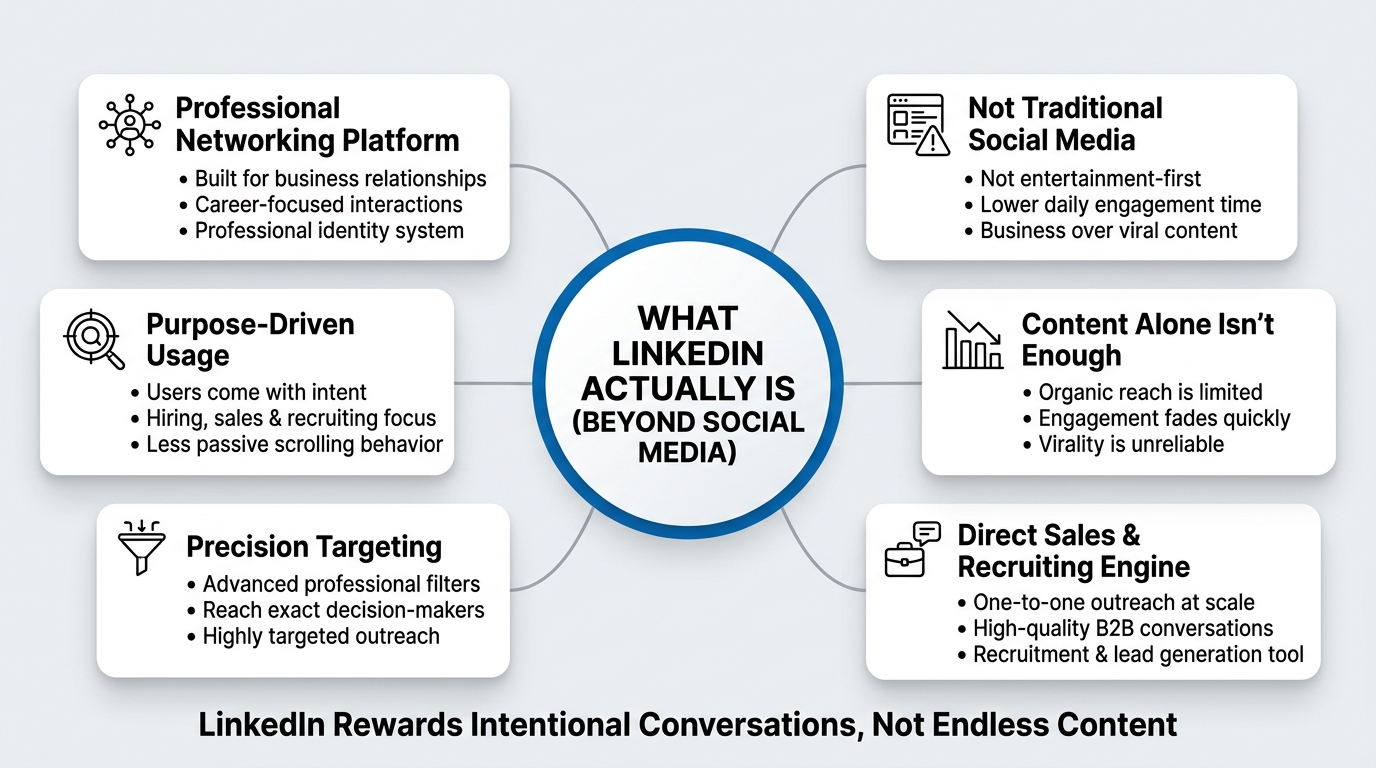
Let’s stop dancing around semantics. LinkedIn is technically a social network. It has profiles, connections, comments, sharing capabilities, and a feed. But the moment you call it “social media” in the same category as TikTok or Instagram, you’ve already made a strategic mistake that will cost you.
LinkedIn is a professional networking and business intelligence platform that happens to include social features. That’s the distinction that actually matters.
LinkedIn’s core infrastructure wasn’t built to maximize engagement time. Facebook and Instagram literally measure success in hours spent on platform. Your average user scrolls, likes, and shares across hundreds of posts daily. LinkedIn’s design is intentionally narrower. People go there to do three specific things: find jobs, find salespeople, or research companies and professionals. The social features (comments, reactions, reposts) exist to support those core functions, not as the primary objective.
This architectural difference is everything. When you understand this, you immediately see why posting once a week on LinkedIn with generic motivational content gets ignored, while a personalized connection request with a specific business reason to prospects in your ICP gets 35-40% acceptance rates. The platform rewards intentionality over volume. It rewards professional relevance over emotional engagement.
The data bears this out. LinkedIn’s average user spends roughly 17 minutes per day on the platform. Compare that to Facebook at 38 minutes, Instagram at 30 minutes, or TikTok at 95 minutes. LinkedIn users aren’t there to procrastinate. They’re there with purpose.
LinkedIn Is Not a Content Amplification Tool
This is where most B2B teams go wrong. They assume LinkedIn works like other social platforms: post great content, get shared, reach expands, leads flow in. It does not work that way.
LinkedIn’s organic reach has declined significantly over the past three years. For most business pages, posting once a day to even a massive follower base reaches maybe 2-5% of those followers. Your 50,000 followers might see your post in maybe 1,000 to 2,500 feeds. Without paid amplification or explicit engagement mechanics (asking people to like, comment, and share), your organic reach is minimal.
This matters because teams often approach LinkedIn strategy like they approach Medium or their blog. They create brilliant content, optimize it for keywords, and expect it to spread. But LinkedIn’s algorithm doesn’t work on keyword authority or content virality. It works on engagement velocity. Posts that get comments and reactions in the first hour get slightly broader distribution. Posts that don’t gain traction quickly disappear.
Compare this to Facebook, where strategic timing, audience interest, and even slightly older posts can still reach thousands through the News Feed algorithm. LinkedIn’s feed is far more ephemeral. Your post lives for maybe 48 hours at relevance. After that, it’s essentially invisible.
LinkedIn Is a Direct Sales and Recruitment Tool Disguised as Social Media
This is the real secret. LinkedIn’s power isn’t in broadcast reach. It’s in precision targeting and one-to-one outreach at scale.
You can search for 47,000 senior marketing managers at SaaS companies in North America with $5-50M revenue and exactly 1-3 employees connected to you. Then reach each of them directly with a personalized message that addresses something from their profile. That’s not social media. That’s a CRM with a social interface.
Recruitment teams have known this for a decade. They use LinkedIn Recruiter to find specific talent pools and reach them directly. B2B sales teams are finally catching up to the same realization. Instead of posting content hoping the right person sees it, you identify the exact people you need to reach and start conversations with them. The “social” part is just the mechanism that makes reaching out feel less intrusive than cold email.
This is why LinkedIn outreach campaigns with 5-8% response rates and 15-25% meeting booking rates are entirely realistic at scale, while Facebook lead generation caps out at a fraction of that effectiveness for B2B. The former is targeted conversation. The latter is broad-net broadcasting.
LinkedIn vs. Traditional Social Media Platforms: The Key Differences That Matter
To truly understand whether is LinkedIn social media is actually relevant to your strategy, you need to see how it stacks up against platforms everyone agrees are social media.
| Dimension | ||||
|---|---|---|---|---|
| Primary User Intent | Find jobs, research companies, B2B decisions | Social connection, entertainment, family updates | Visual discovery, entertainment, lifestyle | News, commentary, real-time discussion |
| Time Spent Daily (Avg) | 17 minutes | 38 minutes | 30 minutes | 20 minutes |
| B2B Lead Quality | Very high | Low to moderate | Very low | Moderate |
| Content Shelf Life | 24-48 hours | 3-5 days | 1-2 hours | Minutes |
| Organic Reach | 2-5% of followers | 5-10% of followers | 3-8% of followers | 0.5-2% of followers |
| Algorithm Focus | Engagement velocity + professional relevance | Engagement + time spent | Engagement + visual appeal | Recency + discourse volume |
| Conversion Mechanism | Direct outreach + targeted content | Paid ads + organic engagement | Influencer partnerships + ads | Thought leadership + viral reach |
| Typical B2B ROI | High (with proper strategy) | Moderate to low | Low | Moderate |
Let’s break down what these differences actually mean for your strategy.
User Intent Difference Changes Everything
Facebook users scroll to relax and maintain social bonds. Instagram users discover content and products. Twitter users engage in discourse and follow trends. LinkedIn users are actively or passively in professional mode.
This changes the type of messaging that works. On Facebook, storytelling and emotional connection drive engagement. On LinkedIn, specificity and professional relevance drive response. A post about how you overcame business challenges is interesting. A post about how you specifically solved a problem for a CTO at a Series B SaaS company is relevant.
The stakes are different too. When someone engages with your personal Facebook post, they’re choosing entertainment. When someone responds to your LinkedIn message, they’re potentially making a business decision or opening a conversation that could impact their career. The weight of that changes behavior.
Algorithm Differences Create Different Winning Strategies
Facebook’s algorithm is notoriously opaque but generally rewards content that keeps people on platform longer. It prioritizes posts that generate multiple types of engagement (likes, comments, shares) and especially posts that spark conversation in comments. The algorithm assumes that if a post gets lots of engagement, it’s valuable and spreads it further.
LinkedIn’s algorithm is subtly different. It cares about engagement velocity (how fast those likes and comments come in the first few hours), but it also factors in something Facebook doesn’t: relevance. If your post gets comments from people in your network with relevant job titles or companies, the algorithm assumes it’s professionally valuable and boosts it. A post by a VP of Sales getting comments from other sales leaders ranks higher than the same post getting comments from random users.
This means on LinkedIn, your network composition matters more than your follower count. 5,000 followers who are all in your exact ICP will give you better organic reach than 50,000 random followers. That’s the opposite of Facebook.
The Reach and Shelf Life Reality
Here’s a concrete example. You post a piece of content on both Facebook and LinkedIn at the same time. On Facebook, if it’s decent, it reaches maybe 8-10% of your followers in the first 24 hours through organic reach. On LinkedIn, it reaches about 2-5% of your followers. Facebook wins on organic reach.
But then consider shelf life. That Facebook post is invisible after 5 days. People’s News Feeds move fast. That LinkedIn post is often completely gone after 48 hours. LinkedIn moves even faster.
However, here’s what Facebook companies don’t tell you: that 8-10% of followers on Facebook includes a lot of people with no business reason to care about your offering. On LinkedIn, that 2-5% is much more targeted to people in professional contexts. The math on engagement quality is completely different.
Conversion Path Differences
On Facebook, conversion usually happens through ads. Organic posts build awareness, but actual lead generation happens through paid campaigns that retarget warm audiences or lookalike audiences. The conversion path is long and indirect.
On LinkedIn, you can generate leads through two totally different mechanisms that both skip the ad step. First, you can run targeted outreach campaigns, reaching people directly with personalized messages and booking meetings. Second, you can create thought leadership content that builds authority in your space, which then converts when someone at your target company sees you have expertise and reaches out to you.
Both of these are basically unavailable on Facebook at scale. You can’t message 10,000 random Facebook users with personalized outreach without your account getting flagged. You can message 10,000 highly targeted LinkedIn prospects and get responses.
The Real Strategic Advantage: LinkedIn as a B2B Sales Channel, Not Just a Social Platform
This is where the distinction between “is LinkedIn social media” and understanding what LinkedIn actually is creates the biggest competitive advantage.
Most teams approach LinkedIn marketing the same way they approach Facebook marketing: create content, build audience, run ads, hope for conversions. But the teams that actually book meetings on LinkedIn have completely different playbooks.
They use LinkedIn for three specific, interconnected purposes that have nothing to do with traditional social media strategy. Understanding these three purposes changes your entire B2B approach.
Purpose 1 – Targeted Direct Outreach and Relationship Building
LinkedIn lets you reach specific people directly with a message that feels less cold than email because you’re on a platform where they expect business conversations.
The mechanics are simple. You identify your ideal customer profile. You search LinkedIn for people matching that profile at target companies. You send a personalized connection request with a specific reason. When they accept (35-40% acceptance rates are standard), you send a message that’s relevant to them specifically. Response rates on those messages, if done correctly, hover around 5-8%. Meeting booking rates from responses are 15-25%.
Here’s the critical difference from social media strategy: you’re not trying to reach everyone. You’re not trying to build a big follower base. You’re trying to have targeted conversations with specific people. Volume matters, but only the volume of the right people. 50 highly targeted outreach conversations per day beat 500 random engagement touches.
This is also why frequency of posting barely matters in this model. You post content maybe 1-2 times per week just to have recent activity on your profile (because people do check your profile before responding to your message). The actual mechanism driving leads is the outreach, not the content feed.
Purpose 2 – Establishing Authority That Prospects Find You
The second piece is often overlooked. Consistent, relevant content on LinkedIn does one specific thing extremely well: it makes your profile show up in searches when prospects are researching solutions.
When a prospect at a target company searches “B2B SaaS marketing strategy” or their job title + problem you solve, they often refine results to people they’re “likely to know.” Your LinkedIn profile and recent posts appear if you’ve been posting relevant content. That visibility creates a moment where they think “I should reach out to this person” or they accept your connection request because they see you as an authority.
This is different from Facebook engagement metrics. You’re not chasing likes and shares. You’re building a content portfolio that appears in targeted search results. Every 2-3 posts about a specific problem or solution you solve builds relevance in LinkedIn’s search algorithm for that topic.
Purpose 3 – Account-Based Sales Intelligence and Research
LinkedIn’s research capabilities don’t exist on Facebook. When you’re running an account-based marketing strategy targeting specific companies, LinkedIn is where you research decision makers, understand their background, identify who you know in common, and personalize your approach.
You can see when someone from your target company views your profile. You can see when someone from your target account is hiring or has just changed roles. You can identify which people in an organization you’re already connected to. None of this is possible at scale on traditional social media platforms.
This isn’t a side feature. For many B2B sales teams, this intelligence gathering is the primary reason to maintain a strong LinkedIn presence at all.
Putting It Together: The Integrated LinkedIn B2B Model
Here’s how this works in practice at a team running serious outreach.
Monday: Your team identifies 500 people matching your ICP at target accounts. They send personalized connection requests with a 1-2 sentence reason that references something from the prospect’s profile or company. 150-200 of those connections get accepted by end of day.
Tuesday-Thursday: As those connections warm, your team sends personalized follow-up messages with a specific problem statement or interesting insight relevant to that person’s role. Of the 150 people who accepted, 7-12 respond with engagement. Of those, 3-4 move to a calendar call.
Meanwhile, you’re posting twice per week about the specific business problems you solve. A prospect at a company you’re targeting searches “how to improve customer retention in SaaS” and finds a 3-week-old post of yours. They check your profile, see your experience, and accept a connection you sent them weeks earlier. They message you first.
Your sales team also runs account research on the 20 target companies you’re focused on. They see that the CMO at your #1 target just hired a new Director of Operations. One of your team members is connected to the new Director. You reach out warm, establish relevance, and schedule a call. Inside sales intelligence meeting the outreach motion.
That’s not social media strategy. That’s a coordinated B2B sales system where LinkedIn is the mechanism, not the channel.
Why Getting This Wrong Costs You Pipeline
The question “is LinkedIn social media” might sound academic, but getting the answer wrong has massive business consequences.
The Content-First Trap
Most teams get this wrong. They treat LinkedIn like other social platforms: focus on building audience through great content, optimize for engagement, run ads to warm audiences. The problem is that motion works on Facebook because Facebook’s entire business model is attention and ads. LinkedIn’s real value isn’t content distribution.
Teams that fall into the content-first trap often see results like: 50,000 followers, 3-5% engagement on posts, strong thought leadership in their space, and almost zero actual leads. They’ve won the social media game. They’ve lost the business game.
The correct approach inverts that. You use content strategically (to rank in searches and appear credible on your profile), but your primary machine is outreach. You measure success not in likes and shares, but in meetings booked and pipeline created. The metric that matters is cost per qualified conversation, not engagement rate.
The Frequency Mistake
Because teams think LinkedIn is social media, they often think posting frequency is critical. Facebook experts recommend 1-2 posts per day. LinkedIn experts often echo that. The problem: LinkedIn users get overwhelmed with content in their feed. Daily posting on LinkedIn often leads to lower engagement rates than 2-3 times per week posting.
But here’s the thing most teams miss: if your strategy is outreach-based (which it should be), posting frequency barely moves the needle. You’re not relying on content going viral. You’re relying on direct conversations. Your top-of-funnel should be outreach volume and quality, not content distribution.
The cost of getting this wrong: teams spending 20 hours per week on content creation that could be spent on strategic outreach. The ROI difference is typically massive. $5,000 in outreach time generates more leads than $5,000 in content creation time on LinkedIn.
The Targeting Waste
Facebook audiences are built on behavioral and demographic data. You target by interests, age, job title, and lookalike audiences. LinkedIn audiences are built on explicit professional data. You target by job title, company, industry, seniority, skills, and even specific company names.
Teams that don’t know this often run LinkedIn ads using Facebook logic: targeting too broad, trying to reach everyone in a space, relying on ads to filter who the right customer is. On Facebook, that’s fine. On LinkedIn, that wastes budget because the platform has much smaller total addressable audience. Your $5 cost-per-click on LinkedIn gets wasted if you’re targeting too broadly.
The alternative: use LinkedIn’s precision targeting. Target 47 companies in your 20-company target list, three job titles, in the US only. Your ads reach maybe 5,000 people. Your click-through rate is 2x higher and conversion rate is 5x higher because you’re only showing ads to people who actually fit your ICP. Smaller reach, massively better ROI.
The Engagement Trap and Influencer Misunderstanding
Because people think LinkedIn is social media, they often assume that building a personal brand as an influencer is the path to business success. Thought leadership is valuable. Building an audience is nice. But if you’re trying to book meetings, influencer status is a side benefit, not the core strategy.
A personal brand that gets 100,000 followers but zero direct outreach motion often converts worse than a personal brand with 10,000 followers where you message 20 highly targeted people daily. The person with 100,000 followers is winning the social media game. The person with 10,000 followers who runs outreach is winning the B2B revenue game.
This matters because time is finite. You can spend 10 hours per week building personal brand or 10 hours per week running targeted outreach. The ROI of the latter is almost always higher if your goal is business meetings and revenue.
How the Answer to “Is LinkedIn Social Media” Should Change Your B2B Marketing and Sales Strategy
Now that we’ve established what LinkedIn actually is, here’s how to redesign your strategy accordingly.
Reframe Your Success Metrics
Stop measuring LinkedIn success through social media metrics. Likes, shares, follower growth, engagement rate, reach: these are vanity metrics on LinkedIn. They don’t drive revenue.
Your real metrics should be:
Outreach conversion: Percentage of targeted outreach messages that get a response and move forward. Standard benchmark is 5-8%. If you’re at 2%, your messaging isn’t resonating. If you’re at 12%, you’ve optimized your ICP and personalization extremely well.
Calendar booking rate: Percentage of conversations that result in a scheduled meeting. Standard benchmark is 15-25%. If you’re at 5%, you’re not qualifying hard enough. If you’re at 40%, you might be booking the wrong meetings (too big, not ready).
Cost per qualified conversation: Total time and money spent on outreach divided by number of qualified conversations started. This is your real lead gen cost on LinkedIn. It should be significantly lower than your cost per qualified conversation from ads or content marketing.
Profile search rankings: For the 10 keywords your ICP is searching, how often does your profile appear in search results? This is less measurable but trackable through profile view sources. If you’re not appearing in the search results for keywords your customers care about, your thought leadership content isn’t working.
The shift from social media metrics to revenue metrics might sound obvious, but it changes everything about how you allocate time and budget.
Build an Outreach-First Machine
Instead of hiring a social media manager to manage your feed, consider hiring someone to manage your outreach campaigns.
A social media manager on LinkedIn typically runs 2-4 hours per day of posting, content curation, and engagement. An outreach-focused person runs campaigns that identify 50-100 target prospects daily, personalizes connection requests, tracks acceptances, and manages follow-up sequences.
The time allocation might be the same (3-4 hours daily), but the output is completely different. Outreach-first machines generate 5-15 qualified meetings per person per month. Social media-first machines might generate 0-3 qualified meetings per person per month. The difference is structural.
How to implement this:
- Identify your ideal customer profile with extreme specificity. Not “VP of Marketing at SaaS companies,” but “VP of Marketing at B2B SaaS companies with $5-50M ARR, Series B-C funding, fewer than 200 employees.”
- Build a list of target accounts (20-100 companies). Focus beats breadth.
- For each target account, identify 3-5 people you need to reach: decision makers, economic buyers, influencers.
- Run a campaign: personalized connection requests with specific reasons, warm follow-ups after acceptance, consistent content posting that builds authority in your space.
- Measure: track connection acceptance rate (35-40% standard), response rate (5-8% standard), meeting booking rate (15-25% of responses standard).
Approach Content Strategy Like SEO, Not Social Media
Stop trying to go viral. Start trying to own specific search results.
Your content should answer specific problems that your ICP is searching for. Not general insights about your space. Specific, tactical answers to business problems they have.
Examples: “How to Reduce Enterprise SaaS Customer Churn by 18% (What We Found After Analyzing 4,000 Companies)” or “The 7-Point Account-Based Expansion Framework for Technical Founders” or “Why Your Customer Retention Rate is Lower Than Competitors and What to Do About It.”
These posts serve three purposes: They rank in LinkedIn search results for keywords your customers are searching. They show up on your profile when prospects research you. They give you something relevant to link to when you reach out.
You’re not trying to maximize likes. You’re optimizing for being found by people actively looking for what you sell.
Use Personalization and Targeting at Scale
Here’s where technology actually helps. Most LinkedIn automation tools are designed to run high-volume, low-personalization outreach. That’s fine for awareness campaigns. But your most effective outreach is higher-personalization, moderate-volume.
Use LinkedIn’s search filters to identify specific people in specific accounts matching specific criteria. Look at their profile for a specific detail you can reference (recent job change, skill mentioned, company announcement). Reference that detail in your connection request. Send 20-50 of those per day.
Compare that to automation tools that blast 500 templated messages per day. The former gets 35-40% acceptance rates and 5-8% response rates. The latter gets 15-20% acceptance rates and 0.5-1% response rates.
Personalization at scale is the actual superpower here, not automation.
LinkedIn Strategy Mistakes B2B Teams Make (Because They Think It’s Social Media)
Mistake 1: Treating Followers Like Currency
Facebook and Instagram teams obsess over follower growth. It drives algorithm distribution, which drives business results. On LinkedIn, followers mean almost nothing if they’re not in your ICP.
I’ve seen teams with 50,000 followers generating zero meetings. I’ve seen teams with 5,000 followers generating 30+ qualified meetings per month. Follower count is one of the least reliable indicators of LinkedIn success.
The problem is that teams often chase broad appeal instead of narrow relevance. They post generic motivational content about leadership or entrepreneurship, which gets shared widely. But the people liking and sharing aren’t in their ICP, they’re just interesting people. When they try to sell, nobody buys.
The fix: optimize for ICP relevance, not broad appeal. Your content should make sense only to people who are actively looking for what you sell. If everyone finds your content interesting, you’re probably too broad.
Mistake 2: Inconsistent Presence
LinkedIn’s algorithm does penalize inactive profiles. But it doesn’t penalize the absence of daily posts. It penalizes profiles that go silent for weeks at a time.
Most teams don’t realize how intermittent their presence actually is. They post 3 times per week for a month, then vanish for 2 weeks, then come back. From their perspective, that’s consistent. From LinkedIn’s algorithm, that’s stop-and-start activity that shows lower engagement over time.
What matters: consistent, predictable presence. 2 posts per week, every week, will perform better long-term than 15 posts one week then silence for a month.
Mistake 3: Expecting Viral Organic Reach
This one’s just accepting reality. LinkedIn’s organic reach is getting worse, not better. LinkedIn is a paid platform now, mostly. If you need reach, you’re going to pay for it or you’re going to build it through direct relationships (outreach).
The cost of not accepting this: teams spend 20 hours per week creating content, expecting it to reach thousands, then wondering why it reaches hundreds. The time is wasted because the premise is wrong.
LinkedIn organic posts rarely reach beyond your direct network unless someone shares the post. It’s the opposite of Twitter, where retweets can send a post viral. On LinkedIn, you get the people who follow you and occasionally someone from an engagement loop if the post gets fast traction. That’s basically it.
The Future of LinkedIn: Is the “Social Media” Question Even Still Relevant?
LinkedIn is investing heavily in AI, creators, community features, and even messaging tools that feel more like Slack than traditional social media. The platform is evolving. So is the answer to whether it’s “social media.”
AI Is Changing the Outreach Equation
LinkedIn is integrating AI into the platform in ways that are starting to change how teams approach it. AI can now help generate messaging suggestions, identify warm introductions, and even engage in initial conversations on behalf of salespeople.
This doesn’t make LinkedIn “more social media.” It makes the outreach mechanism more efficient. Instead of a human writing 20 personalized messages per day, an AI can help draft 100, with a human refining the best ones.
What it means for your strategy: automation is becoming more attractive, but the fundamental principle remains the same. Personalization and targeting matter more than volume.
The Creator Economy on LinkedIn
LinkedIn is pushing “creator” features. Newsletters, audio, video, subscriber-only content. This is moving LinkedIn more toward a content platform. But the difference is that LinkedIn creators are still primarily B2B educators and thought leaders, not entertainment creators.
The creator economy on LinkedIn is much smaller and differently motivated than on TikTok or YouTube. People aren’t becoming LinkedIn creators to get famous. They’re becoming creators to establish authority and generate business leads. That’s a fundamentally different incentive structure.
For your strategy: if you have something genuinely valuable to teach or unique perspective to share, the creator model can work. But it’s not a replacement for outreach. It’s a complementary amplifier.
Conclusion
The answer to “is LinkedIn social media” is technically yes, but practically no. LinkedIn is a professional networking and business intelligence platform with social features, not a social media platform with business features.
This distinction is critical because it determines how you should approach it strategically. If you treat LinkedIn like Facebook, you’ll optimize for the wrong metrics, waste time on content creation that doesn’t drive meetings, and probably end up frustrated with the ROI.
But if you understand LinkedIn as a precision sales and research channel that happens to have social features, you unlock an entirely different playbook. Targeted outreach with higher personalization, content strategy focused on search rankings and ICP relevance, and measurement based on conversations and revenue.
Your competitive advantage isn’t in posting more or following influencer tactics. It’s in understanding that LinkedIn is first a CRM with a social interface, and second a content platform. Build your strategy around that reality, and the meetings follow.
Next step: Audit your current LinkedIn strategy. What percentage of your time is spent on outreach vs. content creation? What percentage of your success metric is coming from direct conversations vs. organic reach? If you’re heavily skewed toward content and reach, it’s time to rebalance toward outreach and targeting. Start with 10 highly specific outreach conversations per day over the next 30 days, and measure the response rates. That number will tell you immediately whether your messaging is resonating.
Frequently Asked Questions
Q: Is LinkedIn considered social media for marketing purposes?
A: Technically LinkedIn is a social network with social features, but for marketing purposes it functions more like a sales channel and business intelligence platform. The distinction matters because the strategies that work on Facebook (content amplification, broad reach, engagement metrics) typically fail on LinkedIn. LinkedIn rewards targeted outreach and professional relevance, not viral reach.
Q: What’s the main difference between LinkedIn and other social media platforms?
A: LinkedIn users are in professional/business mode, not entertainment mode. People spend 17 minutes daily on LinkedIn compared to 38 on Facebook or 95 on TikTok. The algorithm prioritizes professional relevance and engagement velocity over time-on-platform. Organic reach is minimal (2-5%), and the primary conversion mechanism is direct outreach, not content distribution.
Q: Can you generate leads through LinkedIn like you can on Facebook?
A: Yes, but completely differently. On Facebook, leads come primarily through ads and content targeting lookalike audiences. On LinkedIn, leads come through direct outreach to targeted prospects, thought leadership content that establishes authority, and account-based research that identifies decision makers. A well-executed LinkedIn outreach campaign generates 5-8% response rates and 15-25% meeting booking rates, which is significantly higher than typical Facebook lead gen.
Q: How often should I post on LinkedIn for best results?
A: 2-3 times per week is optimal for most B2B strategies. Daily posting on LinkedIn often leads to lower engagement rates than consistent weekly posting because your audience is smaller and feed saturation matters more. However, if your strategy is outreach-based (which it should be), posting frequency barely impacts your lead generation. Your primary KPI should be outreach volume and quality, not content reach.
Q: Is LinkedIn good for B2B marketing?
A: LinkedIn is excellent for B2B marketing when you understand it’s primarily a targeting and outreach channel, not a content distribution channel. B2B sales teams see 5-8% response rates on targeted outreach, 15-25% meeting booking rates from responses, and significantly lower cost-per-qualified-conversation than most other channels. This makes it one of the most effective B2B lead generation channels available when executed properly.
Q: What’s a good connection acceptance rate on LinkedIn?
A: 35-40% is the standard benchmark for personalized connection requests where you reference something specific about the person or their profile. Rates below 25% typically indicate that your targeting is too broad or your messaging isn’t resonating. Rates above 50% might indicate you’re not being specific enough or you’re targeting people who are obviously in your network already. The sweet spot is 35-40% with proper personalization.
Q: Should I use LinkedIn automation tools?
A: LinkedIn automation tools are useful for managing campaigns at scale, but they should focus on efficiency, not volume. High-volume automation (500+ messages per day) violates LinkedIn’s terms and gets accounts flagged or banned. More effective approaches use automation to help manage personalization at moderate volume (50-100 outreach messages per day with personalization). Automation should help you execute better strategy faster, not replace strategy with volume.
Q: How long does it take to see results from a LinkedIn outreach strategy?
A: Most teams see initial positive indicators within the first 2-3 weeks. Initial connection acceptance data shows up immediately (you know within days if your ICP targeting and messaging resonate). Response rates typically stabilize within 30-45 days. Consistent meeting booking at scale usually takes 60-90 days to establish as teams refine their targeting, messaging, and conversion process. This is significantly faster than content marketing, which can take 3-6 months to show meaningful results.
Q: Is LinkedIn better than email outreach for B2B?
A: They’re different and often work better together. LinkedIn outreach gets higher response rates (5-8%) than cold email (1-2%) because the platform expects business conversations and seeing mutual connections increases credibility. Email is still critical for nurturing conversations that start on LinkedIn and for reaching people not active on LinkedIn. Most effective B2B teams use LinkedIn to start conversations, then move to email for ongoing nurturing once someone engages.
Q: How do I measure ROI on LinkedIn outreach?
A: Track these metrics: (1) Connection acceptance rate (benchmark 35-40%), (2) Response rate on follow-up messages (benchmark 5-8%), (3) Calendar booking rate from responses (benchmark 15-25%), (4) Cost per qualified conversation (total investment divided by conversations), (5) Percentage of conversations that advance to next stage in your sales process. Compare these to your other lead gen channels to determine which is most efficient for your specific business.
Q: Why isn’t my LinkedIn content getting engagement?
A: Most LinkedIn content doesn’t get engagement because it’s either too broad (not relevant to your ICP), too generic (motivational or obvious insights), or posting at wrong frequency. Content that performs on LinkedIn is specific, tactical, and relevant to a narrow professional audience. It answers a business problem that someone is actively looking for. If you’re posting general thought leadership and not seeing engagement, your content is likely too broad for the platform.
Q: Can I use LinkedIn if I’m just starting my B2B business?
A: Absolutely. In fact, LinkedIn is more accessible for startups than Facebook paid ads because you can run high-ROI outreach with essentially zero budget (just your time). You don’t need a huge follower base or polished brand. You need a clear ICP, a profile that shows relevant expertise, and a specific business problem you solve. Startups often out-perform larger companies on LinkedIn because they’re willing to do the personalized outreach work that larger companies skip.